
Archived decisions
Hampshire Fire and Rescue Authority Financial and General Purposes Committee | ||
28 July 2004 |
Item 8 | |
Financial issues for 2005/06 | ||
Report of the Treasurer and Chief Officer | ||
Contact: Paul Carey-Kent, Deputy Treasurer, 01962 847525
David Howells, Director of Corporate Services, 023 8064 4000 ext 203
1 Introduction
1.1 This report summarises the financial issues currently facing fire authorities including the likely impact of the Government's Spending Review 2004 and the 2005/06 grant settlement. Particular concerns for Hampshire Fire and Rescue Authority are highlighted. The report starts with a review of the position in 2004/05 and goes on to suggest what the broad position is likely to be for 2005/06.
2 Local Government Settlement 2004/05
2.1 Key points nationally:
· combined fire authorities were given precepting status for the first time in 2004/05 enabling them to set their own council taxes
· floors and ceilings imposed by the Government on the grant settlement meant that all combined fire authorities received a grant increase in 2004/05 of between 3.5% and 5%
· fire authorities received transitional grant from the Government in support of its modernisation agenda, the grant is to be repaid in 2005/06
· fire authorities did not benefit from the additional grant of £340m announced by the Chancellor to keep the council tax rise to low single figures
· the capping criteria for fire authorities (budget increase over 7%, council tax rise over 13% and above average Band D council tax for class) were higher than for other classes of authority perhaps recognising:
- the inequity in the distribution of the £340m between classes of authority, and
- the difficulty for fire authorities of achieving the Government's aim of `low single figure' council tax increases
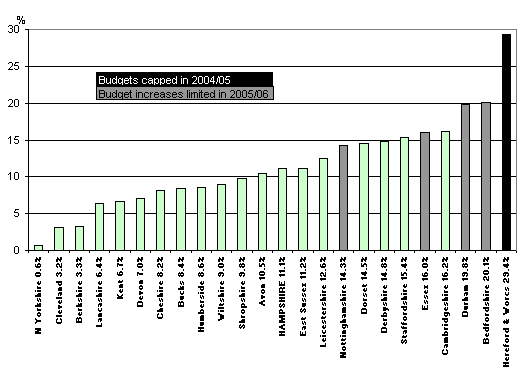
· the Government has announced that Hereford and Worcester Combined Fire Authority will have its budget capped in 2004/05. This has limited its council tax rise to 21.3% (down from 29.4%) and budget rise to 14.9% (down from 19.3%). Both the council tax and budget increases remain above the capping criteria. In addition the Government has set notional budgets for this year, against which future budgets will be assessed for capping purposes, for four other fire authorities (Bedfordshire, Durham, Essex and Nottinghamshire). These changes are subject to parliamentary approval.
· for capping purposes the ODPM used notional council taxes for 2003/04 to calculate council tax increases for 2004/05. Fire authority council tax rises in 2004/05 from those notional taxes for 2003/04 ranged from 0.6% to 29.4% (before capping) as the following graph shows:
Notional council tax rises for Combined Fire Authorities in 2004/05 (before capping)
2.2 The Hampshire Fire and Rescue Authority:
· set a budget of £58.4m for 2004/05 resulting in a budget increase of 8.8%
· was at the ceiling for grant increases and therefore received an increase of 5% (the ceiling `cost' the Authority £665,000 of grant, equivalent to a 2.5% increase)
· set a Band D council tax for 2004/05 of £51.30 (equivalent to 99p per week) resulting in a notional council tax rise of 11.1%
· avoided capping. Whilst the budget increase of 8.8% exceeded the capping criteria (7.0%), the council tax increase was below the capping criteria (13.0%) and the Band D amount was below average for the class (£53.39).
3 Spending Review 2004 (SR2004)
3.1 Government spending plans for the fire service over the coming three financial years were announced in SR2004 on 12 July. They were as follows:
2004/05 |
2005/06 |
2006/07 |
2007/08 | |
Fire FSS (£m) |
1,848 |
1,898 |
1,961 |
2,035 |
Fire FSS (% growth on previous year) |
2.7 |
3.3 |
3.8 |
3.2 These are the figures before efficiency savings targets. These are quoted as £105m by the end of the third year for Fire nationally, which would equate to some £2.6m for this authority, or around £850,000 per year of new savings to be identified. The government has stated that 2/3 of these savings should be `cashable', ie they could be used either to reduce the council tax or for reinvestment in new services, while the remaining 1/3 may be `non-cashable', ie they might lead to enhanced performance but without an identifiable budget impact. It is not proposed to adjust the settlement figures for these targets. Such expectations are not inconsistent with previous statements on the potential to save through modernisation, but members will be aware that the local scope is likely to be much less because lower-cost cover arrangements are already adopted more widely in Hampshire than is typical.
3.3 The LGA submission to SR2004 for fire authorities identified the following pieces of legislation as likely to lead directly or indirectly to additional responsibilities for fire authorities:
· Fire and Rescue Service Bill
· Civil Contingencies Bill
· Housing Bill.
4 Efficiency Review
4.1 Sir Peter Gershon's review of public sector efficiency will be reflected in the spending plans to be announced in SR2004.
4.2 The Government believes there is scope for savings across the public sector in procurement, back-office administration and transactional services such as payroll and payments.
4.3 The Government released transitional grant in 2004/05 to support the changes required under the Modernisation agenda. This is due to be repaid in 2005/06 by realising efficiency savings. The Local Government Association has made representations to the Government to the effect that savings will not be realised in this timescale.
5 Balance of Funding Review
5.1 The Government's review of the balance of funding between central and local government is expected to report later in 2004. It is unclear what recommendations will be made and when any changes will be implemented. At this stage it is difficult to be certain what the impact might be on fire authorities. It will be necessary to monitor developments.
6 Budget pressures
6.1 Budget pressures facing fire authorities in 2005/06 and beyond are:
· Modernisation
· IRMP
· Pay awards
· Regionalisation - control centres
· Repayment /replacement of transitional grant
7 Grant changes for 2003/04 and 2004/05
7.1 The Government has announced that it will be amending the grant allocations for 2003/04 and 2004/05 following upward revisions to the mid-2001 population data used in these grant settlements for Manchester, Westminster and potentially other urban areas. This is likely to affect adversely fire authorities in other areas including Hampshire, Portsmouth and Southampton; the scale of the impact cannot yet be determined but it is not likely to be large. Local authorities are currently being consulted on these proposals although the Government has not produced detailed exemplifications showing how each proposal will affect individual authorities.
8 Outlook for 2005/06 Settlement
8.1 Although the overall national settlement figures for fire authorities for 2005/06 have been announced by the Government in SR2004, the details for individual fire authorities will not be available until late November 2004. This will include details of any floors and ceilings scheme for 2005/06.
8.2 Aside from new responsibilities, the key issues for 2005/06 and the longer term are:
· repayment of £787,000 transititional grant repayable in 2005/06
· the greater focus on efficiency savings in SR2004, and uncertainty about whether Government targets will be achievable
· risk of continuation of pay dispute
· future trends in pension costs
· the impact of any capping in 2005/06
· any changes to the area cost adjustment - which reflects the higher cost of delivering services in the South East - including the annual updating of the information on wage rates
· revaluation of properties for council tax purposes, due to be effective from 2007/08
· achieving / maintaining appropriate levels of reserves in the light of such factors as any successful uninsured claims against the Authority.
9 Areas for possible action
9.1 Possible areas for future lobbying include persuading the Government that:
· repayment of transitional grant should be phased over a number of years or not repaid at all
· realistic targets for efficiency savings should be set for individual authorities, taking account of savings achieved in previous years
· the public's support for the fire service is in danger of being undermined by continued high increases in council tax.
10 Base budget 2005/06
10.1 The committed base budget is an estimated £58.7m. This is calculated assuming no growth, no contributions to reserves, no further additions to the uninsurable and other claims provision (but, equally, no favourable developments allowing for its reduction), 3% for inflation (including firefighters pay), and full repayment of the transitional grant.
10.2 This represents a minimal increase of 0.6% over the 2004/05 budget of £58.4m. However, details of the distribution of the increases in grant are not yet known and changes in the tax base could also have an impact. Inflation and legislative change pressures remain to be assessed. The prospects for 2004/05 in terms of council tax levels will not, therefore, become clear until the detailed settlement towards the end of 2004.
11 European Convention on Human Rights and the Human Rights Act 1988
11.1 The proposals within this report are compatible with the provision of the European Convention on Human Rights and considered in the light of the Race Relations (Amendment) Act 2000.
Recommendation
That the report be noted.