
Archived decisions
Hampshire County Council Environment Policy Review Committee 8 September 2004 Local Transport Plan - Annual Progress Report 2004 Report of the Director of Environment |
Item 10 |
Contact: John Buckett, ext 6599 email: [email protected]
1. Summary
1.1 This report introduces the 2004 Local Transport Plan (LTP) Annual Progress Report (APR) submitted to the Government on 30 July 2004. It covers performance during 2003/04 in terms of scheme delivery, progress towards targets and capital spending levels, as well as forecasts for 2004/05.
2. Corporate Strategy
2.1 The LTP is a corporate document incorporating all corporate aims and detailing the role of transport in promoting them.
2.2 The LTP was produced in 2000 and reflects the corporate strategy as it existed at that time. The next five-year LTP will be submitted in July 2005 and will be produced in accordance with Government guidance and all aims of the current corporate strategy and their interaction with transport.
3. Background
3.1 The APR is the chief mechanism for reporting progress on how the LTP is being implemented.
3.2 The format of APRs has changed markedly since their introduction in 2001 and is now largely to a standard format reporting progress on scheme delivery, progress against targets and capital spending, all compared with the forecasts made in the previous APR.
3.3 Assessment of this information is then used by the Government, both in awarding a performance score to each authority (which is part of the Comprehensive Performance Assessment) and in helping to determine the level of capital resource awarded to each authority for transport investment in the following year.
4. Hampshire County Council Performance 2003/04
4.1 A copy of the APR is attached to this report. The following is a brief summary of the main points:
(i) In terms of the specific criteria of scheme delivery, progress against targets and spending, the County Council was able to report very good progress in most areas.
(ii) The acceptance of the A3 as a major scheme allowed programme acceleration late in the year which meant that delivery and spending forecasts were generally met or exceeded. Progress towards targets was particularly encouraging in terms of casualty reduction, and road condition was reported to be on course. Bus passenger satisfaction and overall public transport use was encouraging.
(iii) Bus patronage as a target is proving a difficult area. While there have been impressive results from some quality partnership and marketing initiatives, the overall downward trend in total passenger numbers has not yet been arrested.
(iv) The cycling targets (both national and local) have proved to have been overly ambitious and the County Council's targets are to be reviewed as part of the new LTP.
(v) In addition to the statistical requirements of the Department for Transport, the APR includes references to new initiatives introduced by the County Council in 2003/04, including the launch of the Solent Travel Card, the opening of Chandler's Ford Rail Station and new services associated with it, the Info-Motion marketing initiative, MIRACLES in Winchester and good progress with travel plans.
(vi) The year also saw increased joint working with neighbouring authorities and other stakeholders, mostly through the Solent Transport Partnership, and working with national and regional governments on accessibility planning, the next LTP process and the regional spatial strategies.
4.2 The APR contains descriptions of performance against county-wide targets, as well as examples of individual schemes or measures. This can create instances where the overall performance is failing to meet a target, but where individual or localised schemes are beginning to show good progress against the target. For example, overall levels of bus punctuality are below target (page 11 of the APR), but better progress is being made in Quality Bus Partnerships (page 41).
5. The next Local Transport Plan
5.1 A new LTP covering the period 2006 to 2011 is required to be submitted by 29 July 2005.
5.2 Government guidance has been delayed and draft guidance for consultation was not issued until August 2004, with responses required by 8 October 2004. Final guidance is now expected in November.
5.3 While still subject to changes through consultation, the draft guidance clearly establishes that the agreed shared priorities for national and local governments of congestion, accessibility, safety and air quality will form the focus of future LTPs, as well as locally important quality of life outcomes.
5.4 It is essential that the new LTP is a true corporate document and that it also incorporates the views of other stakeholders, neighbouring authorities and the wider community.
5.5 The delay in Government guidance means that there is now a very tight timetable to meet the July 2005 deadline. It is proposed that there will be a report on the LTP strategy to an early meeting of this Committee and further reports through the preparation period.
Recommendation
That this Committee considers the performance reported in the Annual Progress Report.
Section 100 D - Local Government Act 1972 - background papers | |
The following documents disclose facts or matters on which this report, or an important part of it, is based and has been relied upon to a material extent in the preparation of this report. | |
NB the list excludes: | |
1. |
Published works. |
2. |
Documents which disclose exempt or confidential information as defined in the Act. |
TITLE |
LOCATION |
None |
Contents
Page
1 Executive Summary 2
2 Delivery of schemes on the ground
2.1 Overview of Progress 4
2.2 Key Programmes and Projects 4
2.3 Divergences from the 2003 APR forecasts 5
2.4 Progress in delivering `Accepted' major schemes 9
2.5 Use of Performance Related Reward Funding 10
3 Progress towards Targets and Indicators
3.1 Introduction 11
3.2 Overall Position 12
3.3 Road Safety, Casualty Reduction Programme 14
3.4 Congestion Reduction/Promotion of Non-Car Modes 17
of Transport
3.5 Air Quality 27
3.6 Accessibility 30
3.7 Road Maintenance 32
4 LTP spending programme
4.1 December 2002 Settlement 34
4.2 2003/04 Outturn 35
4.3 Overall Transport Spending 2003/04 36
4.4 LTP Spending Programme 2004/05 37
4.5 Other Transport Expenditure 2004/05 38
5 Progress - Wider Context and Additional Information
5.1 Regional and sub-regional spatial strategies and regional 39
transport strategy
5.2 Land Use and Transport Modelling 39
5.3 Solent Transport 39
5.4 Working with Neighbouring Authorities and DfT 40
5.5 Quality Bus Partnerships 41
5.6 Marketing and Promotion 42
5.7 Travel Plans (School and Workplace) 43
5.8 Chandler's Ford Railway Station 44
5.9 MIRACLES 44
5.10 Bridge Maintenance and Strengthening 45
5.11 Road Safety and Disadvantage 46
6 Appendices
· Appendix 1 - Progress against core indicators (Annex A) 48
· Appendix 2 - Progress towards local targets (Annex B) 50
· Appendix 3 - Report on status of targets and indicators 51
· Appendix 4 - Finance Forms (F1 - F4) 55
· Appendix 5 - Tables of reporting maintenance data (Annex D) 71
· Appendix 6 - Supplementary bid - A3 Hindhead 73
· Appendix 7 - APR Requirements Index 74
1 Executive Summary
Hampshire County Council had a very successful year in 2003/04 in transport delivery.
Scheme delivery: the Council delivered an effective and full programme. This included over 120 kilometres of road maintenance, 226 new or improved road crossings, 138 new or improved bus stops and 41 approved school travel plans. Actual delivery of schemes closely matched or exceeded plans in many categories. The County Council is reviewing how it monitors scheme delivery to help ensure more accurate forecasts in future years.
Transport scheme delivery is described in section 2.
Progress against targets: the Council is on track to meet the clear majority of its targets. In total, 89% of core performance indicators and 77% of headline targets are expected to be met within their target dates. Where targets are not on track, the Council is taking vigorous remedial action to bring them back into line. All targets are being reviewed as part of the development of the second Local Transport Plan. As part of this process, targets that have been achieved will be replaced with more challenging targets. Where targets are not on course, the first objective will be to identify remedial action rather than identifying less stretching targets.
Progress against targets is covered in section 3.
Transport spending: the Council spent its Local Transport Plan allocation in full, in addition to considerable amounts of revenue funding and external funds. Actual spending closely matched or exceeded plans, except where it was prudent to divert resources into more effective projects or to ensure that targets were met. Allocations were increased in priority areas, such as road safety, highway maintenance and buses. This effective programme management was made more difficult by the Government's delayed decision on the A3 major scheme.
Transport spending is discussed in more detail in section 4.
In addition, to these three indicators of performance, Hampshire County Council also enjoyed the following successes:
· The A3 bus priority corridor major scheme was accepted for funding by the Government. This £25 million scheme will improve bus journeys from Waterlooville to Portsmouth and help to relieve congestion on the A3(M).
· The Council won a national award for the Interchange at Winchester Rail station and a European award for partnership work in road safety casualty reduction.
· The new Solent Travelcard was launched as part of the innovative Solent Transport initiative. This provides bus travel on all bus operators on one ticket.
· The County's "Cango" demand responsive bus service was extended. This helps to improve accessibility, especially in rural areas.
· Chandler's Ford railway station was opened in Summer 2003. This brings new local rail services to Romsey, Eastleigh, Southampton Airport, Southampton and Totton. The station project was shortlisted for "best small interchange" in the 2004 National Transport Awards.
· Winchester's Park and Ride extension was opened in 2003. This provides more parking capacity for the park and ride service and helps to reduce congestion in the city centre.
· The Route 1 Bus Priority Corridor in Rushmoor was introduced, part of a joint initiative with neighbouring Surrey.
· The County Council's "Infomotion" bus marketing scheme has shown impressive results in encouraging more use of public transport.
· The County Council has worked closely with the Department for Transport to refine proposals for the light rapid transit scheme from Fareham to Portsmouth via Gosport. On July 20th 2004 the Government announced that it is not prepared to fund the scheme at present. The promoting authorities are considering this announcement.
· The County Council is also an active player at the regional level. The Council is represented at the Regional Assembly's Transport Advisory Group and Regional Transport Coordination Group. Council officers are leading on a project to consider solutions to the imbalance between revenue and capital funding.
· At European level, the County Council is a member of the POLIS management committee and is currently chairman of the POLIS political group. The Council has agreed to provide expert advice to other European cities and regions on the development of effective LTPs.
The County Council has worked closely with the Department for Transport in the formulation of transport policy. In the Winter of 2003/04, the Council worked with officials of the DfT on a new engagement process designed to develop shared priorities for transport achievement. This work involved close working with the neighbouring transport authorities: Portsmouth City Council, Southampton City Council and the Isle of Wight Council.
County officers also helped in the formulation of policy and practice in accessibility auditing and performance indicators for the LTP process.
The County Council is now turning its attention to the production of its second Local Transport Plan, covering the period 2006/07 to 2010/11. This second LTP will build on the success of the first LTP. It will look to incorporate the Government guidance on LTPs, as well the recently published Regional Transport Strategy and the emerging spatial strategies underpinning the South East Plan. In developing its LTP, Hampshire County Council is working closely with regional and local partners, including neighbouring authorities, district councils and local strategic partnerships.
Summary
The County Council is proud of its record on transport. 2003/04 was a highly successful year. Through effective management of budgets and resources, the Council delivered a full programme of improvements and showed excellent progress against targets. The programme mixes well developed programmes of proven benefit with more innovative projects. The County Council is looking forward to the challenge of its second LTP.
2 Delivery of Schemes on the Ground
2.1 Overview of Progress
Hampshire County Council had an excellent year in terms of delivery of schemes in 2003/04, with significant progress made in priority areas of road safety and public transport.
Most scheme types were delivered broadly according to the plans published in the 2002/03 APR. There were substantial increases in several areas, including casualty reduction, new and improved road crossings and carriageway maintenance schemes.
Only one area of work shows a significant decrease in activity compared with plans. Scheme delivery on travel planning, both work and school, is at a lower level than predicted. The reasons for this are explored in this section, together with a description of the actions taken to put this back on track. As a result, the County Council is confident that targets for this area of work can be met in future.
Some of the divergences between planned and actual delivery are due to revisions in the County Council's forecasting and monitoring methodologies. The changes will help to ensure a closer match between planned and actual delivery in future years.
2.2 Key Programmes and Projects
There were a number of elements within the delivery programme for 2003/04 that are worthy of specific comment.
· Acceleration of the local safety schemes programme meant that it was possible to implement nearly 200 schemes which contribute to local safety.
· The road crossing programme has also been developed with preference being given to the provision of puffin crossings and a significant increase in the number of other road crossings.
· Chandler's Ford Rail station was opened in time for the summer 2003 timetable bringing new local rail services to Romsey, Eastleigh, Southampton Airport, Southampton and Totton. This new services link residential and employment areas in the Southampton City Council and Hampshire County Council areas improving accessibility for residents in both authorities.
· Winchester Park and Ride extension was opened during the year, after a series of legal challenges. The increased capacity allows the service to be offered to shoppers and tourists throughout the day.
· Route 1 bus priority corridor in Rushmoor was introduced, as part of a joint initiative with neighbouring Surrey.
2.3 Divergences from the 2003 APR forecasts
Divergences from the 2003 APR forecasts for 2003/04 are set out in table D1. The APR guidance requires explanations of divergences greater than 25% between the predicted numbers of schemes delivered in 2003/04 in the categories identified, compared with the predicted outturn and APR forecast figures for 2003/04.
There are several areas where delivery exceeded the forecasts, others where the Council's approach is under review and some where delivery was less than anticipated in the APR:
Divergences - Increases
Park and ride schemes (1 scheme - forecast 0)
At the time of the APR forecast, it was expected that legal challenges might delay the Park and Ride extension at Bar End beyond 2003/04. Significant efforts were put into overcoming these objections, which enabled the implementation programme to be advanced and the scheme opened in November 2003. There has already been a 30% increase in Winchester Park and Ride usage.
Other walking schemes (length (km): 65% over forecast, number: 32% under forecast)
The County Council delivered 1.65 km of walking schemes. This represents an increase of 65% over the plans in the 2002 APR. The apparent decrease in the number of schemes delivered is largely due to the fact that several schemes have been merged. The definition of schemes has now been standardised to ensure more clearer reporting in future APRs.
Other local safety schemes (73% over forecast)
In order to maintain good progress against targets, there was a deliberate expansion in the local safety programme. This has included action to tackle accident hot-spots as well as increased use of skid resistance treatments throughout the County.
New or improved road crossings (259% over forecast)
The principal reason for the increase was the introduction of a programme of improvements at uncontrolled road crossings as part of the County Council's footway maintenance programme.
Carriageway maintenance schemes (length (km): 37% over forecast)
Other maintenance schemes (length (m): 39% under forecast)
In total, the delivery of maintenance schemes increased substantially during 2003/04 compared with plans. Some 121 km of improvements were achieved, compared with plans of 98km. There was a relatively minor transfer of priority from "other schemes" to "carriageway maintenance" in order to protect the integrity of the road network. Schemes on the non principal road network were brought forward to meet public demand for better minor rural carriageways and urban footways.
As required by the APR guidance, Table D1 reports only LTP funded capital schemes on the principal road network and a part of the non principal road network. Information on the total structural maintenance programme for 2003/04 on all road categories provides for 568 footway maintenance schemes, 398 carriageway maintenance schemes, 1 noise reducing road surface and 33 other schemes.
Divergences - Under review
There are two areas of transport delivery where policies are under review, and it has not been possible to complete projects as originally planned.
Home zones (1 planned, partially delivered and under review)
One major home zone scheme, including three residential roads commenced in Portchester during 2003/04, as part of a national demonstration initiative. Following extensive consultation with residents in the area, further improvements were made to the design for the scheme which delayed the start of construction work. Good progress has now been made with completion anticipated by October 2004. The County Council will be reviewing its approach to Home Zones in the light of experience gained from the Portchester scheme, its benefits, costs and applicability to other areas. .
Quiet Lanes (1 scheme planned, now under review)
The implementation of quiet lanes in Hampshire is currently on hold pending a review of the County Council's policy in the light of national guidance and advice.
Divergences - Decreases
There is one area of transport delivery where progress has not met the forecasts in the 2002 APR. The delivery of travel plans (both work and school) and the associated safe routes to school to school programme has not met the County's ambitious plans for 2003/04.
School Travel Plans (32% under forecast)
Safe routes to school (40% under forecast)
The County Council approved 41 School Travel Plans during 2003/04 against a target of 60. The County Council has a strict policy of only delivering capital schemes to schools with a fully approved school travel plan. Consequently the lower than forecast production of school travel plans had a knock on effect on the delivery of the safer routes to schools programme.
The key reason for the delay in school travel plan reduction was that the County Council gave considerably more publicity to school travel plans during this period. This resulted in a large number of schools expressing an interest. The school travel plan team has consequently devoted more time to taking these new schools through early stages of the school travel plan process. This has inevitably reduced the number of school travel plans completed during the year. However, it has also ensured good delivery in future years. There are a further 90 schools currently working towards travel plans.
On balance, the County Council believes that this is the most effective strategy for delivering 100% coverage with effective school travel plans. The second LTP is expected to include targets to achieve 100% coverage faster than the Government's target of 2010. It should be noted that the council insists that school travel plans are produced to a high standard. Plans which do not meet the council's standards are not approved.
During the latter part of 2003/04, the County Council recruited additional staff to take advantage of increased DfT bursary funding. The County Council now has four additional full time school travel plan posts. In addition, two posts in district councils are being part funded. This team was in place by May 2004, which will provide the resources necessary to accelerate the delivery programme.
Other travel plans (50% under forecast)
During 2003/04, 11 workplace travel plans were delivered against the target of 22. The principal reasons for this shortfall relate to resource availability and a commitment to ensuring that workplace travel plans are at an appropriate standard. The original plan was to supplement a DfT bursary post with County Council funded staff, but the temporary status of the DfT bursary funding, affected recruitment in this area. The commitment to quality plans has been maintained even though this can adversely affect the number of plans produced.
While many of the 75 organisations the County Council is currently working with have sustainable travel measures in place, there is often reluctance to develop a formal travel plan document. However, the County Council is confident that the introduction of its travel plan web site, the Business Travel Plan Partnership Fund, draft Supplementary Planning Guidance and additional staff resource will assist in bringing delivery back on track during 2004/05.
Further information is provided in section 5.7
Table D1 - Scheme Delivery 2003/04
Scheme Type |
Predicted |
Actual |
+/- Divergence |
Bus priority schemes |
6 (no.) 12 (km) |
5 (to come) |
-17% |
New public transport interchanges |
1 (no.) |
1 |
0 |
Improved public transport interchanges |
10 (no.) |
8 |
-20% |
Park and ride schemes |
0 (no.) |
1 |
100% (infinity) |
New or improved bus stops |
125 (no.) |
138 |
+10% |
Other bus infrastructure schemes |
1 (no.) |
1 |
0 |
New cycle tracks |
10 (no.) 6 (km) |
7 5.1 |
+20% -3% |
New cycle Paths |
5 0.7 | ||
Other cycling schemes |
9 (no.) |
10 |
+11% |
Pedestrianisation schemes |
0 (no.) 0 (km) |
0 0 |
0 0 |
Other walking schemes |
25 (no.) 1000 (m) |
17 1647 |
-32% +65% |
School travel plans |
60 (no.) |
41 |
-32% |
Other travel plans |
22 (no.) |
11 |
-50% |
Safe routes to school |
40 (no.) |
24 |
-40% |
Other local safety schemes |
97 (no.) |
168 |
+73% |
New or improved road crossings |
63 (no.) |
226 |
+259% |
Home Zones |
2 (no.) |
0 |
-100% |
Quiet Lanes |
1 (no.) |
0 |
-100% |
20 mph zones |
4 (no.) |
4 |
0 |
Other traffic management schemes |
20 (no.) |
17 |
-15% |
New rural bypass |
0 (no.) 0 (km) |
0 0 |
0 |
New relief road or ring road |
0 (no.) 0 (km.) |
0 0 |
0 |
Road dualling and widening schemes |
0 (no.) 0 (km) |
0 0 |
0 |
Junction improvements |
5 (no.) |
5 |
0 |
Bridge strengthening |
310 (no.) |
308 |
-1% |
Carriageway maintenance schemes |
80 (no.) 80 (km.) |
86 110 |
+7% +37% |
Other maintenance schemes |
70 (no.) 18000 (m.) |
53 11000 |
-24% -39% |
Other schemes |
10 (no.) |
10 |
0 |
2.4 Commentary on Progress in Delivering Major Schemes
SHRT Phase 1, (LRT Fareham - Gosport -Portsmouth)


On July 20th 2004 the Government announced its
decision not to fund this scheme. The promoting
authorities are currently considering what action
they should take.
In the meantime, the APR guidance requires a
summary of progress to date on major schemes. Prior
to the decision, the two authorities had been working
to deliver the Light Rapid Transit link between
Fareham and Portsmouth. In December 2002,
the promoting authorities received
commercial submissions from two consortia invited
to bid for the contract to design, construct, operate
and maintain the SHRT-1 system for a term of
thirty years. These bids, although improved significantly through initial contract negotiations, indicate clearly that the total financial contribution from the public sector partners would need to exceed that allowed for in the current funding agreement with government.
Since June 2003, Hampshire County Council and Portsmouth City Council have been supporting the Department for Transport in a project review that to determine whether the project is still value for money, and is affordable. The final results of the review were reported to the DfT in March 2004.
A3 Bus Priority Corridor
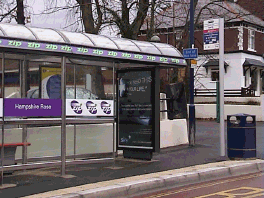
Following the approval of funding for this project as a major scheme in October 2003, full resources are now in place and steps are being taken to see how work can be accelerated to achieve completion in 2007. Inevitably some critical commitments in 2003/04 were held in abeyance until the outcome of the bid for funding was known, which has somewhat delayed progress against the overall programme.
Highway works for Section 2 have been constructed in two phases. 725 metres of bus lane have been completed and the remaining 20% is under construction following completion of BT diversionary works 12 months early. The design for Section 3 Waterlooville Town Centre has undergone significant consultation and refinement and is now being completed for construction in 2004/05 . The design and consultation for Sections 4 and 5 are now being prepared at the same time to speed up delivery.
The Real Time Passenger Information system for bus shelter signs will use new technology that is being made compatible with both the new Portsmouth PORTAL system and the new Hampshire standard. Section 1 bus shelters have proved very successful and a bespoke contract will be used for the procurement of future shelters. Electronic systems for the A3 Corridor have not yet been installed on site and CCTV for Section 1 has been delayed following improvements to the network layout, but they will be operational when the Section 2 cameras are installed.
 Following the approval of funding the partner organisations jointly launched the "ZIP" branding of the A3 Corridor service. Through this the improvements to the service, passenger facilities and priority works will be linked by shared livery and logo to stimulate better awareness and build expectation further up the corridor. This is intended as short term (3 to 6 years) while the project is created, with a view to refreshing it once conditions have settled and the potential of public transport network branding has been considered as part of Solent Transport.
2.5 Use of Reward Funding
Hampshire County Council received a total allocation for integrated transport of £14.393 million in 2003/04 compared to an indicative allocation (from December 2000) of £12.743 million. The additional £1.65 million comprised on a supplementary bid allocation of £880,000 for CIVITAS (MIRACLES EU supported project) and £770,000 reward funding.
Hampshire has a deliberate policy to build flexibility into its capital programme in order to maximise overall delivery and to ensure that spending targets are met. The `reward' funding was not specifically identified as being allocated to a particular scheme or schemes.
However in general terms, in line with local and national priorities, the additional funding was used to expand the casualty reduction and public transport programmes.
3 Progress Towards Targets
3.1 Introduction
Table T1 shows Hampshire County Council's performance against its 19 main targets. There is a discussion on each target area covering progress to date, trajectories and, where necessary, proposed remedial action.
The County Council is on track to meet 15 of these targets (79%). This represents strong performance against a wide variety of challenging targets and performance indicators.
Two targets are not on track - cycling usage and bus punctuality.
The target on walking has no clear evidence to allow an assessment to be made. Measures are being put in place to improve monitoring in the future.
The target on bus patronage has presented the County Council with considerable difficulties in determining whether the evidence available is sufficient to allow a categorical statement to be made. APR Government Office Guidance does not allow for a `no clear evidence' assessment. The evidence is presented below to enable the Government to reach its own conclusions about whether the County Council is or is not on track to meet its target.
3.2 Overall Position
Table T1 - Summary of Progress Against Targets
Topic |
Summary of local objective |
Shared Priority |
Target Type |
On Target |
Road Condition |
Halt deterioration of principal roads |
N/A |
CPI |
Yes |
Halt deterioration of non-principal roads |
N/A |
CPI |
Yes | |
Halt deterioration of unclassified roads |
N/A |
CPI |
Yes | |
Public Transport |
Increase bus use |
Congestion |
CPI |
see text |
Bus passenger satisfaction |
Accessibility/ Congestion |
CPI |
Yes | |
Increase use of public transport |
Congestion |
HCC |
Yes | |
Improve bus service punctuality |
Accessibility/ Congestion |
HCC |
No | |
Cycling |
Increase level of cycling |
Accessibility/ Congestion |
CPI/HCC |
No |
Road Casualties |
Reduce killed & serious injuries |
Road Safety |
CPI/HCC |
Yes |
Reduce child killed & serious injuries |
Road Safety |
CPI/HCC |
Yes | |
Reduce slight casualties |
Road Safety |
HCC |
Yes | |
Accessibility |
Access of rural households to public transport |
Accessibility |
CPI |
Yes |
Traffic Growth |
Halve the rate of traffic growth |
Congestion |
HCC |
Yes |
Walking |
Increase levels of walking |
Accessibility/ Congestion |
HCC |
No clear evidence |
Environment |
Meet target for particulates |
Air Quality |
HCC |
Yes |
Meet target for nitrogen dioxide levels |
Air Quality |
HCC |
Yes | |
Meet target for carbon monoxide levels |
Air Quality |
HCC |
Yes | |
Travel Plans |
Increase in work place travel plans |
Accessibility/ Congestion |
HCC |
Yes |
Increase in school travel plans |
Accessibility/ Congestion |
HCC |
Yes |
As explained in Hampshire's LTP, for many of the outcome targets, particularly those involving behavioural change, progress is not solely dependent upon County Council actions. Government policies and interventions affecting the cost of travel by private and public transport can be crucial in this area.
Where there remains uncertainty, or where it becoming increasingly likely, that a target will not be met, the County Council has developed strategies to address this. Examples include the `Infomotion' project, a direct marketing initiative to households within the catchment of the County's busiest bus routes and working in partnership with the English Regions Cycle Development Team (ERCDT) to maximise cycle usage on key corridors. Apart from a new, tougher target for bus passenger satisfaction, no changes to targets have been made since the 2003 APR, even where it is considered a target will not be met. The primary reason for this is that Hampshire County Council considers that the best way to identify robust and realistic targets is through the Authority's second LTP.
Performance is discussed below in the following areas, which reflect the Central Government's and Local Government Association shared priorities.
Shared Priority |
Targets |
Road Safety |
Casualty Reduction Programme |
Congestion (inc. promotion of non-car modes) |
Traffic Growth Public Transport (Patronage, punctuality and satisfaction) Active Travel (Cycling, walking and travel plans) |
Environmental impacts including air quality |
Air Quality |
Accessibility |
Rural Public Transport Accessibility |
Other policy areas |
|
Road Maintenance |
Road Condition |
Full details on Core Performance Indicators (CPI) can be found in Appendix A and Hampshire's headline targets (where they differ from the CPI) in Appendix B. Where the CPI and Hampshire's headline targets are the same, then this has been reported under the CPI heading.
3.3 Road Safety, Casualty Reduction Programme
Introduction
Improvements to road safety and a reduction in the number of casualties are long standing objectives of the County Council, mirroring the importance placed on this by Central Government and the LGA as one of their shared priorities.
The County Council's Corporate Strategy places a high priority on maximising life opportunities and building strong and safe communities. Policies and programmes for road casualty reduction therefore directly contribute to those aims, which is why the County Council has set out a more demanding road casualty reduction target as part of its locally negotiated Public Service Agreement with the Government.
These programmes are delivered in close partnership with a wide range of public and private sector partners and casualty reduction will be a strong theme in the development of Local Strategic Partnerships. These are already benefiting from the County Council's strong and well established working relationships with the health sector. This relationship is being further developed with the new Hampshire and Isle of Wight Strategic Health Authority and the Hampshire Primary Care Trusts. In turn, the County Council, the Strategic Health Authority, the Hampshire Fire and Rescue Service and Hampshire Constabulary are all members of the Hampshire Strategic Casualty Reduction Partnership. The Partnership is already exploring effective programmes to tackle both road safety and quality of life improvements.
In the spring of 2004, the County Council was very pleased to receive the POLIS/ ACCESS European Road Safety Award for excellence in partnership working towards the European Commission's target of a 50% reduction in road fatalities by 2010. The County Council is a signatory to the new European Road Safety Charter.
CPI & Hampshire Targets
40% reduction in the number of people killed or seriously injured to the average 1994-98 level by 2010
50% reduction in the number of children killed or seriously injured to the average 1994-98 level by 2010
Hampshire Target
10% reduction in the number of slight casualties per 100 million vehicle kilometres to the average 1994-98 level by 2010
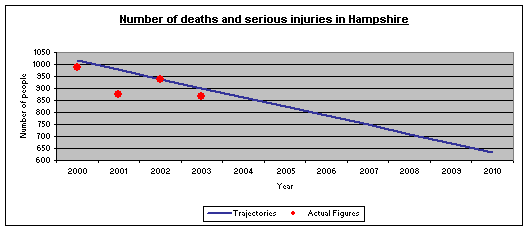
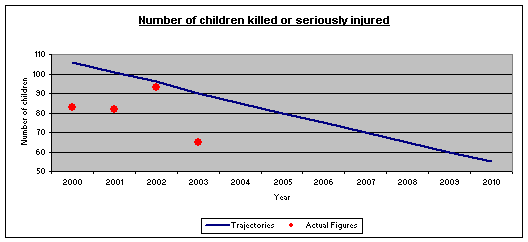
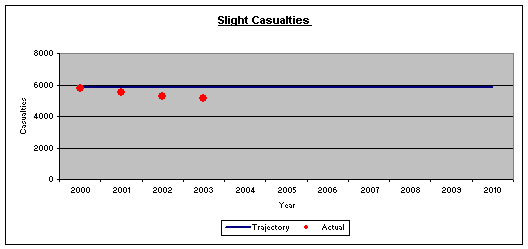
Note: This target relates the number of casualties to vehicle kilometres. As a proxy it has been assumed that a target of not increasing the number of casualties will reflect the current increase in vehicle mileage.
The County Council's remains on target to meet all of its casualty reduction targets, which principally reflect those set nationally.
Under the County Council's locally negotiated Public Service Agreement (PSA), a more demanding target has been agreed with the Government, that of a 26% reduction in all killed and serious injuries by the end of 2004 from the same baseline. The local PSA target was associated with the acceptance of the Hampshire and Isle of Wight Safety Camera Partnership's safety camera operational case to Government, which permitted the early deployment of increased safety camera activity on the Hampshire road network.
The number of deaths and serious injuries on Hampshire's roads in 2003 (including motorways and trunk roads) were 867, representing a reduction of some 17% from the baseline average figure for the years 1994-98. This figure is on target to meet the 40% projected reduction by 2010, and within range of achieving the more demanding PSA figure by the end of 2004, which is encouraging. This figure is also the lowest killed and seriously injured annual road casualty toll on Hampshire's roads to date. Total casualty numbers at 5988 in 2003 represent a 13% reduction from the mid 1990s levels and again is the lowest toll to date on Hampshire's roads. Fatal and serious child casualties numbered 65, a 40% reduction from the baseline average for the years 1994-98. This is the lowest serious child casualty toll on Hampshire's roads to date and is on target to meet the national target figure of 50% by 2010.
The latest County Council returns to the Audit Commission for road casualties on Hampshire's roads are for the accounting period 2003/04 and are calculated based upon the 2002 calendar year. The figures show that at that point the County Council was performing better than the projected targets in the majority of road user categories (each of which is expressed as casualty numbers per unit population). A notable exception was powered two wheeler casualties, repeating the position for the previous year. The County Council's full returns are published at http://www.hants.gov.uk/bestvalueinhampshire. This set of national road safety performance measures will change from the 2004/05 returns to better reflect the national casualty reduction target figures.
The County Council is pleased to note the longer term trend of reducing casualty numbers and severity, which demonstrates a strong causal link with the high priority the County Council and its important partners have placed on road casualty reduction over the last decade or more. However, the Local Public Service Agreement stretched target has proved to be a particularly demanding one to meet and there are concerns that annual casualty tolls are likely to remain vulnerable to fluctuations in traffic levels and wider transport choices, that are difficult to control and fully plan for in our casualty reduction strategies. This is particularly evident in the recent worrying rise in motorcycle casualties.
The County Council therefore fundamentally reviewed the nature and scale of its casualty reduction programmes in the second half of the 2003/04 financial year , with significant funding increases made available for casualty reduction engineering programmes (as highlighted in section 4.2) and heightened activity in partnership with Hampshire Constabulary aimed at directly tackling the recent rise in motorcycle casualties. This fundamentally re-shaped programme will both assist the short term delivery of the stretched PSA target, but also importantly improve casualty reduction performance in the medium to longer term, with resultant increased confidence of meeting the headline casualty reduction targets to 2010.
3.4. Congestion Reduction / Promotion of Non-Car Modes of Transport
Introduction
Congestion, or rather `tackling congestion' is one of the four shared priorities of the Department for Transport and the LGA.
Preparatory work for the second LTP suggests that congestion will be addressed both in terms of direct congestion measurement and through what are known as proxies for congestion , which includes the number of people using non-car transport modes (public transport, walking and cycling) and the impact of school and workplace travel plans in reducing congestion through changing travel behaviour.
Hampshire County Council's first LTP has increasing transport choice as its principal objective, looking to encourage travel mode changes to reduce the impact of forecast travel growth. The LTP identified traffic growth as the principal driver of congestion growth and the County Council's headline target was to seek to reduce traffic growth to half of its forecast level by 2020.
The new round of LTPs is expected to use measurement of congestion derived from Global Positioning Systems and use an index of routes within the local road networks of major urban areas as a basis for assessing performance. Hampshire County Council (with Portsmouth and Southampton City Councils) has been looking at the potential for such a system in the Solent Area in conjunction with the DfT. Hampshire has already obtained data from a GPS network and will be developing its monitoring regime for the next LTP.
In the current LTP period traffic growth remains the only direct traffic related target. Public transport patronage, cycling and walking have County Council headline targets and (and there are specific core performance indicator targets for bus use supplemented with measures on punctuality and customer satisfaction.) There are targets for numbers of school and workplace travel plans adopted at the nationally approved level and these will be complemented by measures of their impacts in the next LTP round. Again there has been close liaison with neighbouring authorities on the potential for Solent Area targets and measures in the next LTP round.
3.4.1 Traffic Growth
Hampshire Target
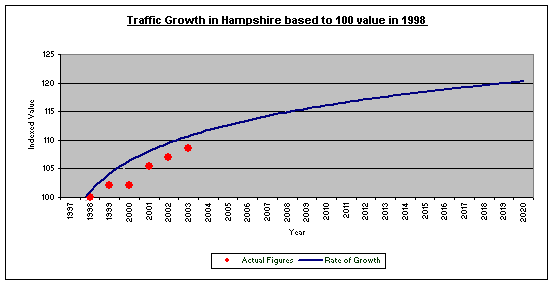
To halve the rate of forecast traffic growth between 1998 and 2020 from 41% to 21%
Overview of Progress
Trends in traffic growth remain similar in Hampshire to those reported in the 2003 APR. The overall level of traffic in Hampshire continues to increase, however the rate of growth continues to fall very slightly compared to previous years, with growth of 1.3% in 2003, compared to 1.6% in 2002.
The traffic growth target is a long term one and it is therefore it is still far too early in the process to draw any firm conclusions and therefore it not considered necessary to revise the target at this stage. Nevertheless, initial progress remains reasonably encouraging, with the impact of the various projects and initiatives being delivered through the LTP perhaps beginning to have some effect.
There were no areas within Hampshire that fell within the Government's original definition of a `large urban area.' The County Council is aware that this indicator has now been dropped pending the introduction of new indicators using GPS data. Nevertheless Hampshire has already been proactive in this area as congestion remains an issue that is of major concern to the travelling public, particularly in the southern part of the County.
The County Council has therefore obtained floating vehicle data on traffic speeds throughout the road network in Hampshire from ITIS in order to begin analysing the trends. The Information provided also include overview maps providing a graphical representation of the core data and will assist in developing a strategy for addressing congestion hotspots within the second LTP.
3.4.2 Public Transport
CPI Targets
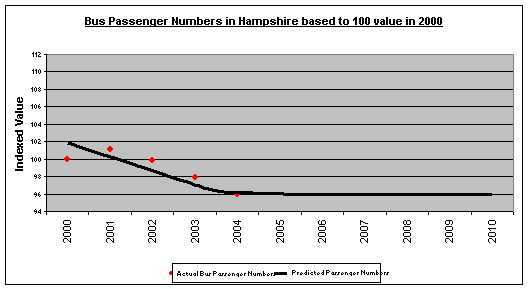
To increase bus use from 2000 levels by 10% by 2010.
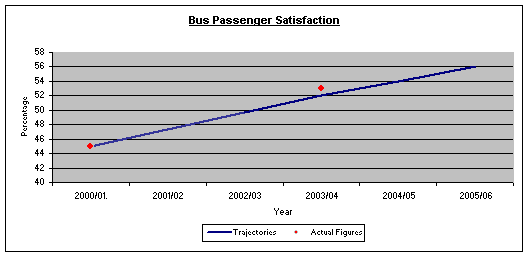
To reach a level of 50% of respondents satisfied with the local bus service by 2003/04.
Hampshire Targets
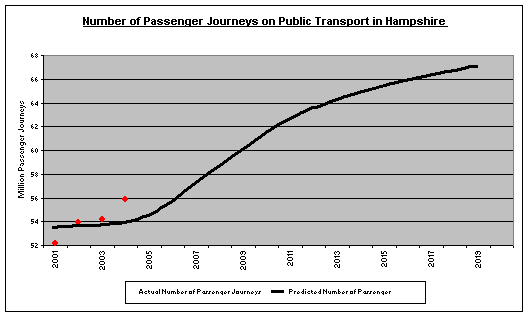
To increase public transport patronage by 25% between 2000 and 2020.
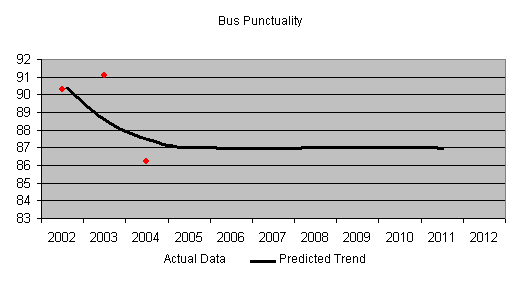
To achieve 95% of bus services operating within a window of 5 minutes late and one minute early by 2010.
Overview of Progress
Bus patronage
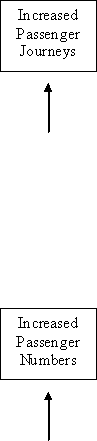
It is difficult to report likely trends in bus patronage according to the existing APR guidance. The current trend is for a small decline in bus use. However, the County Council has introduced a number of measures which are beginning to increase bus passenger numbers. It is anticipated that these measures will shortly arrest the decline and start to show an increase in bus patronage. It is not yet known whether this increase will be sufficient to meet the 2010 patronage target. This is especially difficult to assess, as the target date is after the second local transport plan. As part of the development of the second local transport plan, the County Council will consider whether this target remains viable; what options exist to meet the target and whether and new target should be adopted.
The target of a 10% increase in bus patronage by 2010 is very challenging. It is possible that this target will need to be revised downwards. However, as a policy principle, the County Council would rather take remedial measures to meet a target that is not on track, instead of lowering its targets. The County Council is keen to explore whether its current bus policies plus the new measures proposed in the White Paper "the Future of Transport" could allow the target to be met by 2010. This will require further investigation. At the time of writing, there was no information to elaborate on the concepts contained in the White Paper. In particular, the guidance on full local transport plans was not available.
As a result, the County Council finds it difficult to state whether this target is on track or not. The natural conclusion is that there is insufficient evidence, but the APR guidance does not allow this to be stated where there is a clear trajectory. In this instance, there is a slight downwards trajectory, but this takes no account of the measures which are being undertaken or the possible new measures to be introduced in LTP2.
Although Hampshire has seen a small decline in overall bus use during 2003/04, significant passenger growth has been achieved on our Quality Bus Partnership (QBP) routes. On QBP routes increases of up to 23% have been seen in passenger numbers. In addition where bus priority measures have been introduced a reduction in journey times by 8% has been experienced. The QBP which forms part of the MIRACLES European demonstration project in Winchester has delivered patronage growth of approximately 19% on route 5, one of the main cross-city routes. Further details on the initiatives being delivered are given in Section 5.5 which is complemented by substantial investment in new buses in many areas of the County and increases in frequency on many core urban bus routes.
The growth experienced in passenger numbers on our QBP routes has been underpinned by the `Infomotion' personalised marketing campaign (see Section 5.6). and further work will be focused in this area to maximise the opportunity for this growth to be sufficient to outweigh the general decline in bus patronage outside urban areas in the longer term.
There has also been an encouraging take-up of the Solent Travelcard, which provides bus travel across the Solent area with one ticket. Over 1,000 daily and 500 weekly tickets have been sold since the launch of the scheme in March this year.
A 10% increase in bus patronage is anticipated on the A3 bus priority scheme once it is completed.
The bus passenger satisfaction target set for 2003/04 has been exceeded with overall passenger satisfaction increasing by 18% over the past three years. In each of the individual areas surveyed relating to frequency of buses, number of bus stops, state of bus stops, buses arriving on time and the ease by which it is possible to get on and off buses, there was an increase in the percentage of people who were satisfied.
The considerable progress made in exceeding the 50% satisfaction target, reflects the improvements made to mainly urban bus corridors through investment in Quality Bus Partnerships. Many residents in urban areas will have benefited from these improvements, helping the target has been met. Significant improvements have also been made in rural areas through the Cango Demand Responsive services, although this has had a smaller impact on the result.
The next Best Value Performance Indicator (BVPI) survey of bus passenger satisfaction will take place in 2006/07 and having assessed the progress to date it has been decided that the target should be raised. It is important that work continues with our partners to improve the satisfaction rating, so a stretched target of 56% has been set for 2006/07. The County Council is confident that the target can be met as continuing improvements are being made to the bus network and the provision of information, especially in urban areas.
Unlike the CPI, the headline target for Hampshire covers all modes of public transport use rather than just bus services and this figure shows an increase. This reflects the important role that rail and ferry services play in meeting the local transport needs in the County. In 2003/04 it is pleasing to report that there have been increases in both the number of passenger journeys by rail (10%) and by ferry (1%) within Hampshire, this had led to an overall increase in public transport use of 3%. The new rail station constructed at Chandler's Ford has catered for 94,000 passengers in its first year.
As part of the ongoing dialogue with local train operating companies, far more robust information has been made available on passenger numbers. This has had no effect on the overall target but has led to the replacement of the data reported from the County Council's biannual Transpol surveys with operators data, that is considered to provide a more accurate overall picture of rail usage. This also means that all the passenger numbers reported in the APR, for bus, rail and ferry now come directly from operators.
In relation to bus service punctuality, two different measures are undertaken, which show conflicting results. The bus passenger satisfaction surveys undertaken for the BVPI, show a marked increase in number of people who consider buses are running on time. However, the surveys of tendered bus services that have been reported in previous APRs suggest an overall decline in reliability during 2003/04.
The BVPI survey of over 1000 Hampshire residents undertaken in 2003/04 showed an increase of over 28% in the past three years of the number of people who were satisfied with buses arriving on time. As indicated above this reflects the level of investment being made by the County Council in Quality Bus Partnerships.
Although the surveys of bus services show a decline in the reliability, it should be borne in mind that the variation from the sample monitoring is not particularly robust statistically, as it only covers a selection of contracted bus services, which in turn only account for 28% of the total bus mileage. The 72% of commercial services are not monitored by the County Council and bus operators do not routinely monitor punctuality across the whole of their operations. Therefore the County Council will discuss with operators how this information can be obtained in the future. To improve reliability the County Council continues to invest heavily in a wide range of bus priority measures to ease the passage of buses through congested traffic and is liaising with operators to identify locations where there are particular problems.
Given the uncertainty over the different measures and the bus priority initiatives currently being delivered it is not considered appropriate to amend the target at this time.
3.4.3 Active Travel - Cycling, Walking, Travel Plans
Cycling
CPI and Hampshire Targets
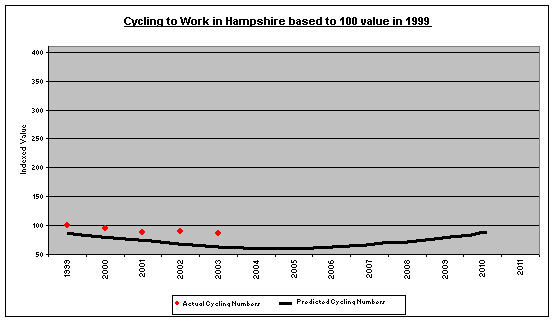
To quadruple the number of cycling trips by 2012 from a 1996 base
 Increased Usage
Overview of Progress
Monitoring of cycling activity in Hampshire continues to show a significant overall decline in cycle usage from a 1999 base against the headline target, although as reported last year this is consistent with national trends. This decline is in part due to the loss of particular types of employment that traditionally involved cycling to work, particularly the impact of reduced MOD employment on the Gosport peninsular.
The original trajectory associated with the cycling target showed an initial decline in cycling usage followed by a marked increase. However the decline to date has been greater than predicted and the County Council now considers that the headline target is not going to be achieved and the above trajectory reflects this. Nevertheless it is still working hard to maximise the potential for cycling in the County and in particular arrest the downward trend in overall cycle usage.
The County Council is working with the English Regions Cycling Development Team (ERCDT) to address the concerns raised in ERCDT's audit of cycling policies, strategies and programme services undertaken in 2003. Although the County Council had previously received a very favourable report of its work (highlighting nine national benchmark best practice areas of delivery), in the earlier national CTC Benchmarking Project the County Council is keen to do all it can to address the ERCDT audit's concerns.
To this end, detailed discussions have been held with the ERCDT's officers and ERCDT are to be invited to assist the County Council with the development of the cycling strategy for the second Hampshire Local Transport Plan. At the same time, the County Council has confirmed that it will take part in the Regional Cycling Benchmarking project currently being initiated by CTC and ERCDT. This will commence with a visit to Hampshire in the autumn of 2004.
Although acknowledging that the existing cycling target is very unlikely to be met, it is not proposed to confirm a replacement local target at this stage. Instead as part of the second LTP, a review of the approach to cycling will be undertaken in partnership with ERCDT and Hampshire Cycling (local representatives of the CTC). This will look particularly into the potential benefits of setting realistic targets for cycling by focusing on areas in the County individually and identifying where investment will be of most benefit. This approach will acknowledge the great range of cycle usage that exists around the County and help to ensure the most appropriate schemes are identified. An example of this is demonstrated in surveys of school children that have recently been completed. The results show that a significant number of pupils wish to cycle but are currently unable or unwilling to do so, therefore investment in this area will be given careful consideration.
Following concerns about the County Council's monitoring system for cycling, in 2003/04 significant investment was made in new cycling monitoring equipment. This is being installed in 2004/05 across the County at locations where investment in new or upgraded cycling facilities has been made or is proposed. The establishment of a more robust baseline data will allow the measurement of change in cycling usage. An improved database will in turn enable improved measurement of effectiveness as associated with individual cycling programmes.
The County Council's accelerated school travel programme is likely to lead to a significant increase in cycling. The full extent of this is not yet known.
Walking
Hampshire Target
To increase the number of walking trips in Hampshire by 25% by 2020 from a 1999 base
Overview of Progress
The 2002/03 APR reported that monitoring of walking had shown significant increases in the levels of activities but as has indicated the extent and range of this data, together with the vagaries of such factors as the weather made it particularly unreliable. The County Council has therefore been developing a more comprehensive and reliable method of measurement.
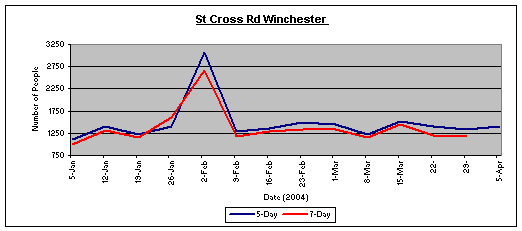
During 2003/04 the County Council entered into a partnership with the Winchester City Centre Partnership to develop a pilot project for a sensed data network for Winchester. This project allows footfall and other movements to be accurately measured in the City using a network of sensors and a direct computer link to correlate the data recorded. As well as providing detailed information on pedestrian movement it is also proving very useful data to assist the measurement of economic activity for the City Centre Partnership.
The pilot became active in February 2004 and data is now being regularly collected from four locations in Winchester. An example of the initial results is shown below.
This work is at a early stage but it is hoped that it could lead to a more robust method of assessing walking in future.
Travel Plans
Hampshire Targets
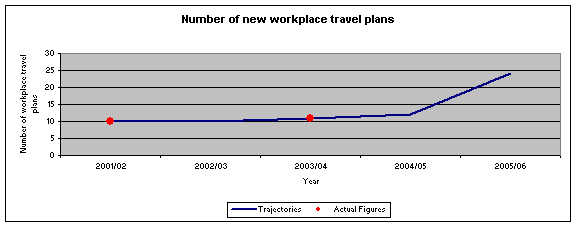
To encourage the development of workplace travel plans among all major businesses in Hampshire, with a target of 100 by 2005.
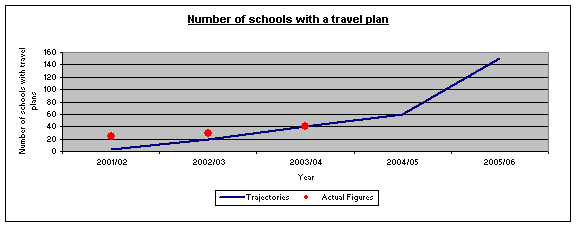
To encourage the development of travel plans amongst all schools in Hampshire, with a target of 150 schools to have a Travel Plan by 2005/06.
Overview of Progress
In relation to workplace travel plans there were 31 organisations, in total across the County that had approved Travel Plans at the end of 2003/04 which represents over 25,000 staff. The County Council approved 11 Travel Plans during 2003/04, with a further 75 organisations currently working towards Travel Plans.
The County Council anticipates exceeding its original target of 50 businesses to have travel plans by 2005/06. In 2002 the target was stretched to 100 businesses to have travel plans by 2005/06. While, based on current forecasts, it appears the latter target may not be met the County Council will, during 2004/05, be redeploying resources to bring things back on track. From 2003/04, a more strict definition of completed travel plan has been applied, this redefinition has affected the delivery total for 2003/04.
The delivery of 41 school travel plans in 2003/04 falls short of the forecast of 60 Travel Plans. However it should be noted that new Government funding for 2004/05 and 2005/06 has meant that a considerable time has been spent preparing for a new team to deliver school travel plans being appointed in May 2004. It is therefore anticipated that the County Council remain on track to achieving the target of 150 school travel plans by 2005/06, with the additional resources now available. Indeed it is intended that as part of the preparatory work for the second LTP the target for school travel plans will be reviewed in light of the increase in staff and resources and the greater ability to deliver school travel initiatives.
3.5 Air Quality
Introduction
Responsibility for local air quality falls mainly on the District Councils. However, the County Council has planning, transport, waste and other strategic responsibilities, which all have the potential to impact on air quality and the environment generally.
The Environment Act 1995 also gives the County Council a responsibility to make recommendations to District Councils with respect to carrying out air quality reviews, the assessment of air quality management areas and the preparation of air quality action plans or their revision.
Road transport is a major source of local air pollution, particularly in our towns and cities. In urban areas, road traffic accounts for a major part of the total emissions of nitrogen dioxide and particles (PM10) - the objectives for which are some of the most challenging to meet.
Various initiatives in the capital programme contribute to improving air quality but it was also considered important to assist district councils more directly in a range of air quality initiatives, which have been approved individually via the project appraisal process.
Hampshire County Council continues to support an increasingly comprehensive network of air quality monitoring and evaluating information throughout the County. LTP funding was allocated in 2003/04 towards web site information on air quality in Gosport and New Forest as well as monitoring equipment in Eastleigh and Petersfield. The dual aim being to increase the availability of information on air quality to the general public as well as improve the quality and range of data collected. As part of the MIRACLES project in Winchester emissions reductions from public transport are being addressed through the installation of new engines, exhaust catalysts and selective catalytic reduction systems; Winchester will potentially have the cleanest bus fleet in Europe.
Hampshire Targets
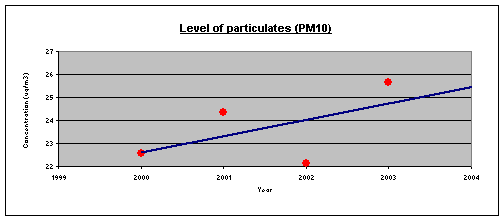
To not exceed 40 µg/m3 for the annual mean for the level of particulates by 2004.
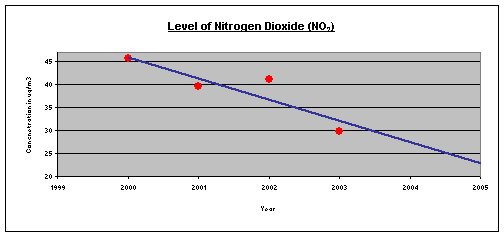
To not exceed 40 µg/m3 for the annual mean for the level of nitrogen dioxide by 2005.
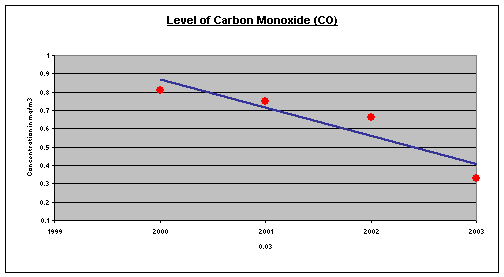
To not exceed a maximum of 10mg/m3 for the daily running 8 hour mean for the level of carbon monoxide by 2003.
Overview of Progress
The targets above are set in line with those contained in the National Air Quality Strategy (National Targets) and within Hampshire levels of pollutants recorded indicate that each of these will be met. The target for carbon monoxide has already been achieved and as yet no new national target has been established. It is intended that as part of the development of the air quality strategy for the second LTP, the appropriateness of the national targets for Hampshire will be reviewed, to establish if more local based targets should be set.
Hampshire has also been working in Partnership with the Highways Agency to investigate the establishment of real time air quality information to be displayed on the Variable Message Signs on the M3 and M27.
The size and diversity of Hampshire makes it difficult to accurately represent the monitoring data obtained from the district councils (who have overall responsibility for collecting this information) and hence establish a true average for the County. For example reported nitrogen dioxide (NO2) concentrations varied between 22.85 µg/m3 in Basingstoke to 43.9 µg/m3 in Winchester. However for 2003 data has been obtained from more district councils than previously (8 out of 11), which has helped to provide a reasonably accurate picture, by evening out the different levels of pollutants experienced.
This increase in the availability of data is welcome but does make comparison with figures reported in previous years particularly unreliable. Levels of Particulates (PM10) have risen by 3.5 µg/m3, levels of Nitrogen Dioxide (NO2) have dropped significantly by 11.28 µg/m3 to 29.79 µg/m3 and Carbon Monoxide (CO) levels have fallen 50% to 0.33mg/m3. However the key conclusion to be drawn is that for each of the three pollutants, the overall trend is well within the levels set by central Government.
3.6. Accessibility
Introduction
Hampshire County Council has developed initiatives to address accessibility issues for a number of years. These were initially concerned primarily with those with a mobility impairment but have been widened to focus on other issues including, tackling social deprivation in area of the County high on the Index of Multiple Deprivation and on improving access to rural bus services.
Hampshire County Council is now working on developing this approach further to include the ability of any individual to travel from one location to another to participate in a particular activity. The Authority has been closely involved with the DfT Working Group helping to develop both overall policy and guidance on accessibility planning. It has also been testing the new `Accession' model for the DfT that will be launched later in the year to assist local authorities in undertaking accessibility audits and developing accessibility strategies for their areas.
This experience will enable the County Council to develop a new approach to accessibility considering not only the transport network provide but also how it is able to access the key services that people require. The new techniques will shortly be available to assist preparation of the second LTP.
CPI Targets
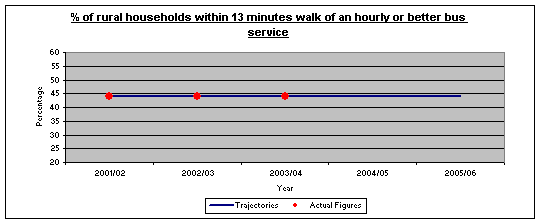
Maintain the percentage of rural households within 13 minutes walk of an hourly or better bus service at 2002 levels by 2005/06
Overview of Progress
There have been no significant changes to the level of provision of conventional bus services within rural areas of Hampshire and hence the percentage of rural households within 13 minutes walk of an hourly or better bus service is unchanged at 44% and hence remains on target. The accessibility figure has been recalculated to include the Cango, demand responsive bus services that represent the main thrust of the County Council's approach to further developing public transport in rural areas. Cango services result in an additional 8% of rural households having access to a regular bus service.
The new approach to accessibility planning highlighted in the introduction above, means that it is not considered appropriate to review the existing walking time based target. Instead new target and indicators will be developed in line with the new guidance to be issued on accessibility planning.
Maintaining sustainable bus services to provide an acceptable level of accessibility in deeper rural areas is a difficult challenge. Whilst there is no single solution the County Council has developed a detailed strategy for introducing flexible, demand-responsive services which integrate conventional, statutory and community services. The first Cango branded demand responsive services, which includes `roam zones' to provide greater penetration and improved accessibility were introduced in Test Valley following a successful bid to the Government's Rural Bus Challenge Fund in 2000.
The services have over 700 registered users and provide over 500 passenger trips per week - an increase of over 50% on the patronage of the conventional services which Cango replaced. Similar services have now been introduced in Lymington and Burghclere with more due to come on line in the coming year.
The performance of the different Cango services has in each case shown a significant growth from the previous baseline patronage, followed by a stabilisation at a higher figure, with a slow but steady growth thereafter.
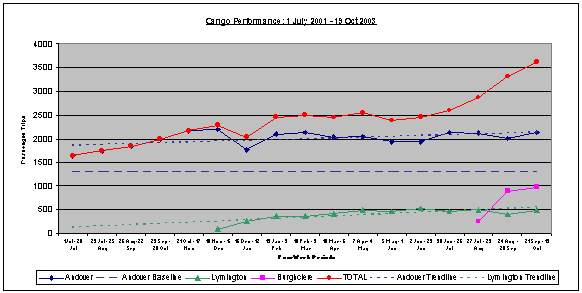 The results are shown in the following graph. Note that the underlying figures solely cover the public service element and exclude the carriage of children on school movements.
3.7. Road Maintenance
Introduction
As a result of Government initiatives in recent years Hampshire is required to measure and report on a number of highway condition performance targets. These are; the Government headline targets for 2004 and 2010, Best Value Performance Indicators (BVPIs) and Public Service Agreements (PSAs). In addition to this Hampshire has its own, local targets to maintain and improve highway condition.
All these condition measures are based on the condition surveys to comply with the annual BVPI requirements and any statistical analysis of these figures must be treated with some caution. It should be remembered that the rules for measuring and processing the data have changed repeatedly and a number of the surveys are cyclic whereby different areas of the network are surveyed each year. Direct annual comparisons may therefore not be representative until reliable trends have been clearly demonstrated.
Highway Condition Measurement and Targets
CPI Targets
Halt the deterioration in the condition of principal roads by 2004
Halt the deterioration in the condition of non-principal roads by 2004
Halt the deterioration in the condition of unclassified roads by 2004
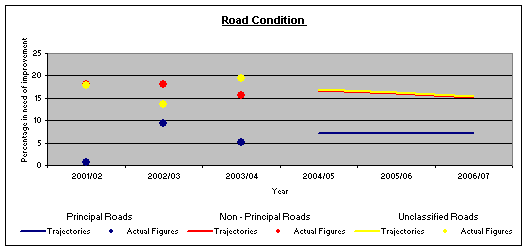
Note: The y-axis shows the percentage of different elements of the road network requiring improvement and hence the graph shows an overall improvement in the condition of roads. However, the surveys conducted each year are only carried out on a proportion of the road network in Hampshire and therefore the annual figures do not represent an estimate for the whole network. In relation to the principal road network, the figure for 2001/02 is included as required but it should be noted that prior to 2002/03 measurement of road condition were carried out on a different basis and therefore a direct comparison between the 2001/02 figure and those for subsequent years is not possible.
Overview of Progress
Hampshire County Councils assessment of the result is that the network is at or near a steady state condition. In recent years survey results from both deflectograph and coarse visual inspections (CVI) on principal roads show some consistency and comparability. There is an assumption that this network is at or about steady state within what can be regarded as accepted tolerances and that therefore the Government headline target for 2004 to halt the rate of deterioration has been achieved. It must be noted however that Hampshire is still concerned that damage caused by the extreme weather patterns such as the flooding in 2000 and the drought in 2002 may still have a detrimental effect on the network in years to come.
To comply with BVPI requirements Hampshire identify annual targets, these are based on local aims to maintain and slightly improve the network annually. The local targets are to maintain the condition of the principal road network at steady state and to improve the condition of the non principal road network by 5% annually i.e. for PI 97a - 5% of 18.09 = 0.9 new target therefore 17.19%. BVPI targets are adjusted annually to accommodate the latest condition data.
The Government headline target to eliminate the backlog of maintenance by 2010 remains a matter of concern and the County Council has not committed itself to this target. The maintenance backlog has as yet not been defined and it is unclear whether there is separation between carriageway and footway condition , and all other highway infrastructure. Hampshire estimate their overall backlog to be in excess of £300 million, with carriageway and footway backlog accounting for £190 million (based on CVI condition at BVPI interventions) of this deficit. These basic figures when compared to present funding levels identify a problem in achieving, or in fact making any measurable inroads into reducing this deficit. Despite the imbalance between funding and need Hampshire has provided an additional £3.5 million from local resources to supplement the capital budget and support Government's aspirations for highway maintenance during the last two years.
Hampshire have undertaken two MORI polls in the last five years, both of these polls identified the condition of urban footways and rural minor carriageways as areas for concern. Each year approximately £1 million has been allocated to rural carriageway structural maintenance and £2 million to urban footway resurfacing. By the end of this year over 400 additional structural maintenance schemes will have been completed. It may be many years before the analysis of condition surveys provides us with a definitive view of performance . It is known that the level of claims in recent years, with the exception of the floods, has remained constant and the maintenance `need', based on the schemes on our prioritised programmes, is not diminishing but this additional funding is a much needed boost to reducing the backlog of maintenance on the network in the years to come.
4 Local Transport Plan Funding
4.1 December 2002 Settlement
This was a particularly challenging year for transport funding. The December 2002 LTP settlement allocated £27.549 million for Hampshire County Council to spend in 2003/04. However, the settlement did not include a firm decision on whether the A3 bus priority major scheme would be funded by the Government.
This required the County Council to plan for two eventualities. If the A3 scheme was accepted for major scheme funding, the Council would be able to spend its full LTP allocation on other projects. If the A3 scheme was not accepted the Council would need to fund it from the LTP block allocation, and other schemes would have to be deferred. Until the decision was known, the Council had to retain the flexibility to accommodate either eventuality.
In October 2003, the Government announced its decision to fund the A3 scheme. Whilst this decision was certainly welcome, its timing considerably complicated the Council's budget management for 2003/04.
Against this background, Hampshire County Council's record of budget management is particularly noteworthy. The allocation was spent in full, with many projects seeing increases in funds compared with the plans outlined in the previous APR. The additional funding released by the A3 decision was concentrated on the County Council's priority areas where it has Public Service Agreement (PSA) targets. Increases were made in spending on highways maintenance and bridges (£1.5 million), casualty reduction (safety) and bus related investment (£0.5 million each). It was also possible to increase the safer routes to school and cycling programmes and to improve the monitoring regimes by investing in new equipment for counting traffic, cycle and pedestrian movements.
4.2 2003/04 outturn
Table S1 below compares the information prepared for the 2003 APR with the actual spending levels achieved in 2003/04.
Table S1 - LTP Spending 2003/04
Actual LTP blocks |
Actual A3 |
Total |
APR July 2003 forecast |
Difference from APR |
Difference from APR | ||
Allocation |
Integrated Transport |
£000's |
£000's |
£000's |
% | ||
Casualty Reduction |
2287 |
2287 |
1809 |
478 |
26.4 | ||
Safer Routes to Schools |
731 |
731 |
649 |
82 |
12.6 | ||
Bus |
2975 |
3614 |
6589 |
5954 |
635 |
10.7 | |
Interchange/Rail/Ferry |
2403 |
2403 |
2079 |
324 |
15.6 | ||
Cycle |
1186 |
1186 |
981 |
205 |
20.9 | ||
Pedestrians |
786 |
786 |
831 |
-45 |
-5.4 | ||
Traffic management |
2653 |
2653 |
3426 |
-773 |
-22.6 | ||
Junction/Road Improvements |
888 |
888 |
873 |
15 |
1.7 | ||
Monitoring/Initiatives |
250 |
250 |
185 |
65 |
35.1 | ||
14393 |
Integrated Transport |
14159 |
3614 |
17773 |
16787 |
986 |
5.9 |
13156 |
Maintenance & Bridges |
13390 |
13390 |
11656 |
1734 |
14.9 | |
27549 |
Total |
27549 |
31163 |
28443 |
2720 |
9.6 |
The APR forecasts included an assumption that late approval of the A3 Bus Corridor as a major scheme would allow expenditure to be increased above the £27.549 million approved in the December 2002 settlement letter. An estimated expenditure level of £28.423 million was included in the APR forecasts.
In the event, the acceleration achieved through investment in priority areas in the latter part of 2003/04 meant that there was total LTP spending (excluding SHRT) of £31.163 million using the whole of the £27.549 million from the block allocations and £3.614 million from the A3 major scheme allocation. £834,000 was spent on the MIRACLES/CIVITAS project.
Table S1 shows that Hampshire County Council used its LTP resources in full. Spending was increased in all areas, apart from minor decreases in pedestrian expenditure and traffic management schemes when compared with the forecasts in the 2003 APR. These decreases were largely due to the difficulties in managing a capital programme with the uncertainty of Government funding of the A3 scheme.
In two cases, Hampshire County Council's spending was more than 25% higher than its APR plans. The road safety programme was 26.4% over forecast. This was as a result of a deliberate decision to increase funding in order to maintain good progress against PSA targets for casualty reduction. Spending on LTP monitoring and related initiatives was increased by 35.1%, although this represented only an additional £65,000. This increase was due to increased investment in additional equipment for monitoring traffic, cycling and walking in preparation for the new LTP.
4.3 Overall Transport Spending 2003/04
Tables S2 and S3 below summarise the overall capital and revenue spending results for 2003/04.
Table S2 - Overall Capital Expenditure 2003/04
|
Spend |
Capital |
£ million |
LTP Block Allocation |
27.549 |
LTP Major Schemes |
4.917 |
Supplementary SCA (Detrunking A339) |
0.0567 |
Local Resources |
19.728 |
Developer contributions |
4.377 |
Total |
56.6277 |
Table S3 - Overall Transport Revenue Expenditure 2003/04
Area of Expenditure |
£000's |
Routine Highways Maintenance |
18,191 |
Winter Maintenance |
3,113 |
Road Safety Education |
220 |
School Crossing Patrols |
950 |
Traffic Surveys |
242 |
Parking Services |
-95 |
Public Transport |
5,404 |
Rural Bus Subsidy Grant |
1,335 |
Management and Support Services |
16,663 |
Total |
46,023 |
4.4 LTP Spending Programme 2004/05
December 2003 Settlement
The LTP block allocations announced for 2004/05 totalled £31.179 million comprising £15.783 million for integrated transport and £15.221 million for maintenance and bridges. The allocations are not ring-fenced.
The integrated transport allocation included `reward funding' of £1.763 million and £900,000 with respect to in the A27 corridor (Southampton to Fareham).
The maintenance and bridges allocation incorporated an additional £750,000 to reflect increased priority for maintenance and strengthening of bridges and carriageways on primary routes.
A supplementary bid of £175,000 was accepted with respect to maintenance of the A339 in 2004/05 following its detrunking. This was in addition to the £90,800 SCA carried forward from the 2-year 2003/04 award with respect to the A339 for both maintenance and safety improvements.
£7.5 million was allocated for the A3 bus priority corridor major scheme in 2004/05. No specific allocation was made for South Hampshire Rapid Transit (Fareham-Gosport - Portsmouth LRT) in the settlement letter.
In February the DfT announced a further £1million was being awarded to Hampshire for maintenance spending in 2004/05 because of clay shrinkage problems the previous summer.
The 2004/05 LTP spending plan (excluding major schemes and special maintenance SCA) is set out in Table S4.
Table S4 - Programmed LTP block allocation spending 2004/05
£000's | |
Casualty Reduction |
3109 |
Safer Routes to Schools |
1100 |
Bus |
1432 |
Interchange/Rail/Ferry |
318 |
Cycle |
1079 |
Pedestrians |
1140 |
Traffic management |
2823 |
Junction/Road Improvements |
1515 |
Monitoring/Initiatives |
210 |
Integrated Transport |
12726 |
Maintenance & Bridges |
19453 |
Total |
32179 |
The figures above include the allocation of £31.179 million as well as an extra £1 million awarded for clay shrinkage.
The programme in Table S4 shows a continued commitment to casualty reduction, safer routes to schools, buses, highways maintenance and bridges.
The `reward' funding is being used to supplement the casualty reduction and bus programmes as well as the enhanced maintenance and bridges spend.
The priority projects for the A27 corridor supplementary award are:
· the A27/ Botley Road North Bus Access road in Hedge End which allows a new bus link to be introduced between Hedge End and Southampton (a jointly funded Solent Transport project}
· pedestrian and cycle crossings of the A27 in the Segensworth area
· other improvements in the Whiteley/M27 Junction 9 designed to alleviate congestion in the M27/A27 corridor and encourage non-car use.
These A27 projects are being prepared during 2004/05 but much of the implementation will be in 2005/06. The County Council's 2005/06 programme is being adjusted to accommodate spending on these A27 projects.
4.5 Other Transport Expenditure 2004/05
Table S5 below summarises all forecast transport expenditure in 2004/05.
Table S5 -Overall Transport Expenditure 2004/05
|
£ million |
A3 Major Scheme |
7.500 |
SHRT (Fareham-Gosport-Portsmouth) |
7.562 |
Developer Funding |
6.000 |
Local Capital Resources (Maintenance & Bridges) |
11.776 |
Revenue expenditure |
48.200 |
LTP Block allocations (inc. clay shrinkage) |
32.179 |
Total |
113.217 |
5 Progress - Wider Context and additional Information
Introduction
This section covers important aspects of transport progress in Hampshire which are not covered in the spend, delivery and targets sections requested by the government. It looks at the wider issues of relationships with spatial strategies and joint working with other authorities and organisations as well as providing more details of initiatives and progress.
The section covers the following:
1. Regional and Sub-Regional spatial strategies and Regional Transport Strategy
2. Land Use and Transport Modelling
3. Solent Transport
4. Joint Working with Neighbouring Authorities and DfT
5. Quality Bus Partnerships
6. Marketing and Promotion
7. Travel Planning
8. Chandler's Ford Rail Station
9. MIRACLES (CIVITAS)
10. Bridges, Maintenance and Strengthening
11. Road Safety and Disadvantage (Required by APR Guidance)
5.1 Regional and Sub-Regional Spatial Strategies and Regional Transport Strategy
The County Council is working closely with other authorities and SEERA on the South East Plan, the new regional spatial strategy for the South East region which will set out the development framework for the region until 2026. The County Council is taking a lead role in the development of the South Hampshire sub-regional strategy and is also involved in the Western Corridor which includes much of the northern half of the County including Basingstoke and the Blackwater Valley Area.
The final version of the Regional Transport Strategy for the South East has recently been published. The County Council was represented at the examination in public in 2003/04 and will be incorporating the guidance in the next Local Transport Plan.
5.2 Land Use and Transport Modelling
The County Council is developing Land Use and Transport models to assist with work on the regional and sub-regional strategies and the Local Transport Plan which will need to reflect the South East Plan, sub-regional strategies and the Regional Transport Strategy. Initially priority will be given to the Solent Area and Basingstoke.
5.3 Solent Transport
The Solent Transport partnership, set up to develop an integrated and seamless transport system for south Hampshire, has continued to deliver a range of improvements designed to increase accessibility through greater transport choice.
One of the initiatives, to improve accessibility, is Solent Travelcard, which was launched by the Minister, Tony McNulty MP in March 2004. Solent Travelcard is a new travel ticket for South Hampshire, enabling travel on all bus operator's services without the financial penalty of paying subsequent fares. This commercial venture has been established through a management committee between the bus operators, which includes representation by Solent Transport.
The concept of the Travelcard developed as a direct result of the climate of cooperation engendered by Solent Transport, in this instance between the bus operators with the assistance and support of local authorities. The ticket has been widely promoted through leaflets, press ads, on-bus advertisement and the Solent Travelcard website (www.solent-travelcard.org.uk).
The management committee is keen to develop the Travelcard further in the future, to incorporate rail and ferry services onto the ticket, and to use Smartcard technology to improve ticket uptake and financial resettlement.
Local authorities working together with rail providers, have embarked on a major study to assess the feasibility of developing possible future light rail use in South Hampshire.
Further studies were commissioned by Solent Transport, including a study into the potential for providing a new ultra light rail system for the waterside town of Hythe, another into operational improvements for the intercity express coach service between Portsmouth and Southampton and cooperating with the Highways Agency in its Influencing Travel Behaviour project
5.4 Joint Working with Neighbouring Authorities and DfT
As well as working through Solent Transport the County Council, Portsmouth, Southampton and the Isle of Wight worked together during 2003/04 looking at potential stretch targets for the wider Solent area.
This exercise with the Department of Transport has proved useful both for the authorities and the DfT in increasing understanding of the inter-relationships within the area and the potential in working across boundaries, across modes and jointly with government agencies towards shared goals.
The County Council has also been heavily involved in CLAWGAP a combined central and local government working on Transport and Social Inclusion and specifically the introduction of Accessibility Planning into the LTP process.
Hampshire County Council also contributed to the work of the DfT's LTP indicators group during 2003/04.
The County Council will work with neighbouring authorities throughout 2004/05 in developing joint approaches to the next LTP. Planning for longer time horizons across the full range of topics affecting the people, economy and environment of Hampshire.
5.5 Quality Bus Partnerships
Quality partnerships continue to be a major feature in the County Council's approach to delivering improvements. This section lists some of the success stories.
The Quality Bus Partnership (QBP) which forms part of the MIRACLES European demonstration project in Winchester has benefited the bus network through substantial investment in state of the art bus stop information displays at every stop showing fares information for the first time, along with stop-specific timetables, route maps, associated publicity and press coverage. Stagecoach (with financial assistance from the County Council) has invested in new buses and has increased the frequency.
The service 21 QBP which operates between Havant and Portsmouth was signed in January 2004, is a joint initiative between the County Council, Stagecoach, Portsmouth City Council and Havant Borough Council. This follows the success of the service 23 QBP (a sister route) which has delivered a 30% increase in patronage since its launch in 2001. New vehicles have been purchased and the service has already seen two frequency enhancements during early 2004 and has so far seen a 11% rise in patronage. The success of the QBPs in the Havant area has lead to funds being allocated to the construction of a new bus station, which will further add to the attractiveness of bus travel in the area and provide the extra capacity required for the expanding network.
Substantial investment in the Basingstoke bus network has also delivered significant growth. The development of the Basingstoke QBP has implemented refurbished easy-access vehicles, frequency enhancements on core routes, new passenger waiting facilities at bus stops, electronic information screens at the recently completed Basingstoke bus station and major marketing efforts. The reward has been passenger growth of 23% on route 6 and 11% on route 1. Overall network growth in Basingstoke has been approximately 6%.
In the Blackwater Valley, the QBP for route 1 which links Aldershot with Farnborough and Camberley (in Surrey) has seen considerable improvements to punctuality and reliability in addition to impressive passenger growth. This QBP with Surrey County Council and Stagecoach has seen major investment in bus priority measures in Hampshire and Surrey, in addition to the introduction of refurbished easy-access vehicles, passenger waiting improvements and marketing efforts. Extensive customer research has indicated that reliability has improved with journey times being more predictable. Stagecoach report that journey times have reduced by approximately 8%, as a result of the bus priority measures. Stagecoach are now seeking to further increase the frequency to ten minutes. This success has spurred on further investment to develop an area wide QBP for the Blackwater Valley area, possibly the first QBP in the country to include three bus operators - First, Arriva and Stagecoach. Real time information and added infrastructure improvements are to be delivered in 2004/05.
5.6 Marketing and Promotion
The County Council has long recognised the fact that it is not possible to change travel behaviour by capital investment alone.
In 2004/05 it has set up a revenue budget of £200,000 for promotion of non-car transport. This new programme will complement it's info-motion project which is funded through its LPSA.
InfoMotion - direct marketing
 In September 2003 the County Council appointed leading specialist marketing company Socialdata, and their partners Sustrans, to carry out direct marketing of 116,000 households (23.3% of the County) residing along the catchment of the County's busiest bus routes. The project, branded `InfoMotion', is funded as part of the local PSA pump priming arrangements.
The project is scheduled to run until March 2005 and is being tackled in four waves:
Timescale |
Area |
No. of households |
Operators | |
1 |
Autumn 2003 |
Fareham/Gosport |
19,345 |
First |
2 |
Spring 2004 |
Basingstoke |
32,117 |
Stagecoach |
3 |
Summer 2004 |
Havant |
32,198 |
First & Stagecoach |
4 |
Autumn 2004 |
Rushmoor/Winchester/Eastleigh |
32,470 |
Solent Blue Line & Stagecoach |
During each wave all residents in the catchment area are contacted by post or telephone, segmented by current public transport use and level of interest, then offered a tailor-made bundle of relevant public transport information. Some non-users are also offered trial tickets.
The initiative has, importantly, been taken forward in partnership with three local bus operators. They have supplied significant volumes of printed material and staff time to prepare personal journey plans and meet potential public transport users through home visits.
Wave 1 in Fareham and Gosport has already seen excellent growth in passenger numbers. The marketing intervention took place in November 2004 and by April 2004 sustained passenger growth of 6% has been achieved.
Assuming similar growth across the remaining waves of the project it is anticipated that this project will deliver a 2% growth countywide, equivalent to 535,000 extra passenger journeys. It should be noted that surveys currently (June 2004) being undertaken will determine the impact this project has had on modal shift.
5.7 Travel Plans (School and Workplace)
2003/04 was the last year of the first bursaries for school and workplace travel plans. Hampshire benefited with £30,000 per year for each. 2004/05 sees Hampshire with £165,000 per year for school travel planning but without specific support for workplace travel planning.
The County Council is however maintaining a full time member of staff in workplace travel planning supplemented with help from its in house consultancy. A new team has been set up for school travel planning and is preparing for an accelerated programme this year. This new team includes a resource contribution in terms of staff from Winchester City Council.
New targets are being prepared for the next LTP covering outcomes in terms of changes in travel behaviour to cover both schools and workplaces in urban and rural locations and consideration is being given to joint targets with neighbouring authorities in the Solent area.
School Travel Plans
The first ever Hampshire Schools Hands Up Travel Survey was carried out in September 2003. 226 schools took part and results indicate that car travel to school in Hampshire is 44% which is higher than the national average of 32%.There are large variations between schools but many showed considerable potential (and willingness) towards switching to non-car modes.
The County Council also launched a website which provides a comprehensive resource for schools:
www.hants.gov.uk/schooltravelplans
Workplace Travel Plans
There are an increasing number of organisations who are developing Travel Plans on a voluntary basis because they recognise the range of benefits a Travel Plan can bring. As an example, Southampton International Airport (BAA) has recently submitted a draft Travel Plan which they undertook on a voluntary basis, to improve access for staff and passengers.
Another example of an organisation that the County Council has helped to develop a Travel Plan is B&Q Head Office in Chandler's Ford. As a result, the company has made a commitment to develop Travel Plans across all their stores in order to promote sustainable travel and become a better neighbour. Store Travel Plan Co-ordinators from around the country are involved in promoting a number of activities, primarily co-ordinated by the company's Head Office in Chandler's Ford. B&Q Travel Plan newsletters are also circulated throughout the UK, which stimulates and maintains interest.
The County Council has produced a working consultation draft Guide to Development Related Travel Plans for use by Development Control officers, developers and their agents to help inform the preparation of travel plans as part of the development process. It is initially intended as an advice document, with a view to it becoming formally adopted possibly as Supplementary Planning Guidance later in 2004/05. For the first time, approval has been granted for a 2004/05 Partnership Fund that will provide matched funding to organisations with Travel Plans for infrastructure measures to help take them forward.
The County Council also launched a comprehensive website that offers a range of resources to organisations:
www.hants.gov.uk/environment/workplacetravel
5.8 Chandler's Ford Railway Station
In May 2003, Chandler's Ford Rail Station was re-opened after 34 years, with a new station building and associated new rail services. The aim of the project was to provide attractive, sustainable transport opportunities for both commuting and leisure purposes, contributing to the economic development of the area. It aimed to encourage modal shift from the car in a dense urban area with a high current level of car usage. In addition to its principal function of enabling Chandler's Ford residents to travel to Eastleigh, Southampton and Romsey for work and leisure, the new service improves levels of social inclusion, particularly through extension to Totton, which enables areas of social deprivation and low car ownership to be connected to employment opportunities in Chandler's Ford. It also provides a direct service to Southampton Airport (Parkway) for workers and holidaymakers.
Hampshire County Council instigated and managed the project, provided the funding and is the owner of the station. This was a unusual partnership arrangement involving three different rail organisations under the overall leadership of the County Council. Close cooperation between the SRA, Network Rail and South West Trains meant that it was possible to introduce both a new service to Chandlers Ford and also new trains for local passengers in the Southampton/Eastleigh area in time for the summer 2003 timetable.
The success of the project was rewarded by being shortlisted in the National Transport Awards 2004.
5.9 MIRACLES
The four year sustainable transport project MIRACLES, part of the EU funded CIVITAS programme, reached its mid-point in February 2004. To date, the project has implemented a number of integrated demonstration measures in the city of Winchester, involving public transport, cleaner vehicles and cycling. Over the next two years, these pilot trials will be developed further and their impact on energy efficiency, air quality, modal shift and congestion evaluated.
5.10 Bridges Maintenance and Strengthening
Although not strictly required by APR guidance, inclusion of bridges information helps to provide a more complete picture of progress.
Table P1 - Financial Summary of Bridge Maintenance
Financial Summary |
2003/04 £ m |
2004/05 £ m |
2005/06 £ |
Structural maintenance (including painting) |
1.70 |
1.40 |
1.20 |
Assessments/design/feasibility |
0.12 |
0.20 |
0.30 |
Flood repairs |
0.27 |
- |
- |
Strengthenings and replacements |
1.81 |
2.00 |
1.70 |
Road / rail interfaces |
- |
0.30 |
0.90 |
Aluminium parapet replacement |
- |
1.20 |
- |
Totals |
3.90 |
5.10 |
4.10 |
-
Works carried out in 2003/04 included the completion of the strengthening of Langstone bridge; seven other strengthenings; completion of the flood remedials; the major concrete repairs to Bursledon bridge and structural maintenance, including painting.
Works proposed for 2004/05 are ten strengthenings; three bridge replacements; a
major concrete parapet renewal and continuing structural maintenance, including
painting.
Protective measures will be installed on the highest ranked road/rail interface,
St Cross Tunnel, Winchester.
All pre-1994 BACO aluminium parapets will be replaced or strengthened, using LTP funding transferred to Bridges from other capital budgets.
The outline programme for 2005/06 includes ten strengthenings/replacements; structural maintenance targeted at reducing the backlog and protective measures on the highest ranked road/rail interfaces.
Progress towards targets given in LTP (2001-2006)
Complete strengthening of bridges with temporary weight limits in two years.
100% completed early in 2004, i.e. within three years.
Complete strengthening of substandard carriageway bridge decks in five years.
96% of these decks will have been strengthened (123 No.) or made subject to permanent weight limits (20 No.) by the target date, the end of 2005/06. The remaining 4% (6 No.) will be included in the next LTP submission. Five of these are small spans and will be programmed for completion in 2006/07, whilst funding and construction of the one larger bridge will be phased over two financial years, 2006/07 and 2007/08.
Complete strengthening of substandard verge bridge decks in ten years.
Because funding has been concentrated on carriageway decks, these verge strengthenings have only been completed as part of other schemes or where there are short term safety implications. There are 26 No. verge decks outstanding and these will be included in the next LTP submission in order to meet the original ten year target.
Reduce the backlog of structural maintenance over five years.
Progress has been made in this area, with a rolling programme of structural painting and the use of stainless steel reinforcement, high specification waterproofing and galvanising, to reduce future maintenance liabilities.
However, over the five-year plan period, funds have been concentrated on strengthening and have also been diverted to unforeseen priority areas, such as road/rail interfaces and flood repairs. Therefore reduction of the maintenance backlog will have high priority in the next LTP submission.
The CSS' Bridge Condition Indicator, used by HCC for two years, together with other bridge performance indicators due to be introduced, will help monitor progress towards this target.
5.11 Road Safety and Disadvantage
The `Guidance on LTP Annual Progress Reports' requested an update on progress in tackling road safety and disadvantage. As reported in the 2003 APR, the County Council has researched the local linkages in Hampshire between vulnerable road user casualties, especially child casualties and the national Indices of Multiple Deprivation (IMD) as they apply to Hampshire wards.
There is one ward in Hampshire that features within the top 10% of such wards ranked by IMD nationally; that is Warren Park in Havant Borough. A further three wards, also in the adjacent Leigh Park area, are just outside the top 10% of wards nationally and together represent the highest four ranked wards in the County.
In this area, a pilot child pedestrian training programme following the national Kerbcraft model is being delivered in partnership with local infant and primary schools. The area is also continuing to benefit from the application of one of the country's most extensive fully engineered 20 mph zones, itself the subject of a published national Traffic Advisory Leaflet. This zone was introduced principally to reduce the high numbers of child casualties and is currently being reviewed, leading to a refurbishment programme commencing this year.
Over a number of years the County Council has directed its larger area-wide traffic calming programmes towards areas with higher than expected non-motorised road user casualties. This has been based upon research work the County Council commissioned in the early 1990's, which demonstrated a linkage between higher casualty rates among these groups and the larger, mostly post war, local authority constructed housing estates. The latest research from Government clearly demonstrates the national linkages between higher casualty likelihood, particularly among children and deprivation/social indices. This conclusion therefore appears to underpin the validity of those earlier County Council findings.
However, the County Council has liaised with other local highway authorities in the Government Office South East Region through the regional RCR2010 Group, with a view to improving understanding of the local linkages between child casualties and ward based data for indices of multiple deprivation. The evidence gathered in Hampshire indicates a very weak linkage overall between wards ranked by IMD and child casualty rates by unit population. Similar results are understood to exist for other south east highway authorities. At the present time therefore there appears to be a weak justification for planning future child casualty reduction programmes based principally upon linkages to indices of multiple deprivation.
The County Council has bid for each tranche of national pilot Child Pedestrian training schemes, where the County Council was successful in gaining funding for Leigh Park in the first round, but unsuccessful with Heron Wood (No. 5 in the County) in the second round and Alamein Ward, Andover (Test Valley), ranked sixth in Hampshire in the 2003 round. Each time, the numbers of child pedestrian casualties were low and with no strong pattern of occurrence.
The County Council's Corporate Strategy places a high priority on maximising life opportunities and building strong and safe communities. Our policies and programmes for road casualty reduction therefore directly contribute to those aims, which is why the County Council has set out a more demanding road casualty reduction target as part of its locally negotiated Public Service Agreement with the Government. These programmes are delivered in close partnership with a wide range of public and private sector partners and casualty reduction will be a strong theme in the development of Local Strategic Partnerships. These are already benefiting from the County Council's strong and well established working relationships with the health sector This relationship is being further developed with the new Hampshire and Isle of Wight Strategic Health Authority and the Hampshire Primary Care Trusts. In turn, the County Council, the Strategic Health Authority, the Hampshire Fire and Rescue Service and Hampshire Constabulary are all members of the Hampshire Strategic Casualty Reduction Partnership. The Partnership is already considering the results of some of the County Council's work looking at the linkages between casualties, casualty rates and indices of deprivation in exploring effective partnership programmes to tackle both road safety and quality of life improvements.
Road safety education and training programmes are also tackling disadvantaged areas by linking programme delivery to the action plans associated with Community Safety Strategies. Communities within the Leigh Park area of Havant Borough (the only Education Action Zone in Hampshire), New Forest and Test Valley districts are benefiting from these local road safety programmes. The results so far in terms of child casualties are showing encouraging reductions in the most serious casualties countywide against the target of a 50% reduction by 2010. By the close of 2003, a 40% reduction in KSI casualties had been achieved, thus well ahead of the target to 2010.
|
|
|
|
|
|
|
|
|
|
|
|
|
|
| ||||||
|
|
|
|
|
|
|
|
|
|
|
|
|
|
|
|
|
|
|
|
|
|
|
|
|
|
|
|
|
|
|
|
|
|
|
|
|
|
|
|
|
|
Core Indicator |
Definitions |
|
Year |
Value |
Year Type3 (Enter C for Calendar Year and F for Financial Year) |
Actual and Trajectory Data2 |
Is your LA on track to meet its target for this core indicator? |
Please indicate if your reported or target figures have changed since you previously reported. |
Please outline the methodology and source of data used to calculate your figures. Also include any other relevant information. | |||||||||||
Road Condition (% where structural maintenance should be considered)4 |
(1) principal roads - BV96 |
|
2001/02 |
0.6 |
F |
Year |
2000/01 |
2001/02 |
2002/03 |
2003/04 |
2004/05 |
2005/06 |
2006/07 |
2007/08 |
2008/09 |
2009/10 |
2010/11 |
Yes |
No |
Course Visual Inspection |
|
2003/04 |
5.09 |
|
Actual Figures |
|
0.60% |
9.38 |
5.09 |
|
|
|
|
|
|
|
| ||||
Units |
|
percentage |
|
Trajectories |
|
|
8.2 |
9.38 |
7.24% |
7.24 |
7.24 |
|
|
|
|
| ||||
(2) non-principal roads - BV97a |
|
2001/02 |
18.09 |
F |
Year |
2000/01 |
2001/02 |
2002/03 |
2003/04 |
2004/05 |
2005/06 |
2006/07 |
2007/08 |
2008/09 |
2009/10 |
2010/11 |
Yes |
No |
Course Visual Inspection | |
|
2003/04 |
15.52 |
|
Actual Figures |
|
18.09 |
18.09 |
15.52 |
|
|
|
|
|
|
|
| ||||
Units |
|
percentage |
|
Trajectories |
|
|
18.09 |
17.19 |
16.8 |
15.96 |
15.16 |
|
|
|
|
| ||||
(3) unclassified roads - BV97b |
|
2001/02 |
17.8 |
F |
Year |
2000/01 |
2001/02 |
2002/03 |
2003/04 |
2004/05 |
2005/06 |
2006/07 |
2007/08 |
2008/09 |
2009/10 |
2010/11 |
Yes |
No |
Course Visual Inspection | |
|
2003/04 |
19.52 |
|
Actual Figures |
|
17.8 |
13.66 |
19.52 |
|
|
|
|
|
|
|
| ||||
Units |
|
Percentage |
|
Trajectories |
|
|
17.8 |
16.9 |
16.99 |
16.19 |
15.39 |
|
|
|
|
| ||||
Number of bus passenger journeys5 |
Thousands of bus passenger journeys (i.e. boardings) per year in the authority - BV102 |
|
1999/2000 |
27.81 |
F |
Year |
2000/01 |
2001/02 |
2002/03 |
2003/04 |
2004/05 |
2005/06 |
2006/07 |
2007/08 |
2008/09 |
2009/10 |
2010/11 |
No Clear Evidence |
No |
Bus operators |
|
2009/10 |
30.59 |
|
Actual Figures |
28.12 |
27.75 |
27.22 |
26.68 |
|
|
|
|
|
|
|
| ||||
Units |
|
million |
|
Trajectories |
28.3 |
27.9 |
27.4 |
27 |
26.8 |
26.7 |
26.7 |
26.7 |
26.7 |
26.7 |
26.7 |
| ||||
Bus passenger satisfaction6 |
Percentage of bus users satisfied with local bus services - BV104u |
|
2000/01 |
45 |
F |
Year |
2000/01 |
2001/02 |
2002/03 |
2003/04 |
2004/05 |
2005/06 |
2006/07 |
2007/08 |
2008/09 |
2009/10 |
2010/11 |
Yes |
Target met and new target established for 2006/07 |
Public Survey (BVPI 104) |
|
2003/04 |
53 |
|
Actual Figures |
45 |
|
|
53 |
|
|
|
|
|
|
|
| ||||
Units |
|
percentage |
|
Trajectories |
|
|
|
50 |
|
|
56 |
|
|
|
|
| ||||
Appendix 1 - Progress against core indicators (Annexe A)
Number of cycling trips |
Number of cycling trips across the authority or number of cycling trips at a representative number of counting points (please state which) |
Base Data1 |
1999 |
100 |
C |
Year |
2000 |
2001 |
2002 |
2003 |
2004 |
2005 |
2006 |
2007 |
2008 |
2009 |
2010 |
No |
||
|
2010 |
400 |
|
Actual Figures |
94.5 |
88.5 |
89.3 |
85.6 |
|
|
|
|
|
|
|
|
No |
Hampshire County Council Casualty Statistics | ||
Units |
|
Index |
|
Trajectories |
95.8 |
91.8 |
88 |
84.6 |
82 |
80.8 |
82.6 |
86.2 |
90.4 |
94.8 |
99 |
|
||||
Number of deaths and serious injuries (all ages)7 |
Number of people killed or seriously injured on roads in the authority |
|
1994-98 |
1054 |
C |
Year |
2000 |
2001 |
2002 |
2003 |
2004 |
2005 |
2006 |
2007 |
2008 |
2009 |
2010 |
Yes |
No |
Data taken from Hampshire Constabulary Personal Injury Database |
|
2010 |
633 |
|
Actual Figures |
988 |
874 |
938 |
866 |
|
|
|
|
|
|
|
| ||||
Units |
|
People |
|
Trajectories |
1016 |
978 |
939 |
901 |
863 |
824 |
786 |
748 |
709 |
671 |
633 |
| ||||
Number of children killed and seriously injured7 |
Number of children (aged less than 16) killed or seriously injured in the authority |
|
1994-98 |
111 |
c |
Year |
2000 |
2001 |
2002 |
2003 |
2004 |
2005 |
2006 |
2007 |
2008 |
2009 |
2010 |
Yes |
No |
Data taken from Hampshire Constabulary Personal Injury Database |
|
2010 |
55 |
|
Actual Figures |
83 |
82 |
93 |
65 |
|
|
|
|
|
|
|
| ||||
Units |
|
People |
|
Trajectories |
106 |
101 |
96 |
90 |
85 |
80 |
75 |
70 |
65 |
60 |
55 |
| ||||
Light rail passenger journeys8 |
Thousands of light rail passengers per year |
|
|
|
|
Year |
|
|
|
|
|
|
|
|
|
|
|
|
|
|
|
|
|
|
Actual Figures |
|
|
|
|
|
|
|
|
|
|
|
| ||||
Units |
|
|
|
Trajectories |
|
|
|
|
|
|
|
|
|
|
|
| ||||
% of rural households within 13 minutes walk of an hourly or better bus service8 |
% of rural9 households within 13 minutes walk of an hourly or better bus service or % of rural9 households within 800 metres of an hourly or better bus service (please state which) |
|
2001/02 |
44 |
F |
Year |
2000/01 |
2001/02 |
2002/03 |
2003/04 |
2004/05 |
2005/06 |
2006/07 |
2007/08 |
2008/09 |
2009/10 |
2010/11 |
Yes |
No |
Use of ACCMAP Model and Hampshire County Council GIS Information |
|
2005/06 |
44 |
|
Actual Figures |
|
44 |
44 |
|
|
|
|
|
|
|
|
| ||||
Units |
|
percentage |
|
Trajectories |
|
|
44 |
44 |
44 |
44 |
|
|
|
|
|
|
Progress towards local targets (Annexe B) Appendix 2
|
|
|
|
Actual and Trajectory Data |
|
|
Which national PSA or 10 Year Plan Target does the Local Target/Outcome Link to? | |||||||||
Local Objectives contained in LTP |
Local Performance Indicators contained in LTP |
Local targets or outcomes contained in LTP |
Baseline Data |
2001/2 |
2002/3 |
2003/4 |
2004/5 |
2005/6 |
2006/7 |
2007/8 |
2008/9 |
2009/10 |
2010/11 |
On track/not on track? |
Source of Data | |
Reduce the rate of traffic growth |
Volume of traffic at permanent traffic count sites |
To halve the rate of forecast traffic growth between 1998 and 2020 from 41% to 21% |
No. of car journeys in 1998 (Index of 100) |
105.43 |
107.1 |
108.51 |
111.8 |
112.7 |
113.6 |
114.3 |
115 |
115.6 |
116.2 |
On target |
HCC Permanent traffic counts |
PSA 1 (Road) Shared Priority: Congestion |
To increase the use of public transport |
Number of bus passenger journeys per year |
To increase public transport patronage by 25% between 2000 and 2020 |
Passenger journeys in 1999/00: 27.81 million |
27.75 |
27.22 |
26.68 |
54.9 |
56.1 |
57.6 |
59 |
60.4 |
61.7 |
62.9 |
On target |
DfT survey of bus operators |
PSA 2 (Local Public Transport). Shared Priority: Congestion |
Number of rail passenger journeys per year |
Passenger journeys in 1999/00: 21.20 million |
22.25 |
23.07 |
25.28 |
Train Operating Companies | |||||||||||
Number of ferry passenger journeys per year |
Passenger journeys in 2000: 3.2 million |
3.93 |
3.90 |
3.95 |
Gosport & Hythe ferry operators | |||||||||||
Increase the level of walking |
Number of people walking |
To increase the number of walking trips in Hampshire by 25% by 2020 from a 1999 base |
Walking trips in 1999/00 (Index of 100) |
No data collected |
165 |
No data collected |
Trajectories to be recalculated from data collected as part of development of sensed data network |
No clear evidence |
HCC Cordon survey/ Sensed data network |
Shared Priority: Congestion | ||||||
Improve the Environment and Health |
Level of particulates (PM10) at selected sites |
To not exceed 40 µg/m3 for the annual mean for the level of particulates by 2004 |
22.55 ug/m3 (2000 level) |
24.33 µg/m3 |
22.15 µg/m3 |
25.65 µg/m3 |
25.5 µg/m3 |
|
On target |
HCC/District Air Quality monitoring stations |
PSA 4 (Air Quality). Shared Priority: Environmental Impacts including air quality | |||||
Level of nitrogen dioxide (NO2) at selected sites |
To not exceed 40 µg/m3 for the annual mean for the level of nitrogen dioxide by 2005 |
45.64 µg/m3 (2000 level) |
39.53 µg/m3 |
41.07 µg/m3 |
29.79 µg/m3 |
27.5 µg/m3 |
22.5 µg/m3 |
|
On target | |||||||
Level of carbon monoxide (CO) at selected sites |
To not exceed a maximum of 11.6 mg/m3 for the daily running 8 hour mean for the level of carbon monoxide by 2003 |
0.81 mg/m3 (2000 level) |
0.75 mg/m3 |
0.66 mg/m3 |
0.33 mg/m3 |
|
On target | |||||||||
Improve bus service punctuality |
95% of services operating within a window of 5 minutes late and 1 minute early |
To achieve 95% of services operating within a window of 5 minutes late and 1 minute early by 2010 |
Percentage of bus servics meeting target in 2001/02: 90.3% |
90.30 |
91.10 |
86.20 |
87 |
87 |
87 |
87 |
87 |
87 |
87 |
Not on target |
HCC Surveys |
PSA 2 (Local Public Transport). Shared Priority: Accessibility |
Travel Plans |
Number of workplace travel plans |
To encourage the development of workplace travel plans among all major business in Hampshire. With a target of 50, subsquently doubled to 100 by 2005 |
3 businesses (yr. 1998/99) |
10 |
90 |
11 |
12 |
24 |
|
On target |
HCC Workplace travel plan co-ordinator |
Shared Priority: Accessibility | ||||
Number of schools with a travel plan 7 |
To encourage the development of travel plans amongst all schools in Hampshire. With a target of 150 schools to have a Travel Plan by 2005 |
3 schools (yr. 1998/99) |
25 |
29 |
41 |
60 |
120 |
|
On target |
HCC School Travel Plan Coordinator |
Shared Priority: Accessibility | |||||
Reduce the number of road accidents |
Number of slight casualties |
10% reduction in the number of slight casualties to the average of the 1994-98 level by 2010 |
5832 in 1994-98 |
5555 |
5299 |
5118 |
5832 |
5832 |
5832 |
5832 |
5832 |
5832 |
5832 |
On target |
HCC Casualties Statistics |
PSA 3 (Road Accidents). Shared Priority: Road Safety |
Appendix 3
Report on Status of Targets and Indicators
Road Safety
40% reduction in the number of people killed or seriously injured to the average 1994-98 level by 2010 - on track
The above target is considered to be on track. Since this target was set in the late 1990s there has been an overall downward trend in the number of deaths and serious injuries, although the year on year figure have tended to fluctuate. It is anticipated that the road safety strategies and programmes will contribute to achieving this target by 2010.
50% reduction in the number of children killed or seriously injured to the average 1994-98 level by 2010 - on track
As with the target for deaths and serious injuries, there has been an overall downward trend in the number of children killed or seriously injured, since this target was set. Similarly it is anticipated that the road safety strategies and programmes, together with the safety education and training schemes that are running, will contribute to successfully achieving this target by 2010.
10% reduction in the number of slight casualties per 100 million vehicle kilometres to the average 1994-98 level by 2010 - on track
There has been a steady fall in the actual number of slight casualties since this target was set, whilst at the same time traffic growth has been experienced. Therefore when measuring casualties in terms of vehicle kilometres this target is well on track to be met and is supported by the various road safety programmes already in place.
Traffic Growth
To halve the rate of forecast traffic growth between 1998 and 2020 from 41% to 21% - on track
The overall level of traffic in Hampshire continues to increase, however the rate of growth continues to fall very slightly compared to previous years. The traffic growth target is a long term one and it is therefore it is still far too early in the process to draw any firm conclusions although if progress is maintained at the rate shown on the trajectory then the target will be met.
Public Transport
To increase public transport patronage by 25% between 2000 and 2020 - on track
Although levels of bus patronage continue to fall this has been more than offset by increases in the number of rail passengers, to the extent that progress towards meeting this target is ahead of the trajectory. The forward trajectory considers there will be a slowing in the rate of growth, particularly as certain parts of the rail network reach capacity, but nevertheless the overall target should still be met.
To increase bus use from 2000 levels by 10% by 2010 - not clear - over decline but increased patronage in Quality Bus Partnership and Infomotion areas (see section 3.4)
To reach a level of 50% of respondents satisfied with local bus services by 2003/04 - on track
The 2003/04 target was exceeded and therefore a new more stretching target has been set of 56% satisfaction with local bus services by 2006/07. It is considered that this new target will be achieved as the local authority will continue to invest in improvements to bus infrastructure and passenger facilities as well as developing further the existing marketing and promotion campaigns that have significantly raised public awareness.
To achieve 95% of bus services operating within a window of 5 minutes late and one minute early by 2010 - not on track
It has proved difficult to obtain reliable information on bus service punctuality. The surveys used to calculate this figure are a selection of bus services contracted out by the County Council and these in turn only represent 28% of total bus mileage. Furthermore the County Council only has limited influence on the operation of services and although investment will continue in a variety of bus priority measures that will help to improve punctuality, there remains a reasonable level of uncertainty as to whether this target will be met and consequently it has been categorised as not on track.
Cycling
To quadruple the number of cycling trips by 2010 from a 1996 base - not on track
The original trajectory associated with this target showed an initial decline in cycling usage followed by a marked increase. However the decline to date has been greater than predicted and the County Council now considers that the headline target is not going to be achieved and the trajectory has been amended to reflects this. The target will be reviewed as part of the preparation work associated with the second LTP.
Walking
To increase the number of walking trips in Hampshire by 25% by 2020 from a 1999 base - no clear evidence
The data previously used to report progress against this target was considered to be particularly unreliable and therefore a new monitoring regime has been established using a sensed data network. The target will be rebased to 2004 using this new data and a revised trajectory reported in the 2005 APR.
Travel Plans
To encourage the development of workplace travel plans among all major businesses in Hampshire, with a target of 100 by 2005. - on track
The original target of 50 businesses to have travel plans by 2005/06 has been stretched to 100. Although progress to date has been slightly below that anticipated additional resources are being deployed in 2004/05 to bring this target back on track.
To encourage the development of travel plans amongst all schools in Hampshire, with a target of 150 schools to have a Travel Plan by 2005/06 - on track

Progress in 2003/04 falls short of the predicted forecast. However considerable additional staff and resources are now in place to deliver an accelerated programme of school travel plans such that the Council remain on track to achieving the target of 150 school travel plans by 2005/06.
To not exceed 40 µg/m3 for the annual mean for the level of particulates by 2004 - on track
Although the level of particulates is increasing it remains well below the maximum acceptable level identified in this target. The data is collected from a number of sites within Hampshire and it is considered that with likely levels of future traffic the rate of increase will continue but will remain well within target.
To not exceed 40 µg/m3 for the annual mean for the level of nitrogen dioxide by 2005 - on track
Levels of nitrogen dioxide are showing a steady decline influenced both by the County Council's policies and improvements in engines and fuel. It is anticipated that this trend will continue.
To not exceed a maximum of 10µg/m3 for the daily running 8 hour mean for the level of carbon monoxide by 2003 - on track
This target reflects the national target for carbon monoxide and was met by the end of 2003. It is considered appropriate to reflect national policy in this area and to date no new national target has been set, other than to carry forward the existing one. The County Council therefore predicts a continued improvement in this area.
Accessibility
Maintain the percentage of rural households within 13 minutes walk of an hourly or better bus service at 2002 levels by 2005/06 - on track
This target is based on the levels of bus services in rural areas. The conventional bus network in this area is relatively stable with the County Council directing future investment in demand responsive `Cango' services. The level of provision has therefore remained constant for the past two years and it is predicted that this will remain for the time period covered by this target.
Road Maintenance
To halt the deterioration in the condition of principal roads by 2004 - on track
There is an assumption that this network is at or about steady state within what can be regarded as accepted tolerances and that therefore the Government headline target for 2004 to halt the rate of deterioration has been achieved. The 2002/03 & 2003/04 surveys were both carried out on a proportion of the road network in Hampshire and hence do not represent an estimate for the whole network, nevertheless the trajectory has been produced by projecting the average of these surveys forward.
To halt the deterioration in the condition of non-principal roads by 2004 - on track
As with the principal road network the non-principal road network is approaching steady state, there is however considered to be scope to improve upon this and meet the local target of improving the condition by 5% per annum. The trajectory is recalculated annually as an average of previous levels of deterioration recorded to reflect that the fact that the surveys are only carried out on a proportion of the road network each year.
To halt the deterioration in the condition of unclassified roads by 2004 - on track
There is an assumption that this network is at or about steady state within what can be regarded as accepted tolerances and that therefore the headline target for 2004 to halt the rate of deterioration has been achieved. The 2002/03 & 2003/04 surveys were both carried out on a proportion of the road network in Hampshire and hence do not represent an estimate for the whole network, nevertheless the trajectory has been produced by projecting the average of these surveys forward.
LOCAL TRANSPORT PLAN - CAPITAL PROGRAMME EXPENDITURE 200203 TO 200708 |
|
|
|
|
|
|
|
|
LTP-F1: Summary of actual, estimated outturn and projected local transport capital expenditure |
|
|
|
|
|
|
| |
Settlement Year: |
200506 | |||||||
|
||||||||
Authority Name: |
Hampshire |
|
|
|
|
Authority No: |
211 | |
Contact Name : |
Steve Jenkins |
Version No: |
1 | |||||
Telephone Number (with extension) : |
01962 846875 |
|||||||
All figures in £000 |
||||||||
200203 |
200304 |
200405 |
200506 |
200607 |
200708 |
|||
(LTP - F3) Maintenance of principal and non-principal highways (MM1, MM3, MM5) |
5,733 |
9,356 |
13,156 |
12,500 |
12,500 |
12,500 |
|
|
(LTP - F3) Maintenance, assessment, strengthening of bridges and other structures (MM7, MM8) |
3,282 |
4,043 |
5,297 |
3,500 |
3,500 |
3,500 |
|
|
(LTP - F3) Maintenance other (including street lighting) (MM9) |
0 |
0 |
0 |
0 |
0 |
0 |
|
|
(LTP - F2) Individual schemes costing £5 million or more |
1,366 |
4,969 |
15,101 |
6,600 |
7,386 |
0 |
|
|
(LTP - F3) Other Individual schemes costing less than £5 million or groups of related schemes (Block) |
21,924 |
14,207 |
13,745 |
15,804 |
15,610 |
15,610 |
|
|
Total |
32,305 |
32,575 |
47,299 |
38,404 |
38,996 |
31,610 |
|
|

Appendix 4
Finance Form F1
LOCAL TRANSPORT PLAN - CAPITAL PROGRAMME EXPENDITURE 200203 TO 200708 |
|
|
|
|
|
|
|
|
|||||||||||
LTP-F2: Actual, estimated outturn and projected local transport capital expenditure on individual schemes costing £5 million or more |
|
|
|
|
|||||||||||||||
Authority Name: |
Hampshire |
Authority No: |
211 |
||||||||||||||||
|
|
|
|
|
|
All figures in £000 |
|||||||||||||
Scheme Name |
Type |
DfT Ref/Pry |
Joint |
Start of Main Works |
End of Main Works |
Gross Total |
Net Total |
200203 |
200304 |
200405 |
200506 |
200607 |
200708 |
||||||
TOTAL LTPF2 - ALL PAGES |
|
|
|
|
|
115,545 |
113,056 |
1,366 |
4,969 |
15,101 |
6,600 |
7,386 |
0 |
||||||
BLACKWATER VALLEY ROUTE (NORTH) |
RD3 |
9176 |
|
01-Sep-89 |
01-Jul-94 |
58,063 |
56,328 |
2 |
0 |
33 |
0 |
0 |
0 |
||||||
TOTTON WESTERN BYPASS STAGE 3 |
RD1 |
9408 |
|
01-Nov-92 |
01-Jun-94 |
10,636 |
9,984 |
1 |
0 |
6 |
0 |
0 |
0 |
||||||
BENTLEY BYPASS |
RD1 |
9441 |
|
01-Sep-93 |
01-Aug-95 |
11,652 |
11,652 |
236 |
52 |
0 |
0 |
0 |
0 |
||||||
SHRT FAREHAM GOSPORT PORTSMOUTH (1) |
LR1 |
7695 |
|
01-Apr-05 |
31-Mar-08 |
9,992 |
9,992 |
1,127 |
1,303 |
7,562 |
0 |
0 |
0 |
||||||
INTEGRATED A3 BUS PRIORITY CORRIDOR |
BL1 |
10055 |
|
01-Apr-04 |
31-Mar-07 |
25,202 |
25,100 |
0 |
3,614 |
7,500 |
6,600 |
7,386 |
0 |
||||||
Appendix 4
Finance Form F2
LOCAL TRANSPORT PLAN - CAPITAL PROGRAMME EXPENDITURE 200203 TO 200708 |
|
|
|
|
|
|
|
|
|||||||||||
LTP-F2: Actual, estimated outturn and projected local transport capital expenditure on individual schemes costing £5 million or more |
|
|
|
|
|||||||||||||||
Authority Name: |
Hampshire |
Authority No: |
211 |
||||||||||||||||
|
|
|
|
|
|
All figures in £000 |
|||||||||||||
Scheme Name |
Type |
DfT Ref/Pry |
Joint |
Start of Main Works |
End of Main Works |
Gross Total |
Net Total |
200203 |
200304 |
200405 |
200506 |
200607 |
200708 |
||||||
TOTAL LTPF2 - ALL PAGES |
|
|
|
|
|
115,545 |
113,056 |
1,366 |
4,969 |
15,101 |
6,600 |
7,386 |
0 |
||||||
BLACKWATER VALLEY ROUTE (NORTH) |
RD3 |
9176 |
|
01-Sep-89 |
01-Jul-94 |
58,063 |
56,328 |
2 |
0 |
33 |
0 |
0 |
0 |
||||||
TOTTON WESTERN BYPASS STAGE 3 |
RD1 |
9408 |
|
01-Nov-92 |
01-Jun-94 |
10,636 |
9,984 |
1 |
0 |
6 |
0 |
0 |
0 |
||||||
BENTLEY BYPASS |
RD1 |
9441 |
|
01-Sep-93 |
01-Aug-95 |
11,652 |
11,652 |
236 |
52 |
0 |
0 |
0 |
0 |
||||||
SHRT FAREHAM GOSPORT PORTSMOUTH (1) |
LR1 |
7695 |
|
01-Apr-05 |
31-Mar-08 |
9,992 |
9,992 |
1,127 |
1,303 |
7,562 |
0 |
0 |
0 |
||||||
INTEGRATED A3 BUS PRIORITY CORRIDOR |
BL1 |
10055 |
|
01-Apr-04 |
31-Mar-07 |
25,202 |
25,100 |
0 |
3,614 |
7,500 |
6,600 |
7,386 |
0 |
||||||
Appendix 4
Finance Form F3
LOCAL TRANSPORT PLAN - CAPITAL PROGRAMME EXPENDITURE 200203 TO 200708 |
|
|
|
|
|||||
LTP-F3: Actual, estimated outturn and projected local transport capital expenditure on individual transport schemes costing less than £5 million and groups of related schemes | |||||||||
Authority Name: |
Hampshire |
Authority No: |
211 |
||||||
|
|
All figures in £000 | |||||||
Scheme Name |
Type |
Gross Total |
Net Total |
200203 |
200304 |
200405 |
200506 |
200607 |
200708 |
TOTAL LTPF3 - ALL PAGES |
|
318,585 |
228,290 |
30,939 |
27,606 |
32,198 |
31,804 |
31,610 |
31,610 |
CHTS ANDOVER RING ROAD DEMAND MANAGEMENT |
TM3 |
350 |
0 |
0 |
0 |
0 |
0 |
0 |
0 |
CHTS WEYHILL RD SALISBURY RD MILLWAY RD |
TM3 |
1,433 |
628 |
234 |
0 |
0 |
0 |
0 |
0 |
CHTS CHARLTON RD FOXCOTTE RD TRAFFIC MGT |
TM9 |
404 |
404 |
21 |
19 |
250 |
112 |
0 |
0 |
CHTS AREA BUS INFRASTRUCTURE IMPROVEMENTS |
BI3 |
150 |
150 |
0 |
0 |
75 |
75 |
0 |
0 |
CHTS AREA CYCLING & PEDESTRIAN SCHEMES |
CY1 |
802 |
587 |
163 |
96 |
116 |
100 |
0 |
0 |
CHTS AREA PEDESTRIAN SCHEMES |
WA1 |
360 |
360 |
251 |
0 |
2 |
0 |
0 |
0 |
CHTS AREA SAFE ROUTES TO SCHOOL |
LS1 |
160 |
160 |
38 |
66 |
0 |
0 |
0 |
0 |
CHTS AREA CORRIDORS DEMAND MGT |
TM3 |
322 |
232 |
27 |
74 |
106 |
1 |
0 |
0 |
CHTS AREA TOWN AND VILLAGE CENTRES |
WA6 |
428 |
426 |
53 |
82 |
96 |
55 |
60 |
60 |
CHTS A325 STRATEGY WHITEHILL AREA |
LS5 |
696 |
696 |
155 |
3 |
0 |
0 |
0 |
0 |
CHTS PETERSFIELD SCHEMES |
WA6 |
966 |
938 |
435 |
159 |
167 |
0 |
0 |
0 |
OTTERBOURNE VILLAGE TRAFFIC CALMING |
TM10 |
701 |
701 |
600 |
17 |
7 |
0 |
0 |
0 |
CHTS AREAS OF OUTSTANDING NATURAL BEAUTY |
TM3 |
18 |
18 |
18 |
0 |
0 |
0 |
0 |
0 |
CHTS AREA MODAL INTEGRATION |
IN6 |
60 |
60 |
32 |
0 |
0 |
0 |
0 |
0 |
CHTS AREA HEALTH AND ENVIRONMENT AND TAPESTRY |
OS1 |
122 |
93 |
30 |
13 |
0 |
0 |
0 |
0 |
CHTS AREA LOCAL ENVIRONMENTAL IMPROVEMENTS |
TM3 |
69 |
69 |
47 |
8 |
11 |
0 |
0 |
0 |
CHTS WOOLMER LINK ROAD |
RD9 |
3,024 |
3,006 |
7 |
0 |
0 |
0 |
0 |
0 |
CHTS ANDOVER TO SALISBURY BUS QUALITY PARTNERSHIP |
BI1 |
20 |
20 |
20 |
0 |
0 |
0 |
0 |
0 |
CHTS PARK AND RIDE AT BUSHFIELD |
PR1 |
55 |
55 |
29 |
0 |
5 |
0 |
0 |
0 |
CHTS CHESIL ST ENVIRONMENTAL TRAFFIC MANAGEMENT |
TM3 |
250 |
250 |
42 |
176 |
13 |
0 |
0 |
0 |
CHTS ROMSEY ROAD TRAFFIC MANAGEMENT |
RC1 |
215 |
204 |
113 |
19 |
53 |
0 |
0 |
0 |
CHTS JEWRY ST CITY RD TRAFFIC MANAGEMENT |
TM3 |
62 |
62 |
22 |
15 |
25 |
0 |
0 |
0 |
CHTS STOCKBRIDGE ROAD IMPROVEMENTS |
RD9 |
403 |
403 |
308 |
56 |
4 |
0 |
0 |
0 |
CHTS WINCHESTER CAR PARK IMPROVEMENTS |
OS1 |
113 |
113 |
107 |
0 |
0 |
0 |
0 |
0 |
CHTS WINCHESTER AIR QUALITY MONITORING |
OS1 |
39 |
39 |
29 |
9 |
0 |
0 |
0 |
0 |
CHTS WINCHESTER STATION INTERCHANGE |
BL7 |
997 |
947 |
869 |
41 |
8 |
0 |
0 |
0 |
CHTS EXTENSION TO PARK AND RIDE AT BAR END |
PR2 |
3,855 |
1,105 |
0 |
450 |
0 |
0 |
0 |
0 |
CHTS JEWRY ST ENVIRONMENTAL (PHASE 1) |
TM3 |
864 |
844 |
6 |
4 |
0 |
0 |
0 |
0 |
NFTS LYNDHURST HIGH STREET ENVIRONMENTAL |
LS1 |
1,061 |
1,061 |
26 |
0 |
1 |
0 |
0 |
0 |
NFTS AREA SAFER ROUTES TO SCHOOL |
CY1 |
92 |
92 |
67 |
25 |
0 |
0 |
0 |
0 |
NFTS AREA CYCLE PLAN |
CY7 |
17 |
17 |
1 |
1 |
15 |
0 |
0 |
0 |
NFTS RINGWOOD PEDESTRIAN AND CYCLE PROVISION |
WA1 |
716 |
666 |
5 |
9 |
250 |
400 |
0 |
0 |
NFTS A326/A35 COLBURY RIGHT TURN FACILITY |
RD11 |
977 |
977 |
88 |
226 |
606 |
0 |
0 |
0 |
NFTS FORDINGBRIDGE HIGH ST TRAFFIC CALMING |
TM9 |
193 |
178 |
37 |
95 |
29 |
0 |
0 |
0 |
NFTS B3055 SWAY AREA FOOTWAYS |
WA1 |
57 |
57 |
19 |
16 |
20 |
0 |
0 |
0 |
NFTS LYNDHIURST TO ASHURST CYCLE SCHEME |
CY1 |
235 |
235 |
42 |
18 |
30 |
145 |
0 |
0 |
NFTS CAR FREE TOURISM MEASURES |
OS1 |
20 |
20 |
0 |
0 |
20 |
0 |
0 |
0 |
NFTS BROCKENHURST VILLAGE IMPROVEMENTS |
TM3 |
101 |
101 |
72 |
2 |
0 |
0 |
0 |
0 |
NFTS RAILWAY STATION FACILITIES |
IN2 |
15 |
15 |
15 |
0 |
0 |
0 |
0 |
0 |
NFTS DECRIMINALISED PARKING |
OS1 |
144 |
144 |
0 |
0 |
24 |
120 |
0 |
0 |
NFTS NEW MILTON TOWN CENTRE SCHEMES |
TM2 |
417 |
349 |
142 |
95 |
41 |
46 |
0 |
0 |
NFTS SOUTHERN LYMINGTON AREA SCHEMES |
TM3 |
153 |
153 |
9 |
21 |
80 |
42 |
0 |
0 |
NFTS AREA CYCLE SCHEMES |
CY1 |
210 |
210 |
12 |
4 |
112 |
44 |
0 |
0 |
NFTS LYMINGTON SAFER ROUTES TO SCHOOL |
LS1 |
213 |
213 |
16 |
12 |
51 |
0 |
0 |
0 |
NFTS AREA BUS INFRASTRUCTURE IMPROVEMENTS |
BI4 |
100 |
100 |
0 |
0 |
65 |
35 |
0 |
0 |
NFTS TOWN & VILLAGE CENTRE IMPROVEMENTS |
TM3 |
8 |
8 |
8 |
0 |
0 |
0 |
0 |
0 |
NHTS BASINGSTOKE SOUTH WEST QUADRANT |
CY1 |
266 |
66 |
34 |
0 |
32 |
0 |
0 |
0 |
NHTS BASINGSTOKE NORTH WEST QUADRANT |
CY7 |
610 |
310 |
0 |
10 |
10 |
290 |
0 |
0 |
NHTS BASINGSTOKE TOWN & CENTRAL SCHEMES |
TM3 |
132 |
132 |
87 |
0 |
0 |
0 |
0 |
0 |
NHTS A30 BASINGSTOKE TO SOUTH WEST CORRIDOR |
TM3 |
924 |
674 |
437 |
103 |
41 |
0 |
0 |
0 |
NHTS A340 BASINSTOKE TO TADLEY |
TM3 |
634 |
134 |
51 |
20 |
40 |
0 |
0 |
0 |
NHTS B3400 BASINGSTOKE TO WHITCHURCH |
TM3 |
39 |
39 |
39 |
0 |
0 |
0 |
0 |
0 |
NHTS A33 BASINGSTOKE TO RISELEY |
TM3 |
3,981 |
2,431 |
230 |
28 |
386 |
1,450 |
200 |
0 |
NHTS NEW RAILWAY STATION AT CHINEHAM |
IN1 |
140 |
140 |
2 |
2 |
20 |
20 |
30 |
50 |
NHTS BASINGSTOKE INTELLIGENT TRANSPORT SYSTEMS |
TM2 |
788 |
301 |
125 |
116 |
59 |
0 |
0 |
0 |
NHTS AREA CYCLE SCHEMES |
CY1 |
128 |
128 |
19 |
1 |
0 |
0 |
0 |
0 |
NHTS AREA PEDESTRIAN SCHEMES |
WA1 |
53 |
53 |
44 |
0 |
0 |
0 |
0 |
0 |
NHTS BASINGSTOKE AREA SAFER ROUTES TO SCHOOL |
LS1 |
214 |
24 |
0 |
0 |
0 |
0 |
0 |
0 |
NHTS AREA RURAL SCHEMES |
TM10 |
180 |
137 |
0 |
11 |
39 |
0 |
0 |
0 |
NHTS BASINGSTOKE DECRIMINALISED PARKING |
OS1 |
75 |
75 |
75 |
0 |
0 |
0 |
0 |
0 |
NHTS BUS QUALITY PARTNERSHIPS |
BI1 |
907 |
407 |
7 |
1 |
140 |
258 |
0 |
0 |
NHTS A325/A30 CORRIDOR DEMAND MGT |
BL1 |
2,985 |
2,285 |
626 |
1,404 |
0 |
0 |
0 |
0 |
NHTS A323 CORRIDOR DEMAND MANAGEMENT |
TM3 |
247 |
247 |
17 |
3 |
100 |
125 |
0 |
0 |
NHTS ALDERSHOT TOWN CENTRE SCHEMES |
WA6 |
7 |
7 |
7 |
0 |
0 |
0 |
0 |
0 |
NHTS NORTH CAMP TOWN CENTRE SCHEMES |
RD5 |
192 |
192 |
24 |
13 |
71 |
78 |
0 |
0 |
NHTS FLEET TOWN CENTRE SCHEMES |
TM3 |
2,556 |
356 |
59 |
117 |
85 |
0 |
0 |
0 |
NHTS YATELEY TOWN CENTRE SCHEMES |
TM3 |
204 |
204 |
17 |
6 |
40 |
112 |
0 |
0 |
NHTS AREA MODAL INTEGRATION |
IN6 |
60 |
60 |
40 |
0 |
0 |
0 |
0 |
0 |
NHTS AREA CYCLE & PEDESTRIAN SCHEMES |
CY1 |
944 |
739 |
227 |
60 |
151 |
30 |
0 |
0 |
NHTS AREA HEALTH AND ENVIRONMENT |
OS1 |
50 |
50 |
50 |
0 |
0 |
0 |
0 |
0 |
NHTS AREA BUS INFRASTRUCTURE IMPROVEMENTS |
BI4 |
106 |
106 |
0 |
3 |
43 |
60 |
0 |
0 |
NHTS DECRIMINALISED CAR PARKING |
OS1 |
238 |
238 |
215 |
0 |
0 |
0 |
0 |
0 |
NHTS INTELLIGENT TRANSPORT SYSTEMS |
TM2 |
82 |
82 |
66 |
15 |
0 |
0 |
0 |
0 |
NHTS AREA SAFER ROUTES TO SCHOOL |
LS1 |
138 |
138 |
116 |
4 |
0 |
0 |
0 |
0 |
NHTS VILLAGE TRAFFIC MANAGEMENT |
TM3 |
337 |
337 |
16 |
27 |
115 |
59 |
60 |
60 |
DORCHESTER ARMS JUNCTION IMPROVEMENT |
RD11 |
357 |
301 |
216 |
3 |
0 |
0 |
0 |
0 |
STS EASTLEIGH DECRIMINALISED PARKING |
OS1 |
126 |
126 |
0 |
70 |
56 |
0 |
0 |
0 |
STS ROMSEY MOVEMENT AND ACCESS STRATEGY |
TM3 |
1,089 |
699 |
63 |
215 |
388 |
0 |
0 |
0 |
STS CENTRAL EASTLEIGH TRANSPORT PLAN |
TM3 |
132 |
132 |
67 |
7 |
52 |
0 |
0 |
0 |
STS NURSLING & ROWNHAMS TRAFFIC MGT |
TM9 |
54 |
54 |
9 |
10 |
33 |
0 |
0 |
0 |
STS TOTTON TOWN CENTRE ENHANCEMENT |
TM3 |
248 |
248 |
134 |
61 |
0 |
0 |
0 |
0 |
STS RUMBRIDGE STREET TOTTON |
WA6 |
701 |
701 |
0 |
1 |
50 |
650 |
0 |
0 |
STS A27 BOTLEY ROAD NORTH BUS ACCESS |
BL7 |
374 |
274 |
0 |
17 |
20 |
237 |
0 |
0 |
STS EASTLEIGH BUS QUALITY PARTNERSHIP |
BI1 |
641 |
521 |
183 |
47 |
177 |
97 |
0 |
0 |
STS HYTHE FERRY AND PIER IMPROVEMENTS |
IN6 |
471 |
471 |
146 |
177 |
140 |
0 |
0 |
0 |
STS SOUTHERN TEST VALLEY BUS QUALITY PARTNERSHIP |
BI1 |
210 |
210 |
46 |
12 |
90 |
60 |
0 |
0 |
STS EASTLEIGH BOROUGH CYCLE NETWORK |
CY1 |
745 |
95 |
73 |
0 |
19 |
0 |
0 |
0 |
STS TOTTON & WATERSIDE CYCLE NETWORK |
CY1 |
75 |
75 |
25 |
0 |
12 |
0 |
0 |
0 |
STS TEST VALLEY BOROUGH CYCLE NETWORK |
CY1 |
538 |
498 |
89 |
5 |
116 |
250 |
0 |
0 |
STS SCHOOL & BUSINESS TRANSPORT PLANS |
TP3 |
734 |
584 |
368 |
130 |
0 |
0 |
0 |
0 |
STS EASTLEIGH BUS STATION IMPROVEMENTS |
IN2 |
731 |
731 |
7 |
6 |
0 |
0 |
0 |
0 |
STS CHANDLERS FORD RAILWAY STATION |
IN1 |
3,100 |
2,500 |
218 |
2,172 |
0 |
0 |
0 |
0 |
STS CHANDLERS FORD PEDESTRIAN LINK |
WA5 |
200 |
200 |
0 |
200 |
0 |
0 |
0 |
0 |
STS A326/A35/A3024 BUS PRIORITY |
BL7 |
17 |
17 |
0 |
0 |
12 |
0 |
0 |
0 |
STS JACOBS GUTTER LANE MARCHWOOD |
RD11 |
1,160 |
250 |
152 |
98 |
0 |
0 |
0 |
0 |
BOTLEY BYPASS PREPARATION COSTS |
RD1 |
21 |
21 |
19 |
2 |
0 |
0 |
0 |
0 |
CHICKENHALL LANE LINK PREPARATION COSTS |
RD3 |
258 |
258 |
0 |
138 |
120 |
0 |
0 |
0 |
STS WINCHESTER RD CUPERNHAM LN ROMSEY |
RD11 |
125 |
25 |
0 |
0 |
25 |
0 |
0 |
0 |
STS AREA OTHER MINOR WORKS 200/01 AND BEFORE |
OS1 |
455 |
455 |
82 |
5 |
0 |
0 |
0 |
0 |
STS INTEGRATED A3 BUS PRIORITY CORRIDOR (1) |
BL1 |
3,720 |
3,720 |
3,203 |
0 |
0 |
0 |
0 |
0 |
STS INTEGRATED A3 BUS PRIORITY CORRIDOR (2) |
BL1 |
1,299 |
1,299 |
1,271 |
0 |
0 |
0 |
0 |
0 |
STS INTEGRATED A3 BUS PRIORITY CORRIDOR (PREP) |
BL1 |
230 |
230 |
113 |
0 |
0 |
0 |
0 |
0 |
STUBBINGTON BYPASS PREPARATION COSTS |
RD3 |
702 |
702 |
214 |
292 |
195 |
0 |
0 |
0 |
STS FAREHAM GOSPORT BUS QUALITY PARTNERSHIP |
BL7 |
328 |
178 |
66 |
55 |
25 |
0 |
0 |
0 |
STS FAREHAM GOSPORT NEWGATE LANE IMPROVEMENT |
RD9 |
57 |
57 |
49 |
2 |
0 |
0 |
0 |
0 |
STS BUS INFRASTRUCTURE IMPROVEMENTS |
BI4 |
150 |
150 |
0 |
0 |
50 |
100 |
0 |
0 |
STS A27 CORRIDOR BUS & CYCLE PRIORITIES |
BL7 |
967 |
967 |
97 |
682 |
79 |
0 |
0 |
0 |
STS HAVANT RAILWAY STATION |
IN2 |
40 |
40 |
40 |
0 |
0 |
0 |
0 |
0 |
STS CYCLE AND PEDESTRIAN NETWORKS |
CY1 |
832 |
832 |
213 |
243 |
127 |
200 |
0 |
0 |
STS FAREHAM RAILWAY STATION |
IN6 |
36 |
36 |
22 |
11 |
0 |
0 |
0 |
0 |
STS TOWN CENTRE SCHEMES |
TM3 |
684 |
595 |
148 |
125 |
153 |
157 |
0 |
0 |
STS GOSPORT BUS STATION |
IN2 |
237 |
237 |
128 |
12 |
50 |
47 |
0 |
0 |
STS FAREHAM BUS STATION |
IN2 |
176 |
176 |
118 |
58 |
0 |
0 |
0 |
0 |
STS HAVANT BUS STATION |
IN2 |
1,650 |
1,570 |
23 |
27 |
100 |
900 |
520 |
0 |
STS LEIGH PARK HAVANT PORTSMOUTH BUS INFRASTRUCTURE |
BI1 |
199 |
199 |
140 |
5 |
0 |
0 |
0 |
0 |
STS FAREHAM WW WESTERN DISTRIBUTOR RD (4B) |
RD3 |
1,492 |
1,117 |
0 |
4 |
57 |
856 |
200 |
0 |
STS LEE TO BROWNDOWN CYCLE ROUTE NCN |
CY1 |
258 |
258 |
252 |
0 |
4 |
0 |
0 |
0 |
STS STOKES BAY GOSPORT CYCLE ROUTE NCN |
CY1 |
33 |
33 |
0 |
0 |
33 |
0 |
0 |
0 |
STS HAVANT BUS QUALITY PARTNERSHIP |
BI1 |
201 |
201 |
0 |
2 |
50 |
149 |
0 |
0 |
STS A27 PARK GATE EASTERN LINK |
RD3 |
200 |
200 |
116 |
2 |
14 |
0 |
0 |
0 |
STS A27 BROADMARSH STRATEGY |
RD5 |
116 |
116 |
105 |
7 |
0 |
0 |
0 |
0 |
STS HAVANT DECRIMINALISED PARKING |
OS1 |
100 |
100 |
0 |
1 |
30 |
69 |
0 |
0 |
STS YEW TREE DRIVE WHITELEY BUS LINK |
BI4 |
401 |
151 |
0 |
1 |
0 |
100 |
50 |
0 |
STS WHITELEY BUS SHELTERS |
BI1 |
102 |
93 |
0 |
93 |
0 |
0 |
0 |
0 |
STS LEE ON THE SOLENT PEDESTRIAN AND BUS FACILITIES |
WA6 |
145 |
145 |
42 |
0 |
21 |
82 |
0 |
0 |
STS A27 CORRIDOR FAREHAM |
TM3 |
400 |
400 |
0 |
0 |
120 |
280 |
0 |
0 |
STS AREA VILLAGE CENTRES |
TM10 |
335 |
335 |
0 |
0 |
168 |
167 |
0 |
0 |
STS HAVANT PEDESTRIANS AND BUSES |
WA6 |
15 |
15 |
0 |
0 |
15 |
0 |
0 |
0 |
STS FAREHAM DECRIMINALISED PARKING |
OS1 |
10 |
10 |
0 |
0 |
10 |
0 |
0 |
0 |
A31 WINCHESTER TO SURREY SAFETY FENCING |
LS5 |
201 |
201 |
177 |
24 |
0 |
0 |
0 |
0 |
A30 SOUTHWOOD CORNER DUMMER |
LS5 |
318 |
318 |
3 |
261 |
54 |
0 |
0 |
0 |
HIGH STREET LYMINGTON |
LS5 |
76 |
76 |
2 |
9 |
65 |
0 |
0 |
0 |
LOW COST REMEDIAL PROGRAMME FROM 2001/02 |
LS5 |
9,391 |
9,391 |
1,060 |
1,653 |
1,098 |
1,500 |
1,600 |
1,600 |
A27 GYRATORY EAST OF TITCHFIELD |
LS5 |
336 |
336 |
0 |
3 |
0 |
0 |
0 |
0 |
MAIN PROGRAMME SINGLE SAFETY SCHEMES |
LS5 |
5,972 |
5,972 |
1 |
4 |
1,650 |
1,066 |
1,200 |
1,300 |
ROUTE STRATEGY CASUALTY REDUCTION PROGRAMME |
LS5 |
41 |
41 |
3 |
6 |
0 |
0 |
0 |
0 |
SAFETY SITE REFURBISHMENT |
LS5 |
666 |
666 |
208 |
27 |
100 |
100 |
100 |
100 |
B3058 BASHLEY CROSSROADS |
RD11 |
287 |
287 |
192 |
28 |
3 |
0 |
0 |
0 |
LOWER FARNHAM ROAD |
TM3 |
200 |
200 |
90 |
0 |
0 |
0 |
0 |
0 |
B2177/B3354 FISHERS POND JUNCTION |
LS5 |
518 |
518 |
110 |
266 |
139 |
0 |
0 |
0 |
A339 DETRUNKING SAFETY SCHEMES |
LS5 |
75 |
75 |
0 |
56 |
19 |
0 |
0 |
0 |
COMMUNITY SAFETY INITIATIVE |
LS4 |
384 |
384 |
81 |
32 |
60 |
60 |
60 |
60 |
PEDESTRIAN CROSSINGS |
RC1 |
1,885 |
1,885 |
378 |
190 |
282 |
300 |
300 |
300 |
MINOR WORKS |
OS1 |
1,765 |
1,765 |
275 |
154 |
265 |
250 |
250 |
250 |
CENTRAL INTELLIGENT TRANSPORT SYSTEMS / RTI2000 |
TM1 |
1,884 |
1,884 |
535 |
334 |
271 |
200 |
200 |
200 |
SAFER ROUTES TO SCHOOL |
TP3 |
6,501 |
6,501 |
70 |
492 |
1,049 |
1,250 |
1,500 |
1,800 |
PASSENGER TRANSPORT INFORMATION |
IN7 |
1,038 |
1,038 |
215 |
142 |
160 |
130 |
130 |
130 |
RURAL PARTNERSHIP |
TM10 |
1,043 |
1,043 |
155 |
185 |
106 |
200 |
200 |
100 |
CHARGING DEVELOPMENT PARTNERSHIP |
OS1 |
301 |
301 |
4 |
1 |
0 |
0 |
0 |
0 |
LTP MONITORING / INITIATIVES |
OS1 |
744 |
744 |
0 |
134 |
160 |
150 |
150 |
150 |
MIRACLES PROJECT WINCHESTER |
OS1 |
1,220 |
1,220 |
240 |
834 |
146 |
0 |
0 |
0 |
RECREATIONAL CYCLING |
CY7 |
401 |
401 |
0 |
61 |
100 |
40 |
100 |
100 |
COMMUNITY TRANSPORT SCHEMES |
OS1 |
2,626 |
2,626 |
281 |
295 |
350 |
400 |
650 |
650 |
REMOTE MONITORING |
OS1 |
185 |
185 |
129 |
53 |
0 |
0 |
0 |
0 |
AIR QUALITY AND NOISE MONITORING |
OS1 |
269 |
269 |
15 |
54 |
50 |
50 |
50 |
50 |
HOME ZONES / COMMUNITY STRATEGIES |
TM4 |
959 |
359 |
47 |
112 |
200 |
0 |
0 |
0 |
TEST VALLEY BOROUGH COUCIL DECRIMINALISED PARKING |
OS1 |
70 |
70 |
50 |
20 |
0 |
0 |
0 |
0 |
RAIL STATIONS AND INTERCHANGES |
IN2 |
569 |
569 |
69 |
0 |
150 |
150 |
100 |
100 |
AREA STRATEGY SCHEMES BUS |
BI4 |
4,000 |
4,000 |
0 |
0 |
0 |
400 |
1,800 |
1,800 |
AREA STRATEGY SCHEMES CYCLES |
CY7 |
2,000 |
2,000 |
0 |
0 |
0 |
200 |
900 |
900 |
AREA STRATEGY SCHEMES INTERCHANGES |
IN6 |
850 |
850 |
0 |
0 |
0 |
0 |
500 |
350 |
AREA STRATEGY SCHEMES IMPROVEMENTS |
RD12 |
2,000 |
2,000 |
0 |
0 |
0 |
0 |
1,000 |
1,000 |
AREA STRATEGY SCHEMES PEDESTRIANS |
WA6 |
2,200 |
2,200 |
0 |
0 |
0 |
200 |
1,000 |
1,000 |
AREA STRATEGY SCHEMES TRAFFIC MGT |
TM3 |
5,215 |
5,215 |
8 |
4 |
3 |
600 |
2,100 |
2,500 |
FUTURE SCHEMES INCLUDING MAJORS |
RD12 |
2,100 |
2,100 |
0 |
0 |
0 |
500 |
600 |
1,000 |
MAINTENANCE OF PRINCIPAL ROADS |
MM3 |
49,625 |
49,625 |
5,630 |
5,422 |
4,818 |
7,000 |
7,000 |
7,000 |
MAINTENANCE OF NON PRINCIPAL ROADS |
MM3 |
110,150 |
36,150 |
103 |
3,934 |
8,338 |
5,500 |
5,500 |
5,500 |
MAINTENANCE STRENGTHENING & ASSESSMENT OF BRIDGES |
MM7 |
27,908 |
27,908 |
3,282 |
4,043 |
5,297 |
3,500 |
3,500 |
3,500 |
REPAIRS TO FLOOD DAMAGED ROADS & STRUCTURES |
OS1 |
5,051 |
5,051 |
2,424 |
0 |
0 |
0 |
0 |
0 |
REPAIRS TO DROUGHT DAMAGED ROADS & STRUCTURES |
OS1 |
1,000 |
1,000 |
0 |
0 |
1,000 |
0 |
0 |
0 |
Appendix 4
Finance Form F4
LOCAL TRANSPORT PLAN - CAPITAL PROGRAMME EXPENDITURE 200203 TO 200708 |
|
|
|
|
|
| |||
LTP-F4: Actual and proposed use of LTP Integrated Transport block and maintenance funding (for actual and indicative allocations respectively) |
|
| |||||||
Authority Name: |
Hampshire County Council |
|
|
|
|
|
Authority No: |
211 | |
General points: |
|||||||||
1. Unless indicated otherwise, codes include new schemes and improvements or extensions to existing schemes; |
|||||||||
2. For distances, use whole numbers only - round up to the nearest kilometre or metre. |
|||||||||
3. Authorities should give complete data for all the years in accordance with the Technical Guidance. | |||||||||
Scheme Type |
|
Code |
Unit of Data |
200203 |
200304 |
200405 |
200506 |
200607 |
200708 |
Bus priority schemes (excluding signalling) |
|
|
|
|
|
|
|
|
|
quality bus corridor / showcase route schemes |
|
BL1 |
number |
2 |
5 |
7 |
4 |
4 |
5 |
|
|
BL2 |
km |
19 |
27 |
18 |
20 |
20 |
20 |
busways / bus lanes |
|
BL3 |
number |
3 |
2 |
4 |
5 |
1 |
3 |
|
|
BL4 |
km |
1 |
3 |
2.8 |
3 |
1 |
1 |
high occupancy vehicle (HOV) lanes |
|
BL5 |
number |
0 |
0 |
0 |
0 |
0 |
0 |
|
|
BL6 |
km |
0 |
0 |
0 |
0 |
0 |
0 |
other bus priority schemes |
|
BL7 |
number |
2 |
2 |
7 |
3 |
4 |
4 |
|
|
|
|
|
|
|
|
|
|
Guided Bus Schemes |
|
|
|
|
|
|
|
|
|
new guided bus scheme |
|
BG1 |
number |
0 |
0 |
0 |
0 |
0 |
0 |
|
|
BG2 |
km |
0 |
0 |
0 |
0 |
0 |
0 |
Bus Infrastructure Schemes (excluding interchanges) |
|
|
|
|
|
|
|
|
|
new bus stop |
|
BI1 |
number |
42 |
6 |
2 |
2 |
2 |
2 |
bus stops with travel information displays |
|
BI2 |
number |
0 |
0 |
94 |
25 |
25 |
25 |
improvements to existing bus stops |
|
BI3 |
number |
110 |
132 |
252 |
95 |
100 |
100 |
other bus infrastructure scheme |
|
BI4 |
number |
2 |
1 |
0 |
0 |
1 |
1 |
|
|
|
|
|
|
|
|
|
|
light rail (including tram and other rapid transit systems; excluding interchanges) |
|
|
|
|
|
|
|
|
|
new light rail line (excluding line extensions) |
|
LR1 |
number |
0 |
0 |
0 |
0 |
0 |
0 |
|
|
LR2 |
km |
0 |
0 |
0 |
0 |
0 |
0 |
light rail line improvements (including track dualling and line extensions) |
|
LR3 |
number |
0 |
0 |
0 |
0 |
0 |
0 |
|
|
LR4 |
km |
0 |
0 |
0 |
0 |
0 |
0 |
additional capacity (vehicles) |
|
LR5 |
number |
0 |
0 |
0 |
0 |
0 |
0 |
other light rail schemes |
|
LR6 |
number |
0 |
0 |
0 |
0 |
0 |
0 |
|
|
|
|
|
|
|
|
|
|
Public Transport Interchanges |
|
|
|
|
|
|
|
|
|
single mode interchanges |
(new) |
IN1 |
number |
1 |
1 |
0 |
0 |
0 |
0 |
|
(improvement) |
IN2 |
number |
16 |
7 |
6 |
1 |
2 |
2 |
public transport interchanges at airports |
(new) |
IN3 |
number |
0 |
0 |
0 |
0 |
0 |
0 |
|
(improvement) |
IN4 |
number |
1 |
0 |
0 |
0 |
0 |
0 |
multi-modal interchanges |
(new) |
IN5 |
number |
0 |
0 |
0 |
1 |
0 |
0 |
|
(improvement) |
IN6 |
number |
5 |
1 |
30 |
30 |
15 |
15 |
new dynamic information systems at interchanges |
|
IN7 |
number |
1 |
3 |
8 |
2 |
2 |
1 |
Park and Ride |
|
|
|
|
|
|
|
|
|
park and ride (bus/road related) : |
new schemes |
PR1 |
number |
0 |
0 |
0 |
0 |
0 |
1 |
|
extensions to existing schemes |
PR2 |
number |
0 |
1 |
0 |
0 |
0 |
0 |
park and ride (rail-related) : |
new schemes |
PR3 |
number |
0 |
0 |
0 |
0 |
0 |
0 |
|
extensions to existing schemes |
PR4 |
number |
4 |
0 |
0 |
0 |
0 |
0 |
|
|
|
|
|
|
|
|
|
|
Cycling schemes |
|
|
|
|
|
|
|
|
|
cycle tracks |
|
CY1 |
number |
15 |
7 |
4 |
10 |
10 |
10 |
|
|
CY2 |
km |
14 |
6 |
9 |
8 |
8 |
8 |
cycle lanes |
|
CY3 |
number |
3 |
5 |
2 |
4 |
4 |
4 |
|
|
CY4 |
km |
2 |
1 |
1 |
1 |
1 |
1 |
new advanced stop lines |
|
CY5 |
number |
1 |
2 |
0 |
4 |
4 |
4 |
new cycle parking facilities |
|
CY6 |
number |
17 |
1 |
1 |
5 |
5 |
5 |
other cycling schemes |
|
CY7 |
number |
9 |
7 |
6 |
8 |
8 |
8 |
|
|
|
|
|
|
|
|
|
|
Walking schemes |
|
|
|
|
|
|
|
|
|
new or improved footways |
|
WA1 |
number |
10 |
13 |
12 |
15 |
15 |
15 |
|
|
WA2 |
metres |
825 |
1647 |
1500 |
1500 |
1500 |
1500 |
pedestrianisation |
|
WA3 |
number |
0 |
0 |
0 |
0 |
0 |
0 |
|
|
WA4 |
metres |
0 |
0 |
0 |
0 |
0 |
0 |
new or improved pedestrian/cycle bridge |
|
WA5 |
number |
0 |
2 |
5 |
0 |
1 |
1 |
other walking schemes |
|
WA6 |
number |
5 |
2 |
2 |
3 |
3 |
3 |
Travel Plans |
|
|
|
|
|
|
|
|
|
local highway authority site travel plans |
|
TP1 |
number |
0 |
0 |
0 |
1 |
0 |
0 |
shire district travel plans |
|
TP2 |
number |
6 |
1 |
1 |
0 |
2 |
2 |
school travel plans |
|
TP3 |
number |
28 |
41 |
60 |
120 |
60 |
60 |
further/higher education establishment travel plans |
|
TP4 |
number |
0 |
2 |
2 |
0 |
1 |
1 |
hospital travel plans |
|
TP5 |
number |
3 |
1 |
1 |
1 |
2 |
2 |
employer travel plans |
|
TP6 |
number |
78 |
9 |
8 |
22 |
25 |
25 |
|
|
|
|
|
|
|
|
|
|
Local Safety Schemes |
|
|
|
|
|
|
|
|
|
schools implementing first safe routes scheme |
|
LS1 |
number |
23 |
24 |
43 |
45 |
45 |
45 |
other sites implementing first 'safe routes' scheme |
|
LS2 |
number |
0 |
1 |
1 |
1 |
1 |
1 |
schemes which include new CCTV cameras |
|
LS3 |
number |
2 |
0 |
2 |
1 |
1 |
1 |
schemes which include new street lighting |
|
LS4 |
number |
2 |
1 |
0 |
1 |
1 |
1 |
other safety schemes |
|
LS5 |
number |
76 |
167 |
230 |
190 |
190 |
190 |
|
|
|
|
|
|
|
|
|
|
Road crossings |
|
|
|
|
|
|
|
|
|
toucan or puffin crossings |
|
RC1 |
number |
11 |
20 |
13 |
13 |
10 |
10 |
other signalled crossings |
|
RC2 |
number |
10 |
6 |
4 |
2 |
2 |
2 |
other unsignalled crossings |
|
RC3 |
number |
47 |
200 |
175 |
175 |
175 |
175 |
underpass replacement |
|
RC4 |
number |
0 |
0 |
0 |
0 |
0 |
0 |
Traffic Management and Traffic Calming (excluding CCTV cameras) |
|
|
|
|
|
|
|
|
|
Urban Traffic Control (instations) |
|
TM1 |
number |
0 |
5 |
2 |
0 |
0 |
0 |
signalling/signal upgrading (outstations) |
|
TM2 |
number |
7 |
8 |
11 |
8 |
8 |
8 |
other traffic management schemes |
|
TM3 |
number |
36 |
17 |
19 |
20 |
20 |
20 |
home zones |
|
TM4 |
number |
0 |
0 |
1 |
0 |
0 |
0 |
quiet lanes |
|
TM5 |
number |
0 |
0 |
0 |
0 |
0 |
0 |
clear zones / low-emission zones |
|
TM6 |
number |
0 |
1 |
0 |
0 |
0 |
0 |
Urban 20mph zones |
|
TM7 |
number |
1 |
6 |
1 |
3 |
6 |
6 |
Rural 20mph zones |
|
TM8 |
number |
0 |
1 |
0 |
1 |
1 |
1 |
other urban traffic calming schemes (excluding home zones) |
|
TM9 |
number |
0 |
53 |
9 |
10 |
10 |
10 |
other rural traffic calming schemes (excluding quiet lanes) |
|
TM10 |
number |
12 |
29 |
10 |
15 |
15 |
15 |
|
|
|
|
|
|
|
|
|
|
Local Road Schemes (excluding trunk roads) |
|
|
|
|
|
|
|
|
|
new rural bypasses |
|
RD1 |
number |
0 |
0 |
0 |
0 |
0 |
0 |
|
|
RD2 |
km |
0 |
0 |
0 |
0 |
0 |
0 |
new relief road or urban ring road |
|
RD3 |
number |
0 |
0 |
0 |
0 |
0 |
0 |
|
|
RD4 |
km |
0 |
0 |
0 |
0 |
0 |
0 |
new or improved access roads with specific regeneration or social inclusion benefits |
|
RD5 |
number |
3 |
0 |
0 |
0 |
0 |
0 |
|
|
RD6 |
km |
1 |
0 |
0 |
0 |
0 |
0 |
road dualling and widening schemes |
|
RD7 |
number |
0 |
0 |
0 |
0 |
0 |
0 |
|
|
RD8 |
km |
0 |
0 |
0 |
0 |
0 |
0 |
road realignment schemes |
|
RD9 |
number |
3 |
0 |
1 |
0 |
0 |
0 |
|
|
RD10 |
metres |
2500 |
0 |
2600 |
0 |
0 |
0 |
new junction or junction improvement schemes |
|
RD11 |
number |
5 |
5 |
0 |
1 |
0 |
0 |
other local road schemes |
|
RD12 |
number |
4 |
|
1 |
2 |
1 |
0 |
Miscellaneous |
|
|
|
|
|
|
|
|
|
other schemes (using LTP Integrated Transport Block funding) |
|
OS1 |
number |
13 |
10 |
15 |
12 |
12 |
12 |
|
|
|
|
|
|
|
|
|
|
Maintenance schemes |
|
|
|
|
|
|
|
|
|
footway maintenance schemes |
|
MM1 |
number |
92 |
25 |
25 |
25 |
25 |
25 |
|
|
MM2 |
metres |
51000 |
10000 |
10000 |
10000 |
10000 |
10000 |
carriageway maintenance scheme |
|
MM3 |
number |
240 |
86 |
80 |
80 |
80 |
80 |
|
|
MM4 |
km |
238 |
110 |
80 |
80 |
80 |
80 |
noise reducing road surfaces |
|
MM5 |
number |
3 |
0 |
1 |
1 |
1 |
1 |
|
|
MM6 |
km |
5 |
0 |
1 |
1 |
1 |
1 |
strengthening to carry 40 tonne vehicular loading |
|
MM7 |
number |
5 |
6 |
13 |
10 |
10 |
10 |
structural maintenance and enhancement of existing highway structures |
|
MM8 |
number |
355 |
323 |
320 |
320 |
320 |
320 |
other schemes (using LTP capital maintenance funding) |
|
MM9 |
number |
1 |
28 |
25 |
25 |
25 |
25 |
Appendix 5
ANNEX D - Tables for Reporting Maintenance Data
Latest available carriageway and footway condition data from 2003/4 surveys
Indicator |
Best Value Performance Indicator |
Value |
Principal Road Condition CVI |
BV 96 |
5.09 |
Non-principal classified road condition |
BV 97a |
15.52 |
Non-principal unclassified road condition |
BV 97b |
19.52 |
Categories 1 & 2 footway condition |
BV 187 |
28.9 |
The BV indicators show the proportion of the network that should be considered for structural treatment.
When stating BV96 value, authorities should also state the survey method used.
Latest bridge data at April 2004
No. of bridges requiring strengthening |
No. of bridges requiring major maintenance (>£50,000) |
Total no. of bridges (>1.5m span) |
26 carriageway deck 26 verge deck |
5 p.a. |
~ 1400 |
Latest Strengthening and Major Maintenance Data for Bridges and Retaining Walls on the "nationally recognised" Primary Route Network (PRN)
Structure Name |
Primary Route (i.e. road number) |
Indicate Strengthening, or Major Maintenance (>£50,000) |
Cost £ |
Date |
Knights Little bridge |
A339 |
Strengthening, waterproofing and ppts |
175,000 |
Jan 2005 |
Warnford North bridge |
A32 |
Strengthening - verge protection |
20,000 |
Sep 2004 |
Percentage of "Appendix B" lighting inventory completed (see Maintenance section in guidance)
Percentage completed |
0 % |
n.b. The County Council is implementing a new means of recording data called Dead Sure which will take over from the old SLIMS system. Much of the data regarding details of columns, i.e. type, height, column material, protective coating etc is easily transferable, and this is currently being worked on but although the inventory of road lighting stock for appendix B is well under way, nothing has actually been entered on to it. Therefore a figure of 0% has been entered above
Note that the "Appendix B" inventory itself does not need to be submitted with the APR.
Appendix 6
Supplementary bid - A3 Hindhead
A joint bid for £492,000 of funding is being submitted by Surrey County Council on behalf of West Sussex County Council and Hampshire County Council to implement a variety of traffic management measures on the local road network around the A3 at Hindhead as an integral part of the A3 Hindhead tunnel major scheme. The County Council considers these improvements to be an integral part of the major scheme. They are also fully consistent with the aims and objectives of the Hampshire County Council's traffic management, speed management and road safety strategies. Hampshire County Council, fully supports this bid, full details of which are contained in Surrey County Council's APR.
Appendix 7
APR Requirements - Index
4th Addition APR Requirements |
Represented in Sections of Hampshire County Council 4th APR | |
Title of requirements |
Section title |
Page No. Appendix No |
Introduction, Arrangements for preparing 4th APR, The shared priority for transport, Presentation No 1-14 |
This APR has taken sections 1-14 advice and this table gives the section titles and page numbers that correspond to the APR requirements |
|
Executive Summary No 15 |
Executive Summary |
2,3 |
Delivery of Schemes on the Ground No 16 |
Delivery of Schemes on the Ground |
4-8 |
No 17 |
Table of Scheme Delivery 2003/04 |
8 Table D1 |
No 18 |
Progress in delivering Major schemes |
9,10 |
No 19 |
Progress in delivering Major schemes |
4-10 |
No 20 |
Use of reward funding |
10 |
Progress on targets and indicators No 21 |
Progress towards targets and Indicators |
11-13 Appendix 1,2 |
Guidelines No 22 |
Noted |
|
No 23 |
Target information |
11-33, Appendix 1,2 |
Bus Patronage No 24 |
Public transport |
19-23 |
Exceptions to requirements No 25 |
Noted |
|
No 26 |
Progress towards targets and Indicators |
11-33 Appendix 1,2 |
No 27 |
Progress towards targets and Indicators |
11-33 Appendix 1,2 |
No 28 |
Progress towards targets and Indicators |
11-33 Appendix 1,2 |
Numerical content to targets No 29 |
Noted - not applicable as all targets have numerical data |
|
No 30 |
Progress towards targets and Indicators |
11-33 Appendix 1,2 |
No 31 |
Progress towards targets and Indicators |
11-33 Appendix 1,2 |
Issues on disadvantage communities No 32 |
Road safety and disadvantaged |
46-48 |
No 33 |
Road safety and disadvantaged |
46-48 |
Delivery of shared priority No 34 |
Progress towards targets and Indicators |
11-33 Appendix 1,2 |
Road maintenance No 35 |
32-34, Appendix 5 | |
BVPI No 36 |
Progress towards targets and Indicators |
Throughout document |
An effective LTP spending programme No 37 |
Local Transport Plan spending programme |
34-38, Appendix 4 |
No 38 |
Appendix 4 | |
No 39 |
11-38, Appendix 1,2,3,4 | |
No 40 |
Appendix 4 | |
No 41 |
34-38, Appendix 4 | |
Evidence of Improvement No 42,43 |
Improvements in planning, delivery and financial management are noted throughout the document |
|
Consultation and best practice No 44-45 |
Awarded the CoE for working in partnership and still maintaining this prestigious title and task |
|
Accuracy of Information No 46 |
All information is accurate and correct at the time of print |
|
Maintenance Information No 47 |
Appendix 5 | |
Formulaic allocations No 48 |
Noted |
|
No 49 |
Appendix 2,5 | |
No 50 |
Noted |
|
Requirements for excellent CPA authorities no 51-57 |
Submitting a full APR document that will cover the requirements for excellent CPA authorities under sections 51-57 |
|
Supplementary Bids No 58 |
Supplementary bids - A3 Hindhead |
Appendix 6 |
Small scale integrated transport schemes No 59 |
Not Applicable | |
No 60 |
Not Applicable | |
No 61 |
Not Applicable | |
No 62 |
Not Applicable | |
Small scale maintenance schemes No 63 |
Appendix 4 | |
Maintenance of detrunked roads No 64 |
Appendix 4 | |
No 65 |
Appendix 4 | |
No 66 |
Appendix 4 | |
No 67 |
Appendix 4 | |
Existing Major Schemes No 68 |
9-10 Appendix 4 | |
No 69 |
9-10 Appendix 4 | |
No 70 |
9-10 Appendix 4 | |
New Major Schemes No 71 |
No new major schemes are intended |
|
No 72 |
No new major schemes are intended |
|
Part 4 Assessment of the 4th APR& Part 5 Reporting progress in 2004/5 |
Noted |
|