
Archived decisions
Hampshire County Council
Policy and Resources Scrutiny and Select Committee Item 8
9 September 2004
Scientific Services Business Plan
Report of the Director of Property, Business and Regulatory Services |
Contact: Paul Berryman. Ext: 6619 e-mail: [email protected]
How the conclusion in this report fits with the Corporate Strategy The Scientific Services Business Plan will impact on the delivery of all the Corporate Aims, in particular. Aim 2 - Stewardship of the environment - delivering scientific support to corporate sustainability projects, including waste management, legionella control, hygiene checks on school meals and health & safety. Aim 4 - Building strong & safe communities - This plan supports the policies of promoting good public health and reducing crime relating to food standards. Aim 5 - Improving Services - New initiatives designed to improve partnership working, laboratory productivity and income generation will improve cost-effectiveness of the service. |
Recommendation(s) | |
That the Policy and Resources Scrutiny and Select Committee note the Scientific Services Business Plan. | |
Section 100 D - Local Government Act 1972 - background papers
The following documents disclose facts or matters on which this report, or an important part of it, is based and has been relied upon to a material extent in the preparation of this report.
NB the list excludes:
1 Published works
2 Documents which disclose exempt or confidential information as defined in the Act
........................
........................
P&RSSC 090904
Appendix 1

Regulatory Services
Scientific Services Business Plan
2004 - 2007
Regulatory Services, Mottisfont Court, High Street, Winchester SO23 8ZE
Tel: 01962 841841. www.hants.gov.uk/regulatory
HAMPSHIRE COUNTY COUNCIL. REGULATORY SERVICES.
SCIENTIFIC SERVICES BUSINESS PLAN 2004-7.
Executive Summary
This Service Plan describes the key objectives relating to Hampshire County Council's Scientific Service.
The primary aim of the Scientific Service is to help protect the public by utilising accredited scientific testing facilities. It provides a statutory Public Analyst Service for the County Council in order to enforce food & agriculture safety laws. It also provides scientific advice and consultancy services in the areas of product safety and environmental health and hygiene. (e.g. mobile phone masts, TETRA, Legionella monitoring and pollution control). Key features of the plan include:
· New Strategic Partnership - A new development for 2004/5, is an extension of the Hampshire-Kent partnership to include the Manchester Public Analyst Laboratory (Casella GMSS). This will improve opportunities to win contracts tendered by northern local authorities.
· Improved productivity - The new sampling system adopted after the Best Value Review increased Hampshire sample numbers by 538 (37%) and reduced sampling costs by £30,000. Nearly 37% of samples tested were unsatisfactory in some way. The key improvement target for 2004/5 will be to reduce sample turnaround times from 6 weeks to 4 weeks by adopting Lean Manufacturing principles. The 2003/4 target is 2000 samples.
· New Business Development Initiatives - New initiatives to generate additional income include: monthly themed food sampling campaigns for Trading Standards customers, tendering exercises, themed product safety projects and a new package of Environmental Safety Services. The target is to recover all costs (£1.35 million) from customers.
· New asbestos management arrangements - A new Asbestos Team will be formed by combining the 10-strong laboratory based team with the management and surveying team within Property Services. The team will become part of the Resources Group of Property, Business and Regulatory Services. The new arrangements represent a significant step forward for the Council's asbestos management processes necessary to deal with much tougher requirements required by new asbestos control legislation.
· New lab-based Environmental Safety Team - This will integrate the existing Microbiology portfolio with all non-asbestos environmental work. It will be strengthened to deliver occupational hygiene, pollution control and microbiology services to new and existing customers.
1. Service Aims and Objectives.
1.1. Aims and Objectives.
Hampshire County Council runs its own Scientific Service which provides scientific advice, consultancy and testing services to both internal and external customers. It is part of the Council's Property, Business & Regulatory Department.
The Regulatory Services vision is:
To be recognised as leaders of service excellence
This simple statement carries four key messages:
· Recognition - we want to achieve high awareness and trust with our key stakeholders by providing maximum impact, accessible, valued services
· Leaders - we want to be innovative and engage enthusiastically with the modernisation agenda.
· Service - we want to focus on service delivery driven by customer needs, not professional interests
· Excellence - we want to strive for continuous improvement through high quality staff, trained and developed to achieve their full potential.
The Scientific Service provides statutory Public Analyst Services to Hampshire County Council and 30 other Local Authorities. It also provides environmental science services, in particular relating to waste disposal and health & safety at work.
The Service also accommodates an asbestos management team managed by Property services and provides quality assurance, administrative and management support to this team.
The aims and objectives of Hampshire Scientific Service are:
Aim:
To apply scientific expertise to protect public health and promote environmental safety.
Objectives:
· To deliver a statutory Public Analyst and Food Examiner Service to Hampshire County Council and other Local Authority Clients.
· To provide specialised Scientific Services to customers in the areas of microbiology, environmental science and product safety.
· To increase market share in the public sector of the Scientific Services Industry.
· To continuously improve customer care in the areas of quality, delivery & price.
· To optimise operational management systems.
· To improve financial performance by increasing income and managing costs.
· To develop new skills, scientific techniques and markets through targeted R&D.
1.2. Links to Corporate Objectives and Plans
Hampshire County Council's Corporate Strategy is about identifying common corporate aims and outcomes and ensuring that activities and resources are targeted to achieve those priorities.
This corporate vision forms the philosophy that drives everything the County Council does and provides a framework for service planning and delivery. The strategy is implemented through cross-service policies and departmental service plans. The strategy complements the Council's democratic Cabinet system by translating policy into action and allocating resources.
The following table describes Hampshire County council's Corporate Aims. The links to Hampshire Scientific Service's Business Plan are also shown. The County Council agrees the Service Plans for all Regulatory Services.
Corporate Aims |
Maximising life opportunities |
Stewardship of the environment |
Achieving local prosperity |
Building strong and safe communities |
Improving Services |
Developing councillors and staff |
Mainly delivered by : |
Education Social Services Recreation & Heritage |
Environment Recreation & Heritage |
Education Environment Economic Development |
Environment Education |
All departments | |
What we do for them is: |
We apply scientific expertise to protect public health and promote environmental safety. A statutory Public Analyst and Food Examiner service is provided to Hampshire County Council and other Local Authority clients. We also provide specialised scientific services to customers in the areas of microbiology, asbestos management, environmental science and product safety. | |||||
Our policies & strategies complementary to the corporate aims are: |
We Implement a staff performance development programme. |
We carry out projects which are in the Corporate Sustainability Plan: · Waste management services for Environment Dept. · H&S services for County Council departments · Legionella monitoring in Hampshire buildings · Hygiene checks on Hampshire school meals. |
· We support Hampshire's food businesses and promote good quality food production · We promote scientific and technological businesses in Hampshire |
We carry out statutory Public Analyst services for the purposes of: · Promoting good public health · Reducing crime relating to food, environmental and product safety laws |
We compete in the marketplace to supply Public Analyst work to other Local Authorities. This helps to accrue economies of scale and offer a more cost effective service to the County Council. We carry out a wide range of internal and external audits/reviews to monitor and improve services. We are externally accredited to: · ISO 9001:2000 · ISO/IEC 17025 · EN 45004 · IIP |
We have a staff performance development programme and are committed to the Investors in People Standard. |
2. Background.
2.1. Profile of Hampshire County Council.
Hampshire is mainly rural with Basingstoke, Winchester, Aldershot, Farnborough, Fareham and Eastleigh being the main urban areas.
Hampshire County Council provides essential Services for the 1.2 million people living in Hampshire. Over 30,000 staff deliver a wide range of services including education, social services, libraries, museums, country parks and regulatory services.
In 1997, the Council was the first in the UK to launch an integrated Regulatory Service combining the expertise of Trading Standards Officers and Public Analysts under a single management team. The Service benefits from an integrated, project-managed approach to food sampling, analysis, inspection, advice and enforcement.
In 2004, the same principles were applied to form an integrated Asbestos Management team; to include the 10-strong laboratory based team and the management and surveying team within Property Services. The new asbestos team will become part of the Resources Group of Property, Business and Regulatory Services, line managed by Glenn Taylor (former Environmental Safety Manager at HSS) who is now working in Property Services. The new arrangements represent a significant step forward for the Council's asbestos management arrangements necessary to deal with much tougher requirements required by new asbestos control legislation. It will provide opportunities for several staff to enhance existing skills through structured career developments.
The County Council runs its own Public Analyst laboratory, employing 40 staff and conducting over 150,000 tests per annum on a wide range of samples. The laboratory is appointed Public Analyst to 25 other food authorities in addition to Hampshire County Council. The laboratory is known as "Hampshire Scientific Service".
Over the last three years, Hampshire Scientific Service has delivered the following numbers of tests or surveys.
Year |
2001/02 |
2002/03 |
2003/04 | |||
samples |
tests |
samples |
tests |
samples |
tests | |
Food & Agriculture samples - Hampshire |
1281 |
19090 |
1491 |
25009 |
1808 |
27005 |
Food & Agriculture samples - other LA's |
3061 |
38631 |
2963 |
37543 |
3183 |
42668 |
Product Safety |
741 |
13359 |
638 |
10315 |
814 |
9993 |
Environmental Science |
534 |
679 |
1061 |
1161 |
906 |
923 |
Microbiology |
2509 |
14354 |
2676 |
15018 |
2394 |
13254 |
Asbestos surveys - Hampshire - Bulks |
1962 |
1962 |
2118 |
2118 |
2711 |
2711 |
Asbestos surveys - Hampshire - Air tests |
1810 |
1810 |
1898 |
1898 |
302 |
302 |
TOTAL |
11898 |
89885 |
12845 |
93062 |
12118 |
96856 |
2.2. Organisational Structure.
Regulatory Services is part of the Property, Business and Regulatory Department of Hampshire County Council. At present, Regulatory Services report through the Director to the Cabinet Lead Member for Policy and Resources.
Since September 2001, the County Council has operated an Executive Panel structure, which included the establishment of a set of policy review committees. These committees are responsible for monitoring performance against service plans, performance indicators and best value targets.
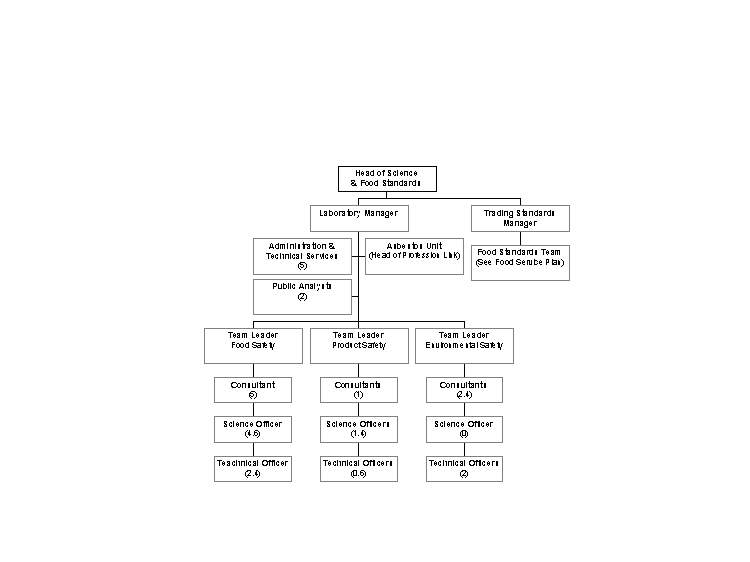 The current relationship between County Council Members and the Scientific Service is shown in the Regulatory Services Management Manual. The structure for Hampshire Scientific Service is shown below:
The Head of Science & Food Standards, in conjunction with other Senior Managers and scientific staff, identifies a yearly business plan for Hampshire Scientific Service. The plan is designed to deliver all Contracts and Service Level agreements with due regard to quality, delivery and price of services. The plan also identifies new services for development, Research & Development opportunities and new business targets.
The Head is responsible for the specification, delivery, monitoring and review of all science projects. The Business Plan is delivered by a thirty strong Science Team that works closely with the Food Standards Team, (See Food Service Plan) and other Council Departments.
The Laboratory Manager has day-to-day responsibility for the operational management of the Service. This includes staffing, financial, quality and business decisions. A key role is in managing and developing customer relations.
The Public Analysts each have a statutory food control function, reporting results generated by the Food Science Group. This may involve subsequent court appearance as expert witness. One Public Analysts has service-wide responsibilities for Technical & IT issues and the other for Research & Development. They also act as mentors to any trainee Public Analysts.
A specialist Team Leader manages each operational team. Professionally qualified, they are responsible for motivating, coaching and supervising their team and also provide relevant technical and legal support.
Science Consultants have specialised skills, are professionally recognised and report scientific findings directly to customers. In the laboratory, they carry out complicated chemical or microbiological tests and method development activities and are responsible for a section of work within their team. In the field, they are responsible for leading environmental or safety projects. They also offer consultancy services to clients.
Science Officers are fully competent in a designated area of science. They are responsible for carrying out analyses or microbiological examinations on a wide range of samples. Field Science Officers carry out sampling and inspections away from the laboratory as part of a team.
Technical Officers undergo training in analysis or examination and carry out tests or sampling activities accordingly.
The Administration & Technical Services team are responsible for invoicing clients and purchasing chemicals, apparatus, maintenance contracts and capital equipment. Building maintenance, reception services, word processing and administrative tasks are also key roles.
3. SERVICE DELIVERY.
3.1. Service Delivery Points
The analysis and examination of Hampshire's food and agricultural samples is carried out by Hampshire's in house laboratory and by its partner laboratory Kent Scientific Services based in West Malling, Kent. Most animal feeds and samples for pesticide residue tests are analysed at the latter.
Laboratory |
Address |
Telephone |
Opening Hours |
Public Analyst & Laboratory Service |
Hampshire Scientific Service, Hyde Park Road, Southsea, PO5 4LL. |
023 9282 9501 |
9am-5pm Monday to Friday. |
Agricultural Analyst & Public Analyst. |
Kent Scientific Services, 8 Abbey Mill Road, Kings Hill, West Malling, Kent ME19 4YT. |
01732 220001 |
9am-5pm Monday to Friday. |
3.2. Service Level Agreements with Hampshire CC Departments.
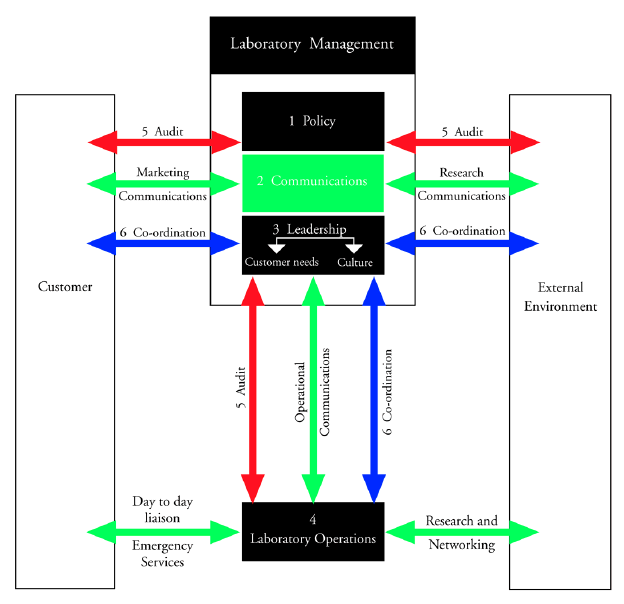
Strategies to match customer requirements with operational capabilities are generated using the LABKEY strategic management model (Appendix 1). The key to success is producing reliable results in accordance with client requirements. A Contract or Service Level Agreement is essential to ensure that mechanisms are in place to ensure delivery to customer requirements.
There are five key programmes planned for 2004/5. All of this work is carried out for Hampshire County Council for one of three reasons:
· To fulfil a statutory duty (Public Analyst work)
· To satisfy Health & Safety Legislation. (In particular the Council's duty of care to ensure a safe working environment)
· To protect the Environment (Especially contributions to the Council's Sustainability Plan)
The SLA's are summarised below:
3.2.1. Property, Business & Regulatory.
Property Services:
In 2004, management arrangements for asbestos surveying were transferred to Property Services. The Scientific Service is currently negotiating an SLA for £115,000 per annum to provide accommodation, administrative support, quality management and scientific "head of profession" services.
Business Services:
Hampshire Caterers contribute to a joint programme with the Education and Social Services Departments to monitor the quality and microbiological safety of school meals. Tests for genetically modified food and E. coli 0157 are included. In 2004/5, approximately 500 samples will be tested. A breakdown of contributions follows:
Customer |
Contribution |
Hampshire Caterers |
13184 |
Education |
45114 |
Social Services |
8240 |
Portsmouth City Council |
10712 |
TOTAL |
£77,250 |
Regulatory Services:
This programme represents the key statutory role of Public Analyst. Around 2000-2500 samples will be taken for analysis to support our Trading Standards enforcement projects. Of these, approximately 10% will relate to product safety and 90% to food & agriculture standards.
The new sampling system adopted after the Best Value Review increased sample numbers by 538 (37%) and reduced sampling costs by £30,000. Nearly 37% of samples tested were unsatisfactory in some way. The key improvement for 2004/5 will be to reduce sample turnaround times from 6 weeks to 4 weeks by adopting Lean Manufacturing principles. The 2004/5 target is 2000 samples. The new sampling programme includes monthly themes aimed at highlighting particular areas of concern.
The financial allocation for sampling, analysis and consultancy is given below:
Area of Work |
Value, £ |
Management & Public Analyst consultancy |
£30,000 |
Food Analysis (including research & quality control samples). |
£238,000 |
Agricultural Analysis |
£10,000 |
Product safety testing (e.g. Toy testing) |
£35,000 |
Product safety consultancy |
£5,000 |
Total |
£318,000 |
3.2.2. Social Services.
There are two SLA's with Social Services. The first one relates to testing of meals in elderly persons homes. (See under Business Services above).
The second SLA for £61,800 covers legionella testing of water systems at elderly persons homes. The programme contributes to the Council's Health & Safety objectives and ensures that its duty of care to this vulnerable group is addressed.
3.2.3. Education Department.
There are two SLA's with the Education Department. The first one relates to testing of school meals. (See under Business Services above).
The second SLA covers Health & Safety in Hampshire Schools. As part of this SLA, we will perform around 200 tests on school swimming pools and over 60 full safety inspections of fume cupboards in Secondary School science laboratories. The value of this SLA is £90,125.
3.2.4. Environment Department.
A programme has been designed for the County Surveyor's Waste Management Service to monitor closed landfill sites at Casbrook, Westwood, Newnham and Minley Wood. Inspections and tests will be carried out to prevent contamination of watercourses and to control methane build-up. Approximately 1400 samples will be tested to check for watercourse contamination and methane build up at landfill sites. The SLA is valued at £25,000 per annum.
3.3. Other Local Authorities
3.3.1. Hampshire & Kent Scientific Partnership
Hampshire and Kent County Councils' Scientific Services have worked together since 1995. The partnership brought together two leading Public Analyst laboratories to provide services to other Trading Standards Departments in the UK. By specialising on each site, avoiding duplication and pooling resources, the partnership has been able to improve efficiency, broaden the range of services on offer and win contracts from other authorities in open tender.
In 2003/04 the partnership shared approximately £600,000 of income from joint clients. This was £100,000 (20%) above the target. This was mainly due to additional funds provided to Food Authorities by the Food Standards Agency to carry out additional tests on imported foods.
In 2004/05, it is intended to increase joint income to £650,000 (£325,000 each) by targeting local authorities via competitive tenders, negotiations and targeted campaigns. (See section 5.2.1).
At present, Hampshire's Scientific Service works in partnership with Kent Scientific Services to provide Public Analyst services to the following food authorities:
Bedfordshire |
Essex* |
Reading |
Bournemouth* |
Hertfordshire* |
Southampton* |
Bracknell Forest |
Isle of Wight* |
Southend on Sea |
Brighton & Hove* |
Kent* |
Surrey* |
Cambridgeshire* |
Lewes |
Swindon |
Crawley |
London* |
Tower Hamlets |
Derbyshire* |
Medway |
West Berkshire |
Devon* |
Oxfordshire |
West Sussex* |
Dorset |
Poole |
Wiltshire* |
East Sussex |
Portsmouth* |
Windsor & Maidenhead |
(* Denotes contract secured)
The Hampshire-Kent partnership is now the UK market leader in provision of Public Analyst Services. The partnership was praised in a Government Report as a good example of joint working in local government.
3.3.2. Services for Local Businesses.
The Laboratory also provides consultancy and testing services to local businesses in the areas of Environmental Safety and Microbiology.
There is a strict policy of conducting no private sector Food Analysis or Product Safety Testing work. This is to avoid any potential conflict of interest between enforcement and commercial work.
Whilst recognising the service has no direct responsibility in relation to Outbreaks and Food Related Infectious Diseases it will liaise and assist where appropriate those authorities to which such responsibility lies.
3.4. Liaison with Other Organisations.
3.4.1. Liaison in Hampshire
HSS liaises with the Environmental Health Departments of the 11 District & Borough Councils. HSS acts as official Public Analysts & Port Analysts to Southampton and Portsmouth. In addition, 50 person days per annum is dedicated to client meetings and liaison between laboratory staff and the food authorities listed at section 3.3.1.
3.4.2. Contributions to UK Initiatives
· Hampshire is represented on four DTI Science Foresight Focus Groups in addition to participating in a number of VAM (Valid Analytical Measurement) groups run by the Laboratory of the Government Chemist.
· It is a member of the Food & Agricultural Laboratories Consultative Group (FALCON), a DTI focus group comprising the UK's top ten food laboratories. Other members include DEFRA, ADAS, two Food Research Associations, Lawlabs, Eclipse, Eurofins and Reading Scientific Services Ltd (RSSL).
· It is represented on the United Kingdom Analytical Partnership (UKAP). The Under Secretary of State for Competitiveness launched this in July 2001. Its aim is to drive forward the UK's analytical industry, noting its centrality to consumer protection.
· It has two members on the Council of the Association of Public Analysts.
· It is represented on two Trading Standards Regional food groups, SETSA and SWERCOTS.
· It is a member of PLATO, a Business Link network whereby heads of businesses meet monthly to swap business improvement ideas share best practice.
3.4.3. Liaison in Europe
Hampshire represents the UK on an EU Funded Thematic Network aimed at developing agreed tests for the analysis of foods for quantitative ingredient declarations (QUID).
The network includes 25 European Laboratories. Other network members include Belgium, Romania, Spain, Czech Republic, Malta, Germany, Austria, Eire, Greece, Denmark, France, Netherlands, Poland, Slovenia, Hungary and Italy. It carried out international trials on analysis of meat products, butter-containing foods and fruit products.
Hampshire's Head of Science will present a paper on the QUID project at the final Network Conference to be held in Teddington in September 2004. The paper will highlight Hampshire's enforcement role relating to QUID food labelling.
4. RESOURCES.
4.1. Financial Resources
4.1.1. Income and Expenditure 2003/04
The following table shows the income and expenditure for the year 2003/04.
Actual for the Year 2002/2003 |
Expenditure by Type |
Revised Budget 2003/2004 |
Actual to March 2004 |
(Under)/ Over spend |
Major Cost Items |
||||
1,028,960 |
Staffing |
1,073,300 |
1,067,693 |
(5,607) |
60,316 |
R&M |
38,600 |
26,166 |
(12,434) |
89,551 |
Chemicals |
90,000 |
87,405 |
(2595) |
77,294 |
Apparatus |
76,900 |
87,673 |
10,773 |
182,770 |
Sub-Contracting |
117,600 |
152,057 |
34,457 |
203,219 |
Other |
210,500 |
218,568 |
8068 |
1,642,110 |
Total Expenditure |
1,606,900 |
1,639,562 |
32,662 |
Income |
||||
1,228,617 |
Fees |
1,277,000 |
1,230,185 |
46,815 |
340,500 |
Recharge |
310,000 |
310,500 |
(500) |
1,569,117 |
Total Income |
1,587,000 |
1,540,685 |
46,315 |
72,993 |
Net Cost |
19,900 |
98,877 |
78,997 |
|
|
|
|
Expenditure 2003-04.
Overall expenditure was slightly over budget (2%). Most of the major expenditure items were on budget. Although the apparatus budget was overspent by around £10,000 this was offset by savings on repair & maintenance of defunct equipment. The subcontracting budget shows the biggest anomaly, being £35,000 (29%) over budget. This accounts for most of the 2% overspend. Most of this was extra asbestos work sent to private sector subcontractors.
In 2004/05, the subcontracting budget will be easier to manage because asbestos work will be delivered via a new Property Services team with its own separate budget.
Income by Client 2003-04.
Despite winning new contracts from Derbyshire and Bedfordshire in 2003, income was lower than projected for three main reasons:
1. Income from Social Services for Legionella testing decreased by £25,000 but this reflected the improved Legionella management systems in place as a result of last year's monitoring programme. Income from Hampshire County Council's Trading Standards Service dropped by £30,000 as part of best value savings (planned, but difficult to make up with external income - see 2). All other Hampshire Service Level Agreements increased or remained the same.
2. The new income from Derbyshire and Bedfordshire County Councils did not materialise, despite winning the Derbyshire contract by tender. It became apparent that HSS had been appointed as a back up lab rather than a main provider. However, Derbyshire have promised to take part in some of HSS's new food sampling campaigns in 2004-5.
3. Income from HSS's traditional client base was £67,000 less than projected, despite large increases from Southampton and Portsmouth City Councils relating to testing imported foods. Work for Hampshire Fire & Rescue Service and the private sector clients were particularly disappointing. This was not surprising because the bulk of this work relates to asbestos and most of our resources were focussed on HCC asbestos work.
The main increases were:
1. The biggest increases related to Hampshire-Kent partnership clients. In particular Devon CC, Surrey CC and Swindon Borough Council, submitted an extra £60,000 worth of food samples. This reflected higher sampling of imported foods, which was funded indirectly by the Food Standards Agency. This funding continues in 2004/05.
2. Two of Hampshire's longstanding clients, Southampton and Portsmouth City Councils also submitted additional imported foods, resulting in an extra £45,000 income.
3. Internally, the Hampshire Property Services SLA resulted in £18,000 more asbestos income than budgeted, but due to recruitment issues almost £80,000 worth of work had to be subcontracted.
The table below gives a more detailed breakdown of 2003/04 income. Comparisons are made with 2002/03 actual figures and the projected figures for 2003/4 and 2004/5.
Note that the 2002/03 figures for joint Hampshire and Kent Scientific Services included Kent income, which appeared as a debit in the subcontracting budget. Since 2003/04, each site has invoiced clients directly.
In order to improve turnaround times and cash flow, it will be important to improve sample scheduling in 2004/05. This is a key business plan target.
Marketing plans, designed to increase income in 2004/05 are given at section 5.
INCOME |
Client |
2002-03 Actual |
2003-04 Projection |
2003-04 Actual |
2004-05 Projection |
|
|
|
|||
Hampshire CC |
Catering Contract |
£72,000 |
£75,000 |
£74,520 |
£77,250 |
|
Coroners |
£31,355 |
£0 |
£1,139 |
£1,000 |
|
Education |
£84,560 |
£87,500 |
£87,520 |
£90,125 |
|
Property Services |
£363,186 |
£425,000 |
£443,901 |
£115,000 |
|
Social Services |
£84,804 |
£65,000 |
£60,000 |
£61,800 |
|
Trading Standards |
£340,500 |
£310,500 |
£310,500 |
£318,000 |
|
Waste Management |
£19,800 |
£25,000 |
£22,680 |
£25,000 |
|
Other |
£8,168 |
£15,000 |
£6,485 |
£11,825 |
SUBTOTAL |
INTERNAL HCC |
£1,004,372 |
£1,003,000 |
£1,006,745 |
£700,000 |
HSS-KSS |
Bedfordshire |
£0 |
£10,000 |
£0 |
£10,000 |
Brighton |
£10,225 |
£17,000 |
£18,420 |
£18,000 | |
Cambridgeshire |
£54,776 |
£28,000 |
£34,914 |
£42,000 | |
Derbyshire |
£0 |
£32,000 |
£0 |
£20,000 | |
Devon |
£5,325 |
£5,000 |
£28,349 |
£25,000 | |
Essex |
£14,925 |
£32,500 |
£33,707 |
£45,000 | |
Hertfordshire |
£19,103 |
£15,000 |
£7,831 |
£10,000 | |
Kent |
£26,896 |
£26,000 |
£28,039 |
£30,000 | |
Surrey Food |
£93,721 |
£52,000 |
£72,491 |
£80,000 | |
Swindon |
£29,970 |
£20,000 |
£33,721 |
£5,000 | |
West Sussex |
£10,425 |
£6,000 |
£9,125 |
£20,000 | |
Wiltshire |
£27,337 |
£22,000 |
£18,402 |
£20,000 | |
SUBTOTAL |
HSS-KSS EXTERNAL |
£292,703 |
£265,500 |
£284,999 |
£325,000 |
HSS only |
Bournemouth |
£4,655 |
£5,000 |
£6,478 |
£7,000 |
|
Camden |
£1,500 |
£1,500 |
£0 |
£1,000 |
|
Crawley |
£4,090 |
£3,000 |
£800 |
£1,000 |
|
Dorset |
£3,690 |
£4,000 |
£2,519 |
£2,500 |
|
East Hants |
£1,650 |
£2,000 |
£55 |
£1,000 |
|
East Sussex |
£980 |
£1,000 |
£186 |
£1,000 |
|
Hants Fire |
£31,506 |
£35,000 |
£16,171 |
£10,000 |
|
Havant BC |
£1,620 |
£2,000 |
£2,420 |
£2,500 |
|
IOW |
£8,543 |
£7,500 |
£8,916 |
£9,000 |
|
Lincolnshire |
£1,846 |
£2,000 |
£0 |
£1,000 |
|
Portsmouth |
£55,401 |
£55,400 |
£73,717 |
£70,000 |
|
Reigate |
£875 |
£1,000 |
£771 |
£1,000 |
|
Southampton |
£46,868 |
£52,000 |
£78,739 |
£75,000 |
|
Suffolk |
£5,030 |
£5,000 |
£4,990 |
£5,000 |
|
Surrey Product Safety |
£300 |
£10,000 |
£1,627 |
£2,000 |
|
Tower Hamlets |
£2,895 |
£3,000 |
£1,104 |
£1,000 |
|
West Berkshire |
£2,275 |
£2,500 |
£864 |
£1,000 |
|
Westminster |
£1,230 |
£1,000 |
£93 |
£1,000 |
|
Windsor & Maidenhead |
£1,465 |
£2,000 |
£2,400 |
£3,000 |
|
Other Local Authorities |
£11,816 |
£31,000 |
£17,263 |
£70,000 |
|
Private sector |
£40,673 |
£50,000 |
£32,286 |
£60,000 |
Carry over from previous yr |
£40,000 |
£43,000 |
£0 |
£0 | |
SUBTOTAL |
HSS EXTERNAL |
£268,908 |
£318,900 |
£251,399 |
£325,000 |
GRAND TOTAL |
£1,565,983 |
£1,587,400 |
£1,543,143 |
£1,350,000 | |
Income and expenditure targets for 2004/05.
Based on the trends from 2003/04, the incorporation of new contracts awarded by tender, productivity savings and projected income from promotional campaigns, the budget for 2004/05 is as follows:
The 2004/05 revised budget makes allowance for the new asbestos team, which will be funded from a separate Property Services budget. (Some figures to be finalised).
Actual for the Year 2003/2004 |
Expenditure by Type |
Approved Budget 2004/5 |
Revised Budget 2004/2005 |
Major Cost Items |
|||
1,067,693 |
Staffing |
1,152,000 |
915,000 |
26,166 |
R&M |
25,000 |
25,000 |
87,405 |
Chemicals |
93,000 |
90,000 |
87,673 |
Apparatus |
80,000 |
80,000 |
152,057 |
Sub-Contracting |
122,000 |
90,000 |
218,568 |
Other |
226,000 |
150,000 |
1,639,562 |
Total Expenditure |
1,698,000 |
1,350,000 |
Income |
|||
1,230,185 |
Fees |
1,360,000 |
917,000 |
310,500 |
Recharge (Trading Standards) |
318,000 |
318,000 |
Recharge (Property Services) |
0 |
115,000 | |
1,540,685 |
Total Income |
1,678,000 |
1,350,000 |
98,877 |
Net Cost |
20 |
0 |
|
|
|
4.1.2. Capital Investments
Requirements for the next three years are shown below:
Financial Year |
2004/05 |
2005/06 |
2006/07 |
Capital items |
ICP-MS (Stage 2 payment), £23,000 |
LECO (Stage 2 payment)£20,000 |
To be decided |
LECO Protein Analyser (Stage 1 payment) £20,000 |
|||
Total |
£43,000 |
£20,000 |
|
Budget |
£43,000 |
£43,000 |
£43,000 |
Balance |
£0 |
£23,000 |
4.1.3. Building Improvements.
In 1997, Hampshire County Architects carried out a full structural survey of the Laboratory located in Southsea. The report highlighted key refurbishments required in years 1, 3, 5 and 10. Most of the work for years 1 (1997) and 3 (2000) has been completed, but year 5 work (2002) is still outstanding. The following table indicates the outstanding repairs, maintenance and refurbishment required.
Item |
Cost (as estimated in 1997) |
Laboratory Climate Control |
50,000 |
New roofing & building works |
130,000 |
Main upstairs laboratory refurbishment |
10,000 |
Miscellaneous |
10,000 |
Approx total |
£200,000 |
Although the laboratory was designed for 20 staff it now houses over 40, so space is very tight. Possible solutions include: Relocation of new asbestos team to other HCC buildings, external extension of laboratory (approx £100,000) or conversion of current boiler room into an extra laboratory space.
In October 2004, the main upstairs laboratory will be redecorated and benches will be refurbished. The cooling tower for the air conditioning is also scheduled for replacement.
4.2. Staffing.
4.2.1. Staffing Allocation.
The staffing levels at April 2004 for Hampshire Scientific Service are shown below:
Function |
Post |
FTE |
Management |
Head of Science & Food Standards |
1.0 |
Laboratory Manager |
1.0 | |
Public Analysts |
Technical Manager |
1.0 |
Public Analyst |
1.0 | |
Operational |
Team Leaders |
3.0 |
Consultants |
9.3 | |
Science Officers |
5.0 | |
Technical officers |
5.0 | |
Administration |
Admin Officer, Secretary, Admin Assts |
3.0 |
Technical services |
Tech Services Officer, Lab attendants |
2.2 |
TOTAL |
31.5 |
This reflects the lower staffing levels due to transfer of the asbestos team to Property Services. It also includes allowance for a new consultant in the Environmental Safety Team and a new consultant for the Food Safety Team.
4.2.2. Staff Qualifications:
Staff are qualified in management, administration, chemistry, biology, science and specialist professional subjects as appropriate. The qualifications of staff as at April 2004 are given at appendix 2.
4.2.3. Staff Development Plan.
Property, Business & Regulatory Services was re-awarded Investors in People status in 2003.
Training needs are identified by examining:
· Operational requirements arising from the Business Plan
· Individual needs highlighted at performance development review (PDR) meetings.
Each member of staff has a PDR with their Line Manager. Training and Development needs are assessed at this time and throughout the year as updates are carried out. The Service will establish team training needs arising out of the team plan. Training must be prior-approved and post-evaluated. The usual sources of training include:
· Day release courses
· On the job training
· In-house short courses
· External short courses (e.g. Those run by Campden & Chorleywood Food RA, Leatherhead Food RA, professional bodies and Universities).
5. BUSINESS DEVELOPMENT
5.1. Market Analysis:
The key features of the Public Analyst market are:
· Increased competition and reducing Trading Standards budgets nationwide. This is a direct knock-on from the Best Value Reviews of Local Government.
· Increased demand for asbestos management services within Hampshire County Council, and other local authorities and private sector landlords due to new Asbestos control legislation. This makes the employment market very competitive, particularly for qualified surveyors.
· Increased demand from customers for add-on services such as help with sample planning, couriers, training sessions etc.
· Increased demand for occupational hygiene and microbiology work, in both public and private sector, due to higher profile health and safety regimes.
5.2. Key marketing activities 2004/5.
In response to the above market pressures, the key activities to increase income will be:
5.2.1. Food Safety
Three new initiatives to increase income by £50,000 from the food safety market:
· Public Protection Lab UK. In order to increase our customer base we will launch this new initiative inviting all UK Trading Standards Departments to appoint Hampshire as an additional back-up Public Analyst. This increases choice for enforcement authorities and gives Hampshire a statutory mechanism to roll out its National Public Protection campaigns.
· A New Strategic Partnership: The Hampshire-Kent partnership, which has been so successful in bidding for new Public Analyst contracts, will be extended in 2004/5 to include the Manchester Public Analyst lab. This gives a new strategic triangle in England, which will improve opportunities for successful bids in the North of England. The first bid will be to provide Public Analyst Services to Liverpool City Council starting in July 2004.
· Monthly themed sampling campaigns. Customers have been invited in advance to take part in special promotions. Tests can be offered at a lower price, through economies of scale. A major benefit is that outcomes have a bigger impact because many authorities look at the same issue in a coordinated way. E.g. press releases to highlight issues. The 12 themes are shown in the table below:
Month |
Title |
Sample |
Analysis |
April |
April Fools |
Individual pots milk based desserts |
Fat, sugar colours, sweeteners |
May |
Seeing Red |
Ethnic shops - dried and pastes |
Sudan 1 - 1V |
June / July |
Armchair Athletics |
Beer - pubs serving during football matches |
Alcohol content |
Curry and Pint |
Curry from takeaways |
Colours | |
Sports Drinks |
Sports drinks |
Sugars, sweeteners, preservatives | |
August |
`Buttered Up' |
Ice-cream / All butter claims |
Composition |
September |
`Autumn Apple' |
Apple juice / local cider |
Alcohol, patulin, sweeteners |
October |
Sweet October |
Honey |
Composition |
November |
Fruit and nut case |
Nuts, fruits |
Aflatoxin, mycotoxin |
December |
Christmas Spirit |
Gift foods |
Alcohol content |
January |
Take it away! |
Chinese takeaways |
Monosodium Glutamate |
February |
Make no bones without it! |
Osteoporosis / mineral claims |
Minerals |
March |
The icing on the cake! |
Cake icing |
Preservatives |
A summary of all current public analysts appointments with an indication of those that include contracts is given at section 3.3.1.
5.2.2. Environmental Safety
Due to the increased demand for asbestos surveying, brand new management arrangements will be implemented in 2004/05. We will form an integrated Asbestos Management team, to include the 10-strong laboratory based team and the management and surveying team within Property Services. The new asbestos team will become part of the Resources Group of Property, Business and Regulatory Services, line managed by Glenn Taylor (former Environmental Safety Manager at HSS) who is now working in Property Services.
The new arrangements represent a significant step forward for the Council's asbestos management arrangements necessary to deal with much tougher requirements required by new asbestos control legislation. It will provide opportunities for several staff to enhance existing skills through structured career developments.
A related advantage is the launch of a new Environmental Safety Team, which integrates the existing microbiology Unit, and all non-asbestos environmental work.
The key target for this new team is to increase income by £30,000 by:
· Increasing Legionella testing by offering the Hampshire model to other local authorities.
· Extending water-testing services to local Port Health authorities. (On-ship samples)
· Launching a probiotics campaign, to check the effectiveness of live yoghurts and other bio-active foods.
· Promoting the services of a new Occupational Hygienist to deliver the Hampshire SLA's and new Health & Safety services targeted at other authorities and local businesses.
5.2.3. Product Safety
In 2003/04, the target is to increase external income by £20,000 by targeting UK Trading Standards Departments via safety testing campaigns, particularly:
· Toxic Elements in toys and consumer goods
· Safety of Candles
· A number of themed product safety campaigns.
5.2. Marketing Mix
The marketing mix is summarised below:
Products |
Services are described in section 3. |
Price |
Prices have been reviewed in 2003/04. Key changes are: · A 3.0% increase on existing SLA's and external contracts · A target of 10% profit on all external tenders for new work |
Promotions |
· 12 national food sampling campaigns will be launched · 4 SETSA campaigns · New Environmental Safety services package · 4 Product Safety campaigns |
6. QUALITY ASSESSMENT.
6.1. Quality Assessment.
6.1.1. Accreditation
In 2001, Hampshire became one of the first laboratories to become UKAS Accredited to the new BS EN ISO/IEC 17025 Quality Standard. It is recognised as an Official Food Enforcement Laboratory for both analysis and microbiological examinations.
The laboratory intends to maintain its registration to the ISO 9001 Quality Standard and will use this as a mechanism to continuously improve service to customers.
6.1.2. External Proficiency Schemes.
In 2004/05, the laboratory will continue to take part in seven external proficiency schemes run by Government bodies to monitor its performance. These include:
· FAPAS and FEPAS- Food testing schemes run by the FSA
· TOYTEST - run by the DTI
· Food Microbiology EQA - run by PHLS.
· Water Microbiology EQA - run by PHLS.
· Legionella Microbiology EQA - run by PHLS.
6.1.3. Internal Performance monitoring.
Internal monitoring will be conducted to assess the Service's performance of the plan and the Standard on a quarterly basis.
Key performance indicators are given at section 8.2.
6.1.4. Quality Objectives.
The quality objectives for 2004/05 are:
· Implementation of client review programme
· Implementation of total method review programme (to include validation data, updateable Wp data, Reference material validation data, uncertainty, risk assessment)
· Completion of Audit Programme on schedule
· Measurement of performance in external proficiency schemes
7. RESEARCH AND DEVELOPMENT.
7.1. Vitamin analysis
Over the last two years HSS has contributed to a £600,000 research programme to identify a new test for multivitamins. The project received DEFRA and BBSRC LINK funding. Partners include Boots PLC, Britvic Soft Drinks Ltd, Reading Scientific Services Ltd, Newcastle upon Tyne Hospitals NHS Trust, Selective Antibodies Ltd, and the Royal Society of Chemistry. The consortium members will benefit from early adoption of the new test and a licence-free agreement to use the new technology. Prototype tests for folic acid and vitamin B12 should be launched in 2004/5.
7.2. Trace Metals Analysis
A new ICP-MS instrument was commissioned in March 2004. It offers improved accuracy and turnaround times for toxic metals tests for clients. This will support our food projects to detect lower traces of the toxic metals lead and cadmium (to check food samples against new, more stringent, EU regulations) and our Product Safety campaigns. (e.g. lead in toy paints).
7.3. Probiotics
Methods to verify the efficacy of probiotic health claims have been commissioned. The new Environmental Safety Unit will use this new test to check yoghurts containing live bacteria, to see if the bacteria present are likely to cause the health benefits claimed on the food labelling.
7.4. Potato Authenticity
In conjunction with the French Food Enforcement Authorities and Kent Scientific Services, a new electrophoresis test for authenticating potato varieties was developed in 2003/04. This will be offered to Trading Standards Authorities in 2004/05. The aim is to crack down on the illegal sale of cheaper potato varieties in the guise of expensive varieties such as King Edwards.
7.5. Government funded projects
In addition to the above projects, HSS will take part in a number of collaborative trials of new analytical procedures organised and funded by the Food Standards Agency.
8. REVIEW.
8.1. Review against the Business Plan.
The County Council operates an Executive Cabinet structure, which includes a set of policy review committees. These committees are responsible for monitoring performance against service plans, performance indicators and best value targets.
The management team monitors performance under the following headings:
· Quality
· Delivery
· Financial performance
· Innovation
The Business Plan is subject to annual review where an assessment is made as to progress. Outcomes will be evaluated. The review includes an assessment against the previous years plan as a means by which to measure improvement.
8.2. Performance Indicators
The key performance indicators for Hampshire Scientific Service are:
Criteria |
Performance indicator |
Target |
Quality |
Customer Complaints |
Responded to in 1 week Resolved in 20 working days |
Performance in external audits |
No Cat 1 Non Compliances | |
Performance in proficiency schemes |
95% satisfactory | |
Delivery |
% samples delivered in 1,2,3,4,6,8 weeks |
95% in 4 weeks |
Customer satisfaction |
Good feedback | |
Financial performance |
Performance in tenders, negotiations, marketing exercises & campaigns |
Full cost recovery (£1.35 million) |
Innovation |
Number of new tests brought on line |
3 |
Number of major research projects |
1 | |
Number of FSA collaborative trials |
2 | |
Number of process improvements |
3 |
8.3. Continuous Improvement.
Where the review process identifies areas for improvement or development these will be adopted in accordance with ISO 9001 practices. A key aim of the Service is to continuously improve the quality, efficiency and effectiveness of its services.
APPENDIX 1. LABKEY
LABKEY - A new Strategic Management Model for the Scientific Analytical Services Industry
Reference: Berryman, P. M, (2000), LABKEY: A Strategic Management Model for the Scientific Analytical Services Industry, PhD Thesis, University of Portsmouth. |
© Paul Berryman 2000
APPENDIX 2. Staff Qualifications at April 2003.
Post |
Name |
Qualifications | |
Management |
Head of Science & Food |
Paul Berryman |
BSc(Hons) MSc MChemA MBA PhD |
Standards |
MIFST CBiol MIBiol CChem FRSC | ||
Laboratory Manager |
Anne Scarrett |
MSc | |
Public Analysts |
Technical Manager |
Shayne Dyer |
MChemA CChem MRSC DMS |
Public Analyst |
Philip Stanley |
MChemA CChem MRSC | |
Food Science Group |
Team Leader |
Ian Jerrum |
CChem MRSC |
Consultant |
Jen A Green |
BSc CChem | |
Consultant |
Paul Welsh |
BSc CChem MRSC | |
Consultant |
Rachael New |
BSc (Hons) CChem MRSC | |
Consultant |
Linda French |
AMRSC | |
Consultant |
Jenny Green |
BSc PGCE | |
Consultant |
Heather Thomas |
BSc (Hons) Food Science | |
Science Officer |
Sarah Denham |
HNC Chemistry | |
Science Officer |
Carol Willis |
BA (Hons) CChem MRSC | |
Science Officer |
Belinda Farmer |
HNC Chemistry, BSc (Hons) pending | |
Science Officer |
Louise Barber |
BSc (Hons) CChem MRSC | |
Science Officer |
Debbie Axford |
BSc (Hons) | |
Technical Officer |
Robert Marriott |
BTEC Science | |
Technical Officer |
Karen Baldry |
GCSE's | |
Technical Officer |
Chris Payne |
||
Product Safety Team |
Team Leader |
Stuart Swain |
CChem MRSC |
Science Consultant |
Julia Leonard |
BSc (Hons) in progress | |
Science Officer |
Adam Hughes |
BSc (Hons) | |
Technical Officer |
Gerry Daly |
MA | |
Technical Officer (Casual) |
Terry Evans |
A levels | |
Microbiology Team |
Team Leader |
Lynette Welsh |
BSc (Hons) CBiol MIBiol |
Consultant |
Julia Palmer |
BSc (Hons) DMS CBiol MIBiol | |
Consultant |
Michelle Cartman |
BSc (Hons) CBiol MIBiol | |
Technical Officer |
Rebecca Tuffnell |
ONC, A levels | |
Technical Officer |
David Emmett |
A levels | |
Science Admin & |
Admin Officer |
Jan Bryant |
HNC Business |
Technical Services |
Admin Asst |
Karen Llewellyn |
RSA III, NVQ 3 Business Admin |
Admin Asst |
Lucy Ray |
||
Tech Serv Officer |
Brian Bannister |
||
Science Officer |
Mavis Hiseman |
||
Technical Officer |
Sylvie Searle |
||
Technical Officer |
Brenda Buckingham |
DISTRIBUTION LIST.
Copy No |
Holder |
1 |
Andrew Smith, Director. |
2 |
Paul Berryman |
3 |
Anne Scarrett |
4 |
Shayne Dyer |
5 |
Phil Stanley |
6 |
Ian Jerrum |
7 |
Lynette Welsh |
8 |
Stuart Swain |