
Archived decisions

Regulatory Services
Food Service Plan
2004 - 2007
This Service Plan is issued under the authority of:
...............................................
Dr Paul Berryman
Head of Science & Food Standards
This Food Service Plan forms part of the Official Quality System of Hampshire County Council's Regulatory Services. It is Service confidential.
Copy Number: -------------------
Issued to:----------------------------------------
Regulatory Services, Mottisfont Court, High Street, Winchester SO23 8ZE
Tel: 01962 841841. www.hants.gov.uk/regulatory
HAMPSHIRE COUNTY COUNCIL. REGULATORY SERVICES.
FOOD SERVICE PLAN 2004-7.
Executive Summary
This Service Plan describes the key objectives relating to Hampshire County Council's Food Enforcement Function. It is a statutory responsibility to update the plan, which is audited from time to time by the Food Standards Agency.
The primary aim of the food standards team is to promote and enforce animal health & welfare and food & agriculture safety laws. Key features of the plan include:
· Integrated Service - The County Council delivers a fully integrated food enforcement system via a specialist team of Trading Standards Officers, Public Analysts, Food Scientists and Animal Health Inspectors.
· Targeted Inspections - in order to enforce and promote food safety laws we will inspect over 2000 Hampshire Food Businesses including 155 high-risk premises. Inspections will be designed to highlight quality control problems and to offer technical and legal advice to Hampshire businesses. This will include advice on new Regulations relating to Genetically Modified Foods. Enforcement action is only taken as a last resort to deal with wilfully non-compliant businesses.
· Focused Sampling - The new sampling system adopted after the Best Value Review increased sample numbers by 538 (37%) and reduced sampling costs by £30,000. Nearly 37% of samples tested were unsatisfactory in some way. The key improvement for 2004/5 will be to reduce sample turnaround times from 6 weeks to 4 weeks by adopting Lean Manufacturing principles. The 2004/5 target is 2000 samples. The new sampling programme includes monthly themes aimed at highlighting particular areas of concern.
· Healthy Eating Campaign - A major new development for 2004/5 is a promotion campaign on Healthy Eating for All. This will utilise the website, promotional stands for exhibitions and talks, new promotional materials and links with partner organisations. It is also proposed to link with Department of Health initiative "Choosing Health" which discourages destructive choices in diet, alcohol and tobacco.
· Animal Health - One of the few authorities to pilot the new DEFRA framework, the team is now ready to deliver a targeted inspection programme, which concentrates on the Interim Disease Control measures. (e.g. Foot & Mouth control). Over 1400 farm visits will be made in 2004/5.
· Agriculture - to support the County Council's "farm to fork" approach to food control, nearly 100 animal feed producers will be inspected to ensure that feeds are free from contaminants and are nutritionally sound.
1. Service Aims and Objectives.
1.1. Aims and Objectives.
The Regulatory Services vision is:
To be recognised as leaders of service excellence
This simple statement carries four key messages:
· Recognition - we want to achieve high awareness and trust with our key stakeholders by providing maximum impact, accessible, valued services
· Leaders - we want to be innovative and engage enthusiastically with the modernisation agenda.
· Service - we want to focus on service delivery driven by customer needs, not professional interests
· Excellence - we want to strive for continuous improvement through high quality staff, trained and developed to achieve their full potential.
Regulatory Services aims to protect the public by ensuring a fair and safe trading environment in Hampshire.
This is achieved by giving advice and carrying out inspections relating to a wide range of consumer laws. Priorities are established by using a risk assessment approach. Specifically in relation to animal health, food safety and animal feeding stuffs, activities include: inspections, sampling programmes, response to complaints, awareness and education campaigns and provision of specialist advice to traders.
With respect to the food function, the aims and objectives are:
Aim:
To promote and enforce animal health & welfare and food & agriculture safety laws.
Objectives:
· To carry out Food Standards Inspections to trade premises in accordance with published Food Standards Agency and LACORS risk assessment and to ISO 9001 Quality Standards.
· To carry out an effective programme of sampling, analysis and checking of food and animal feeding stuffs (feeds) with respect to composition and labelling.
· To respond to consumer complaints relating to animal health, food & feeds safety and quality, working in partnership with central government, other local government agencies and industry to provide a seamless service to customers.
· To carry out specific food & feeds safety campaigns to highlight potential areas of good or bad practice in food trade to the public.
· To respond to requests by all traders for advice on compliance with food, feeds and animal health legislation including operation of the Home Authority principle.
· To carry out an effective programme of animal health & welfare inspections and to react to outbreaks in accordance with DEFRA guidance.
1.2. Links to Corporate Objectives and Plans
Hampshire County Council's Corporate Strategy is about identifying common corporate aims and outcomes and ensuring that activities and resources are targeted to achieve those priorities.
This corporate vision forms the philosophy that drives everything the County Council does and provides a framework for service planning and delivery. The strategy is implemented through cross-service policies and departmental service plans. The strategy complements the Council's democratic Cabinet system by translating policy into action and allocating resources.
The corporate aims that have been adopted by the Council are:
No. |
Corporate Aim |
Link to Food Service Plan demonstrated by: |
1 |
Maximising life opportunities |
· Monitoring the quality of school meals - hygiene, nutrition and GM tests |
2 |
Stewardship of the environment |
· Promoting good quality agricultural and animal health practices. · Informing HCC's GM Foods Policy |
3 |
Achieving economic prosperity |
· Supporting Hampshire's food businesses · Promoting good quality food production |
4 |
Building strong & safe communities |
· Promoting good public health · Reducing crime relating to Food Standards. |
5 |
Improving services |
· Accreditation to recognised quality systems · An emphasis on communicating with the public · A reliance on outcome-based service planning techniques |
6 |
Developing councillors and staff |
· Staff performance development programme · Commitment to the Investors in People Standard. |
The County Council agrees the Annual Plan and related Service Plans for all Regulatory Services. The Food Service Plan is linked to the Council's Annual Performance Plan.
In addition, Hampshire County Council has a Corporate Food Standards Group with representatives from Education, Social Services, Hampshire Caterers (HC3S), Communications, Trading Standards and Science. The role of this team is to set and implement corporate policies relating to food safety. Issues addressed have included salmonella in eggs, Genetically Modified foods in school meals, matters relating to the BSE crisis, E. coli 0157 testing and nutritional quality of school meals.
Hampshire County Council is also a major supplier of food. Hampshire Caterers (HC3S) prepare approximately ten million meals per annum for schools, social services establishments, staff restaurants and public outlets. Each year the Scientific Service carry out £75,000 worth of tests and inspections to ensure the quality of the food it serves. Tests include microbiological quality, nutritional quality and genetic modification. Food suppliers are inspected by trained auditors and need to comply with product specifications.
2. Background.
2.1. Profile of Hampshire County Council.
Hampshire is mainly rural with Basingstoke, Winchester, Aldershot, Farnborough, Fareham and Eastleigh being the main urban areas.
Hampshire County Council provides essential Services for the 1.2 million people living in Hampshire. Over 30,000 staff deliver a wide range of services including education, social services, libraries, museums, country parks and regulatory services.
Hampshire County Council is responsible for regulating some 33,500 trade premises including 6461 food establishments, 3670 livestock holdings and 409 feed premises.
In 1997, the Council was the first in the UK to launch an integrated Regulatory Service combining the expertise of Trading Standards Officers and Public Analysts under a single management team. The Service benefits from an integrated, project managed approach to food sampling, analysis, inspection, advice and enforcement.
Over the last five years, Hampshire County Council has carried out food inspections and food sampling at the levels shown below:
Year |
1999/00 |
2000/01 |
2001/02 |
2002/3 |
2003/04 |
Total inspections |
1170 |
1400 |
1680 |
1827 |
1637 |
Total samples for analysis |
1490 |
1800 |
1350 |
1441 |
1979 |
Samples unsatisfactory (%) |
24 |
26 |
39 |
41 |
37 |
In addition to the full food standards inspections above, 482 other Food Compliance visits were carried out, so overall inspection levels for 2003/04 were higher than those achieved last year. Importantly, 100% of our 242 high-risk premises were inspected. However, the target of reaching 1889 medium risk inspections this year has proven to be unrealistic.
The target for 2004/05 is 2040 inspections of which 140 are in the high-risk category. These new targets take account of the new LACORS risk assessment scheme for inspections, described more fully at section 3.1.1.
The effect of the new sampling system adopted after the 2002 Best Value Review is that sample numbers are up by 538 (37%) and sampling costs are down by £30,000. The 2003/4 target is 2000 samples.
The County Council runs its own Public Analyst laboratory, employing 30 staff and conducting over 150,000 tests per annum on a wide range of samples. The laboratory is appointed Public Analyst to 30 other food authorities outside Hampshire.
2.2. Organisational Structure.
Regulatory Services is part of the Property, Business and Regulatory Department of Hampshire County Council. At present, Regulatory Services report through the Director to the Cabinet Lead Member for Policy and Resources.
Since 2001, the County Council has operated an Executive Panel structure, which included the establishment of a set of policy review committees. These committees are responsible for monitoring performance against service plans, performance indicators and best value targets.
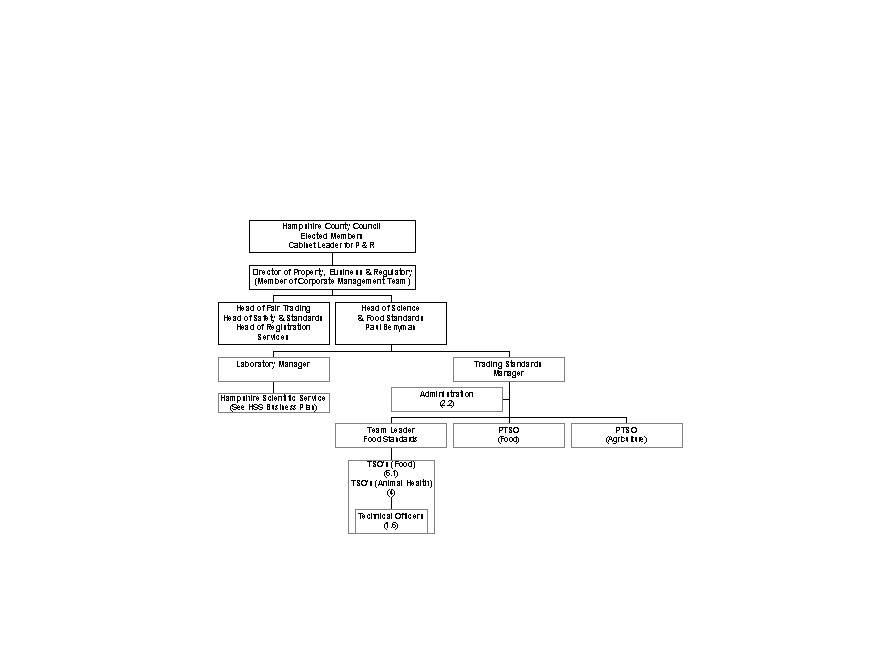 The current relationship between County Council Members and the food function is shown below:
The four Heads shown above make up the Management Team of Regulatory Services. This Team set overall Enforcement Policy and formulate the overall Service Plan. (The roles of the other Heads are set out in the Trading Standards National Performance Framework (NPF) Service Plan).
The Head of Science & Food Standards, in conjunction with other Senior Managers and food experts, identifies a yearly food service plan which includes inspection, programmed retail surveillance, actions to redress complaints, sampling and testing.
The Head is responsible for the specification, delivery, monitoring and review of all food and agriculture projects. The Food Service Plan is delivered by a 16-strong Food & Agriculture Standards Team that works closely with food scientists, analysts and technologists from the Public Analyst laboratory.
A policy group meets quarterly to discuss and review strategic issues. The terms of reference of this Food & Agriculture Safety Team (FAST) are given at Appendix 1.
2.3. Scope of the Food Enforcement Function.
Employees of Hampshire County Council deliver the Food Enforcement Function. It should be noted that the County Council has no responsibility for food hygiene enforcement - this is the responsibility of the District Council Environmental Health Services. However, the laboratory carries out analysis and examination of food complaints for District Council Environmental Health Services on a contractual basis.
This plan also includes all agricultural enforcement and all animal health and welfare activities, so represents a "farm to fork" approach to food law enforcement.
Where appropriate, other relevant inspections (e.g. safety, pricing and weights & measures) are carried out at the time of the food standards inspection. This will depend upon the premise type and the risk assessment attached to that premise.
The relevant areas of the food service are delivered as follows:
2.3.1. Food Standards Inspections:
The Food Standards Team delivers these via staff trained in food law, food science and ISO 9001 auditing techniques.
2.3.2. Food Analysis:
The Laboratory's Food Science Group carries out most food analysis. Most feed analysis is carried out at Kent Scientific Services.
2.3.3. Dealing with Food & Agriculture Complaints:
Food & agriculture complaints are initially processed by either the County or District Councils but are then passed on to the responsible authority for action. The Advice Team initially deals with this aspect of the service. Specific cases will then be passed on to the Food Standards function if necessary.
2.3.4. Animal Health & Welfare.
The Animal Health and Welfare Officers of Regulatory Services enforce the provisions of the Animal Health Act 1981, which cover animal disease prevention measures, such as those used following the foot-and-mouth disease outbreak. These officers visit livestock keepers in Hampshire to ensure the correct keeping of animal records and identification of individual animals where necessary. The Act also covers the welfare of animals in transport. While carrying out this role any welfare concerns of livestock animals are dealt with, often in partnership with Veterinary Officers of DEFRA.
2.4. Demands on the Food Service
There are 6461 identified food establishments in Hampshire. The greatest proportion are in the categories of retailer and restaurant / caterer accounting for 88% of the total.
There are 237 producers, one slaughterhouse, 270 manufacturers/ processors, 35 Packers, 43 Importers/Exporters, 142 distributors, 2269 retailers, 3397 caterers/restaurants, 67 retailers that manufacture foods and 409 feed premises including feed mills, pet shops, importers, head offices and certain farms. There are also 3501 livestock holdings and 169 premises associated with livestock operations.
For Home Authority Companies producing the following foods, we have identified the need for specialist knowledge as a result of complex processes. Examples include:
· Mineral and Spring Waters. (e.g. Well, Well, Well; Somerly).
· Chocolate. (e.g. Bendicks)
· Tea. (e.g. Twinings)
· Flour Confectionery. (e.g. Manor Bakeries)
· Ethnic foods (e.g. Manning Impex)
· Speciality imported foods (e.g. Petty Wood)
· Watercress and salads (e.g. Vitacress)
· Ice Cream Manufacturers (e.g. New Forest Ice Cream Co.)
In addition, specialist knowledge is required to deal with the following agriculture and animal health issues:
· Animal feeds (e.g. Feed Mills)
· Horse Markets (New Forest Pony Sales)
· Livestock on common land (New Forest)
Inspections are carried out in the field. The service delivery points for the service are as follows:
Part of Food Service |
Address |
Telephone |
Opening Hours |
General enquiries and advice |
Advice Service, Mottisfont Court, High Street, Winchester SO23 8ZE. |
0845 6030081 (Local call rates) |
9am-5pm Monday to Friday. |
Animal Health |
The Parkway, 96, Wickham Road, Fareham PO16 7JL. |
01329 316200 01329 316207 (emergency) |
9am-5pm Monday to Friday. Also emergency call out at weekends and evenings. |
Food Standards Team |
The Parkway, 96, Wickham Road, Fareham PO16 7JL. |
01329 316182 |
9am-5pm Monday to Friday. |
Sun Alliance House, 47 Wote Street, Basingstoke RG21 1NG |
01256 776100 |
9am-5pm Monday to Friday. | |
Public Analyst & Laboratory Service |
Hampshire Scientific Service, Hyde Park Road, Southsea, PO5 4LL. |
023 9282 9501 |
9am-5pm Monday to Friday. |
Agricultural Analyst & Public Analyst. |
Kent Scientific Services, 8 Abbey Mill Road, Kings Hill, West Malling, Kent ME19 4YT. |
01732 220001 |
9am-5pm Monday to Friday. |
Individuals requiring help and advice on food and agriculture matters would in the first instance contact the Advice Service. Referrals to the appropriate expert would then be made as appropriate.
2.5. Enforcement Policy.
The County Council has signed and endorsed the Enforcement Concordat.
Guidance on Hampshire's enforcement policy is given on the Service's website.
Internal quality procedures are documented. (Ref: QPLP 1).
2. Service Delivery.
2.5. Food and Feedingstuffs Premises Inspection.
An inspection may be a programmed inspection of premises based on risk assessment, or may form part of a project. Such projects arise from our own observations of areas that require a more in depth examination, or from regionally driven sampling plans.
3.1.1. Food Premises Inspections.
Food Standards inspections of trade premises are carried out in accordance with published Food Standards Agency and LACORS risk assessment guidelines. In April 2004, revised LACORS guidelines were introduced to provide better national consistency. This resulted in a change to the risk profile of Hampshire food premises, most notably in a reduction of high-risk premises (from 242 to 140) and an increase in medium risk premises (from 3779 to 4075). The guidelines recommend that:
· 100% high-risk premises are inspected per year.
· 50% medium-risk premises are inspected per year
· 20% low-risk premises are inspected per year
· Samples may be taken from premises outside the inspection programme
By applying the risk assessment criteria to Hampshire's 6464 food premises, the following profile was obtained:
Food establishments
Risk category |
No of establishments |
Inspections required per annum |
Inspection Target for 04/05 |
Officer days |
High |
155 |
155 |
155 |
155 |
Medium |
4063 |
2030 |
1890* |
378 |
Low |
2246 |
450 |
0 |
0 |
Total |
6464 |
2635 |
2045 |
580 |
* assumes average of 5 inspections per day.
Low risk premises will be visited following any complaints or when samples are obtained.
High-risk visits will only be conducted by those officers meeting the criteria set out in Code of Practice No. 19. In particular, Lead Assessor qualified persons, (or equivalent), will carry out all high-risk inspections. A full ISO 9001 accredited quality audit is carried out at selected highest risk premises according to in-house procedures.
The table shows that the team will concentrate on high and medium risk premises inspections. It will only inspect low risk premises to follow up a complaint or as part of a special project.
3.1.2. Animal Feed Premises Inspections.
Animal Feed Standards Inspections of trade premises are carried out in accordance with LACORS risk assessment guidelines, as follows:
· 100% high-risk premises are inspected per year.
· 50% medium-risk premises are inspected per year
· 20% low-risk premises are inspected per year
· Samples may be taken from premises outside the inspection programme
By applying these criteria to Hampshire's 402 Animal Feed producers the following profile is obtained:
Animal Feed Establishments
Risk category |
No of establishments |
Inspections per annum |
Officer days |
High |
10 |
10 |
10 |
Medium |
2 |
1 |
1 |
Low |
390 |
78 |
29 |
Total |
402 |
89 |
40 |
3.1.3. Other Food & Feedingstuffs Standards Work.
Estimates for other food and feed standards work are shown below:
Project |
Officer days |
Reactive work (Including prosecutions & investigations) |
470 |
Consumer Education project |
80 |
Special projects |
80 |
Internal audits |
10 |
Regional Projects |
10 |
Total |
650 |
Additional inspections may be conducted in response to
_ Complaints and Home Authority referrals
_ Projects - internal and regional
_ Business inquiries
_ New legislation
_ Food Hazard warnings
The total resource requirement for food and feed inspections plus other operational work equates to approximately 8 FTE qualified staff. (See section 4.2 for breakdown).
3.1.4. Food Science Work.
An annual sampling programme is carried out involving the analysis and data interpretation for up to 2000 samples. A financial breakdown is given in section 4.1. The food sampling plan, showing key projects and sampling themes for 2004/05 is shown below:
April |
May |
June |
July |
Aug |
Sept |
Oct |
Nov |
Dec |
Jan |
Feb |
March | |
Theme Name |
April Fools |
Seeing Red |
Cheers |
Sports Drinks |
Buttered Up |
Autumn Apple |
Sweet October |
Which filling? |
Christmas spirit |
Happy New Year |
Make no Bones without it |
The Icing on the Cake |
Theme |
Individual pots milk based desserts |
Dried powders and pastes |
Retail Beer |
Sports drinks |
Ice Cream/ all butter claims |
Apple juice cider |
Honey |
Sandwiches |
Gift foods |
Chocolate Products |
Osteoporo-sis/ Mineral claims |
Cake Icing |
Analysis |
Fat, sugar, colours, sweeteners |
Sudan I - IV |
Alcohol |
Sugars, sweeteners, preservatives |
Composition |
Alcohol, patulin, sweeteners |
Composition |
QUID |
Alcohol Content |
Composition |
Minerals |
Preservatives |
SETSA |
Ready meals |
School meals |
Materials and articles in contact with food | |||||||||
Healthy Eating (Contaminants and Additives in Imported Foods) - all year. | ||||||||||||
Special Projects |
Internet Food Sales | |||||||||||
`Use By' in newsagents |
Direct Delivery Meals |
|||||||||||
Show Events |
||||||||||||
Projects via Planned Visits |
Sulphur Dioxide Preservative in Potatoes |
|||||||||||
Whisky authenticity - all year. Meat Products composition - all year. | ||||||||||||
3.1.5. Animal Health Work.
As part of DEFRA strategy for Animal Health and Welfare controls, a Framework for Local Authority Enforcement was piloted in 2003. This Service was one of a few local authorities to pilot the draft Framework and has now adopted this new approach. The targeted enforcement in the inspection programme takes account of the Framework, which concentrates on the Interim Disease Control measures.
Estimates for all animal health & welfare work in 2004/05 are shown below:
Project |
Officer days |
Reactive work (Including prosecutions & investigations) |
230 |
Targeted Inspections including pilot framework |
312 |
Special projects |
30 |
Other work (Pony Sales, Horse Fair, Transport with Police) |
86 |
Total |
658 |
This represents a 25% increase on last year's work.
3.2 Food and Feedingstuffs Complaints.
Food complaints are investigated in line with documented procedures.
In accordance with Code of Practice No. 2, procedures have been agreed, through the Hampshire & Isle of Wight Food Liaison Group and implemented for the transfer of complaints between the Service and the relevant Environmental Health Department.
Estimate of consumer complaints for 2004/05 - 375
Resources - 187 person days per annum
3.3. Home Authority Principle.
The Service is committed to the LACORS Home Authority Principle and will respond accordingly.
No. of Home Authority food/feed businesses - 150
Resources - 50 person days per annum
3.4. Advice to Business.
In addition to Home Authority commitment, the service provides advice and information to businesses on a reactive and proactive basis. This is achieved through:
_ A dedicated telephone advice line
_ Advice during inspections and visits
_ Production and distribution of guidance notes for particular legislation or product areas
_ Dialogue with businesses and contact through Hampshire's Business Standards Partnership. (Buying with Confidence Scheme).
_ Presentations & seminars. (e.g. Butchers seminar on beef labelling rules)
Estimate of time spent per annum- 100 days.
3.5. Food and Feedingstuffs Inspection and Sampling.
3.5.1. Sampling Policy:
Hampshire County Council places much emphasis on food sampling and analysis as a food enforcement tool. This has been demonstrated by consistently high levels of formal sampling for many years. (Amongst the highest in the UK).
The effect of the new sampling system adopted after the 2002/03 Best Value Review was that 2003/04 sample numbers were up by 538 (37%) and sampling costs were down by £30,000. The 2003/4 target is 2000 samples for the same cost. Improvement measures in 2004/5 will focus on reducing turnaround times from 6 weeks to 4 weeks.
Sampling will be conducted where appropriate
_ as a feature of food and feed premises inspections including Home Authority businesses. Priority is given to sampling at food manufacturers based in Hampshire. Statistical sampling is performed at food manufacturers and importers.
_ during the approval process of feedingstuffs establishments and intermediaries
_ in response to complaints
_ for identified internal, regional and national projects
Formal sampling will be conducted in accordance with Code of Practice No. 7. A programme of informal sampling projects will also be undertaken. This enables technical officers to take a more active role in sampling projects. This releases Trading Standards Officers to concentrate on inspection targets. Sampling is conducted to determine compliance with food standards, feedingstuffs standards and to monitor the effectiveness of manufacturing processes and any linked quality system.
Statistical sampling is carried out on manufactured foods and feeds when multiple sampling will give a better indication of process control.
The analysis and examination of Hampshire's food and agricultural samples is carried out by Hampshire's in-house laboratory and by its partner laboratory Kent Scientific Services based in West Malling, Kent. Most animal feeds and samples for pesticide residue tests are analysed at the latter.
It is estimated that 50 samples will be submitted in 2004/5 in relation to complaints. This will require the following resources: 25 person days per annum for sampling food complaints & 25 person days for analysis of food complaints.
3.5.2. Analysis for Authorities other than Hampshire.
In addition to the food analysis carried out for Hampshire County Council, and the 11 District & Borough Councils within Hampshire, the laboratory carries out tests for 30 other Food Authorities on a fee-paying basis.
Hampshire's Scientific Service works in partnership with Kent Scientific Services to provide Public Analyst services to the following food authorities:
Bedfordshire |
Essex |
Reading |
Bournemouth |
Hertfordshire |
Southampton |
Bracknell Forest |
Isle of Wight |
Southend on Sea |
Brighton & Hove |
Kent |
Surrey |
Cambridgeshire |
Lewes |
Swindon |
Crawley |
London |
Tower Hamlets |
Derbyshire |
Medway |
West Berkshire |
Devon |
Oxfordshire |
West Sussex |
Dorset |
Poole |
Wiltshire |
East Sussex |
Portsmouth |
Windsor & Maidenhead |
3.6. Control and Investigation of Outbreaks and Food Related Infectious Disease.
Whilst recognising the service has no direct responsibility in relation to Outbreaks and Food Related Infectious Diseases it will liaise and assist where appropriate those authorities to which such responsibility lies. All members of the Food Team are authorised by the Minister under the Food & Environment Protection Act to deal with any food-related environmental problems.
3.7. Food Safety Incidents.
The Service will act in accordance with Code of Practice No. 16 and internal procedures to:
_ identify and report food and animal feed hazards
_ respond to Food Hazard Warnings issued by the FSA
A list of responsible managers and officers has been identified to provide an out of hours service to such incidents. See section 2.4 for emergency call out number.
In 2003/04, four food safety incidents had an impact on the service:
· Sudan I, an illegal red dye, was found in chilli products
· Jelly sweets that posed a choking hazard to children were recalled
· Aflatoxins in animal feed was investigated
· Counterfeit contaminated Vodka was identified.
3.8. Liaison with Other Organisations.
The Service adheres to the principles of the Enforcement Concordat. The prosecution policy has been established following discussion with other Trading Standards Services in the region.
Across the South of England ten local authorities are working in partnership on a range of regulatory issues including food enforcement. This group comprises the South East Trading Standards Authorities (SETSA). Hampshire leads the SETSA Food Specialists Group, providing both Chairman and Secretary. Hampshire also chairs the Animal Feed Specialists Group. These groups aim to ensure consistent enforcement across different authorities.
The service is represented at the Hampshire and Isle of Wight Food Liaison Group. The Group comprises representatives of the Environmental Health Departments in the County, three neighbouring Unitary Authorities, PHLS and the Health Authority.
The service provides representatives on three LACORS expert panels: Food Labelling, sampling & analysis and Agriculture. Animal Health Officers liaise with DEFRA, Hampshire Horsewatch and relevant LACORS panels.
The service also provides the secretary/deputy chairman for FALCON. This is a DTI-sponsored focus group tasked with advising the government on Valid Analytical Measurement for Food Science Laboratories.
In 2004, Regulatory Services became a Member of Campden & Chorleywood Food Research Association. This body provides specialist information, advice and training relating to food control.
Resources - 30 person days per annum, plus 45 person days per annum (lab staff) for client meetings and liaison.
3.9. Food and Feedingstuffs Safety and Standards Promotion.
A major new development for 2004/5 is a promotion campaign on Healthy Eating for All. This will utilise the website, promotional stands fro exhibitions and talks, new promotional materials and links with partner organisations. It is also proposed to link with Department of Health initiative "Choosing Health" which discourages destructive choices in diet, alcohol and tobacco. 40 days are allocated to this project.
Food Safety and other Trading Standards issues are also promoted to the children of Hampshire through Lifesmart - a special education campaign targeted at schools. Other key education campaigns include Junior Citizen, and a consumer education package. 40 days of officer time from the Food Team will be allocated to these education projects.
Hampshire Caterers (HC3S) promotes healthy eating in schools and other County outlets and contracts a nutritionist to help devise healthy menus.
The Service issues a number of Factsheets on food law and consumer advice and has associated website pages. E.g. beef labelling. In 2003, Regulatory Services joined "TS Interlink", which provides updated information sheets on behalf of subscribers. This approach saves resources and improve consistency between authorities.
Regulatory Services staff help to promote Hampshire Farmers Markets and also give talks and lectures to trade groups. e.g. Honey Packers, butchers. Hampshire County Council's Economic Development Unit also promotes locally produced quality food via its Hampshire Fare scheme.
Some food sampling campaigns result in ad hoc awareness campaigns.
These will be evaluated by measuring questionnaire returns, the uptake of sampling campaigns by food authorities and resultant media interest.
Resources:
· 40 person days per annum on Healthy Eating project.
· 40 person days per annum on Lifesmart and Junior Citizen.
4. RESOURCES.
4.1. Financial Allocation.
Regulatory Services Management Team is responsible for the allocation and delegation of budgets allocated for Food Enforcement functions.
The current salary and transport budget allocated to the Food Standards team is approximately: £500,000 per annum. Section 4.2 gives a full staffing breakdown as at April 2004.
Inspection levels are currently meeting 100% high risk and around 40% medium risk establishments. The aim for 2004/5 is to maintain 100% high risk premises and to get closer to the 50% target for medium risk premises.
The financial allocation for sampling, analysis and food science was reviewed as part of the 2002/03 Best Value review. It was decided to make efficiency savings of £30,000 by implementing new sampling policy and reducing the costs of consultancy and management. This was very effective resulting in a 37% increase in samples at reduced cost. In 2004/05, it is proposed to target 2000 samples for analysis at no increase in price. (In 2003-4, 1979 samples were analysed). Increased costs will be offset by improvements in efficiency and increased income from external food clients.
The breakdown is given below:
Food science consultancy & management |
25,000 |
Food analysis, research, quality. |
245,000 |
Total |
£270,000 |
The Hampshire Scientific Service Business Plan highlights planned investments in new equipment for the laboratory. A capital budget of £41,000 per annum is currently allocated to Regulatory Services.
4.2. Staffing Allocation.
The following table summarises the staffing levels dedicated to food enforcement at April 2004:
Function |
Post |
FTE |
Management |
Head of Science & Food Standards |
0.3 |
Trading Standards Manager |
0.9 | |
Team Leader |
0.6 | |
Specialist |
Food PTSO |
0.5 |
Agriculture PTSO |
0.5 | |
Operational (F&A) |
Team Leader |
0.1 |
Food PTSO |
0.5 | |
Agriculture PTSO |
0.5 | |
TSO |
6.1 | |
TO |
1.0 | |
Operational (Animal Health) |
TSO |
4.0 |
TO |
1.0 | |
TOTAL |
16.0 |
The following table summarises the current staffing levels dedicated to food science and analysis:
Function |
Post |
FTE |
Management |
Head of Science & Food Standards |
0.3 |
Laboratory Manager |
0.7 | |
Team Leader |
1.0 | |
Public Analysts |
Technical Manager |
1.0 |
Public Analyst |
1.0 | |
Operational (F&A) |
Consultants |
4.0 |
Science Officers |
4.0 | |
Technical officers |
3.0 | |
TOTAL |
15.0 |
The qualifications of key post holders are given below:
Post |
Qualifications |
Head of Science & Food Standards |
BSc, MSc, M.ChemA, MBA, PhD, CBiol, MIBiol, MIFST, CChem, FRSC. |
Trading Standards Manager |
DTS, DMS |
Laboratory Manager |
MSc |
Technical Manager |
M.ChemA, DMS, CChem, MRSC. |
Public Analyst (Hampshire) * |
M.ChemA, CChem, MRSC. |
Public Analysts (Kent) * |
M.ChemA, CChem, MRSC. |
Team Leader |
DTS, DMS |
Food Science Team Leader * |
CChem MRSC |
Principal Trading Standards Officer |
DTS/DCA |
Trading Standards Officer (Including Animal Health) |
DTS/DCA. |
Food Scientists * |
A levels to Chartered Chemist. |
Technical Officer (Science) |
A levels to BSc |
Technical Officers (Inspection) |
GCSE's to DCA |
* Includes testing for all Food Authorities shown in section 3.5.2. | |
Each Trading Standards Officer working on food enforcement is appropriately qualified in accordance with Code of Practice No.19. (In practice this means either DTS or equivalent, or DCA qualified). Also, the Food Science Team Leader has specialist food factory auditing skills and is part of the Food Audit inspection team.
Each team member has undertaken Basic Food Hygiene Training. There are seven officers with ISO 9001 Lead Assessor training.
4.3. Staff Development Plan.
The Property, Business & Regulatory Department attained Investors in People status in November 2001. This was reconfirmed by IIP in 2003/4.
Training needs are identified by examining:
· Operational requirements arising from the Service Plan
· Individual needs highlighted at performance development review (PDR) meetings.
Each individual member of staff has a PDR with their Line Manager. Training and Development needs are assessed at this time and throughout the year as updates are carried out. In addition, the Service will establish team training needs arising out of the team plan. In accordance with Code of Practice 19, each authorised officer undertakes at least 10 hours training per annum.
How these needs are met may vary, but the usual sources of training include:
· Awareness days. (An annual in-house programme of five sessions).
· Day release courses
· On the job training
· In-house HCC short training courses
· External short courses (e.g. Those run by Campden & Chorleywood Food RA, Leatherhead Food RA, the FSA, LACORS, TSI, APA, professional bodies and Universities).
Training must be approved before it is undertaken and it is evaluated after the event.
5. QUALITY ASSESSMENT.
5.1. Quality Assessment.
Internal monitoring will be conducted to assess the Service's performance of the plan and the FSA Framework Standard on a quarterly basis.
All Food Standards functions are registered to the ISO 9001 Quality Standard. Registration covers both the inspectorate and scientific service. Peer review may be conducted through a programme of audits with regional trading standards services.
In addition the Scientific Service is UKAS accredited to the EN ISO/ IEC 17025 standard and participates in external proficiency schemes. E.g. FAPAS. It is recognised as an Official Food Enforcement Laboratory for both analysis and microbiological examinations.
6. REVIEW.
6.1. Review against the Service Plan.
The County Council operates an Executive Panel structure, which includes a set of policy review committees. These committees are responsible for monitoring performance against service plans, performance indicators and best value targets.
There are also performance measures set in the Service Development Plan against which progress is measured. All food enforcement work will be delivered on a project basis. Each project will have associated performance indicators and desired outcomes.
Each month the plan will be monitored to establish:
· Inspections for High risk premises against target.
· Inspections for Medium risk premises against target.
· Numbers of samples against targets.
· Outcomes of campaigns and promotional activities.
In addition, on a quarterly basis, we will evaluate
· Actual resource allocation versus projected allocation.
· Responses to food complaints.
· Reactive work, prosecutions and investigations.
The Food Service Plan is subject to annual review where an assessment is made as to progress. Outcomes will be evaluated. The review includes an assessment against the previous years plan as a means by which to measure improvement. Resource requirements are also reviewed quarterly by managers and are adjusted as necessary, taking into account overall Regulatory Services priorities.
6.2. Identification of any variation from the Service Plan.
At the quarterly review meetings any variance in the plan will be examined and the reason considered. These variances will be documented and where additional "non - planned" work has met the desired objective this will be recorded.
6.3. Areas of Improvement.
Where the review process identifies areas for improvement or development these will be adopted in accordance with ISO 9001 practices. A key aim of the Department is to continuously improve the quality, efficiency and effectiveness of its services.
APPENDIX 1
Food & Agriculture Specialists Team. Terms of Reference.
Team Structure and Purpose:
A new Food & Agriculture Specialists Team (FAST) was formed in October 2001, to take a strategic view of Food Enforcement, set policies and lead the formulation of the Food Service Plan.
The team includes experts in Food & Agriculture Law, Labelling, Food Science, audit and inspection systems, Animal Health and Trading Standards. The members are:
Head of Science & FS |
TS Manager (Food) |
PTSO (Food) |
PTSO (Agric) |
A Public Analyst A TSO representative |
Laboratory Manager |
Team Leader (Food) |
An Animal Health Officer |
Overall Aims
· To formulate the Food Service Plan.
· Set policies relating to food, Agriculture and Animal Health Enforcement
· To monitor implementation of the Service Plan
· To act as a focus of expertise on food, agriculture and animal health within Regulatory Services
Key Activities
1. To discuss and agree areas of activity in food & agriculture.
2. To co-ordinate food & agriculture projects.
3. To identify and manage resources required to deliver food & agriculture plans.
4. To keep up to date with legislation, enforcement procedures, science, technology and any other developments relating to food & agriculture.
5. To collect, filter and disseminate relevant food & agriculture information.
6. To offer a food & agriculture advisory service to the advice service, public and businesses of Hampshire.
7. To represent Hampshire County Council on external groups and bodies relating to food & agriculture. e.g. LACOTS, SETSA Food Specialists, FALCON, APA, MAFF, Food Liaison Groups and Health Authorities.
8. To act as a forum for identifying, sourcing, giving and receiving training in food & agriculture for Regulatory Services.
9. To devise policies, quality systems and procedures required to deliver food & agriculture action plans.
10. To consider promotional and media relations activities relating to food & agriculture.
Frequency of Meetings
FAST will meet a minimum of 4 times per annum. The quorum will be 4 members.
DISTRIBUTION LIST.
Copy No |
Holder |
1 |
Andrew Smith, Director. |
2 |
Paul Berryman |
Note: The Plan will be available electronically for all staff and will also be published on the Regulatory Services website for access by businesses and the general public. | |