Archived decisions
Hampshire Fire and Rescue Authority Item 8 15 September 2004 Integrated Risk Management Planning - Update Report of the Chief Officer |
Contact: Deputy Chief Fire Officer Alan House - 023 8062 6831 |
1 |
Introduction |
1.1 |
Originating back to World War II, the method by which fire engines were sent to calls was based on minimum standards which identified areas of risk by building type. Having established the risk `area', a specific number of fire engines were despatched which were then expected to arrive in a specified timeframe. Further guidance gave an expectation as to the number of firefighters who would be on the first fire engine to arrive. |
1.2 |
These standards therefore were based around a given area (not by individual buildings), a prescriptive weight of response and a prescriptive time of arrival. All of this, which of course originated from plans to combat air raids, was only to cater for our ability to meet our statutory duty to deal with fires under the Fire Services Act 1947. The last occasion when the standards were reviewed was in 1985 when very little changes were made from the previous review in 1958. |
1.3 |
As from April 2003, all Fire and Rescue Authorities were required to produce local Integrated Risk Management Plans (IRMPs) to replace the previous rigid national standards. The IRMP for Hampshire must now set down our approach to making our communities a safer place to live and work. |
2 |
Principles of IRMP |
2.1 |
Importantly the IRMP focuses on the risk to life rather than the previous approach of risk to property. The plan has to be flexible, dynamic and suit local needs, embracing all members of the community. It is for each Fire and Rescue Authority to decide what type of calls it will respond to (not just fires), whether these calls are categorised as emergency or non emergency, what resources it will send to calls and set a standard for arriving at any call that is attended. The standard that has been set for Hampshire is to arrive at emergency incidents within 8 minutes on 80% of occasions. Locally this has become known as the "8/80" standard. |
2.2 |
Whilst of course the response to an emergency is important the IRMP has much wider aims. Any response is really the last resort and the larger emphasis must now be the reduction in the need to respond to any emergency by our involvement in all strategies aimed at having safer communities with fewer emergencies, particularly those leading to death and injury or widespread damage or destruction. |
2.3 |
The Fire and Rescue Service Act 2004 places a statutory duty on Fire and Rescue Authorities to promote fire safety. This is an important part of updating legislation and reflects the increased emphasis on prevention. |
2.4 |
Research shows that those most likely to be at risk from fire are those in the lower socio-economic groups, the elderly, ethnic minorities and families with young children, who are often concentrated in deprived neighbourhoods. For a variety of reasons these groups may be particularly hard to reach with fire safety advice and unable or unwilling to take action in response. In many cases this will require innovative methods and as part of the IRMP process joint working with partners in health, social services, housing, education, the voluntary sector and other emergency services. |
2.5 |
The Fire and Rescue Service Act 2004 will also extend duties of Fire and Rescue Authorities to include: - Responding to road traffic accidents. - Removing chemical, biological or radioactive contaminants from people (using the mass decontamination equipment provided under the Government's New Dimension programme) and capturing any water used to remove such contaminants. - Incidents involving search and rescue. This would include any terrorist or other incident where there is the potential for persons to be trapped, or where it is necessary to use search and rescue equipment to detect individuals. - Major flooding incidents where there is a serious threat to human health or welfare. For example, firefighters would be needed to assist in the rescue of people trapped by large floods and their transfer to safety. This excludes smaller and more localised flooding events such as a burst water main and serious transport incidents other than road traffic accidents. |
The Act also requires Authorities to use and maintain any equipment as specified by the Secretary of State. This would include mass decontamination and search and rescue equipment provided under the Civil Resilience (New Dimension) programme. | |
Where Authorities are given new duties in relation to the Civil Resilience programme, the Government will provide new resources in agreement with CFOA and the LGA. | |
2.6 |
Specifically the IRMP must set out the Fire and Rescue Authority's strategy for: - Reducing the number and severity of fires, and in collaboration with other agencies, road traffic accidents and other emergency incidents occurring in the area for which it is responsible. - Reducing the severity of injuries in fires, road traffic accidents and other emergency incidents. - Reducing the commercial, economic and social impact of fires and other emergency incidents. - Safeguarding the environment and heritage (both built and natural). - Providing value for money. |
2.7 |
The IRMP must include the Authority's assessment of local risk to life and, in line with this analysis, how it is going to deploy its resources to tackle these risks and improve the safety of all sections of society. |
2.8 |
The IRMP should identify the ways in which the Authority can work in partnership with neighbouring Authorities and other agencies to deliver improved public safety. The Police Reform Act 2002 places a duty on Fire and Rescue Authorities, working with the Police and local authorities in Community Safety Partnerships, to identify crime and disorder problems in their area and to develop and implement a strategy to tackle them. Increasingly, Local Strategic Partnerships (LSPs) also include Fire and Rescue Authorities. |
2.9 |
Fire and Rescue Authorities can also contribute to community cohesion by working with young people. Youth training schemes and youth diversion work can increase awareness of fire safety and reduce hoax calls, and therefore form an important part of an Authority's community fire safety strategy. This type of work can also help to tackle crime, vandalism and anti-social behaviour, as well as improving school attendance and employment chances for young people. |
2.10 |
Arson is the largest single cause of fires attended by Fire and Rescue Services and deliberate firesetting is a very significant problem in many areas. This crime puts lives at risk, damages property and strains the resources of Fire and Rescue Authorities and other public services. It can also have a very negative effect on the local environment. |
2.11 |
Arson is often part of a complex pattern of anti-social behaviour - low level disorder and thoughtless actions which affect the quality of life of others by creating fear or degrading the environment. These issues can only be dealt with successfully if Fire and Rescue Authorities, the Police and other local partners work together and the IRMP must reflect partnerships aimed at reducing the level of arson. |
2.12 |
The IRMP should be a strategic, forward looking document with the approach and detail of business and change management plans. Annual action plans, which may be produced separately or integrated with the main plan, will set what the Authority plans to do in the year ahead. The Plan must also set out the targets an Authority will set itself and the standards it will apply to meet the specific pattern of local risk. |
2.13 |
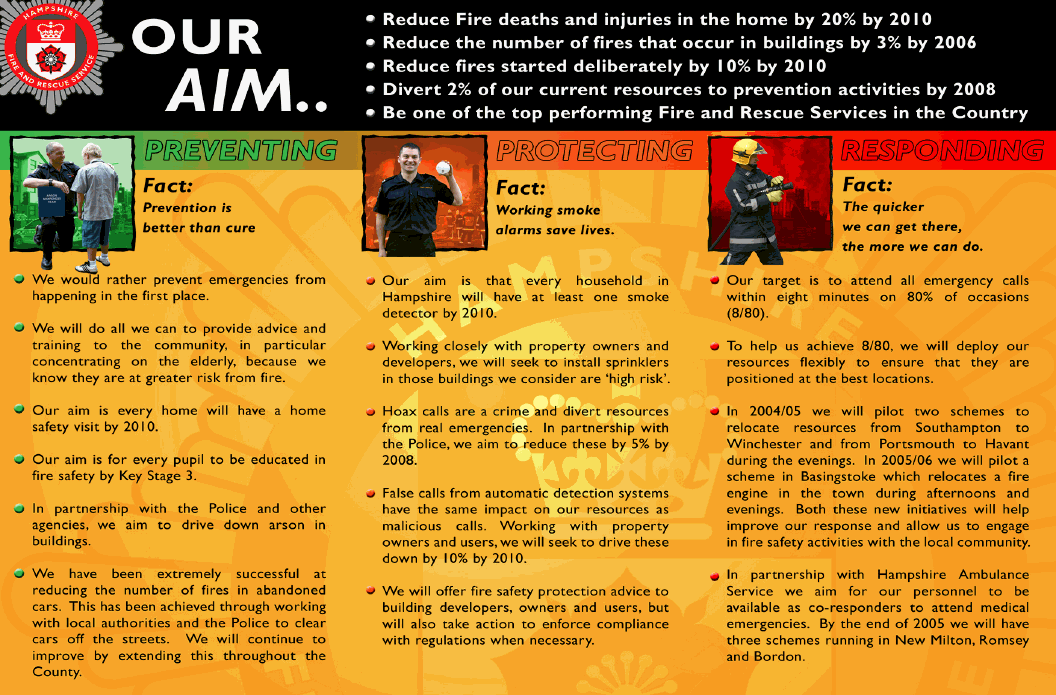
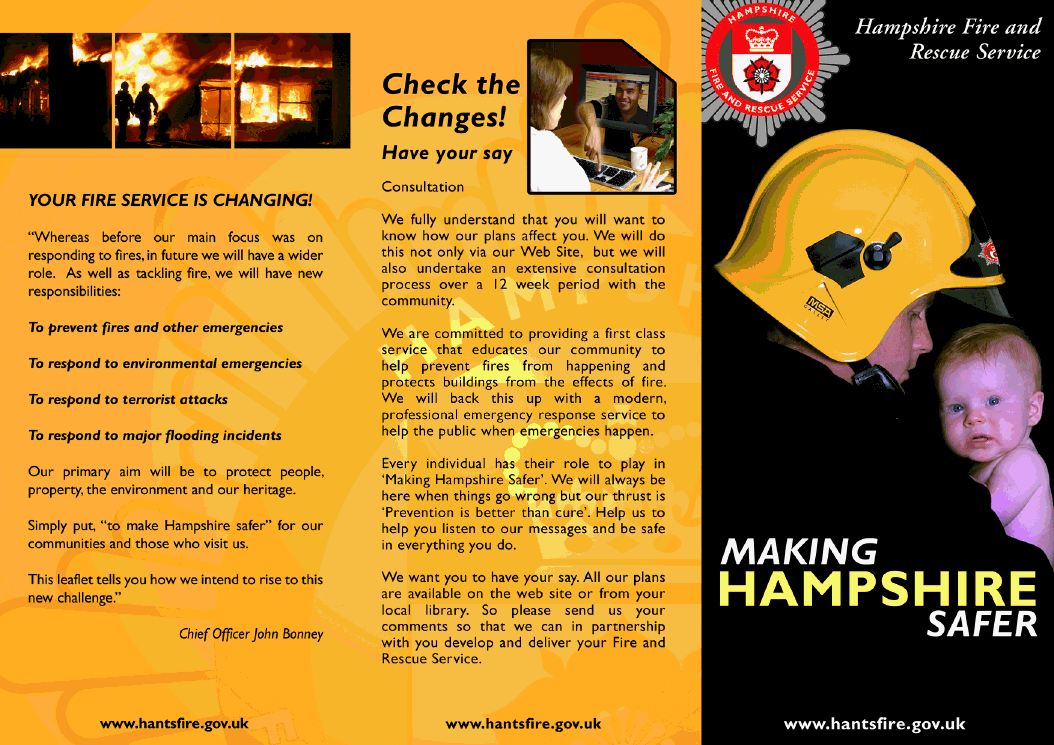
Authorities should ensure that their IRMPs are both accessible - to the public, business and other stakeholders - and easy to understand. Consultation with all members of the community must be given high importance and their views should be taken into account. Each year the Authority is expected to produce an annual action plan on which they have fully consulted their local communities, allowing 12 weeks for the consultation. This years consultation leaflet on the IRMP is attached as Appendix A. |
2.14 |
In determining the most appropriate method of delivering the IRMP, the Fire and Rescue Authority is expected to make effective and efficient use of its resources including the adoption of efficient working practices. Fire stations in the future may well become regarded as resource locations from which those resources are deployed to meet identified risks at other locations according to time of day or day of the week. |
2.15 |
IRMPs should be able to: - Identify existing and potential risks to the community within the area. - Evaluate the effectiveness of current preventative and response arrangements. - Identify opportunities for improvement and determine policies and standards for `preventing', `protecting' and `responding'. - Determine resource requirements to meet these policies and standards. |
2.16 |
More detailed information on the purpose of IRMPs as `frequently asked questions' is provided in Appendix B. |
3 |
The Hampshire IRMP |
3.1 |
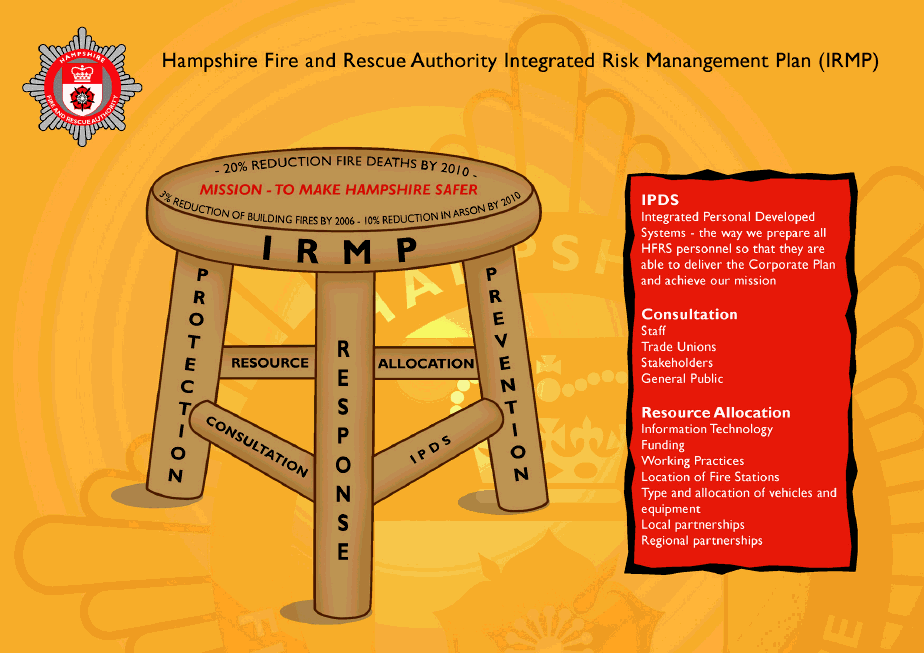
The Hampshire IRMP will be the method by which we achieve our corporate mission "TO MAKE HAMPSHIRE SAFER". |
3.2 |
The current key aims of the Hampshire IRMP are: - 20% reduction in fire related deaths by 2010. - 10% reduction in arson fires by 2010. - 3% reduction in building fires by 2006. - 2% transfer of resources from response to prevention/protection by 2006. - Place HFRA in the top 20% of best performing Fire and Rescue Authorities. |
3.3 |
The Plan will be supported by 3 functional `legs', each having specific action plans devised to achieve/drive key aims and to achieve our Mission. - Preventing - Protecting - Responding The inter-relationship of these factors is illustrated diagrammatically in Appendix C. |
3.4 |
The Hampshire IRMP is developed and reviewed by the Corporate Management Team (CMT) who meet on a regular basis. The CMT consists of lead HFRA Members and HFRS principal officers, supported by functional heads who implement and drive the policy of CMT and then prepare the plan for presentation by CMT to the HFRA. |
3.5 |
Following a good deal of preparatory work the Hampshire IRMP became effective on 1 April 2004. As Year 1 of the Plan was launched work began on shaping progress for future years. This can be summarised as follows: |
3.5.1 |
Prevention |
What we have achieved since April 2004: - The development of technology systems to produce a `risk map' for the county. Work is progressing well to integrate various existing information databases and conversion of that data into GIS format. This will provide the accurate management information on which targeted prevention work can be focused. - Analysis of the `Causes of Incidents' has helped to refine our Community Fire Safety (CFS) campaigns, focussing on specific themes. We have targeted identified vulnerable groups such as elderly people, focussing on the specific causes of fire within our campaigns. - In developing our prevention resources to improve the safety of the community we have given the newly appointed Group Managers clear direction as to the areas of focus for CFS activity and have set targets accordingly. This has redirected our response crews into more specific and targeted CFS activity such as the Home Fire Safety Check. - We are actively participating in partnership schemes with other agencies. We are now able to facilitate the provision of timely and accurate data. This has enabled Local Authorities to include in their 3 year plans activities that will support their aims as well as HFRS corporate aims. - Our pilot project with the Police relating to arson statistics (completion due November 2004) has served to highlight the discrepancy in arson figures between the 2 organisations. Working together we are now seeing a higher priority being given to this issue by both organisations with resulting diversion of resources to combat this area of crime. | |
What we intend to do: We are not content to just accept and maintain the high standards we already have. It is our commitment to the public that we will seek to make continuous improvements to the way the Fire and Rescue Service in Hampshire responds to preventing emergencies occurring. We have set some clear objectives for the future and these will be developed using our IRMP. These objectives are: - Smoke detectors: Achieve smoke detection in every household in Hampshire by 2010. - Older people: Work in partnership to target the older population to improve fire safety in their homes. - Arson reduction: Develop proactive and reactive arson reduction initiatives with the county, city, district and borough councils. - Schools education: Continue to improve delivery of our schools education programme at Key Stage 1, 2 and 3. - Youth initiatives: Develop programmes and work with young people in Hampshire to reduce arson and anti-social behaviour. - Warden schemes: Support local warden schemes by providing arson reduction training and accommodation on Service premises. - Risk information: Provide `risk focused' information to Group Managers to support local risk reduction initiatives. - Operational crews: Use our wholetime and part time operational crews to deliver Home Fire Safety Checks. | |
3.5.2 |
Protection |
What we have achieved since April 2004: - Awarded the contract for the replacement of our existing Fire Safety database with a community fire risk management information system. - Restructured Technical Fire Safety in line with the National Occupational Standards and Role Maps. - Played a lead role at national level in the preparation for the introduction of new Fire Safety legislation. - Introduced a risk based inspection programme and audit process in accordance with FP Act Circular 29. - Introduced development plans for Fire Safety Inspectors. - Implemented the outcomes of the Technical Fire Safety Best Value Review, where appropriate. - Completed a review of our administration processes. - Piloted post incident protocols in the North East of the county. - Seconded a Fire Safety Inspector to HCC with the aim of highlighting the benefit of sprinkler protection. | |
What we intend to do: - Inspect all very high and high risk rated premises at least once a year. - Produce risk management plans for selected premises. - Continue development of the community fire risk management information system facilitating flexible working. - Share risk information with both internal and external partners. - Extend our Fire Safety publicity and education activities. - Develop fire investigation protocols to consider Technical Fire Safety issues. - Publish risk management plans for each of the 3 delivery groups. - Work towards a quality assurance award for HFRS activities. - Work towards achieving professional registration of Fire Safety Inspectors. - Continue to develop internal and external partnerships to effectively reduce risk. - Finalise the restructure of Fire Safety offices in the TFS Group (North) to fully align Borough and District Council boundaries to TFS groups. | |
3.5.3 |
Response |
What we have achieved since April 2004: - We have developed our own response standards to replace the old `Standards of Fire Cover'. - A study has been completed that has informed us of the response times to emergency incidents from our existing fire stations in relation to our new response standard. - We are now conducting trials to improve our response times and provide more resources for Community Safety projects in areas of identified risk. Specifically, we have identified 3 areas (Basingstoke, Winchester and Havant) where we will trial alternative methods of utilising our resources during known periods of increased emergency response activity. - After consultation with the public we still respond to identified calls that are outside of our statutory duty. We continue to do this because of our commitment to the public we serve. - All of our resources are now classified as `Emergency' or `Non Emergency'. This allows us to use our resources in a more flexible manner to improve the service we provide. - We have reduced the number of vehicle movements that we make to unwanted calls from Automatic Fire Detection (AFD) systems. These calls have the same detrimental effect on the service we provide as a malicious call. By doing this we have more resources available to attend real emergencies. - We have developed new procedures and acquired more equipment to respond to the threat posed by international terrorism and from wide-scale natural disaster. | |
What we intend to do: We are not content to just accept and maintain the high standards we already have. It is our commitment to the public that we will seek to make continuous improvements to the way the Fire and Rescue Service in Hampshire responds to emergency incidents. We have set some clear objectives for the future and these will be developed using our IRMP. These objectives are: - We will continue to review the arrangements for providing the fastest response possible to any emergency situation in the county. This will include a review of the location of human resources and ensuring the correct type of vehicles and equipment is available to those resources to meet the identified risks. - We will explore new working arrangements to ensure that our human and physical resources are utilised efficiently and effectively at all times. - We will take positive steps to reduce the number of fire related deaths and injuries in line with our key aims by redeploying resources into Community Safety initiatives. - We will visit every home in Hampshire within the next 5 years to carry out a home fire risk assessment. This will include supplying and fitting smoke detectors as part of our commitment to reducing death and injury from fire. - To redeploy 2% of our human and physical resources into Community Fire Safety initiatives. - Introduce community responder schemes operating from our fire stations in collaboration with the Hampshire Ambulance Service. | |
4 |
Summary |
4.1 |
In Summary, what is Integrated Risk Management Planning? |
4.1.1 |
Integrated Risk Management Planning must take account of and be included in local community safety strategies. |
4.1.2 |
Integrated Risk Management Planning is not about making cuts: The allocation of resources may change in order to effectively manage the risk in an area. IRMP is about the effective management of risk, not cuts. Resources may be moved or made to work more effectively whilst maintaining the level of cover that is appropriate to the level of risk. Management has a responsibility to consult personnel on all change that will affect them. |
4.1.3 |
Integrated Risk Management Planning will allow Fire and Rescue Authorities to address the risks they encounter every day: Different areas face different levels of risk from fire. IRMPs will ensure that services are directed to address the incidents that are occurring within an areas based on, for example, analysis of past incidents, population, potential hazards, social deprivation and levels of fire protection. |
4.1.4 |
Integrated Risk Management Planning will focus on reducing the number of incidents occurring: Fire Authorities now have a duty to undertake Community Fire Safety work. IRMPs will outline how Fire and Rescue Authorities intend to reduce the incidence of fires and non fire related emergencies occurring in the first place. |
4.1.5 |
Integrated Risk Management Planning will include the consultation with the public before implementing any plan: Fire and Rescue Services will have a statutory duty to consult the public in respect of the Best Value requirements embodied in the 1999 Local Government Act. Effective consultation can act as a catalyst for greater community participation. A 12 week consultation will be expected as the plan is reviewed each year. |
4.1.6 |
Integrated Risk Management Planning will provide a new flexible approach to creating safer communities: IRMP is about providing Fire and Rescue Authorities with the freedom to manage the risks they encounter locally, rather than having this dictated centrally. IRMP will allow Fire and Rescue Services to deploy their services in the most efficient and effective way to both address current risks and reduce risk in the future. Savings may arise from more efficient working practices but this is not the reason why IRMP was introduced. |
4.2 |
Integrated Risk Management Planning will simply become part of core business for members of the HFRA and members of the HFRS alike. It is a fundamental part of our Corporate Plan and as such will be a strong influence for future budget setting strategies. It will also set many of the standards against which we will be judged and measured in the process of future audits and comparisons. It will, in particular, play an important role in relation to Comprehensive Performance Assessment (CPA). Simply put, we will stand or fall by its success. |
4.3 |
The full engagement of all HFRA members in the process of approving and implementing the Hampshire Integrated Risk Management Plan is vital to its success and ultimately achieving our mission of making Hampshire safer. |
5 |
European Convention on Human Rights and the Human Rights Act 1998 |
5.1 |
The proposals within this report are compatible with the provisions of the European Convention on Human Rights and the Human Rights Act 1998 and considered in the light of the Race Relations (Amendment) Act 2000. |
Recommendations | |
1 |
That Members of the Authority endorse the approach taken in developing the IRMP and note the progress that has been made to date. |
Section 100D - Local Government Act 1972 - Background Papers The following documents disclose the facts or matters on which this report, or an important part of it, is based and has been relied upon to a material extent in the preparation of the report. (Note: Insert here either the details of the background papers used or type the word `None' if no background papers used - Delete this paragraph) Note: The list excludes: (1) Published works (2) Documents that disclose exempt or confidential information as defined in the Act |
cehC/H/IntegratedRiskManagement3
25 August 2004
Appendix A
Appendix B
FREQUENTLY ASKED QUESTIONS
1 |
Could the Fire and Rescue Service reduce cover in high risk areas to reduce costs? No. Fire and Rescue Services have a duty to provide the appropriate cover to manage the level of risk. Any risk management plan will go through thorough public scrutiny. It must then be approved by the democratically elected body and be monitored by the Audit Commission. |
2 |
Will this affect the number of staff employed by a Fire and Rescue Service? It depends on the risk assessment. There could be an increase in the number of firefighters needed by the Fire and Rescue Authority if resources are found to be inappropriate for the level of risk found. Risk management is more likely to redeploy existing resources more effectively based on the level of risk, rather than reduce the available resources. |
3 |
Will the Fire and Rescue Service work to reduce the risk of fire in high risk areas? Yes. Fire and Rescue Services will have to increase community safety and reduce risk as well as attend fire and non fire incidents. This will involve reducing the number of fires and other incidents, deaths and injuries through fire and non fire incidents. Fire and Rescue Services will also have to maintain the status quo in low risk areas as well. |
4 |
What are the most likely changes to cover? It is difficult to say what will be the precise changes, if this were possible, we'd be back to where we were previously with a nationally prescriptive system. However, the most likely changes suggested by statistics on fire and fire deaths are that residential areas will be recognised as the most high risk areas requiring the highest priority cover. Around 80% of deaths from fires occur in these areas. City centre and industrial areas are likely to become lower risk as they tend to be heavily protected with sprinkler or other high levels of protection in general. These areas will still be adequately protected by the Fire Service although the new system is recognising the lower risk of fire and fire deaths occurring. There are also likely to be changes on cover during the day and night to better reflect the changing level of risk throughout a 24 hour period. Residential areas have a far higher risk of fire and death at night so cover should reflect this. There will also be a movement of resources to cover non fire related incidents (car accidents, etc), that have grown nationally from 85,000 in 1979 to the current 180,000. IRMPs will be able to assess the risk of non fire incidents and address these when managing resources. |
5 |
How will decisions made within the IRMP be monitored? IRMP will be monitored in a number of different ways: - All plans will go out to public consultation. - IRMPS are the responsibility of the Fire and Rescue Service, which includes elected members responsible to their electorate. - The Audit Commission will monitor all plans. |
6 |
What are the links between IRMP and Civil Resilience (New Dimension)? Any risk management plan will have to take account of the threats from either terrorism or natural disasters. The White Paper gives Fire and Rescue Services the duty to address these issues and therefore they should form part of any plan. |
7 |
What are the links with the new Civil Contingencies Bill and IRMP? As with Civil Resilience, the role of Fire and Rescue Services as category one responders in the Civil Contingencies Bill will have to be reflected in any plan and contingencies made for large scale terrorist attack or natural disaster. |
Once the Bill is enacted, Fire and Rescue Authorities will be under a duty to work in co-operation with other emergency services, local authorities and front line responders at the local level to: - Assess the risk of an emergency occurring. - Put in place emergency contingency plans and conduct exercises to ensure that they can both prevent and respond to emergencies. - Establish business continuity management arrangements so that an authority can function in an emergency. - Share information with other local emergency responders. - Inform the public about civil protection in order to reduce, control or mitigate the effects of emergencies. |
cehC/H/IntegratedRiskManagement3
25 August 2004
Appendix C