
Archived decisions
Supported Housing Commissioning Plan
2004/5
Hampshire County Council Social Services Department
Contents
1. What is the context in which we operate? p.3
· National Context p.3
· Regional Context p.4
· Local Context p.10
2. What are we trying to achieve? p.17
3. Where are we now? P.18
4. What are the gaps that we must bridge?
How will we go about it? p.27
5. Improvement Plan p.35
6. Budget Overview p.51
1. What is the context in which we operate?
1. Central Government Initiatives:
Generic:
Central Government has made radical changes to the way that housing and support are delivered locally. The first of these changes is Supporting People. The second is the establishment of the Regional Housing Board, which takes over some of the responsibilities of the Housing Corporation and some of the responsibilities of the district councils. This includes funding for Social Housing (LASHG).
_ Supporting People, info available: (see Chapter 5; Stakeholders)
_ Regional Housing Strategy (See chapter 2)
Information on its development at:
http://www.go-se.gov.uk/key%20business/housing/housingrhs.html
1.2 Older Persons:
Central government is promoting services that enable people to live in their own homes safely and for longer. In particular, it is targeting extra-care housing, intermediate care and home improvement agencies.
_ National service framework, available at:
_ Extra care housing for older people: An introduction for commissioners available:
http://www.doh.gov.uk/changeagentteam/commissioners03.pdf
_ Housing-based models of care: Learning and Improvement Network, available at:
www.doh.gov.uk/changeagentteam/housing-lin.htm
_ Quality and Choice for Older person's Housing; the Story so Far, available; www.housing.odpm.gov.uk/information/hsc/olderpeople/storysofar/pdf/qcoph.pdf (Nov 2002)
_ Developing Older People's Strategies: Linking Housing to Health, Social Care and Other Strategies.
1.3 Children and Families:
The new approach to housing means that housing departments have to include consideration of 16-18 year olds in their housing strategy.
_ Quality protects, info available:
_ Research findings from the University of York
_ The Children's taskforce, info available :
http://www.doh.gov.uk/childrenstaskforce/about.htm
1.4 Mental Health:
_ National Service Framework, available at:
http://www.doh.gov.uk/nsf/mentalhealth.htm
_ Making it happen:
1.5 Physical Disability:
_ The disabled facilities grant, info available at:
1.6 Learning Disability:
_ Valuing people, available:
2. The Regional Context
The South East, overall, is a prosperous and densely populated region, with 8 million people living within 7,000 square miles. The housing stock is generally old, with a low level of new build. A large proportion of the population live in rural areas. Recent sharp increases in house prices have meant that much private housing is not affordable for people on low and medium incomes. Key workers choose to live in other areas. People on low incomes are faced with the possibility that their house may suffer from decay and they might have little choice over where they live.
The Office of the Deputy Prime Minister (ODPM) has recently re-organised the housing function to give new responsibilities to the Regional Housing Board, which produces a Regional Housing Strategy. This contains a new approach to commissioning housing. The Regional Housing Board holds funding for housing investment, which combines funding previously allocated to the Housing Corporation's Approved Development Programme and local authorities Housing investment Programme. This money is now used to fund developments within the framework of the strategy. The Regional Housing Board have identified 9 priority areas for funding:
· Priority 1 To meet the need for affordable housing.
· Priority 2 To help key workers access accommodation.
· Priority 3 To reduce homelessness and rough sleeping.
· Priority 4 To meet the needs of those who require supported housing.
· Priority 5 To meet the housing needs of black and minority ethnic people and asylum seekers.
· Priority 6 To improve the quality and suitability of the housing stock.
· Priority 7 To promote regeneration & neighbourhood renewal.
· Priority 8 To encourage the development of sustainable rural areas.
· Priority 9 To support crime reduction through housing provision.
The Government is considering how best to increase the allocation of funding through the Regional Housing Statements. It will therefore be important for Housing Associations and Local Authorities to reflect the priorities of the Regional Housing Statement in the development of their future Housing Investment Strategies.
Housing Capital Allocations
Under the new arrangements, Regional Housing Boards were established in each region to make recommendations to Ministers on how housing investment resources should be allocated to address strategic housing priorities. The new arrangements cover housing funds allocated to local authorities and to housing associations. The South East Regional Housing Board has made recommendations on where funds should be allocated in the region and the broad activities it should support, e.g. the provision of new affordable housing, key worker housing, areas of regeneration.
N.B. the Housing Corporation has retained a role in ensuring that new social housing stock is built. Local authorities have a more strategic role in ensuring affordable housing supply meets need, as identified in the housing and homelessness strategies.
The Strategy (for the South East)
1. Summary
The strategy states that the South East is economically a successful area, resulting in prosperous people being attracted to live here and buy properties. There are also huge income disparities within the region and a shortage of housing. The strategy aims primarily to do two things:
1. to make alterations to the planning system so that there are more opportunities to develop in towns where housing is needed.
2. To provide incentives to developers so that they build in these areas.
This should make housing more affordable for the most vulnerable. To achieve this, the strategy focuses on addressing five areas:
1. Housing Supply
2. Affordability (including inexpensive housing for key workers)
3. Regeneration and neighbourhood renewal.
4. Homelessness and supported housing
5. Quality and suitability
2. Key Areas
The strategy identifies key areas for development (drawn from an assessment of available land). Hampshire has some key areas, but none of which have already been allocated growth funding.
Hampshire does have a number of areas termed Key Strategic Growth Points, which may receive funding. These are:
1. Ministry of Defence land in Rushmoor
2. Land west of Waterlooville
3. Basingstoke
4. Andover
This is not a comprehensive list of land as the Regional Housing Board would welcome other suggestions.
3. Overall Priorities
The Regional Housing Board suggest the following weightings to influence distribution of funding:
Key workers 25%
Homelessness 25%
Prospective Home Owners 20%
Additional Care & Support 15%
Other Priority Need 10%
Black and Minority Ethnic groups 5%
The capital allocated to "Additional Care & Support" will be supported by revenue from local authorities and Supporting People.
2004/6 South East Regional Housing Board Allocations by District Council
District Council |
Main programme |
|
Key Worker Programme |
|
Total |
|
Works to HA stock | ||||||
Rent |
Intermed Mkt rent |
Shared own'ship |
Homebuy market |
Homebuy newbuild |
Intermed mkt rent |
Shared own'ship |
Homebuy newbuild | ||||||
|
|
|
|
|
|
|
|
|
|
|
|
|
|
Bas & Deane |
10,663 |
0 |
1196 |
0 |
0 |
|
406 |
500 |
1007 |
|
13,772 |
|
0 |
East Hants |
4,544 |
93 |
439 |
45 |
0 |
|
654 |
1702 |
252 |
|
7,730 |
|
0 |
Eastleigh |
6316 |
0 |
163 |
0 |
52 |
|
559 |
1514 |
513 |
|
9117 |
|
0 |
Fareham |
2604 |
0 |
0 |
0 |
0 |
|
0 |
1130 |
0 |
|
3734 |
|
0 |
Gosport |
2314 |
0 |
310 |
0 |
0 |
|
0 |
180 |
0 |
|
2804 |
|
0 |
Hart |
2586 |
0 |
758 |
180 |
0 |
|
0 |
442 |
0 |
|
3966 |
|
0 |
Havant |
2010 |
0 |
0 |
0 |
0 |
|
500 |
1706 |
0 |
|
4216 |
|
0 |
New Forest |
5528 |
1 |
653 |
0 |
0 |
|
757 |
249 |
0 |
|
7188 |
|
0 |
Rushmoor |
5191 |
0 |
1777 |
211 |
0 |
|
0 |
4264 |
621 |
|
12064 |
|
129 |
Test Valley |
2530 |
195 |
210 |
0 |
0 |
|
0 |
0 |
0 |
|
2935 |
|
170 |
Winchester |
3690 |
0 |
535 |
3122 |
0 |
|
424 |
175 |
0 |
|
7946 |
|
474 |
|
|
|
|
|
|
|
|
|
|
|
|
|
|
TOTAL |
47976 |
289 |
6041 |
3558 |
52 |
|
3300 |
11862 |
2393 |
|
75472 |
|
773 |
Local Authority Housing Capital Allocations (£ thousands) |
||||||||||||||
Region/local authority |
Allocations 2004/05 |
|
Provisional Allocations 2005/06 | |||||||||||
Housing |
Private |
Housing |
Private |
|||||||||||
Capital |
Sector |
Total |
Capital |
Sector |
Total | |||||||||
South East |
Allocation |
|
Renewal |
|
Allocation |
Allocation |
|
Renewal 1 |
|
Allocation | ||||
Regional Total |
84,200 |
2,500 |
86,700 |
87,499 |
2,500 |
89,999 | ||||||||
Basingstoke and Deane |
898 |
- |
898 |
934 |
- |
934 | ||||||||
East Hampshire |
752 |
- |
752 |
781 |
- |
781 | ||||||||
Eastleigh |
586 |
- |
586 |
609 |
- |
609 | ||||||||
Fareham |
650 |
- |
650 |
675 |
- |
675 | ||||||||
Gosport |
791 |
- |
791 |
822 |
- |
822 | ||||||||
Hart |
371 |
- |
371 |
386 |
- |
386 | ||||||||
Havant |
923 |
- |
923 |
959 |
- |
959 | ||||||||
New Forest |
1,435 |
- |
1,435 |
1,491 |
- |
1,491 | ||||||||
Rushmoor |
805 |
- |
805 |
836 |
- |
836 | ||||||||
Test Valley |
648 |
- |
648 |
674 |
- |
674 | ||||||||
Winchester |
853 |
- |
853 |
886 |
- |
886 | ||||||||
3. Hampshire: the local environment
Population
The population of Hampshire in 2001 was 1,240,800, an increase of 62,100 or 5.3 per cent since 1991. This compared with increases of 2.6 per cent in England and Wales, and 5.0 per cent in the South East Region as a whole in the same period.
Within Hampshire, the highest numerical and percentage increase in population occurred in Eastleigh (9,700 or 9.1 per cent), closely followed by Winchester (8,900 or 9.0 per cent), Test Valley (8,600 or 8.5 per cent) and Fareham (8,500 or 8.5 per cent).
The population of Havant declined by 2,900 or 2.4 percent. There was also a small population loss of 100 persons in Gosport.
The population in the unitary authority of Southampton increased by 12,800 or 6.2 per cent. It is likely that a substantial proportion of this increase is attributable to students. The population of the unitary authority of Portsmouth has remained virtually unchanged since 1991.
Changes in age structure 1991 - 2001
As in 1991, the age structure of Hampshire's population in 2001 was very similar to the national average.
Between 1991 and 2001, the proportion of Hampshire's population aged 45 and over increased from 37.0 per cent to 41.4 per cent. During the same period, the proportion of the population aged 65 years and over increased from 14.9 per cent to 18.3 per cent.
Changes in the age structure of the population are predominantly the result of the pattern of births in former years. Thus, the largest increase between 1991 and 2001 was people in the 50 to 59 age range, whose numbers increased by 44 thousand or 35 percent, the result of the arrival in this age band of the post-second world war baby boom.
Conversely, the largest decrease was in persons in the 20 to 29 age band, whose numbers decreased by 40,600 or 23.3 percent, the result of the arrival in this age band of the very small cohorts born in the second half of the 1970s.
The numbers of children aged under 5 years declined by 6,900 or 8.8 per cent, but the numbers of children of school age (5 to 15 years) increased by 15,600 or 9.6 per cent as a result of the larger number of births in the late 1980s and early 1990s compared with the previous ten years.
The largest percentage increase was in persons aged 85 years and over, whose numbers increased by 7,900 or nearly 45 per cent. The numbers of people aged 75 to 84 years also increased by almost 10,000 or about 16 per cent.
The largest percentage increase was in persons aged 85 years and over, whose numbers increased by 7,900 or nearly 45 per cent. The numbers of people aged 75 to 84 years also increased by almost 10,000 or about 16 per cent.
The largest percentage increase was in persons aged 85 years and over, whose numbers increased by 7,900 or nearly 45 per cent. The numbers of people aged 75 to 84 years also increased by almost 10,000 or about 16 per cent.
Conversely, the population of Havant declined in every 5 year age band under 45 years, with the exception of the numbers in the 10 to 14 and the 35 to 39 age bands. The populations in the younger age bands also declined by significantly more than the County average in the younger age groups in East Hampshire and Gosport.
Population estimates and projections for South East Region
Population forecasts for the South East indicate that current trends will continue and the fastest growing group will be those of pensionable age, increasing from 18.8% of the population in 2001 to 23.3% in 2021. There is a corresponding fall predicted in the percentages of young people aged 0 to 19 from 24.7% to 22%, and those aged 25 to 44 falling from 28.9% to 24.8%.
Census 2001
|
Total population |
Percentage of people aged: | ||||||||
|
0-9 |
10-15 |
16-29 |
30-44 |
45-59 |
60-64 |
65-74 |
75-84 |
85+ | |
152,573 |
13.31 |
7.87 |
16.76 |
24.89 |
20.23 |
4.51 |
6.92 |
4.13 |
1.39 | |
109,274 |
12.24 |
8.17 |
14.61 |
22.65 |
21.36 |
5.11 |
8.24 |
5.46 |
2.15 | |
116,169 |
12.77 |
8.27 |
15.99 |
23.43 |
20.06 |
4.70 |
7.81 |
5.22 |
1.76 | |
107,977 |
11.52 |
8.07 |
14.04 |
22.92 |
20.70 |
5.34 |
9.43 |
5.90 |
2.08 | |
76,415 |
12.62 |
7.95 |
18.34 |
22.88 |
17.56 |
4.47 |
8.54 |
5.61 |
2.04 | |
83,505 |
12.57 |
7.88 |
16.12 |
24.12 |
21.53 |
5.05 |
7.02 |
4.17 |
1.55 | |
116,849 |
11.59 |
8.36 |
14.54 |
21.01 |
20.03 |
5.55 |
10.43 |
6.38 |
2.12 | |
169,331 |
10.78 |
7.41 |
12.56 |
19.94 |
20.92 |
5.76 |
11.12 |
8.44 |
3.05 | |
90,987 |
13.95 |
7.48 |
21.02 |
25.34 |
16.86 |
3.75 |
6.14 |
4.02 |
1.42 | |
109,801 |
12.75 |
8.21 |
14.58 |
23.43 |
21.08 |
4.94 |
7.92 |
5.17 |
1.93 | |
107,222 |
11.21 |
7.41 |
17.16 |
21.34 |
20.74 |
4.97 |
8.69 |
5.99 |
2.48 | |
186,701 |
11.83 |
7.54 |
22.10 |
22.85 |
16.20 |
4.13 |
7.37 |
5.90 |
2.09 | |
217,445 |
11.47 |
6.81 |
26.87 |
20.36 |
16.01 |
3.94 |
7.16 |
5.57 |
1.82 | |
132,731 |
10.59 |
7.61 |
13.19 |
19.04 |
21.22 |
5.98 |
10.93 |
8.27 |
3.17 | |
1,240,103 |
12.23 |
7.90 |
15.69 |
22.76 |
20.22 |
4.98 |
8.53 |
5.64 |
2.04 | |
1,644,249 |
12.08 |
7.72 |
17.89 |
22.46 |
19.21 |
4.74 |
8.22 |
5.66 |
2.02 | |
1,776,980 |
11.97 |
7.71 |
17.54 |
22.20 |
19.36 |
4.84 |
8.42 |
5.86 |
2.10 | |
Census 2001 - Housing data
|
Owner occupied |
Rented from |
||||||
|
Owns outright |
Owns with a mortgage or loan |
Shared ownership |
Council (Local Authority) |
Housing Association/ Social Landlord |
Private landlord or agency |
Other | |
61,722 |
24.21 |
48.73 |
0.55 |
0.68 |
16.74 |
5.87 |
3.24 | |
43,625 |
33.41 |
43.93 |
0.47 |
1.05 |
10.44 |
6.61 |
4.08 | |
47,001 |
29.96 |
50.87 |
0.54 |
1.12 |
10.63 |
5.13 |
1.75 | |
43,577 |
35.70 |
49.83 |
0.58 |
5.71 |
1.95 |
3.77 |
2.46 | |
31,337 |
27.27 |
44.28 |
0.51 |
11.74 |
6.04 |
5.72 |
4.43 | |
32,470 |
30.81 |
50.01 |
0.57 |
0.41 |
7.98 |
6.31 |
3.91 | |
48,460 |
32.14 |
41.49 |
0.40 |
10.91 |
8.49 |
4.24 |
2.32 | |
71,985 |
41.76 |
38.45 |
0.43 |
6.74 |
3.39 |
6.12 |
3.12 | |
35,263 |
24.62 |
47.60 |
0.71 |
1.27 |
13.98 |
6.66 |
5.16 | |
44,134 |
29.08 |
44.85 |
0.58 |
5.53 |
8.43 |
7.04 |
4.48 | |
43,132 |
32.43 |
37.79 |
0.30 |
11.70 |
4.27 |
8.56 |
4.95 | |
78,719 |
25.33 |
38.77 |
0.73 |
13.33 |
5.19 |
12.91 |
3.75 | |
91,217 |
22.99 |
33.76 |
0.81 |
19.09 |
5.05 |
15.56 |
2.74 | |
57,519 |
41.67 |
34.49 |
0.80 |
0.91 |
9.15 |
9.95 |
3.03 | |
502,706 |
31.60 |
44.88 |
0.50 |
5.13 |
8.41 |
5.97 |
3.51 | |
672,642 |
29.70 |
42.66 |
0.57 |
7.98 |
7.57 |
8.08 |
3.43 | |
730,161 |
30.64 |
42.02 |
0.59 |
7.42 |
7.70 |
8.23 |
3.40 | |
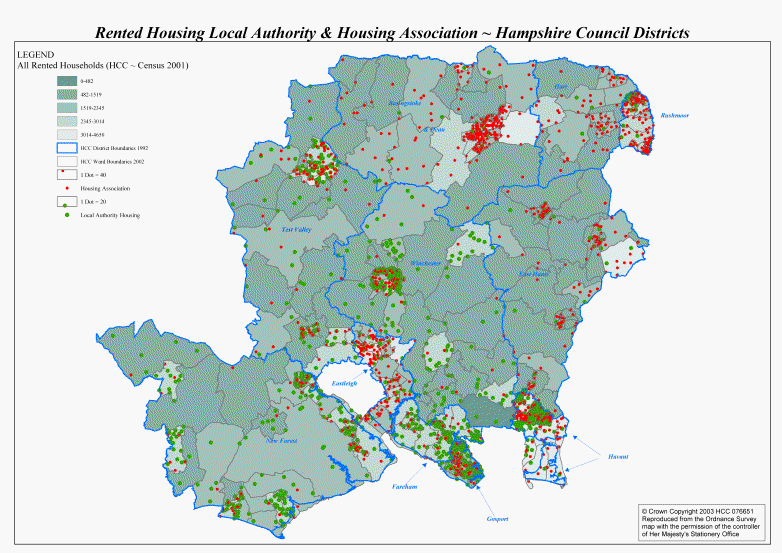
Hampshire is a large, generally affluent county with pockets of deprivation. 40% of the population live in rural areas. Although the South East has the highest house prices outside London, prices in Hampshire do not rate as particularly high in relation to income. A report from the Joseph Rowntree foundation (Can work, Can't Buy) lists 20 areas in the South East where people do not earn enough to support a mortgage. The only area in Hampshire to appear on the list is Havant (where the average income is low) in 18th place.
House prices are however still relatively high and are therefore not affordable for many people to purchase or rent privately. People who use Social Services may live in any type of housing. However, the move to decrease the number of people living in residential care and support people living in their own homes, together with the high cost of owner-occupation, in many cases means a move towards social housing, provided by one of the Registered Social Landlords (RSL's). Social Services therefore has an interest in promoting this type of housing and in helping their service users to gain access to it.
Provision will be made in local plans for the development of 63,960 additional dwellings in Hampshire between April 1996 and March 2011, with the following distribution between the Districts:
|
Total |
Basingstoke and Deane |
12,060 |
East Hampshire |
5,500 |
Eastleigh |
6,295 |
Fareham |
4,740 |
Gosport |
2,980 |
Hart |
4,750 |
Havant |
2,990 |
New Forest |
5,480 |
Rushmoor |
2,980 |
Test Valley (North) |
6,160 |
Test Valley (South) |
2,730 |
Winchester |
7,295 |
|
|
Hampshire |
63,960 |
Out of the total provision of 63,960 additional dwellings, provision for 12,000 dwellings will be met by the development of new communities in line with the individual MDA Policies and will be distributed as follows:
District |
Total |
Basingstoke |
4000 |
South East of Eastleigh |
3000 |
Andover |
3000 |
West of Waterlooville |
2000 |
|
|
Total |
12,000 |
In addition to this, a reserve housing provision will be identified in local plans to accommodate up to 14,000 additional dwellings in the period 2001-2011, distributed as follows:
in Northern Hampshire |
|
in East Hampshire District |
1500 dwellings |
in Hart District |
1500 dwellings |
Winchester City (north) MDA |
2000 dwellings |
in Basingstoke and Deane District |
500 dwellings |
Basingstoke MDA |
1500 dwellings |
|
|
in South East Hampshire |
|
West of Waterlooville MDA |
1000 dwellings |
in Fareham District |
1500 dwellings |
in Havant District |
500 dwellings |
|
|
in South West Hampshire |
|
in Eastleigh District |
1500 dwellings |
South East Eastleigh MDA |
1000 dwellings |
in southern Test Valley |
1000 dwellings |
in New Forest District |
500 dwellings |
The need for allocations of land to be released to accommodate this reserve provision will be determined by the local and strategic planning authorities. The strategic planning authorities will only support the release of individual greenfield sites to meet this where Structure Plan and Local Plans indicates there is a compelling justification to do so.
What are we trying to achieve?
The aim of the supported housing function is to enable more people to live safely in their own homes longer.
The Supported Housing function of the Social Services Department is geared towards helping the department and the County Council perform better against Corporate aim no. 5, Improving Services. This includes:
_ Increasing access to services in a way that suits the consumer.
_ Shaping services around users' needs and ensuring they are flexible enough to take account of changing circumstances and requirements.
This enables the department to perform better against the following performance indicators:
Adults with physical disabilities helped to live at home. | |
Adults with learning disabilities helped to live at home. | |
Adults with mental health problems helped to live at home. | |
Older People helped to live at home (BVPI 54). |
Where are we now?
We are presently working on the following issues:
The Supported Housing Planning System
The Social Services Department needs to ensure that it is able to respond as effectively as possible to the housing needs of its service users. Through improved use of IT systems and the Housing allocation panels, we need to be able to gather better quality information on the quantity, location and type of housing that are required, to engage in meaningful planning negotiations with partner agencies who will deliver this housing.
It is the aim of the department that people who use its services should be able to live in a socially integrated environment.
Social services service users can gain access to social housing via the Special Needs Housing Allocation panels, held at district level. In this arena, housing supply is considered alongside people needing housing and housing is allocated.
Negotiations with Supporting People
1. SHMG
Supported Housing Management Grant (SHMG) was originally allocated to housing schemes by the Housing Corporation. When Supporting People was established (with the objective of amalgamating all housing related support funding), SHMG was transferred from the Housing Corporation to Supporting People. Supporting People cannot directly fund registered care, so the decision was taken to withdraw this funding. The total amount to be withdrawn is £1,051,707 with £629,186 having been withdrawn in April 2004.
Some service providers, facing a reduction in their overall funding, are looking to the service purchasers to increase their contribution. The Social Services Department are presently in negotiation with providers concerning the viability of their services.
2. Reductions in the overall level of Supporting People funding.
Supporting People established itself in the belief that it would retain all legacy funding until the first review of each service. This proved to be a false premise, with the ODPM asking SP teams to make savings from the first year of their existence. It seems likely - from the Robson Rhodes independent review of Supporting People - that further cuts will be made in the future. The view of the Social Services department is that these reductions in funding should be met by improved efficiency in the first instance, rather than direct cuts to services for service users. This view is supported by the Robson Rhodes findings, notably the comment that Supporting People is not delivering value for money.
3. Departmental engagement in the supporting people process
Partnership managers play a key role in the Supporting People planning process. They have the responsibility for representing the department at the Supporting People District Core Groups, where local spending priorities are set and local funding decisions are made.
Client group representatives at local level need to ensure that the partnership manager is kept fully informed of client group priorities. The partnership manager will be ensuring that links are made to local implementation groups and teams so that overall priorities can be considered. (See diagram p.32).
Extra-care Housing (Very Sheltered Housing)
Extra-care housing has not been defined by central government. Locally, we are working with the following definition:
"People who have tenancies in schemes and receive personal and/or social care, can choose in what manner they receive that personal care and are able to deny entry to their property to other people."
Characteristics of the scheme will be:
1. Self-contained accommodation (not bed-sits, a one-bed flat would be a minimum),
2. 24 hour care cover providing a flexible level of support determined by individual assessments.
3. All accommodation to be fully accessible and to wheelchair standard
This year, the DoH have announced a new target to increase the numbers of people being cared for in extra-care housing by 6,900 by 2005/06 from a baseline of 20,300 in 2000.
(For extra-care provision see App. 5)
We are presently working on the following issues:
Home Improvement Agencies
Improvement Agencies project manage home improvements and give advice on funding. They also help people to apply for grants if they are available.
Home improvement agencies exist to help people maintain the physical structure of their houses so that they are fit to live in, are suitable for the people living in them and do not present a hazard. The service is for people who rent privately or who own their own homes. People who rent from a social landlord presently have their repairs and adaptations done by the landlord, who is funded to do this.
Home improvement Agencies therefore help people to live in their own homes longer and help people to be discharged from hospital to their own homes. Appendix 3 shows that Winchester and Test valley are the only areas in Hampshire that do not presently have a Home Improvement Agency. During 2003 we worked closely with the Supporting People Team, Home Improvement Agency providers, and district councils to develop a bid for ODPM funding for a Home Improvement Agency for Winchester, Test Valley and East Hants. This bid was successful and we are confident we will have a Home improvement Agency in all districts by the end of 2004.
Telecare
We are investigating and piloting the use of telecare for older people in a variety of settings across the county in partnership with district councils and PCTs. Huntleigh's Insight Active Support Environment (formerly Millennium Homes) is a computer-based support system which involves placing small detectors in critical points around a person's home, such as their fridge or back door. These sensors detect significant abnormality in a person's movement or activity. When they do they contact the person via telephone and/or loudspeaker and give them the opportunity to rectify the situation. If there is no response then the system will contact somebody outside the home. This is being piloted in two areas across the county, with at least one more pilot planned for 2004/05. Also being piloted is the Tunstall system. This is similar but does not allow the person to the interact with the system in the same way, instead contacting a call centre if a sensor is triggered. Some of the pilots will involve testing the Insight Active Support Environment System and the Tunstall system side by side. Pilots are also currently taking place of systems in residential homes in the county, with a view to installing some form of telecare system in the new nursing homes if it proves to be of use.
Floating support
Floating support is low-level support that people are able to receive regardless of where they live. It is the type of support that might be provided, for example, by a warden in sheltered accommodation, but a person would not have to live in a sheltered housing scheme to receive it. They could live anywhere.
Floating support exists to help people to stay in their own homes, either through maintaining a tenancy or through helping people to live in the homes that they own. This helps to prevent evictions and helps prevent unnecessary admissions to residential care or to hospital. Floating support helps the department meet its targets on helping people to live in their own homes.
In the past, floating support has been funded by the Social Services department and the District Councils. Recently there has been a large increase in this funding, mainly through a one-year investment by the SSD, which is now being funded by Supporting People. The Social Services areas still make a contribution to the services as well.
The Social Services Department now has an opportunity to refer people who need low level care (no personal care). Contacts for the Floating Support Schemes are given in Appendix 2.
Strengths:
_ Early-intervention service that prevents people from developing more acute needs.
_ Bridges the service gap between warden support in sheltered housing for Older Persons and residential care.
_ Quick referral route through the district council or Social Services Department.
_ Meets all low level housing-related support needs across all client groups.
Areas for Improvement:
_ Service not always effectively accessed by area offices.
_ Some schemes running at full capacity.
Since the advent of Supporting People, the Social Services Department funds very little floating support. However, many social services service users may also have a need for housing-related support, so it is important that there continues to be cross-referrals between organisations
"Special Needs" Housing Need by District
The following table indicates the percentage and numbers (in brackets, where available) of people with support needs by District Council boundary. It also shows adaptations to property.
|
|
B&DBC |
EHDC |
Eastleigh BC |
Fareham BC |
Gosport BC |
Havant BC |
Hart DC |
NFDC |
Rushmoor BC |
TVBC |
WCC |
|
Total number of dwellings |
60,281 |
45,137 |
|
40,989 |
|
|
|
|
|
44,882 |
43,146 |
Information about needs of residents |
| |||||||||||
1. |
All households including person with a disability |
17% |
16% |
16% |
9.6% |
|
|
|
17.5% |
|
17% |
14% |
The following refer to percentages of households including someone with a disability. | ||||||||||||
2. |
H.h. incl. disabled person over 60 |
58% |
|
|
|
|
|
|
69% |
|
65% |
|
4. |
H.h inc. person with a mobility problem |
47% |
49.3% |
30.9% |
|
|
|
|
45.7% |
|
47%(3,998) |
52% |
5. |
H.h. inc. a wheelchair user. |
10% |
12.9% |
6.4% |
|
|
|
|
10% (1800) |
|
12% |
9% |
6. |
H.h. inc. person with a mental health problem |
|
|
6.8% |
8.5% |
|
|
|
8% |
|
|
|
7. |
H.h. inc. person with l.d. |
|
|
3.6% |
7.5% |
|
|
|
4% (497) |
|
|
|
8. |
H.h. inc. person with p.d. |
|
|
23.8% |
47.8% |
|
|
|
|
|
|
|
9. |
H.h incl person with sight/hearing difficulties |
|
|
12.8% |
13.5% |
|
|
|
|
|
|
|
|
|
|
|
|
|
|
|
|
|
|
|
|
|
|
B&DBC |
EHDC |
E'l BC |
Fare BC |
Gos. BC |
Hav. BC |
Hart DC |
NFDC |
RBC |
TVBC |
WCC |
Information about adaptations to property | ||||||||||||
10. |
% of all dwellings adapted to meet needs of person with a disability |
|
|
|
|
|
|
|
8.9% |
|
11% |
25% |
The following figures refer to a percentage of the totals listed in row 10 | ||||||||||||
11. |
% of these dwellings wheelchair adapted |
19% |
7% |
|
|
|
|
|
|
|
18% |
17% |
12. |
% of these dwellings with handrails/grabrails |
50% |
25% |
|
|
|
|
|
|
|
53% |
57% |
13. |
% with bathrooms adapted |
43% |
19% |
|
|
|
|
|
|
|
37% |
40% |
14. |
% with improved access |
|
|
|
|
|
|
|
|
|
|
36.8% |
15. |
% with stairlift/vertical lift |
|
|
|
|
|
|
|
|
|
|
17.2% |
16. |
% of wheelchair users living without wheelchair adaptations |
81% |
|
|
|
|
|
|
|
|
72% |
|
14. |
% of these households receiving support |
|
|
|
1674 |
|
|
|
540 |
|
|
|
15. |
% of these household receiving intensive support |
|
|
|
|
|
|
|
46% (244) |
|
|
|
Winchester as an Example of demand for services
Many of the Districts Housing Needs Strategies indicate a mismatch between adapted properties and occupiers who require adaptations. As an example, Winchester City Council states that "only 8% of wheelchair adapted properties are occupied by wheelchair user. 456 households are not adapted to needs of the occupiers" . Similarly, with support, Winchester states that "44% (3110) of household members with a disability indicated a need for care/support. Of these, 74% were receiving sufficient care/support."
Of those still requiring support, people identified the following support as being required:
Care/support |
% responses |
% households |
Nos. implied |
Claiming welfare benefits/ managing finance |
22.7% |
46.1% |
397 |
Supervising health/well-being |
7.6 |
15.4 |
133 |
Emotional support/managing behaviour |
10.8 |
22.1 |
190 |
Establishing social contacts/activities |
16.3 |
33.1 |
285 |
Establishing personal safety/security |
7.8 |
15.8 |
136 |
Advice/advocacy |
15.3 |
31.2 |
269 |
Looking after your home |
4.2 |
8.5 |
73 |
Access training/employment |
15.3 |
31.2 |
269 |
Total |
100.0 |
|
1,752 |
Adaptations by tenure
Tenure |
% |
Numbers |
Owner occupied with mortgage |
4.1 |
702 |
Owner occupied no mortgage |
10.1 |
1598 |
Private rented |
5.5 |
136 |
Council rented |
18.9 |
953 |
HA rented |
25.4 |
452 |
Shared ownership |
15.7 |
17 |
Tied to employment |
7.0 |
63 |
Types of adaptations still needed for current occupier
Adaptations |
% responses |
% households |
Numbers of households |
Bathroom adaptation |
26.9 |
41.5 |
1,807 |
Handrails/grabrails |
17.1 |
26.3 |
1147 |
Stairlift/vertical lift |
13.7 |
21.1 |
919 |
Extension |
11.9 |
18.3 |
798 |
Ground floor toilet |
9.5 |
14.7 |
640 |
Access to property |
7.4 |
11.5 |
501 |
Wheelchair adaptations |
7.1 |
10.9 |
475 |
Other |
6.4 |
10.0 |
434 |
Total |
100.0 |
154.3 |
6287 |
Accommodation for elderly relatives required in next 5 years
|
% responses |
% households |
Numbers of households |
Live with respondent (but need extension/adaptation) |
18.3 |
23.6 |
898 |
Residential care/nursing care |
18.5 |
23.8 |
907 |
Private sheltered housing |
23.5 |
30.2 |
1150 |
Council/HA sheltered housing |
11.0 |
14.1 |
539 |
Private housing |
15.8 |
20.3 |
773 |
Live with respondent (Existing home adequate |
8.0 |
10.4 |
394 |
Council/ HA housing |
4.9 |
6.3 |
242 |
|
|
128.7 |
4903 |
This information is available from all District Councils through their Housing Needs Surveys.
What are the gaps that we must bridge? How will we go about it?
This section records the housing priorities identified by the client groups in their commissioning plans.
Older Persons
The older persons Commissioning Strategy Action Plan gives the commissioning priorities as:
1. Improving performance on intensive Home Care through implementation of local C28 Service Plans.
2. Continue development of community based intermediate care schemes.
3. Identify resources and outcomes from Supporting People applicable to Older People.
4. Promote and evaluate pilot projects of the Millennium Homes concept.
5. Establish priority needs of Older People with respect to housing provision in each locality especially extra care housing.
6. Secure appropriate housing with support to assist with preventing unnecessary admissions to hospital and effecting timely discharge.
Action taken so far has been:
· Develop a proposal for extra-care housing in Test Valley (Andover). This proposal was not successful in attracting DoH funding but may be developed anyway through locally agreed funding.
· Develop a proposal for extra-care in Gosport in accordance with revised DoH bidding criteria. This is likely to be large scale, of notable design and will include communal facilities.
· Work with the Change Agent Team and localities within Hampshire to map local housing need for local people and consider viable provision.
· Commission research into Extra-care housing that will map demand and supply across Hampshire, develop proposals for Extra-care and examine alternative methods of service provision.
· Development of a draft extra-care strategy.
· Piloting of telecare systems across the county.
Children and Families
The children and families section gives the following targets for housing related services:
1. Increase the Accommodation Choices for young people (including Care leavers) especially emergency provision.
2. Identify strategically the need in relation to housing using the care leavers monitoring systems.
3. Have mechanisms in place for assessing young people using the housing needs using a single assessment tool under the joint working agreement protocol in place with SSD and the District councils.
4. Ensure ALL district councils are fully signed up to the joint working agreement Protocol.
5. Access and have representation on the housing panels in partnership with the district councils.
6. Have a working partnership with the Supporting People team to maximise funding streams to integrate Care Leavers into their local community.
7. Provide information from the Care Leavers service about the range of accommodation available to the young people and t their accommodation options and their responsibilities.
8. Work alongside Supporting People and Housing Authorities to agree a "preferred model" of housing for teenage parents that best suit their individual needs.
Standards
1. All young people in need will have access to suitable accommodation to meet their assessed needs.
2. Young People will be fully involved in determining their accommodation needs.
3. All young People will have an a housing needs assessment completed.
4. Provide Quarterly reports to the county young persons accommodation steering group on housing allocation and priority needs.
5. Establish strong working links with housing providers and monitor appropriately.
Priorities
1. Increase the provision in emergency accommodation and have a range of options available.
2. Contract out Supported Lodgings to Registered Social Landlords.
3. Develop the Young Adult Placement County Service.
4. Improve the access to floating support service particularly in relation to young parents.
5. Work with Children and Families section to promote continuity of Commissioning Officer post for Children and Families.
Action taken so far has been to:
· Establish an agreement with the adult placement service to deliver a service to young people leaving care who require a homely "base" , such as young people away at university who would benefit from living with a family during the holidays.
Mental Health
The majority of people with mental health needs live in their own accommodation but a small but significant number of people are housed in designated schemes. Clearly, there is a link between homelessness and mental health needs and the SP programme encompasses all these service users. SP exists to provide services for all three groups
It is imperative that permanent housing and housing related support are seen as an integral part of the local multi-agency approach. Mental Health Local Implementation Teams (LITs) led by Primary Care Trusts are an important means of linking SP with relevant mental health strategies.
The National Service Framework (NSF) sets targets to improve standards in services for people with mental health needs and the Local Delivery Plan sets targets for service developments over the next three years.
These include:
· Countywide Mental Health Housing Strategy Group comprising health and social care to coordinate initiatives and work on county wide issues for mental health housing in the whole system.
· Ensure that LITs have subgroups for housing to identify local needs and links exist from the LIT to DIFs, DCGs to ensure Mental Health priorities are heard (see The Supported Housing Consultation and Decision-making Structure, following this section).
· Ensure care coordination involves assessment and frequent review of service users' housing need thereby adopting a proactive approach to enable move on and maximising independence.
· 24 hour crisis resolution
· home treatment services
· assertive outreach
· respite breaks for carers
Reviews of mental health, homelessness and housing needs have been undertaken in the County and in the Districts, including a Best Value review of residential care and housing needs for people with mental health problems. The Action Plan identified the following key issues:
_ should be available for people with severe mental health problems in all tenures
_ generic floating support is very appropriate for this group
_ women only services should be available locally
Action taken so far has been to:
_ appoint a temporary worker to assess the housing needs of a discrete group of people with mental health problems in North Hants and aggregate this need into a cohesive plan.
_ Appoint a temporary housing-related support worker to respond to the needs of people with mental health problems attached to the Meadows.
Physical Disabilities
The Physical and sensory disability commissioning plan aims to develop OT Direct as the first point of contact for Occupational Therapy referrals. This will ensure a consistency of service, standardise practice, reduce duplication and divert a proportion of referrals directly to equipment services, home improvement agencies and technicians services.
The plan aims to improve performance on performance indicator C38 (Percentage of equipment and adaptations delivered within seven working days - this includes all equipment and minor adaptations that do not require structural work).
We will work with District councils to reduce waiting times for Disabled Facility Grants.
Action taken so far has been to:
· Link Hampshire OT Direct to the Home Improvement Agencies for the rapid delivery of minor items of equipment and adaptations.
· Develop and submit a bid for the county-wide coverage of Home Improvement Agencies.
· Work is planned, using the Supported Housing Officer Group (SHOG) as a forum, to develop a county-wide database of adapted properties. This should enable people requiring adapted properties to have an overview of the availability of these properties and to reduce the present mismatch between adapted properties and people who require adapted properties.
Learning Disabilities
The Hampshire Learning Disabilities Partnership Board has written a Housing and Support Strategy. It states that people with learning disabilities in Hampshire will have access to a full range of accommodation options, with appropriately skilled care and support staff. They will have the same choice in accommodation as is available to other citizens in similar circumstances.
Action taken so far has been to:
· Work with the voluntary sector on the Futurebuilders project so develop a bid for Treasury funding for major capital investment aimed at young people reaching adulthood, to prevent costly and poor quality out-of-county placements.
Supporting People
Supporting People "went live" in April 2003. It has offered both life-changing opportunities for vulnerable people and a number of organisational difficulties to be overcome.
Through the Supporting People programme, 25,000 people are supported to live in their own homes. Of these, approximately 5,000 would not otherwise have had this opportunity. It has substantially improved the quality of life for many people who require support.
These establishment of this new system has not been without its teething problems. Those that have had a significant impact on the Social Services Department are listed below, wherever possible with a solution outlined.
· The adoption of block contracts with service providers initially meant the people receiving services paid for by Supporting People could not move to different accommodation. This was a severe limitation on a someone's personal freedom and as such was contrary both to the ethos of the Social Services Department and to the aims of the Supporting People Commissioning Body.
The Commissioning Body agreed that a contingency fund should be established to enable people to move to different accommodation without losing the required support.
· The removal of SHMG from Registered Care Homes poses genuine difficulties to the providers of registered care homes affected by this withdrawal. The Supporting People team agreed to delay the withdrawal of this funding until April 2005 and to ring-fence this money to meet Social Services department objectives for supported living schemes within the grant criteria for Supporting People.
· The Supporting People Team has recently introduced two additional mechanisms to reduce expenditure;
1 A funding cap (referred to in other documents as "Quartiles"). This has meant that some services have had the majority of their funding withdrawn. As a result of the 2003/4 reviews, approx £2.44 million will be withdrawn due to these caps. This measure result s in a reduction in service to the service user.
2. A limit of £20 per hour of support to be paid to providers. A further £1.18 million will be withdrawn from services due to this limit. This measure should not affect the service offered to service users but will reduce profits to the providers.
There will therefore be a total reduction in full-year funding of £3.62 million. The same methodology will be applied to the 2004/5 and 2005/6 reviews, so similar cuts are to be expected for these years.
The funding caps, or quartiles, used by the Supporting People Team are as shown below;
Client Group |
Accomodation Type |
Lower Quartile |
Upper Quartile |
Frail Elderly People |
Very Sheltered Housing |
£27.00 |
£50.00 |
Sheltered Housing |
£16.00 |
£34.00 | |
Generic Services |
Unregistered Adult Placement |
£255.00 |
£328.00 |
Supported Housing |
£50.00 |
£171.00 | |
Floating Support |
£41.00 |
£92.00 | |
Homeless Families with Support Needs |
Supported Housing |
£13.00 |
£93.00 |
Offenders or People at risk of offending |
Supported Housing |
£112.00 |
£268.00 |
Older People with Support Needs |
Very Sheltered Housing |
£13.00 |
£43.00 |
Supported Housing |
£4.00 |
£37.00 | |
Floating Support |
£26.00 |
£64.00 | |
Sheltered Housing |
£4.00 |
£15.00 | |
People with a Physical or Sensory Disability |
Supported Housing |
£11.00 |
£169.00 |
Floating Support |
£54.00 |
£205.00 | |
People with Drug Problems |
Supported Housing |
£77.00 |
£212.00 |
People with Learning Disabilities |
Unregistered Adult Placement |
£175.00 |
£258.00 |
Supported Housing |
£130.00 |
£401.00 | |
Floating Support |
£85.00 |
£432.00 | |
Registered Adult Placement |
£84.00 |
£137.00 | |
Residential Care Home |
£25.00 |
£254.00 | |
People with Mental Health Problems |
Supported Housing |
£78.00 |
£207.00 |
Floating Support |
£42.00 |
£99.00 | |
Residential Care Home |
£64.00 |
£248.00 | |
Single Homeless People with Support Needs |
Supported Housing |
£55.00 |
£177.00 |
Floating Support |
£42.00 |
£70.00 | |
Teenage Parents |
Supported Housing |
£123.00 |
£208.00 |
Supported Housing / Floating Support |
|||
Women at Risk of Domestic Violence |
Supported Housing / Refuge |
£177.00 |
£274.00 |
Young People at Risk or Leaving Care |
Supported Housing |
£93.00 |
£249.00 |
Floating Support |
£39.00 |
£107.00 | |
Foyer for Young People |
Foyer for Young People |
£80.00 |
£198.00 |
Improvements to planning systems and information
Information on housing needs has not previously been collected through the assessment process of ACMS. With the development of SWIFT, it so now possible for housing needs to be included as part of the assessment and for the information to be aggregated for planning purposes.
Action taken so far has been to:
· Work with the IT sector to include housing within the SWIFT development and implementation process.
· Work with SHOG to identify the key information needed for housing planning purposes.
At present the system is not producing the information needed to form the basis of a robust planning system. It must be a matter of priority for the department to ensure that the systems outlined work to keep people properly informed.
Improvement to the Structure
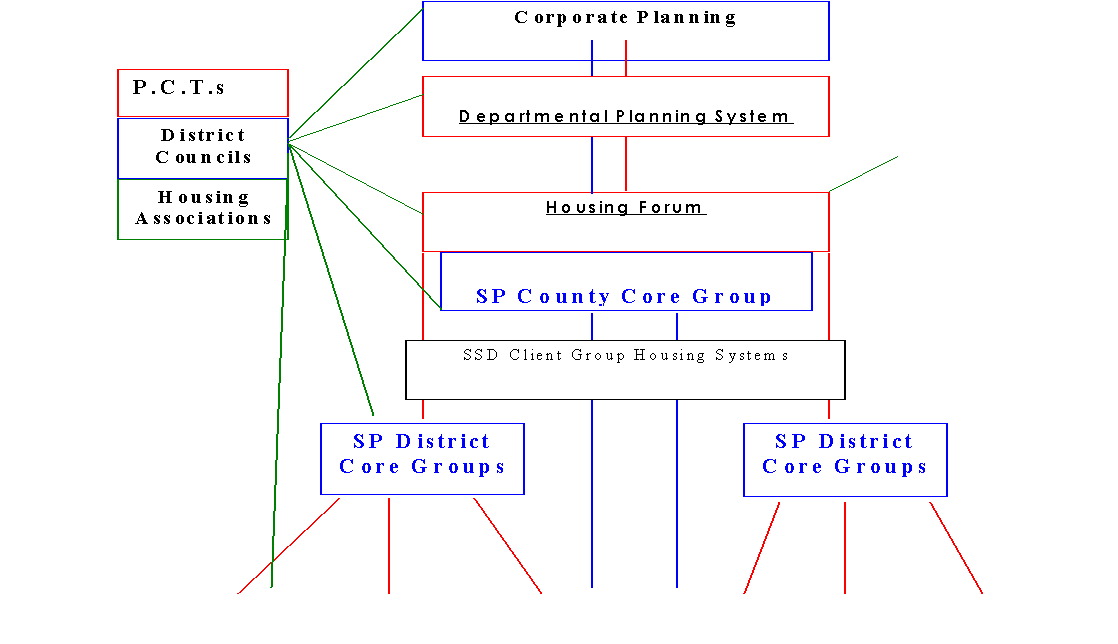
Regular meetings will be held with all client groups , and information will be shared and disseminated through the Housing Forum. This will improve the information flow to Partnership managers when they make funding decisions for their locality, and should ensure that the department as a whole has their voice heard at the Supporting People County Core Group.
Partnership managers have a key role for the local planning and prioritising of housing-related support services. It is to be anticipated that some funding will be saved through the review process. 50% of all funding saved will devolved to the Supporting People District Core Groups to be spent on local priorities. Partnership managers will represent the social services interests in these funding decisions.
Partnership managers should receive feedback from local planning groups such as LIT's and LIG's. They can also use the Supported Housing Forum as a resource for obtaining information on client group priorities.
50% of the funding will stay within the decision-making processes of the County Core group. The Supported Housing Forum will discuss all decisions to be made at the County Core group, so that the departmental view is represented.
The Structure will be as illustrated on the following page:
The Supported Housing Consultation and Decision-making Structure


Housing Corporation

Improvement plan
Supported Housing Expenditure 2004/5 and Projected Improvement in Performance
1. Increase in the county-wide capacity to deliver Extra-care housing
Outcome: Increase in numbers of people living in extra-care housing | ||||||||
Performance Measure |
Current performance |
Target performance |
Action |
Cost |
Saving |
Date |
Responsibility | |
Capital |
Revenue | |||||||
C32 Older People helped to live at home (BVPI 54) |
201,650
|
201,725 Increase of 50 Extra-care flats, supporting 75 people. |
See Extra-care strategy |
Total: £360,000 |
£65,000
|
Example A: £703,456
|
April 2006 |
Martha Fowler-Dixon, Caroline England, OP Operational Service Managers, Partnership managers
|
Example B: £428,898 | ||||||||
Details of Extra-care development | ||||||||
0 Extra care flats |
15 Extra-care flats |
Gosport Reprovision |
£140,000 |
£17,727
|
A: £131,898 |
April 2006 |
MFD, CE, Jane Selvege, Nicki Pendleton | |
B: £80,418 | ||||||||
O Extra-care flats |
10 Extra-care flats |
Basingstoke reprovision |
£50,000 |
£11,818 |
A: £87,932 |
April 2006 |
MFD, CE, Rosemary Gould, Christina Sell | |
B: £53,612 | ||||||||
3 extra-care schemes; 94 flats |
10 extra-care flats |
New Forest development |
£20,000 |
£11,818 |
A: £87,932 |
April 2006 |
MFD, CE, Behrooz Vaezi, Pauline Owen | |
B: £53,612 | ||||||||
O Extra-care flats |
8 extra-care flats |
Romsey reprovision |
£50,000 |
£9,454 |
A: £70,346 |
April 2006 |
MFD, CE, Robert Blunden. | |
B: £42,890 | ||||||||
I Extra-care scheme; 17 people |
12 Extra-care flats |
Andover reprovision |
£50,000 |
£14,181 |
A: £105,518 |
April 2005 |
MFD, CE, Lyn Middleton | |
B: £64,334 | ||||||||
Notes
1. Hourly rate for Extra-care is approximately £7.20 - £8.50 per hour, compared to £9.50 to £12.50 for Dom care, due to economies of scale.
Example worked on paying £7.80 per hour.
2. Assume paying £300 - £350 per week for residential care, with £80-£85 being re-imbursed through charging.
3. Extra-care costs based on Warner Court Extra-care provided by HVHS:
Provides Extra-care for 17 people at cost of £45,000 per year.
Majority of tenants have some degree of early-onset dementia.
24 Hour cover provided by sleeping night staff.
Cost per person per week, Extra care: £50.90
Net cost per person per week in residential care: £220
Cost of 2 hours per day Dom care, per week: £154
Saving per person per week/per year compared to Residential care: £169.10/£8,793.20
Saving per person per week/per year compared to Domiciliary care: £103.10/£5361.20
4. Example A shows savings to be made from people living in Extra-care housing rather than moving to residential care.
It is based on the following assumptions:
· 50% of the extra-care flats are for single people, 50% are for couples, providing housing for 75 people.
· Costs for extra-care are same as those paid at Warner court.
· Supporting People contributes £2124 per person per year.
· Net costs paid for residential care are £220 per week:
75 people at £220 per week is £16500 per week.
Annual cost is £16500 x 52 = £858,000
· Cost of extra-care is £50.90 per week. For 75 people this is £3817.50 per week, £198,510 per year.
· Savings of extra-care over residential care is £858,000 - £198,510 = £659,490 per year.
5. Example B shows savings to be made from people living in Extra-care housing rather than receiving 2 hours domiciliary care per week (no night cover).
It is based on the following assumptions:
· 50% of the extra-care flats are for single people, 50% are for couples, providing housing for 75 people.
· Costs for extra-care are same as those paid at Warner court.
· Supporting People contributes £2124 per person per year.
· Net costs paid for domiciliary care average £11 per hour, £154 per week for 2 hours per day.
75 people at £154 per week is £11550 per week.
· Annual cost is £11550 x 52 = £600,600
· Cost of extra-care is £50.90 per week. For 75 people this is £3817.50 per week, £198,510 per year.
· Savings of extra-care over domiciliary care is £600,600 - £198,510 = £402,090 per year.
Please note that Supporting People funding varies greatly from one Extra-care scheme to another. The above example is worked on the example of Warner Court where the annual contribution is £36108.37 per year in total. Supporting people is presently paying £112,387 for 12 people in Fernhill EMI Extra-care.
Comparison:
Example worked on annual SP payment per person per year of £2,124.
Fernhill EMI Extra-care SP payment per person per year of £9,399.
Savings for extra-care worked out on the following assumptions:
Payment of an average hourly rate of £10 per hour for care.
Support costs met by Supporting People.
Please note that the revenue costs indicated are the start-up costs. Ongoing revenue costs will be paid from the Older persons budget, as an alternative to residential care. As such, the savings are to be anticipated from the Older Person's revenue budget.
The Supported housing revenue budget will be used as bridging to relieve pressure on the OP budget during the transition from one service to another. It is not anticipated that bridging finance will last longer than three months.
Please note - the outcome of increased extra care is consistent with the Older Persons Extra-care Strategy reproduced below:
Extra Care Housing Strategy - draft 2
The aim of this strategy is to develop extra care provision in Hampshire so that it is available as a housing option to older people across the county.
The strategy is part of the Commissioning Strategy Action Plan for Older People. It contributes to Objective One - to promote the independence of older people by enabling them to remain in their own homes wherever possible. It also has links with the Hampshire Supporting People Strategy and other key strategic documents.
Actions |
Outcomes |
Progress |
Timescale |
Priority |
Map current provision across the county |
Comprehensive list of schemes across the county produced |
Completed - in Housing Position Statement |
Completed |
1 |
Work with district councils, local providers and service managers to identify developments and future plans. This work to be tied into the Extra Care Housing Fund bids to the Department of Health |
Good links with all district councils and major providers. Service managers are included in and contribute to developments. |
Autumn 2003 - all district councils have been approached to see what plans they have. Visits have taken place to Fareham and Gosport, East Hants, Basingstoke, New Forest and Test Valley. Relevant service managers have attended meetings or have been kept informed. |
Ongoing |
1 |
Put in bid for Year One of Extra Care Housing Fund |
Successful bid which provides Hampshire with at least one new extra care scheme. |
Areas with no or few extra care schemes have been prioritised. |
November 17th 2003 |
1 |
Commission research into extra care housing |
Develop a knowledge base and identify good practice. |
Initial meeting with researcher has taken place. Proposal is being drafted. |
Research to be completed by March 2004 |
1 |
Ensure consistency of practice and procedures across county in terms of charging for services, meal provision, etc |
Clear criteria for provision of extra care housing in Hampshire |
Some discrepancies have been identified and work has begun to address them. |
Ongoing |
2 |
Put in bid for Year Two of Extra Care Housing Fund |
Robust bid developed on a partnership basis focusing on areas with no or few extra care schemes |
Bid to be submitted autumn 2004. Build on work identified in visits to district councils in autumn 2003. |
Autumn 2004 |
2 |
Develop and strengthen links between Supporting People programme and extra care housing and identify any funding opportunities |
Clear links between Supporting People programme and sheltered housing provision and the development of extra care housing |
Supporting People officers have been involved in the Extra Care bid to the Department of Health. List of all schemes funded by Supporting People for older people has been obtained. |
Ongoing. |
1 |
Identify opportunities to use assistive technology in extra care schemes |
Assistive technology to be considered in all new schemes and used as appropriate |
Some schemes already have assistive technology. New schemes will be encouraged to utilise it. |
Ongoing |
2 |
Investigate models of extra care provision for people with dementia |
Schemes for people with dementia developed in line with best practice and take into account evaluations of current schemes |
Rowan Court in Eastleigh is for people with dementia and will be evaluated. Other models will be identified. |
Ongoing |
2 |
Learn from extra care developments across the UK |
Developments in Hampshire based on good practice |
Resources will be used including websites and conferences. |
|
2 |
Keep a watching brief on new schemes and contribute as appropriate. |
New schemes developed as part of this strategy, utilising expertise of strategic service managers for housing and older people |
CE has visited Rowan Court in Eastleigh and has attended a steering committee meeting. A visit to Place Court in Aldershot is planned |
|
2 |
Raise the profile of extra care housing across the county |
Extra care recognised across the county as a housing option |
Give presentations, email information and put it on agendas of meetings as appropriate. |
Ongoing |
2 |
Disseminate good practice on extra care housing |
Good practice used to inform progress in this strategy |
Utilise good practice documents and evaluations and disseminate to a wider audience. |
Ongoing |
2 |
Alternative outcome 1: additional funding to provide housing for client groups affected by the withdrawal of SHMG
In April 2004, Supporting people withdrew £629,186 from residential care. Funding had been allocated to schemes as SHMG (Supported Housing Management Grant) by the Housing Corporation. This money was transferred from the Housing Corporation to supporting People, who cannot fund residential care. The decision was therefore made to withdraw this funding.
This change has meant that providers are approaching the social services department for additional funding for services affected. To counteract this additional cost to the SSD. Supporting People has agreed for £250,000 SP funding to be ring-fenced for new services, which are within SP eligibility criteria. This is unlikely to meet the cost of reprovision, meaning that additional funding will be needed either from this budget or from the client group budgets. Reprovision schemes have not yet been developed, but one option would be for the money ring-fenced for extra-care in 2004/5 to be spent on these projects.
2. Ensuring that more people who require adaptations live in adapted properties
Outcome: County-wide coverage of Home Improvement Agencies | |||||||
Performance Measure |
Current perf. |
Target perf. |
Action |
Cost |
Date |
Resp. | |
Cap |
Rev | ||||||
Decrease in
C26 Admissions of supported residents aged 65 or over to residential/nursing care. C27 Admissions of supported residents aged 18-64 to residential/nursing care. Increase in:
Adults with physical disabilities helped to live at home. C30 Adults with learning disabilities helped to live at home. C31 Adults with mental health problems helped to live at home. C32 Older People helped to live at home (BVPI 54). D40 Clients receiving a review (BVPI 55) E49 Assessments of older people per head of population (BVPI59) E50 Assessments of adults and older people leading to provision of service(s)
|
Yearly flow: 920 accountable to SSD
|
1050 accountable to SSD |
Establishment of new HIA to provide service to East Hants, Winchester, Test Valley. |
Total: £0 |
£26k
|
April 2006 |
Martha Fowler-Dixon, Helen Eaton, Angela Watwood.
|
Outcome: Home Improvement Agencies to deliver minor aids and adaptations | |||||||
Performance Measure |
Current perf. |
Target perf. |
Action |
Cost |
Date |
Resp. | |
Cap |
Rev | ||||||
Increase in: C38 Equipment and Adaptations delivered within seven working days |
29,973 |
Increase accountable to HIA's;
300 |
HIA link to OT Direct |
£0 |
£0
|
April 2006 |
Martha Fowler-Dixon, Helen Eaton, Angela Watwood.
|
Outcome: Home Improvement Agencies to assist in prevention of housing-related delayed discharge and prevent unnecessary admissions | ||||||||||
Performance Measure |
Current perf. |
Target perf. |
Action |
Cost |
Date |
Resp. | ||||
Cap |
Rev | |||||||||
Increase in:
C29 Adults with phys. dis. helped to live at home, C30 Adults with learning dis. helped to live at home. C31 Adults with m. h. problems helped to live at home. C32 Older People helped to live at home (BVPI 54). D31 Delayed transfers of care |
4 per 1000 2 per 1000 2.9 per 1000 62.5 per 1000
|
To prevent all housing-related delayed discharge. |
Additional agreements with HIA providers to prevent housing-related delayed discharge. |
unk |
Unk.
|
April 2006 |
Martha Fowler-Dixon, Helen Eaton, Caroline England, Lyn Waite
| |||
Outcome: development of a county-wide database of adapted properties to assist matching housing to housing needs | ||||||||||
Performance Measure |
Current perf. |
Target perf. |
Action |
Cost |
Date |
Resp. | ||||
Cap |
Rev | |||||||||
Increase in: C29 Adults with phys. dis. helped to live at home, C32 Older People helped to live at home (BVPI 54). |
4 per 1000 62.5 per 1000 |
|
Establish database with all District Council housing departments |
£50 |
£0
|
April 2006 |
Martha Fowler-Dixon, Helen Eaton, Angela Watwood.
| |||
3. Improving access of Social Services Service Users to Social Housing
Outcome: Consistency of outcomes from District Council housing allocation procedures | |||||||
Performance Measure |
Current perf. |
Target perf. |
Action |
Cost |
Date |
Resp. | |
Cap |
Rev | ||||||
Increase in: C29 Adults with physical disabilities helped to live at home, C30 Adults with learning disabilities helped to live at home. C31 Adults with mental health problems helped to live at home. C32 Older People helped to live at home (BVPI 54).
|
4 per 1000 2 per 1000 2.9 per 1000 62.5 per 1000
|
|
Improve the consistency and outputs of the Housing Allocations Panels
|
£0 |
£0 |
April 2006 |
Helen Eaton, Caroline England
|
4. Improve IT support for the Housing Planning process
Performance Measure |
Current perf. |
Target perf. |
Action |
Cost |
Date |
Resp. | |
Cap |
Rev | ||||||
Increase in: C29 Adults with physical disabilities helped to live at home, C30 Adults with learning disabilities helped to live at home. C31 Adults with mental health problems helped to live at home. C32 Older People helped to live at home (BVPI 54).
|
4 per 1000
2 per 1000
2.9 per 1000
62.5 per 1000
|
To provide district councils with robust information of the departments housing requirements. |
Establish information required for housing development. Include information in SWIFT assessment of need
|
£0 |
£0 |
April 2006 |
Martha Fowler-Dixon, Stevie Jennings District councils
|
Budget overview 2004/5
Supported Housing Capital Budget
Capital allocation |
Amount carried forward from 2003/4 |
Total |
Projected expenditure | |
1. |
£100,000 |
£260,000 |
£360,000 |
£360,000 |
Capital expenditure by project | |
Scheme |
Amount |
EXTRA CARE | |
Gosport reprovision |
£140,000 |
Basingstoke reprovision |
£50,000 |
New Forest development |
£20,000 |
Romsey reprovision |
£50,000 |
Andover reprovision |
£50,000 |
County-wide database for adapted properties |
£50,000 |
Total |
360,000 |
Supported Housing Revenue TX84 H4421
Revenue allocation |
Projected expenditure | |
1. |
£193,000 - £25,000 temp virement |
£168,000 |
Revenue expenditure by project | |
Scheme |
Amount |
EXTRA CARE | |
Gosport Reprovision |
£17,727 |
Basingstoke reprovision |
£11,818 |
New Forest development |
£11,818 |
Romsey reprovision |
£9.454 |
Andover reprovision |
£14,181 |
Housing support project - North Hants |
£36,000 |
Housing support project - Meadows |
£27,000 |
Older Persons Housing Research |
£8,000 |
Eastleigh Floating Support |
£10,000 |
Adult Placement Review |
£10,000 |
Commissioning Officer @ 50% |
£22,000 |
Total |
£167,998 |
HIA's and handyperson services TX84 H4420
Revenue expenditure by project - | |
Scheme |
Amount |
Budget - £163,000 + £26,000 from OP budget |
£189,000 |
Basingstoke HIA (Southern Focus Trust) |
£20,000 |
Eastleigh HIA (Southern Focus Trust) |
£13,500 |
Fareham HIA (Southern Focus Trust) |
£7,500 |
Gosport HIA (Southern Focus Trust) |
£7,500 |
Havant HIA (Southern Focus Trust) |
£15,000 |
East Hampshire HIA (Hyde) |
£16,120 |
Hart/Rushmoor HIA (Hyde) |
£20,400 |
New Forest Staying Put (Community First) |
£20,000 |
Fareham Handyperson |
£5,000 |
Gosport Handyperson |
£5,000 |
Basingstoke Handyperson |
£5,250 |
Havant and Petersfield Handyperson |
£10,000 |
Eastleigh Handyperson |
£7,000 |
Winchester/Test valley - ongoing |
£26,000 |
Winchester/Test Valley - start-up |
£10,000 |
TOTAL |
£188,270 |
Name of Service/ Function _______________________________________________________________________
Please provide a brief description of the function/service
Are you aware of any race equality implications arising from this function/service ?
Briefly summarise
Do your service policies/procedures and strategies make reference to race equality where relevant ?
YES / NO
Please outline below any work you may have carried out to assess, monitor, address and review the race equality implications of your function.
Consultation |
||
Monitoring |
||
Access to Information/Services |
||
Marketing/ Promotion |
||
Target Setting |
||
Training Staff / Briefings |
||
Review / Evaluation |
||
Other |
||
What issues has the above raised if any ?
Briefly outline what further action you will take to address the race equality issues raised.