Archived decisions
Hampshire County Council Executive Member - Social Care Item 7 IT to support Mobile Working in Social Services Report of the Director of Social Services |
Contact: |
Ken Howard |
Ext: |
7332 |
E-mail: |
1 Background
1.1 The National Priorities and E-Government Outcomes published by the ODPM has established a requirement for all authorities to provide online facilities to allow "ICT support and documented policy for home/remote working [for staff]" and "Access to home/remote working facilities."
1.2 IT for mobile working has been identified as potentially offering substantial benefits to the Social Services and other Departments. These have been documented in the department's draft e-Government Improvement Strategy and include:
· Time savings for social workers
· Support for flexible working and associated improved work - life balance
· Assisting recruitment and retention of social workers
· Savings in office accommodation costs
· More efficient processes and improved data accuracy
· Enabling the achievement of a full electronic social care record and savings in paper file storage
1.3 These benefits are likely to be similar for other Department's with a mobile workforce. An investment in the common corporate infrastructure, therefore, has the potential to yield substantial wider benefits across the County Council.
1.4 The full implementation of SWIFT by the Children and Families sector has reinforced the requirement to enable social workers to use SWIFT and other systems directly while out of the office, rather than having to make notes and return to base to undertake this task. Also the pressure on office accommodation (such as in Andover) requires the implementation of limited mobile IT facilities within offices. Further development would allow these to offer substantially more benefit to work outside the office and possibly enable further reductions in office space.
1.5 The increase in locality based teams for Children's Services will require a different systems solution than is currently in place, with shared office spaces in various hosts. Experience to date with the similar position in Mental Health would indicate that mobile IT would offer substantial operational advantages.
1.6 This paper describes what is meant by Mobile IT, considers implementation issues, proposes a development approach, and sets out an indicative plan, costs and benefits.
1.7 Mobile IT working can be delivered at different levels via mobile devices such as tablet PCs. In a social services context these levels can be seen as:
· On line access to all office systems and SWIFT from anywhere using a combination of wireless technologies with capability for off line working where a network connection cannot be achieved (e.g. parts of the New Forest)
· On line access to full SWIFT and the electronic social care record (not IT2000 office systems) from anywhere (as above)
· Off line access to the core forms in SWIFT with frequent synchronisation of data through fixed office and mobile network links
· Off line access to the core forms in SWIFT with at least daily synchronisation of data through office network links (similar approach to the IT2000 PDA service currently offered)
1.8 Level one is more complex, requires more development effort and would yield maximum benefit. Level 4 offers an entry level to test the concepts and benefits of having SWIFT available through Mobile IT. However it does not support full flexible working and use of an electronic records as the worker is restricted to returning to a Council base to update and check information that has not been previously downloaded and to use office systems. Appendices one and two describe the operational impact of the above options.
1.9 From experience of similar trials of mobile working elsewhere Tablet PCs or similar appear to offer the best technology to support this way of working. A number of authorities are now introducing these for their social work staff. They emulate an A4 sheet of paper and can accommodate handwriting, a much more acceptable input mechanism for a lot of staff.
1.10 Other information technology to support the delivery of Home Care services has also been identified and will be examined in parallel to this project. That technology uses mobile telephones and smartcards.
2 Implementation issues
2.1 Requirements
The technical design and solution needs to meet the requirements of the Council as a whole and so those wider requirements will need to be specified at an early stage.
2.2 Technology
This is complex and requires development. The Council's mobile architecture will need to be designed tested and piloted. However it has been done elsewhere and there is a body of expertise in the IT industry as a whole and in social care in particular that could be bought in to assist with this work.. The infrastructure will support application by all Council departments.
2.3 Change Management
While there is a rising demand among social workers to have mobile technology, enabling this and achieving the benefits will require substantial changes to working practices which will have to carefully managed and supported. Experience elsewhere suggests that, initially at least, best results are achieved by voluntary take up of the technology and new working practices. The change then sells itself. It is possible that this softer implementation approach would naturally yield accommodation savings that would part offset the cost.
2.4 Equalities
The proposal has been assessed to be in accord with requirements of the Equality Standard for Local Government and the Corporate Equalities Plan and Race Scheme.
3 Proposed Approach
3.1 Four stages are proposed:
· Assessment (including business requirements)
· Design, proof of concept and business case
· Build and Pilot
· Full Implementation
3.2 The Proof of Concept will involve the development of a working prototype of the facilities. These will then be tested, using simulation exercises, by a group of children's social workers based in Gosport.
3.3 The pilot would involve approximately 50 C&F social workers in Fareham and Gosport and Andover areas. It would build on the changes planned at Chantry House, Andover.
3.4 Indicative Timescales
Work Item: Complete by:
Phase 1
Return on Investment analysis Mid Sept. 04
Decision to proceed to full technical evaluation and planning
End Sept. 04
Phase 2
Technical Evaluation, Integration planning, Pilot plans, Proof of Concept and Business Case
Dec. 04
Decision to proceed to pilot January 05
Secure Funding for Phases 3 and 4 Feb. 05
Phase 3
Pilot Implementation April 05
Pilot Period April - July 05
Pilot Completion and Evaluation and recommendations
Aug. 05
Decision to Roll Out and release funding End Sept 05
Phase 4
Technical Preparations, Communications, etc Dec. 05
Roll Out Period Begins Jan. 06
3.4 Decisions on the options could be delayed until completion of the Return on Investment work within Phase 1 which would give a clearer picture of the financial benefits case for connection options (1-4 above) and the extent to which we would wish to enable work to be completed out of the office.
4 Financial Implications
4.1 Initial estimates indicate that the corporate IT infrastructure to fully support Social Services and other departments applications will cost in the region of £640,000 to set up. This is necessary for SSD options 1, 2 and 3.
4.2 It is estimated that there are about 1,000 `fieldwork' staff who could benefit from this technology of which about 500 are qualified social workers. Early rough estimates of the additional SSD specific costs of implementing these options for 500 and 100 users are given below.
4.3 These figures will be validated in Phases 1 and 2 .
500 users |
One off software £m |
One Off Hardware & Consultancy £m |
Corporate £m |
Total £m |
Increase in running costs pa £m |
Option 1 |
1.3 |
0.8 |
0.6 |
2.6 |
1.8 |
Option 2 |
1.3 |
0.7 |
0.6 |
2.6 |
1.4 |
Option 3 |
0.6 |
0.6 |
0.6 |
1.9 |
1.0 |
Option 4 |
0.6 |
0.4 |
0 |
1.1 |
0.4 |
1000 Users |
|||||
Option 1 |
1.5 |
1.0 |
0.6 |
3.1 |
3.5 |
Option 2 |
1.5 |
1.0 |
0.6 |
3.0 |
2.8 |
Option 3 |
0.8 |
0.9 |
0.6 |
2.2 |
2.0 |
Option 4 |
0.8 |
0.9 |
0 |
1.3 |
0.8 |
4.4 Spend Profile
Phase |
Step |
Timescale |
Funding Amount £ `000 |
One |
Return on Investment analysis |
Mid Sept 04 |
10 |
Decision to proceed to full technical evaluation and planning |
End Sept 04 |
||
Two |
Technical Evaluation, Proof of concept, Integration planning, Pilot plans, Business Case |
December 04 |
260 |
Decision to proceed to pilot |
January 05 |
||
Three |
Pilot Implementation |
April 05 |
500 (+200 Corporate) |
Pilot Period |
April - July 05 |
||
Pilot Completion and Evaluation and recommendations |
August 05 |
||
Decision to Roll Out, funding available |
End Sept 05 |
||
Four |
Technical Preparations, Communications, etc |
December 05 |
1,730 (+440 Corporate) |
Roll Out Period Begins |
January 06 -> |
5 Benefits
5.1 Tangible savings in mileage and office IT equipment would offset the annual costs to some extent. Other larger productivity improvements could reduce the expected growth in social care staff and associated costs Release of office accommodation could yield substantial additional cost savings and capital `windfalls'. Application of the common infrastructure to other departments will yield additional benefits.
5.2 The main departmental benefits of full Level One facilities for 1000 staff are likely to be of the order of: £'000 pa
Mileage 67
Staff time saving 3,190
Accommodation 254
5.3 Additional capital receipts are likely to be achieved from the disposal of office accommodation.
5.4 Cost / Benefit Summary:
The cost and benefits of full Level One facilities for 1000 social care staff are roughly:
One off £' 000 |
Annual £'000 | |
Cost |
3,140 |
3,509 |
Benefit |
Capital Receipts ? |
3,511 |
6 Next steps
6.1 Decision to complete Phases One and Two at a cost of £270,000
6.2 Report back on completion of the above and seek funding for Phases 3 (Pilot) and Phase 4 (full implementation).
6.3 Refer to Cabinet for endorsement of the decision (1.2) to, in principle, proceed to Phase 3 (pilot) and Phase 4 (implementation) subject to the outcome of the first two phases
6.4 Set up project management arrangements
7 Recommendations
That the following decisions are approved
7.1 Agreement to proceed with Phase 1 (Return on Investment Analysis) and Phase 2 (Technical evaluation, design and proof of concept) and report back by the end of December 2004, at a cost £270,000; to be funded by re-prioritising IT and other capital projects.
7.2 Agreement in principle to proceed to Phase 3 (build and pilot) and Phase 4 (implementation), subject to the outcome of the first two phases.
Appendices:
Appendix 1 IT Mobile Options, Picture of a Typical Day
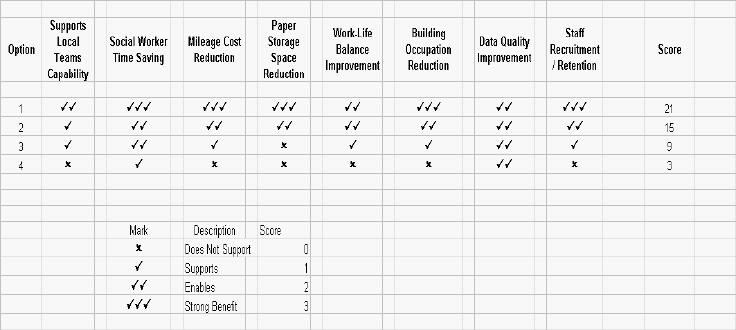
Appendix 2 Indicative Benefits Matrix
Appendix 1
IT Mobile Options, Picture of a Typical Day
Current:
Charlie is a Registered Children & Families Social Worker who starts the day by driving the 10 miles from home to the office. Once there, by checking SWIFT workflow, talking to colleagues and her team manager, she can establish that in addition to the two visits already planned for the day, another visit is now required to be slotted in. Charlie then locates the paper files for the three visits, reads through and replaces the files, checks SWIFT to establish whether any new contacts have been recorded and leaves the office.
In two of her meetings, Charlie takes ample notes on paper to be able to complete in SWIFT the next stages of the cases she is working on. At the last appointment however, the client was not there and Charlie was forced to drive past her house, back to the office to type the day's notes into SWIFT and to deal with any workflow items received since she was last in the office. She works until after 6pm to complete the work and drives home
Option 4: Forms synchronised in the office
The variation from Charlie's day to one under Option 4 would be that Charlie would be able to capture the details on an tablet PC, which reads and translates her handwritten notes into text, or keeps some items in free script. She will still drive past her house to go back to the office, although once there, is able to press a single button to transfer the days' notes to SWIFT, enabling her to leave earlier. Charlie will still have to work through the Workflow items at the beginning and end of the day but will be able to leave a bit earlier.
Option 1: Swift and IT2000 available on-line from anywhere
Charlie is now able to login to IT2000 and SWIFT to check email and SWIFT workflow to see whether anything new has arrived before she leaves home. She can read up on the Electronic case files, found by pressing a button in SWIFT while reading the workflow items and can make the journey directly to the first appointment. At that appointment, she will use an offline version of SWIFT to avoid being connected to the network all the time, but knows that she is the only person who can make any alterations to the case while she is dealing with it that day. For the next appointment, Charlie feels that the use of the Tablet will not be practical, so chooses to capture the detail on paper. This will require re-work later, but since the last appointment is aborted, can drive straight home and make the update. While connected, Charlie can check the workflow items and email, and is comfortably finished and at home by 5pm, still in contact with the office should any other case arrive which requires urgent response.
Appendix 2
Indicative Benefits Matrix