
Archived decisions
Hampshire County Council | |||
Cabinet |
Item 7 | ||
27 September 2004 |
|||
Government consultations on business rates and on grants for the Private Finance Initiative | |||
Report of the County Treasurer | |||
Contact: Jon Pittam, ext 7400
1 Introduction
1.1 The Government has issued consultation papers on:
· the local authority business growth incentives scheme which will allow local authorities to benefit from part of future increases in business rateable values in their areas. The deadline for responses is 29 October 2004
· the small business rate relief scheme which will reduce the burden on small businesses. Deadline 4 October 2004.
· the business rates transitional arrangements for the revaluation of business rateable values on 1 April 2005. Deadline 29 October 2004.
· changes to the calculation of revenue grant towards the cost of Private Finance Initiative schemes. Deadline 15 October 2004.
1.2 This report briefly summarises the consultation papers and suggests that the County Treasurer should be authorised to respond in the light of this report and any comments Cabinet may have.
2 Local authority business growth incentive scheme
2.1 An earlier Government consultation on the principles of the local authority business growth incentives scheme (LABGI) was reported to Cabinet in October 2003. The Government has now issued a second consultation paper inviting comments on detailed proposals on how the scheme will operate from 1 April 2005.
2.2 The scheme is intended to give those local authorities with responsibilities for economic development (ie, not fire or police authorities) a financial incentive to maximise local economic growth by allowing them to receive a proportion of increases in local business rate revenues to spend on their own priorities. Growth will come from increasing the business taxbase as a result of economic development. There will be no scope to make changes locally to the national rate in the £.
2.3 Although the national business rates are collected locally, they are pooled centrally by the Government and then re-distributed to local authorities on a per capita basis. From 1 April 2005 under LABGI, these arrangements will continue but local authorities will also receive a proportion of their growth locally in business rates, above a pre-determined floor and up to a maximum amount set by a ceiling. The floor will be based on each local authority's historic average annual growth in rateable values less a national adjustment factor of 1.4%. Local authorities will receive 70% of the increase above the floor. The ceiling will make sure that no local authority gains disproportionately from the scheme.
2.4 The Government is consulting on:
· how to set the ceiling for the maximum amount each local authority can receive - this needs to reflect the relative size of individual local authorities and the Government proposes setting the ceiling at 3% (in the first year) of an amount calculated by applying the parts of the formulae for the FSS for Environmental, Protective and Cultural Services (EPCS) to each local authority. This replaces the Government's original proposal of using the total FSS for all services as the basis
· how to divide the additional income between county and district councils in two-tier areas - the Government proposes to use relative proportions calculated, as above, from the FSS for EPCS, which will give approximately 35% to county councils and 65% to district councils
· how to give local authorities that fail to gain under LABGI in the first year an opportunity to benefit in the future - the Government will re-set such authorities' base positions for year two
· how to pay over the additional income to local authorities - the Government proposes making a single payment in the final quarter of each financial year.
Comments on LABGI
2.5 The Government's decision to use parts of the formulae for the FSS for EPCS as a basis for sharing the additional income appears to be driven more by a wish to give approximately 35% to counties and 65% to district councils than by any justification on grounds of principle. The Government's original proposal to use total FSSs as the basis would have allocated 85% to county councils. This would reflect better the higher level of spending on economic development at county level. The majority of the financial consequences of service demands from new businesses are also faced by county councils, including local transport, environmental impacts, education and community safety. The proposed 65% share for districts could also give them a level of additional income that is disproportionate to their overall spending needs. By 2007/08, some districts could be receiving as much as 7.5% of their budget requirements as result of this scheme. It is suggested that the Government should be urged to revert to its original proposal of basing the apportionment on total FSSs.
2.6 It will be important that the Government abides by its earlier commitment that local authorities' extra revenue from this scheme will not be offset against other Government funding. As the extra revenue will no longer be paid into the national business rates pool for redistribution to local authorities on a capita basis, the Treasury will have to add an equivalent amount to the revenue support grant to compensate. Otherwise, LABGI will be merely redistributive, using the new LABGI growth basis at the margin instead of the existing per capita basis. It is suggested that this point is emphasised in the response to the consultation.
2.7 The Government's other proposals for re-basing floors for authorities who initially fail to gain under LABGI and for making a single annual payment are reasonable.
3 Small business rate relief scheme
3.1 The small business rate relief scheme is intended to reduce the disproportionate burden of business rates on small businesses. The Government has already consulted extensively on the basic framework of the scheme and the outline legislation has been established in the Local Government Act 2003. The Government is now consulting on the practical details. These include proposals that:
· business rate relief will be available at 50% for properties with a rateable value of up to £5,000, with relief declining in percentage terms on a sliding scale for rateable values up to £10,000 at which point there would be no entitlement to relief. These thresholds are higher than the limits previously proposed by the Government of £5,000 and £8,000. They will benefit about 400,000 small businesses nationally
· the cost of the relief will be paid for by a supplement on the rate bills of business ratepayers with properties of rateable values above £15,000 (equivalent to 1.6% on the bills of those paying)
· there will be a buffer zone for properties with a rateable value between £10,000 and £15,000 which would not benefit from the relief but would not have to pay the 1.6% supplement. This will benefit a further 50,000 businesses
· the relief will be available to any business occupying only the one property for which it is claiming relief
· businesses will be able to claim relief at any time up to six months after the end of the financial year.
3.2 The Government has acknowledged the burden of its taxation policies on small businesses, but expects larger businesses to meet the costs of its plans for tax relief for small business. Government could be asked to pick up the burden of its small business rate relief from other forms of central taxation but that would have the effect of further depressing the yield from business rates. That yield is already depressed by the retail price inflation index cap on poundage increases and it would not be helpful to reduce further the contribution to local authority funding from business rates.
3.3 The scheme will have no direct impact on the County Council beyond paying the 1.6% supplement on its properties. This could add £0.2m per annum to the County Council's costs.
4 Business rates transition arrangements
4.1 The new non-domestic rating list comes into effect on 1 April 2005 following the latest revaluation of properties. The Government is consulting on proposals for transitional arrangements to soften the impact of sudden and dramatic rises in business rates as a result of the revaluation. The proposed transitional scheme will cap significant increases in rates bills as a result of revaluation over a four-year period. It will be self-funding with no contributions towards the cost from either central or local government. This will be achieved by limiting the size of reductions in rates bills for businesses that gain significantly from the revaluation. The Government is consulting on its plans for:
· the scheme to run over the four years from 2005/06 to 2008/09, so that in the fifth year, 2009/10, all business rate payers are paying their true liability
· capping increases in business rates as a result of revaluation, with the caps gradually rising from 12.5% to 25% over the period 2005/06 to 2008/09 for large properties (rateable value over £15,000) and 5% to 15% for small properties
· the scheme to be self-financing by limiting decreases that should have occurred as a result of revaluation. For large properties, the reduction in 2005/06 will be limited to 7%. Businesses will benefit from more of their reductions in subsequent years so that by 2008/09, properties with reductions in rateable value of up to 20% will benefit in full. Those with reductions of more than 20% will be limited to 20%. For small properties the cap will rise from 17.5% to 50% over the same period. By 2009/10, all businesses will benefit in full from whole of their reductions.
4.2 The impact of the revaluation and the transitional proposals on the County Council's properties is difficult to assess at this stage. Overall, the proposals are reasonable and it is suggested that no response be made to this consultation.
5 Private Finance Initiative grant reform
5.1 The Chancellor announced in the Spending Review 2004 that the Government had decided to reform the way that revenue support grant is allocated for approved private finance initiative (PFI) schemes, with the aim of establishing a level playing field with conventional capital investment.
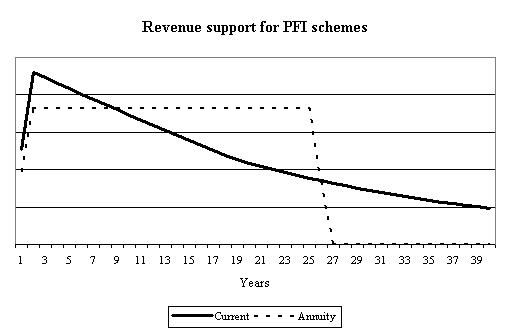
5.2 Revenue support grant towards the capital element of PFI schemes is currently calculated by the Government as if a loan had been raised, with the principal and interest declining over time, as shown by the continuous line in the graph below. This does not match the usual profile of payments under a PFI contract, which tend to be fairly steady or gradually increase over the life of the contract.
5.3 The Government proposes to change to an annuity basis for calculating its support, as shown by the dotted line in the graph for a 25 year contract. Grant will continue to be paid through the revenue support grant system.
5.4 This is a sensible proposal and can be supported. However, if the Government wishes to promote best value procurement, it should merge the separate funding streams for PFI and conventional schemes.
5.5 This response has been reinforced by a recent report of the Institute for Public Policy Research (IPPR). It argues that there is still no level playing field between the PFI and other public sector procurement. In particular PFI may be chosen to remove investment from the public sector balance sheet (or to attract separate PFI funding credits as far as local authorities are concerned) rather than secure value for money. The IPPR recommends the introduction of a single capital budget for the PFI and other forms of investment. This would then ensure that the only reason for choosing the PFI is to secure value for money. This could be supported and would be compatible with the separate report on value for money (item 7).
5.6 The Government should also accept the County Council's long running argument that its waste management contract should receive grant support. As a service contract entered into before the Government established its PFI regime, the capital costs of providing the essential new infrastructure for waste management in Hampshire are not eligible for PFI or any other grant support, despite having many of the characteristics of a PFI arrangement. The Government has provided all its capital support for waste management through PFI, benefiting other areas of the country which followed Hampshire's lead but were able to enter into PFI contracts. It is suggested that these arguments should again be brought to the Government's attention.
Recommendation
1. The recommendation is contained in the decision sheet summary which precedes this main report.
Section 100 D - Local Government Act 1972 - background papers
The following documents disclose facts or matters on which this report, or an important part of it, is based and has been relied upon to a material extent in the preparation of this report.
NB the list excludes:
1. Published works.
2. Documents which disclose exempt or confidential information as defined in the Act.
TITLE FILE
None
i:\ . . . . \ian\docs\consultations cabinet 27sep04 ch.doc 15 September 2004