
Archived decisions
Hampshire County Council Education Policy Review Committee 12 October 2004 Review of primary school provision in the Romsey area Paper 1 - strategic overview Report of the County Education Officer |
Item 11a |
Contact:
Ann Begley, Assistant County Education Officer (School Branch), 01962 846518; [email protected]
Alex Munro, Education Officer (Admissions and Special Projects); 01962 846462; [email protected]
Bob Eardley, Strategic Planning Manager; 01962 846275; [email protected]
1 Summary
1.1. This series of reports highlights further work undertaken as part of the County Council's commitment to raise standards and enhance facilities by reducing surplus places and ensuring that resources are deployed fairly and effectively.
1.2. Although this pattern of overview report (Paper 1), complemented by area specific reports, will be familiar to members of the committee, it must be stressed that this overview report contains detailed financial information which has not been available previously but which is an important element of this review.
1.3. The following reports (Papers 2-4) focus on the outcomes of consultations following the review of primary school provision in the Romsey area. It became apparent during the consultations that the issues affecting Ampfield CE Primary School were substantially different from those involving Romsey town primary schools. The consultation paper approved by the Executive Member for Education in March 2004 is attached as an appendix to Paper 2.
1.4. Paper 2 sets out the background and common issues affecting the two areas under review, which comprise the following schools:
· Area 1 - Cupernham Infant, Cupernham Junior, Halterworth Primary, Romsey Abbey CE Primary (Aided), Romsey Infant and Romsey Junior Schools
· Area 2 - Ampfield CE Primary School.
1.5. Papers 3 and 4 consider options for future primary school provision for each of the above areas. Each report suggests a way forward, the combination of which represents an overall strategy designed to achieve high quality, cost effective educational provision.
1.6. The issues raised in these reports reflect the following County Council corporate aims:
· Aim 1 - maximising life opportunities;
· Aim 4 - building strong and safe communities;
· Aim 5 - improving services.
1.7. By addressing surplus places the County Council ensures that there is a sustainable pattern of long-term provision of schools which are viable and attract pupils. Where reorganisations occur, the County Council has generally invested substantial resources into improving the school buildings and early years provision where local circumstances require it and resources allow.
1.8. The reorganisation of schools with declining pupil numbers can lessen the burden on school managers and reduce the time spent on dealing with activities such as teacher redundancy and the management of imbalanced class sizes. Reorganised schools generally provide more security for the local community and prove attractive for the recruitment and retention of staff. Improvements in the provision of such educational services are an illustration of how the County Council seeks to make effective use of limited financial resources, bearing in mind that empty school places have an associated cost.
1.9. These reports should be considered in the light of the County Council's equalities policies, particularly in relation to:
· Admission policies which are `clear, fair and objective' as required by the DfES (2003) Code of Practice on admissions;
· Ensuring that good quality provision for children with special educational needs (SEN) is maintained and if possible enhanced; and
· Providing appropriate facilities for disabled pupils in any new building or adaptations.
1.10. The methods and purpose of the review are consistent with the County Council's Constitution which describes its role as delivering services "in an open, transparent and cost-effective way, acting in the best interests of Hampshire and its citizens as a whole".
1.11. Members are asked to advise the Executive Member for Education on the options set out in the reports on the strategy for the provision of primary education in the Romsey and Ampfield areas.
2 Strategic implications
Educational standards
2.1 The reasons for reviewing the number and distribution of schools places are embodied in the duties of the County Council as local education authority to make the best use of resources to maximise the quality of education provision for the whole community. Wherever possible, the County Council would prefer to see resources being directed towards the development of facilities and resources for staff and children rather than being spent on empty places.
2.2 Whatever the size of school, it must provide the best possible opportunities for each child. In order to provide a full curriculum, small schools require significantly more support. High standards can be, and are, achieved in small schools but the County Council needs to avoid overstretching its resources, which is a risk if the number of small schools rises beyond what is essential.
2.3 Small schools are vulnerable to changes in numbers on roll, because a small number of pupils represent a large proportion of the total. Changes in staff too have a significant impact because the quality of the whole school's teaching depends on the input from each person. For example, a single teacher in a four-teacher school can have a significant influence on overall standards.
School places
2.4 The County Council has a statutory duty to plan the provision of school places and to secure an appropriate balance locally between supply and demand. Needs change in response to population movements and fertility trends. In many areas of the county, child populations are falling as populations stabilise. Although additional dwellings are being built, many of these are to house an increased number of households which will not necessarily contain children. Where child populations do rise, additional school accommodation may be needed, but this becomes difficult if resources are locked up in areas of declining population.
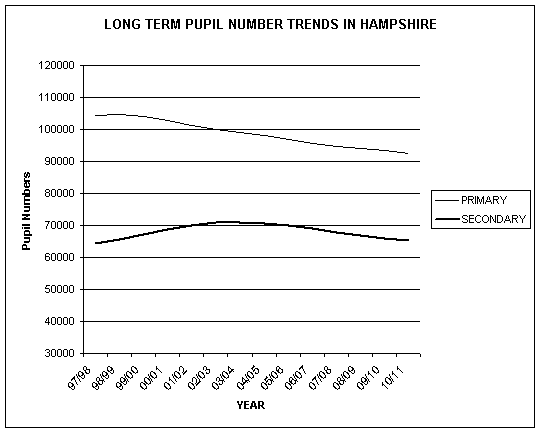
2.5 Graph 1, taken from the 2004 update of the School Organisation Plan 2003/04 - 2007/08, shows pupil number trends in both primary and secondary sectors to 2010-2011.
Graph 1
2.6 Population changes mean that schools may go through periods when there is pressure on places and others where there is a surplus. Where numbers are falling sharply, and the trend is more than short term, the extent of any surplus raises questions about the use of resources. Premises have to be maintained whether they are full or not. Where schools become small, they have to be subsidised at the expense of the rest of the service in order to sustain the curriculum. In isolated communities, this may be unavoidable. Large numbers of small schools will, however, reduce significantly the resources available to other schools.
2.7 The 2004 update of the SOP draws attention to the rising number of primary surplus places in Hampshire and the need to ensure that the increase is effectively managed. The overall level of surplus, which was 9% in January 2004, is forecast to rise to 14% by 2009, significantly above the 10% level considered a reasonable upper level by the Audit Commission and incorporated within the County Council's Corporate Aim 1. The forecast surplus is now equivalent to 71 one form entry primary schools (i.e. 71 schools of 210 places = 14,910 surplus places).
2.8 The effective management of surplus places creates valuable opportunities to improve the learning environment through the provision of specialist teaching spaces and also to enhance community provision, particularly through the development of early years facilities. It is important to maximise opportunities by releasing the resources which would otherwise be locked up in surplus places.
2.9 Schools will increasingly be providing facilities for the community as "extended schools", involving other agencies such as the health service. These facilities will need further investment, making it even more important to use resources cost effectively and to plan for future needs. Such extended facilities will need strong, stable and viable schools at their heart.
2 Financial considerations
2.1 Examples of the costs of educating pupils in schools of different sizes, based on the agreed funding formula for schools in Hampshire are given in Table 1. As a school's budget depends substantially on the number of pupils on roll, significant drops in pupil numbers affect staff numbers and stability and can only be "cushioned" to a limited extent. It is important to plan for the future. A school which is functioning well with current numbers of pupils and staff may find it difficult to sustain the quality and range of provision as numbers and resources fall. Numbers on roll may also be indicators of parental confidence in a school.
2.2 Table 1 shows comparative costs of primary age pupils in schools of varying sizes in accordance with the provisions of the local management formula. This formula allocates additional funding to smaller schools to take account of the diseconomies of scale and to help schools to deliver the full curriculum. In addition, the formula "cushions" schools where numbers have dropped so that no budget will be less than 95% of the previous year's budget; this will increase costs in schools which become smaller. This is known as "real term protection".
2.3 Table 1 - Per pupil costs in Hampshire primary schools - 2004/05
No. of pupils on roll |
Cost per pupil £ p.a. 2004/5 |
20 |
6,806 |
50 |
3,855 |
100 |
2,868 |
150 |
2,539 |
200 |
2,380 |
250 |
2,298 |
300 |
2,249 |
350 |
2,214 |
400 |
2,188 |
450 |
2,168 |
500 |
2,152 |
2.4 Graph 2 shows the cost implications for the Education budget of taking no action to reduce surplus places in primary schools. As rolls reduce, both the number of pupils in small schools and the number of small schools will increase. The effect of this is that the amount cost of real term protection, to reduce the rate of budget loss, and of additional small school funding through the LMS formula will increase, at a time when the amount of Government funding will reduce because of the decline in pupil numbers. The graph indicates that the funding gap will reach £2.3m p.a. by 2009/10 with a cumulative total by the same date of £7m.
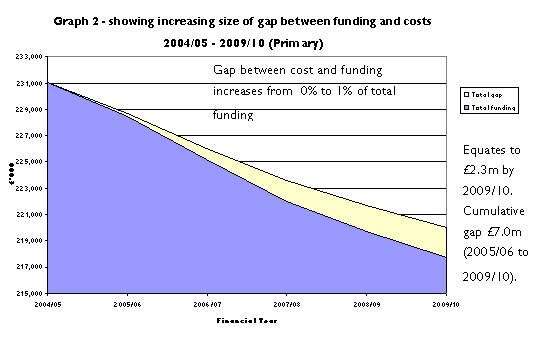 Graph 2
3 Key factors affecting school place reviews
Size of schools
3.1 Hampshire County Council's School Organisation Plan sets out its policy with regard to optimum school size as follows:
· Infant schools should, wherever possible, fall within the range two forms of entry (180 children) to five forms of entry (450).
· Junior schools should, wherever possible, fall within the range two forms of entry (240) to five forms of entry (600).
· Primary schools should, wherever possible, fall within the range one form of entry (210 places) to three forms of entry (630).
3.2 Whilst recognising that there will inevitably be schools outside the optimum ranges quoted in the School Organisation Plan for a variety of reasons, for example because of local geography or fluctuating rolls, the factors generating the County's policy of optimum school size, such as achieving a pupil population of a size which facilitates cost effective education, remain. It is acknowledged that schools outside these ranges can achieve excellent results. It is also recognised that schools which fall below the minimum optimum size are more vulnerable in their ability to sustain high quality education.
3.3 School reorganisation proposals often involve the closure of a small school or amalgamation with a larger school. Whilst parents' anxieties about school size and the perception of the individual child within it are understood, experience in Hampshire shows that children do well in the size of new schools which are established through amalgamation. There are benefits from the economies of scale arising from larger budgets and from the career opportunities which these larger schools can offer to teaching staff. The development of new workforce reforms presents wide opportunities for staff offering a range of skills. Schools of larger size successfully use effective senior and middle management, allied with appropriate pastoral care, to ensure the best provision for the pupil community.
Replacing separate infant and junior schools with a 4-11 primary school
3.4 The County Council supports infant and junior as well as primary schools. Providing for the primary age groups in a single school or in separate infant and junior schools works equally well, and there are many examples of successful schools of all types. Infants can flourish in both infant and primary schools. That includes large primary schools where any concerns over size can be addressed by good leadership and organisation; there is evidence that the older children take a particularly responsible attitude towards the youngest. Funding per pupil is based on the same formula, whatever the type of school.
3.5 When a primary school is formed from existing infant and junior schools, the process is managed carefully, in the light of local circumstances. This usually entails the closure of both the existing infant and junior schools and the opening of a new primary school. A temporary governing body for the new primary school is established prior to its opening and will appoint the headteacher who will then work with the temporary governors to appoint staff for the new school. Potentially displaced staff from the closing infant and junior schools would, with the agreement of the temporary governing body, be given first opportunity to apply for positions in the new primary school.
3.6 Another way of managing closure entails the closure of one school and the change of character and enlargement of either the junior or the infant school to a primary school. The governing body of the continuing school becomes the governing body of the primary school. The staff of the continuing school form the basis of the new school but potentially displaced staff from the closing school, with the agreement of the governing body, are given first opportunity to apply for vacant posts in the new primary school.
3.7 Moving from separate infant and junior schools to all-through primary schools is by no means the only option favoured. For example, amalgamation of two infant or junior schools could be the best way forward in some situations. The same procedures and principles outlined in paragraphs 4.5 - 4.6 apply.
4 Capital strategy and revenue implications
4.1 Capital works arising from school reorganisations are primarily funded from the sale of land, with additional funding when required from resources in the Education capital programme and from schools' devolved capital.
4.2 When school reorganisations are carried out, the opportunity is taken to add accommodation where necessary and carry out alterations to bring buildings up to the standard of the current primary school building brief. Guidance from the DfES on standards, building regulations applying to construction, and feedback from previous projects are all used to recommend the best solution for each project. Each design and building solution is unique to the particular site and school community and involves significant consultation with staff and governors.
4.3 Improvements may be achieved by the addition of specialist teaching accommodation, as well as providing any further general teaching spaces required. Where facilities for early years or the community are required, these are provided, where possible, within the overall funding available, and by making use of suitable existing accommodation. Proposals from other agencies to use or develop new facilities are welcomed, provided they are supported by sufficient funding.
4.4 The County Council has an excellent track record of managing significant building works on a range of education sites throughout the county every year. The current capital programme exceeds £50 million annually on school buildings. High standards are demanded and achieved every year with a high level of customer satisfaction at the completion of projects. Any building work is inevitably disruptive and this is recognised by a carefully managed process from design to completion using professionals and contractors with experience and skills. Health and safety is a prime concern and works on site are controlled rigorously to ensure the safety of pupils, staff and other occupants.
4.5 In many cases refurbishment work is required in a school being extended and/or adapted as a result of reorganisation. This ensures that the whole building is developed to a good standard. The extent of refurbishment needed will vary from building to building; this work could be phased over a period of time. During the feasibility study exercise, the Director of Property, Business and Regulatory Services investigates the scope and cost of internal refurbishment to the existing buildings based upon a combination of:
· desktop studies of the existing buildings, including available Asset Management Plan data;
· previous experience of similar building types;
· site visits.
4.6 The likely scope of works would include new decorations, finishes, fixtures and fittings if they are in poor condition and improved accessibility for disabled pupils. During future design development, further work would be done to ascertain the detailed scope of works and costs, together with the potential opportunity to bring forward other expenditure from the capital programme and landlord resources.
5 County Council policy requirements
5.1 Legal implications - None.
5.2 Financial implications - Addressed in detail in this paper and in complementary reports.
5.3 Personnel implications - If schools were to close as the result of this review, every effort would be made to redeploy staff into appropriate alternative posts and to avoid redundancies. Clear procedures are in place agreed with professional associations and unions.
5.4 Impact assessment - Race and equality impact assessment has been considered in the development of this report and no adverse impact has been identified.
5.5 Community cohesion, inclusiveness and partnership working - The proposals contained in Papers 3 and 4 provide a basis for continuing work in these areas.
5.6 Crime prevention issues - The enhancement of community cohesion and partnership working will contribute positively to crime prevention.
6 Process and timescales
6.1 Details are provided for each area in Papers 3 and 4.
7 Recommendation
7.1 That the report be noted and used to inform consideration of the three complementary papers dealing with schools in Romsey and Ampfield.
Section 100D - Local Government Act 1972 - Background Documents
The following documents disclose facts or matters on which this report, or an important part of it, is based and has been relied upon to a material extent in the preparation of this report.
.
NB The list excludes:
1 Published works
2 Documents which disclose exempt or confidential information as defined the Act.
None.