
Archived decisions
Hampshire County Council Environment Policy Review Committee 1 December 2004 Housing Affordability in Hampshire Report of the Director of Environment |
Item 8 |
Contact: Dawn Heppell, ext 5011 email: [email protected]
1. Summary
1.1 Housing affordability will become an increasingly important dimension of housing policy following proposals in the Barker Review and the latest Government consultation on housing and planning in the regions. In light of this, the latest update by the Joseph Rowntree Foundation provides a useful comparison of housing affordability based on house prices and household incomes. Within this research the South East emerges as the third least affordable region in England. Despite high house prices and ratios of house prices to incomes, Hampshire districts, including Portsmouth and Southampton (included in the rest of this report as part of Hampshire), do not rank amongst the least affordable in the South East. This is likely to make it increasingly hard for Hampshire to argue for priority funding from the Government and Regional Housing Board to address this issue.
2. Corporate Strategy
2.1 This report supports Aim 3 of the Corporate Strategy (Achieving Economic Prosperity) by helping to ensure the provision of enough affordable housing for key workers and others so that Hampshire firms can secure the workforce they need.
3. Housing Affordability
3.1 One of the overall objectives of the Barker Review published earlier this year was to "achieve improvements in housing affordability in the market sector". The report identified that housing had become less affordable, with the number of new households able to afford to buy property falling from 46% in the mid-1980s to 37% in 2002. It argued that policy should recognise the importance of affordability, with the Government taking a lead in setting a goal for improving affordability of market housing.
3.2 Kate Barker proposed the establishment of an independent Regional Planning Executive to set out advice on measures required to meet market affordability targets, and recommended that each region should set its own target to improve market affordability. The Government's preference is for an independent national advice unit to be established, working closely with regional bodies to develop a consistent approach to determining the scale and allocation of housing and taking into account cross-regional issues. A consultation is currently underway on this proposal with a view to establishing this unit in 2005. The County Council has already responded to this consultation document, which was considered by the Cabinet on 9 November 2004.
3.3 As part of a reorganisation in the housing sector, affordability targets will be introduced next year. A target for the cost of an affordable home and the subsequent amount of affordable market housing required will be determined at the regional level for the first time. Possible measures of affordability proposed in the Barker Review included matching median house prices to median incomes, compiling an index to assess access to housing or setting a ceiling on mortgage payments for lowest quartile earnings. However, the actual components of these affordability targets have yet to be decided.
3.4 Given the importance the Government is now placing on housing affordability, it is worth considering recently published research on the subject by the Joseph Rowntree Foundation.
4. Joseph Rowntree Research
4.1 The Joseph Rowntree Foundation Report `Can work, Can't buy' (2003) assessed housing affordability in England using three different measures of affordability. This research found that Hart and Winchester districts were both amongst the 15 least affordable areas in the South East, based on key worker incomes. It also considered affordability based on the ratio of house prices to household income and this part of the research has now been updated using data to the end of 2003.
4.2 Drawing upon a variety of information sources, the report `Can work, Can't buy' compared the average price of a modest-sized family dwelling (2 to 3 bedroom) to income earned by working households aged between 20-39. It was designed to look at the difficulties faced by first time buyers based on information for local authority areas and regions at the end of 2002.
4.3 The original research calculated in 2002 that the average ratio of house price to household income in England using the above methodology was 3.4 to 1, see Figure 1. This means that the average household would need to pay 3.4 times their income to purchase an average-priced property. The national average masks large variations between regions across the country, with a ratio of less than 3 to 1 in the three northern regions and more than 4 to 1 in London, the South West and the South East. Mortgage advances to first time buyers do not generally exceed 3.5 times their household income.
Figure 1 Ratio of House Prices to Household Income
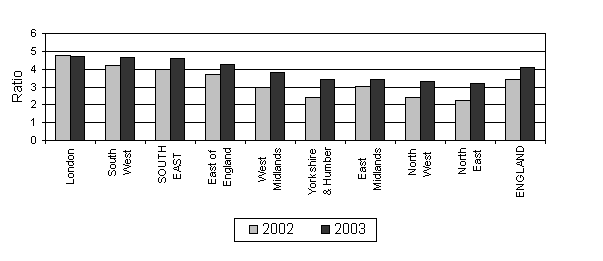
4.4 Ratios increased between 2002 and 2003 in all regions except London. This means that a buyer would need to find more money in 2003 than in 2002 to purchase the same property. By the end of 2003 the ratio of house prices for a modest family property to household incomes earned by working households aged between 20-39 in England exceeded 4 to 1. Whereas in 2002 housing in the South East was more affordable than in London; in 2003 they were virtually the same.
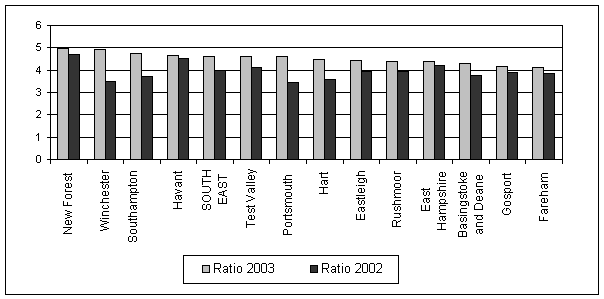
4.5 The same trend is evident in every Hampshire district, but most notably in Basingstoke and Deane, Hart, Southampton and Winchester. In 2002 there were two areas in Hampshire where the ratio of house price to household income was 3.5 to 1 or less: Portsmouth and Winchester (see Figure 2 overleaf). By the end of 2003 in Fareham, now the most affordable area in Hampshire, a household on an average income would require an advance of over four times their salary to afford a property. In the New Forest, the least affordable area, this increases to almost five times their salary.
4.6 Despite average house prices of up to £225,000, none of the local authority areas in Hampshire was on the list of the 40 least affordable areas in England on this measure, reflecting the relatively high average income levels in the areas with the highest house prices. In comparison to the rest of the South East, Hampshire's least affordable district, New Forest, was only the 19th least affordable area in the region (see attached appendix).
Figure 2 Ratio of House Prices to Household Income in Hampshire
5. Conclusions
5.1 In the year since the initial research was completed, house prices for modest family houses in England increased by more than four times the rate of household income growth. Market housing has therefore become significantly less affordable in this time.
5.2 Between 2002 and 2003 house prices rose at more than six times the rate of income growth in the South East. Despite this increasing problem in the South East, it is the South West that remains the second least affordable region in England after London. As a consequence, the Joseph Rowntree Foundation report argues that the Government approach to affordable housing should be reviewed and its focus extended beyond London and the South East. In the absence of any increase in overall Government funding for affordable housing, such a move would reduce the amount of money available for affordable housing in the South East, including Hampshire.
5.3 Households will rarely be able to borrow a mortgage advance of more than 3.5 times their household gross income for their first property. At the end of 2002 this mortgage advance was enough to enable a household on an average income to afford a modest family property in two Hampshire districts. By the end of 2003 it was insufficient in all areas. Despite this, relatively high average incomes in the areas of Hampshire with high average house prices have ensured that in this research Hampshire districts are not even identified as amongst the least affordable areas in the South East. This is likely to make it increasingly hard for Hampshire to argue for priority funding from the Government and Regional Housing Board to address this issue.
Recommendation
That the report be noted, and the issue of housing affordability be kept under review and closely monitored, as the South East Plan and Local Development Frameworks are prepared within Hampshire.
Section 100 D - Local Government Act 1972 - background papers | |
The following documents disclose facts or matters on which this report, or an important part of it, is based and has been relied upon to a material extent in the preparation of this report. | |
NB the list excludes: | |
1. |
Published works. |
2. |
Documents which disclose exempt or confidential information as defined in the Act. |
TITLE |
LOCATION |
Briefing Note to the Members of the Strategic Planning Joint Advisory Panel November 2004 |
Environment Department Room 211 |
9096/DH
APPENDIX
Ratio of House Prices to Household Income in Hampshire
Local Authority Area |
2003 |
2002 |
South East affordability rank (2003) 1 | ||||
Household income £ |
Mean house price £ |
Ratio |
Household income £ |
Mean house price £ |
Ratio | ||
New Forest |
37,883 |
187,835 |
4.96 |
33,374 |
157,497 |
4.72 |
19 |
Winchester |
45,137 |
223,102 |
4.94 |
50,734 |
177,573 |
3.50 |
20 |
Southampton |
31,882 |
151,140 |
4.74 |
31,307 |
115,816 |
3.70 |
26 |
Havant |
34,286 |
159,774 |
4.66 |
29,882 |
134,834 |
4.51 |
29 |
South East |
39,734 |
183,175 |
4.61 |
38,478 |
152,555 |
4.00 |
- |
Test Valley |
38,005 |
174,969 |
4.60 |
36,118 |
148,010 |
4.10 |
32 |
Portsmouth |
30,718 |
141,080 |
4.59 |
32,614 |
112,907 |
3.46 |
34 |
Hart |
48,323 |
215,338 |
4.46 |
52,047 |
185,509 |
3.56 |
43 |
Eastleigh |
39,147 |
173,746 |
4.44 |
35,978 |
141,868 |
3.94 |
46 |
Rushmoor |
38,676 |
170,530 |
4.41 |
38,274 |
150,785 |
3.94 |
49 |
East Hampshire |
44,195 |
193,485 |
4.38 |
39,364 |
165,247 |
4.20 |
51 |
Basingstoke and Deane |
42,586 |
183,839 |
4.32 |
41,971 |
157,415 |
3.75 |
53 |
Gosport |
32,357 |
134,240 |
4.15 |
27,175 |
106,120 |
3.91 |
58 |
Fareham |
38,633 |
159,909 |
4.14 |
37,577 |
144,004 |
3.83 |
59 |
1 Based on 67 local authority areas in the South East. 1 = least affordable area