
Archived decisions
lajC/HFRA/ESLG
23/11/04
Appendix 1
Draft SO/1/6/3
COMPREHENSIVE EQUALITY POLICY
1 INTRODUCTION
1.1 Our commitment to fairness and dignity and equal access to employment opportunities and services is set out in the Fairness, Dignity and Diversity Service Order (SO1/6/2). In general terms, our policy under fairness and dignity and specifically the procedures for fair recruitment, selection, progression and retention of staff and the procedure for dealing with complaints.
1.2 Recent legislative developments covering religious belief, sexuality, the Disability Discrimination Act 1995 which removes the exemption given to Fire Services and the requirement for us to comply with the Equality Standard for Local Government (ESLG), necessitated a review of our policies and procedures regarding equality and diversity.
1.3 The review found that although we are making progress, there is more for us to do to fully commit to a comprehensive equality policy covering race, gender, disability, religious belief and sexuality as set out in the ESLG. We also have to meet our obligations under the Age Discrimination Bill which is expected to become law in 2006.
1.4 In response to the review, the Chief Officer and Service Management Team re-iterate their commitment to the principles of equality, fairness, dignity and valuing diversity for everyone - our employees, service users, partners, contractors and our diverse communities in Hampshire, in one Comprehensive Equality Policy .
Our Comprehensive Equality Policy (CEP) covers the following:
- Our values and standards
- Our key aims and objectives
- Processes we have put in place to make it happen
- Our milestones for employment
- Our responsibilities in respect of:
▪ Consultation
▪ Publication
▪ Targeting and Monitoring
▪ Access to Information and Services
▪ Training
▪ Equality Impact Assessments
▪ Partners and Contractors
1.5 How is our CEP going to Work in Practice?
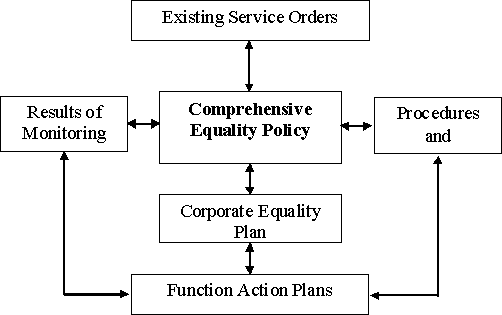
We already have a range of Service Orders (policies), strategies and action plans/timelines. The CEP provides a framework for all of these, including:
▪ Service Orders
▪ Function action plans
▪ Procedures and best practice
SO/1/6/3
Page 2
(AK 11/04)
Our CEP will be translated into actions within our Corporate Equality Plan.
The following flow chart shows how all the components fit together:
- End -
COMPREHENSIVE EQUALITY POLICY
CONTENTS
SECTION A : VALUES, STANDARDS AND STRUCTURES
1 Values
2 Key Objectives
3 Resources, Roles and Responsibilities
4 Relationship to Race Equality Scheme
SECTION B: EMPLOYMENT
1 Context
2 Commitment
SECTION C: ISSUES AND DUTIES
1 Equality Impact Assessment
2 Consultation
3 Publication
4 Targeting and Monitoring
5 Access to Information and Services
6 Training
7 Partners and Contractors
APPENDICES
Appx A HFRS Equality and Employment Policy Statement
Appx B Definitions
Appx C Consultation
Appx D Targeting and Monitoring
- End -
SO/1/6/3
Page 1
(AK 11/04)
SECTION A: VALUES, STANDARDS AND STRUCTURES
1 VALUES
1.1 Our Mission
1.1.1 We will contribute to our mission, "making Hampshire safer" by promoting greater understanding and responsible attitudes towards fire safety and by providing a responsive, caring fire and rescue service. In order to fulfil our mission we will embrace the following 4 values:
- We value Openness, Honesty and Integrity
- We Value Diversity
- We Value Challenge and Innovations
- We Value Service
1.1.2 To achieve this we rely on the contribution of all our elected members, employees, our diverse communities and other partners, in contributing to our policies and creating a positive climate where:
- Difference is positively valued and celebrated
- People from different backgrounds have equality of opportunity
- Positive relationships are developed between all groups
1.1.3 It is essential that all our managers actively promote our values of equality, diversity, fairness and dignity in our activities as an employer and as a service provider.
1.2 Our Commitment
1.2.1 We are committed to addressing all forms of discrimination, and have identified some priorities including race, gender, disability, sexuality, religious belief and age. We are also considering other issues or forms of potential disadvantage.
1.2.2 We accept our obligations under the Race Relations Act to promote good race relations and in particular our duty to have regard to the need, in all our activities to:
- Tackle racial discrimination
- Promote equality of opportunity; and
- Promote good relations between people of different racial and social groups
1.2.3 Our Equality and Employment policy statement in support of this is to be found in Appendix A
2 KEY OBJECTIVES
2.1 Our 2 key objectives are to:
SO/1/6/3
Page 2
(AK 11/04)
- Work towards ensuring that all our customers have equal access to our services
- Provide fair and equal access to all employment opportunities, including access to career development, progression and training opportunities for employees.
2.2 We accept that to achieve these objectives we must address the issues of discrimination including institutional, direct and indirect discrimination (definitions of these can be
found in appendix B)
3 RESOURCES, ROLES AND RESPONSIBILITIES
3.1 We have created several forums to promote and support our equality and fairness strategies in employment and service delivery within a framework which accepts that equality and fairness is a mainstream function. All employees and elected members share a common responsibility for contributing to the success of our Equality Policy.
3.2 Organisational Roles and Responsibilities. Responsibility for implementing and monitoring Equality Policy and plans lies at two levels:
Corporate level
Function level
3.3 The Corporate Level
3.3.1 Elected members and the Service Management Team will provide the framework to deliver our equality policy. Their role is to:
- Determine our values and standards to be reflected in our service provision and employment.
- Set the overall targets for employment and service delivery to meet the needs of our customers and employees.
- Provide the guidance to assist functions in complying with those standards
- Monitor progress
3.4 Elected Member roles and Responsibilities
3.4.1 Elected Members have an important role to play in building an organisation that values equality, diversity and fairness and are formally involved in equality issues at three levels:
- Hampshire Fire and Rescue Authority
- Personnel Committee
- HFRS Fairness and Dignity Committee
SO/1/6/3
Page 3
(AK 11/04)
Their responsibilities include:
- Providing leadership and support in achieving our equality objectives
- Ensure appropriate resources are available to achieve our objectives
- Oversee progress in policy development, service delivery and employment, through the committee reporting process and where appropriate discussing new equality objectives
3.5 The Service Management Team (SMT)
SMT is made up of the Principal Officers and function heads and all have a corporate responsibility for leadership, policy and target monitoring regarding equality, diversity and fairness. Function managers also have a responsibility for linking the activities of their function to the Local Diversity Group and the internal Equality and Diversity Focus Group. Members of SMT chair the Fairness and Dignity Committee on a rotating basis.
3.6 Function Level
3.6.1 Our middle and supervisory managers are responsible for meeting our key objectives in employment and service delivery and will be responsible for:
- Producing and reviewing function action plans to reflect our values and standards
- Achieving the standards and targets in service provision/delivery and in employment
- Contributing to annual progress reports to SMT and the Personnel Committee
3.7 Employee Involvement
As part of their contractual obligation, all employees are expected to comply with the Service policy on equality and diversity. To achieve this a structure is in place that facilitates employee involvement and participation as follows:
3.8 The Local Diversity Group (LDG)
3.8.1 In addition to SMT members and other managers, the LDG includes representative bodies and an external community representative. The LDG provides the link between corporate equality activities and function management teams by:
- Clarifying how functions can contribute towards the corporate equality objectives
- Sharing information from internal/external consultations and monitoring
- Providing progress reports and monitoring information to inform corporate decision making
SO/1/6/3
Page 4
(AK 11/04)
3.9 HFRS Fairness and Dignity Committee (F&D Committee)
3.9.1 The F and D Committee links the Fire Authority, SMT, LDG and the rest of the workforce in addressing the equality and diversity. It meets quarterly at different workplaces to enable employees to take a participative role in committee business.
3.10 The Diversity Training Programme
Our Diversity Training Team delivers our continuation training programme to all our employees and members. Training sessions focus on race and cultural awareness in addition to contemporary issues with a different topic being introduced approximately every 2 years. Additionally, the sessions are an opportunity for our trainers to engage with our employees in debate on wider diversity related issues.
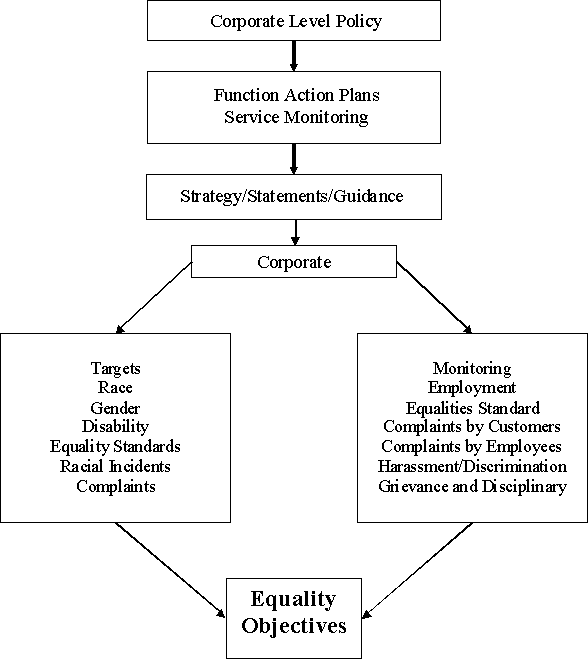
3.11 Corporate Equality Policy Activities Chart
SO/1/6/3
Page 5
(AK 11/04)
4 RELATIONSHIP TO OUR STATUTORY RACE EQUALITY SCHEME
4.1 The Race Relations (Amendment) Act 2000 requires all authorities to publish a Race Equality Scheme (RES) which sets out how they will meet their duties under this Act.
4.2 The Equality Standard for Local Government (ESLG) framework requires local authorities to publish and implement a Comprehensive Equality Policy that integrates with and complements the RES and we have prepared our CEP accordingly.
4.3 In line with 4.2, our Race Equality Scheme will be developed incorporated into our Corporate Equality Plan, covering the requirements set out in the ESLG Framework. The ESLG sets out the value and standards for guiding all our equality and diversity work, including the specific strategy outlining the key issues for each priority group.
4.4 The Function action plans from the operational levels of our Corporate Equality Plan and these plans set out the detailed activities each function is taking to address our objectives of improving access to employment, training and services for all our priority groups.
5 TARGETING AND MONITORING
5.1 In trying to reduce disadvantage in employment, we will set targets for service providers and recruiters and monitor compliance through a formal cycle of review.
5.2 We will monitor recruitment and relevant areas of service delivery to ensure that people from all backgrounds have equal access to employment and services.
Guidance for equality monitoring of service delivery and employment are set out in Appendix D
6 ACCESS TO INFORMATION AND SERVICES
6.1 The success of our initiatives depends on our ability to communicate with our community about services and employment opportunities. We will ensure that:
- Our customers have equal access to information about our business, our services and employment opportunities.
- Our services meet the needs of our diverse communities.
- Our employees have the skills, information and understanding to respond to all our communities appropriately.
7 TRAINING
7.1 We recognise that appropriate training is essential to achieve our equality objectives and assist our employees to fulfil their professional and career aspirations.
7.2 Our approach to training is detailed in our Training and Development Policy and incorporates a number of principles, which include:
- Our statutory responsibilities for training under the Race Relations Amendment Act 2000.
SO/1/6/3
Page 6
(AK 11/04)
- The need to incorporate our core value of embracing equality, diversity and fairness when delivering training.
- The importance of training in addressing issues of historic disadvantage in employment, including the presence of women and people from minority ethnic people in senior management.
- Setting training targets to enable employees to deal confidently and effectively with a diverse customer base.
7.3 We will monitor all aspects of training provision and the employees being trained and learning outcomes.
8 PARTNERS AND CONTRACTORS
8.1 Like many other public sector service providers we are becoming increasingly involved in partnership working with local government, private sector and voluntary agencies. We also use contractors to carry out specific work for us.
8.2 We recognise our duty to promote equality of opportunity and the elimination of discrimination when working with partners and contractors. In doing so we are committed to:
- Working with and influencing our partners to make Hampshire a place where all communities are treated fairly and respectfully and where diversity is valued and celebrated.
- Ensuring that contractors comply with our Equality, Fairness and Dignity at work policy when they are undertaking work for us.
- Encouraging partner organisations and contractors to understand and oppose all forms of discrimination.
- End -
SO/1/6/3
Section B
Page 1
(AK 11/04)
SECTION B: EMPLOYMENT
1 THE CONTEXT
1.1 We recognise the business advantage of having a workforce that reflects our community as we rely on the diverse skills and experiences our employees bring to the workforce and our community. Our employee profile is a visible aspect of our performance in achieving this. Our ongoing monitoring of how we achieve this, and our work environment is also a requirement under legislation.
2 COMMITMENT
2.1 Commitment needs to be translated into visible actions to remove barriers, and which demonstrate progress in achieving our objectives and therefore support our equality policy.
2.2 To support this commitment we have policies covering employment practice which highlight a range of action points including:
- Monitoring our workforce, recruitment processes, grievance and disciplinary procedures, complaints and training programmes.
- Using data to identify areas and reasons for under-representation and any positive action measures to address this.
- Engaging with our under-represented groups to identify and remove any barriers to employment.
- Modifying policies, practices, equipment facilities and premises where appropriate to accommodate individual personal needs.
- Maintaining a safe working environment where people are treated with dignity and which has a zero tolerance of unacceptable behaviour.
- End -
SO/1/6/3
Section C
Page 1
(AK 11/04)
SECTION C: ISSUES AND DUTIES
1 EQUALITY IMPACT ASSESSMENT (EIA)
1.1 EIA's are a key component of the Race Relations Amendment Act 2000 and reflect that some services are more relevant in race terms than others. Additionally the ESLG seeks to extend equalities beyond gender, disability and race to include sexuality, religion/belief and age within the assessment process.
1.2 Equality Impact Assessment (EIA) is a through and systematic analysis of a policy
or working practice to ascertain the actual or potential for different treatment or impact on different groups. Differential impact can be:
- Positive - beneficial to one or more groups
- Negative - having a detrimental affect on a group or groups
- Neutral - different but without notable consequences
Not all different impacts are undesirable. Where a differential impact is identified, a judgement has to be made as to whether the impact would be unlawfully discriminatory or contravenes our own equality policies.
1.3 It is also important to understand how different groups view the impact of our services on them by being part of our consultation and review process. This will help eliminate unlawful discrimination and promote best practice in both employment and service delivery.
1.4 If proposals are likely to be discriminatory, or may have a detrimental impact on some racial groups, alternatives will be considered.
1.5 The outcomes of the EIA's will inform future policy development and guide the conduct of function performance against the ESLG.
1.6 We will review our policies on a systematic basis, commencing in 2005, to assess their impact to the promotion of equality for the group categories of race, gender, disability, sexuality, religion or belief and age. We will then use this data to set priorities within our planning processes and in identifying other policies to be included for EIA.
1.7 Records of decisions made in respect of significant change to policy operating procedures and the outcomes of the EIA's must be kept by a named officer for each of the functions. Our Equality and Diversity Advisor in conjunction with the LDG will be responsible for overseeing the EAI process and checking that all decisions or changes to policy and procedures have been subject to the EIA process.
2 CONSULTATION
2.1 We believe in engaging with our communities to seek to improve the service that we deliver and our practices in promoting equality in employment. Comments regarding how our services are delivered or how our employees conduct themselves are valuable as part of our monitoring process.
SO/1/6/3
Section C
Page 2
(AK 11/04)
2.2 We are committed to:
- Listening to our communities and employees and involving them in the development of services which recognise and value their diversity
- Consulting with them over the likely impact of relevant policy proposals
- Responding to new or different needs which are identified during consultations
- Use the data gathered from the monitoring of comments to identify areas of disadvantage and improve our ability to respond to customers' needs
Principles of consultation are set out in appendix C
3 PUBLICATION
3.1 To ensure transparency of our activities we will publish the results of monitoring and consultation in a way that is accessible to our communities. In doing so we will consider the appropriateness of language and media.
3.2 When publishing the results of monitoring or consultation we will included:
- Why we undertook the exercise
- How it was carried out
- What information it provided
- An assessment of the policy options involved
- Why we chose our preferred actions
- End -
SO/1/6/3
Bibliography
Page 1
(AK 11/04)
BIBLIOGRAPHY
LEGISLATION
Best value review guidance notes
Race Relations Act 1976
Race Relations Amendment Act 2000
Race Relations Act (Statutory Duties) Order 2001
Sex Discrimination Act 1975
Sex Discrimination (Gender Reassignment) Regulations 1999
Sex Discrimination (Indirect Discrimination and Burden of Proof) Regulations 2001
Disability Discrimination Act 1995
Disability Rights Commission Act 1999
Equal pay Act 1970 (as amended)
Equal Pay (Amendment) Regulations 1983
Freedom of Information Act 2000
Data Protection Act 1988
POLICY
Fairness, Dignity and Diversity Service Order - SO/1/6
Service Equality and Employment Statement
Service Race Equality Scheme
Management of Contractors on Service Premises - SO/3/2
Training & Development General Policy - SO/9/1
TERMS OF REFERENCE
Terms of Reference of the Local Diversity Group
Terms of Reference of the Internal Equalities Focus Group
Terms of Reference of the Fairness and Dignity Committee
GUIDANCE DOCUMENTS
Equality Standard for Local Government - published by Local Government employers.
- End -
SO/1/6/3
Appx A
Page 1
(AK 11/04)
HFRS EQUALITY AND EMPLOYMENT POLICY STATEMENT
We are committed to making our services more responsive to different community and individual needs and we value the diversity of our population. We want our services, facilities and resources to be accessible to every member of our community regardless of race, gender, ethnic origin, religious belief, disability, marital status, sexuality or any other individual characteristic which may unfairly affect a person's access to employment opportunities or services.
We accept that our ability to meet these diverse needs can be significantly improved by having a workforce that is reflective of our local population and which has the skills and knowledge to achieve our service objectives. We are committed to valuing diversity in our workforce and to developing and training our employees to enable them to meet these goals in a supportive and open working environment.
- End -
SO/1/6/3
Appx B
Page 1
(AK 11/04)
DEFINITIONS
1 INSTITUTIONAL DISCRIMINATION
"The collective failure of an organisation to provide an appropriate and professional service to people because of their colour, culture, ethnic origin, nationality, religious belief, gender, disability, sexuality, age or other status. It can be seen or detected in processes, attitudes and behaviour which amount to discrimination through unwitting prejudice, ignorance, thoughtlessness and stereotyping".
Institutional discrimination can consist not just of actions taken by a person or organisation but also of actions not taken, neglect, or services provided which do not meet the needs of individuals or communities from different backgrounds. It can be unwitting and may exist no matter how good the intentions of an individual or organisation.
2 DISCRIMINATION
Conduct, words or practices which disadvantage or advantage people because of their colour, culture, ethnic origin, nationality, religious belief, gender, disability, sexuality, age, geographical location or other status".
This includes direct and indirect forms of discrimination.
Direct discrimination occurs where a person is treated less favourably or more favourably than others would be, on grounds that are not justifiable, such as race, gender, disability or other status.
Indirect discrimination consists of treatment that appears to be fair and is applied to everybody equally, but has an unjustifiable adverse impact upon a particular group.
3 RACIST INCIDENT
"A racist incident, which is perceived to be racist by a victim or other person".
4 DISCRIMINATORY INCIDENT
"An incident of discrimination is any incident which is perceived to be discriminatory by the victim or any other person".
- End -
SO/1/6/3
Appx C
Page 1
(AK 11/04)
PRINCIPLES OF CONSULTATION
1 PRINCIPLES OF CONSULTATION
1.1 All consultation that we undertaken should follow the following principles:
- It should take place with service users, including potential users.
- It should take place within a structured and systematic framework.
1.2 We will consult on an agreed cycle with key partner organisations in Hampshire on equality and fairness issues. In accordance with the Race Relations Amendment Act, we will consult on strategic race related issues to address the main minority ethnic groups in Hampshire. This will take place through a number of channels including focus groups.
1.3 All Functions are required to consult with their customers about their initiatives to maximise access to services and employment opportunities.
1.4 We have identified a number of methods to engage with our communities and functions should consider which are most appropriate for their needs. Some options include:
- Focus groups involving direct consultation with service users and potential users.
- Internal consultation with our employees.
- Consultation through seminars, conferences and public meetings.
- Citizens panels.
- Commercial- style market research.
1.5 We also have in place the following corporate vehicles which can be accessed for consulting purposes:
- HFRS Fairness and Dignity Committee.
- The Local Diversity Group.
- HFRS Intranet.
1.6 Complaints
All Functions and their respective units are required to comply with the corporate complaints procedure and in particular to:
- Ensure that all customers are aware of the complaints procedure.
- Ensure that all employers understand the value of customer complaints.
SO/1/6/3
Appx C
Page 2
(AK 11/04)
- Ensure that all complaints are dealt with in accordance with the procedures.
- Monitor all complaints and use the data to review issues.
- End -
SO/1/6/3
Appx D
Page 1
(AK 11/04)
TARGETING AND MONITORING
1 TARGETING AND MONITORING
1.1 Monitoring plays a key role in highlighting inequalities and addressing issues of unfairness or disadvantage in service provision and employment. Our principal strategy for addressing issues of discrimination in service delivery and employment is by setting clear targets for service providers and recruiters and to monitor compliance through a formal cycle of review. The review process should also include a review of the targets as measured against the outcomes achieved.
1.2 We are committed to monitoring recruitment and relevant areas of service delivery to ensure that people from all backgrounds have equal access to jobs and services.
1.3 Equality monitoring of service delivery and employment guidelines are set out below:
- We need to know who is benefiting from our services and recruitment opportunities.
- All services should be able to show what levels of service take up and customer satisfaction they are achieving in terms of, at minimum, Race, Gender and Disability.
- Monitoring must lead to action plans based upon quantified and realistic targets.
- Targets must be based upon a detailed understanding of the composition of the client group the service is trying to serve rather than the general population.
- Targets must be achievable, quantifiable and relevant to the client group the service is trying to reach.
- Monitoring and targeting should be structured so as to allow comparison with the categories used in the 2001 census to enable us to make meaningful comparisons with the local demographic.
1.4 Our approach to equality and diversity is based on the principle of mainstreaming. In simple terms, it means that our mainstream processes must address the needs of all our diverse communities, rather than establishing special or separate arrangements for some parts of the community.
1.5 We recognise that a key factor in this mainstreaming process is to engage the Best Value Review process to challenge and end institutional discrimination. In order to bring equality and fairness activity and best value into line we will utilise checklist for assessing how fair our service delivery is:
- What does this service currently undertake and how is it delivered? (Service specifications).
- Who has access to this service? (Service access).
SO/1/6/3
Appx D
Page 2
(AK 11/04)
- What needs does this service meet? (meeting diverse needs).
- Who is using this service? (Service take up).
- Who has been asked about this service? (consultation and participation).
- Who works for this service? (Employment).
- How is this service planning to set, monitor and meet its equality and diversity commitments? (Performance setting, monitoring and evaluation).
1.6 The Service was set employment targets for women and people from minority ethnic communities by the Home Office following the HMI Thematic Review in 1999. These targets have been incorporated into the National Framework Document. Targets for service delivery needs to be established by the Functions and incorporated into an action plan following EIA.
- End -
Appendix 2
EQUALITY STANDARD FOR LOCAL GOVERNMENT
LEVEL 1: COMMITMENT TO A COMPREHENSIVE EQUALITY POLICY
· Leadership and Corporate Commitment
· Consultation and Community Development and Scrutiny
· Service Delivery and Customer Care
· Employment and Training
LEVEL 2: ASSESSMENT AND CONSULTATION
· Leadership and Corporate Commitment
· Consultation and Community Development and Scrutiny
· Service Delivery and Customer Care
· Employment and Training
LEVEL 3: SETTING EQUALITY OBJECTIVES AND TARGETS
· Leadership and Corporate Commitment
· Consultation and Community Development and Scrutiny
· Service Delivery and Customer Care
· Employment and Training
LEVEL 4: INFORMATION SYSTEMS AND MONITORING AGAINST TARGETS
· Leadership and Corporate Commitment
· Consultation and Community Development and Scrutiny
· Service Delivery and Customer Care
· Employment and Training
LEVEL 5: ACHIEVING AND REVIEWING OUTCOMES
· Leadership and Corporate Commitment
· Consultation and Community Development and Scrutiny
· Service Delivery and Customer Care
· Employment and Training