
Archived decisions
Hampshire Fire & Rescue Authority Item 18 8 December 2004 Trade Union Recognition and Support Report of the Chief Officer |
Contact: Deputy Chief Officer Dave Curry - Tel : 023 80 626 832 |
1 |
Summary |
1.1 |
Following a period of industrial unrest and considering the degree of change being faced by the Fire Authority, it is considered an appropriate time to review the local consultation and negotiation framework currently operating within Hampshire Fire and Rescue Service. Initial discussions with the Fire Officers Association (FOA) and the Retained Fire Union (RFU) have been followed by formal applications by both parties seeking voluntary recognition for local consultation and negotiation purposes. |
1.2 |
Discussion continues at a national level regarding changes to the NJC constitution which includes the recognition of FOA and the RFU. |
1.3 |
A more inclusive approach advocated in the proposed Service values, and the added value a wider consultation framework has to managing strategic risk, is recognised. |
1.4 |
This paper clarifies the current arrangements and makes recommendations to amend the local consultation and negotiation framework. |
2 |
Background |
2.1 |
The Fire Authority currently recognises four trade unions for the purposes of negotiation and consultation of staff employed by the Authority. These are :- · Fire Brigades' Union, for those employees covered by the National Joint Council (NJC) for Local Authorities' Fire Brigades Scheme of Conditions of Service (The Grey Book) below Principal Officer level. · Association of Principal Fire Officers (APFO) for uniformed Principal Officers covered by the NJC (The Gold Book) · Unison and GMB, for those employees covered by the NJC for Local Government Services National Agreement on Pay and Conditions of Service (The Green Book). |
2.2 |
Fire Officers Association Historically, the Fire Brigades' Union (FBU) has represented the majority of firefighters and fire officers below Principal Officer level within Hampshire Fire and Rescue Service. The FBU and Unison have represented Fire Control Staff. The FOA has advised Officers that it currently has a membership of 12, which represents 12% of Officers primarily employed in the roles of Station Manager to Area Manager. |
With the exception of the Authority's retained firefighters, who have the option to join the Retained Firefighters Union (RFU), other staff conditioned to the Grey Book below Principal Officer level have had little option but to join the FBU if they wish to be represented by a trade union in the workplace. | |
Some personnel, particularly fire officers, have begun to question the appropriateness of a single trade union representing both firefighters and fire officers, where the differences in their roles within the organisation have become increasingly apparent. | |
In most organisations managers are able to belong to a separate trade union or association. However, as the Authority only currently recognises the FBU as the representative body for all uniformed personnel below Principal Officer level, there has been reluctance by such staff to join other organisations, such as the FOA. | |
We are aware that the number of officers joining the FOA has increased. Therefore, following initial discussions with the Secretary of the FOA, the Association has formally requested that the Fire Authority recognise the Fire Officers Association for local consultation and negotiating purposes. If agreed, this approach would fall in line with a number of other Fire Authorities who have recognised the FOA in recent months, notably LFEPA in June 2004. | |
2.3 |
Retained Firefighters Union The RFU is an independent Trade Union registered under the Trade Union and Labour Relations (Consolidation) Act 1992. The RFU was created during the firefighters national strike in 1977 and currently claims a membership of over 4500 members. In Hampshire Fire and Rescue Service, the RFU have advised Officers that it has a membership of 317 members which represents 44% of the retained staff. |
Although the RFU have been involved in Service issues for sometime, this has been on the basis of informal consultions. Following initial discussions with the Secretary of the RFU, the Union have formally requested that the Fire Authority recognise the Retained Firefighters Union for local consultation and negotiation purposes. | |
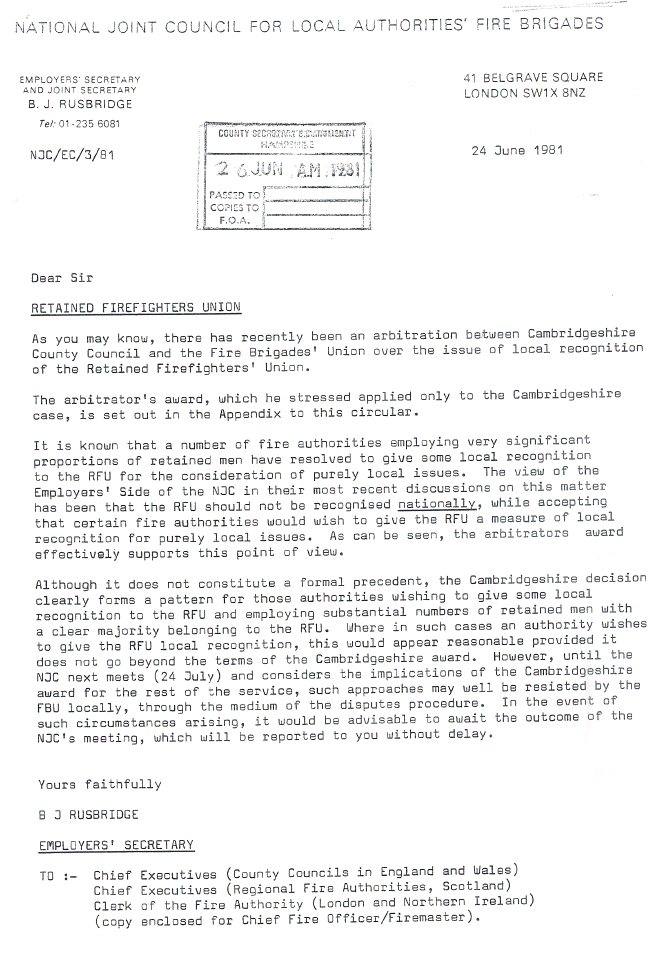
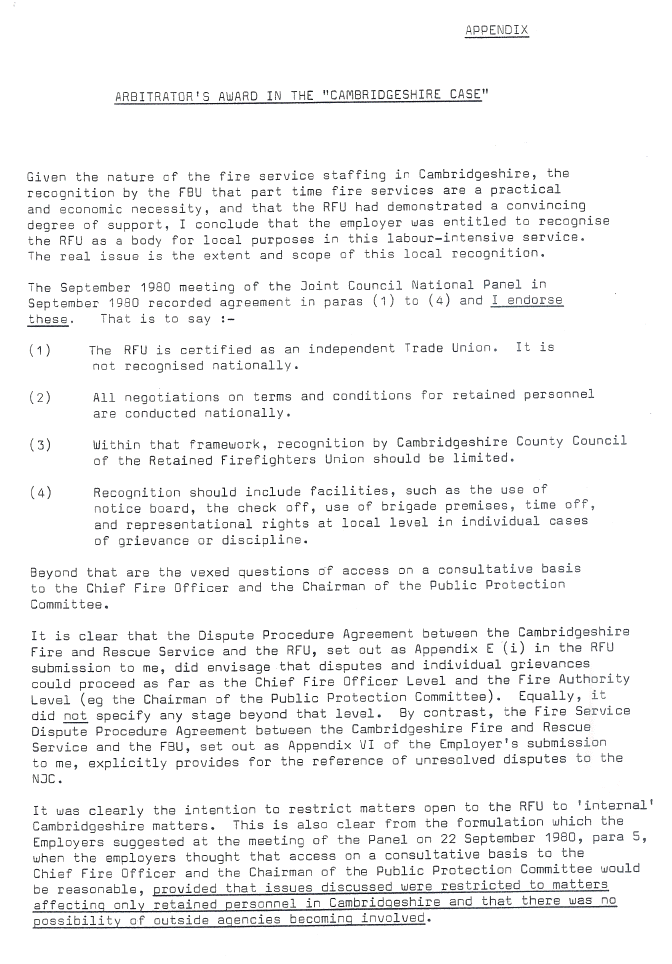
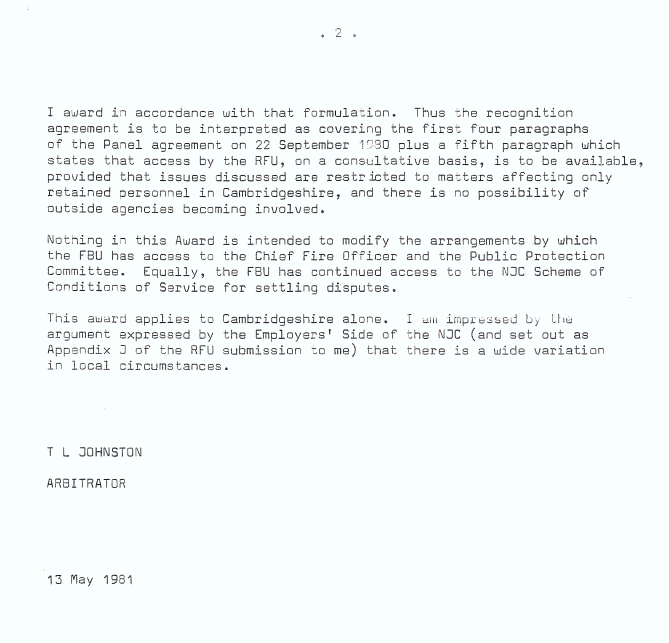
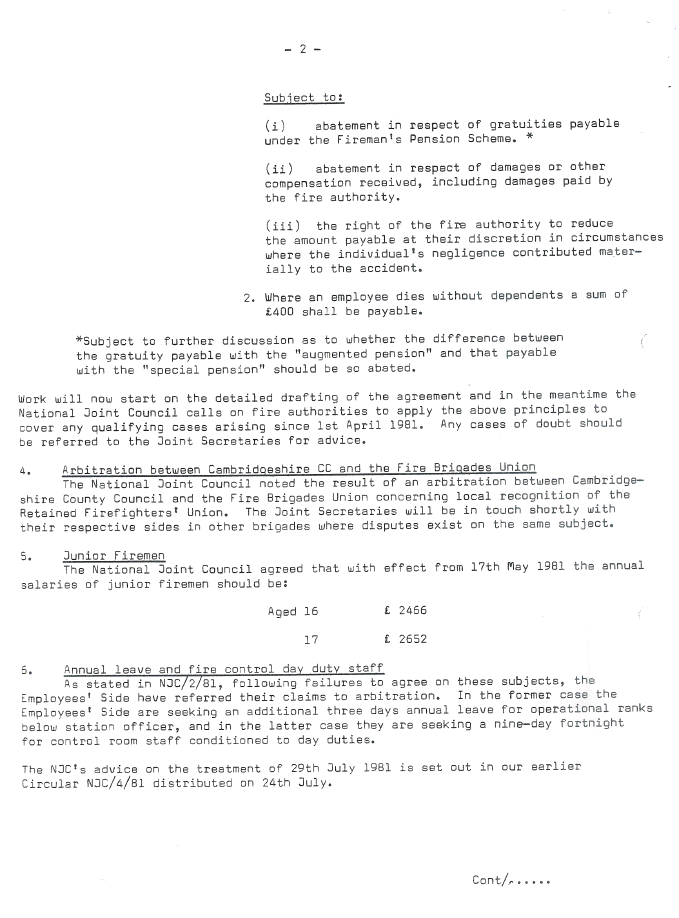
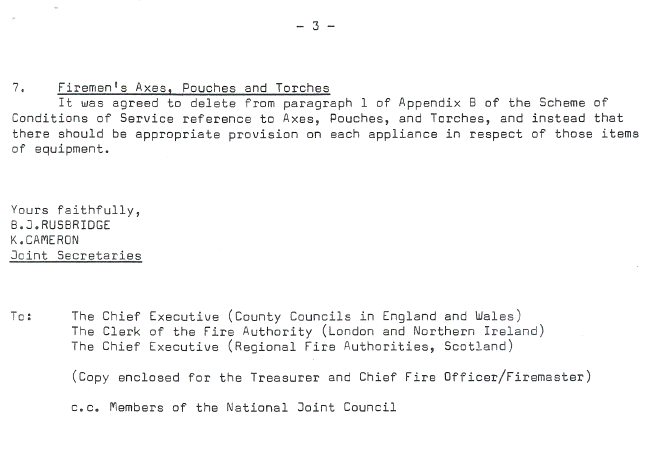
The issue of the RFU's recognition was considered by a number of Fire Authorities in the early 80's which led to an arbitration between Cambridgeshire County Council and the Fire Brigades Union. The decision, although not binding, provided a model for other Fire Authorities to work to. The decision of the arbitrator was that the RFU should be formally recognised for consultation purposes of issues specifically relating to retained personnel employed by Cambridgeshire Fire and Rescue Service. The outcomes of the Arbitration are detailed in Appendix 1. | |
In the early 80's, all negotiations were carried out at a national level through the NJC. However, the revised terms and conditions of employment for Grey Book employees now places a requirement on us to negotiate certain items locally. This brings into question the scope of the Cambridgeshire arbitration and its relevance to the current business environment. | |
2.4 |
National Recognition |
At a national level, the employers side of the NJC are currently considering proposals to amend the NJC constitution. This includes recognition of other representative groups, therefore the FOA and RFU are awaiting formal recognition in the NJC constitution for national consultation or negotiation. Although this is the current national position, a strong indication on the way forward was given in the White Paper `Our Fire and Rescue Service' which stated "We also agree with the independent review that a new negotiating body should involve a representatives from the Retained Firefighters Union, the Fire Officers Association and the Association of Principal Fire Officers". This view is supported in the National Framework, Annex E: Draft Fire and Rescue Service Core Values which states under the section, We Value Our People, "We work in an inclusive way" and "We recognise that everyone has a contribution to make". http://www.odpm.gov.uk/stellent/groups/odpm_fire/documents/page/odpm_fire_029700.pdf | |
2.5 |
Information and Consultation of Employees (ICE) Regulations 2005 The ICE Regulations come into force on 6 April 2005 and implement the EC directive giving employees rights to be informed and consulted about the business they work for. The regulations encourage good practice in terms of clear, and inclusive methods of information dissemination and staff consultation. Although the Service's current arrangements satisfy most of the criteria, the recommendations in this report develop these arrangements to meet the expectations set out in the new regulations. |
2.6 |
Hampshire Fire and Rescue Service Values The Fire Authority has considered the adoption of values for the Service under a previous agenda item. These values indicate an inclusive approach to the modernisation of the Service. The restructuring of the consultation and negotiation framework gives the Authority an opportunity to communicate a clear message and commitment to these values and an inclusive approach to staff representation. |
2.7 |
Strategic Risk Register The Authority will also be considering the adoption of a strategic risk register. The Strategic risks to the Authority are managed through initiatives, which develop the Service and meet the expectations of stakeholders. Members will know that a crucial element in the successful implementation of the initiatives is the involvement of staff and their representatives. Therefore, the wider the involvement of representative groups, the more likely the initiatives will be successful and the greater the Service ability to manage the strategic risks. |
2.8 |
Employment Relations Service Order If the FOA and RFU are formally recognised for local consultation or negotiation, it is proposed to offer them the same facilities offered to the FBU, Unison and GMB representatives. The detail of these arrangements are contained within Appendix 2 which will be amended if the recommendations are approved to include facilities for the FOA and RFU. |
It is also proposed, if recognised, that discussions are held with all recognised representative bodies to establish a new and efficient process of local negotiation and consultation. These proposals will not affect the way we currently meet all our unions informally to progress the development or revision of policies and their involvement on specific project groups. | |
Recognition of these representative groups will entitle them to local consultation and negotiation rights as detailed in Appendix 3. | |
3 |
Financial Implications |
3.1 |
If the recommendations are agreed and the employee relations service order is subsequently amended, there will be a small increase in costs for the additional representatives. These costs will be met from the 2004/05 budget and following years. |
4 |
Consultation with existing Representative Groups |
4.1 |
APFO APFO representatives have been consulted over these proposals and are supportive of the recommendations being proposed. |
4.2 |
FBU The FBU have been consulted over the recommendations and have raised some concerns regarding the suitability of the RFU the issues raised centre around :- · The ability of the RFU to formulate constructive long term agreements · The RFU's Financial sustainability · Under representation of staff groups · Non representation on the NJC · A non inclusive approach to membership · Policy differences between the FBU and RFU |
The FBU have expressed an intention to raise a formal dispute with the Authority if the proposal of formal recognition for either the FOA or RFU is approved. However, having reviewed the Authority's position and the new consultation/negotiation procedures, it is evident that the Service has formally consulted the FBU regarding this issue . Therefore, the FBU have no right of dispute and indeed the latest EMP Circular 31/04 states under the consultation process "there can be no failure to agree as agreement is not required". A letter has been sent to the FBU explaining this position and we have since had indication that they still believe they are in dispute over this matter and have started to refuse to attend meetings where the RFU are invitees. | |
The FBU also raise a concern that their national constitution does not allow local representatives to jointly consult or negotiate with the FOA or RFU. This limitation will be taken into consideration when discussing the new working arrangements with the recognised trade unions. | |
4.3 |
Unison and GMB Unison have been consulted over the recommendations and object to the recognition of any representative body that is not recognised by the Trade Union Council |
The GMB have not responded with any comments on the proposals. | |
5 |
European Convention on Human Rights and the Human Rights Act 1998 |
5.1 |
The proposals within this report are considered compatible with the provisions of the European Convention on Human Rights, the Human Rights Act 1998, and the Race Relations (Amendment) Act 2000. |
Recommendations | |
1 |
The Fire Authority considers whether the timing is right to formally recognise the Fire Officers Association for local consultation and negotiations on issues directly relating to, or impacting upon, officers employed in the role of Station Manager to Area Manager. |
2 |
The Fire Authority considers whether the timing is right to formally recognise the Retained Firefighters Union for local consultation and negotiations on issues directly relating to, or impacting upon, firefighters employed on the retained duty system. |
Section 100D - Local Government Act 1972 - Background Papers The following documents disclose the facts or matters on which this report, or an important part of it, is based and has been relied upon to a material extent in the preparation of the report. The Fire and Rescue Service National Framework 2004/05 http://www.odpm.gov.uk/stellent/groups/odpm_fire/documents/page/odpm_fire_029700.pdf Our Fire and Rescue Service White Paper Note: The list excludes: (1) Published works (2) Documents that disclose exempt or confidential information as defined in the Act |
Appendix 1 - Outcome of the Cambridgeshire Arbitration : -NJC/EC/3/81 dated 24 June 1981Circular EMP/7/00 - Retained Firefighters Union - Local application for recognition http://www.lg-employers.gov.uk/documents/pay_conditions_stats/fire/emp7-2000.pdf Circular EMP 31/04 dated 29 September 2004 http://www.lg-employers.gov.uk/documents/pay_conditions_stats/fire/20040929_emp31.pdf Appendix 2 - Hampshire Fire and Rescue Service Employee Relations Service Order S0/1/10 Appendix 3 - Consultation and Negotiation Rights on Recognition |
lajC/H/Trade Unions
26/11/04
Appendix 1
Appendix 2
Target Audience:
SO/1/10
Page 1
(PBC 6/03)
EMPLOYEE RELATIONS
1 POLICY
HFRS has a mission to make Hampshire safer by promoting greater understanding and responsible attitudes towards fire safety and by providing a highly responsive, caring and efficient fire and rescue service.
This mission can only be fully met by actively promoting a positive relationship between employees, their Representative Bodies, and management , based on recognition of common interest, which promotes quality and efficiency of the Service and improves the quality of the work environment for its employee .
This relationship is referred to as the Workplace Partnership. See Appendix A
2 PROCEDURE
For all formal negotiations and matters concerning conditions of service, HFRS recognises the following Representative Bodies (RB's):
- Fire Brigades Union (FBU)
- UNISON
- GMB
The Service also recognises that it has an obligation to listen to, and in certain circumstances, to consult the views of other members of staff, and provide them with such support as they see fit to participate in this process.
A full explanation of the mechanisms for RB's involvement is given in Appendix B - Recognition and Representation.
HFRS will endeavour to make reasonable time and facilities available for agreed RB activities and encourage the fullest possible participation by officials within the Workplace Partnership. Please refer to Appendix C - Facilities Agreement
Specific duties, rights and responsibilities of Representative Bodies in relation to the Safety Representatives and Safety Committees Regulations 1977; Health and Safety (Consultation with Employees) Regulations 1996 and the Health and Safety Representatives facilities agreement can be found in Service Order SO/8/1/1.
SO/1/10
Page 2
(PBC 6/03)
3 CONDITIONS OF SERVICE
Nothing in this Service Order should be interpreted as contradicting the provisions made in:
- The National Joint Council for Local Authorities' Fire Brigades, Scheme of Conditions of Service (The Grey Book)
- The National Joint Council for Local Government National Agreement on Pay and Conditions of Service (The Green Book), or any agreed preceding national conditions of service not covered by the Green Book but still in force.
4 APPENDICES
Appendix A - Workplace Partnership
Appendix B - Recognition and Representation
Appendix C - Facilities Agreement
5 FURTHER INFORMATION
FM/1/4/1 - Record of Formal Agreement
- End -
SO/1/10
Appx A
Page 1
(PBC 6/03)
WORKPLACE PARTNERSHIP
HFRS have a mission to make Hampshire safer by promoting greater understanding and responsible attitudes towards fire safety and by providing a highly responsive, caring and efficient fire and rescue service.
This mission can only be fully met by actively promoting a positive relationship between employees, their Representative Bodies and management based on recognition of common interest, which promotes quality and efficiency of the Service and improves the quality of the work environment for its employees
This relationship is referred to as the Workplace Partnership.
The Workplace Partnership is based on the following principles:
- A commitment by all parties to the success of the Service
- A commitment by all parties to wise stewardship of public finances
- A recognition of all parties legitimate interests
- A commitment by all parties to employment security
- A focus by all parties on the quality of working life
- Transparency by all parties in their dealings with each other.
- A commitment by all parties to strive to find areas of mutual agreement and avoid unnecessary conflict
- A commitment by all parties to equality, fairness and dignity in the workplace
- A commitment by all parties to value diversity in the workplace.
- A commitment by all parties to maintain a healthy and safe work environment
- A commitment by all parties to the welfare of the employees
The Service and the RB's will continuously promote and monitor the workplace partnership. It will form a standing agenda item for the Joint Trade Union meetings.
- End -
SO/1/10
Appx B
Page 1
(PBC 6/03)
RECOGNITION AND REPRESENTATION
1 RECOGNITION
For all formal negotiations and matters to do with conditions of service HFRS recognises the following Representative Bodies (RB's):
- Fire Brigades Union (FBU)
- UNISON
- GMB
The Service also recognises that it has an obligation to listen to, and in certain circumstances to consult the views of other members of staff, and provide them with such support as they see fit to participate in this process.
2 REPRESENTATION
For the purposes of information gathering representatives of the recognised RB's will be provided with the opportunity to attend:
- Combined Fire Authority meetings
For the purposes of negotiation representatives of the recognised RB's will be provided with the opportunity to attend:
- Joint Trades Union Meetings with Service Management
- Individual RB Meetings with Service Management
For the purposes of consultation and within the principles of the Workplace Partnership representatives of the recognised RB's will be provided with the opportunity to attend:
- Service Health, Safety and Welfare Committee
- Service Fairness and Dignity at Work Committee
- Service Delivery Policy Group
- Service Personnel Planning Group (subject to confidentiality issues)
- Service Technical Fire Safety Policy Group
- Service Training Policy Group
- Single topic working groups
- Joint investigations and enquiries
- To provide RB information to trainees on initial wholetime courses
SO/1/10
Appx B
Page 2
(PBC 6/03)
For the purposes of representing specific individuals or groups representatives of the recognised RB's will be provided with the opportunity to attend:
- Discipline hearings
- Grievance hearings
- Medical tribunals
- Capability hearings
- Employment tribunals
- Formal latter stages of Probationary processes where continuation of employment may be at risk.
(Note: representation of employees is not exclusive to RB officials, see Grievance; Sickness Absence Management; Capability Support; Fairness and Dignity; Disciplinary Procedure Service Orders)
3 AD HOC MEETINGS
The above list is not exhaustive and all parties recognise that there may be a need for ad hoc meetings that do not fall into one of these categories.
4 AGREEMENTS
This Service order recognises the commitment by all parties to strive to find areas of mutual agreement and avoid unnecessary conflict. To this end all parties will have an obligation to:
- Wherever possible enter into dialogue at the earliest possible stage
- Wherever possible work in partnership to find solutions to issues
- Accurately record decisions jointly arrived at by the completion of form FM/1/4/1
- Communicate decisions jointly arrived at.
- Comply with decisions jointly arrived at
5 DISPUTES AND FAILURE TO AGREE
In acknowledging the commitment by all parties to strive to find areas of mutual agreement it has to be recognised there may come a time when disagreement becomes unavoidable.
In the event of there being a failure to agree parties will follow the process outlined in their respective conditions of service.
6 NOTIFICATION OF ELECTED POSTS
The secretaries of the recognised RB's will advise the Personnel Manager in writing of the names of any Brigade level officials elected to offices within their RB, and keep this up to date.
7 MANAGEMENT ATTENDANCE AT REPRESENTATIVE BODIES MEETINGS
Whenever possible representatives of the Service management will react positively to any reasonable requests for their attendance at recognised RB meetings.
SO/1/10
Appx B
Page 3
(PBC 6/03)
8 ATTENDANCE OF RB'S AT STATION OPEN DAYS AND OTHER PUBLIC EVENTS
In the event that a request is received from the RB's requesting to attend a Station Open Day or any other public event the request should not be unreasonably refused providing that the following aspects are in place:
- Any presentation is given in a `passive' way i.e. there is no attempt to force literature or the message on the public, there is no use of loudhailers, etc.
- There is a central fixed presence for the distribution of literature and the display of information.
- A reasonable number of union members crew the stand (the level will be at the discretion of the Station Commander, but should not interfere with operational activities).
- That FBU Members, where in uniform, will be appropriately attired not PPE) and must conduct themselves both as ambassadors of the Service and their Trade Union.
- No money collection is made.
- RB's will ensure that the presence and action of its members does not in any way embarrass the public or bring the Service in to disrepute.
- End -
SO/1/10
Appx C
Page 1
(PBC 6/03)
FACILITIES AGREEMENT
1 INTRODUCTION
HFRS will endeavour to make reasonable time and facilities available for agreed RB activities and encourage and promote the fullest possible participation in the Workplace Partnership.
In making time and facilities available for RB activities all parties will be referred to:
`ACAS code of practice 3 Time off for Trade Union Duties and Activities'
Copies of this code of practice are available from Personnel Department or trade union secretaries
2 TIME AVAILABLE FOR REPRESENTATIVE BODIES DUTIES AND ACTIVITIES
Section 5 of the ACAS code of practice covers what the agreements should specify in relation to time available for Trade Union Duties and Activities, in particular:
2.1 To Whom Paid Time Will be Made Available
Principally, this agreement will extend only to elected officials of the recognised RB's having a brigade wide remit (or their nominated representatives). However, it does recognise that elected officials from individual workplaces may also occasionally need some time made available for legitimate RB duties.
2.2 The Amount of Time Permitted
It is not possible to put an exact figure in terms of hours, as this will inevitably vary depending on the circumstances at the time. However, it is expected that the following principles will apply:
- The time made available will always be at the exigencies of the Service and the operational commitment will always take precedence
- It is expected that an individual undertaking RB duties will return to normal duties at the earliest opportunity after completion of the RB duties
- Compensatory time off at plain time may be claimed where an official is asked by management to undertake RB duties in an off duty period. Such time off will be taken at the exigencies of the Service. Where an official is asked by management to undertake RB duties in an off duty period immediately prior to proceeding onto a night duty, reasonable time will be allowed for rest and recuperation prior to reporting for duty.
- Local managers need to recognise the important contribution made by RB officials and should make every effort to accommodate legitimate requests.
- It will be for local managers to prioritise the commitments put on their available staff. However, the Service does recognise the important role played by RB officials and as a consequence, expects that legitimate requests for time off will be treated with due consideration.
SO/1/10
Appx C
Page 2
(PBC 6/03)
- The maintenance of critical operational response remains paramount and whilst a standby from another station to enable an official to be released is accepted, time will not be made available if it results in the ability to provide critical operational response being compromised.
- RB officials will be expected to work closely with local managers to organise time available for RB obligations in such a way that it minimises the impact on working lives of others at any particular workplace
- Where there is more than one official working at a single work location, it is expected that the RB commitments would be shared to avoid putting unnecessary strain on the available resources
- It is expected that RB officials will record all time taken up by RB activities.
- For individual workplace based RB activities, it will be expected that those participating will maintain full operational availability during the course of the activity, if needed.
- There may be occasions when, at management's request, consideration will be given to secondment of an RB official, in order to undertake work on a large-scale project on behalf of the Service.
2.3 Occasions on Which Time Can be Made Available
In addition to those activities identified in paragraph 2 of Appendix B, the Service will make reasonable time available to RB officials identified in 2.1:
- For preparation for, and attendance at, and subsequent administration of any of the activities and commitments referred to in Appendix B.
- To attend at the request of management to assist in a particular task or event.
- For attendance at Brigade Committee meetings
- For attendance at Executive Committee meetings
- For attendance at annual TUC conferences or their Trade Union annual national conference as a nominated delegate
2.4 Procedures for Requesting Time to be Made Available
RB officials will be expected to co-operate fully with local managers by giving as much notice as possible of future RB obligations.
Local managers need to monitor all work time made available to officials for RB duties.
SO/1/10
Appx C
Page 3
(PBC 6/03)
2.5 Local Meetings Held in Work Time
The Service will make available reasonable facilities for properly constituted local branch meetings to be held in individual workplaces, and in work time, subject to the following:
- All local meetings will be held subject to the exigencies of the Service.
- The branch secretary will give local managers sufficient notice of any proposed meeting.
- The time place and duration of meetings will be agreed with the local manager.
- Operational availability will be maintained at all times.
- The meeting will not interfere with key times during the working day i.e. hand over or roll call times.
- Necessary work not undertaken as a result of the meeting being held will be addressed after the meeting has finished.
- Off duty personnel may attend in their own time.
- Meeting times are kept to a reasonable length.
- Meetings frequencies are such as to not cause unnecessary disruption.
- Only RB members employed at the workplace in question or legitimate RB representatives may attend the meetings.
- The meetings should not disadvantage or unduly inconvenience non RB members working at the same place.
- It would be expected that, whenever possible, any visiting RB official would make themselves known to the local manager on arrival at a particular place of work.
2.6 Training Events
RB officials may be allowed time to take advantage of appropriate RB training, subject to:
- Requests for attendance at RB training events in work time being submitted and approved in good time.
- The training is provided by a RB recognised by the Service.
- Copies of the syllabus or prospectus are submitted with the application to attend.
- Attendance will be at the exigencies of the Service.
- The total time being requested is reasonable.
- Attendance at RB training whilst off duty will not attract overtime or time off in lieu.
- Time off from a night shift on the day prior to a course is permitted. Time off is permitted from the night shift if the course is held on the day immediately after.
3 PHYSICAL RESOURCES AND FACILITIES AVAILABLE FOR REPRESENTATIVE BODIES DUTIES AND ACTIVITIES
3.1 Accommodation
Where available, and subject to other legitimate pressure on resources, HFRS will provide RB officials with sufficient desk and filing cabinet space to enable them to fulfil their function.
When needed for confidential interviews and discussions, HFRS will make every effort to provide suitable private facilities on Service premises.
SO/1/10
Appx C
Page 4
(PBC 6/03)
3.2 Joint RB Office Facility
The Service recognises that RB officials require the use of an office facility. The Service will endeavour to provide a suitable office for this purpose, within HFRS premises . This will be subject to the operational requirements for office facilities, which will take precedence.
3.3 Notice Boards
Recognised RB's will be provided with the facility of a prominently located notice board at each work location.
Local officials will take responsibility for the material displayed. In particular the material displayed must:
- Only be displayed if it is accredited to the RB's in question
- Not be derogatory or offensive
- Be in date
- Be kept tidy
3.4 Telephone and Fax
Officials will be allowed reasonable, free access to telephone and fax facilities in their workplace.
Unless extremely urgent, telephone calls should not be allowed to interrupt normal work activity, in particular training sessions.
3.5 Email and Profs Use
Officials will be allowed reasonable free access to email and Profs facilities at their place of work, subject to the normal rules governing usage.
3.6 Copying and Printing
Reasonable use of reprographic and photocopying equipment may be made. A charge may be made for paper used.
3.7 Post
RB officials may make use of the Service's internal mail system, free of charge. Cost of external post will be borne by the RB.
3.8 Deduction of Trade Union Contributions from Salaries
The Service will facilitate the deduction of contributions to recognised trade unions by direct deduction from salaries upon receipt of written authorisation from members of staff.
SO/1/10
Appx C
Page 5
(PBC 6/03)
3.9 Protocols for the Use and Management of the Joint Trades Union Office at C32 Eastleigh
The Service, in the spirit of the Workplace Partnership and the Employee Relations Service Order has provided this office for use by the recognised Trade Unions.
The office, furniture and equipment is provided for the use of all the recognised trade unions and the allocation of space and the apportionment of time is a matter of agreement between the unions using this office.
3.10 Management Obligations
- To provide the office, furniture, telephone, fax line and IT terminal
- To arrange for free access to the office at all reasonable times
- The Service retains overall responsibility for Health and Safety and maintenance of the office
- The Service will respect the privacy of the office
- The Service will pay the telephone line rental
- The Service will pay utility costs
3.11 Trade Unions Obligations
- To comply with Health and Safety stipulations laid down in respect of the office and the rest of the building
- To arrange with the station commander for periodic cleaning of the office
- To comply with the Data Protection Act by correctly and safely storing materials and documents
- To allow access to the office for Health and Safety purposes
- To comply with local safeguards with regard to `Loan Worker' arrangements
- To allow access to the office for maintenance purposes
- As with all other Service facilities, any private use of telephone and fax facilities will need to be paid for
4 TRAVELLING AND SUBSISTENCE
When undertaking RB duties during normal working hours officials will be entitled to travelling expenses and subsistence allowances in accordance with their relative agreed conditions of service.
When undertaking RB duties, at the request of the Service, outside normal duty hours, officials will be entitled to travelling expenses and subsistence allowances in accordance with their relative agreed conditions of service.
When undertaking RB duties, at the request of the Service, outside normal duty hours officials will be regarded as being at work for pension scheme and insurance purposes.
Where the official's RB covers travelling and subsistence expenses, no claim can be made to HFRS.
SO/1/10
Appx C
Page 6
(PBC 6/03)
5 MONITORING
All parties will monitor the workings of this agreement to ensure that it best serves its needs in meeting its mission. It will be reviewed annually, and will be listed as a standing agenda item for the first JTU meeting of each calendar year.
- End -
Appendix 3
RIGHTS ON RECOGNITION
Information and Consultation Rights
· A right to disclosure of information for the purpose of the collective bargaining for which it is recognised (S181 TULR©A)
· The right to be consulted on collective redundancies (S188 TULR©A)
· A right to information and consultation in connection with the transfer of undertakings (Transfer of Undertaking (Protection of Employment) Regulations 1981)
· A right to information and consultation on occupational pension schemes (S11(5) Pension Schemes Act 1993) and regulations created thereunder
· A right to information and consultation with its appointed safety representatives (Health and Safety at Work, Safety Representatives and Safety Committees Regulations 1977)
· A right to initiate negotiations for the establishment of a European Works Council (Transnational Information and Consultation of Employees Regulations 1999)
Negotiating rights
Recognition also confers negotiating rights in respect of pay, holidays and hours. In addition, the employer may, if it chooses, grant negotiating rights in respect of one or more of the following "collective bargaining" matters (S178 TULR©A), so far as they are negotiable :-
· Terms and conditions of employment, or the physical conditions in which any workers are required to work
· Engagement or non-engagement, or termination or suspension of employment or the duties of employment, of one or more workers
· Allocation of work or the duties of employment between workers or groups of workers
· Matters of discipline
· A worker's membership or non-membership of a trade union
· Facilities for officials of trade unions and
Machinery for negotiation or consultation, and other procedures in relation to any of the above matters, including recognition of the right of the trade union to represent workers in such negotiation or consultation or in the carrying out of such procedures