
Archived decisions
DRAFT DOCUMENT
Hampshire Partnership
CHILDREN'S FUND
2005-2008
Strategic Plan
"Building Better Futures for Hampshire's Children"
Vision: "That Hampshire's children and young people get the best start in life, and flourish throughout their childhood by achieving their hopes and dreams."
Project name/no |
Area |
Outputs |
Theme |
Timescale |
£ spend |
Forest Bus |
New Forest |
999? |
1-7 |
2003-2008 |
£50,000 |
Mountbatten Project |
Winchester |
999 |
... |
||
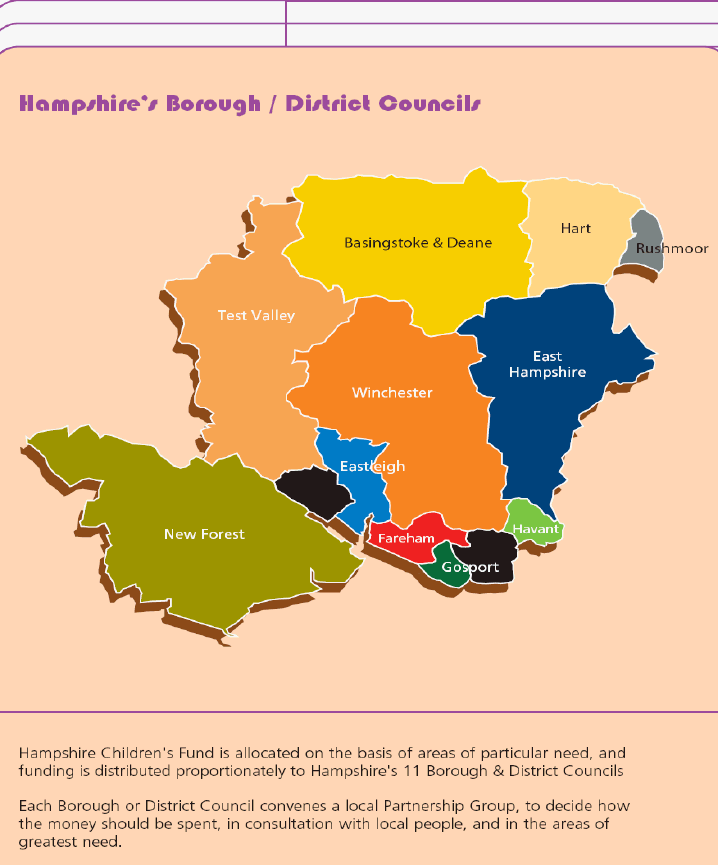
*Colour text to match map's area colours to illustrate spread of projects. |
**delete rows to fit number of projects |
Introduction
1.1 Hampshire is a large, diverse county in the extreme south of England, third largest in terms of population, with 1.245 million people, it is the second largest in terms of area measuring approximately ? miles from East to West and North to South. Although thought of as an affluent county, it encompasses five wards which are amongst the most deprived in the country as measured by the Index of Multiple Deprivation in 2002.
Such wards can be seen as `islands' of deprivation within a hinterland of relative affluence and this can make them harder to reach. Communications are excellent across the `M27/M3 corridors' but areas such as the New Forest, Rushmoor and Gosport can present more challenges, particularly for those families without access to a car.
1.2 Using the categories set out in the Green Paper; `Every Child Matters', it can be estimated that 8,850 young people in Hampshire aged 0-15 are vulnerable and 3,500 are `children in need'. Additionally, there are 1,250 Children Looked After and 473 children and young people on the Child Protection Register, some of whom may also be Children Looked After. This is from a total population 0-15 in Hampshire of 250,245.
1.3 Hampshire's Children's Fund is a wave 3 partnership, and came into existence in April 2003. Its initial funding was estimated using the Standard Index of Multiple Deprivation at £2.4 million. Its adjusted allocation for the Financial Year 2004/5 is £2.5million pounds. The average allocation across the three Financial Years 2005-2008 is £2million per annum.
1.4 Hampshire Children's Fund has Hampshire County Council as its accountable body and Hampshire Social Services Department as its administering department, an arrangement that has been both effective and productive in placing the partnership at the heart of local planning for change following from recent and forthcoming legislation and changes to working arrangements.
1.5 Hampshire is divided into 11 Borough and District Councils. At the inception of the Children's Fund it was decided, after consultation to form a Local Partnership Group for 10 of the eleven districts. The remaining district, Hart has a smaller advisory group due to its modest allocation of funds. Each Local Partnership Group (LPG) receives an annual amount arrived at using the Standard Formula, following a top-slice of the budget for Hard to Reach Groups and for Crime Prevention.
1.6 The Local Partnership Group model has flourished and has resulted in a thriving `local democracy' whereby funding is allocated to projects following local consultation and an analysis of local need. Allocations are then endorsed; modified; or in a small number of cases disapproved by the Partnership Board.
1.7 Each Local Partnership Group has an elected Chair of whom, currently 6 are drawn from the VCS, 2 from Borough and District Councils, and 2 from the statutory sectors.
1.8 The major achievements of our first year of operation included:-
· More than 140 projects brought into operation across Hampshire.
· Service delivered to in excess of 10,000 children and young people.
· Widespread consultation achieved to inform local commissioning plans and local services.
· More than £2 million spent.
· Hampshire's progress was commended by the GOSE Regional Team at Standard Assessment Review visit in 2003.
· Thriving local network of Partnerships established to oversee and guide local implementation.
· Effective and thorough strategic plan completed for 2003-2006.
· Special provision and an effective commissioning plan in place for Harder to Reach Groups encompassing Traveller Families Children with disabilities, Young Carers, Minority Ethnic Groups and women's refuges.
· Fully developed Child Protection policy and Standard Assessment Framework documentation developed to support and inform application processes.
1.9 A cohesive central Management Team has been recruited as follows:
Management Team and Youth Iinclusion and Support Panel
|
|
| ||
IT & Information Officer |
Finance Officer |
|
Contracts Officer (.5) |
PR & Communication(.5) |
|
||||
Senior Development Officer South West Test Valley Eastleigh New Forest Winchester |
Senior Development Officer North/Central Basingstoke & Deane Hart Rushmoor All Hard to Reach |
Senior Development Officer South East Fareham Gosport Havant East Hants | ||
YISP Manager
|
||||
|
2 x caseworkers Gosport |
2 x caseworkers New Forest |
2 x caseworkers Rushmoor |

 Programme Manager
 Admin Manager
 Admin Assistant (.5)






1.10 The Partnership's work is currently directed by the following Board and sub group arrangement.
· Children's Fund Partnership Board
· Commissioning and Mainstreaming Group
· Local Partnership Chairs Group
· Youth Inclusion and Support Panel Steering Group
· Hard To Reach Subgroup
· Participation SubGroup
1.11 This first period of the Hampshire Children's Fund has been characterised by rapid development and change and by considerable challenges and adaptation to new circumstances. All this took place against a background of burgeoning change within the public sector. The partnership has sustained a good level of morale and adaptation and is well placed to take a leading role in current and forthcoming responses to legislation and planning frameworks.
1 The Vision for the Future 2005-2008
2.1 Although a large, diverse and complex county, Hampshire has a good record in developing services for Children and Families and is currently a two - star authority.
2.2 The county is well placed to take forward the busy agenda of work associated with building a new paradigm for delivery of services to children, young people and families.
2.3 Hampshire has already taken some considerable strides towards making some of the key preparations for change as follows:
· Has a fully functioning and active Children and Young People's Strategic Plan
· Has produced an Early Intervention and Prevention Strategy (Appendix 1)
· Is a pilot area for a Children's Trust partnership with CAMHS
· Is well on the way to ratifying an Information Sharing Agreement (ISA)
· Has Best Value Reviews underway to scrutinise delivery of service to Care Leavers and service to children and families via Family Support Teams.
· Has developed a successful cross- Wessex Youth Offending Team with integrated management arrangements and a pooled budget to tackle youth offending issues across the region.
· Is actively pursuing common methods of assessment to ensure effective multi-agency working, avoid duplication and provide a solid information base to ease collection of effectiveness and comparative data.
· Has effective, developing and innovative Sure start and Connexions programmes.
2.4 Against this background, the central vision for the Children's Fund is as follows:
2.4.1 That it will be an integral part of the overall Hampshire Strategy for Early Intervention and Prevention, and a major provider in the delivery of preventative strategies and projects to :
· Identify Problems at an early stage
· Stop problems occurring again and again
· To quickly take action when a child is perceived to be in need or at risk.
· To give support to children and young people who are experiencing difficulties.
(Hampshire draft Early Intervention and Prevention Plan 2004)
2.4.2 That the Children's Fund will have played a full part in , and be a significant partner in the delivery of a new, modality of service delivery for Children and young people aged 5-13 which is founded in a belief that it is better to intervene at an early stage in the emergence of issues and difficulties than to deal with these when they have become more serious and entrenched.
2.4.3 That the Children's Fund and all its projects will be firmly rooted in local need and aspirations via the Local Partnership Groups, and will all be able to show a direct link to the outcomes required by the Green Paper, `Every Child Matters', the Children's Bill and the National Service Framework for the Health and Social Care of children. Thus ensuring that all children are enabled to:
· Be Healthy enjoying good physical and mental health and living a healthy lifestyle.
· Stay Safe - being protected from harm and neglect.
· Enjoying and achieving getting the most out of life and developing skills for adulthood.
· Making a positive contribution by being involved with the community and society, and not engaging in anti-social behaviour or offending.
· Economic well being - not prevented by economic disadvantage from achieving their full potential.
ALL CF INTERVENTION
FAMILY SUPPORT MODEL
|
|
 YISP INTERVENTION




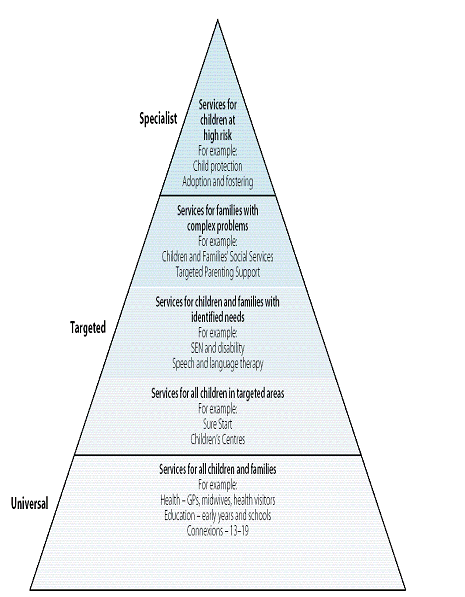
THE MATRIX OF NEED AND SERVICES
VULNERABLE
TIER 2 EARLY INTERVENTION
MAPPING CHILDREN'S FUND AND YISP FOCUS
2.4.4 The diagram at page ( 8 ) shows the intended focus of intervention for general Children's Fund preventative services and YISP services. Within the proposed multi-agency delivery teams proposed by the Children's Bill and the National Service Framework, the Children's Fund is uniquely positioned to deliver early intervention and preventative services to children and young people aged 5-13. `General Services (i.e. non crime prevention) will be:
· Strongly rooted in local need via Local Partnership Group focus.
· Targeted at Children and Young People who may be `vulnerable' or `in need'.
· Provided via services and projects that are `universally' accessible within the locality, to avoid stigma.
· Fully integrated and linked to other statutory and voluntary effort to maximise impact and expand local capacity.
· Cost effective and capable, where successful, of being `mainstreamed' within statutory funding as funding progressively moves forward preventative delivery.
· Able to demonstrate successful outcomes as defined by the Children Bill and NSF.
2.4.5 Youth Inclusion and Support Panel services will be widely distributed across Hampshire's Districts and Borough's and their intervention will be:
· More tightly targeted than general Children's Fund services.
· Accessing children and young people predominantly aged 8-13 who are demonstrating early signs of offending, anti-social behaviour or, who are in particular in danger of social exclusion.
· Whenever possible YISP teams will be co-located and co-operational with other preventative services such as Anti Social Behaviour Order teams and Crime and Disorder Reduction Partnership initiatives.
· Working closely with local Youth Offending Team and sharing information to better target vulnerable families and children in line with the `Prevent and Deter' strand of the YJB's, Prolific and other Priority Offender Strategy.
2.5 In terms of meeting the five outcomes of Every Child Matters, the Hampshire Children's Fund is exceptionally well placed to meet this challenge. The comprehensive set of commissioning plans (Local Partnership Group's x 10, Hard to Reach, Crime Prevention) were informed and guided by the identification of the Five Hampshire Themes (see page ) and a Standard Assessment Framework document and thus all funding proposals have been assessed with the 8 sub-objectives and the 5 themes in mind. This structure is currently being amended to more closely mirror the five outcomes of the Children bill.
2.6.1 A comprehensive annual review process has also been fully developed in conjunction with our local evaluation and at the time of writing this process is being completed for the second time. Each project is assessed for its success in meeting both the sub objectives, and any locally set targets. Each project is rated using a "Traffic light" indicator system and where necessary targets and milestones for improvement are set and monitored.
2.6 The Hampshire Children's Fund is currently in the process of adopting assessment evaluation and review processes to meet the specific outcomes of `Every Child Matters'. There is broad congruence and the migration should not be problematic, although there may be an impact on the evaluation of data, if the data sets are altered at this stage. Consultation to resolve this issue is currently underway.
2.7 Overall, the vision for an integrated, prevention based modality for the delivery of services to children is strong in Hampshire. The Children's Fund has developed a vibrant, thriving network, of carefully commissioned, assessed and monitored projects that are already showing early results and which are supported and enjoyed by local families and communities. Also, a strong response to the challenges set by Every Child Matters is already well underway with the establishment of a Children and Young People's Strategic Plan and the imminent publication of the Hampshire Local Preventative Strategy' which, blueprints a through going delivery plan. Nevertheless, some very considerable challenges remain:-
· The complexity, size and diversity of the county will make truly localised services a real challenge.
· Financial challenges potentially leave preventative services vulnerable and this may make mainstreaming successful services difficult, particularly those provided by the VCS.
· Current uncertainty about key elements of the migration to Children's Trust status makes detailed planning difficult in the medium term.
· Remodelling of service delivery by key partners presents barriers to strategic planning in the short to medium term (although this latter can also be seen as a potential opportunity for re-engagement.)
· The forthcoming Children's Services Plan will be a key document, with many linkages to this plan; it is not available even in draft form at this time which makes detailed analysis difficult.
2 Planning for lasting Change.
3.1 The Children's Fund is involved at the forefront of planning for change within Hampshire. The Programme Manager and staff are represented and involved in the following key change groups:
· Children and Young People's Strategic Plan
· Every Hampshire Local Partnership Group
· County Participation Group
· Connexions LMC
· Information Sharing Agreement Group
· Threshold and Assessment Group
· Family Support Team Best Value Review Team
Thus its voice is well heard and influential in key change processes. Some central elements of the delivery process outlined in the LPS are developed from or mirror current Children's Fund practice, such as the Local Partnership Group structure, local consultation processes, and balanced multi-agency services.
3.2 As the Children's Fund moves into the second phase of its existence in Hampshire, the time is opportune to move away from initial setting-up and scoping of service delivery towards a more considered strategic approach that takes into account emerging evidence of best practice and greatest effectiveness. An assured budget 2005-2008 also requires a more considered approach to be taken to planning and this opportunity is to be welcomed.
3.3 The imminent publication of the Hampshire Preventative Strategy demonstrates a close congruence between the structures and strategy outlined and those already existing within the Children's Fund, all can be seen from the overall aims; which are as to:-
· Achieve better outcomes for young people and their families.
· Increase levels of early intervention and protection.
· Tackle inequalities in services delivered and received.
· Develop services that meet individual need.
· Promote partnership working.
· Improve co-ordination of service delivery.
· Maximise joint working.
All of these elements are already to be seen and are being developed within Children's Fund practice, and thus the Fund will be excellently placed to play a pivotal role in the delivery of this agenda. It is also to be expected that the flexibility of the management and delivery structure should allow the Fund to act as an exemplar of innovative practice.
3.4 The local history of development thus far in partnership, prevention and participation demonstrates a strong local sense of purpose and a fitness to meet future challenges: three brief examples:
· Participation: Hants Children Fund has allocated £5,000 p.a. towards the cost of a Participation Manager to ensure smooth development and delivery of participation activity to give young people a real say in the planning and delivery of the services they need and want.
· Prevention: Currently actively seeking to further expand Youth Inclusion and Support Panel provision via partnership with a local CDRP.
· Partnership: Developing common protocols of practice with Connexions to ensure seamless delivery of services to 13 and14 year olds.
3.5 The Local Partnership Group Structure
The Local delivery of services via a Local Partnership Group is seen to be both effective and the only way to deliver services that meet local aspirations and local needs in a county of this size and complexity, and this will not be changed. However, if additional duties are to be placed upon these groups, as envisaged in the LPS, then consideration may need to be given to appointing and remunerating the chair of such groups to recognise the increasing workload.
3.6 Reviewing and Assessing Services and ensuring congruence with the Every Child Matters outcomes
Every project and service will be reviewed and will be required to demonstrate outcomes against the' Every Child Matters' criteria. The existing arrangements and deployment of resources will also need to be reconsidered in the light of the requirements of other key change documents such as:
· The Children's Services Plan
· The National Strategic Framework.
· Local Development Plans.
· The Youth Offer.
3.6.1 The result of this review, which will be completed early in 2005will be that:
· Every project will be evaluated in terms of an ECM objective.
· Greater focus across and within Local Partnership Group's.
· Specific milestones and action plans for every project but in particular those not currently fully meeting objectives.
3.7 The Children's Fund Partnerships re-affirms its commitments to a thorough local evaluation, and will continue to fund this work at the current level to ensure all delivery is based on sound effectiveness information.
3.8 Challenges and Opportunities in Strategic Planning
3.8.1 Streamlining: It is intended to vigorously pursue opportunities
opportunities to amalgamate the currently diverse commissioning processes and funding streams associated with the Children's Fund, Connexions, the Drug Action Team, the Teenage Pregnancy Strategy and Sure start. It may also be possible to provide an overall partnership management structure for these bodies to lesson duplication of effort and maximise the impact of an amalgamated approach. However, the complexities of current arrangements, coupled with a slowly emerging project plan for a Children's Trust would mean that this process will require a considerable amount of sustained management effort across the three year lifetime of this plan.
3.8.2 Improving links and joint planning with key partners:
· Health Via the Healthy Schools initiative, Healthy Eating projects, and a range of health related activities and projects at Local Partnership Group level; the Children's Fund has developed good initial links with Health. However, much more needs to be done in order for the Children's Fund to play a full role in meeting the ambitious agenda set out in the National Service Framework (NSF) in order to achieve this, better representation on the Partnership Board will be required. Management time will also be needed to forge stronger links with the Children's Trust, CAMHS pilot in Hampshire and to ensure that Children's Fund activity supports this activity wherever possible. This will be a priority in the coming year.
· Education Although a substantial proportion of Children's Fund projects are Education linked, there is currently little explicit congruence between Children's Fund activity, the local Behaviour Support Plan and the recently published Five Year Strategy for Children and Learners. More explicit congruences need to be forged in pursuit of better outcomes in this area.
· Parenting
The Children's Fund has good links with the County Parent Development Team and contributes to Parent line and Parent line Plus projects in Hampshire. There are several well established models for delivering Parenting Support and both SPOT programmes and CPCK programmes are locally available. The Wessex Youth Offending Team also has strong Parenting Support provision. The Children's Fund will maintain a presence in this important area to ensure that further development of services meets local aspirations.
3.9 The development of Youth Inclusion and Support Panel's in Hampshire
3.9.1 There has been some delay in establishing YISP's in Hampshire which would have rolled out in early 2004 following the adoption of the Crime Concern strategic plan commissioned in 2003. However, funding uncertainties prevented this until March 2004. Recruitment and development time have meant that at the time of writing YISP's are only just operational.
3.9.2 The current structure is that 3 YISP's have been established in the LPG areas of Rushmoor, Gosport and the New Forest. There are two caseworkers for each area and an overall team Manager. The YISP teams are co-located with other projects active in the CP fields.
3.9.3 As an interim measure in 2003/04 crime prevention monies have been spent on three major projects; Stakes Lodge Project, NCH Mini-Mentoring project and an anti-bullying initiative: the Same Difference project. It is intended that these monies will now be applied to the maintenance and expansion of the YISP initiative.
3.9.4 There are also a further group of projects distributed throughout the LPG's which clearly aim at crime prevention or anti-social behaviour, and which were previously counted as `crime prevention' initiatives under the old 25% rules. Such projects are an essential part of local provision, and it is not intended that they should no longer be supported.
3.9.5 The maintenance, support and expansion of YISP provision is the central plank of crime prevention for the Children Fund, and spending will be maintained at least at the 25% of total budget level, and in fact is likely to increase as the need to support ISP packages grows with caseload.
3.9.6 A detailed plan for development of the YISP initiative was prepared in conjunction with crime Concern, and sets out a three-stage process, of which the first stage is now complete. It is intended to proceed to the second stage in 2005/6, which will involve the establishment of YISP's in one further area. This will however, be contingent upon joint funding being secured to ensure the sustainability of such development. It is intended that strong links are therefore forged with Local ASBO Teams and Crime and Disorder Reduction Partnerships.
3.9.7 It will be essential to YISP success that close links are forged, both with local YOT teams and at a strategic YOT management level if the aims of the Prevent and Deter strand of the VJB Persistent and Priority Offender Plan are to be achieved. It is intended that specific high risk groups of young people will be targeted for support and intervention in the light of solid research evidence that shows them to be at much increased risk, of developing offending patterns. These groups to include;
· Siblings of known persistent and serious offenders.
· Young people reprimanded for offences of particular gravity or concern.
· Under 10's who are frequently coming to police notice.
· Young people engaging in anti-social behaviour on a regular basis and who are at risk of ASBO action.
· Young people excluded from full time education who are coming to police notice.
· Those in public care who are at risk of offending.
3.9.8 Ultimately the vision is to have YISP Team coverage of most or all of Hampshire, but this would require a large increase in available budget which is not currently available. Every opportunity to seek additional funding in this area will be vigorously pursued.
3.9.9 A potential issue for YISP staff (and ultimately for all CF staff) is that of short-term contracts. Opportunities must be sought to engage partners and stakeholders in solving this problem, and providing greater stability for what is already showing itself to be a skilful and committed workforce.
3.9.10 Finally YISP panels have the potential to be an excellent multi-agency forum locally. They have the capacity to build inter-agency co-operation and understanding. However, for this to happen they must be supported and given due weight by stakeholders. This may prove to be an issue as agencies struggle with competing demands on management and staff time.
3 Partnership and Management Structure.
3.1 The positioning of the CF core team management arrangements and engagement with Local Authority processes are dealt with in the Introduction Section. Hampshire Children's Fund is well placed to play a full and influential part in the development of new services for children and young people. Core membership of the CYPSP and other key change forums assures our voice will be heard.
3.2 The ability of the CF to act as a change-agent and an exemplar of innovative practice has been recognised by the CYPSP and thus a level of credibility and trust has been established which should allow for future influence.
3.3 Hampshire CF, with Hampshire County Council as its accountable body, is located within Hampshire Social Services Department for administrative and line management purposes.
Diagram on page 19
|
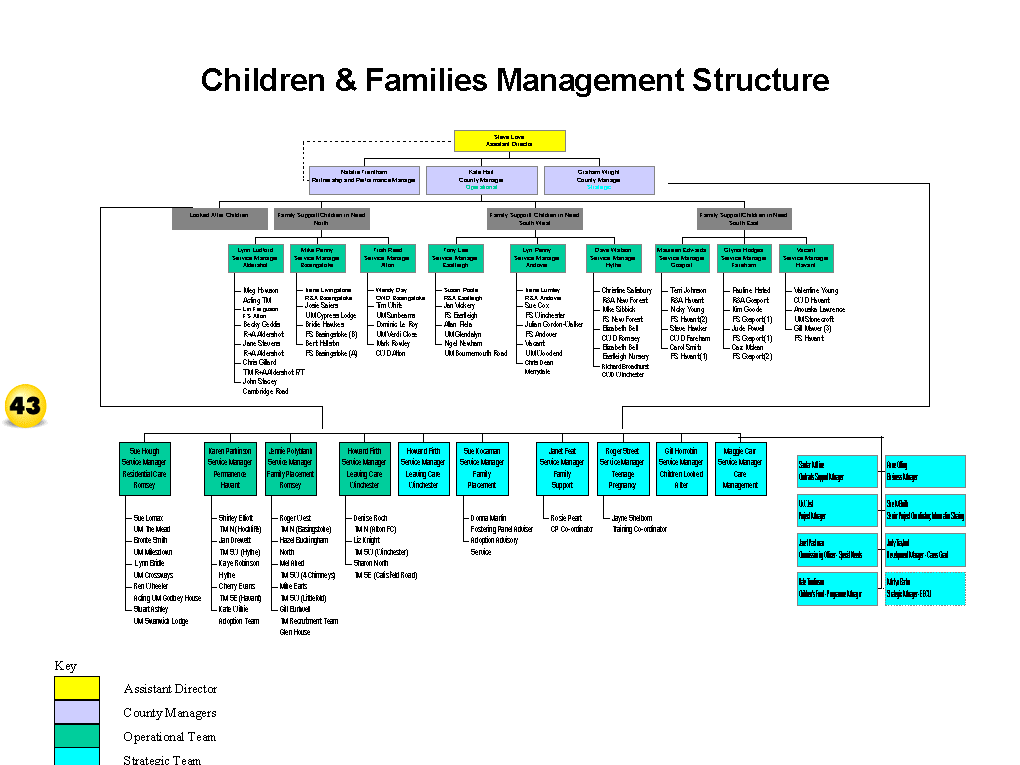
3.4 The inception of the Local Preventative Strategy and the newly published Information Sharing Agreement provide a firm footing for developmental change towards the new structure for delivery of Children's services set out in the Children's Fund and Every Child Matters. Key milestones and timescales are set out within appendix. ( )
3.5 Upon publication of the Children's Services Plan (March/April 2005) a further review and annual outcome plan will be undertaken to ensure congruence between CF planning and the broader Local Authority multi-agency agenda. By this time it will also be possible to consider any further necessary management strategic linkages such as possible membership representation on the Children's Services Board or the eventual Children's Trust Planning Groups.
3.6 As described earlier, close communication with the YOT is central to CF planning and strengthened joint consultative processes and joint planning of preventative initiatives, centred on the YISP are envisaged.
3.7 The Partnership Structure
3.7.1 The current partnership membership is shown below
Diocesan for Social Responsibility (1)
NSPCC (1)
EYDCP (1)
HCYVS (1)
Hampton Trust (1)
HCFF (1)
Community Action (1)
Parents/Carers (3)
Local Partnership Groups (11) members
Minority Groups (2)
YOTS (1)
Strategic HA (1)
PCT (1)
Connexions (1)
Borough Council (1)
Surestart (1)
Police (1)
Social Services (1)
Education (2)
Youth Service (1)
Library Service (1)
Heritage Services ?
3.7.2 This structure has proven to be an effective and energetic forum for taking forward Children Fund work. Particular strengths are considered to be:
· Strong membership from VCS sector, including past and current Partnership Chairs.
· Elected Chair supported by honorarium payment.
· Good cross section of stakeholder agencies represented and active.
· High levels of attendance at core meetings.
· Regular key co-options from other stakeholders as required.
· Core business reported to CYPSP regularly.
3.7.3 Safeguarding the position of the VCS
The localised structure and membership of the LPG system ensures a strong VCS voice, as does their strong membership on the Board. Further measures already adopted include a preferential approach for VCS led and run projects in considering mainstreaming priorities, that is that they will normally attract core funding for a longer period than projects within the statutory sector. LPG Chairs also receive a more generous honorarium structure and reimbursement of expenses. The strong tradition of VCS effort supporting and enhancing statutory provision is also a strong factor evidenced within existing and planned CF activity.
3.7.4 Consultation and Participation
A short summary of the extensive consultation undertaken by HCFF on behalf of the Children's Fund is attached to this document as an appendix (debs docjument to go i ) All of this information has been utilised to inform local and central commissioning plans. In addition, the following measures are either currently in place or are planned.
· Specific amount allocated to each LPG to fund participation at a local level.
· Annual participation and consultation event to showcase the best activity and to collect views about what is still required.
· A Link Group, with paid a co-ordinator is in process of implementation. This group of young people will, on a rotating basis, inform a matrix of other groups (supervised and supported) to receive information about the activity of the Fund and to provide direct feedback on both commissioning and strategic direction.
· In excess of 400 questionnaires from Annual report completed and analysed to draw up picture of local unmet need.
· Participation events in nearly every LPG leading to direct inputs into the decision making and commissioning process.
· CF funding contribution to CYPSP based Participation Manager to ensure consistency of approach across partner agencies.
· Programme of planned consultancy time to inform participation planning across LPG's and the Board currently planned for roll out in 2005.
· Young People routinely involved in all recruitment of Children's Fund staff.
3.8 Areas for concern
It has proven difficult due to post holders moving on, and internal re-organisation affecting Hampshire's seven PCT's to have consistent representation from Health at an appropriate level. This is currently being addressed and should be resolved soon.
3.9 It has proven problematic to attract and retain board members either from the faith community or from black and ethnic minority communities within Hampshire. This situation needs to be addressed, and consultation is currently underway to identify potential representatives.
4 Proposed Activities
4.1 The Children's Fund welcomes the further allocation of funding that ensures CF activity until 2008. This allows for strategic planning and will ensure maximum impact from monies spent.
4.2 The basic method of commissioning and funding activity will remain as before, via our well developed and tested LPG model.
4.3 It is therefore proposed that the maximum funding of £2.1million be drawn down in year 1 of this plan, and that the remaining allocation be taken in two equal amounts in year's 2 & 3. This will allow maximum `cushioning' for LPG's in year one, as decisions are made about projects that will need to seek alternative funding or to achieve mainstreamed status. Nevertheless, this approach will amount to a 20% reduction of funding to the LPG's in year one. This will be a challenging process, and will be carried out.
4.4 The strategic approach, adopted by the Board is that whenever possible funding decisions to meet any deficit will be taken on the basis of the following principles:
· Redundancies are to be avoided if possible.
· That preference for funding will be given to projects run by or located within the VCS.
· That annual review and evaluation data will be used in assessing which projects to support and retain, thus supporting the five outcomes and local priorities.
4.5 The Partnership Board is broadly confident that projects funded are already supportive of the five outcomes of ECM. Review work is currently underway to ensure that a direct link is demonstrated in every case, and that appropriate outcome measures and milestones to record progress are in place for every project.
4.6 There are an existing core of services in place across Hampshire which should be considered as the `backbone' of early intervention and preventative work. These include Early Education and Child care, Sure start and Children's Centres, Connexions and the Children's Fund. PCT workers, Behaviour Support Workers in Education, the Parent Support Service and the Teenage Pregnancy Partnerships are all carrying out important roles and many share multi-agency or Board arrangements similar to the Children's Fund.
4.7 In the drive towards integrated "full-service" teams covering early locality, it will be essential to ensure that, as far as is possible, these arrangements are brought together and streamlined; including the consideration of joint commissioning arrangements. This would both safeguard good practice and avoid waste and possible duplication of effort.
4.8 Local priorities in most cases are set, and, therefore there are expected to be few changes from previous funding allocation decisions, unless annual review or budget data suggests that project's are failing to meet their objectives.
4.9 Existing activity in crime-prevention will be brought within overall YISP planning and commissioning. The proportion of the overall budget spend will be mainstreamed at around the 25% level, and all opportunities for joint funding of further expansion of YISP's will be actively pursued. A YISP for the Basingstoke LPG area, will be the priority for expansion in year one.
4.10 Cost effectiveness and value for money issues are addressed via the comprehensive monitoring and M.I.S systems now in place. Additionally, the annual review of all services gathers performance data, sets improvement targets and is able to compare costs for projects of similar purpose, size and scope of operation.
5 Monitoring and Evaluation
5.1 The HCF has a comprehensive local evaluation project in place, under the aegis of Dr Mary Acton of Portsmouth University. The Partnership intends to maintain its expenditure on this evaluation as it provides a major data set to inform future direction of preventative work and the balance of the different elements.
5.2 It will be necessary to undertake a revision of planned work to encompass the five outcomes of ECM and to provide equitable measures of outcomes to be applied to the current methodology.
5.3 A copy of the local monitoring and review documentation is provided at App () Applied on an annual basis and firmly linked to the contract process this system ensures a focus on outcomes and a method for constructing milestones and targets in cases where problems arise.
5.4 Local and National findings from evaluations are discussed at Board meetings and lessons learned are formed into action plans to guide future commissioning decisions. Early results from local evaluation identified some weaknesses in relation to outcome focus, and a relatively large number of projects focusing on play and creativity. Both of these aspects are addressed in the current review processes and will be adjusted in line with current and developing priorities.
5.5 As a wave 3 partnership we are only now beginning to be in a position to respond to evaluation data gathered over the past year. Action planning for each of the coming three years will ensure that the lessons from both local and national data will have an increasing impact on commissioning and mainstreaming and any necessary re-allocation of resources.
5.6 The development of an Access software based management information system has been invaluable in quality assuring collected data, and this will be readily available to the national web-based system when it is operational. Data is reported to the Programme Manager on a regular basis and is routinely used in informing planning decisions.
5.7 The programme is currently in a transitional phase in undertaking reviews of services at the LPG level against emerging trends and further strategic effort will be required to ensure that LPG's are fully informed about the need to balance local aspiration against a greater focus on outcomes especially where medium term planning has taken place to support projects on an on-going basis.
5.8 To date, there are limited examples of services and projects that have been mainstreamed on basis of performance data, not least because projects are still in mid-life in most cases. However, much attention is now being focussed in this area and budget adjustments are now adding impetus to the process. An annual work report and plan will relate progress across Partnership activity from April 2005.
6 Three Year Spending Plan
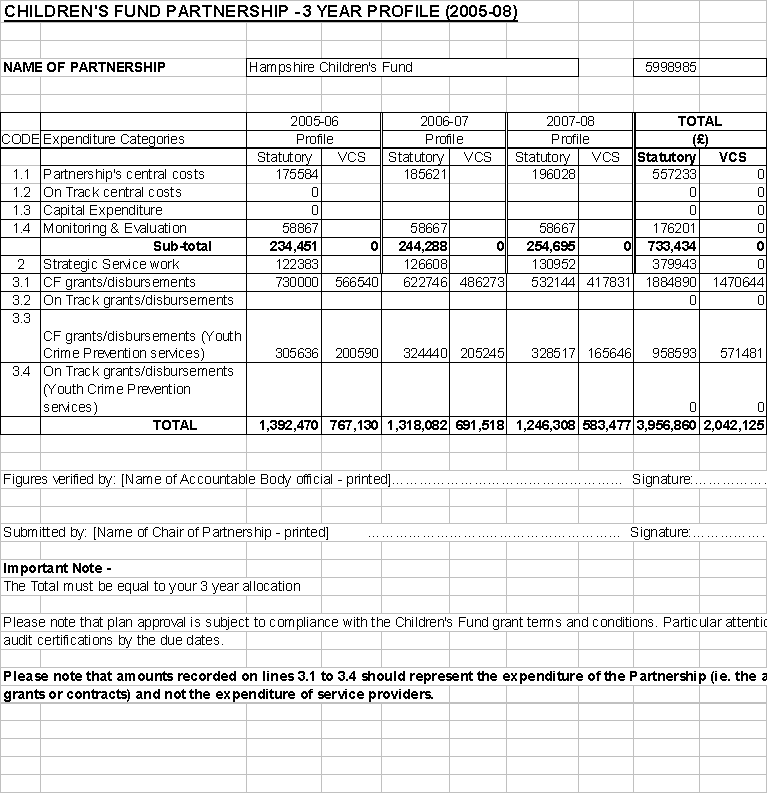
6.1 The required budget templates are amended, showing a maximum draw down of funding in year one, and a subsequent equal division across the final two years. This will equate to a 20% cut per LPG, but will minimise the impact in year one and allow some consideration of mainstreaming Principles and guidance to be followed are set out in section 4, these both set equitable and performance based criteria for reducing or withdrawing funding, and are designed to protect the position of the VCS.
6.2 The partnership is committed to reducing management costs to a workable minimum, evidence of this is demonstrated by the fact that the central management team has never recruited to two posts outlined in the original work force plan. Furthermore, under current definitions of management costs it appears that at least three Development Officer posts should now be included in the strategic section of the budget template. This will achieve a considerable reduction in management costs.
6.3 It is further agreed that across the remaining three years of the CF, every post will be reviewed annually, and in the even of any vacancy arising, to see if the post is still required, or if savings can be achieved.
6.4 Active enquiry will be made of all relevant partners and stakeholders to see if further savings can accrue via the sharing or amalgamation of existing roles. This process should be made easier by the planned review of cross-partnership arrangements, and the potential amalgamation of partnerships and commissioning processes.
DPT 07/11/04
APPENDICES
1 First Hampshire Children's Fund Annual Report
2 The Child Friendly Summary
3 The Local Preventative Strategy (draft)
4 Children's Services Planning Timetable
5 Children and Young People Strategic Planning Framework
6 Project Timeline
7 The AR Assessment documentation and guidance
8 Hampshire Children and Families Forum Summary of Consultation and Participation