
Archived decisions
Hampshire County Council River Hamble Harbour Management Committee 17 December 2004 Harbour Master's Report Report of the Director of Environment |
Item 7 |
Contact: Tony Clatworthy, tel 01489 576387
email: [email protected]
1. Summary
1.1 This report summarises the activities and events on the river from 16 June 2004.
2. Corporate Strategy
2.1 The report supports Aims 1 to 5 of the Corporate Strategy (Maximising Life Opportunities, Stewardship of the Environment, Achieving Economic Prosperity, Building Strong and Safe Communities, and Improving Services) by contributing to the statutory duties entailed in the management of the River Hamble.
3. Report
3.1 The river has been patrolled daily during daylight hours, from 0600 to 2200 hours from June to September and 0700 to 1830 hours from September, by duty staff. The Harbour Office employed three seasonal staff whose contracts ceased the first week of September. The seasonal staff must be congratulated on their excellent performance and hard work during a very busy season; it is hoped that they will return next year. Rick Harding leaves the harbour staff on retirement and his knowledge of boats, the river and the local wildlife will be missed by the staff and also by many river users. He is wished well in retirement and his hobby of naval history.
3.2 The river has been relatively busy during the start of the period building up to the main summer season. It suffered very little damage during the period of high winds from 20 to 24 June. Hamble Week was well attended when the Harbour Authority closed the river during the fireworks display.
3.3 The good weather during August and the Bursledon Regatta ensured that the river was very busy throughout August and the first week of September. Harbour Authority patrols were in attendance during the regatta and the following fireworks display, when again the river was closed for safety reasons. The day went well with nothing of note to report.
3.4 During the period the Harbour Authority gave assistance to Hamble Rescue and the lifeboat during the landing of a number of casualties recovered to the river from the Solent and Southampton Water.
4. Incidents
4.1 Throughout the period the Harbour Office reacted to a number of incidents on a daily basis, giving help and assistance to vessels in difficulties and ensuring the safety of navigation. Below is a sample of some of these incidents, and a full record of all responses to incidents is shown in Appendix 1.
4.2 Throughout the period the Harbour Office received a number of reports of speeding vessels transiting the river after 2200 hours and after patrol staff ceased patrols. Vessels have been reported travelling at speeds of 25 to 30 knotts, causing a nuisance to people on their vessels and a danger to other river users. There is concern about this trend but an inability to operate outside the set time limits owing to budget and man-hour constraints. Some out of hours patrolling has been organised but that had an impact on man-hours available for normal rosters. These incidents will be fully investigated during the six monthly audit of the Port Marine Safety Code that is due in January 2005.
4.3 Throughout the period reports of children jumping from the A27 bridge have been received. The fencing and a closer liaison with the police have reduced the number of incidents compared to last year's figures. The danger remains that injuries from this practise may occur, both to those that jump and to innocent people passing under the bridge in boats. The police have stated that children within a boatyard are carrying out a trespass, and it is therefore a civil offence and they will not attend. This leads to greater difficulties as the boatyard owner is then unable to proceed because the trespasser's details cannot be obtained without police presence. This is ongoing and is the subject of further liaison with the police.
4.4 Throughout the period the ferry operator and others have experienced difficulties caused by youths on Hamble Jetty. The jetty is used as a diving and swimming pontoon clothes, bicycles and fishing equipment are spread around on the main landing pontoon. This is a danger to crews as it restricts jumping ashore space to moor vessels on approach. Children also take joy in jumping into the wake and wash of the ferry and other vessels. Patrol Officers have attempted to remove youths causing a problem by stating that unaccompanied children are not allowed on the jetty. This has worked for a short period but they return as soon as the patrol departs. The police will not remove these children as there is not a byelaw in place. The subject of Byelaws is covered in the Marine Director's report.
4.5 Throughout the period staff, both on the water and in the harbour office, have suffered frequent verbal abuse from a minority of mooring holders and other river users. Staff support has included training in customer handling skills, anger management and reviews of procedures, especially lone working procedures. The staff are very skilled in handling difficult people and have excellent customer service skills which have proved very effective in managing difficult situations. For use in extreme situations and to help overcome lone working problems an alarm that sounds directly to the police has been installed. Staff should not have to deal with these difficult and abusive verbal attacks and suggestions would be welcomed on appropriate sanctions for those that are abusive to staff, not withstanding Byelaw 25, which is not powerful enough to cover such eventualities. The Hampshire County Council procedures governing situations involving verbal abuse from members of the public are followed and adhered to. Notwithstanding those procedures it is suggested that some form of sanction be imposed to withdraw the licence or request all business be completed by mail in the future for offenders.
4.6 Throughout the period a number of small vessels, marine engines and other items have been stolen from marinas, yards and mid-stream moorings. Owing to the difficulties in communicating trends and the reporting procedures of two police areas, the Harbour Office has set up an email reporting chain. It is designed to inform all others on the river when items go missing and therefore identify the trend a lot earlier than before.
4.7 In June a member of staff was subjected to abuse by the owner of a small boat. A detailed report was completed with an Aggression Report. The vessel's owner has been written to, warning him of his responsibilities under the bye-laws and that his actions could lead to him being banned from the river as it may cause a breach of the peace.
4.8 On 14 July a near miss was reported to the Harbour Authority by the master of Wight Rebel, a charter fishing vessel. A number of small dinghies tacked directly into his path as they were manoeuvring for the start line at Warsash Sailing Club. During the same incident a small dinghy capsized directly in the path of Wight Rebel. Fortunately the master managed to avoid the people in the water. The harbour patrol was in attendance at the incident and completed a separate report about the matter. A letter was sent to Warsash Sailing Club about the matter.
4.9 In July a number of yachts became entangled with the moorings off the Harbour Master's Jetty and Stone Pier Yard. A diver was called to release the vessels. This does occur regularly during the summer period and causes concern to those approaching the fuel jetty.
4.10 Over the weekend of 25 and 26 July a number of boats were entangled on various moorings. These moorings are in the area on the eastern side upstream of Stone Pier Yard.
4.11 On 1 August patrol staff gave first aid to a woman with an injured leg on a yacht before calling for an ambulance to transport her to hospital.
4.12 On 2 August there was a report of a collision between a vessel and a yacht on a mooring. The harbour patrol organised the exchange of details for insurance purposes.
4.13 On 13 August (Cowes Fireworks Night) a major incident was declared at Warsash when a RIB with seven people aboard hit an unlit mooring buoy in Southampton Water at an estimated speed of 20 to 30 knotts. Harbour Authority patrols and staff gave assistance to the RNLI lifeboat, Hamble Rescue, RNLI Calshot Inshore Rescue and the MCA patrol vessel Osprey. Seven casualties were recovered to the Harbour Master's Jetty and attended by a paramedic and ambulance team before transported to hospital.
4.14 On 3 September the side door to the Harbour Office Annex was found to be vandalised and the outer pane smashed. This was reported to the police.
4.15 On 7 September the vessel "Moonshine", which was on a fore and aft mooring, was found to be taking in water and had become in danger of sinking at its moorings. The patrol attended and pumped it dry before calling the owner of the vessel, who attended immediately.
4.16 On 8 September the 18 foot, open cabin speed boat "Terminator" was found sunk on the Harbour Master's Jetty Warsash. The vessel was recovered with the help of the tug " Albatross". The owner was informed and presented with an invoice for the work completed.
4.17 On 15 September the vessel "Avocet" HB115 broke away from its moorings and was re-secured by the patrol and the owner informed.
4.18 On 16 September the patrol recovered a sunken tender moored on G25-26.
4.19 On 17 September the patrol recovered a stolen 15 foot cabin cruiser that was found anchored in the upper Hamble. The Police were informed and the boat restored to its owner.
4.20 Also in September, following a near miss between a large motor vessel and sailing dinghies preparing to start a race at the Warsash Sailing Club start line, a new operational procedure was written and is attached as Appendix 2 (see paragraph 4.8 above).
5. Closed Circuit Television Cameras
5.1 At the time of writing the CCTV contract had not been completed and a number of issues remain outstanding. Even so, the bulk of the main contract has been completed and the Harbour Office now receives the pictures from all three cameras and the equipment records correctly. The outstanding matters are various issues covering the control and picture quality. There is confidence this will be settled by the contractor. The following elements of the CCTV system have now been installed and are operational:
(i) camera on the Harbour Master's Building;
(ii) camera on the Royal Southern Yacht Club (RSYC);
(iii) radio link to RSYC;
(iv) pile at Bursledon Bend completed and fitted with camera on solar and wind generated power;
(v) rebroadcast unit in place for camera on Bursledon Bend;
(vi) consul and screen in the Harbour Master's Building;
(vii) recording system in the Harbour Master's Building; and
(viii) firewall installed to halt intrusion into the system by radio transmitters.
5.2 The CCTV system will be operated by Hampshire County Council/Harbour Authority staff only, who will conform to the Code of Practice attached as Appendix 3.
5.3 Members of the public who are nervous about the viewing of their property have been asked to visit the CCTV Harbour Office to view the system and, should it be necessary, arrangements can be made to block-out views at given locations.
5.4 Various operational procedures have been evolved during the training of staff which include fixed reference points and the recording of all three cameras 24 hours a day. All staff have now been trained on the equipment. The operating procedures cannot be released owing to their sensitivity to the security of the Port.
5.5 The Harbour Master will organise public viewing days to demonstrate the system and its capabilities to river users. Viewing days will be controlled and conform to the Code of Practice.
6. Incident Investigation
6.1 At present it is the responsibility of the master or the owner of a vessel to report accidents under MGN 115. However, the Department for Transport (DfT) will shortly consult on new draft Merchant Shipping (Accident Reporting and Investigation) Regulations which will also require harbour authorities to report any accident. Issues to be addressed include incorporating incident rating into risk assessments and leisure craft accidents. The new regulations will be in force by the end of the year and the Harbour Authority will be consulted in more detail on these proposals when the DfT publishes the consultative documents, which are expected at any time.
7. Time Team
7.1 The Channel 4 programme `Time Team' funded an exploration of the wreck "Grace Dieu" which was managed by the Marine Archaeology Department of Southampton University with help from the Hampshire and Wight Trust for Maritime Archaeology. Consents for the dive and works were obtained from English Heritage Marine Department and the Crown Estate. On behalf of the Crown Estate the Harbour Authority issued a licence for the dive and works, restricting them to a confined area and also to supply a full report of the dive and findings. The Harbour Authority helped in various ways, including helping to carry out a geophysical survey of the area. The programme will go out on Channel 4 in January 2005. A report from the Marine Archaeology Department of Southampton University is attached as Appendix 4.
8. Local Development Frameworks
8.1 At the stakeholders' workshop held in January 2004 to assist development of Strategic Principles to Guide Development on the River Hamble, it became evident that, although the Borough Local Plans are highly valued across all sectors, there is concern about some inconsistencies between policies in the two Plans. Under the new planning system, Local Plans will be replaced by Local Development Frameworks (LDFs), and both Eastleigh and Fareham Borough Councils are currently considering the scope and timetabling of work on their LDFs.
8.2 During an informal discussion on a range of planning issues with planning officers of the two Borough Councils recently, the idea of preparing a river-wide plan for the Hamble was raised. In response the officers confirmed that the new planning regulations allow for the preparation of a river-wide plan, straddling the boundaries of the two Councils, within the LDFs. However, whilst not ruling out the possibility in the longer term, they are not prepared to formally consider it at the present time. Therefore, in the meantime, it must be ensured that appropriate and effective planning policies for the River Hamble are included in the LDFs for the two Boroughs and that there is consistency across the boundaries.
9. Oil Spill Response Limited
9.1 Oil Spill Response Limited, the Harbour Authority's contracted response company for tier two responses, has now completed its investigation into booming the river. This investigation took place following the withdrawal of the BP boom and the difficulties experienced in booming after various new pontooning at the Hamble Point area was installed. Following a trial a chevron style of booming was deployed on 17 November and proved very successful. Data was also collected to establish the correct anchorage points to ensure a swift response during any emergency. Various other schemes for the recovery of oil at Warsash were investigated and proved successful.
9.2 The Harbour Authority now has in place trained and qualified oil spill response personnel, as required by legislation, and the Harbour Master is confident in reporting that the contractor, Oil Spill Response Limited, has a tried and tested deployment plan that satisfies the requirements of the Marine Coastguard Agency. Legislation requires that the deployment plan will not have to be tested again until November 2007. To ensure stability of the new plan, built into the planning process is a review of the effects of any proposed future development and how such developments might effect the booming plans.
10. The Confiscation and Sale of the Yacht "Sunshine"
10.1 The yacht "Sunshine" had not paid harbour dues since 12 November 2003 and despite all the efforts of the Harbour Authority, the dues remained outstanding therefore forcing the action that was taken. To recover the harbour dues the Harbour Master confiscated the vessel under The Harbour, Docks, and Piers Clauses Act 1847 Section 44, which gives the owner seven days to pay the amount outstanding. Following the seven day period the boat was sold and the harbour dues and expenses recovered. The owner was then paid the remaining amount of money from the sale of the yacht.
10.2 It appeared that the vessel had not been attended to or used by the owner for an unknown period, later the yacht's condition was of some concern to the Authority. The vessel had a wooden hull and had been in the water for some time, therefore the integrity of the vessel was in doubt. The Authority was concerned that the vessel might sink at any time, causing a navigational hazard and an environmental danger to the protected designated marine sites on the River Hamble.
10.3 Following an inspection by the Harbour Authority, the integrity of the vessel was confirmed as sound and was then secured to the Harbour Authority's pontoon. The Authority had undergone a long and drawn-out procedure to attempt to contact the owner to settle the matter. Unfortunately, despite all the efforts of the Harbour Authority harbour dues remained outstanding therefore forcing the action that was taken.
11. Executive Member for Environment Decisions
11.1 Attached as Appendix 5 is a list of decisions relating to the River Hamble made by the Executive Member for Environment from June to November 2004.
Recommendation
That this report be noted.
Section 100 D - Local Government Act 1972 - background papers | |
The following documents disclose facts or matters on which this report, or an important part of it, is based and has been relied upon to a material extent in the preparation of this report. | |
NB the list excludes: | |
1. |
Published works. |
2. |
Documents which disclose exempt or confidential information as defined in the Act. |
TITLE |
LOCATION |
None. |
9087M/TC
APPENDIX 1
RESPONSES TO INCIDENTS
May 2004 through to September 2004
Attention to speeding vessels |
May |
June |
July |
Aug |
Sept |
Oct |
RIBs Slowed |
163 |
165 |
146 |
247 |
35 |
13 |
Warning Verbal |
13 |
32 |
24 |
31 |
3 |
2 |
Warning Formal |
1 |
- |
- |
1 |
- |
- |
Motor Cruisers Slowed |
91 |
96 |
44 |
92 |
25 |
12 |
Warning Verbal |
7 |
10 |
3 |
- |
- |
3 |
Warning Formal |
- |
- |
- |
3 |
- |
- |
Yachts Slowed |
13 |
10 |
30 |
13 |
15 |
6 |
Warning Verbal |
- |
- |
1 |
- |
- |
2 |
Warning Formal |
- |
- |
- |
- |
- |
- |
Power Boats Slowed |
63 |
82 |
70 |
117 |
23 |
5 |
Warning Verbal |
4 |
8 |
8 |
6 |
4 |
- |
Warning Formal |
- |
- |
2 |
- |
- |
- |
PWC Slowed |
15 |
17 |
12 |
2 |
3 |
- |
Warning Verbal |
1 |
1 |
1 |
0 |
1 |
- |
Warning Formal |
- |
- |
1 |
- |
- |
- |
Incident Reports |
6 |
3 |
6 |
7 |
2 |
3 |
Assisting Vessels |
May |
June |
July |
Aug |
Sept |
Oct |
Help mooring a vessel |
2 |
5 |
15 |
15 |
12 |
16 |
Towing |
9 |
7 |
15 |
19 |
19 |
14 |
Pumping out |
1 |
2 |
- |
- |
3 |
- |
Sinking |
1 |
1 |
- |
- |
2 |
1 |
Rigging and sails |
- |
- |
3 |
- |
9 |
8 |
Standing by to give assistance |
3 |
2 |
5 |
11 |
6 |
7 |
Vessel aground |
4 |
4 |
4 |
2 |
- |
1 |
Vessel adrift |
1 |
1 |
1 |
4 |
- |
- |
Swimmers |
May |
June |
July |
Aug |
Sept |
Oct |
Hamble jetty |
1 |
1 |
8 |
13 |
2 |
- |
Warsash jetty |
3 |
1 |
2 |
3 |
1 |
- |
A27 road bridge |
1 |
1 |
3 |
6 |
1 |
- |
Railway bridge |
- |
- |
- |
1 |
- |
- |
Private marina or pontoon |
- |
- |
4 |
4 |
2 |
- |
Emergency Services called or worked with |
May |
June |
July |
Aug |
Sept |
Oct |
Police |
3 |
2 |
3 |
4 |
- |
- |
Fire |
- |
- |
- |
- |
1 |
- |
Ambulance |
2 |
3 |
1 |
4 |
- |
- |
Coastguard |
2 |
2 |
3 |
1 |
- |
- |
Hamble Rescue |
1 |
1 |
0 |
1 |
- |
- |
Attending to or assisting: |
May |
June |
July |
Aug |
Sept |
Oct |
Dinghies |
- |
- |
1 |
2 |
- |
5 |
Tenders |
3 |
3 |
2 |
1 |
4 |
- |
Windsurfers |
- |
- |
- |
- |
- |
- |
RIBs |
1 |
1 |
1 |
- |
- | |
Motor cruisers |
2 |
3 |
1 |
1 |
- |
- |
Yachts |
4 |
- |
3 |
5 |
8 |
13 |
Power boats |
- |
- |
1 |
3 |
3 |
1 |
PWC |
- |
- |
- |
- |
- |
- |
Other incidents: |
May |
June |
July |
Aug |
Sept |
Oct |
Attending to moorings |
5 |
4 |
5 |
10 |
12 |
27 |
Fuel spills |
3 |
3 |
2 |
0 |
1 |
1 |
Rescue of persons |
- |
- |
2 |
- |
- |
- |
Collisions |
1 |
1 |
0 |
1 |
1 |
- |
Swamping and danger or sinking |
- |
- |
- |
1 |
- |
- |
Damage to vessel |
- |
- |
- |
- |
1 |
- |
Pontoons adrift |
1 |
- |
1 |
0 |
- |
1 |
Recovery of floating items |
14 |
12 |
1 |
15 |
13 |
6 |
APPENDIX 2
OPERATIONAL PROCEDURE
10 Dinghy Sailing in the Area of Warsash and the Entrance to the River Hamble
10.1 Introduction
The River Hamble is one of the busiest leisure harbours in the UK and the volume of traffic is steadily increasing each year. The type of craft using the facilities in the Hamble are also changing, the trend being an increase towards the larger motor vessel.
The practice of sailing and racing dinghies in this area is well established and occurs on a weekly basis with as many as 20 to 30 dinghies forming up to start a race. Because of this well-established practice sailing clubs believe that they have priority within that area to continue this practice regardless of any consequences. On occasions this brings some River users into confrontation with dinghy sailors.
The Code of Practice, that all yacht clubs have signed, has identified all the risks and put in place procedures to manage those risks. The organisers of the various events are therefore responsible for ensuring they manage the associated risks.
10.2 Actions By Duty Harbour Master
· The Harbour Authority has taken note of various complaints and near misses during the start of the summer season. To help overcome the possibility of any further incidents the Duty Harbour Master will position a patrol craft up and downstream of the starts. The reasoning behind this is to warn transiting vessels or dinghies of any oncoming dangers.
· Notes should also be made on the daily report log sheet of the actions of the yacht club safety boats and how effective they are in protecting the dinghy crews and reacting to various situations.
· All patrol staff are to give as much help and assistance as they can to the dinghy fleet to ensure that the River remains as safe as possible.
· Reports of any incidents between vessel traffic and the dinghy fleet should be recorded on an Incident Report Form to ensure it comes to the notice of the Harbour Master and the Port Marine Safety Code Audit Team. Any photographs of incidents or near misses should be attached.
Please note that The Code of Practice for Racing in the River covers all the risks associated with the above. The yacht clubs should be conforming to that Code and therefore managing those risks.
APPENDIX 3
PROCEDURE - RHHA/P/022
CCTV System Code of Practice
1. INTRODUCTION
1.1 The purpose of this Code of Practice is to regulate the management, operation and use of the closed circuit television (CCTV) system on the River Hamble.
1.2 The system comprises a number of fixed cameras located around the River Hamble. All cameras are monitored from the Harbour Master's Office.
1.3 This Code follows guidelines set out by the Home Office.
1.4 The Code of Practice will be subject to review annually to include consultation as appropriate with interested parties.
1.5 The CCTV system is owned by River Hamble Harbour Authority.
2. OBJECTIVES OF THE CCTV SCHEME
2.1 (a) To enable the Harbour Master to carry out his statutory duties.
(b) To promote maritime safety.
(c) To help manage vessel traffic.
(d) To increase safety to those operating in small boats.
(e) To protect the Harbour Authority's buildings and assets.
(f) To support the Police in a bid to deter and detect crime.
(g) To assist in identifying, apprehending and prosecuting offenders.
(h) To increase personal safety and reduce the fear of crime.
(i) To protect members of the public and private property.
(j) To assist in managing the River Hamble.
3. STATEMENT OF INTENT
3.1 The CCTV Scheme will be registered with the Information Commissioner under the terms of the Data Protection Act 1998 and will seek to comply with the requirements both of the Data Protection Act and the Commissioner's Code of Practice.
3.2 The River Hamble Harbour Authority will treat the system and all information, documents and recordings obtained and used as if data were protected by the Act.
3.3 Cameras will be used to manage and monitor activities on the River Hamble and to identify criminal activity actually occurring, anticipated, or perceived, and for the purpose of securing the safety and wellbeing of the Harbour Authority, mooring holders and visitors.
3.4 Staff have been instructed that static cameras are not to focus on private homes, gardens and other areas of private property.
3.5 Unless an immediate response to events is required, staff must not direct cameras at an individual, their property or a specific group of individuals, without an authorisation being obtained using the County Council's forms for Directed Surveillance to take place, as set out in the Regulation of Investigatory Power Act 2000. (See 5.4)
3.6 Materials or knowledge secured as a result of CCTV will not be used for any commercial purpose. CDs will only be released to the media for use in the investigation of a specific crime and with the written authority of the police.
CDs will never be released to the media for purposes of entertainment.
3.7 The planning and design has endeavoured to ensure that the Scheme will give maximum effectiveness and efficiency but it is not possible to guarantee that the system will cover or detect every single incident taking place in the areas of coverage.
3.8 Where possible, warning signs, as required by the Code of Practice of the Information Commissioner, have been placed at all access routes to areas covered by the Harbour Authority's CCTV. These are in accordance with Hampshire County Council's and the Harbour Authority's policy re signing.
3.9 The nature of some of the areas covered precludes the siting of warning signs.
A public notice in the form of a Notice to River Users has been issued, in accordance with the Data Protection Act 1998, in lieu of such signs.
4. OPERATION OF THE SYSTEM
4.1 The Scheme will be administered and managed by the Harbour Master in accordance with the principles and objectives expressed in the code.
4.2 The day to day management will be the responsibility of the Harbour Master.
4.3 The Operations Room will only be staffed by the Harbour Master's staff.
4.4 The CCTV system will be operated 24 hours each day, every day of the year.
5. OPERATIONS ROOM
5.1 The CCTV terminal equipment will be sited in the Operations Room.
5.2 The Harbour Master/Duty Harbour Master will check and confirm the efficiency of the system daily and in particular that the equipment is properly recording and that cameras are functional.
5.3 Access to the CCTV Operations Room will be strictly limited to the Harbour Master's staff while the screen is active. Should the operations room be unattended the screen will be switched off but allowing the recording system to operate in the background.
5.4 Unless an immediate response to events is required, staff in the Operations Room must not direct cameras at an individual or a specific group of individuals, without having signed an Authorisation Form, according to the requirements of the Regulation of Investigatory Powers Act 2000. These corporate forms are available for downloading at http://www.hants.gov.uk/TC/members/ripa/forms.html and must be used whenever Directed Covert Surveillance or use of a Covert Human Intelligence Source is planned or being considered as part of a surveillance operation.
5.5 Visitors and other contractors wishing to enter the Operations Room while the screen is active will be subject to particular arrangement as outlined below.
5.6 The system may generate a certain amount of interest. It is vital that operations are managed with the minimum of disruption. Casual visits will not be permitted.
Visitors must first obtain permission from the Harbour Master and must be accompanied by a member of his staff throughout the visit.
5.7 Separate arrangements may be made for organised parties.
5.8 Any visit may be immediately curtailed if prevailing operational requirements make this necessary.
5.9 Out of hours emergency maintenance may arise. In these circumstances the staff must be satisfied of the identity and purpose of the contractor before allowing entry.
5.10 A visitors book will be maintained in the Operations Room. Full details of visitors including time/data of entry and exit will be recorded for visits made while the screen is active.
5.11 Other administrative functions will include maintaining compact discs, filing and maintaining occurrence and system maintenance logs.
5.12 Staff will operate and monitor any radio and phone systems installed in the Operations Room.
5.13 Emergency procedures will be used in appropriate cases to call the Emergency Services.
6. LIAISON
6.1 Liaison meetings will be held with the Police and all bodies involved in the support of the system.
7. MONITORING PROCEDURES
7.1 Camera surveillance will be maintained at all times.
7.2 A monitor is installed in the Operations Room to which pictures will be continuously recorded.
7.3 If covert surveillance is planned or has taken place copies of the Authorisation Forms, including any Review, or Cancellation must be returned to the Corporate Monitoring Officer, Hampshire County Council, Chief Executive's Department, Elizabeth II Court, The Castle, Winchester, Hants. SO23 8UJ.
The corporate policy and procedures can be downloaded from http://www.hants.gov.uk/TC/members/ripa/index.html
8. COMPACT DISC (CD) PROCEDURES
8.1 In order to maintain and preserve the integrity of the CDs and the facility to use them in any future proceedings, the following procedures for their use and retention must be strictly adhered to:
(i) Each CD must be identified by a unique mark.
(ii) Before using each CD must be cleaned of any previous recording.
(iii) The operator shall register the date and time of CD insert, including CD reference.
(iv) The date and time of the ejection of the CD from the recorder must be registered.
(v) A CD required for evidential purposes must be sealed, witnessed, signed by the operator, dated and stored in a separate, secure, evidence CD store. If a CD is not copied for the police before it is sealed, a copy may be made at a later date providing that it is then resealed, witnessed, signed by the operator, dated and returned to the evidence CD store.
(vi) If the CD is archived the reference must be noted.
(vii) CDs will be changed at all times to be specified for each shift. Accurate records of CDs' use will be kept.
(viii) CDs will be retained for 28 days from the date of recording. The recording will then be erased and the CD reused. No CD will be used for more than 12 cycles. The CD will then be erased prior to disposal.
(ix) CDs will be disposed of by special certificated collection for incineration.
8.2 CDs may be viewed by the Police, authorised officers of the Harbour Authority for supervisory purposes, authorised demonstration and training.
8.3 A record will be maintained of the release of CDs to the Police or other authorised applicants. A register will be available for this purpose.
8.4 Viewing of CDs by the police must be recorded in writing on the approved form.
8.5 Should a CD be required as evidence a copy may be released to the Police under the procedures described in paragraph 8.1 (v) of this Code. CDs will only be released to the Police on the clear understanding that the CD remains the property of the Harbour Authority, and both the CD and information contained on it are to be treated in accordance with this code. The Authority also retains the right to refuse permission for the Police to pass to any other person the CD or any part of the information contained thereon. On occasions when a Court requires the release of an original CD this will be produced from the secure evidence CD store, complete in its sealed bag.
8.6 The police may require the Authority to retain the store CDs for possible use as evidence in the future. Such CDs will be properly indexed and properly and securely stored until they are needed by the police.
8.7 Applications received from outside bodies to view or release CDs will be referred to the Harbour Master. In these circumstances CDs will normally be released where satisfactory documentary evidence is produced showing that they are required for legal proceedings or in response to a Court Order. A fee will be charged in such circumstances.
9. BREACHES OF THE CODE (INCLUDING BREACHES OF SECURITY)
9.1 Any breach of the Code of Practice by Hampshire County Council staff will be initially investigated by the Harbour Master in order for him to take the appropriate disciplinary action.
9.2 Any serious breach of the Code of Practice will be immediately investigated and an independent investigation carried out to make recommendations on how to remedy the breach.
10. ASSESSMENT OF THE SCHEME AND CODE OF PRACTICE
10.1 Performance monitoring, including random operating checks will be carried out by the Harbour Master.
11. COMPLAINTS
11.1 Any complaints about the River Hamble Harbour Authority CCTV should be addressed to:
The Harbour Master
The Harbour Master's Office
Shore Road
Warsash
Southampton SO31 9FR
11.2 Complaints will be investigated in accordance with Para 10 of this Code.
12. ACCESS BY THE DATA SUBJECT
12.1 The Data Protection Act provides Data Subjects (individuals to whom "personal data" relates) with a right to data held about themselves, including those obtained by CCTV. Requests for Data Subject Access should be made on an application form available from the Harbour Master, address as above.
13. PUBLIC INFORMATION
13.1 Copies of this Code of Practice will be available to the public from the Harbour Master and Hampshire County Council's Data Protection Officer.
Summary of Key Points
· This Code of Practice will be reviewed annually.
· The CCTV system is owned and operated by the River Hamble Harbour Authority.
· The Operations room will be manned out of hours and weekends, but not 24 hours a day.
· The Operations Room is not open to visitors except by prior arrangement and good reason. The screen will be switched off when the room is not manned.
· Liaison meetings will be held with the Police and all other bodies involved in the support of the system.
· Recording CDs will be used properly indexed, stored and destroyed after appropriate use.
· CDs may only be viewed by the Harbour Master, Operations Room staff and the Police.
· CDs required as evidence will be properly recorded witnessed and packaged before copies are released to the police.
· CDs will not be made available to the media for commercial or entertainment.
· CDs will be disposed of securely by incineration.
· Any Covert Surveillance or use of a Covert Human Intelligence Source being considered or planned as part of an operation must comply with the corporate policies and procedures.
· Any breaches of this code will be investigated by the Harbour Master. An independent investigation will be carried out for serious breaches.
· Breaches of the code and remedies will be reported to the Harbour Master.
APPENDIX 4
 Centre for Maritime Archaeology
University of Southampton
Henry V's Grace Dieu (1418-1439)
A Preliminary Report 2004
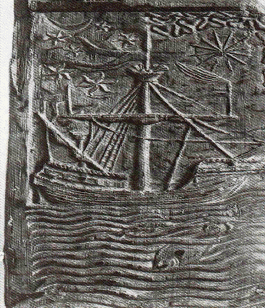
A carved image of a two-masted ship (King's Lynn), dated to c. 1415 (V&A museum)
Jon Adams, Justin Dix. October 2004.
Centre for Maritime Archaeology, University of Southampton, Avenue Campus, Southampton SO17 1BF. UK
+44 (0) 2380 594439 Fax 593032
Introduction
This report summarises the fieldwork carried out on the site of Henry V's `great ship' Grace Dieu in July 2004. Some post-excavation work is still ongoing thus a more comprehensive paper will be prepared in due course with a view to publication.
1: The site
The remains of the wreck lie in the mud on the eastern shore of the river Hamble. At very low spring tides the tops of frame timbers can be seen protruding above the sediment.
2: Tasks
The following tasks were targeted for the summer of 2004, facilitated with an excavation license from EH.
1. Re-labelling of key frame timbers using tags fastened with 75mm copper nails. Survey with a Leica RTK (Real Time Kinematic) DGPS.
2. Collection of environmental samples (as part of an ongoing project carried out in conjunction with Dr Mark Jones at the Mary Rose Trust).
3. A new geophysical survey, initially with `chirp 2' and if possible an experimental system built by colleagues at MIT.
4. Excavation along the line of the stern frames in order to expose enough of the timbers for detailed recording.
5. Collection of timber samples for dendrochronological dating if possible.
The project was originally scheduled to run through part of the monthly tidal cycle from spring tides (geophysics) to neap tides (excavation and sample collection), the latter to encompass a three-day Time Team shoot. However, the times at which Time Team could shoot the film meant running the excavation through a moderate spring tide. Tasks 1 and 2 were therefore postponed. Task 1 will be carried out as a separate operation and the necessity for recovering the next samples under task 2 is not yet pressing and will also be done at low water when the excavation licence is renewed next year.
Task 3 - 5 were achieved, and although excavation took place over a spring tide, it is emphasised that the standard of the work done was not compromised, especially as visibility was better than anticipated.
3: Geophysics
On July 5, a chirp 2 survey was carried out in the attempt to model the hull below the riverbed. A previous attempt in 1995 had not produced good data and it was suspected that the reason was due to propeller noise and aeration of the water column through which the signal was passing. This time, rather than towing the system by boat we pulled the system across the site by hand. This was done by mooring a boat to one side of the site and using dry-suited swimmers to push the transceivers across the site. The results were extremely encouraging and further data was collected over the period of the Time
Team shoot (Fig. 1). A series of similar profiles has allowed the generation of a 3D model of the buried structure to be generated (Fig. 2). Further work is planned for the New Year at which time we will be using a new set of our own higher frequency transponders as well as the experimental system from MIT. For all this work we are indebted to the Hamble Harbour Master for the loan of a boat ideally suited to river work.
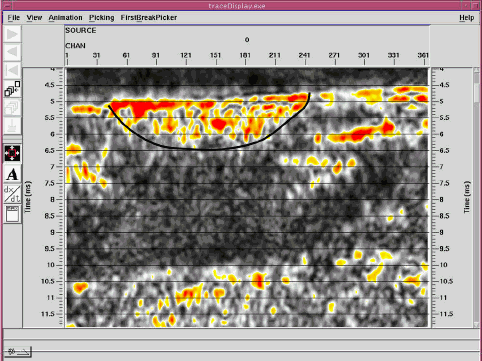
Figure 1. Screen dump of one of the passes over the midship area. The areas of strong reflection correlate with the extent and depth of the surviving hull structure indicated by the black line
(J. Dix).
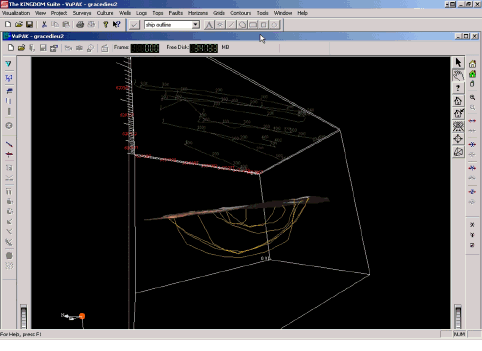
Figure 2. A series of profiles used to generate a 3D image of the buried hull (J. Dix)
4: Excavation
The three-day shoot was run over July 16 - 18. This ran up to a moderate spring tide and so did not provide the best possible conditions. However, underwater conditions for archaeological work were generally better than expected.
For the last two years the CMA have been involved in the development of new excavation methodology. This is partly directed towards deep water (Adams in press), but spin-off ideas that may be useful in turbid water, particularly rivers, have been the subject of experiment. Successful trials have been carried out in Piraeus Harbour and the opportunity was taken to test a similar system in the Hamble (Fig. 2). Essentially, an enclosure is positioned over the trench into which cleaned water is pumped at a rate sufficient to continuously displace the turbid river water, thus improving visibility.
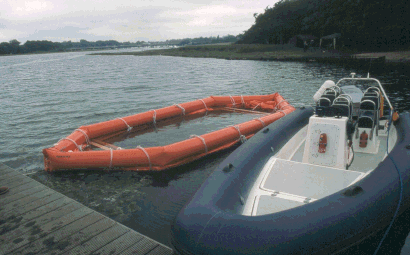
Figure 2. The enclosure in the water prior to being positioned over the site.
A cyclone is used to clean the water, extracting the particulate matter as it passes through the centrifuge chamber. The output is then directed into the trench. The device was demonstrated to work (Fig. 3) but the Time Team Schedule did not permit enough time to be spent arranging sufficient anchorage to resist the maximum current flow in this part of the lunar cycle. In the event, visibility was adequate, not only for excavation but video.
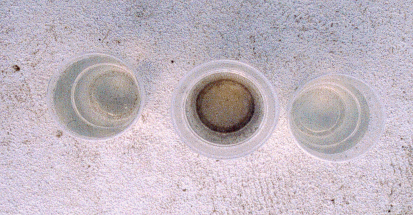
Figure 3: A) River water prior to passing through the centrifuge (`cyclone').
B) Water with sediment removed by the centrifuge.
C) Clean water output from the centrifuge (Photos J. Adams).
A stainless steel grid 2.5 X 2m was positioned over the stern of the wreck to define the excavation trench and to support excavators and their equipment. This keeps everything off the deposit and the timbers, maximising visibility in the process. The trench was positioned near the stern so as to span the width of the structure and to provide room for working down the outside of the hull as well as inboard. In view of the height to which the hull timbers are preserved, working at the stern in this way would also mean the timbers would be nearer vertical rather than splayed flat as they are amidships. Hence the outer surface would be more accessible.
By day two the installation was complete and the excavation started in earnest. By the end of day three we had reached a maximum depth of 70cm below riverbed, working through a hard silty, shelly clay inboard and a firm, silty light grey clay outboard. The full width of the structure was exposed at this point, revealing a series of large V-shaped, crooked floor timbers (Drawings forthcoming). Outside these there was the expected triple-thickness of hull planking, one of which was sampled for tree ring dating.
5: Dating
The plank sampled for tree-ring dating was given to Nigel Nayling at Lampeter University. The ring sequence spanned the date range AD1241-1349 (Nayling correspondence). This is consistent with the known construction date 1416-18 but suggests that more than just the sapwood was removed from the parent tree during production of the plank. The sequence produces reasonable matches against medieval sequences, but does not exhibit significant cross-match with the single
sequence produced by Lowther (1949). This implies diversity in the sources of timber procured for the ship's construction, only to be expected in view of the enormous quantities needed. As for how widely distributed these sources were, is just one aspect that will be illuminated by further samples.
6. Recording
In the time available, video was an important medium, though in the relatively turbid conditions its uses as a means for three-dimensional recording is limited. Datum points were positioned in the principal timbers exposed and measurements were taken to complement a series of underwater sketches. These are being drawn up in preparation for additional work next season.
7. Conservation
It was thought unlikely that the trench would be deep enough to reach deposits in which artefacts might lie and this proved to be the case. None were recovered.
Conclusions
The work carried out in 2004, albeit in rather a short sharp manner has provided some excellent data and shed light on some of the enduring questions surrounding the wreck. The focus of many of these concerned the planking which was where we hoped to find evidence for timber procurement, conversion and sequence of construction. Earlier work (Anderson 1934; Hutchinson 1994: 30) suggested that all planks were in the region of 6 feet in length. There was also some discussion about whether the construction sequence would allow the plank scarf joints to be offset or not. Another question was whether all planks were sawn or whether some might have been cleft (radially split).
In the area exposed it was observed that the scarfs were certainly not all positioned together, though in some cases they were fairly close. This has implications for reconstructing a sequence of plank assembly and requires detailed study with more of the hull exposed. At least one plank proved significantly longer than 6 feet. It was followed for 2.5m (over 8 feet) before running into the sediment. The sample taken for dendrochronology seemed to be from a sawn plank and is therefore consistent with timbers removed from the site previously. However, the quality of the board itself seemed good so it may be that sawing the boards and keeping their length relatively short had as much to do with the nature of the construction as limitations of available timber. Up to 5 thicknesses of planking would be extremely difficult to fair together if they were radially split and significantly longer.
A relatively high information return from a small amount of exposed structure suggests that there is much more to come. That being the case we are planning to apply for a further licence for 2005 in which the trench begun this year will be continued. Further geophysics is planned for spring tides over the winter.
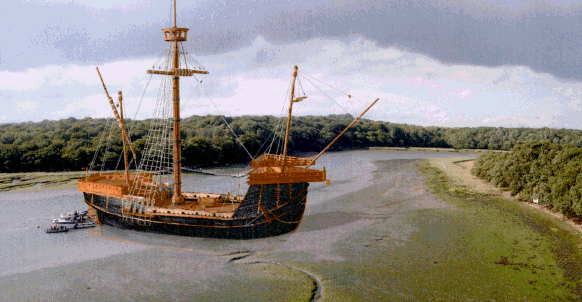
Computer reconstruction of the Grace Dieu superimposed onto a view of the river with the dive boats in position during the July excavation. (Courtesy of Time Team ©)
Acknowledgements
Crown Estates; English Heritage; the Hamble Harbour Master, Tony Clatworthy and all staff at the River Hamble Harbour Authority; Time Team; Manor Farm Country Park (Head Ranger Stuart Bray); the Environment Agency and English Nature. Nigel Nayling, Charles Pochin, and numerous volunteers both surface and underwater.
References
Adams, J. Excavation Trials. In A. M. McCann, & J. Olsen (eds). The Investigation of Roman Wrecks at Skerki Bank. (In Press)
Anderson, R. C. 1934. The Bursledon Ship. Mariner's Mirror 20:
Hutchinson, G. 1994. Medieval Ships and Shipping. London: Leicester University Press.
Lowther, A. W. G. 1949. Date of timbers from the spire of Chilcomb Church and from the wreck in the R. Hamble. Hampshire Field Club Papers and Proceedings. 17: 130 - 3.