
Archived decisions
Hampshire County Council
Recreation and Heritage Policy Review Committee Item 7
20 January 2005
Executive Member - Recreation and Heritage Item 1
20 January 2005
Arts Office Review
Report of the Director of Recreation and Heritage and the
Director of Human Resources
Contact: Nicola Horsey ext 5423 e-mail: [email protected]
Sarah Stone ext 6105 e-mail: [email protected]
1. Introduction
1.1 This joint report has been prepared by the Directors of Recreation and Heritage and Human Resources on the review and suggested re-organisation of the Arts Office. The main purpose of the report is to inform members of the main findings of the review, and to seek clarification from members on the key policy areas for the future. These will then go to the Executive Member for Recreation and Heritage for a decision.
1.2 The Arts Office Review contributes directly to the Corporate Strategy's Aim 5 (Improving Services) and indirectly to Aim 1 (Maximising Life Opportunities), Aim 2 (Stewardship of the Environment), Aim 3 (Achieving Economic Prosperity) and Aim 4 (Building Strong and Safe Communities).
2. Background
2.1 Following the completion of the reviews of the Countryside Service and the Libraries and Information Service, the Museums and Archives Service and the Arts Office were both asked to undertake their own reviews. As far as the Arts Office was concerned the reasons for the review were:-
· To lay the foundations for a new Arts Strategy. The existing Arts Strategy, which was agreed by the Executive Member for Recreation and Heritage in April 20021, had been produced before Hampshire's Cultural Strategy which sets out guidelines and priorities for cultural services across Hampshire. A new Arts Strategy is needed which aligns itself with the Cultural Strategy and the revised Corporate Strategy.
· Unlike many services, the Arts Office had not undergone a Best Value Review in the late 1990s and had not had a major change since Local Government re-organisation in 1997. It was felt the time was right for an in-depth review of the Arts Office.
3. Process
3.1 A Review Team was set up by the Head of Arts, Tourism and Marketing and included the three most senior staff in the Arts Office, the Head of Business Development, the Head of County Services (Libraries & Information) and a representative from the Arts Council, South East. The first meeting was held in April 2004, where the terms of reference were agreed which were to:-
· Confirm the clear purposes of the County Council's Arts Office.
· determine the nature and structure of the organisation best fitted to fulfil these purposes.
3.2 A consultant, Alun Bond from Artservice, was appointed at the end of April. During May and June Mr. Bond undertook a series of consultations with all Arts Office staff, including four workshops, one at each of the Arts Centres, and another workshop for externally funded arts organisations. Mr. Bond also had meetings with several County Councillors and other colleagues in the Recreation and Heritage Department and other County Council departments too, as well as further consultations with all Hampshire's District and Unitary Councils, the Arts Council and so on. The Executive Summary of Mr Bond's report is enclosed in Appendix 1.
3.3 Following the submission of Mr. Bond's report in August, the Review Team spent a day in October discussing the best way of responding to Mr. Bond's findings and recommendations. This report pulls together the Review Team's responses to the main findings of Mr. Bond's report and seeks clarification from members on a number of key policy areas.
4. Arts Office
4.1 The current set up of the Arts Office consists of:
· Two senior officers managing all of the Arts Office.
· 30 staff running four Arts Centres in Winchester (The Tower), Fareham (Ashcroft), New Milton (Forest) and Aldershot (West End).
· Nine staff in Arts Marketing Hampshire, an audience development agency, which is run as a separate business unit.
· Three staff running Hog the Limelight (touring rural programme) and events at Recreation and Heritage sites (libraries, country parks, museums, outdoor centres) and in Social Services' residential homes.
· Three staff administering approximately £1 million grants to arts organisations around Hampshire and providing administrative support to the Arts Office.
· Four Arts Development Officers covering youth, literature, schools and local arts development in the New Forest.
· One Arts Project Officer working mainly on capital projects.
4.2 Within the Arts Office there is specialist knowledge of particular art forms such as performance, dance and visual arts.
5. Summary of the Main Findings
5.1 The review report found that the County Council's Arts Office is a highly respected service which has a national reputation and a high profile both within the region and nationally. Arts Office staff are highly committed and have great expertise and the service is greatly valued in Hampshire by arts organisations and District Councils. It plays a key role in supporting an extensive arts infrastructure which attracts considerable amounts of funding into Hampshire through investment by the Arts Council and other agencies and generates substantial amounts of income via ticket sales and other activities. Hampshire's arts infrastructure, in all its guises, is an important part of the Hampshire economy as well as making a valuable contribution to Hampshire's sense of place.
5.2 The review report was divided up into the following areas, which will be considered in detail in the rest of this report.
i) The Arts Strategy
5.3 The review concluded that the current Arts Strategy needs to be reviewed and updated and relate specifically to the County Council's corporate and cultural policies, in particular the Cultural Strategy. It needs to be an inspirational document, setting out an agenda for change, covering areas of policy which are currently absent or under-stated and for which there are no development objectives.
5.4 Our response:-
Agreed, work on the new Arts Strategy will start in 2005, following clarification from Members on policy issues detailed elsewhere in this report.
ii) Arts Centres
5.5 The review report stated that the four arts centres run by the Arts Office provide wide ranging programmes in response to local needs and are well used by their local catchment areas, as shown by the table below:
Centre |
Live Performance 2003/04 |
Regular Classes 2003/04 |
Ashcroft, Fareham |
4,315 |
1,061 |
West End, Aldershot |
11,738 |
3,608 |
Forest, New Milton |
8,300 |
6,460 |
Tower, Winchester |
9,710 |
4,266 |
5.6 In addition the arts centres are used by local groups hiring the performing or exhibition spaces, though there are not any figures on the number of people using the arts centres for these purposes.
5.7 In addition to the four arts centres run by the Arts Office, the Arts Office supports three other independently operated arts centres through annual grant aid. These are the arts centres in Havant and Bedhampton, operated by Havant Arts Active, and the Fairfields Arts Centre in Basingstoke. The review highlighted the fact that the District Council support for these arts centres varies considerably, as does the level of County Council support via the Arts Office, see the table below:
* New Forest District Council do contribute £15,710 to most of the costs of a local Arts Development Officer who is based at the Forest Arts Centre. In addition some of the District Councils have contributed capital in the past to improve the art centres.
5.8 The District Council financial contributions to arts centres in Hampshire, both Arts Office operated and independent, is not consistent and, overall, the Arts Office remains by far the major funder of these facilities. The review felt that this balance of funding is unusual. Elsewhere in the country, where arts centres of this scale are also locally based, the majority of funding is normally provided by the District Councils.
5.9 The current pattern of arts centres in Hampshire has not been developed strategically, but as a result of former drama provision provided by the Education Department which was then inherited by the Arts Office. The arts centres are housed in buildings not designed specifically for their current use (most are in Victorian school buildings) with limited seating capacity (100 - 120 seats) which restricts the type of performances they can put on.
5.10 The review report recommends a further review of the Arts Office funding of the full network of arts centres to consider ways which might be more equitable and within the context of developing stronger strategic partnerships with the District Councils. The review also recommends the development of a standardised reporting system for the Arts Office's four arts centres so that performance can be compared along with a facilities and buildings review.
5.11 Our response:-
Our four arts centres are professionally run and provide good quality and wide ranging events, activities and workshops for their local community. They are a good way of delivering different art forms in their locality. The Centre Directors plan programmes to meet local needs and provide challenges too, increasing the range of art forms their audiences are exposed to and thereby developing their audiences. Our four arts centres are very diverse and appeal to different sections of the community. A summary of their respective strengths is enclosed in Appendix 2.
5.12 Whilst we agree there is a need to improve the reporting system for our four arts centres and carry out a facilities review, we think it is unrealistic, at least in the short/medium term, to expect the District Councils to pay more for the arts centres in their localities.
5.13 We believe the best way forward is for the Arts Office to undertake a separate review of its funding for arts centres across Hampshire. This would need to take into account factors such as:-
· Could the County Council's investment be more effectively used for arts development in other ways?
· If it is agreed that the County Council should be supporting arts centres, then we need a clear rationale to justify this support.
· We need to investigate the pros and cons of moving all the arts centres to being independently run and managed.
· What are the views of the relevant District Councils? We support the view in the report that the arts centres should be developed as part of a strategic framework with the District Councils.
a) A review of the Arts Centres should be undertaken, taking into account the issues raised above.
iii) Grant Aid Programmes
5.14 In parallel to the department's Review of Partnership Funding (1), the Arts Office review also considered the Arts Office's significant grant aid programme.
5.15 Currently there are several grant aid streams. The largest grant aid scheme provides ongoing revenue partnership funding for key independent art organisations (£786,150); then there is funding to other arts organisations through annual programme partnership grants (£29,500); and smaller one-off arts development grants to voluntary sector bodies (£24,000), festivals (£11,000) and the Two for One scheme (£10,000).
1. "Partnership Funding and Support in Recreation and Heritage". Recreation & Heritage Policy Review Committee
18 November 2004, Item 8 and Executive Member Recreation & Heritage, 18 November 2004, Item 7
5.16 There has traditionally been a capital fund of £60,000 for supporting the capital needs of arts facilities (the majority of which is spent on the Arts Office's arts centres) and a minor capital grant scheme (£10,000). An additional budget of £10,000 from the Economic Development Office, supports festivals. All grant aid decisions (except the minor capital grant scheme) involve the Executive Member for Recreation and Heritage in the process.
5.17 The Arts Office administers a dance bursaries fund on behalf of the Education Department which supports children through a registered dance school from the age of 11 to 16. Every year, as one child leaves the scheme, a new one is then supported via the scheme.
5.18 The Creative Hampshire Fund has been created to support arts and education programmes, including the arts in schools work co-ordinated by the Arts Office. It receives £90,000 from the Arts Council, South East spread over three years and is supported by £25,000 from the Department's Policy Fund for 2004/05. Additional money from the Policy Fund has been used to support arts and education programmes by a number of revenue and project clients including The Anvil, The Nuffield Theatre, the Bournemouth Symphony Orchestra (BSO) and Proteus Theatre Company during 2004/05.
5.19 The list of organisations due to be benefiting from the revenue partnership grant aid scheme for 2005/06 is shown in Appendix 3. With a few exceptions, this list has not really changed over the last few years, leaving little room for manoeuvre when new initiatives/projects appear. The review report also found that the current client list is balanced strongly in favour of the performing arts and does not include organisations involved with film, media or a gallery (Winchester Gallery has only been added for 2005/06). The level of support for dance, arts and crafts and music promotion (other than to the BSO) was also felt to be modest.
5.20 The review report recommends:-
· A more streamlined process and for funding over a longer period than one year.
· A reduced level of monitoring via attendance at board meetings, freeing up Arts Office staff time for other things.
5.21 The review highlights a key issue for the Arts Office which is how the Arts Office might create the flexibility to respond to new organisations and initiatives and addressing areas of under-provision.
5.22 The review report suggests several ways this might be done, including:-
· Withdrawing financial support to arts venues based outside the administrative county of Hampshire.
· Reviewing the funding relationship with the BSO in relation to the benefits.
· Reviewing the policy of supporting two touring theatre companies on a revenue basis (Proteus and Forest Forge) rather than supporting one as a revenue client and providing project funding to the other.
· Reviewing the effectiveness of the funding to the Sculpture Trust in view of the organisation's narrow funding base (just the Arts Office's grant) and its limited capacity to deliver projects from within its own core funding.
· Working closely with the Arts Council England, South East on its review of Regularly Funded Organisations to ensure there is an agreed plan of action for future funding.
5.23 Other recommendations from the review report have been picked up by the Department's review of partnership funding.
5.24 Our response:-
The Arts Office grant aid programme has been effective in helping to facilitate the provision of the highest possible quality of arts experiences for the people of Hampshire, as set out in the current Arts Strategy. We accept that there currently is not much ability to respond to new changes and pressures and we seek clarification from members on the recommendations put forward by the review, namely:-
b) Should the Arts Office continue to financially support arts organisations outside the administrative county of Hampshire, even though these organisations are used by Hampshire residents? If it was decided to discontinue this support, then there would be a saving of £50,615 in the revenue grant fund by cutting the funding to the Nuffield and Salisbury Playhouse. However, it can be argued that as much of the funding to the Nuffield goes to its education programme (£29,250) which involves many schools in the administrative county of Hampshire, the County Council would wish this to continue. If this was the case, then the saving to the budget by discontinuing support outside Hampshire would be £21,365.
c) Currently the Arts Office gives the BSO a £172,148 grant. This grant represents 20.5% of the revenue partnership grant aid programme for 2005/06. The grant provides Hampshire with 25 orchestral performances a year (13 in Portsmouth's Guildhall, 3 in Southampton's, and 4 in Winchester Cathedral and 5 at The Anvil), plus, in association with Hampshire Music Service, a total of 63 three hour sessions in Hampshire schools. Is it appropriate to spend a significant proportion of the revenue partnership grant fund with one organisation? Should some flexibility be written into the agreement so that the Arts Office and the BSO can respond to new initiatives when they arise?
d) We believe the Arts Office should continue to provide revenue funding to two touring theatre companies and, since the review report was written, a third, Solent Peoples' Theatre, has joined the list. Do Members endorse this approach?
e) Should the Arts Office target grants, excluding the large revenue ones, to organisations which intend to provide projects in priority art areas (such as film, media, visual arts, dance, arts and crafts and music promotion) and in the County Council's areas of priority, Aldershot, Havant, Gosport, Andover and the rural areas?
A review of the revenue grants should be undertaken, taking into account Members' views on b) - e) above.
5.25 In addition to the changes in the way the grants will be administered (as outlined in the review of partnership funding) there is also scope for more Arts Office officers with expertise in specific areas being involved in making recommendations of whether projects should be supported or not. We can make internal arrangements within the Arts Office to set this up.
5.26 As far as the Sculpture Trust is concerned, the issues raised about its effectiveness by the review report will be picked up by the review of partnership funding.
iv) Other areas of Arts Office Activity, including Partnerships
5.27 The review report found that the work of the Arts Office is very varied. Over and above the work covered earlier in this report the work of the Arts Office includes:-
· Hog the Limelight, the rural and community touring scheme providing access to live performances, workshops and other arts events in villages throughout Hampshire. The scheme offers live performances and participatory work to 8,000 people in rural and urban communities by co-ordinating 115 performances and 33 workshops in 2003/04; Hog receives varying levels of financial support from five District Councils and some sponsorship, the Arts Office contributes £23,000.
· Literature development - providing programmes of live literature events, workshops and residencies in partnership with libraries, the Arts Office's arts centres, other arts venues; also some work with District Councils, developing literature festivals for instance and work on the literature element of Hog the Limelight.
· Youth Arts - a development programme with a specific target on deprived areas of Hampshire (Gosport and Andover in particular); providing specialist arts support to youth workers and youth centres in those areas and setting up training programmes for them; working with District Council arts development officers to develop local youth arts programmes and working with Arts Office's arts centres.
· Creative Hampshire - a new arts in schools programme which provides opportunities for schools to access professional arts practitioners through residences and workshops and offers arts and education training programmes to teachers - part funded by the Arts Council England, South East, see also 5.18.
· Events - a new post to develop and run an ongoing programme of events including work in residential homes and libraries within the Hog the Limelight programme, as well as large-scale events such as Jools Holland in Manor Farm Country Park. This post has been created to run events across Recreation and Heritage.
· Arts Projects - this post leads on the development of a major capital initiative to develop new crafts facilities in Basingstoke and Havant. The postholder has a role in raising funding and supporting other projects including public art developments (e.g. Gosport Discovery Centre) and commissioning of arts for offices, a County Council scheme to use office equipment funds for art commissions. The Antony Gormley exhibition was a recent major project co-ordinated by the postholder.
· International links - the Arts Office works with other officers in the department and Policy Unit to build arts projects into exchange programmes. It also supports members attendance at the Assembly of European Regions and at other European network meetings.
· Audience Development (Arts Marketing Hampshire - AMH) is currently operated under the umbrella of the Arts Office and undertakes research and audience development work in Hampshire, but also on a commissioned basis for other agencies in the region. Its role has been expanding to include other areas of Recreation and Heritage. It is funded by the Arts Office (£58,900) and the Arts Council England, South East (£61,800) which is now leading a separate review of AMH. This has already proposed that the option of building AMH into a new regional audience development agency should be explored, but the impact of this on future audience development work in Hampshire has not yet been fully assessed.
· Co-ordination, Advice and Information - the Arts Office works with and supports a wide variety of agencies and projects as well as the District Councils by providing advice and support through its arts centres and through its officer team. The review found that the Arts Office advice was valued.
· Advocacy - the Arts Office has a key role to play in advocating for the arts both within and outside of the Council.
5.28 The review report highlighted some issues relating to the work of the Arts Office which included:-
· A split between the two areas of work of the Arts Office, i.e. arts infrastructure/grants and arts development, with limited crossover between the two. This results in officers in the Arts Office having a lack of awareness of the work of others and little sense of a shared direction.
· In some areas of work such as literature development and rural touring, the role and range of work is well defined; in others there appears to be a lack of coherence and planning.
· A shift in emphasis over the last two years to major events and ad hoc one-off initiatives which tend to override ongoing work.
· An increasing tendency for arts officers to become engaged with work at a local level which is very hands-on and involves individual projects related to specific locations, rather than being of county-wide significance.
· Some areas of activity (creative industries, film and media, exhibitions and public art) have a much lower profile than other art forms.
· A tendency to be reactive rather than pro-active in dealings with other services in the Department and other County Council departments.
· No structured approach to local authority partnerships on a one to one basis with District Councils.
5.29 In order to address these issues the review report recommends:-
· The creation of a new Head of Arts (or similar title) to lead the work of the Arts Office and develop a pro-active role in taking forward integrated countywide strategic initiatives.
· A review of the current staffing structure and staff roles to achieve a more integrated structure.
· Adopting a more pro-active approach to inter and intra-departmental working, such as music development involving the Music Service, and exhibitions involving the Museums and Archives Service, and taking the lead on working with other departments to develop an integrated corporate policy approach to public art.
· Consider placing some services out of house e.g. AMH, Creative Hampshire, Hog the Limelight.
· Closer working with District Councils to monitor work and identifying continuing initiatives which might be supported and developed jointly along with deciding which tier of local authority should take lead responsibility for areas of arts development and support.
· Seeking to safeguard the level of audience development work in Hampshire as AMH's role changes.
5.30 Our response:-
We agree that there is a need for a review of the structure of the Arts Office to make it more integrated and to provide overall leadership and direction. The proposed new management structure is set out in Appendix 4 and the Role Profile for the Head of Hampshire's Arts Service is included in Appendix 5.
5.31 Once this structure has been agreed, approved by the Leader and set up (1 April 2005), officers will settle into these different roles and many of the issues identified in the review report should be solved. New internal arrangements may need to be set up to help us do this, such as a public art working group involving officers from across the County Council.
5.32 We also propose to change the name of the Arts Office to the Arts Service, which includes the arts centres and AMH. The Arts Office will refer to the non-AMH staff based in Mottisfont Court.
5.33 We have considered placing some services out of house. As the parallel review of AMH unfolds, this may well be the best solution for AMH, with the Arts Office (and the rest of the department too) buying in audience development activities on a service level agreement or on a project by project basis. As far as the Arts Office is concerned, the priorities for future audience development work will be the arts centres we run or jointly fund, the organisations we fund through the revenue funding grants and critical evaluation of initiatives such as Creative Hampshire and Hog the Limelight.
5.34 We do not consider that Creative Hampshire would benefit from being out of house as it is very reliant on contacts Arts Office colleagues have with artists and good relations with the Advisory Inspectors in the Education Department.
5.35 As far as Hog the Limelight is concerned we have devised an alternative proposal which involves gradually reducing the level of subsidy to the villages that regularly use Hog and increasing the subsidy to attract new villages and communities to participate. At the moment five District Councils contribute varying sums to Hog. For 2005/06 we propose providing a standard level of Hog across all 11 Districts, with extra provision, on a pro-rata basis, for the Districts that financially contribute to the programme. We also propose piloting summer holiday workshops and films, working with the District Councils to target appropriate areas, with District Council funding
5.36 With the direct links between Hog's programme in the rural areas and its work with the libraries and residential homes, we do not think it would be appropriate to move Hog out of house.
5.37 We seek the following from members:-
f) Endorsement of the new staff structure (Appendix 4) and approval of the change of name to the Arts Service.
g) Approval to keep Creative Hampshire and Hog in-house and the suggested changes to Hog as outlined in 5.35.
h) To keep a watching brief on AMH and whether it stays within the Arts Office or moves out of house.
6. Summary
6.1 The Arts Office is a highly respected service which has done an excellent job in maintaining the arts infrastructure in Hampshire and providing services. However, it does have a tendency to be inward-looking and focussed on those areas of provision with which it is directly engaged, rather than leading and co-ordinating a strategic approach to the arts countywide with other local authorities, partners and County Council colleagues.
6.2 The Recreation and Heritage Department is now seeking a more pro-active approach to arts provision and development and to raise the profile of the County Council's work in the arts. The challenge for the Arts Office is to maintain the excellent work it has done in supporting the arts infrastructure and developing the arts, whilst responding positively to the new challenges which it is being set.
6.3 The Arts Office has a varied portfolio of arts agencies and venues, but there remain some significant gaps in provision and the Office lacks flexible funding with which to encourage new organisations to grow and for addressing areas of under-provision. The challenge is to free up some resources so that new developments can be pursued which means reviewing areas of the revenue client portfolio and reducing expenditure on its arts centres.
6.4 The Arts Office needs clearer leadership in order to forge a more dynamic policy for the future and to ensure that it works in a fully and co-ordinated way on pursuing the County Council's objectives and priorities and building for the future.
6.5 In order to move the Arts Office review forward and to set the parameters for a new Arts Strategy, Members are being asked for their views on the following issues:-
a) A review of the Arts Centres should be undertaken, taking into account the issues raised 5.13.
b) Should the Arts Office continue to financially support arts organisations outside the administrative county of Hampshire, even though these organisations are used by Hampshire residents? If it was decided to discontinue this support, then there would be a saving of £50,615 in the revenue grant fund by cutting the funding to the Nuffield and Salisbury Playhouse. However, it can be argued that as much of the funding to the Nuffield goes to its education programme (£29,250) which involves many schools in the administrative county of Hampshire, the County Council would wish this to continue. If this was the case, then the saving to the budget by discontinuing support outside Hampshire would be £21,365.
c) Currently the Arts Office gives the BSO a £172,148 grant. This grant represents 20.5% of the revenue partnership grant aid programme for 2005/06. The grant provides Hampshire with 25 orchestral performances a year (13 in Portsmouth's Guildhall, 3 in Southampton's, and 4 in Winchester Cathedral and 5 at The Anvil), plus, in association with Hampshire Music Service, a total of 63 three hour sessions in Hampshire schools. Is it appropriate to spend a significant proportion of the revenue partnership grant fund with one organisation? Should some flexibility be written into the agreement so that the Arts Office and the BSO can respond to new initiatives when they arise?
d) We believe the Arts Office should continue to provide revenue funding to two touring theatre companies and, since the review report was written, a third, Solent Peoples' Theatre, has joined the list. Do Members endorse this approach?
e) Should the Arts Office target grants, excluding the large revenue ones, to organisations which intend to provide projects in priority art areas (such as film, media, visual arts, dance, arts and crafts and music promotion) and in the County Council's areas of priority, Aldershot, Havant, Gosport, Andover and the rural areas?
f) Endorsement of the new staff structure (Appendix 4) and approval of the change of name to the Arts Service.
g) Approval to keep Creative Hampshire and Hog in-house and the suggested changes to Hog as outlined in 5.35.
h) To keep a watching brief on AMH and whether it stays within the Arts Office or moves out of house.
6.6 The Arts Office Review has highlighted a number of key issues that need to be considered in more detail over the next few months and it is proposed to set up a Special Members Panel to do this. The Panel will consider the key issues and recommendations of the Review and report back as soon as possible. Comments and views of the Members at this Policy Review Committee meeting will be reported to the Executive Member for Recreation and Heritage for decisions on the key issues raised by the Arts Office Review and will help to inform the Special Members Panel too.
7. Financial implications
7.1 At the moment the precise value and timing of the new staff structure cannot be quantified because the structure will evolve during 2005. The situation will be monitored and regular reports will be made to the Executive Member, Recreation and Heritage.
Recommendation
It is recommended that Members of the Policy Review Committee:
1. Note the recommendations of the Consultant and the comments of the Arts Office.
2. Support the changes in structure and management arrangements identified in this report.
3. Set up a Special Members Panel to look in detail at the Review recommendations and report back as soon as possible
4. Submit the above recommendations to the Executive Member for Recreation and Heritage for his consideration.
Section 100 D - Local Government Act 1972 - Background Documents
The following documents disclose facts or matters on which this report, or an important part of it, is based and has been relied upon to a material extent in the preparation of this report.
NB the list excludes:
1. Published works
2. Documents which disclose exempt or confidential information as defined in the act.
TITLE LOCATION
ARTS OFFICE REVIEW REPORT Appendix 1
EXECUTIVE SUMMARY
1. The Arts Office
The Hampshire County Arts Office is a highly respected service which has a national reputation and a high profile both within the region and nationally. Arts Office staff are highly committed and have great expertise. The service is greatly valued in the County by arts organisations and District Councils and plays a key role in supporting an extensive arts infrastructure which attracts considerable amounts of funding into the County through investment by the Arts Council and other agencies and generates substantial amounts of income via ticket sales and other activities.
The Arts Office places considerable importance in its work on supporting and monitoring the arts infrastructure and undertakes a range of arts development work, including work in new policy areas (e.g. arts and education, events, work in residential homes) which have been prioritised by the Recreation and Heritage Department. It is a direct provider of services, including operating four arts centres and plays a key role in co-ordinating County local authority forums for the arts.
The work of the Arts Office is currently divided into two areas, one under the management of the Senior Arts Officer and the second under the management of the Arts Development Officer. The former leads on the arts infrastructure, grants, audience development and policy and the latter on arts centres, other areas of direct service provision and arts development in the broadest sense. Both posts share management responsibility, though the Senior Arts Officer has seniority in terms of length of service and scale grade.
The division of the work into two distinct areas, each with its own manager, has tended to lead to a fragmented pattern of work, with different parts of the Arts Office not always fully aware of the activities of the other. Though there is communication at a personal level between staff within the Arts Office, the lack of integration and split management responsibility results in limited joint working and some lack of awareness of the totality of the work of the Office.
The Arts Office also suffers from a lack of clarity in terms of leadership responsibilities and from a fragmented approach to policy development and implementation. It therefore lacks a strong sense of direction in terms of policy. As a result it sometimes appears to be working in disconnected ways and there is a lack of awareness and understanding of its policies and range of activities externally.
A further factor is the new energy and ambition being injected into the Recreation and Heritage Department by senior management, which is pushing new policy agendas and ways of working and challenging existing policy priorities. Though welcomed by many staff and external agencies, new initiatives promoted by departmental managers have further complicated the policy context and added to a sense that policy direction is being driven from different directions. Furthermore the current arts policy does not set a strong agenda for change and future development and needs reviewing and updating.
The Arts Office needs the focused leadership which a single management post can provide and to consider how in structural terms it can bring the work of the Office together so that it operates as a unified service. A post of Head of Arts (or equivalent) should be created and the staffing structure reviewed in the light of this post being created to ensure that the service is operating in a fully integrated manner.
The Arts Office has to balance its role as a direct service provider delivering a variety of projects and programmes (e.g. arts centres, Hog The Limelight - rural and community touring) with more strategic work. At times there may be a tendency for arts officers to become too engaged with work at local level rather than addressing work of countywide significance. It could adopt a more strategic approach, particularly in working with District Councils, with other Council services and departments, and with the arts sector as a whole.
2. Arts Centres
The County Council originally operated seven arts centres, three of which have subsequently been devolved to local management. It therefore continues to operate four directly and at a higher cost to the Council than those which have been devolved. The current position, though entirely understandable, may appear inequitable in terms of District Council levels of support and with regard to the pattern of funding for arts centres across the County.
The County's arts centres are primarily of local significance, yet are funded largely by the County Council, a position that is relatively unusual nationally. Total County Council funding for the seven arts centres in 2004/05 amounts to £650,100 with District Councils spending £162,462. County Council expenditure on the four directly-operated arts centres amounts to £509,900 with District Council funding amounting to £59,310. It has to be questioned whether this level of expenditure on local provision provides value for money to the County Council and ties up too much of its arts funding.
There is a need for a review of the County's funding of the full network of arts centres to consider ways in which support might be rationalised, taking into account other areas of arts expenditure and support and within the context of work to develop stronger strategic partnerships with District Councils. It should work with District Councils to redress the balance of funding with respect to the four directly-operated centres.
The Council needs to review its procedures for monitoring and evaluating the performance of its arts centres by introducing revised systems for monitoring financial performance, attendances and programme balance. It also needs a more standardised approach to measuring the value of its investment in arts centres, and to develop forward plans for capital developments.
3. Local Authority Partnerships
The Office works in partnership with District Councils and there is considerable support for its work from them, but there is also a view that it needs to work through more structured partnerships and to work more strategically with District Councils in pursuing shared objectives.
The County Council has a commitment to direct service provision and in this context its operation of four arts centres is in line with its broader policy approach, but the County Council's level of investment in what is essentially local provision is not recognised as much as it should be in the form of partnership funding from District Councils. It should seek to achieve a better funding balance in the context of closer strategic partnership working with District Councils.
There is no structured approach to local authority partnership on a one to one basis with District Councils in the form of partnership agreements or agreed procedures on District and County responsibilities. As a result there is inconsistency in the County's approach to the funding of arts venues for instance. Neither are there structures in place to engage individual local authorities in joint planning and funding of countywide initiatives, such as Hog the Limelight.
The Arts Office should work strategically with individual District Councils to clarify which tier of local authority should take lead responsibility for areas of arts development and support, agree the basis of funding partnerships with regard to local provision involving the County Council and in agreeing broader policy aims and objectives to inform local funding partnerships.
It should also identify countywide priorities for arts development, define its role in leading on countywide strategic initiatives and work with District Councils to achieve joint ownership of and support for countywide programmes, including Hog the Limelight.
4. Departmental Partnership Working
The Arts Office approach to inter-departmental working other than where specific measures/officer posts are in place, has in the past been largely reactive and limited to the length of particular projects or programmes. The Arts Office does not seem to have actively sought out opportunities to develop work with other departments, though where special inter-departmental programmes are in place, (e.g. in libraries) the relationship appears to be working effectively and the Arts Office is working pro-actively.
There are many opportunities to work with other departments and it is essential that inter-departmental working is actively pursued by the Arts Office. However it has to balance this work with its developmental work with its existing programme of arts development, grant-aiding and client-based work. Without carrying spare capacity its ability to respond to initiatives from outside the Arts Office will always have severe limitations.
Where there are specific areas of activity, such as in relation to public art and exhibitions, where gaps in provision and opportunities might be addressed through partnership, a more planned and strategic approach should be pursued.
5. Grant Aid Programmes
The Council's grant aid programmes are invaluable in maintaining the arts infrastructure and supporting work by independent agencies around the County. However, its annual grants procedures for key arts organisations could be streamlined with a more integrated approach between funding partners. It has limited flexibility in its budgets and if the Council is to support new areas of development it may need to achieve shifts in the current pattern of revenue funding, including re-assessing its current portfolio of revenue clients, reviewing its levels of expenditure on arts venues based outside the County, re-directing some expenditure to artforms which are less well supported, e.g. dance, and reducing the level of expenditure on its own arts centres.
6. Performance Management and Assessment
The Arts Office collects a range of data from external organisations and from its own arts centres, but management and assessment systems tend to be based on ongoing officer monitoring rather than formalised reporting systems. A new approach to performance management and assessment should be introduced involving more consistent data collection and analysis and annual reviews of Arts Office services. The overall review of the Arts Office and the services it delivers should relate to the arts strategy priorities.
7. Options for Change
The Council's priorities in the arts must take into account a range of factors including its own corporate policy framework and Cultural Strategy; the existing pattern of provision and the funding partnerships which underpin it; geographic spread and balance; artform balance; its strategic role in working in partnership with District Councils and the Arts Council; other factors which might impact on provision such as the Arts Council's review of regularly funded organisations; the external investment currently attracted and opportunities which might arise to attract new external funding. In shifting priorities and resources it has to consider all of the above.
There are various options for change. In terms of its own services it might reduce the level of its annual support for arts centres by increasing the levels of District Council support; review how it supports audience development work; and explore options for transferring responsibility for some service areas to other agencies. It could review areas of annual grant aid expenditure, including the level of support for organisations based outside the County, reviewing some areas of the current client portfolio and slightly shifting the balance of expenditure between artforms.
The Arts Office could also reduce its own level of commitment at local level by working more closely with District Councils to clarify local responsibilities so as to reduce the amount of work required in dealing with local arts development issues, and by developing joint monitoring systems for key clients with other funders to reduce the time spent on attendance at board and other monitoring meetings and in assessing grant applications.
8. Summary
The Arts Office is a highly respected service which has done an excellent job in maintaining the arts infrastructure in the County and providing services. It has at times however had a tendency to be inward-looking and focussed on those areas of provision with which it is directly engaged, rather than co-ordinating a strategic approach to the arts countywide with other local authorities and partners.
The County Council is now seeking a more pro-active approach to arts provision and development and to raise the profile of the County Council's work in the arts. The challenge for the Arts Office is to maintain the excellent work it has done in supporting the arts infrastructure and developing the arts whilst responding positively to the new challenges which it is being set.
The County has a varied portfolio of arts agencies and venues, but there remain some significant gaps in provision and the Office lacks flexible funding with which to encourage new organisations to grow and for addressing areas of under-provision. The challenge is to free up some resources so that new developments can be pursued and this is likely to mean reviewing areas of the revenue client portfolio and reducing expenditure on its arts centres.
The Arts Office needs clearer leadership in order to forge a more dynamic policy for the future and to ensure that it works in a fully integrated and co-ordinated way in pursuing the Council's objectives and priorities and building for the future.
Appendix 2
Summary of the County Council's Arts Centres
Ashcroft Arts Centre, Fareham
The Ashcroft Arts Centre provides small scale arts events for residents of Fareham, Gosport and the surrounding area. The centre has an excellent reputation for high quality performance, particularly in a range of music styles. The centre also has a thriving workshop programme which focuses particularly on young people and the ageing population, with well over 30% of participants being concessions.
Forest Arts Centre, New Milton
Forest Arts Centre is the sole multi art form venue for performance, visual and participatory arts in the New Forest District. It is used extensively by the local community who are keen attenders of the wide range of live events in the 150 seater theatre as well as the large variety of workshops and regular visual arts exhibitions in various media. Theatre includes classic, children's, comedy, musical, physical; music covers folk, world, blues, classical; and in addition Forest programmes dance, comedy (including for children), and literature. Forest also runs many regular and one-off workshops which are heavily subscribed, in art forms including dance, drama, writing, and arts practice.
Tower Arts Centre, Winchester
The Tower provides an imaginative and varied arts programme for Winchester District and the wider Hampshire community. As well as being Winchester's premier live music venue, it also presents regular arts classes, theatre, literature, exhibitions, holiday activities for children and adults and other special events. In 1997 The Tower created the Winchester Children's Festival, introducing a Battle of the Bands in 2004 which alone attracted over 1,000 young people.
West End Centre, Aldershot
As well as having an extensive performance programme, the West End Centre is also one of the most important music facilities for young people in the south, offering audiences the chance to see some of the best new bands before and as they break through. It provides a safe venue for young aspiring bands as they develop, and offers advice and support to bands on promotion, industry and music matters. The Centre plays an important role in educating young people in positive social behaviours, engendering respect for each other and creating a feeling of community. It also has good links with a range of local organisations including those who deal with young people at risk of exclusion. The Centre also offers a world class performance programme of blues, rock, world and folk music, theatre, comedy and literature, plus exhibitions, classes and workshops for young and old throughout Rushmoor Borough and the surrounding area.
Appendix 3
Revenue Partnership Funding for Independent Arts Organisations 2005/06
Appendix 4
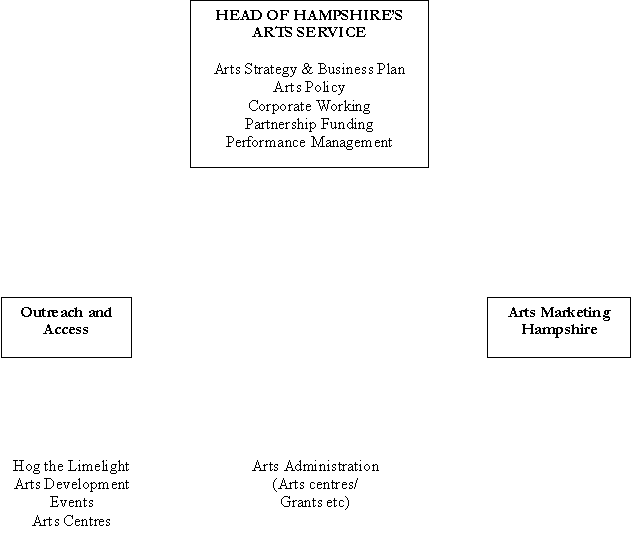
Appendix 5
New Version
Role Profile Form Number
( to be completed by project team )
.
Data Protection Act 1998. This form will enable us to process any information you contribute to the role profiling process and will be used by Hampshire County Council evaluation panels for job evaluation purposes. At a later date, the information will also be used in other personnel areas, e.g. performance development review, induction, and training and development Processing of information includes storage of records electronically and in hard copy format. Personal data will only be made available to Hampshire County Council staff and trade union representatives involved in these processes. Any data required for statistical/research purposes will be depersonalised.
ROLE PROFILE FORM
Section A
Department/Section: |
RECREATION & HERITAGE |
Role Title: |
HEAD OF HAMPSHIRE'S ARTS SERVICE |
Reports To - (Supervisor/manager's role title) : |
HEAD OF ARTS, TOURISM & MARKETING WILL BE ON DEPARTMENTAL MANAGEMENT TEAM |
Role Purpose: (why the role exists) |
To provide strategic leadership for the Hampshire Arts Service and arts generally throughout Hampshire. To develop, direct and implement a new Hampshire Arts Strategy. To develop the arts in Hampshire. |
Section B Organisation
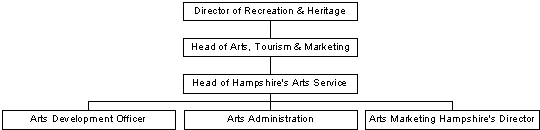
Please provide a simple line drawing indicating where the role sits within the organisation in the box below. (See guidance notes with regard to the use of formal organisation charts).
Section C
ROLE REQUIREMENTS
This involves identifying the most significant responsibilities of the role. Accountability statements are key functions of the role which in combination make up the main purpose.
PROGRESSION IN ROLE
Section I - Entry: Necessary role-related knowledge, skills and experience at selection | ||
· Qualification at degree level in arts or a relevant discipline. · Strong understanding of national and regional arts policy/funding and of local government generally. · A track record (5 years) of senior arts management experience. · Likely to have profile within the arts at a regional and national level. · Evidence of continuous professional development. · Knowledge of Health and Safety, risk management and diversity issues. · Knowledge of effective financial management. | ||
Section J - Initial induction/training required to become effective in the role | ||
Estimated time to become operationally effective |
3 months |
|
Induction to Managers Guide and Corporate Standards. Understanding of Corporate and Departmental objectives and priorities Establishment of key networks externally and internally. Familiarisation of the arts `product' in Hampshire. | ||
Section K - Operationally effective: How would effectiveness in role be demonstrated? | ||
Support and confidence of senior staff and elected Members. Confidence and trust of lead partners and independent arts organisations. | ||
Section L - Adding value: What characteristics will the advanced role holder demonstrate? | ||
Visionary leadership leading to service advancement and staff development. Ability to deliver projects and initiatives of national significance. Proven track record of making a difference and actually making things happen. Establishing a positive national profile for Hampshire's Arts Service. | ||
You have now completed the sections which will be used in job evaluation. Please continue to complete the remaining sections of the form.