Archived decisions
Hampshire County Council Health Review Committee Item 5 25 January 2005 The Future of Health Services in Fareham and Gosport: Report of the Chief Executive |
Contact :Denise Holden ex 7338 or e-mail [email protected]
1. Summary and Purpose
This report sets out the final recommendations of the Health Review Committee, and further action taken, following the extraordinary meeting on the 26 November 2004 to Fareham and Gosport Primary Care Trust.
The final report agreed by the Committee after the 30 November meeting is attached at Appendix One.
The letters sent to the Secretaries of State for Defence and Health are attached at Appendix Two and Appendix Three respectively.
The response of Fareham and Gosport PCT to the recommendations made by the Committee is attached at Appendix Four and Appendix Five. The paper setting out the option appraisal and recommendation that went to the Trust Board to inform their decision on 15 December 2004 is attached at Appendix Six.
Additional information from key stakeholders since the 26 November is attached at Appendices Seven to Twelve.
2. Further Information and Action arising from the meeting on 26 November
The Ministry of Defence sent the Committee a copy of a letter from Defence Estates to the Chief Executive of Hampshire and the Isle of Wight Strategic Health Authority setting out the procedure for the disposal of land and the Government Accounting Rules that apply to transfers between departments. This is attached at Appendix Seven.
The Committee has also received confirmation from the Ministry of Defence regarding the usage of the Royal Hospital Haslar by the NHS after Spring 2007 when the MoD will vacate the site. This is attached at Appendix Eight. No further information has been received on financial or other implications of this decision for the local NHS.
Additional comments and supporting papers from Gosport Borough Council are attached at Appendix Nine.
The comments made by Peter Viggers MP to the Committee on the 26 November are attached at Appendix Ten and a letter to Mr Viggers from the Parliamentary Undersecretary of State for Defence is attached at Appendix Eleven.
Correspondence received from Fareham Borough Council is attached at Appendix Twelve.
The Chairman has written to the Commission for Patient and Public Involvement in Health setting out the importance of this issue for local people and that the action of the Commission had prevented the Patient and Public Involvement Forum from sharing their views with the Committee.
3. The response to Fareham and Gosport PCT to the recommendations from the Committee
(i) The additional health needs information referred to by the PCT be made available to the Committee which should include the way in which primary care and community services across Fareham and Gosport will be developed to complement the service provided at Queen Alexandra Hospital and take account of the need to keep as many services as local as possible. In particular people living in Gosport need to have a better understanding of how the commitment made to them in 2000 would be delivered, with as many services as possible being provided in the community.
We have received confirmation, via the PCT's Director of Public Health, that the additional information on health needs has now been supplied to the Committee. If there is any outstanding information remaining, please inform me so that we can supply it to you.
Since the special Health Review Committee meeting, a further paper has been produced, Fareham and Gosport Future Health Services' Strategy which aims to set out the strategy for how services will be developed to complement the services provided at Queen Alexandra Hospital and to take account of the need to keep as many services as local as possible. This paper is enclosed for your information.
With regard to the 2000 consultation commitment, this detail is contained in appendix 5 of the PCT Board paper; Planning the Future Health Services for Fareham and Gosport - Option appraisal and recommendation. The PCT intends to publicise the links between the 2000 consultation and our current plans via a large media release. At its December meeting, the Project Steering Group advised the PCT to wait until later in January 2005 to do this. This information should help the
people of Gosport to have a better understanding of how we will meet the 2000 commitments and what services will be provided locally.
(ii) That the PCT re-examine the population projections provided to take account of the planning assumptions discussed during the day and the policy of the Office of the Deputy Prime Minister with regard to new housing. Members expressed deep concern at the figures presented regarding projected population growth in the area, particularly with regard to new housing and other demographic shifts. If planning assumptions did not take account of all relevant factors there was a risk that local health service provision could be compromised.
See Appendix 1 of the PCT board paper: Planning the Future Health Services for Fareham and Gosport - Option appraisal and recommendation. Following the meeting with the Health Review Committee, the PCT sought further advice from Hampshire County Council experts who confirmed that the use of any other population figures at this point in time by the PCT would be `pure speculation', as there is yet no clear agreement on the number of new homes to be built or their distribution.
This will remain the case until summer 2005 when there will be more clarity about future housing requirements and their potential impact on population numbers. Appendix 1 contains detail of the scope for future expansion of local services in the event of further growth in the local population and its needs
(iii) Additional Information be provided, based on postcodes, demonstrating the way in which people living in Fareham and Gosport use the Royal Hospital Haslar ATC and NHS Trust Accident and Emergency Departments
Work to date on analysing postcodes for patients using accident and emergency services has been confined to identifying Fareham and Gosport residents who have visited the A&E department but who could have been treated at the Haslar Accident Treatment Centre. A further piece of work is being commissioned to identify those people who need a minor injuries type service, not just in Fareham and Gosport, but to include neighbouring PCTs, whose residents may wish to use a service at Coldeast in future. This work will be shared with the Steering Group and the Committee. The outcome of this work will help the local PCTs to identify whether there is enough potential demand to justify a minor injuries unit at Fareham Community Hospital in future.
(iv) Additional information on the health needs of local people, differentiating between the communities of Fareham and Gosport and further information about the way in which the health needs of those identified as being vulnerable or disadvantaged would be met be provided to the Committee.
See our response to paragraph 14 (above) on the health needs analysis. Planning the Future Health Services for Fareham and Gosport - Option appraisal and recommendation, Appendix 2 also covers this recommendation.
(v) Agreement be reached between the PCT and Gosport Borough Council on an appropriate methodology for assessing the impact of changes proposed on traffic transport consideration.
The PCT has met with senior officers of the Gosport Borough Council and discussed planning and traffic issues relating to planned developments at the Gosport War Memorial Hospital and the new Gosport Health Centre. It was confirmed that planning permission would not be required for the Gosport War Memorial Hospital and that the PCT is therefore not formally required to undertake any further work on traffic impact. However, the PCT has shared the traffic impact study already undertaken with officers for information. The Gosport Health Centre development will require planning consent and the PCT will work closely with the Gosport Borough Council on the next stage of planning.
The PCT recognises that car parking at the Gosport War Memorial Hospital is a problem and this has been compounded in recent months with the introduction of car parking charges in the vicinity of the hospital. A group has been tasked to resolve the car parking issues and a survey of staff using the Gosport War Memorial car park has been undertaken. Options for reducing staff traffic are being identified. See Appendix 4 in the paper Planning the Future Health Services for Fareham and Gosport - Option appraisal and recommendation for information.
(vi) The PCT Board provides the Committee with a fuller account of the financial implications of the options presented, including a more detailed breakdown of the costs associated with redeveloping the Royal Haslar Hospital and further information on the income to be generated from the sale of assets.
A fuller account of the financial implications of the options presented, including a more detailed breakdown of the costs associated with the redevelopment of Haslar Hospital and information on income from the sale of assets is contained in Appendix 3 Planning the Future Health Services for Fareham and Gosport - Option appraisal and recommendation.
The PCT Board is fully committed to getting back into financial balance and via this letter provides an unequivocal assurance to the Committee that financial risks will be managed. One of the key planks of financial recovery is the reduction in emergency admissions to hospitals by the development of local primary and community alternatives. The Board believes that the selection of Option 2 gives the greatest scope to reduce duplication and therefore costs and provides the highest potential for
integration of services for the benefit of patients. To choose Option 1 therefore would have led to increased costs, which would not have been consistent with delivering financial recovery.
(vii) The PCT Board provides the Committee with unequivocal assurance that the financial risks identified were being managed to ensure that the acute and community health services planned were affordable and sustainable.
The PCT Board is fully committed to getting back into financial balance and via this letter provides an unequivocal assurance to the Committee that financial risks will be managed. One of the key planks of financial recovery is the reduction in emergency admissions to hospitals by the development of local primary and community alternatives. The Board believes that the selection of Option 2 gives the greatest scope to reduce duplication and therefore costs and provides the highest potential for integration of services for the benefit of patients. To choose Option 1 therefore would have led to increased costs, which would not have been consistent with delivering financial recovery.
4. Next Steps
The Committee will wish to assess whether, taking account of the response of the PCT and the additional information and comment received from key stakeholders, the preferred option identified is in the interests of the health service Fareham and Gosport.
If the Committee is satisfied that this is the case then no further action is necessary.
If the Committee considers that this is not the case then four options exist
1. Further information or action by the PCT
2. A formal `select committee' style meeting to further examine the decision of the Trust Board
3. A request to the Independent Reconfiguration Panel to informally assess the proposals for future health services in Fareham and Gosport
4. Formal referral of the matter to the Secretary of State for Health
5. Recommendations
1. That the Committee determines
· If the response from the PCT to the recommendations as set out above is satisfactory
· If the preferred option, as set out in the document attached at Appendix Six, is in the interests of the health service in the area
· If the Committee is not satisfied with regard to the information provided, or that the proposal is in the interests of the health service in the area, the further action required to address this. This may take the form of:
a. Request for further information from, or action by Fareham and Gosport PCT
b. A formal `select committee' meeting to consider the decision by the PCT
c. Request for informal evaluation by the Independent Reconfiguration Panel
d. Formal referral to the Secretary of State for Health
Section 100 D - Local Government Act 1972 - background papers
The following documents disclose facts or matters on which this report, or an important part of it, is based and has been relied upon to a material extent in the preparation of this report.
NB the list excludes:
1. Published works
2. Documents which disclose exempt or confidential information as defined in the Act.
File Location
Hampshire County Council Appendix One
Health Review Committee: Extraordinary Meeting 26 November 2004
Future of Health Services in Fareham and Gosport: Recommendations for Action
Purpose and Next Steps
1. This report summarises the outcome of the meeting held on 26 November 2004 to consider the consultation by Fareham and Gosport Primary Care Trust (PCT) regarding arrangements for providing NHS services to people living in Fareham and Gosport.
2. The interest of the Committee in responding to the proposal is twofold:
· Is the Committee satisfied with the content of the consultation and that sufficient time has been allowed.
· Is the preferred way forward in the interests of the health service in the area affected.
3. A select committee approach was adopted to consider this matter. This provided an opportunity for the PCT to set out the case for change and for key stakeholders in Fareham and Gosport to share their views on the proposal and consultation process.
4. Key stakeholders attending the meeting on 26 November included:
· Portsmouth Hospitals NHS Trust
· Hampshire and Isle of Wight Strategic health Authority
· Ministry of Defence
· Member of Parliament for Fareham
· Hampshire Social Services
· Fareham Borough Council
· Fareham Community Action
· Gosport Voluntary Action
· Save Haslar Task Force
· Gosport Borough Council
· Member of Parliament for Gosport
5. The Fareham and Gosport Patient and Public Involvement Forum were invited to attend the meeting to give independent feedback on the views of people living in Fareham and Gosport. On advice from the Commission for Patient and Public Involvement the Forum withdrew from the meeting on the 24 November. It is hoped the Forum would be able to share their views with the Committee at a later date.
6. The Board of Fareham and Gosport PCT will take the final decision on the way forward on 15 December 2004. The Committee will expect that the relevant recommendations set out in this report will be responded to at that time.
7. If the Committee is not satisfied with the response of the PCT, the option remains for the decision of the Board to be `called in' for formal scrutiny. If any outstanding issues cannot be resolved locally the matter may be referred by the Committee to the Secretary of State for Health. The grounds on which this action can be taken are prescribed and would need to demonstrate the basis on which the Committee was contesting the decision of the PCT.
Findings of the Committee
Content and Timing of the Consultation process
8. The Committee noted the detail report produced by the PCT outlining the extensive consultation process followed and the way in which this had shaped the current proposal.
9. The Chairman commented that the consultation process had been exemplary and the Committee confirmed its view that this process had been satisfactory and robust.
Is the preferred option in the interest of health services in the area.
10. Members were mindful that the configuration of health services in south east Hampshire was a complex issue and included non-NHS interests such as the Ministry of Defence (MoD). The action points set out below therefore relate to:
· Specific recommendations for consideration by the PCT Board.
· Areas where the Committee will be seeking further information and comment not previously covered in evidence to Members.
11. The Committee was clear that the current status quo in terms of health provision in Fareham and Gosport is not sustainable. This was influenced by the decision taken in 2000 with regard to the redevelopment of the Queen Alexandra Hospital in Cosham. The Committee did not revisit that decision. Many present did however voice reservations about the proposed capacity of the redevelopment given the increasing health demands of local people.
12. The Committee also noted that a range of in-patient services were currently being provided successfully from Royal Hospital Haslar (RHH). These included a treatment centre that was able to contribute to reducing waiting for elective surgery for people from across the south east area. This effectively provided reserve acute capacity that could be used flexibly to ease pressures on other in-patient services.
13. The Committee took the view that well developed and robust community services will be essential if the new development at Queen Alexandra Hospital is to work effectively and act as the `hub' of an integrated health service across south east Hampshire. The services to be provided to the people of Fareham and Gosport do not exist in isolation and will be interdependent with other health services in the area. The uncertainties expressed by some key stakeholders during the course of the meeting highlighted that people who were not part of the NHS still needed to be convinced that this strategic thinking is taking place. This point needed to be addressed as a matter of urgency by the NHS.
14. The Committee recommended that the additional health needs information referred to by the PCT be made available to the Committee. This should include the way in which primary care and community services across Fareham and Gosport will be developed to complement the services provided at Queen Alexandra Hospital and take account of the need to keep as many services as local as possible. In particular people living in Gosport need to have a better understanding of how the commitments made to them in 2000 will be delivered, with as many services as possible being provided in the community.
15. The Committee noted the emphasis quite properly given to the strength of the views of local people about the way forward. These had to be given due weight by the PCT. However other factors, including financial considerations would shape the extent to which the PCT can accommodate the preferences expressed and these could not be ignored.
16. The role of the PCT was to identify and meet the health needs of local people living in both Fareham and Gosport. Planning to date seemed to have been reliant on broad demographic trends. The Committee was of the view that further work needs to be done to refine this information to give more clarity about the health services that people living in the different communities need, taking account of the key policy documents such as `Keeping the NHS Local' and the approach to health needs commissioning outlined in the briefing note for the meeting.
17. The Committee recommended that the PCT re-examine the population projections provided to take account of the planning assumptions discussed during the day and the policy of the Office of the Deputy Prime Minister with regard to new housing. Members expressed deep concern at the figures presented regarding projected population growth in the area, particularly with regard to new housing and other demographic shifts. If planning assumptions did not take account of all relevant factors there was a risk that local health service provision could be compromised.
18. The Committee recognised that it would not be appropriate for the PCT to submit planning applications before the outcome of the consultation process. As business cases were developed early meetings with key planning personnel would provide an opportunity for potential problems to be anticipated.
19. The Committee strongly supported the emphasis placed by the PCT on `Keeping the NHS Local'. A more detailed health needs assessment would create a better understanding of the role of community hospitals at the heart of the communities in Fareham and Gosport. In particular the Committee would be keen to see additional information on extended roles for health professionals, the provision of ambulatory care, integrated unscheduled care (including minor injury units, GP out of hours and other emergency services) and the role of telemedicine as part of this work.
20. Members were also unclear about how the different needs of the people living in Fareham and Gosport would be assessed and met, including the way in which screening and other preventative action would impact on demand. The commitment of the PCT to addressing this point was encouraging. Concerns were raised with the Committee that the differences in health services provided to each population, particularly with regard to the provision planned at Fareham Community Hospital, did not take account of health needs of planned changes in housing. No information was available to indicate if the comparisons presented were appropriate. An example shared with the Committee was the case for there to be an Accident Treatment Centre (ATC) based at Fareham Community Hospital, providing services for people living in the surrounding communities rather than confined to those living in the PCT boundaries.
21. Members asked for additional information, based on postcodes, about the way in which people living in Fareham and Gosport used the Royal Hospital Haslar ATC and NHS Trust Accident and Emergency Departments.
22. The Committee heard that the different populations of Fareham and Gosport were concerned that they could be disadvantaged by the decision to site a specific service in another part of the patch. This is both divisive and unhelpful. The Committee had previously requested that was clarity about the way that the health needs of the different communities of Fareham and Gosport would be met. This information had not been forthcoming. In particular the Committee wanted to see further detail about the health needs of vulnerable groups living in the area and the way in which front line services, such as out of hours and unscheduled care will be managed given the realities of access to services and transport issues to and from the Gosport peninsula.
23. The Committee recommended that additional information be provided to Members on the health needs of local people, differentiating between the communities of Fareham and Gosport. The Committee also required further information about the way in which the health needs of those identified as being vulnerable or disadvantaged would be met.
24. Access was a major issue and conflicting views on the validity of the traffic impact assessment were shared at the meeting.
25. The Committee is therefore recommending that agreement be reached between the PCT and Gosport Borough Council on an appropriate methodology for assessing the impact of the changes proposed on traffic and transport. It may be possible to integrate this with the next stage of assessment outlined by the PCT.
26. The Committee was of the view that, whatever option for moving forward was decided by the PCT at its meeting on 15 December, the Board must have absolute confidence that the option is sustainable and in line with the current and future health needs of the population. The Committee noted that the PCT was already struggling with an underlying deficit that was projected to rise to £10.8 million at the end of the financial year. This was significant and did not sit easily with the statutory duty to remain in financial balance. The costs of the servicing the Queen Alexandra Hospital PFI project have risen considerably and the contract had still not been signed. Additional financial pressures from the new General Medical Services contract, agenda for change and payment by results were also starting to emerge in the health economy.
27. The Committee was of the view that these factors represent a considerable risk to plans to develop and enhance community services in Fareham and Gosport.
28. The Committee recommended that the PCT Board provide a fuller account of the financial implications of the options presented, including a more detailed breakdown of the costs associated with redeveloping Haslar Hospital and further information on the income to be generated from the sale of assets. The Committee will also seek an unequivocal assurance from the Board that the financial risks identified are being managed to ensure that the acute and community health services planned are affordable and sustainable.
29. Additionally the Committee will write to Portsmouth Hospitals NHS Trust to ask for details of the final cost of the PFI contract. Should this exceed the estimated cost of £200 million stated at the meeting the Committee may wish to investigate this further.
30. With regard to RHH, the Committee noted that the MoD has been clear throughout regarding the intention to close the Haslar site, based on the Defence Medical Services Review undertaken in 1998.
31. Members noted that there is a significant military presence in the Hampshire area and that a large proportion of this population could be affected by decisions of the MoD regarding health service configuration. Members were concerned that the decision taken by the MoD some seven years ago could not have foreseen the current involvement of military personnel in so many different conflict arenas with the potential increase in medical care that these bring. The Committee will seek to understand how these fundamental changes have been taken into account by the MoD.
32. It was the unanimous view of the Committee that the MoD be invited to comment on whether the findings of the Defence Medical Services Review now need to be reconsidered to take account of the many factors that have changed since 1998. In the summer of this year the British Medical Association indicated that recruitment and retention of medical personnel issues still exist. Members were concerned that, should there be an escalation in the health needs of the armed forces, there was potential for civilian NHS provision to be seriously disrupted. The Committee did not believe that this would be in the interests of the public or the armed forces.
33. Taking into account the considerable investment of public funding in RHH the Committee was keen to establish the feasibility of reducing or waiving the transfer of assets if this is considered to be in the public interest. Conflicting information on this point was received at the meeting. The MoD was clear that Government Accounting rules preclude this option. Gosport Borough Council cited an example of these rules being waived.
34. The Committee requested that this point be explored further as a matter of urgency. The Committee will also seek an assurance from the MoD that, should a decision be made to proceed with closure of the Haslar site, this will be able to demonstrate that this is the only viable option that represents value for taxpayer's money.
35. The MoD was clear with regard to its duty to maximise return on surplus land. The Committee was of the view that this should be secondary to changing circumstances and the public interest.
36. The Committee will write to the Secretaries of State for Health and Defence, copied to the Defence Select Committee requesting additional information with regard to the Defence Medical Services Review and the impact these decisions will have on local NHS provision, taking account of commitments made in 2001. The Committee will also seek an assurance that the Defence Medical Service Review has been evaluated to ensure that it is able to meet the existing and new challenges facing our armed forces in Hampshire.
37. The Committee was clear that the NHS, on its own, could not afford the capital and revenue costs quoted for the retention of the `Crosslink' building on the RHH site without a disproportionate impact on direct service provision to the community that is served by the PCT. This would not be in the interest of the health service in the area. Nevertheless it is also true that, if the costs associated with the use of the site were comparable with other options, the RHH would be the site of choice for many people living in south east Hampshire. The strength of public feeling support for this way forward makes further evaluation of other options imperative. One way of achieving this would be for there to be a sharing of the costs of using the site, working across different public sector organisations and commercial interests.
38. The Committee was of the view that this option has not been fully explored and will ask that the MoD now takes stock of the options for getting maximum benefits from the site by working with both Gosport Borough Council and the PCT to fully explore the options for achieving this objective. An agreed basis for valuing the Haslar site would be one way forward.
39. Although the LIFT programme may not be a feasible route for bringing potential partners together there were examples of other projects such as the `Health Park' model in south Bristol, that provide a `one stop' centre for people with health, social and economic needs. This and other innovative solutions to the current impasse need to be tested rigorously.
40. The Committee welcomed the confidence of the MoD and Portsmouth Hospitals that Haslar Hospital would not close until at least the summer of 2008. This decision is currently with the Minister responsible.
41. The Committee was unanimous in its view that it would not be in the interests of the health service in the area for Haslar Hospital to close before the redevelopment of Queen Alexandra Hospital was complete. The MoD has given a clear commitment that Haslar would close `only when suitable alternatives are in place to ensure the continued health care of the area'. To impose a deadline for closing a hospital that could compromise this position, without consultation and due regard to the impact on local people would not be acceptable to the Health Review Committee.
42. The Committee will write to the Secretary of State for Defence setting out this view as a matter of urgency. Should the a decision be made that Haslar should not remain open at least until the redevelopment of Queen Alexandra Hospital is complete the Committee will wish to consider further action in the interests of the health service in the area.
RE/dh |
|
13 December 2004 |
|
Right Honorable Geoffrey Hoon MP, Secretary of State for Defence, Floor 5, Zone A Whitehall London, SW1A 2HB |
|
Dear Mr Hoon
Configuration of Military and Civilian Health Services in South East Hampshire.
I am writing on behalf of Hampshire County Council's Health Review Committee following a recent meeting to discuss the future of NHS provision in Fareham and Gosport.
You will, I am certain, be well acquainted with the strength of public views about the decision of the Ministry of Defence (MoD) to close Royal Hospital Haslar (RHH). The case for keeping this highly valued facility open has been vigorously pursued by the local MP, Mr Peter Viggers, Gosport Borough Council and the Save Haslar Task Force. The strength of public support for retaining some NHS provision on the RHH site remains undiminished, reflecting the views of many elected members on our Committee.
My purpose in writing at this juncture is not to repeat the protests that have been made previously to you about this decision. I am however requesting information about the way in which the direction of travel set by the Defence Medical Services Review in 1998 has been evaluated and tested to ensure that changes in the configuration of services will secure the optimum benefits in terms of military and civilian health care.
There are complex interdependencies with the NHS and military medical care in this area and it is essential that the Health Review Committee understand how these impact on the health of our population, particularly in south east Hampshire. The Private Finance Initiative planned at Queen Alexandra Hospital will ensure that there are modern acute facilities in the area, although some concerns have been expressed about capacity given the changing demographics of our population. Advances in technology and medical care also mean that RHH has the potential to provide additional intermediate capacity to complement NHS acute and community services as well as providing the MoD with reserve in-patient capacity should this ever be required.
It is in this context that the Committee would welcome your comments on the following two points:
1. Have the findings of the Defence Medical Services Review been revisited to take account of the many factors that have changed since 1998? Members expressed concern that the decision taken some seven years ago could not have anticipated the involvement of military personnel in so many different conflict arenas and the potential increase in demands for medical care that these bring. This summer the British Medical Association indicated that difficulties remained in the recruitment and retention of medical staff. An escalation in the health needs of the armed forces could potentially seriously disrupt NHS provision in south east Hampshire and the Committee is keen to learn what work has been undertaken to minimise the risk of this happening.
2. Confirmation that the Royal Haslar Hospital will remain open until AT LEAST, the redevelopment of Queen Alexandra is completed. A clear commitment was given in 2001 that RHH would close `only when suitable alternatives are in place to ensure the continued health care of the area'. RHH is currently providing a range of elective care, which has been extended to accommodate additional health services displaced whilst rebuilding work at Queen Alexandra takes place. The Committee understands that the final decision on this matter rests with you as the responsible Minister and would urge that this proposal is supported. Members are clear and unanimous that it would not be in the interests of the health service in the area for RHH to close before the redevelopment of Queen Alexandra Hospital was complete. Your commitment that this will not happen would be appreciated.
The third point on which Members would invite your views relates less to our function as a Health Overview and Scrutiny Committee and more to our role as elected members. There has been considerable investment of public funding in RHH site by both the MoD and the NHS. We are therefore keen to establish the feasibility of reducing or waiving the transfer of assets if this is considered to be in the public interest. At our meeting on the 26 November, and in subsequent correspondence the MoD was clear that current Government Accounting rules preclude this option. Other views shared with the Committee suggest this flexibility exists.
The Committee understands that the NHS, on its own, cannot afford the capital and revenue costs quoted for the retention of the `Crosslink' building on the RHH site without a disproportionate impact on direct service provision to the community that is served by the PCT. This would not be in the interest of the health service in the area. Nevertheless it is also true that, if the costs associated with the use of the site were comparable with other options, the RHH would be the site of choice for many people living in south east Hampshire.
Members believe that the strength of public support for this way forward makes further evaluation of options for securing value for money from the RHH site imperative. One way of achieving this would be for there to be a sharing of the costs of using the site, working across different public sector organisations and commercial interests. The Committee is therefore asking that you intervene to allow for there to be a full assessment of the options for obtaining maximum benefits from the entire site, working with Gosport Borough Council and the PCT to meet this objective. This should start with an agreed basis for valuing the site.
Should a decision be made to proceed with closure of the Haslar site, Members will ask for your assurance that this course of action can demonstrate that it is the only viable option that represents value for taxpayer's money.
Please do not hesitate to contact me should any of the points we are raising be unclear.
Yours sincerely
Signed on original
Cllr Dr Raymond J Ellis C.Chem FRSC
Chairman, Health Review Committee
Cc Secretary of State for Health
House of Commons Health Select Committee
Health Review Committee Members
Cllr Ken Thornber
Cllr Mrs M Snaith
Peter Viggers, MP for Gosport
Mark Hoban, MP for Fareham
Cllr Peter Edgar
Cllr Brian Bayford
Lucy Doherty
Ian Piper
Gareth Cruddace
Rear Admiral P Rafielli
RE/dh |
|
13 December 2004 |
|
Right Honourable Dr John Reid MP Secretary of State for Health Department of Health Richmond House 79 Whitehall London SW1A 2NL |
|
Dear Dr Reid
Future of Health Services in Fareham and Gosport
I am writing to alert you to correspondence sent recently to the Secretary of State for Defence regarding the future of Royal Hospital Haslar (RHH).
You may be familiar with the controversy caused by the decision of the Ministry of Defence to withdraw from the RHH site in 1998, following the Defence Medical Services Review. You will note from our letter that, in our role of scrutinising the local health service, we have asked for additional information about the impact that the implementation of this decision will have on the health economy in the area taking account of a number of material changes in local circumstances.
In particular the Committee is deeply concerned that the RHH will be closed before the redevelopment of the main acute hospital, the Queen Alexandra, is complete. The financial close on the Private Finance Initiative contract has yet to be signed, some 12 months after this was due to be agreed. RHH is currently hosting a number of services displaced from the Queen Alexandra Hospital pending the redevelopment. Should the MoD persist with the plan to withdraw from the RHH site this will effectively close the facility, creating real problems for local people needing acute or elective care. The Committee is clear that, should the MoD persist with this course of action, it would not be in the interest of the health service in the area and would be contacting you accordingly. Our purpose in writing at this juncture is to ask if there is any scope for you to intervene on behalf of the population of south east Hampshire to prevent such an impasse.
To date the exhortations of local MPs, Local Authorities and the public for there to be `joined up' action by the MoD, NHS and commercial sector to find a way forward that will reflect the public interest and secure value for tax payers money seem to have been ignored. Whilst the Committee does understand the need for Government departments to maximise returns on public investment when disposing of assets to the private sector, due regard must be given to the impact on other public sector services, particularly where substantial interdependencies exist.
Delays to the PFI contract means that the original assumptions of the MoD now need to be revisited to take account of changing circumstances. A commitment was given in 2001 that RHH `would only close when suitable alternatives are in place to ensure the continued healthcare of the area'. This commitment needs to be honoured to ensure that changing circumstances do not disadvantage local people or compromise access to NHS care.
Your advice on any further action that we need to take to safeguard health services for this population and promote greater collaborative working between the MoD and NHS would be gratefully received.
Yours sincerely
Signed on original
Cllr Dr Raymond J Ellis C.Chem FRSC
Chairman, Health Review Committee
Cc House of Commons Health Select Committee
Health Review Committee Members
Unit 180, Fareham Reach
166 Fareham Road
Gosport
PO13 OFH
Tel: 01329 233447
Fax: 01329 234984
Ref IP/jkf/L 7 1
Cllr Dr Raymond J Ellis
Chairman, Health Review Committee
Hampshire County Council
Members' Room
The Castle
Winchester
SO23 8UJ
10 January 2005
Dear Ray
Health Review Committee: Extraordinary Meeting 26 November 2004,
Future of Health Services in Fareham and Gosport: Recommendations for Action
Thank you very much for your letter dated 6 December 2004, which contained the Health Review Committee's final report following the special meeting held on 26 November 2004. Thank you again for arranging the special meeting which, whilst challenging, was also very helpful to both the Committee and the Primary Care Trust.
This letter is the formal response of Fareham and Gosport Primary Care Trust (PCT) to the recommendations set out in the Committee's report, which are relevant to the PCT.
The PCT attempted to address the relevant recommendations contained in your report within its paper: Planning the Future Health Services for Fareham and Gosport - Option appraisal and recommendation, which is enclosed for your information. This report was one of the two papers on the PCT's public board meeting agenda for 15 December 2004 and was also posted on the PCT's website. It was this report that formed the basis of the board's discussion and decision to select Option 2.
This letter will now address each of the relevant recommendations in turn. (For ease of reading, the Committee's recommendations are reproduced at Annex A of this letter.)
Paragraph 14:
We have received confirmation, via the PCT's Director of Public Health, that the additional information on health needs has now been supplied to the Committee. If there is any outstanding information remaining, please inform me so that we can supply it to you.
Since the special Health Review Committee meeting, a further paper has been produced, Fareham and Gosport Future Health Services' Strategy which aims to set out the strategy for how services will be developed to complement the services provided at Queen Alexandra Hospital and to take account of the need to keep as many services as local as possible. This paper is enclosed for your information.
With regard to the 2000 consultation commitment, this detail is contained in appendix 5 of the PCT Board paper; Planning the Future Health Services for Fareham and Gosport - Option appraisal and recommendation. The PCT intends to publicise the links between the 2000 consultation and our current plans via a large media release. At its December meeting, the Project Steering Group advised the PCT to wait until later in January 2005 to do this. This information should help the people of Gosport to have a better understanding of how we will meet the 2000 commitments and what services will be provided locally.
Paragraph 17:
See Appendix 1 of the PCT board paper: Planning the Future Health Services for Fareham and Gosport - Option appraisal and recommendation. Following the meeting with the Health Review Committee, the PCT sought further advice from Hampshire County Council experts who confirmed that the use of any other population figures at this point in time by the PCT would be `pure speculation', as there is yet no clear agreement on the number of new homes to be built or their distribution.
This will remain the case until summer 2005 when there will be more clarity about future housing requirements and their potential impact on population numbers. Appendix 1 contains detail of the scope for future expansion of local services in the event of further growth in the local population and its needs.
Paragraph 21:
Work to date on analysing postcodes for patients using accident and emergency services has been confined to identifying Fareham and Gosport residents who have visited the A&E department but who could have been treated at the Haslar Accident Treatment Centre. A further piece of work is being commissioned to identify those people who need a minor injuries type service, not just in Fareham and Gosport, but to include neighbouring PCTs, whose residents may wish to use a service at Coldeast in future. This work will be shared with the Steering Group and the Committee. The outcome of this work will help the local PCTs to identify whether there is enough potential demand to justify a minor injuries unit at Fareham Community Hospital in future.
Paragraph 23:
See our response to paragraph 14 (above) on the health needs analysis. Planning the Future Health Services for Fareham and Gosport - Option appraisal and recommendation, Appendix 2 also covers this recommendation.
Paragraph 25:
The PCT has met with senior officers of the Gosport Borough Council and discussed planning and traffic issues relating to planned developments at the Gosport War Memorial Hospital and the new Gosport Health Centre. It was confirmed that planning permission would not be required for the Gosport War Memorial Hospital and that the PCT is therefore not formally required to undertake any further work on traffic impact. However, the PCT has shared the traffic impact study already undertaken with officers for information. The Gosport Health Centre development will require planning consent and the PCT will work closely with the Gosport Borough Council on the next stage of planning.
The PCT recognises that car parking at the Gosport War Memorial Hospital is a problem and this has been compounded in recent months with the introduction of car parking charges in the vicinity of the hospital. A group has been tasked to resolve the car parking issues and a survey of staff using the Gosport War Memorial car park has been undertaken. Options for reducing staff traffic are being identified. See Appendix 4 in the paper Planning the Future Health Services for Fareham and Gosport - Option appraisal and recommendation for information.
Paragraph 28:
A fuller account of the financial implications of the options presented, including a more detailed breakdown of the costs associated with the redevelopment of Haslar Hospital and information on income from the sale of assets is contained in Appendix 3 Planning the Future Health Services for Fareham and Gosport - Option appraisal and recommendation.
The PCT Board is fully committed to getting back into financial balance and via this letter provides an unequivocal assurance to the Committee that financial risks will be managed. One of the key planks of financial recovery is the reduction in emergency admissions to hospitals by the development of local primary and community alternatives. The Board believes that the selection of Option 2 gives the greatest scope to reduce duplication and therefore costs and provides the highest potential for integration of services for the benefit of patients. To choose Option 1 therefore would have led to increased costs, which would not have been consistent with delivering financial recovery.
Paragraph 29:
We believe Portsmouth Hospitals Trust is addressing this recommendation.
Paragraph 34 and 36:
This is being addressed by the MoD and the Hampshire and Isle of Wight Strategic Health Authority.
Paragraph 41:
The PCT notes the view of the Committee and concurs with it.
Paragraph 42:
Again we support the Committee's view.
Thank you also for the clarification contained in paragraph 7 that if the Committee is not satisfied with the PCT's response the option remains for the decision of the PCT Board to be called in for formal scrutiny. If any outstanding issues cannot be resolved locally the matter may be referred to the Secretary of State for Health.
The Board of Fareham and Gosport PCT has considered very seriously the options and complex range of issues associated with developing future health services for the people of Fareham and Gosport. We firmly believe that the decision we have taken to support Option 2, following a thorough and exhaustive process, is the best way forward for health services in Fareham and Gosport and we are looking forward to working with our partners locally to implement our decision.
If there is any further information you require please do not hesitate to contact me. As discussed with Denise recently, the PCT will be in attendance at the Health Review Committee meeting scheduled for Tuesday 25 January 2005.
Best wishes.
Yours sincerely
Signed on original
Ian Piper
Chief Executive
East Hampshire and Fareham and Gosport PCTs
Encs (2)
Copy letters to:
Lucy Docherty, Chair
Inger Hebden, Director of Strategic Development
Noreen Kickham/Kathryn Rowles, Director of Public Health
Alan Pickering, Director of Finance
Gareth Cruddace, Chief Executive, Hampshire and Isle of Wight Strategic Health Authority
Surgeon Rear Admiral Philip Raffaelli, Chief Executive, Defence Medical Education and Training Agency
Denise Holden, Health Review Officer, Hampshire County Council
Sheila Clark, Chief Executive, Portsmouth City Teaching PCT
Bill Shields, Acting Chief Executive, Portsmouth Hospitals NHS Trust
Appendix Four-Annex A
Health Review Committee - Extraordinary Meeting 26 November 2004
Future of Health Services in Fareham and Gosport: Recommendations for Action
Paragraph 14:
The Committee recommended that the additional health needs information referred to by the PCT be made available to the Committee. This should include the way in which primary care and community services across Fareham and Gosport will be developed to complement the services provided at Queen Alexandra Hospital and take account of the need to keep as many services as local as possible. In particular people living in Gosport need to have a better understanding of how the commitments made to them in 2000 will be delivered, with as many services as possible being provided in the community.
Paragraph 17:
The Committee recommended that the PCT re-examine the population projections provided to take account of the planning assumptions discussed during the day and the policy of the Office of the Deputy Prime Minister with regard to new housing. Members expressed deep concern at the figures presented regarding projected population growth in the area, particularly with regard to new housing and other demographic shifts. If planning assumptions did not take account of all relevant factors there was a risk that local health service provision could be compromised.
Paragraph 21:
Members asked for additional information, based on postcodes, about the way in which people living in Fareham and Gosport used the Royal Hospital Haslar ATC and NHS Trust Accident and Emergency Departments.
Paragraph 23:
The Committee recommended that additional information be provided to Members on the health needs of local people, differentiating between the communities of Fareham and Gosport. The Committee also required further information about the way in which the health needs of those identified as being vulnerable or disadvantaged would be met.
Paragraph 25:
The Committee is therefore recommending that agreement be reached between the PCT and Gosport Borough Council on an appropriate methodology for assessing the impact of the changes proposed on traffic and transport. It may be possible to integrate this with the next stage of assessment outlined by the PCT.
Paragraph 28:
The Committee recommended that the PCT Board provide a fuller account of the financial implications of the options presented, including a more detailed breakdown of the costs associated with redeveloping Haslar Hospital and further information on the income to be generated from the sale of assets. The Committee will also seek an unequivocal assurance from the Board that the financial risks identified are being managed to ensure that the acute and community health services planned are affordable and sustainable
Paragraph 29:
Additionally the Committee will write to Portsmouth Hospitals NHS Trust to ask for details of the final cost of the PFI contract. Should this exceed the estimated cost of £200 million stated at the meeting the Committee may wish to investigate this further.
Paragraphs 34 and 36:
The Committee requested that this point be explored further as a matter of urgency. The Committee will also seek an assurance from the MoD that, should a decision be made to proceed with closure of the Haslar site, this will be able to demonstrate that this is the only viable option that represents value for taxpayer's money.
The Committee will write to the Secretaries of State for Health and Defence, copied to the Defence Select Committee requesting additional information with regard to the Defence Medical Services Review and the impact these decisions will have on local NHS provision, taking account of commitments made in 2001. The Committee will also seek an assurance that the Defence Medical Service Review has been evaluated to ensure that it is able to meet the existing and new challenges facing our armed forces in Hampshire.
Paragraph 41:
The Committee was unanimous in its view that it would not be in the interests of the health service in the area for Haslar Hospital to close before the redevelopment of Queen Alexandra Hospital was complete. The MoD has given a clear commitment that Haslar would close `only when suitable alternatives are in place to ensure the continued health care of the area'. To impose a deadline for closing a hospital that could compromise this position, without consultation and due regard to the impact on local people would not be acceptable to the Health Review Committee.
Paragraph 42:
The Committee will write to the Secretary of State for Defence setting out this view as a matter of urgency. Should the a decision be made that Haslar should not remain open at least until the redevelopment of Queen Alexandra Hospital is complete the Committee will wish to consider further action in the interests of the health service in the area.
 DRAFT
DRAFT
Fareham and Gosport Future Health Services Strategy
1. Introduction
This strategy sets out the PCT's vision for the future provision of community services to meet local health needs. The strategy has been developed as a result of two key issues that the PCT has had to address:
_ Firstly, the relocation of services from the Royal Hospital Haslar (RHH) site due to the Ministry of Defence (MoD) decision to vacate the site by 2007. All inpatient services will be relocated to the Queen Alexandra Hospital (QAH), which is being developed thorough a Private Finance Initiative (PFI). The services to be relocated within Gosport include:
_ The Accident Treatment Centre
_ Outpatients
_ Physiotherapy/ Occupational Therapy
_ Minor Day Surgery/ Endoscopy
_ Diagnostics
_ Secondly, the relocation of inpatient and outpatient services from St Christopher's Hospital (SCH), Hill Park Clinic (HPC), Sylvan Clinic (SC) in Fareham and also Hewatt House (HH) in Gosport. The services to be relocated include:
_ Intermediate Care
_ Continuing Care
_ Physiotherapy
_ Outpatients
_ Community Mental Health Service
_ Substance Misuse Service
_ Day services
This strategy will ensure the provision of high quality services, in modern premises that are easily accessible for local residents.
The plans underpinning this strategy are based on a variety of care models which provide the flexibility to meet future changing health needs. In particular, the strategy will ensure that a range of community health services are available to meet the health needs of an increasingly ageing population.
2. Fareham and Gosport Primary Care Trust's Vision
Fareham and Gosport PCT was established in April 2002 and covers a registered population of 191,451. The Trust encompasses twenty-one GP practices and also provides district nursing, health visiting, school nursing, physiotherapy and occupational therapy services. Since April 2002, the Trust has provided learning disability services on behalf of the District.
The main provider of acute hospital services for Fareham and Gosport residents is Portsmouth Hospitals NHS Trust (PHT). Hampshire Partnership NHS Trust provides adult mental health services for the PCT's population. The PCT works in partnership with Hampshire Social Services, Fareham and Gosport Borough Councils and local voluntary organisations to provide integrated health and social care services.
The PCT's vision is to enable local residents to be able to access a range of high quality, easily accessible health services when they become ill or are in need of healthcare, irrespective of their age, sex and health problem. In addition the PCT, in conjunction with other agencies, aims to improve the health of the local population through screening, surveillance and health promotion activities.
Fareham and Gosport PCT's priorities for the future are to:
_ Offer patients quicker and more convenient access to services, with greater plurality of choice in line with the Patient Choice agenda
_ Improve the health and well-being of the people in the neediest parts of the population
_ Be a valued employer and contractor with staff who are trained and supported to provide patient focused care in new ways and settings
_ Gain the confidence of local people and be known for approachability, openness and accountability
_ Involve patients and carers in decision-making and reshaping of local services
_ Work collaboratively with local partners to provide seamless health and social care provision to local residents ie Hampshire Social Services, Fareham and Gosport Borough Councils, Voluntary organisations
_ Demonstrate how the financial and staffing resources have been utilised to benefit the patients
_ Demonstrate that governance and performance management arrangements are in place to meet or exceed the required standards.
These objectives underpin the PCT's 5-year strategic direction set out within "Working Together for our Future Health."
The PCT's Local Delivery Plan 2005 - 2008 sets out the national and local targets to be delivered over the next three years within the PCT's resource allocation. Priorities will include the development of cancer services, mental health services, as well as services for older people.
3. A Picture of Health Need in Fareham and Gosport
A baseline overview of the health status and key health challenges facing the population in Fareham and Gosport is provided in the Director of Public Health's Annual Public Health Report published in March 2004 (`How Healthy are we in Fareham and Gosport?'), with further local health need analysis presented in a document prepared for a stakeholder event held in March 2004 (`Planning Future Services for Fareham & Gosport - A presentation of Local Health Needs and Activity'). Supplementary health needs analysis work has also been undertaken during 2004 to predict longer-term population, death and disease trends.
The main sources of data used for the health needs analysis exercise has included:
_ National Public Health Mortality File
_ Hospital Healthcare Purchasing System (HPS)
_ Office of National Statistics (ONS)
_ Hampshire County Council (Small area population data)
_ Quality Management Analysis System (QMAS - new GP contract)
The data presented in the above documents been analysed and presented at ward level to provide an accessible and comprehensive baseline of local health need that highlight issues of death / disease prevalence and service access.
Demographic changes
The current population in Fareham and Gosport is 191,451, of which 113,477 people are resident in Fareham and 77,974 in Gosport. Latest information from Hampshire County Council (Chelmer Population Projections November 2004) indicates that for Fareham and Gosport the overall projected population growth for the period 2001 - 2026 will be 6.6% (Annex A). This represents a projected total population of 196,585 at 2026. For Fareham this reflects an overall population growth of 3% and for Gosport 11.7% over the 25-year period. The most significant change during this period is the shift in population aged over 55 years. The projection indicates that this age group will represent about 40% of the total population in 2026 compared with about 28% of the population at this current time.
The table below outlines the Life Expectancy for the population of Fareham and Gosport compared with the South East Region and England.
Table 1: Life Expectancy in Fareham and Gosport
Location |
Males |
Females |
Fareham |
77.8 |
81.5 |
Gosport |
74.8 |
80.5 |
South East Region |
76.7 |
81.2 |
England |
75.5 |
80.3 |
The data illustrates that life expectancy is higher in Fareham than in Gosport for both males and females. Males in Gosport have a life expectancy of 3 years less than males in Fareham and 2 years less than the South East Region.
Deprivation in Fareham and Gosport
Evidence suggests that levels of deprivation influence both life expectancy and health experience. Nationally, areas of deprivation have been associated with higher prevalence rates of preventable ill health, such as Coronary Heart Disease. Local analysis of the index of multiple deprivation by super output area indicates higher levels in the Gosport area. Five super output areas in Fareham and Gosport are defined as being in the most deprived 20% of England. Four of these are in the central part of Gosport and one in North Fareham (Annex B).
Key causes of premature death
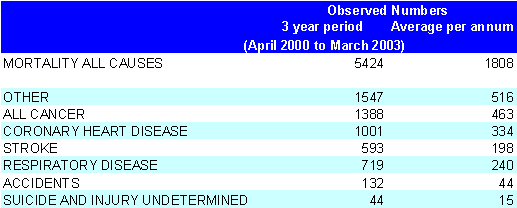
The key causes of premature death in Fareham and Gosport (Annex C) are:
_ Cancers
_ Coronary Heart Disease
_ Respiratory Disease
_ Stroke
The analysis of local mortality trends for key causes of premature death show that for Coronary Heart Disease and Circulatory Disease there will be a decline in premature death over the next decade with a `steady state' maintained relating to premature death from Cancer and Stroke. These trends for Fareham and Gosport reflect the national picture.
Prevalence and trends in disease
The prevalence and trends in patterns of disease across Fareham and Gosport has been drawn from two key sources of data. This has included an analysis of:
_ outpatient and inpatient service activity by ward of residence across a wide range of specialties, as an indicator of the level of prevailing illness and disease
_ GP practice data around 10 chronic health conditions following the implementation of the new national GP contract (April 2004), to ascertain the prevalence of disease within Fareham and Gosport and to predict future trends.
Analysis of outpatient and inpatient service activity over a three-year period (2001/02 - 2002/03) indicates that overall there is a mixed picture of disease prevalence by ward across the range of specialities in Fareham and Gosport. Preliminary analysis of GP data around 7 key causes of chronic diseases (including asthma, cancer, diabetes, coronary heart disease, chronic obstructive pulmonary disease, hypertension and stroke) suggests that the prevalence of key causes of disease in Fareham and Gosport reflects a similar picture to that in England (Annex D). Initial analysis of disease trends using data from a small cluster of GP practices across the Fareham and Gosport localities suggests a potential increase in prevalence around these seven disease areas over the next decade. This also reflects nationally published data. However, projections for national and local disease trends should be interpreted with a degree of caution. It is assumed that current trends will continue unabated, which may not be realistic, and that the recording of disease data in GP practices accurately reflects date of diagnosis, which may not be the case.
Key points
A number of key points have been drawn from the health needs analysis for Fareham and Gosport. These are:
_ There will be a significant projected growth and shift in the population aged over 55 years during the next 20-year period.
_ There will be a reduction in premature death from key causes of mortality and a predicted increase in key causes of chronic disease within the population.
_ Service volume will need to take account of population growth and shifts by different age groups and where there is evidence of higher usage of services.
_ There is a need for sustained delivery of primary, secondary and preventive activities targeted around some wards/population groups where needs are greatest.
_ A range of primary care, diagnostic and treatment facilities will be needed across both localities to address a mixed picture of health need and disease prevalence in both adult and older population age groups.
4. Future Service Provision Across Portsmouth and South East Hampshire
The wider strategy for hospital services across Portsmouth and South East Hampshire has been developed as a result of rising national standards, and the reconfiguration of acute health services on the Queen Alexandra Hospital site through the Private Finance Initiative (PFI), supported by a network of complimentary community hospitals in East Hampshire, Fareham and Gosport and Portsmouth City.
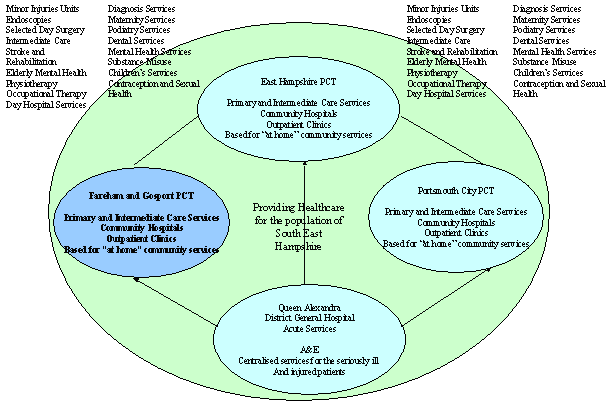
The diagram below illustrates the future provision of acute and community health service provision across the District. The community health services to be provided in the Fareham and Gosport locality are clearly shown:
Diagram 1: Fareham and Gosport in the context of District-wide health services
5. Future Health Services Provision
5.1 Capacity Mapping
In June 2002, Hampshire and the Isle of Wight Strategic Health Authority, Portsmouth Hospitals NHS Trust and the three local PCTs completed a review of the Private Finance Initiative (PFI) for the redevelopment of Queen Alexandra Hospital (QAH). The conclusions included strategic plans for hospital provision across South East Hampshire as follows:
_ To centralise acute inpatient services on the QAH site through a PFI scheme with expected completion of summer 2008
_ To redevelop St Mary's Hospital (SMH) to provide post acute care and community hospital facilities for Portsmouth City.
_ To re-provide services on the Gosport peninsula as a result of the closure of The Royal Hospital Haslar and the re-provision of services in Fareham through the development of community hospital facilities on the Coldeast site;
_ To provide a new community hospital on the Oak Park site in Havant, to facilitate the development of more local services and to rationalise existing hospital provision in East Hampshire.
Preliminary information on the capacity map for the major new capital projects planned in Portsmouth and South East Hampshire has been provided to the Hampshire and Isle of Wight Strategic Health Authority, showing how capacity will be affected; changes to care pathways; cost and workforce implications and interdependency between projects. Assumptions have been made with regard to the capacity-planning map:
_ An Independent Sector Treatment Centre (ISTC) run by Mercury Healthcare Ltd is being developed at St Mary's Hospital and this is due to become operational in January 2006. This will provide day surgery for all three PCTs, endoscopy for Portsmouth City and East Hants PCTs and a wider range of services for Portsmouth City including a minor injuries unit and a primary care walk-in centre.
_ The PFI scheme at QAH is due to complete in summer 2008 and it is anticipated that the community hospitals will play an increasingly proactive role in managing demand and avoiding inappropriate use of secondary care. Underpinning the PFI capacity plans is a set of assumptions about the availability of community facilities to support PHT outreach. Key assumptions are that:
_ Day Surgery activity equivalent to one theatre would be provided away from the main site. This will be in the St Mary's Hospital ISTC; minor surgery will be available in community hospitals
_ Endoscopies would be provided in the community facilities in each PCT;
_ Increase in A&E activity would be absorbed by the Gosport Accident Treatment Centre and other similar units in both Portsmouth and Havant;
_ 30% of all outpatient activity will be seen in the community
_ 30 post acute beds will be provided in each PCT area
_ Elderly rehabilitation beds and elderly day care would be provided in community settings; and
_ Elective surgery currently provided at Royal Hospital Haslar is to transfer to the QAH in 2008, outpatients; diagnostics and the Accident Treatment Centre will continue to be provided on the Gosport peninsula.
5.2 Bed Requirements
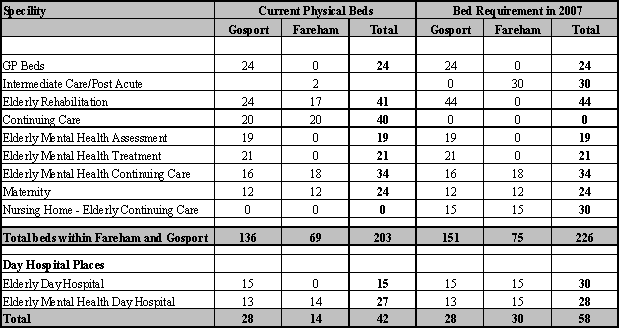
Table 2 shows the current bed utilisation for inpatient community services within Fareham and Gosport. The table presents the number of beds currently physically present in Gosport and Fareham for the various specialities and the projected bed requirements for 2008.
The bed requirements for 2008 are estimated figures. Work is ongoing with regard to capacity planning and it should be noted that these requirements may change. The total requirement for 2008 has increased from 203 to 226 beds over the period 2004/05 to 2007/08. The main variances are around Intermediate / Post Acute care, relating to the transfer of beds from QAH, and continuing care, where the services are to be transferred to the Independent Sector.
The transfer of beds from QAH relates to creating extra capacity within the acute sector to tackle the waiting list and waiting times targets and transfer patients back into the community for rehabilitation, in order to avoid delayed discharges.
The Elderly and Elderly Mental Health Day Hospitals do not have inpatient beds but places are available for patients to be seen by clinical and nursing staff for assessment and tests. The 15 Elderly Day Hospital Places will be provided at Fareham Community Hospital in the future to replace the 10 places previously provided at Trevor Howells Day Hospital at QAH.
Table 2: Bed Requirements
5.3 Reprovision of Existing Services
5.3.1 Services to be Re-located
Table 3 shows the changes of sites for services to be re-provided in alternative accommodation as an integral part of the strategy for the future provision of health services across the Fareham and Gosport locality. In determining where services should be located, the PCT has used the health needs assessment to ensure that health services are available to address areas of greatest health need, whilst maintaining equity and ease of access for local residents. Further information regarding the care models underpinning service provision is provided in Section 6.
Table 3: Change of sites for services to be re-provided
Provider |
Services Currently Provided |
To be re-provided in 2008 |
Royal Haslar Hospital |
Minor Surgery Out-patients Accident Treatment Centre Diagnostics Physiotherapy and Occupational Therapy |
GWMH GWMH GWMH GWMH GWMH & Gosport Health Centre (new) |
St Christopher's Hospital |
Avalon Substance Misuse Service Rehabilitation Beds Continuing Care Offices Day hospital (Cedarwood) and community teams |
Fareham Health Centre Coldeast Nursing Homes Coldeast Coldeast |
Gosport War Memorial Hospital (GWMH) |
GP Surgery (Gosport Health Centre) Family Planning Community Dental Podiatry Continuing Care |
Gosport Health Centre (new) Gosport Health Centre (new) Gosport Health Centre (new) GWMH Nursing Homes |
Queen Alexandra Hospital |
Post Acute Beds (30) |
GWMH & Coldeast |
Hill Park Clinic |
Physiotherapy Services |
Fareham Health Centre |
Blackbrook Maternity Home |
Blackbrook Maternity Home |
Coldeast |
Hewatt House |
Community Mental Health Team Out-patients |
Gosport Health Centre (new) or Rowner Road Site |
The remaining inpatient services from the Haslar site will be re-located to the QAH, and the community services to be relocated within Gosport will move to the refurbished GWMH utilising the vacated space at the Gosport Health Centre.
6. Future Provision of Health Services across Fareham and Gosport
The introduction of the NHS Plan where the patient is put at the centre of service provision, patient choice, lifestyle changes, relieving pressure on acute units to enable waiting list/times targets to be met, the shortage of healthcare professionals and an increase in the demand for certain specialities, has made it necessary for service providers to review the way in which the services are delivered. Fareham and Gosport PCT has been proactive in developing models of care which best meets the needs of the local population.
The models of care have been developed based on the National Service Framework (NSF) guidance and are aimed at ensuring that the patient receives the right care, in the right place, at the right time. In determining where services should be located, the PCT has used the health needs assessment to ensure that health services are available to address areas of greatest health need, whilst maintaining equity and ease of access for local residents.
6.1 Primary Care Services
Primary care has provided excellent services to patients over the years. In the new modern NHS it must strive to improve the services to the public in order to improve their health and well-being. Care will be provided more locally and faster and it will be planned around the needs of the public and the choice of patients.
To ensure that services are provided in modern fit-for-purpose premises, the PCT will be providing new surgery premises in Gosport and Fareham. These developments will allow practices to provide a wider range of services within the local community, some of which are currently provided in hospital environments, for example, GPs with a specialist interest (ENT, endoscopy, ultrasound), local phlebotomy services, physiotherapy and chronic disease management. In particular, physiotherapy provision for Fareham will re-locate from Hill Park Clinic to Fareham Health Centre to improve access for local residents. There will also be a considerable growth in activity from 5,200 physiotherapy appointments in 2004/05 to 15,200 in 2007/08 (which includes the transfer of a considerable level of civilian workload at Haslar). The increase in activity will be provided primarily at GWMH and Fareham Health Centre.
The new Primary Care premises will also improve access to primary care services for patients, as there will be a significant increase in the number of consulting rooms available within Fareham and Gosport, which will give an estimated additional 500 appointments available per week for GPs and a further 500 appointments for other healthcare professionals, such as in house pharmacists and nurse specialists.
In addition to the development of premises, the PCT is actively working with primary care to review the skill-mix of staff and this will lead to the further development of practice nurses and specialist nurses working particularly in areas such as chronic disease management.
New contracts for GPs, dentists and pharmacists, together with the alternative Primary Medical Services (PMS) and Primary Dental Services (PDS) contracts offer the opportunity for innovative working to improve the range and quality of local primary care services. This will be further facilitated through the introduction of Practice based commissioning in 2005 which will involve greater involvement of primary care professionals in the commissioning of health care services and enable clusters of practices to work collaboratively to develop services to meet the health needs of their local populations.
NHS Dentistry
Fareham and Gosport PCT are currently working with East Hampshire and Portsmouth City PCTs to undertake a review of local services provided in the area across primary, community and secondary care services, taking into account the health needs within the locality. This information will be used to inform the development of a dental strategy for the future provision of NHS dental services. This strategy will build on the work already underway to improve access to dental services within Fareham and Gosport:
· The PCT has secured the provision of an additional five NHS dental practices within Fareham and Gosport under the Personal Dental Services (PDS) contract, who became operational in November 2004. This accounts for 15% of Fareham and Gosport Dental Practices, providing 21,387 patients with NHS Dental Care, incorporating a negotiated increase of 6,374 patients. The PCT is currently negotiating with a further five dental practices to provide NHS dental services in 2005.
· In addition, the PCT runs a mini-Personal Dental Services Scheme which provides emergency dental care for patients who are not registered with a dentist. The PCT currently commissions a total of 8 mini-PDS sessions a week, enabling approximately 1,500 unregistered patients to be seen per annum.
The PCT will continue to work in collaboration with integrated dental holdings and local General Dental Practitioners to further expand NHS dental service provision across the locality. Where possible, services will be developed to address greatest health need.
Community Pharmacy Services
The PCT will support and empower community pharmacists to work differently, reducing time spent on traditional dispensing roles, and offering enhanced services to patients, thereby improving access to services and supporting the patient choice agenda. This will include:
_ New ways of working across primary care enabling patients to get treatment for minor ailments and advice directly from a local pharmacist
_ Integrated health care teams - pharmacists will work much closer with other healthcare professionals providing integrated care to patients
_ Increase in skill-mix within pharmacy, with accredited technicians embracing some of the traditional pharmacist roles. This will enable pharmacists to provide more face to face consultations with patients.
Minor Injury Units
Haslar Accident Treatment Centre (ATC) is a nurse led unit providing treatment for a defined range of minor accidents or trauma. The ATC currently sees approximately 15,000 patients per year with activity projected to rise by 33% by 2007/08. The ATC was established at Haslar in August 2000 but will be re-provided at GWMH. This will enable greater integration with a range of community services, such as intermediate care and out of hours services and should result in the provision of more seamless care packages for patients (i.e a patient who has fallen but does not have a fracture may require rehabilitation and social care support to return home. Closer linkages between the ATC and the Community Enabling Service will facilitate the provision of this care).
The PCT will explore the future development of a Minor Injuries Unit in Fareham.
Out of Hours Care
Primary Care out of hours services (including Saturday morning cover) are provided by Portsmouth City PCT on behalf of the District. The PCT took responsibility for the provision of primary care out of hours services from GPs on 1st October 2004. The out of hours service is co-ordinated from a base in Drayton where call-handling for the whole District is located. Medical services for Fareham and Gosport PCT are provided from GWMH where up to three GPs are located providing triage and consultations. Home visits are provided where necessary.
The PCT is currently exploring the integration of primary care and community out of hours services. The provision of a range of services at GWMH, including primary and community out of hours services and the ATC, will enable a comprehensive out of hours service to be provided, resulting in more efficient working and improved patient care.
6.2 Elective Services
Waiting times for elective services have significantly reduced, with a maximum wait of 9 months for elective surgery and 17 weeks for an outpatient appointment at the end of March 2004. The PCT is committed to continuing to reduce waiting times for local residents and is on target to deliver the national waiting times targets of 6 months for elective surgery and 13 weeks for a first outpatient appointment by December 2005. A further reduction in waiting times will be required to meet the national waiting times target of a total waiting time of less than 18 weeks between GP referral and patients receiving treatment by 2008.
Fareham and Gosport PCT's capacity plan projects the level of emergency, elective (inpatients and outpatients) and diagnostic activity required 2005 - 2008 in order to deliver the NHS Plan waiting times for local residents. It is envisaged that significant capacity will be available locally to deliver the targets, primarily from the PCT's main acute provider, Portsmouth Hospitals NHS Trust but also through the ISTC development on the St Mary's Hospital site (see section 5.1). It is not envisaged that additional activity will be required from the independent sector, although the PCT recognises the Government's intention to further increase plurality and choice.
The PCT will continue to commission a range of elective services for local residents primarily from its main acute provider, Portsmouth Hospitals NHS Trust. Acute elective inpatient activity will be centralised on the QAH under the PFI. Day case surgery will be provided at the St Mary's Hospital site and within GWMH and at Coldeast. The PCT will also continue to commission specialist services from a range of acute providers.
Outpatient services will be provided at St Mary's Hospital, Gosport War Memorial Hospital and the Coldeast site in Fareham. The total level of outpatient activity will not significantly increase between 2005 - 2008 but the proportion of outpatient activity undertaken within the community will increase from approximately 10.5% to 30% (43,000 outpatient attendances).
Based on a pro rata division, the Gosport catchment population requirement is for around 17,630 and Fareham's 25,370 of the total 43,000 outpatient attendances. GWMH currently provides around 10,500 attendances annually in 5 acute and general medical specialties and the Sylvan Clinic at Coldeast in Fareham provides approximately 3 - 4,000 outpatient attendances in 6 acute specialties.
The key factor in determining the extent to which outpatients can be seen in community locations is the availability of on site diagnostic equipment and expertise. Planning for the redevelopment of QAH has involved consideration of clinical requirements and likely availability of diagnostic equipment and expertise off the QAH site. The outcome is that current plans are based on a proportion of outpatient work in 21 specialties taking place off the QAH site. The underpinning assumption is that plain film x-ray and ultrasound will be available in locations where outpatients are seen. These diagnostic facilities are currently available at GWMH but would need to be further developed to enable an increase in outpatient activity. Similarly, the major constraint on the number of outpatients who can be seen at Sylvan is the lack of diagnostic facilities. If x-ray and ultrasound facilities and appropriate staff expertise were available either within Sylvan or the proposed Fareham Community Hospital then significantly more outpatients could be seen.
Diagnostic capacity across the locality will need to be addressed but the provision of 30% of all outpatient activity within the community is a significant increase. This will enable a higher number of Fareham and Gosport residents to be seen within the locality, resulting in improved ease of access to health services. The provision of diagnostic and outpatient clinics on the community hospital sites will also enable patients to be assessed and diagnosed, increasing the potential for one-stop clinics in a range of specialties.
6.3 Services for People with Chronic Diseases and Long-Term Conditions
The health needs data shows that the increasing ageing population will result in a rising number of people with chronic diseases (including asthma, chronic obstructive pulmonary disease, cancer, diabetes, coronary heart disease, hypertension and stroke). This will be both a national and local trend.
People with chronic diseases / long term conditions will require ongoing clinical management and may require complex care packages. The PCT's aim is to ensure that patients' with chronic diseases / long term conditions receive high quality systematic care to ensure optimal treatment and good symptom control, together with information, education and support to enable self-management of the condition. The proactive management of these patients has been shown to be effective in reducing the number and length of acute hospital admissions and readmissions and can significantly improve quality of life.
The PCT is developing a team of specialist nurses to work in conjunction with primary care services to proactively manage patients with chronic diseases / long term conditions within the community.
6.3.1 Coronary Heart Disease
Coronary heart disease is common, frequently fatal and largely preventable. In Fareham and Gosport there are approximately 5,600 people currently registered with CHD; equating to 3% of the total population. CHD is the second highest cause of death within the locality, accounting for 18% of all deaths in Fareham and Gosport (approximately 340 deaths per annum). CHD rates are higher in Gosport than Fareham.
The National Service Framework for Coronary Heart Disease was published in March 2000 and sets standards for the prevention, diagnosis and treatment of coronary heart disease. The PCT is working to implement the NSF in order to reduce premature deaths from CHD and to deliver faster, more equitable access to high quality CHD services.
A key target is the substantial reduction in mortality rates by 2010 from heart disease by at least 40% in people aged under 75 years. The PCT is working in collaboration with local organisations to tackle the broader determinants of health, including housing, socio-economic inequalities and transport. This work includes the implementation of a range of health promotion activities, focusing on healthy eating, stopping smoking and regular physical activity to encourage local residents to lead healthier lives (i.e Healthy Heart clinics, Walking Your Way to Health, locality smoking cessation clinics).
All Fareham and Gosport Practices have established CHD registers which are updated on an ongoing basis. CHD clinics are held in each GP Practice by nurses trained in the management of CHD to regularly review patients' treatment and provide lifestyle advice. In addition, to address the higher rates of CHD in Gosport, the PCT has employed a specialist CHD nurse. The nurse reviews all patients with established CHD and those at high-risk, and ensures that they are receiving optimal care before referring them back to their GP for ongoing management. The nurse also reviews and manages patients with more complex disease and provides training and advice for Practice CHD nurses. The service is provided at GWMH.
The PCT is also planning to develop a community heart failure service, as part of its demand management and chronic disease management strategies. The service will ensure:
_ The improved identification of patients at high risk of heart failure and the assessment and investigation of those with suspected heart failure
_ Timely access to accurate diagnosis of heart failure through improved access to echocardiography
_ Optimal treatment and good symptom control through initial management and review by a community based Heart Failure Nurse and a GP with a specialist interest in heart failure (GPwSI).
The service will be based at GWMH and will become fully operational in 2005. It is envisaged that the service will ensure patients receive high quality care leading to improved quality of life and a reduction in the level of acute emergency admissions.
Fareham and Gosport PCT currently commissions acute cardiac services from Portsmouth Hospitals NHS Trust, Southampton University Hospitals NHS Trust and King Edward VII Hospital. In order to deliver the 3 month maximum waiting times for cardiac revascularisation by March 2005 and increase the cardiac revascularisation rate to meet NSF standards, significant expansion in cardiac services is required across Hampshire. A strategic framework for the expansion of cardiac services has been developed which will see the development of a district angioplasty service at Portsmouth Hospitals NHS Trust and the significant expansion of Southampton University Hospitals NHS Trust as the main cardiac centre across Hampshire for complex cardiac surgery over the next 5 years.
6.3.2 Diabetes
There are currently 3,232 people with Diabetes in Fareham and 2,352 in Gosport. The higher rates in Fareham are primarily due to lifestyle factors.
The National Service Framework for Diabetes was published in December 2001. The PCT is committed to developing Diabetes services in line with the NSF standards.
Practices in Fareham and Gosport provide nurse-led diabetes clinics to ensure patients are regularly reviewed and receive appropriate treatment and advice regarding the management of their condition. The new General Medical Services (nGMS) contract supports the provision of high quality services through the monitoring of specific quality indicators relating to diabetes care.
The Diabetes Centre at Portsmouth Hospitals NHS Trust provides diagnostic and specialist diabetes care for Fareham and Gosport residents. In addition, specialist diabetes nurses run education days for newly diagnosed patients with type 2 diabetes within the locality.
The PCT is working with Portsmouth City PCT, East Hampshire PCT and Portsmouth Hospitals Trust to develop a strategy for the future provision of diabetes services. The PCT is committed to developing a more community-focused model, with patients receiving ongoing treatment and care from trained professionals (Diabetes Nurse Specialist / GPwSI) within the locality.
6.3.3 Respiratory / Chronic Obstructive Pulmonary Disease (COPD)
Respiratory disease kills one in four people in the United Kingdom and accounts for 13% of all deaths in Fareham and Gosport. COPD is a chronic disabling lung disease and accounts for one fifth of respiratory mortality. Exacerbations of COPD are the most common cause of hospital admission due to respiratory disease and accounted for 761 admissions of less than 2 nights stay amongst Fareham and Gosport residents within 2003/04. The disease is primarily due to cigarette smoking and is likely to increase with an ageing population and the cumulative effect of smoking.
The PCT will continue to provide locality based smoking cessation services to reduce the incidence of COPD in the longer-term. In addition, the PCT is committed to the development of services within the community to proactively provide care, treatment, and advice for COPD patients, to improve quality of life and reduce the need for acute hospital admissions. The PCT will appoint a specialist COPD nurse in 2005. The nurse will review patients with complex disease and ensure they are receiving optimal treatment and care. The nurse will also educate patients and their carers in the self-management of their condition.
Pulmonary rehabilitation is currently provided by Portsmouth Hospitals NHS Trust at St Mary's Hospital. Pulmonary rehabilitation can improve patient's quality of life and ability to function. Benefits include increased exercise capacity, physical endurance, reduced breathlessness and improved independence. The PCT will explore the development of locality based pulmonary rehabilitation services to improve access for Fareham and Gosport residents.
6.3.4 Cancer / Palliative Care
Cancer is the largest cause of mortality in Fareham and Gosport. On average, 463 people die from cancer per annum, which accounts for a quarter of all deaths (26%). Fareham and Gosport residents mainly receive cancer services from Portsmouth Hospitals NHS Trust and Southampton University Hospitals NHS Trust which are the designated Cancer Centres within Hampshire and the Isle of Wight.
The Cancer Plan was published in 2000 and provides a comprehensive strategy with key milestones for delivery on prevention, screening, diagnoses, treatment and cancer care.
The PCT is committed to promoting the causes of cancer and the importance of prevention (healthy eating, regular exercise, smoking cessation), together with the uptake of breast and cervical cytology screening services. Cervical cytology screening services will continue to be provided by GP Practices and breast screening services will be re-provided as part of the PFI initiative.
The District has been selected as one of the national integrated cancer care pilot sites. The pilot will focus on the development of integrated cancer care services across primary, secondary and community care services and will ensure the pro-active management of cancer patients to ensure they receive optimal care and treatment. The pilot will commence in September 2005 and will inform the future development of cancer services for the locality.
A key priority is the reduction of waiting times for cancer patients. The PCT, in conjunction with Portsmouth Hospitals NHS Trust, continues to deliver a maximum two-week wait for an urgent outpatient appointment for all suspected cancers and is committed to achieving the December 2005 waiting times targets of a maximum one month wait from diagnosis to treatment and a maximum two month wait from urgent GP referral to treatment for all cancers. The delivery of the 2005 and 2008 waiting times targets will require additional diagnostic activity, in particular radiotherapy. The Central South Coast Cancer Network is undertaking a review of non-oncology services which will inform the future development and configuration of clinical oncology (radiotherapy), medical oncology (chemotherapy) and malignant clinical haematology services across the Network.
Specialist palliative care services are provided by East Hampshire PCT, The Rowans and Countess Mountbatten House (Southampton University Hospitals NHS Trust). An integrated palliative care strategy has been developed for the District, which aims to:
_ Develop a multi-disciplinary service that interfaces primary, community and secondary care services
_ Ensure appropriate admission to acute care in line with the care pathway
_ Facilitate timely discharge, thereby reducing the length of stay for palliative care patients
_ Reduce the number of deaths in acute care and provide greater choice for patients who wish to die at home in line with national palliative care standards. It should be noted that significant investment has been made by the PCT in specialist palliative care services to provide increased home care and treatment to enable people to remain at home.
6.3 Services for Older People
Fareham and Gosport has a total registered population of 191,451, of which approximately 33,000 people are aged 65 years and over. Between 2003 - 2006, it is forecast that the number of people over 65 years living in Fareham and Gosport will increase by 1,000 (3.2%) resulting in rising demand for health and social care services. As over half of this increase will be people aged 80 years and over, there will be a need for the provision of additional complex care packages, which will place further pressure on the health and social care system.
The ageing population has also resulted in a rising number of acute emergency admissions. In 2001/02 there were 4,491 emergency admissions to Portsmouth Hospitals NHS Trust of people 65 years and over who were registered with a Fareham or Gosport General Practitioner. This increased to 5,178 in 2002/03. Rising emergency admissions impact on the Trust's ability to undertake elective work and deliver shorter waiting times for patients. In addition, many older people admitted to hospital do not require acute medical care but do need a level of health care provision and social care support, either provided within the community or in their own homes.
6.4.1 Intermediate Care Services
With an increasingly ageing population, the PCT, in conjunction with partner agencies, needs to ensure that it provides a range of health and social care services at the right place and at the right time to be able to meet the health and social care needs of older people. The PCT has developed a comprehensive intermediate care strategy which sets out the PCT's vision for the future development of services for older people. The strategy focuses on the promotion of independence, ensuring older people remain fit, active and healthy through a range of health promotion initiatives (Flu immunisation / Falls prevention initiatives, `Keep warm, Keep well' campaigns etc) and the pro-active management of vulnerable older people by a team of specialist nurses who assess patients who are at high clinical risk and / or are high users of health and social care services and ensure they receive comprehensive care packages to meet these needs. In addition, the strategy describes the planned development of a comprehensive range of intermediate care services designed to provide alternatives to acute admission and facilitate early discharge from acute hospital care. These encompass the Community Enabling Service, Stroke Rehabilitation Team, Rapid Response Service, Welcome Home Scheme, Day Hospital Services, Falls Prevention Services and the Chronic Disease Nurse Specialists. It is envisaged that the intermediate care services will be fully integrated and accessed via a single point of access, so that patients are assessed and receive a seamless, comprehensive package of health and social care services which meet their needs (See Annex E). The co-location of the intermediate care services on two community hospital sites will facilitate joint working and the provision of integrated services for patients.
Promotion of Independence and Healthy Living
Managed Care - Evercare Model
Managed care is a proactive community based service delivered by senior nurses and social care workers in conjunction with primary care professionals. The service is targeted at people aged over 65 with poor health and who are high users of health and social care services. The team undertake multi-disciplinary assessments and plan packages of care (e.g social care support / rehabilitation) to ensure the health and social care needs of the individuals are met. Evidence has shown that the pro-active management of these patients can improve independence and quality of life, and significantly reduce the level of acute emergency admissions. Fify (50) patients from each of the 21 GP Practices across Fareham and Gosport will be managed by the service.
Chronic Disease Management - Specialist Nurses
The incidence of chronic disease increases with age. The PCT has developed a team of specialist nurses to pro-actively manage patients with chronic disease / long term conditions to ensure they receive optimum treatment and care. (See Section 6.2)
Integrated Falls Service
An integrated falls service consists of a falls prevention programme (prevention and treatment of osteoporosis and falls prevention initiatives i.e exercise classes and homecheck services); improved diagnosis, care and treatment of older people who have fallen (through the development and implementation of a falls care pathway) and the provision of rehabilitation and long term support. The PCT has appointed a Falls Co-ordinator and is planning to deliver a fully integrated falls service by December 2005 in line with standards contained within the Older Person's National Service Framework.
Health Promotion Campaigns
The PCT will continue to deliver an annual health promotion campaign targeted at older people, for example, flu immunisation, `keep warm - keep well,' physical activity programmes, and health checks. This will be developed and co-ordinated by the PCT's Health Promotion Team, in conjunction with local voluntary and statutory organisations.
Intermediate Care Services
Specialist, co-ordinated multi-professional intermediate care services have shown to be effective and efficient in reducing length of stay and ensuring potential for recovery is achieved outside acute hospital settings. Fareham and Gosport Primary Care Trust, in conjunction with local statutory and voluntary organisations, has developed a range of intermediate care services designed to provide alternatives to acute hospital admission and to facilitate early discharge from acute hospital care. To enable the Trust to continue to deliver high quality care in the most appropriate setting for people aged 65 years and over and adults with complex neurological conditions (i.e Parkinson's Disease, Multiple Sclerosis), the Trust is committed to the reconfiguration and expansion of local intermediate care services.
Intermediate care services provide rapid and comprehensive rehabilitation and social care packages within community settings to facilitate early discharge and prevent admissions to local acute hospital care. Intermediate care services:
_ Are targeted at people who would otherwise face unnecessarily prolonged hospital care stays or inappropriate admission to acute inpatient care, long term residential care or continuing NHS inpatient care
_ Are provided on the basis of a comprehensive assessment, resulting in a structured individual care plan that involves active therapy, treatment or opportunity for recovery
_ Have a planned outcome of maximising independence and typically enabling patient / users to resume living at home
_ Are time limited, normally no longer than six weeks and frequently as little as 1 - 2 weeks or less
_ Involve cross professional working, with a single assessment framework, single professional records and shared protocols
_ Include health promotion, disability management and promotion of independence as core components of the service.
The following intermediate care services have been developed within the Fareham and Gosport locality:
Community Enabling Service
A multi-disciplinary team (i.e physiotherapists, District Nurses, Community Psychiatric Nurses, O.Ts, pharmacists, dietitians, care managers etc) who provide comprehensive rehabilitation and social care support to patients in an elderly rehabilitation / intermediate care bed or within their own homes.
Intermediate Care Beds
Currently there are 41 elderly rehabilitation / intermediate care beds. As a result of the acute service reconfiguration (PFI), this number will increase to 44 beds at GWMH and 30 intermediate care / post-acute beds at Coldeast, Fareham. This will ensure a larger number of Fareham and Gosport patients can receive care within the community, resulting in shorter lengths of stay within acute hospitals and a reduced number of emergency admissions. The PCT has appointed a community geriatrician to provide clinical leadership and further strengthen the intermediate care service. Key roles of the community geriatrician include:
_ Working with GPs to identify frail, vulnerable older people and to develop appropriate services and levels of care to meet their needs
_ Provide advice to primary care colleagues regarding options for the management of older people, including enhanced care at home, referral to intermediate care facilities and acute hospital admission
_ Assessment of patients on the acute Medical Assessment Unit and the facilitation of safe discharge from acute care to an appropriate post-acute setting
_ Provision of medical inpatient care to the elderly rehabilitation / intermediate care beds
_ Supporting GPs in the management of acutely unwell patients
G.P Beds
Patients registered with a Gosport GP can be admitted to the 18 GP beds at GWMH under the care of their GP for observation prior to treatment, assessment for pain control. ACE trials, palliative care, short stay convalescence, medical investigations and post-surgical rehabilitation. Currently Fareham patients can be admitted to a nursing home bed, (which is spot-purchased by the PCT according to need), under the medical care of their GP for treatment and rehabilitation.
Stroke Rehabilitation
Fareham and Gosport have been working on the development of the Stroke Rehabilitation Service to create a Centre of Excellence within the District. Stroke is the third most common cause of death and with a population of nearly 600,000 across Portsmouth and South East Hampshire, it has been estimated that 1,432 people per annum will suffer from a stroke. The current incidences of new stroke cases are 35 per month across the District and the current average length of stay is 24 weeks. In Fareham and Gosport, stroke accounts for 11% of all deaths, (198 people per annum). The burden to individuals, their families and society is well documented and stroke is the most common cause of permanent disability.
The National Service Framework for Older People outlines the developments required for a stroke service and particularly describes the need for early and ongoing targeted rehabilitation, follow up by expert teams and outreach teams delivering care in people's own home. The National Clinical Guidelines for Stroke produced by the Royal College of Physicians and a further NSF on Long Term Conditions endorses these developments as best practice.
Locally, due to environmental factors there has been a need to re-provide inpatient services at St Christopher's Hospital. This has provided an opportunity to review the current stroke rehabilitation service and bench mark it against local requirements.
It is proposed to bring together the current provision of beds in Fareham and Gosport and to create a single 20-bedded unit at GWMH. This ensures a critical mass of expertise, which would be better able to deliver an efficient and effective inpatient rehabilitation service. This enables the PCT to progress towards a `centre of excellence', which would meet NSF targets and deliver its own local priorities, as well as leading to better health outcomes for the patient.
Day Hospital
Day Hospital provision is currently provided at Dolphin Day Hospital for Gosport residents and Trevor Howell Day Hospital at QAH for Fareham residents. Day hospitals provide individual treatment programmes and investigations on a once or twice weekly basis for patients who have complex rehabilitation or diagnostic requirements (including specialist falls assessment for unexplained collapses or falls). Dolphin Day Hospital has 15 places and facilities are available via GWMH for day case blood transfusion, COPD assessment, 24 hour ECG and blood pressure monitoring. There are 10 places available at Trevor Howell Day Hospital but as part of the PFI, this service will be re-provided at Coldeast, Fareham and expanded to 15 places in recognition of the increased demand due to the ageing population and to ensure equity and ease of access for Fareham residents.
Assessment Unit
The PCT is planning to develop an assessment unit as an integral part of its intermediate care strategy. Currently, many elderly patients are referred to the acute Medical Assessment Unit (MAU) at QAH which provides a range of diagnostic tests and complex interventions. Patients may be discharged with an appropriate care package or admitted to an acute medical bed following assessment within the MAU. Provision of an assessment unit within the community will enable patients to receive a rapid assessment which avoids the need for admission to the MAU and reduces the likelihood of an acute hospital admission. The provision of the assessment unit within the community hospitals will ensure access to a range of diagnostic facilities and intermediate care services to support patients either within an intermediate care bed or within their own homes with an appropriate care package.
Rapid Response Nursing
The rapid response service enables the rapid provision of enhanced nursing care at home or within a nursing home bed to support discharge from hospital or prevent unnecessary admission to hospital. Enhanced nursing support is provided for a maximum of 14 days, although therapy services (via the Community Enabling Service) can continue beyond this period.
Rapid Response Homecare Team (Hampshire Social Services)
This service enables people to remain at home or to be discharged quickly through the provision of time limited social care packages.
Welcome Home (Hampshire Social Services)
The Welcome Home Service provides short-term support (up to 4 weeks) by support workers on discharge from hospital to enable people to regain their former skills and live as independently as possible.
Step up / step down beds in elderly care / EMI nursing homes (Hampshire Social Services)
The service enables people to be discharged to a residential or nursing home bed within a range of homes across Fareham and Gosport for up to six weeks whilst waiting for the nursing / residential home of their choice.
Continence Services
Local continence services are primarily provided by District Nurses and the District Continence Nurse Specialist. A comprehensive strategy for the provision of continence services has been developed. The PCT has recently purchased portable bladder scanners to enable the more accurate diagnosis and management of incontinence within the community.
The further development of intermediate care services is one of the highest priorities for the PCT and is seen as vital to address the rising health and social care needs of an ageing population. The provision of a fully integrated intermediate care service as described above, will promote independence, prevent admissions and facilitate early discharge. It will also improve the quality of care provided to older people and ensure they receive the right care, in the right place, at the right time.
6.4.2 Elderly Mental Health
Elderly Mental Health Services are provided by East Hampshire PCT for the district. Elderly Mental Health services for Fareham and Gosport residents are provided at GWMH within 19 EMI assessment beds and 21 treatment beds. The PCT also provides NHS elderly mental health continuing care beds at Redclyffe House in Gosport and Summervale in Fareham.
Fareham and Gosport PCT, in liaison with East Hants PCT and partner agencies, has jointly produced an Elderly Mental Health framework. The document sets the operational framework for the provision of services for older people in Fareham and Gosport with mental health problems and their carers. It describes a range of services, including access and their inter-relationship as stated in the National Service Framework for Older People and the `Forget-me-not Guidance of Good Practice.'
The PCT is committed to the provision of a range of high quality, integrated services for older people with mental health problems. The PCT has undertaken extensive consultation regarding the future provision of elderly mental health services which will help to inform future planning. A key outcome of the consultation was the need for service provision in both Fareham and Gosport to ensure equity and ease of access for service users and their carers.
6.4.3 Continuing Care
Continuing care (or long term care) is the care that people need over an extended period of time, as a result of disability, accident or illness to address physical and / or mental health needs. The care of an individual may require services from health and / or social services and may be provided in a range of settings, from an NHS hospital to the patient's own home.
Locally, due to environmental factors there has been a need to re-provide inpatient services at St Christopher's Hospital. This has provided an opportunity to review the current NHS continuing care service and bench mark it against future requirements. The outcome of the review showed that the needs of patients could be more appropriately met within the community and resulted in a move from fully funded NHS continuing care provision of 40 beds within the community hospitals, to a model of supported care within the independent sector. Alternative provision has therefore been commissioned through the independent sector, with the PCT entering into agreements with local nursing homes to provide continuing NHS care. This provision is supported by a multi-professional outreach team to pro-actively manage patients in conjunction with the nursing home and primary care services.
Elderly mental health NHS continuing care beds are currently provided at Redclyffe House in Gosport (16 beds) and Summervale in Fareham (18 beds). The PCT plans to review elderly mental health NHS continuing care services as part of the wider strategy for the future provision of elderly mental health services for the locality.
6.4 Services for Children and Young People
Fareham and Gosport PCT is committed to working with children and their families to deliver children's services that effectively meet their healthcare needs. The PCT endorses the need for closer collaboration between agencies to deliver better children's services and is working closely in partnership to achieve this outcome.
The majority of children who have episodes of ill health are managed by the delivery of services through primary care. Primary care professionals include GPs and their practice staff, pharmacists, health visitors, school nurses, primary mental health workers and other allied health professionals.
The PCT delivers services across Fareham and Gosport for:
_ Health Visiting
_ School Nursing
_ Child and Family Therapy Services (CAMHS)
In addition, the children in Fareham and Gosport receive health services from Portsmouth City and East Hampshire PCTs' under hosted arrangements for:
_ Community Paediatrics Services - based at the Coldeast site
_ Community Nursing Service
_ Paediatric Therapy Service
_ 0-12 specialist CAMHS Service
_ Unified Adolescent Service
The PCT also provides services as a result of Government grants for healthcare for children:
· Cool 2 B Healthy Nurse
· Teenage Pregnancy Project Worker
· Children's Fund
· Single Regeneration Budgets (SRB)
· Youth Inclusion and Support Panel (Gosport)
· National Healthy Schools Scheme
Each of these initiatives aims to deliver children's services that are local and accessible for families in need and that deliver better outcomes for both children and parents. Gosport is recognised as having wards that are amongst the 20% most deprived in England. Therefore it is vital that these areas receive comprehensive health services. All of the above schemes operate in Gosport, with the Cool 2 B Healthy project and SRB projects focussing specifically in Rowner. Each of these services engage with the local population to provide services that meet their needs and link closely with other statutory and voluntary agencies to provide a cohesive approach to the health and well being of vulnerable young people. Fareham is recognised as having individual pockets of deprivation and the PCT does target services to meet the needs of these areas.
Sure Start and Children's Centres
The PCT currently delivers community services from health visitors, school nurses, nursery nurses and primary mental health workers in geographical areas. The PCT is committed to supporting the Sure Start programme aimed at children aged 0 - 4 years and their families. The Sure Start model encourages the development of Children's Centres, which must be located and serve families in the 20% of the most disadvantaged wards in England. In Gosport, Rowner is identified as being one of these areas. The aim of Sure Start is to provide access to the following core services:
_ Early education, integrated with child care
_ Family support and outreach to parents
_ Child and family health services
In addition, the service acts as a hub within the community for parents and providers of childcare services for children of all ages - offering a base for childminding networks, links to day-care provision, out of school clubs and extended schools. Children's Centres will also have links with local training and education providers, Jobcentre Plus and Children's Information Services.
Sure Start in Rowner will operate from a new purpose built building due for completion in 2005. This will contain a 60 place, full day care nursery as well as space to deliver family support services, which currently include Post Natal Therapy, Breast-feeding Support and Baby Clinics. The Haven Children's Centre in Bridgemary delivers similar services to Sure Start, as does Oak Meadow in Fareham.
Child and Adolescent Mental Health Services (CAMHS)
The PCT is an active partner in the Hampshire CAMHS Children's Trust, and actively works to secure local investment and service improvements in CAMHS services. Currently, the PCT has a Child and Family Therapy Team, based in Osborn Centre, Fareham, who also work from the Gosport Health Centre, ensuring easy access for residents in both Fareham and Gosport. Services to support complex cases requiring admission are located at Leigh House in Winchester and referrals can be made to the Unified Adolescent Team or the 0 -12 service, hosted by East Hampshire PCT.
Children With Disabilities
The PCT is working to develop a Children's Disabilities Register (Joint Information Link) and is currently piloting a shared services project to establish virtual integrated children with disabilities team. This group of children are amongst the most vulnerable in our community. They need services that are co-ordinated across the agencies, so that parents and children have a single point of access for multi-agency provision. Evaluation of this project is currently underway and it is hoped it will influence service delivery in the future.
Child Protection
The PCT has established a Child Protection Management Committee and has a dedicated GP for Child Protection and a Named Nurse. Working with Portsmouth Hospitals NHS Trust, the PCT is committed to delivering a 24 hour, 7 day a week child protection service, provided by the community paediatric service.
Maternity Services
The women of Fareham and Gosport are able to access a wide range of maternity choice options. Women can deliver at home, at two stand alone midwifery led birth centres - Blake Birth Centre in Gosport (12 beds) or Blackbrook Birth Centre in Fareham (12 beds), or at the co-located Mary Rose Birth Centre, next to the main maternity unit in Portsmouth. All women are encouraged to access a range of local antenatal and postnatal support services delivered by community midwives and primary care.
Local service provision is provided by Portsmouth Hospitals NHS Trust, but women can also access maternity services from the Princess Anne Hospital in Southampton or from the Royal County Hospital in Winchester.
The main obstetric unit will transfer from St Mary's Hospital to the new Queen Alexandra Hospital in Cosham under the PFI Initiative, when the redeveloped hospital opens in summer 2008. Facilities at the new site will mean that Portsmouth Hospitals Trust will care for babies who require the highest levels of intensive care from Portsmouth, St. Richard's Hospital, Chichester, and St. Mary's Hospital, Isle of Wight.
The PCT, in line with the Maternity Strategy, aims to continue to support the range of maternity choice options for women, including the provision of midwifery-led units in Fareham and Gosport. There are no plans to change the provision at Blake Birth Centre in Gosport but the PCT will aim to relocate the Blackbrook Birth Centre to the proposed new Fareham Community Hospital on the Coldeast site. This will ensure the provision of maternity services for Fareham women within modern, purpose-built facilities.
6.6 Sexual Health Services
In 2001 the Government published `The National Strategy for Sexual Health and HIV' following increasing concern at rising rates of sexually transmitted infections (STI's) and a doubling of the number of visits to Departments of genito-urinary medicine (GUM) during the 1990's. In addition to supporting the need to reduce unintended pregnancy rates, the strategy aims to:
_ Reduce the transmission of HIV and STIs, with a national goal of achieving a 25% reduction in the number of newly acquired HIV infections and gonorrhoea infections by 2007
_ Reduce the prevalence of undiagnosed HIV and STIs
_ Improve health and social care for people living with HIV
_ Reduce the stigma associated with HIV and STIs
_ Work towards the national standard that women who meet the legal requirements should have access to an abortion within 3 weeks of the first appointment with the GP or other referring doctor.
In general across the Portsmouth and South East Hants area, levels of Sexually Transmitted Infections (STIs) have risen over the last 5 years, with particular concerns around warts (1100 cases in 1998 rising to 1600 cases in 2002), chlamydia (900 cases in 1998 - 1300 cases in 2002), NSU (950 in 1998 -1200 cases in 2002) and herpes (200 cases in 1998 - 700 cases in 2002). The number of new HIV diagnosis in Portsmouth and South East Hampshire has been rising steadily over the last 3 years - 12 cases in 2000, 20 in 2001 and 43 in 2002. The trend continues in 2003/04 and attendances at both GUM and Contraceptive and Sexual Health (C&SH)clinics continue to rise.
Contraceptive and Sexual Health (C&SH) and Genito-urinary Medicine (GUM) services are both provided centrally within Portsmouth City with satellite clinics in the Fareham and Gosport locality. The C&SH service particularly has a well established clinic within Gosport Health Centre and the PCT wishes to maintain this service to address local health need and ensure high quality and accessible services continue to be available to the local population.
6.7 Mental Health Services
The ten-year National Service Framework (NSF) for Adult Mental Health was launched in 1999 and introduced seven key standards for the comprehensive modernisation of commissioning and delivery of Adult Mental Health Services. The drive for the NSF came from major incidents and concerns about the success of community care for mental health patients and particularly the inquiry into the care and treatment of Christopher Clunis in 1994.
The recommendations of the Clunis Report expected major changes to ensure risk management processes were in place and that the much needed infrastructure to support people with mental illness in the community was put in place.
As a result, the main components of this community based infrastructure are now contained within the NSF and include the following targets:
_ Assertive Outreach Teams (by December 2003)
_ Crisis Resolution and Home Treatment Teams (by 2005)
_ Early Intervention Teams (by 2006)
_ Carers Support Workers (by 2004)
_ Additional Primary Care Staff (Gateway / Graduate Workers) (by 2004)
The PCT commissions adult mental health services largely from Hampshire Partnership NHS Trust which provides a 30 bed acute unit in Fareham (The Meadows), 2 Community Mental Health Teams (CMHTs) at Hewatt House in Gosport and the Osborn Clinic in Fareham, together with 2 residential rehabilitation facilities (Rivendale in Fareham and Lee Grove House in Gosport). Portsmouth PCT is commissioned to provide a range of services such as low secure provision, specialist rehabilitation for people with acquired brain injury and the counselling service within Primary Care.
The implementation of the NSF requires significant service modernisation, mainly involving clinical practice and workforce reconfiguration but also requires some vital development of appropriate infrastructure. The PCT is working closely with Hampshire Partnership NHS Trust to modernise the service. The Assertive Outreach Service was established in 2004 and the PCT aims to develop early intervention and crisis resolution services within 2005. These services will enable the pro-active management of patients within the community, and should reduce the level of acute mental health admissions.
The Community Mental Health Team (CMHT) base at the Osborn Centre in Fareham has recently been refurbished and extended to provide a fully integrated CMHT base and resource centre for the Fareham locality. This building is leased by Hampshire Partnership Trust from Fareham Borough Council. Hewatt House (owned by Fareham and Gosport PCT) currently provides the focus for the Gosport CMHT, but cannot accommodate all members of the team and has cramped conditions with poor access and parking and inadequate clinic facilities. The PCT plans to relocate the CMHT base and outpatient service to either the Gosport Health Centre or the Rowner Road site. This will enable the integration of the health and social CMHT and the provision of outpatient services from modern facilities, resulting in improved access and service quality for service users and their carers.
6.8 Substance Misuse Services
In 1998 the Government published a ten-year drug strategy `Tackling Drugs' which was amended in 2002. The overall aim of the strategy is to `reduce the harm that drugs cause to society - communities, individuals and their families' and within this context the strategy focuses in on four key theme areas:
_ Young People: To help young people resist drug misuse
_ Treatment: To support people to overcome their drug problems
_ Communities: To protect communities from drug related crime and anti-social behaviour
_ Availability: To stifle the availability of illegal drugs in the community
In 2002 the National Treatment Agency (NTA) published `Models of Care', a framework for developing local systems of effective drug misuse treatment. This has been adopted for local implementation and is based on a four tier model of treatment modalities:
· Tier 1: Non-substance misuse specific services requiring interface with drug and alcohol treatment
· Tier 2: Open access drug and alcohol treatment services
· Tier 3: Structured community-based drug treatment services
· Tier 4: Residential services for drug and alcohol misusers.
Local services are currently focused within the Avalon Centre, the Community Drug Team (CDT) based at St Christopher's Hospital. Provided by Portsmouth City PCT, the CDT provides a drop-in and assessment service, advice, individual support, care management, prescribing programmes, home detoxification, referral to residential detoxification and rehabilitation. The Avalon Centre also provides a locality base for the District wide Drug Treatment and Testing Order Team (DTTO). This is a joint probation/health team providing individualised care packages for drug using offenders on a DTTO court order. In addition, satellite clinics are held in other locations, particularly Gosport Health Centre in order to provide an accessible service to areas of high need.
St Christopher's Hospital has been identified as no longer being fit for purpose and therefore the CDT is required to relocate. In line with `Models of Care', a process is underway to remodel services provided by the Avalon centre to ensure they provide a comprehensive Tier 3 service. In addition, the continued development of the criminal justice elements of the drug service has led to an increasing workforce with a resultant change in working practices and pressure on current accommodation. The relocation of the service to the new Fareham Health Centre is supported by both the staff team and service users alike, as it enables the service to be easily accessed, within the town centre, in a non-stigmatising primary care setting which is central to the whole locality via good transport links. It also affords the substance misuse service an ideal opportunity to develop a working environment that allows it to meet the needs of the team and the service users in line with aims of the drugs strategy. Satellite clinics in Gosport will continue to be provided.
6.9 Learning Disabilities Services
Fareham and Gosport PCT hosts Learning Disabilities Services for the people of Portsmouth and South East Hampshire. Healthcare services include residential provision, outpatients services, assessment and treatment services, respite care and three community teams, serving each PCT area. Social care services include domiciliary care and registered care homes which are delivered within each of the three geographical localities - Fareham and Gosport, Portsmouth City and Havant and Petersfield - in partnership with other statutory, voluntary and independent organisations. Fareham and Gosport has six residential homes with a total of 43 beds.
The service aims to provide a range of high quality social support and health care for adults with learning disabilities, ensuring that:
_ Services are person centred both in planning and delivery of care and support
_ Genuine joint, collaborative working creates a cohesive service
_ Services are flexible, responsive and appropriate; supporting people to remain within their local community.
The PCT is committed to maintaining local service provision and will continue to ensure that people with learning disabilities have access to high quality services in line with national standards.
7. Summary
The strategy sets out the PCT's vision for the future provision of community services within Fareham and Gosport. The health needs of the local population have underpinned the planning of NHS services across the PCT and the development and delivery of the wider health improvement programme.
It is envisaged that through the further development and delivery of this strategy, the PCT, in conjunction with partner agencies, will be able to deliver both national and local priorities to ensure the continued provision of high quality, accessible health services for Fareham and Gosport residents.

Planning the Future Health Services for Fareham and Gosport
Option Appraisal And Recommendation
Planning the Future Heath Services for Fareham and Gosport
Option Appraisal And Recommendation
1. Purpose of this paper
1.1 This paper sets out the background and rationale for future local health services in Fareham and Gosport and makes a recommendation to the Board on which option to approve for further development to full business case stage.
2. Background
2.1 There are many drivers in the local health economy and these have combined to give the Primary Care Trust (PCT) and its partners a unique opportunity to review the needs of the local population and to design services to match those requirements.
2.2 The PCT, together with its local partners and stakeholders, launched this project on 31 October 2003. A steering group including stakeholder representatives has met monthly and overseen the project including the consultation exercise, outlined in a separate paper. Questions raised during the formal consultation process are answered in detail in the appendices to this report.
3. Our vision
3.1 This is a time of great change and opportunity locally with the redevelopment of Queen Alexandra Hospital, the potential in the LIFT programme, advances in technology, new national policy in primary and community services and the need to replace much of the PCTs aging estate. This gives the PCT a once in a lifetime opportunity to design new, local services and buildings that are fit for the 21st century.
3.2 Our vision is to provide modern, integrated services with our local health partners and social services to meet the needs of local people.
3.3 It is our intention to provide better healthcare, closer to home and in some cases directly into people's own homes. We want to develop services that patients, carers and staff have confidence in.
3.4 We will focus on promoting the independence and well being of our residents by providing community and primary care services that actively manage disease, avoid crisis admissions to hospital and empower patients to manage their own health.
4. Keeping the NHS local
4.1 The plans for Fareham and Gosport Community Hospitals are very much in line with the principles in the document: Keeping the NHS local:
- Developing options with people, not for people - our consultation process has been robust and has included vulnerable people such as those with mental health and substance misuse health needs and their requirements will be met
- Providing a range of services locally - rather than centrally - we are not planning a centralised model of care but rather a hub and spoke model, with a wide range of local services including acute outpatients, minor injuries units, diagnostics and post acute beds set in thriving community hospitals
- Recognising the contributions of different hospitals, primary, intermediate and social care within a whole systems approach - we have been planning these services with our partners and they fit into the whole system model forming an integral part of network of hospital and community care
- Community Hospitals are good examples of local ambulatory care - as described in the document (page 33) our hospitals will provide a range of ambulatory care including out-patients, diagnostics and minor surgery
- A wide range of consultation, investigation and diagnosis will all be provided in our community hospitals
- A range of outpatients services will be provided including over 20 acute specialties in local community hospitals
Minor Injuries Units taking the widest possible range of conditions will be sustained; our Accident Treatment Centre in Gosport is the one that was taken as the model for Keeping the NHS Local
- Community Hospitals will work as a part of a thriving network of care with redeveloped QAH, other community hospitals, community enabling scheme etc in exactly the way envisaged in the document
-
5. The options.
Option 1: Dispersed Model
Option 2: Community Hospitals
5.1 Option 1 and Option 2 provide the same range and quantity of services for local people.
5.2 The key difference between the two options is that in option 1 services for Gosport will be split between the Crosslink Building at the Royal Hospital Haslar site and the Gosport War Memorial Hospital, while option 2 will provide most of the services at the Gosport War Memorial Hospital and in a new health centre in Gosport.
5.3 Both options provide a new community hospital for Fareham at Coldeast and will replace Blackbrook Maternity Home, Hill Park Clinic, Sylvan Outpatients Clinic, St Christopher's Hospital and additional services currently provided in Portsmouth and Cosham. Fareham Health Centre will be re-provided in both options.
5.4 Both options accommodate the need to provide at least 30% of outpatients locally in support of the redeveloped Queen Alexandra Hospital.
6. Synopsis of the option appraisal document
6.1 In order to assist in the Board in making a decision on 15 December 2004, the following is extracted from the option appraisal document produced by Ernst and Young. The table compares the financial and non- financial aspects of the two options. Option 2 is the favoured option using either criterion.
6.2 Economic Appraisal
Table 1
Cost Category |
Option 1 Devolved model using Crosslink |
Option 2 Community Hospitals |
£000's |
£000's | |
Net Capital required (a) |
51,585 |
29,919 |
Revenue (b) |
3,087 |
3,851 |
Net Present Value (c) |
93,038 |
75,318 |
Capital Charges (d) |
1,897 |
270 |
Total Revenue consequences per year (e) = (b)+(d) |
4,984 |
4,121 |
(a) Net capital required represents the amount of money that will be needed under each option to pay for building costs. These are one off costs.
(b) Revenue represents the ongoing running costs of facilities and recurs every year.
(c) Net Present Value means that the costs of the options are compared using the discounted cash flow technique. This calculates a single figure for each option to represent all the cash payments and receipts over the 30-year period of analysis.
(d) Capital charges represents the amount of money that the PCT has to pay each year for the benefit of using assets such as building and equipment. This can be likened to a lease or rental charge and recurs every year.
(e) Revenue consequences per year represents the total ongoing costs per year and is calculated by adding together the revenue and the capital charges
6.3 These costs can be used for comparing the options, it should be noted that capital charges are a revenue cost and therefore have been added to the revenue figure.
6.4 All costs assume that LIFT will provide the Fareham Community Hospital and any community facilities. NHS capital would be required for the purchase and adaptation of the Crosslink under option 1 and for the expansion of Gosport War Memorial Hospital under option 2. LIFT was not considered suitable for the Crosslink due to the lack of residual value (residual value is the amount of money that could be released in the event of the failure of LIFTCo) and the PCT has been advised that LIFTco. would probably not get the necessary support from their bankers. However the additional revenue costs under LIFT would add approximately £1million per annum to the revenue costs of Option 1 when compared with capital charges costs using NHS capital.
6.5 There is a large element of costs that relate to the provision of a new Community Hospital in Fareham in both options.
6.6 Where costs are unknown at this point such as the cost of re-providing the health centre at Fareham, these do not impact on the comparison of the two options as the cost would appear in both options equally. An estimate for primary care facilities under LIFT has been built into the PCT's seven-year financial plans.
6.7 Non financial appraisal
Weighted scores for each option are given below.
Table 2
Weighted Benefit Score |
Average Raw Scores |
Weighted Scores | |||
Option 1 |
Option 2 |
Option 1 |
Option 2 | ||
Criteria |
Weight |
1a |
2 |
1a |
2 |
Health Needs |
23 |
3.75 |
4.75 |
86.21 |
109.20 |
Accessibility |
21 |
3.25 |
4.25 |
67.24 |
87.93 |
Clinical Networks |
14 |
2.50 |
3.63 |
34.48 |
50.07 |
Strategic Fit |
11 |
3.25 |
4.00 |
37.36 |
45.98 |
Quality of Care |
11 |
3.25 |
4.00 |
37.36 |
45.98 |
Recruitment and Retention |
10 |
3.50 |
3.88 |
36.21 |
40.14 |
Quality of Environment |
9 |
3.13 |
4.38 |
28.78 |
40.28 |
Totals |
100 |
13 |
16 |
140 |
172 |
The weighted benefit score indicates the ability of each option to deliver, support or facilitate the benefits required from the project. The project Steering Group members developed the criteria. Each benefit criteria has been given a weight to indicate the comparative importance of the benefit. The benefits identified are:
Ensuring the health needs of the local population are addressed
· allowing flexibility in service provision for the anticipated increase in population
· focused on deprived areas where the health needs are greatest
Accessibility for staff, patients and visitors
· to make access by bus, car, cycle and on foot as easy as possible
· to reduce the generation of traffic where possible
· to provide adequate car parking
Best fit for providing clinical networks
· optimum co-location of clinical services
· fit with local reconfiguration of acute services
Strategic fit
· sufficient flexibility to cope with future changes in patterns of service delivery
· to realise benefits of inter-dependence e.g. efficiencies in synergy
· congruence with national and local strategy
Ensuring that service provision in the locality
· improve patient care experience
· ensure critical mass for service providers
Improves recruitment and retention of staff
· to make it easier to recruit and retain staff
· to enhance facilities for teaching and research
Provide a clinical environment that supports high quality clinical care
· facilities meet the standards required for modern clinical practice
· provide a safe and homely environment
· ensure that facilities and support services are adequate
Each benefit was weighted to reflect its relative importance by the Steering Group members. Each panel member then scored each option against each criterion. The total scores were then averaged. Option 2 scores higher than Option 1 on all of the benefits criteria listed, with particular emphasis on health needs, accessibility and clinical networks.
6.8 Conclusion of the Option Appraisal
The tables below provide a summary of
· Weighted Benefits and Economic Analysis
· Comparison of the Options
Table 3
Option 1 |
Option 2 | |
Option No. |
1a |
2 |
Weighted Benefit Score |
140 |
172 |
Risk Adjusted Net Present Value (£000's) |
93,038 |
75,318 |
Cost Benefit Score (£000's/benefit point) |
666 |
437 |
Rank |
2 |
1 |
Table 4
Option 1 |
Option 2 | |
Cost Benefits Appraisal Operational Impact Impact of Vision |
Greater Lower Duplication of resources including staff and equipment · Delay of key elements of the plan e.g. Fareham Community Hospital · Reduction in services if whole programme to be funded from planned operating budget |
Lower Greater Rationalisation of facilities leading to reduction of duplication and more efficient use of funds · Improved quality of services at Gosport War Memorial Hospital · Sustainable services provided well into the future |
8. Next steps
8.1 Following the Board decision, a full business case will be produced to comply with the NHS Capital Investment Manual requirements and will be brought to the PCT Board for approval, prior to seeking approval from the Hampshire and Isle of Wight Strategic Health Authority. Further work will be undertaken on the financial aspects during the production of business cases.
8.2 It is planned that formal approval of the Business Case will be obtained in summer 2005.
9.Conclusion
9.1 Both options are technically feasible. However, the options differ on the grounds of both financial and non-financial benefits and quality of service provided, and acceptance by the public (although the latter factor is not constant throughout the PCT area).
10. Recommendation
10.1 It is recommended that the PCT Board select Option 2 for further development and production of a full Business Case.
.
Appendix 1
Questions raised as a result of the formal consultation process
An option appraisal document was produced for the PCT Board and shared with stakeholders and posted on the PCT website. The PCT also attended a special meeting of the Hampshire County Council Health Review Committee on November 26th 2004. A number of questions were raised as a result and these are addressed on the following pages. These cover five key areas:
1. Has the PCT properly considered the population's health needs, especially vulnerable and disadvantaged groups, and the potential for future growth in population?
2. How do the plans meet our population's health needs and join up strategically with our NHS partners?
3. Are the finances robust? Will the MoD gift the Crosslink building at Haslar to the PCT?
4. What is the impact on transport, traffic and car parking?
5. Has the PCT honoured the conclusions from the consultation exercise in 2000?
1. Has the PCT properly considered the population's health needs, especially vulnerable and disadvantaged groups, and the potential for future growth in population?
The analysis of health needs of the local population
The local health needs assessment has been underpinned by 2 principles.
1. First, that it should be based on as complete and accurate a set of data as possible. Second, it should not be a static process - that is, the data should be continually reviewed and updated as appropriate. Both of these principles are in line with the Health Equity Audit Cycle approach, which has been adopted by the NHS.
2. The Health Needs Assessment has involved 2 stages.
· Stage 1 was completed in March 2004 and it aimed to create a comprehensive baseline of population health needs for Fareham and Gosport. The needs analysis included:
- Demographic information - population forecast & projections, age/sex breakdown and life expectancy
- Index of Multiple Deprivation
- Major causes of premature death
- Outpatient and in-patient service activity across a wide range of specialities, used as a proxy indicator of the level of prevailing disease.
· The PCT was the first in Hampshire/IOW to present a comprehensive set of data in this way to support this kind of service-planning activity.
· Three key points have been drawn from this analysis. That is:
- Service volume needs to reflect population growth and shifts
- Preventive activities and services need to be targeted around some wards/population groups
- A range of primary care, diagnostic and treatment facilities will be needed across both localities to address a mixed picture of health need.
· Stage 2 of the health needs assessment process has involved predicting future health needs, with a focus on:
- Population trends
- Trends in key causes of death and disease
· Population trends: The PCT has been working closely and consistently with Hampshire County Council to secure the most up-to-date population projections. The County Council is the primary source of population census data.
· The latest information from HCC indicates that for Fareham & Gosport, the overall projected population growth for the period 2001 - 2026 is 6.6%. This means that the population projection at 2026 will be 196,585.
- This represents an overall projected population growth of 3.0% for Fareham and 11.7% for Gosport over the 25 yr period
- The most significant change during this period is the shift in population aged over 55. The projection indicates that this age group will represent about 40% of the total population in 2026 compared with about 28% of the population now.
· The trends for key causes of premature death (Coronary Heart Disease, Circulatory Disease, Stroke and Cancer) show that there will be a `steady state' maintained or a decline over the next decade.
· In terms of determining trends in key diseases, the main source of prevalence data is from GP practices. This data is now available for the first time relating to 10 chronic health conditions, and follows the implementation of the new national GP contract from April this year. Some preliminary work is underway with a small number of practices across Fareham & Gosport to predict future trends around a selection of chronic diseases.
· In summary, there are two overarching messages from the ongoing health needs analysis work.
o that there will be significant population shifts in the over 55 year age groups.
o projected trends suggest that there may be an increase in certain diseases but a steadier state in others.
This requires the PCT to ensure that re-provided services are planned with sufficient spare capacity in terms of space and service delivery to accommodate increased need and demand.
· The local health needs assessment process has informed our plans and population assumptions that have been used for the site appraisal for options 1 and 2. Both options have been based on a predicted population of 200,000. Hampshire County Council is currently projecting a population of 196,585 at 2026, which is based on RPG9 projections of 29, 500 new homes pa in the whole of Hampshire.
· Following the meeting with the Health Review Committee, the PCT has sought further advice from Hampshire County Council experts and they are confident that the use of any other figures at this point would be `pure speculation', as there is yet no clear agreement on the number of new homes to be built or their distribution. This will remain the case until summer 2005 when there will be more clarity about future housing requirements and their potential impact on population numbers.
Growth: Future proofing of our provision
In the event of further growth in the population and its needs, there is scope for future expansion of local services in both options.
· Both options have `unused accommodation' capacity to take account of future population revisions or additional service demands due to population shifts or disease prevalence. There is 700sq mtrs in Option 1 and 400s mtrs in Option 2 plus space to expand at Fareham Community Hospital at Coldeast.
· Future expansion at Fareham Community Hospital could accommodate a minor injuries service in future. Work on the potential demand for this service has already begun with Portsmouth Hospitals Trust, looking at both A&E and the Haslar ATC attendances by postcode and we will also work with Mid Hampshire and Eastleigh PCTs, and their respective A&E Departments, as their population may need this service. Information on Portsmouth Hospitals services will form part of the consultation planned for the New Year regarding emergency services on the Gosport peninsula.
· Fareham patients will continue to be treated as in-patients for stroke rehabilitation and elderly mental health at Gosport War Memorial Hospital. When the need arises, the PCT could reprovide these services for Fareham residents in Fareham Community Hospital, thereby freeing up two wards at the Gosport War Memorial Hospital to provide additional beds for Gosport patients.
Appendix 2
2. How do the plans meet our population's health needs and join up strategically with our NHS partners?
Both options provide services in the north and south of the area to meet the mixed pattern of health needs identified in the needs assessment. The specific detail of our service provision will form the next part of our business case process working in partnership with Portsmouth Hospitals Trust.
We have built into our plans the requirement to ensure:
- There is sustained and enhanced primary and community health care provision to meet rising demand
- There is timely access to out-patient clinics, including diagnostics and the scope to increase capacity
- The implementation of new models of care within a range of different settings both in local community hospitals and via intermediate care provided directly into patient's homes
The redevelopment of the QAH site has been informed by service reviews undertaken in 2002 and re-visited in 2004. This led to the development of a `hub and spoke' model for health services, with QAH acting as the `hub', reliant on the development of new services operating as the `spokes' in local communities. There is a need for the following services to be provided in the community, across all three PCTs (East Hants, Portsmouth and Fareham & Gosport), post 2008:
· Out patients in 20 specialties, totalling 30% of total activity
· A 15 place day case unit utilising one theatre, included in the NHS Treatment Centre at St Mary's Community Hospital
· 166 post acute medical beds plus a range of other pre and post acute beds making a total of 240
· A range of diagnostic facilities including Endoscopy, pathology, plain film x-ray and ultrasound supported by telemedicine links to QA
· 3 Minor Injuries Units, 1 in each PCT area
The post acute bed numbers have been reviewed following a bed census in November 2003 covering all acute and community hospital beds. We looked at whether people needed acute care or 24 hour nursing care or an alternative.
A detailed analysis was undertaken of future bed requirements, taking a realistic view of what changes could be achieved, and what the care needs for those in the community were. We found that overall:
· less people need acute beds than are currently in them
· about the same number of people need community beds but they will have different needs from those currently using these beds
· around 200 (out of 1,100 audited) could be supported at home, in nursing homes or residential care subject to putting necessary community services in place
Comparison with plans for the redeveloped Queen Alexandra and other community hospitals across the locality indicate that bed capacity is sufficient overall provided that the shift from acute to community based provision is achieved.
Service Delivery post 2008.
Listed below is a comprehensive overview of our plans on a service-by-service basis for Fareham and Gosport.
· Post acute medical beds, 30 additional beds would be required, currently at QAH/St Mary's and would be re-provided at Fareham Community Hospital. A project to look at post acute models of care has been commissioned to cover the whole of the Portsmouth and South East Hampshire patch.
· Services for older people including intermediate care and better use of the community hospital facilities can be achieved if services such as diagnostics are readily available. This could include MRI and CAT scanning in future allowing the community hospitals to care for more dependent patients and provide assessment services. Day Hospitals are being reviewed to assess the potential for rapid intervention for people who would currently be referred to QAH as emergencies. The thinking on this model of care has been has been developed by East Hampshire PCT and is being adopted in their plans for Oak Park Community Hospital. Day hospitals will follow this model and will, in future, be called Day Assessment Units.
· Continuing care for older people is currently provided in community hospitals and in future will be provided in conjunction with social services and the independent sector in more appropriate settings such as nursing homes, supported by community health services.
· Rehabilitation is provided at home and in community hospitals. This will continue and the community element will be enhanced by the further development of the Community Enabling Scheme.
· Out patient services can be provided by, either extending the Gosport War Memorial Hospital or by utilising part of the Cross-link block at Haslar and building a new Fareham Community Hospital in both options.
· Developing community team models such as intermediate care and the provision of teams to support people with continuing care needs and chronic conditions such as heart failure and chronic obstructive pulmonary disease (COPD)
· Rapid access to diagnostics such as the development of community hospitals to provide a base for x-ray, ultrasound, endoscopies and, in future as technology develops, MRI and CAT scanning
· Care closer to home, all of these schemes mean that patients will be able to access care closer to home or at home in future
· Developing enhanced services and practitioners with special interests. The new GMS contract came into operation 1 April 2004 and local GPs are keen to provide new services for their patients and can also provide these services to neighbouring practices. We have a list of their interests and will use this to develop local enhanced services such as phlebotomy services
· Developing new roles for staff and contractors is an underlying theme in all of the work undertaken so far. A workforce development Co-ordinator has been appointed by the PCT to further develop new roles
· Out of hours and walk-in services. As from April 2004 the responsibility for the provision of out of hours services has transferred to the PCT which gives us the opportunity to join up the planning of all `unscheduled care' including minor injuries, out of hours services and walk-in centres. We plan to co-locate these services in order to maximise the use of highly skilled personnel and a Primary Care Centre will provide out of hours services at the Gosport War Memorial and Fareham Community Hospitals. The PCT plans to join up the commissioning of unscheduled care including ambulance and NHS Direct.
· Co-location of services to maximise sharing of facilities, the development of community hospitals as a `hub' for local services provides the best opportunity for sharing of facilities such as diagnostics.
· Dental services will be expanded, by providing new dentists and new dental facilities, using LIFT. The community dental service at the Gosport War Memorial may be provided with new accommodation at the new Gosport Health Centre site. They are keen to keep part of their service at the Gosport War Memorial in order to work alongside consultants from Portsmouth Hospitals Trust such as orthodontics and oral surgery.
· Podiatry currently provides services in the community and uses the Gosport War Memorial Hospital (GWMH) for surgery. This will continue and the facilities will be extended if the GWMH is expanded.
· Contraception and Sexual Health services at GWMH may move to new facilities at new Gosport Health Centre site if the GWMH is expanded
· The Community Mental Health Team for Gosport is based at Hewatt House and they need new accommodation due to the building condition and lack of space. This could be provided at Rowner Road or the new Gosport Health Centre site if the GWMH is expanded. If Option 1 were selected, they would move to 1st floor of the Crosslink building.
· St Christopher's Hospital is no longer considered fit for purpose and the plan is to replace the facilities of St Christopher's at Coldeast in the proposed Fareham Community Hospital, this includes elderly mental health services based there. The in-patient services have already been re-provided due to the poor environment which compromises patient care.
· Fareham Health Centre is over crowded and there is no room to expand. The Fareham Health centre could be re-provided onto a new site in the town centre. Fareham Borough Council have identified a town centre site and they require a decision from the PCT in 2005.
· Gosport Health Centre is attached to the GWMH. The GP practice (Dr Evans) do not have enough space and could be provided with new facilities on the new Gosport Health Centre site, if the GWMH is expanded into the space currently occupied by the health centre
· Substance misuse services are provided at the Avalon Centre at St Christopher's, these would be re-provided in the Fareham Health Centre.
· Maternity services at Blackbrook Maternity Home need to be re-provided due to the building condition and layout and will be included in the new Fareham Community Hospital.
· Physiotherapy at Hill Park Clinic in Fareham is also in need of replacement due to the building condition and would be re-provided at the new Fareham Community Hospital.
The services currently provided at Haslar Hospital that will remain on the Gosport peninsula are:
· Day cases - minor surgery under local anaesthetic
· Accident Treatment Centre
· Out patients
· Diagnostics including endoscopies
· Physiotherapy and Occupational Therapy for outpatients.
Other services, such as Elderly Mental Health, Adult Mental Health and services for people with Learning Disabilities, for both Fareham and Gosport, will remain where they are in these plans.
Appendix 3
3. Are the finances robust? Will the MoD gift the Crosslink building at Haslar to the PCT?
Ernst and Young Accountants were commissioned by the PCT to undertake the production of the option appraisal document including the financial and non-financial appraisal. They are experts in this field and have produced a robust document that will provide a firm base for the production of future business cases.
Inventures provided the feasibility studies and costings for the building works, they employ architects and surveyors and they have carried out all of the work on both options in order to ensure that there is consistency in the approach taken. Inventures are very experienced in undertaking estates planning work for the NHS.
The following is a detailed break down of the costs of each option:
Capital Costs |
|||||||||||
Option 1 |
Option 2 |
||||||||||
£'000 |
£'000 |
||||||||||
Crosslink Building |
|||||||||||
Purchase of land |
8800 |
||||||||||
Additional cost related to planning issues |
4200 |
||||||||||
Construction costs (including VAT) |
14920 |
||||||||||
Sub total |
27920 |
||||||||||
Fareham Community Hospital - Construction |
23665 |
||||||||||
Total |
51585 |
||||||||||
Adaptations to GWMH |
3594 |
||||||||||
Fareham Community Hospital - Construction |
23665 |
||||||||||
Relocate Gosport Health Centre - Land and Construction Costs |
2003 |
||||||||||
Relocate GWMH Services - Construction/Administration Costs |
657 |
||||||||||
Total |
29919 |
||||||||||
Revenue Costs |
|||||||||||
Option 1 |
Option 2 |
||||||||||
£'000 |
£'000 |
||||||||||
1) Costs Associated with acquisition of land and building |
|||||||||||
Lease for Community Hospital at Fareham |
2436 |
||||||||||
Lease for Avalon Centre |
84 |
||||||||||
Risk Adjustment |
567 |
||||||||||
Total |
3087 |
||||||||||
Lease for Rowner Road development |
150 |
||||||||||
Lease for new Health Centre Gosport |
240 |
||||||||||
Lease for Community Hospital at Fareham |
2436 |
||||||||||
Lease for Community Mental Health Team base |
234 |
||||||||||
Lease for Avalon Centre |
84 |
||||||||||
Risk Adjustment |
707 |
||||||||||
Total |
3851 |
||||||||||
2) Capital Charges (a revenue cost) |
|||||||||||
(3.5% return on capital employed plus depreciation |
1897 |
270 |
|||||||||
Total revenue |
4984 |
4121 |
|||||||||
Given that the cross link option would need to be a stand alone health facility with duplicatory support services e.g., reception, facilities, security etc., it is inevitable that the service revenue costs would be higher in Option1. |
|||||||||||
Economic Appraisal |
Option 1 |
Option 2 |
|||||||||
£'000 |
£'000 |
||||||||||
Net present value over 30 years* |
93,038 |
75,318 |
|||||||||
Based on capital construction and life cycle revenue costs (risk adjusted) |
|||||||||||
Sensitivity Analysis - Economic Appraisal |
|||||||||||
For cross link option to become the better value option the benefits score would have to increase by 59% |
|||||||||||
Alternatively the net present cost of Option 1 would have to reduce by 37% for it to become the preferred option |
|||||||||||
The Crosslink building and refurbishment costs of £18m are high because of the amount of work that would have to be carried out in order for the Crosslink to stand-alone from the main hospital. Services to the building will have to be re-provided as the Crosslink is currently fed by the whole site service including the provision of mains water and an electricity sub station. A new heating system would be required as the existing steam system feeds the whole site.
A more substantial part of the costs of the Crosslink are the purchase costs of £9m and injurious affection costs of £4m. The estimates for these costs were provided by the District Valuer, who is the arbiter in these cases for the public sector. The £9m covers the cost of the land including car parking and the building itself. The £4m could be reduced if the future use of the Haslar building were deemed to be for non-residential use in line with the Gosport Borough plans.
If the £4m injurious affection costs were reduced it would still not be enough to make Option 1 comparable with Option 2 financially, but a reduction in capital costs might make it easier to access NHS capital that is in short supply. However the revenue costs will remain the same, regardless of the building and land costs, as the capital charges will be based on the District Valuer's final valuation of the building.
Both the PCT and the MoD have been asked whether the Crosslink could be `gifted' to the NHS and it has been reiterated that this is outside of the rules of transfer of assets within the public sector. There are examples where the highest market rate does not have to be obtained for such transfers in special circumstances but market rates will still apply. The PCT has very recently received further confirmation from Defence Estates and the MoD that if the PCT decided upon Option 1, then any such transfer would be in accordance with Government Accounting Rules i.e. at Market Value and taking into account injurious affect.
We were also asked by the Health Review Committee about future land sale receipts from Blackbrook and St Christopher's sites. These sites are still in use at the moment but will become surplus to requirements once Fareham Community Hospital have been completed. Both sites are in the process of transferring to the PCT's ownership and any sale receipts will be reinvested in local health services.
The PCT Board is committed to getting back into financial balance and this is the starting assumption for our future 7-year financial planning. The PCT now has a single management team designed specifically to ensure that financial balance is sustained. One of the key planks to financial recovery is the reduction in emergency admissions to hospitals by the development of local primary and community care alternatives. It is therefore essential for our financial recovery that the more economical of the two Options is progressed.
We are also working with East Hampshire and Portsmouth City PCTs and Portsmouth Hospitals and have developed a costed Capacity Map of all our strategic plans, and these are affordable.
Appendix 4
4. What is the impact on transport, traffic and car parking?
Traffic is a problem on the Gosport peninsula and has been considered an important aspect of this project. The PCT has been working with our local authorities to develop transport plans and Hampshire County Council funded an expert to work with us on this, particularly in relation to the Coldeast development. It is clear from this work that the bus links will need to be improved for Coldeast.
We have also joined the various local authority transport groups, in order to ensure that we learn lessons from them in developing our transport strategy, but also to ensure that access to health services is on their agenda when they are developing plans.
With advice from transport experts in the local authorities the PCT commissioned a traffic impact study to assess what effect option 2 would have at the Gosport War Memorial Hospital and to assess the accessibility of both options.
The results show a considerable decrease in traffic at the Gosport War Memorial Hospital in option 2. This is due to the fact that primary care services would move off the site and they generate more traffic than the services that would replace them. This study has given rise to considerable debate and Mott MacDonald was requested by the PCT to review the report in the light of public concerns. The results of the revised report show that under option 2 there would be a net decrease of 169 vehicle movements per day, on and off the Gosport War Memorial site while option 1 would have no effect on the Gosport War Memorial site.
Further work will be undertaken on traffic impact as part of planning for the Gosport Health Centre.
The PCT has held a meeting with the Gosport Borough Council Planners and they have confirmed that planning consent is not required for the development of Gosport War Memorial Hospital, as the building footprint does not change under either option.
The PCT recognises that car parking is a problem at the Gosport War Memorial Hospital and this has been compounded in recent months with the introduction of car parking charges in the vicinity of the hospital. A car-parking group has been set up to address this and a survey of staff has been undertaken. This shows us that a third of our staff would leave their cars at home if the PCT provided an incentive. This is being pursued by the PCT and evidence from elsewhere shows that this can have a substantial impact on car parking at hospitals.
Appendix 5
5. Has the PCT honoured the conclusions from the consultation exercise in 2000?
The PCT has done everything within its power to honour the commitments made in 2000.
Following formal consultation on future service provision in 2000, the conclusions were:
To provide the following services on the Gosport peninsula:
2000 commitment |
2008 proposed |
ATC - 24hrs, 7 days per week staffed by Emergency Care Practitioners backed up by x-ray and telemedicine - 17,500 attends per year |
<15,000 attendances per year, will take 20,000. Opening hours will be 7 days a week, following pilot may be reduced to 8am - 9pm |
Expand the services for in-patients at Gosport War Memorial Hospital, increase rehabilitation |
Done. Inpatient services are being further redeveloped to include post acute and intermediate care, centre of excellence for stroke & rehab |
Outpatient clinics per week in 20 specialties |
210 clinics in over 20 specialties per week, >40,000 in acute specialties plus psychiatry etc. |
In-patients will continue at Haslar until 2005 |
Done and Diagnostic Treatment Centre developed in the meantime for use until additional capacity is provided for orthopaedics |
Day cases 1,100 cases per year, 1 - 2 theatre sessions per week |
Day theatres for minor surgery will be provided in community hospitals with the aim to use every day |
Enhance Ambulance including rapid response vehicle and extra during peak time |
Done. Will be maintained |
Clinical services to be managed by PHT from April 2001 |
Done. Will be maintained |
The second main conclusion was to pursue discussions with the MoD on the long-term provision of services on the Haslar site:
The PCT initiated contact with MoD immediately it was formed (April 2002) and has been in constant dialogue ever since. In particular discussions focussed on the potential for the acquisition of part of the Haslar site for use post 2007/8. Two sites were identified by the MoD on the Haslar site:
1. The Crosslink Building
2. A site for a new building near the incinerator site
Both these options have been the subject of feasibility studies and costs have been established. Both these options have been found to be more expensive than the community hospitals option.
Portsmouth Hospitals Trust and the MoD are in negotiation about the continued use of Haslar until the Queen Alexandra Hospital redevelopment is complete. There is a commitment from the PCT to support the use of Haslar until that time. The Strategic Health Authority is assisting us with this issue.
1.
e-mail from Rear Admiral P Rafielli
1. Further to my e-mail dated 9 Dec 04 I am now writing formally to advise you of the directive I have received from the Under Secretary of State's Office with regard to the Royal Hospital Haslar.
2. As I indicated, the Minister has indicated his agreement as follows:
a. MDHU(Portsmouth) will be established as an independent unit on 1 Apr 05.
b. Work to facilitate MoD withdrawal from the RHH site by 31 Mar 07 is to continue. The Minister has stressed, once again, that he sees this date as set in concrete on the basis of his assurances to the HCDC and in the House.
c. The Minister recognises the requirement of the local health economy to continue to provide health services from the Haslar site between Apr 07 and Aug 08 and is content that this is so subject to an appropriate financial agreement being reached.
3. Additionally, I have had further confirmation from Defence Estates and MoD Centre that if Gosport and Fareham PCT decide to take Proposal 1 as detailed in their Future of our Health Services consultation booklet requiring the Haslar Cross Link building, then any such transfer of government assets between Departments would be in accordance with Government Accounting Rules i.e. at Market Value and taking into account injurious affect.
Signed on Original
Distribution:
Lucy Docherty* Fareham & Gosport Primary Care Trust
Ian Piper* Chief Executive Fareham & Gosport Primary Care Trust
Jonathan Montgomery* Chief Executive Hants & IOW Strategic Health Authority
Richard Samuel* Hants & IOW Strategic Health Authority
Simon Tanner* Hants & IOW Strategic Health Authority
Ursula Ward* Chief Executive Portsmouth Hospitals NHS Trust
Bill Shields* Director Finance Portsmouth Hospitals NHS Trust
Mark Price* Portsmouth Hospitals NHS Trust
Cllr Ellis* Chairman Hampshire County Council HRC
Denise Holden* Executive Officer Hampshire County Council
Annex A
Fareham & Gosport
Population - % change 2001 - 2026
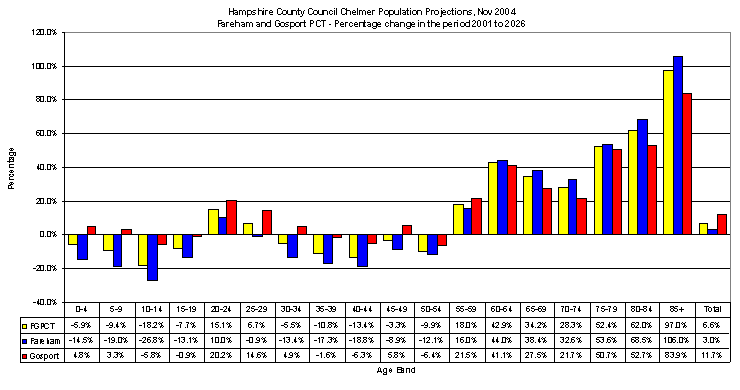
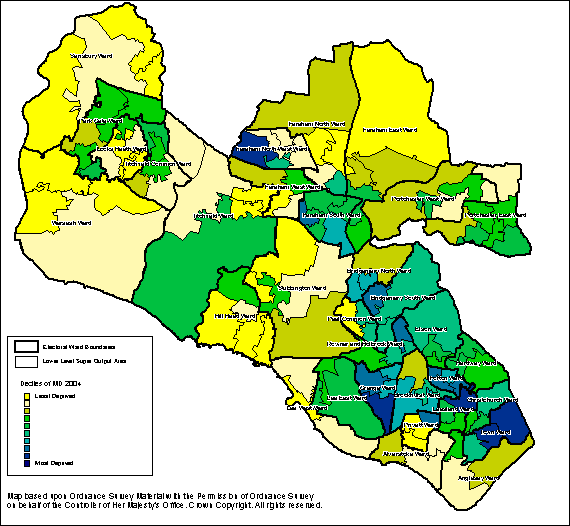
The Indices if Multiple Deprivation 2004 were released for geographical areas known as `Super Output Areas' (SOAs). These are a new geography developed by the Office for National Statistics in order to provide a more stable geography over time than electoral wards. The indices have been released for the lowest level SOAs, which have a target population of 1,500 and which nest within the 2001 ward boundaries. There are 32,482 SOAs in England.
Annex C
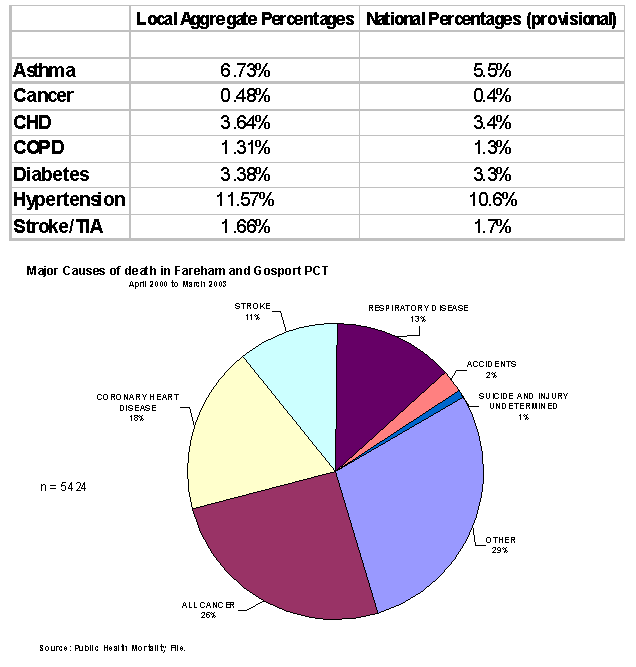 Percentage Disease Prevalence
aggregated from four local Practices