
Archived decisions
Hampshire Fire and Rescue Authority Item 15
9 February 2005 Integrated Risk Management Plan 2005/6 Report of the Chief Officer |
Contact: Chief Officer - John Bonney Telephone: 023 80 626830 |
1 |
Summary | |||
This report explains the development and contents of the Authority's second Integrated Risk Management Plan (IRMP). The report details how the organisation is seeking to embed the IRMP into the wider Corporate Plan. | ||||
2 |
Recommendation | |||
That the Authority approves the draft IRMP and authorises the Chief Officer, in consultation with the Chairman, to incorporate in the final document any further feedback from the consultation process and any necessary revisions following an Equalities Impact Assessment of the Plan. | ||||
3 |
Introduction | |||
3.1 |
The government expectation on Fire Authorities, as detailed in the National Framework 2004/5, requires that every Fire Authority produces an Integrated Risk Management Plan and annual action plan. The plan needs to not only have surveyed and quantified the risks in the county, but also determine how we will set about reducing those risks. Specifically the IRMP must address: | |||
3.1.1 |
reducing the number and severity of fires, and in collaboration with other agencies, road traffic accidents and other emergency incidents occurring in the area for which it is responsible; | |||
3.1.2 |
reducing the severity of injuries in fires, road traffic accidents and other emergency incidents; | |||
3.1.3 |
reducing the commercial, economic and social impact of fires and other emergency incidents; | |||
3.1.4 |
safeguarding the environment and heritage (both built and natural); and | |||
3.1.5 |
providing value for money. | |||
3.2 |
A component part of the IRMP is an annual action plan of the Authority's intentions. Given that the annual action plan inevitably details how the Authority will use its resources differently, there is a requirement to undertake an exercise with both public, staff and other key stakeholders. The results of the feedback to date are laid out in Appendix A. | |||
3.3 |
This year's IRMP continues the themes of last year, separating the plan into three main planks of Protecting, Preventing and Responding. This year, however, these three main elements are supported by a section on Resourcing as clearly the delivery of the IRMP cannot take place without the necessary Financial, Human and Information and Communication resources. | |||
4 |
Incorporating the IRMP into the Corporate Plan | |||
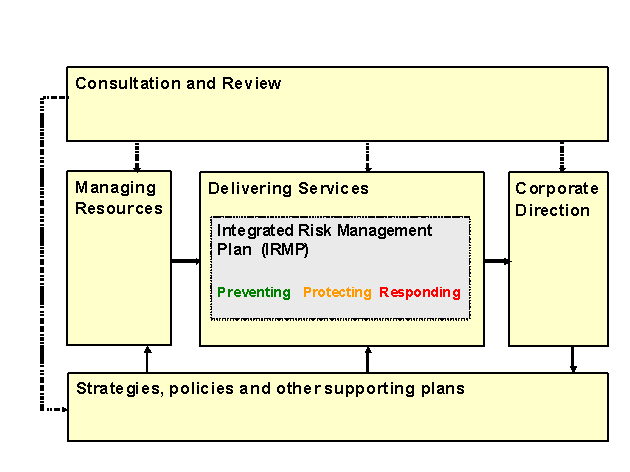
4.1 |
In many ways the IRMP, in defining the way we address risk and service delivery, naturally forms the central core of what we are here to do. As such, whilst the Corporate Plan may incorporate a wider range of policies and activities, a central component will be our intention to prevent, protect and respond to identified risk. Previous committee reports on Restructuring the Corporate Plan have highlighted this central role (15 September 2004 - /decisions/decisions-docs/040915-fireau-R0914100143) | |||
4.2 |
Appendix B illustrates how the IRMP is located in the overall corporate planning process. | |||
4.3 |
By doing this, not only do we reduce the number of separate plans created by the Authority, but we also ensure that the IRMP remains constantly updated and an integrated component of our planning process. | |||
5 |
Progress in Implementing IRMP 2004/5 | |||
The Authority's first IRMP commenced on 1 April 2004 (see report dated 11 February 2004) and the detail of progress can be accessed at http://www.hantsfire.gov.uk/manage/irmp/index.html. However, for members' information, a number of key milestones have been achieved. | ||||
Preventing | ||||
5.1 |
We have commenced the training of Community Wardens to assist them identify arson reduction initiatives and initiate Home Fire Safety Check referrals. | |||
5.2 |
We have completed a project, working with the Police to rationalise arson statistics. | |||
5.3 |
We have increased our rate of Home Fire Safety checks. | |||
5.4 |
We have commenced pilots to involve retained staff in delivering Home Fire Safety checks. | |||
5.5 |
We have increased the size of our Schools Education Team and we are achieving more visits to schools. | |||
5.6 |
We have commenced a pilot youth initiative to reduce arson and anti-social behaviour. | |||
Protecting | ||||
5.7 |
We have introduced a risk based inspection programme and audit process. | |||
5.8 |
We have seconded a Fire Safety Inspector to HCC to assist with the identification of premises suitable for the installation of sprinklers and other risk reduction solutions. | |||
Responding | ||||
5.9 |
We have completed our trials of providing alternative emergency cover arrangements at Winchester and Havant utilising a fire appliance and crew from Redbridge Hill and Cosham respectively. | |||
5.10 |
We have gained planning permission for a temporary building to be placed at Popley Community centre and we are on target to commence our pilot scheme to provide emergency cover in the North End Basingstoke area relative to the risk profile for the area. | |||
5.11 |
We now mobilise to the re-classification of calls on `emergency' or `non-emergency' basis. | |||
5.12 |
We have reduced the number of vehicle movement to unwanted calls from Automatic Fire Detection (AFT) systems. | |||
5.13 |
We have established an Urban Search and Rescue (USAR) Team to respond to incidents locally and nationally. | |||
5.14 |
We have established 3 co-responder teams in conjunction with the Hampshire Ambulance Service, operating from our Romsey, New Milton and Bordon stations. We have also commenced the creation of 4 further schemes from identified fire stations. | |||
5.15 |
We have completed a review of the crewing and use of our `special' appliances. | |||
5.16 |
We have completed a call profile for all of our fire stations. | |||
6 |
Key Elements of IRMP 2 | |||
6.1 |
A major component of the first IRMP was to improve our understanding of the county's risk profile and to improve our intelligence in relation to changing risk trends and patterns. As we see the IRMP as an evolving process, much of the improvements in risk intelligence has informed the Authority's second IRMP. A draft copy is attached as Appendix C for members of the Authority only. A copy of IRMP will be available on the website in due course. | |||
6.2 |
For members' information a number of key issues are worthy of note. | |||
6.2.1 |
Our aim is every home will have a home safety visit by 2010. | |||
6.2.2 |
Our aim is for every pupil to be educated in fire safety by Key Stage 3. | |||
6.2.3 |
Our aim is that every household in Hampshire will have at least one smoke detector by 2010. | |||
6.2.4 |
Hoax calls are a crime and divert resources from real emergencies. In partnership with the Police, we aim to reduce these by 5% by 2008. | |||
6.2.5 |
False calls from automatic detection systems have the same impact on our resources as malicious calls. Working with property owners and users, we will seek to drive these down by 10% by 2010. | |||
6.2.6 |
We will offer fire safety protection advice to building developers, owners and users, but will also take action to enforce compliance with regulations when necessary. | |||
6.2.7 |
Our target is to attend all emergency calls within eight minutes on 80% of occasions (8/80). | |||
6.2.8 |
In partnership with Hampshire Ambulance Service, we aim for our personnel to be available as co-responders to attend medical emergencies. by the end of 2005 we will have three schemes running in New Milton, Romsey and Bordon. | |||
7 |
Contribution to Corporate Aims, Objectives and Key Tasks | |||
As previously explained, the IRMP is an intrinsic part of the Corporate Plan and as such, directly underpins the Corporate Aims. This is deliberately aligned to national targets and therefore our IRMP contributes directly to our own Corporate Aims and those of the National Public Service Agreement. The corporate objectives are themselves drawn directly from the preventing, protecting and responding elements of the IRMP. | ||||
8 |
Resource Implications | |||
8.1 |
The IRMP has significant resource implications which are described in more detail in the Resourcing element of the draft plan. It has impact for human resources in terms of working patterns and more flexible use of people. In terms of data gathering and risk analysis, there is already a major ICT project on developing a new risk database. From a financial perspective, it is intended that the initiatives within the IRMP will be met within existing resources but as articulated in key aims, resources will be transferred between the three functions of preventing, protecting and responding. | |||
8.2 |
If the Popley Fields trial is deemed a success, there is a major physical resource implication in that an intended capital project to built a second traditional type fire station in Basingstoke would be abandoned. | |||
9 |
Equality Impact Assessment | |||
The significance of the IRMP to the service we offer to the public means there is clearly a requirement to undertake an Equality Impact Assessment under the Race Relations (Amendment) Act. The purpose of this is to ensure our policies: | ||||
- |
Eliminate any unlawful discrimination | |||
- |
Promote equality of opportunity | |||
- |
Promote good race relations | |||
By ensuring we pass these tests, the document and the actions we intend to undertake will be more accessible to the whole community. The final plan will therefore be formally impact assessed before being finally published. | ||||
10 |
Risk Analysis | |||
10.1 |
Failure to produce a comprehensive IRMP can represent a significant risk for the Authority, both in terms of its ability to deliver a coherent service to the public and drive down risk in the community it serves. It would also amount to a failure in its statutory duty which would lead to government intervention and have a significant adverse impact on our reputation and inevitably lead to a poor CPA score. This latter point is also likely to affect future funding opportunities for the Authority. Therefore, overall failure to produce and deliver an IRMP would represent a significant threat to the Authority. | |||
10.2 |
At present, as we have an IRMP it is not included on the Risk Register - but would need to be if a revised IRMP is not in place by 31 March 2005. | |||
11 |
European Convention on Human Rights and the Human Rights Act 1998 | |||
The proposals within this report are considered compatible with the provisions of the European Convention on Human Rights, the Human Rights Act 1998, and the Race Relations (Amendment) Act 2000. | ||||
Section 100D - Local Government Act 1972 - Background Papers The following documents disclose the facts or matters on which this report, or an important part of it, is based and has been relied upon to a material extent in the preparation of the report. The Fire and Rescue National Framework 2004/05 The Fire and Rescue National Framework 2005/06 Note: The list excludes: (1) Published works (2) Documents that disclose exempt or confidential information as defined in the Act |
cemC/H/HFRA 9 2 05 IRMP 05-06 13 January 2005 - Updated 1/2//05
Appendices:
Appendix A - Feedback from Consultation - attached
Appendix B - Incorporating the IRMP into the Corporate Plan - attached
Appendix C - A draft copy is attached for Members of the Authority only.
Note: A copy of IRMP will be available on the website in due course.
HAMPSHIRE FIRE AND RESCUE AUTHORITY
APPENDIX A
Feedback from Consultation |
PREVENTING |
Working with Others |
There is broad consensus that preventing emergencies is more preferable to responding to them and that the Service has a key role in this. It is, however, accepted that the Fire Service, and particularly firefighters, cannot do this alone and we need to work with others to achieve our aim. |
Focusing on Target Groups |
Given there is much to do, all stakeholders felt there is a need to target those groups most at risk, particularly the elderly. Here many felt the greatest success would be achieved by focusing on visiting the elderly in their own homes, either directly, or by training carers who regularly visit this group. Similarly, in relation to arson, the feedback is we cannot do this alone. The Police are a key player and we need to work with them to promote the serious social impact of all types of arson. |
PROTECTING |
Home Safety Checks |
All stakeholders supported the target to ensure every house in the county is provided with a free home safety check and have smoke alarms fitted. Staff particularly felt this was a challenging target. We will have to work flexibly and `smarter' if we achieve this without distracting from other core business such as training. |
Preserving Response Standards |
Some staff felt that `preventing and protecting' activities should not be at the expense of our excellent response record. The public and business felt this could be best achieved by using our people and resources more innovatively. |
Transferring Resources |
The transfer of 2% of resources into preventing activities was broadly welcomed, although some felt the target is not challenging enough. Staff were concerned that the transfer should not be an excuse for overall cuts in service. |
RESPONDING |
08/80 Target |
Our commitment to responding to 80% of all emergencies whenever they occur within 8 minutes is felt to be good, but we should not be complacent once we have achieved it. The message was that we must consistently strive to improve this. There was also confusion about what the target means and some felt it would mean resources moving from urban to rural areas - we need to work hard to explain this is an overall average not a stand alone figure for each response to an emergency. |
Trials at Havant, Winchester and Popley Basingstoke |
All groups felt there is considerable benefit in conducting the trials at Havant, Winchester and Popley (Basingstoke) before making any long term changes. Whilst staff are concerned about how these changes might affect their pay and conditions, the public feel there is a need to experiment with new ways of working where we use our resources flexibly. |
Reduced Response to Automatic Fire Alarms |
Similarly, our approach to a reduced attendance to Automatic Fire Alarms is broadly supported, even amongst the business community who feel owners should take much more responsibility for reducing unnecessary alarms. Separating out emergency and non emergency calls is also felt to be sensible, not least because of the added hazards caused by a blue light response. All groups thought there needed to be careful monitoring of this and where there is any doubt, a full emergency response needs to be made. |
Co-Responder Scheme |
Using our resources to mount a first response to specific medical emergencies in support of the ambulance service (co-responder scheme) was positively supported by all groups. Staff particularly were concerned that in providing the scheme we should take care not to become a substitute for the ambulance service or compromise our other emergency responses. |
HFRA 9 2 05 IRMP 05-06
HAMPSHIRE FIRE AND RESCUE AUTHORITY
APPENDIX B
Incorporating the IRMP into the Corporate Plan
HFRA 9 2 05 IRMP 05-06