
Archived decisions

The Hampshire
Supporting People Strategy
2005 - 2010
DRAFT for CONSULTATION

Contents
Section ONE Introduction
Structure of the Five Year Strategy
Consultation on the Strategy
Executive Summary
Section TWO Progress since Shadow Strategy
Section THREE Partnership and Communications
The Decision Making Process
Communications
Service User Involvement
Links with the Wider Agenda
Section FOURPolicy and Prevention Framework
Hampshire Supporting People Policy Framework
Section FIVEData Analysis
Analysis of
Supply of Services
Analysis of SP Spend
Needs Analysis
Section SIX The Commissioning Process
Prioritising New Services
Section SEVEN Service Monitoring and Reviews
Section EIGHT Planning
Five Year Plan
Annual Plan ( and Prevention Statements )
Financial Planning
Risk and Contingency Planning
Cross Authority Statement
Appendices Appendix A: Pipeline Services
Appendix B: Progress against Objectives
Appendix C: Decision Making Structure
Appendix D: Communications Structure
Appendix E : Involving Service Users
Appendix F : HCC Community Strategy
Appendix G: Supply Analysis
Appendix H: Chart-Capacity under 1000
Appendix I : Small Providers
Appendix J: Prevention Services Grids
Appendix K: South East Regional Quartiles
Appendix L: Steady State Contracts
Appendix M: Strategic Review Process
Appendix N: Risk Register
Appendix O: Demographics
Appendix P: Consultation Programme
Appendix Q: References
Glossary
Consultation
1.2 Consultation on the Five Year Strategy 77
1.3 Structure of the Five Year Strategy 88
Consultation - Section ONE 1010
Section TWO: PROGRESS TO DATE 1111
2.3 Development of County Home Improvement Agencies 1212
Consultation - Section TWO 1212
Section THREE: PARTNERSHIPS AND COMMUNICATION 1313
3.2 The Decision Making Process 1414
3.3 Decision Making Groups 1414
3.4 Review Of Decision Making Structures 1515
3.6 Involving Service Users 1616
3.7 Links with the Wider Agenda 1818
3.9 SP Links To The Hampshire Community Strategy 2121
Consultation - Section THREE 2222
Section FOUR: POLICY AND PREVENTION 2323
4.2 Hampshire Supporting People Policy Framework 2323
4.3 Prevention Statements 2525
Consultation - Section FOUR 3030
Section FIVE : DATA ANALYSIS 3131
5.1 Analysis of Supply of Services 3131
5.2 Distribution of Hampshire Spending by District 3535
5.3 The Cross Authority Picture 3737
5.5 Changing Pattern of Provision 3838
5.7 Prevention Services Grids' (PSGs)' 3939
Consultation - Section FIVE 4040
Section SIX: The Commissioning Process 4141
6.1 Prioritising New Services 4141
6.2 Client Group Supply and Needs Statements 4343
F. Physical Disabilities and Sensory Loss 50515051
H. Women Fleeing Domestic Violence 52535253
Consultation - Section SIX 55565556
Section SEVEN: MONITORING AND REVIEWS 56575657
Summary of Section SEVEN 56575657
7.2 Service Review Methodology 57585758
7.3 Service Review Process 58595859
7.5 Achieving Measurable Outcomes 58595859
Consultation - Section SEVEN 60616061
Section EIGHT: FIVE YEAR DEVELOPMENT PLAN 61626162
Summary of Section EIGHT 61626162
8.1 Overarching Objectives 2005 - 2010 62636263
8.2 Annual Development Plan 2005-2006 68696869
8.3 Financial Planning 70717071
8.4 Risk And Contingency Planning 71727172
8.5 Cross Authority Statement 72737273
Consultation - Section EIGHT 77787778
APPENDIX A: Pipeline Services 79807980
Appendix B: Progress against objectives since 2003 80818081
Appendix C: Decision Making Structure 81828182
Appendix D: County Level Communications and Partnership Structure 82838283
Appendix E: Service Users - Three Levels of Communications 83848384
Appendix F: Hampshire Community Strategy (Extract) 85868586
Appendix G: Supply Analysis 86878687
Appendix H: Capacity By Service User Group where Capacity is under 1000 Units 100101100101
Appendix I: Definition of a Small Provider 101102101102
Appendix J: Preventative Services Grid - County Overview 102103102103
APPENDIX K: South East Regional Quartile Range 108109108109
Appendix L: Steady State Contracts 109110109110
APPENDIX M: Strategic Reviews - `A 12 Step Process' 110111110111
APPENDIX N: RISK REGISTER 119120119120
Appendix O: Hampshire's Population 125127125127
Appendix P: Record of Consultation 131133131133
Appendix Q: References 132134132134
GLOSSARY OF TERMS 133135133135
Section ONE: INTRODUCTION
In this section we: · Introduce the strategy and described its structure. · Detail the consultation process undertaken in the development of the strategy. · Present the executive summary of the document as a whole, emphasising the preventative nature of the programme. · Outline over arching objectives for the Five Year Strategy. |
This is the second Supporting People Strategy; the first, the "Shadow Strategy" having been agreed two years ago. The Supporting People Team want this strategy to make a real difference to the direction of the programme and the network of services available to service users.
Supporting People funds, low level housing related support. It is our intention that the programme will help as many people in Hampshire as possible through targeted, cost effective services.
The Team will be conducting in depth strategic reviews of all sectors in all areas throughout the life of this strategy. These reviews will then guide investment, remodelling, commissioning and decommissioning.
The first year of Supporting People has been fraught with budgetary difficulties, particularly in Hampshire, but we hope for a more stable situation to ensure that the exciting potential of the programme can be made real.
1.2 Consultation on the Five Year Strategy
This strategy contains different sections which have been developed through consultation processes and timetables however they have all been discussed at District Core Groups, District Inclusive Forums and the County Inclusive Forum.
The strategy as a whole has been the subject of extensive consultation between December 2004 and mid February 2005. Consultation questions have been posed at the end of each section of the strategy and listed together in a separate appendix at the end of the document. The final document has been agreed by the overall Commissioning Body and the County Core Group.
1.3 Structure of the Five Year Strategy
The Five Year Strategy begins with an Executive Summary briefly outlining the Supporting People policy, the emphasis on preventative services, and eight principal overall objectives for the next five years.
Section Two describes the progress since Hampshire agreed the Supporting People Shadow Strategy for 2003-4.
Section Three describes in some detail the Supporting People decision making process, which can be particularly complex in two tier local authority areas such as Hampshire. The different groups and agencies and their roles are defined. This section lists all of the strategies that Supporting People must link in with at the national, regional, county, district and primary care trust levels.
Section Four moves on to the policy and strategic direction that will drive the Supporting People programme over the next five years. It defines the policy and strategic review process that will be the basis for ensuring that Supporting People funding is targeted at the priorities and strategies of the partner agencies. This section also contains the Hampshire Supporting People Policy Framework.
Section Five concentrates on data analysis, looking at :
· The supply of services
· The annual spend by service user group
· Service capacity by service user group
· The provision of accommodation and non-accommodation based services.
· The distribution of Supporting People spending by District Council
· A profile of service provider types.
Section Five also summarises the work that has been carried out on gap analysis, looking at the Prevention Services Grids, needs analysis and also at the results of the Pathways needs research in Hampshire.
Section Six includes a description of how potential new services will be prioritised in the first year. It also contains Client Group needs statements, and a re-prioritisation of the existing unfunded priorities, which was identified in the Shadow Strategy.
Section Seven contains an analysis of the service monitoring and review process. The review process is explained and progress to date is outlined. The section also sets out the way in which Hampshire Supporting People (SP) tackles issues arising from reviews, through the setting of objectives, timescales and ongoing monitoring. The future of the review process in the light of the introduction of strategic reviews is mapped out.
Section Eight deals with Hampshire's plans for the future. Headline objectives for the next five years are set and more detailed plans and shorter term objectives for the next 12 to 18 months are specified. The section sets out the financial methodology adopted, the way in which SP aims to control the budget and the approach to risk and contingency planning. Section Eight also contains the Cross Authority Statement and an assessment of the issues faced.
This first Five Year Strategy has been developed in consultation with SP partners; Hampshire County Council Social Services, Health, Probation, Housing, Providers, Service Users and other stakeholders. The strategy will be reviewed and updated annually.
The aims of the strategy are:
· To assess the current status of the programme
· To guide the development of the programme from 2005 - 2010
· To ensure service provision meets evidenced needs
· To guide those involved in the provision of housing related support when devising their own strategies.
The ODPM have produced the following definition of the SP Programme:
The Supporting People programme offers vulnerable people the opportunity to improve their quality of life by providing a stable environment which enables greater independence
It will deliver high quality and strategically planned housing-related services which are cost effective and reliable, and complement existing care services. The planning and development of services will be needs led. Supporting People is a working partnership of local government, Service Users and support agencies
Hampshire SP Policy and Prevention
Hampshire's Commissioning Body has adopted a `Policy Framework' following extensive consultation with partners, stakeholders and Service Users which clearly set out the nature and strategic direction of the programme within the County.
In addition to the Policy Framework, `Prevention Statements' have been agreed. These apply the principles of the `Policy Framework' to different service user groups within the programme.
Based upon these statements, strategic reviews of services within each Client Group will be undertaken, followed by service reviews which serve to implement the results of the strategic review.
What is a Prevention Statement?
Each service user group statement defines an agreed set of expectations on behalf of all partner agencies for SP funding, emphasising the potential benefits that the programme can have for each agency and their Service Users. SP expects all services to demonstrate that their work will contribute to the Prevention Statement. In this way SP will ensure that Service Users and Partner Agencies are best served by the efficient and effective use of resources
Objectives for the Five Year Strategy
Tasks for the immediate and long term future are set out in detail within the strategy. In brief, the following objectives have been identified for the next five years :
Objective |
Detail |
1 |
Implement the revised service and strategic review process |
2 |
Improve awareness of and access to SP services |
3 |
Implement Communications and Partnership Strategy |
4 |
Undertake research into the needs of BME groups |
5 |
Link in with capital funding sources : · Regional Housing Board · Housing Corporation · Registered Social Landlords |
6 |
In partnership with Portsmouth, Southampton and Isle of Wight adopt a cross authority approach to services of mutual concern |
7 |
Undertake a strategic review of Home Improvement Agencies to identify the best model for delivery of this service |
8 |
Review legal framework for decision making processes between the AA and CCG |
| 1. Is the structure of the document clear and accessible ? 2. Has the consultation carried out been inclusive of all interested parties ? 3. Are the overarching objectives specific measurable accurate realistic and timely (SMART) ? 4. Are there additional objectives we need to consider / include ? |
Section TWO: PROGRESS TO DATE
In this section we: · Detail areas that progress has been made since the agreements of the SP strategy for 2003-4 · Discuss the allocation of funding for pipeline services before the implementation of Supporting People and refer to the appendix which details the twenty three new services that were funded · Describe the development of the strategy for the delivery of home improvement agencies at a county level reflecting the commissioning of a new agency for three districts in Hampshire, thereby ensuring county wide provision |
Following the implementation period, the SP programme went live on 1 April 2003. Core tasks since implementation include :
·Successful implementation of a three year programme of service reviews by April 2006
· Management of a cash limited budget
· Delivery of a monthly payment schedule for over 800 services / 19,000 Service Users
· Performance and quality monitoring of all SP contracted services
· Maintenance and development of the consultative and decision making processes at District and County level
· Development of an hours based contract allowing Providers a greater flexibility of delivery
· In partnership with the CAB, SP ensures that no eligible Service Users are excluded from eligibility for SP funding
Changes in the SP workload since going live have required a more centralised working pattern than was previously in place. The challenge has been to retain valued district relationships and facilitate a consistent approach to reviews. This has been successfully achieved by retaining the role of the district coordinator and the appointment of a centrally based Review Support Team consisting of a County Review Coordinator and four Project Officers. Regular progress meetings are held and clearly defined targets set. To support Providers with the administrative burden of SP, training events have been held around the County. The positive contribution of local Providers is recognised and appreciated.
The review programme commenced in April 2003 following a timetable prepared upon a risk basis and all scheduled Year One service reviews have been carried out. A revised hours-based contract has been introduced following extensive consultation.
Hampshire was successful in securing the country's largest allocation of pipeline funding from ODPM (£1,402,451.00). This additional resource provided funding for 23 new services, all of which fell within the categories identified in the National and County Steers. New services include those for women fleeing domestic violence, single homeless people with support needs, people with mental health problems and older mentally infirm people, in all providing support to an additional 200 individuals.
For details of these services see Appendix A
2.3 Development of County Home Improvement Agencies
Significant progress has been made since 1991/ 92 when Hampshire began funding Home Improvement Agencies (HIAs).
In line with the ODPM drive to ensure that full geographical coverage of HIA agencies is achieved by 2006, Hampshire SP submitted a bid for funding to provide additional HIA services in Winchester and Test Valley, those areas not previously covered. The bid was successful and the additional funding provided the opportunity for SP, SSD and the districts to work in partnership to issue a tender for the proposed new service. A consortium of local Providers was successful in tendering and a joint contract has been awarded to provide an HIA service covering Winchester, Test Valley and East Hants.
All strategic partners are signatories to the new contract.
Between now and the expiry of the contracts all parties will take part in a strategic review to look at how best to provide HIA services in the future.
For progress against the Shadow Strategy Objectives see Appendix B
· Are you aware of any developments or new services that have not been listed in this section ? · Do you have any suggestions to contribute to the further development of HIA's and handyperson services in Hampshire ? |
Section THREE: PARTNERSHIPS AND COMMUNICATION
In this section we: · Review the legal basis for partnership working between the Commissioning Body and the Administering Authority, in particular, the `Memorandum of Understanding'. · With the aid of a flow chart, we describe the Supporting People decision making process at the County and District levels. · Provide a definition of the groups involved in the decision making process. · Outline the policy on ensuring effective communications between the various groups and agencies. · SURG is the lead Service User body for Supporting People in Hampshire · Consultation with Service Users is targeted at three levels, Strategic, Service and Personal. · All key SP Policy documents are `SURG Approved'. · The review timetable allows targeted consultation by SP Team and SURG. · Detail the links that need to be made with relevant strategies at national and local levels. · Provide additional information on linking with capital funding and the Hampshire Community Strategy. |
The introduction of the SP programme represented a major change in the funding of housing related support services. Statutory bodies, Providers and Service Users assisted with the implementation and now work in partnership to ensure the delivery of an effective programme of support services.
Memorandum of Understanding
Partnership working lies at the heart of the programme. Decisions on funding are made by the inter agency County Core Group (CCG), (the Commissioning Body), with Hampshire County Council as the Administering Authority (AA).
Administering Authorities (AA's) are required by Direction 4 of the Supporting People Directions and Grant Conditions to approve a `Memorandum of Understanding' (MoU) which defines the relationship between the AA and CCG. This document must be formally accepted by the CCG.
As an `Excellent Authority', Hampshire is not required to abide by ODPM Grant Conditions, however a MoU has been adopted within the County under the terms of which it has been agreed that:
· The CB and AA will comply with the Directions and Grant Conditions as above, except where any variation is agreed by the CB and AA and is permissible under Central Government Regulations.
· The AA will comply with Grant Conditions issued by the Government when administering the Supporting People Grant.
3.2 The Decision Making Process
In Hampshire the Supporting People programme is overseen by the County Core Group and County Inclusive Forum. All decisions must be agreed by the four statutory partners:
· District and Borough Councils
· Hampshire County Council
· Probation
· Health
A "bottom up" decision making process though District Core Groups and Inclusive Forums has been adopted. See Appendix C
District Inclusive Forum (DIF)
Meeting a minimum of twice yearly, this group brings together representatives of Providers and the statutory sector and acts as a consultative forum for the development of policy and proposals. Sub-groups may be commissioned on a task and finish basis.
District Core Group (DCG)
Meeting a minimum of four times a year, this group forms the local commissioning body, bringing together representatives from the statutory sector of Housing, Social Services, Health and Probation. In some districts the provider sector is represented by ROCC ensuring a wide breadth of experience is brought to bear in discussion and planning.
The group oversees the development and delivery of SP on a local basis, receives review reports and identifies local priorities.
District Core Groups have been meeting regularly since 2001 and have taken the lead in driving the Supporting People process, setting out work priorities, evaluating processes and overseeing the work of the Inclusive Forum and associated sub-groups.
County Inclusive Forum (CIF)
Chaired by ROCC, the CIF comprises representatives from each local inclusive forum in Hampshire and is charged with ensuring that the needs of all Client Group s are met on a Hampshire-wide basis, especially where demand may be insufficient within one authorities' area. Meeting quarterly, the group provides a forum where Providers may raise issues of concern and are consulted on the development of Hampshire wide policies and proposals including matters referred to the CCG. Additional meetings may be held as required to discuss particular concerns.
County Core Group (CCG)
Meeting quarterly this group comprises representatives from each District or Borough Council, The County Council, Health and Probation and has ultimate responsibility for agreeing the Hampshire-wide SP policy, strategy and implementation.
Cross Authority Group (CAG)
Chaired by ROCC, the Cross Authority Group consists of Hampshire, Portsmouth, Southampton and the Isle Of Wight. A primary concern of the CAG is to address issues of common concern. For more information please refer to Section Eight.
3.4 Review Of Decision Making Structures
These constitutional arrangements have now been in place for some three years and have guided the `live' programme since April 2003. It is therefore appropriate to reassess their effectiveness in tackling the issues which have arisen in administering the programme to date.
The County Council Legal Services Department is reviewing the effectiveness and constitution of these structures. It is anticipated that a report will be submitted to the County Core Group in March 2005.
Following completion of the Year One activities and reviews an updated co-ordinated Communication Strategy was required to ensure efficient information sharing with all partner agencies and interest groups. An updated structure has therefore been developed incorporating three levels of communication which are outlined below. See Appendix D
Level One sets out the communications structure proposed with strategic partners, Health, Housing, Probation and Social Services.
Level Two sets out the communications structure proposed for stakeholders including ROCC, the Provider Reference Group and SURG which together represent a variety of interested parties.
· ROCC is a charitable organisation which supports Providers and other interested agencies in implementing Supporting People and represents their interests. Under Level Two of the Communications Strategy ROCC will be made aware of issues within the programme as they emerge.
· The Provider Reference Group meets quarterly to discuss topical issues relating to operational matters, particularly relating to the review process and contracting. Current membership consists of a representative cross section of SP Providers but all are welcome to attend.
· Service User Reference Group (SURG): Chaired by ROCC, this body meets on a bi-monthly basis and focuses on consulting and developing Supporting People policy issues. SURG is the key strategic body for overseeing Service User involvement processes in Hampshire. Membership is limited to 10 users of SP contracted services at any one time with every effort made to ensure that it is representative of all districts and SP Client Groups. A member of SURG reports to the quarterly County Core Group meetings giving Service Users an opportunity to express an opinion, in particular giving advice on policy development, consultation methods, and the quality of SP services.
A key role for SURG members is to learn about important SP issues, such as the review process and the commissioning of new services. Members then consult with their peers feeding back the results to the next meeting and agreeing a policy or process proposal.
The consultation may be with a tenant group, or those in a shared home, direct consultation with street homeless, to an established user or via a wider survey. The key to SURG working effectively is in maintaining a consistent membership throughout a year. This ensures members develop a good understanding of SP and the current key issues.
Meetings are split into 2 half day sessions; morning sessions normally include a presentation on a key policy issue (e.g. involving Service Users in the review process) from a member of the Hampshire SP team. SURG members will then debate the issues and draw up a response which is then taken back to their agreed consultation network and brought back to the following meeting for final drafting. The final document submitted to the CCG has the `SURG Approved' logo inserted across the top.
Training is provided during the second half of the day aimed at developing participation skills such as constructing and giving presentations, minuting or chairing meetings.
SURG achievements 2004
Policy Area |
Approach |
Policy Developed |
CCG Approval |
SP access to service user files |
Consultation and discussion on access and confidentiality of support files. |
Access Policy for SP Teams to Service User Files |
Oct 2004 |
Hampshire SP Policy Framework |
Consultation with peers and discussion on implications of Policy Framework |
SURG approved version agreed in final tier of consultation |
Submitted to December meeting |
Consulting with Service Users in advance of service reviews |
Develop a broad range of approaches to obtain Service Users' views on strategic relevance, quality , performance and value for money of services |
Ongoing development of a policy for the SP Team to implement from April 2005 |
Submitting draft policy to the March 2005 meeting |
Consultation
With a diverse range of Client Groups within the Supporting People Programme, meaningful involvement of Service Users presents a considerable challenge. A `one size fits all' approach cannot be adopted if a broad and robust user involvement programme is to be developed.
The SP approach is to develop policy on consultation at all levels through the Service User Reference Group (SURG) as set out above. All consultation is being undertaken across three key levels: The strategic, service and personal levels. For a detailed description please see Appendix E
Annual Plan: Service User Involvement
Action |
Method |
Target Date |
Resources |
Continue to develop SURG |
Agree funding for 2005/6 |
Feb 2005 |
County Manager |
Apply Policy on including SU's view gathered prior to review |
SURG drafting policy document for CCG agreement |
March 2005 |
SURG, SP Lead Coordinator. |
Develop Process to include SU's in Strategic Reviews |
SURG to develop policy when Strategic review process is published. |
June 2005 |
SURG, SP Lead Coordinator |
Review effectiveness of SURG |
Meeting between SP, ROCC and SURG |
January 2006 |
County Manger, SP Coordinator, ROCC, SURG |
3.7 Links with the Wider Agenda
Supporting People stands alongside and links with government initiatives in the fields of crime reduction, homelessness, social care and health care. In meeting these objectives SP recognises a wide range of linked agendas and strategies which are listed in the table below.
Details on how SP links with them is contained in Section Six which details Client Group strategy statements.
Department of Health |
National Level Strategies and Legislation |
| National Strategies for Mental Health - NSF Joint Investment Plans Drug and Alcohol Strategy National Strategy for Carers Valuing People Teenage Pregnancy Domestic Violence Strategy Initiatives on: _ Building Capacity and Partnership in Care _ Quality and Choice, A Strategic Framework for Older People`s Housing _ National Service Framework for Older Persons _ National Strategy for Sexual Health Three Year Plan : National Targets 1. Public Health Promotion 2. Long Term Managed Care 3. Access to services Maintaining Independence -Engaging with People at Home |
PCT Level |
| Primary Care Local Strategy Locally Based Hospital Unit Strategy Three Year Plan, Local Targets Teenage Pregnancy Local Strategy for Mental Health |
County Level |
| Local Strategy for Mental Health Teenage Pregnancy - Hampshire County Action Plan 2004 - 6 Supported Housing Commissioning Plan Client Group Strategies |
District Level |
Client Group Strategies |
Home Office |
National Level Strategies and Legislation |
| Probation Strategy Domestic Violence Strategy Youth Justice Strategy National Drugs Strategy -Tackling Drugs to build a better Britain 1998-2002 Reducing Re-Offending |
County Level Strategies |
| Wessex Youth Offending Team Strategy 2004-2009 Drug and Alcohol Strategy Domestic Violence Strategy Youth Justice Strategy |
District Level Strategies |
Crime Reduction Strategy |
ODPM |
National Level Strategies and Legislation |
| Homelessness Act 2002 The Homelessness (Priority Need for Accommodation)(England ) Order 2002 Rough Sleepers Initiative National Housing Statement |
Regional Level |
Regional Housing Strategy 2004/5 to 2005/6 |
County Level |
| Hampshire Community Strategy Safer Communities Strategy Hampshire Corporate Strategy |
District Level |
| Community Strategy Community Safety Strategy Housing Strategies Learning Disability Housing Strategy Homelessness Strategies Neighbourhood Renewal Hampshire Drug Action Team Strategic Statement Youth Strategy Local SP Strategies |
Hampshire is to undertake Client Group focused strategic reviews with effect from April 2005. These may result in a decision to remodel the sector or require additional capital resources to fund the commissioning of new accommodation-based services. It is therefore important to retain a link with capital funding.
The principal sources of capital finance are:
· Regional Housing Board
· Housing Corporation
· Registered Social Landlords
Hampshire retains links with the sources of capital funding through the South East Regional Implementation Group (SERIG), The Hampshire and Isle of Wight Local Authorities Group (HIOWLA,) Local District Councils and the Senior Housing Officers Group (SHOG).
The following objectives currently identified by The Regional Housing Board are relevant to SP :
· To reduce homelessness and rough sleeping
· To support crime reduction through housing provision
· To meet the needs of those who require supported housing
· To meet the needs of black and minority ethnic people and asylum seekers
3.9 SP Links To The Hampshire Community Strategy
The Local Government Act 2000 placed a duty on the County to produce a Community Strategy to promote `social, economic and environmental well-being' of the area. Guidance requires that the strategy be prepared and delivered by a Local Strategic Partnership (LSP) involving representatives from the community, public, private and voluntary sector. Hampshire and Isle of Wight Local Authorities (HIOWLA) elected members adopted a framework for developing strategies across the County to include strategies for Districts and a County Strategy.
The Hampshire Strategic Partnership is a multi-sector/multi-organisation partnership established in 2002 as the LSP for the County. With a steering group consisting of over 30 members, it oversees the development and implementation of the County Community Strategy.
HCC has been actively involved in the setting up of eleven LSPs across the Districts and will be a signatory to all Community Strategies. LSPs have been established locally, based upon district boundaries. District level strategies have been produced and links will be established by SP Coordinators with the LSPs where possible.
Key priorities identified within the Hampshire Community Plan relevant to SP are: tackling deprivation, reducing inequalities and improving accessibility. Please see Appendix F
Consultation has been undertaken with the LSP on the SP Policy Framework via the lead officers for the relevant key priorities. SP is working closely with the Community Strategy at a County level and will demonstrate where SP funding is helping to meet County objectives.
| 1. As an excellent authority, should Hampshire retain the current working arrangements between the Commissioning Body and the Administrating Authority, in particular the `Memorandum of Understanding'? 2. Can we improve on the SP decision-making process at the County and District levels? 3. Does the improved communications structure adequately include all the various groups and agencies: is it too onerous ? 4. Can we improve involvement of Service Users? 5. Are the links clear and concise / relevant ? 6. Are there other funding sources we need to explore ? |
Section FOUR: POLICY AND PREVENTION
In this section we: · Present the agreed Policy Framework for Supporting People in Hampshire for 2005-2010. · Describe the role of the Prevention Statements which translate the Policy Framework into Client Group based Action Plans. |
SP interfaces with many agencies, strategies and interests. It is a programme based upon housing related support which contributes to the prevention agendas of Health, Housing, Probation and Social Services.
In order to clearly describe the nature and strategic direction of the programme, Hampshire has adopted the `Hampshire Supporting People Policy Framework'. This will provide a clear direction for the review and commissioning of all services.
The Policy Framework, Prevention Statements, strategic reviews and service reviews are all part of Hampshire's strategic approach to the commissioning of all SP services.
A detailed description of how this will work is contained in Section Eight
4.2 Hampshire Supporting People Policy Framework
This statement has been developed in consultation with strategic partners, Service Providers, Service Users and Elected Members.
Preventative Housing Related Support - A definition
Housing related support services provide short term early intervention that focuses on preventing homelessness and low level long term support, that will enable vulnerable individuals to live independently in their own homes.
Housing related support services are provided to develop, promote and sustain individuals to live independently or to gain access to appropriate accommodation.
The Supporting People Vision
Supporting People aims to implement policies and strategies that will make a real difference to peoples lives, to ensure that all people with support needs have the widest range of housing and support opportunities that can be provided.
Supporting People will give individuals choice to live in their own homes; it will be the responsibility of purchasers and Providers to deliver the required support. In order to achieve this Supporting People will work with strategic partners in Health, Housing, Probation, Social Services, Service Providers, Carers and Users.
Proposals for the expansion of existing services and the establishment of new ones will be developed within the following strategic framework:
a. Service Model - Supporting People will move to become less dependant on accommodation based responses to people's support needs by developing services that work flexibly wherever people choose to live.
b. Tenure - Services will be funded independently of the person's housing so that support can be provided to Service Users irrespective of whether they are tenants or owner-occupiers.
c. Quality - Supporting People will improve the quality of housing support services across the county.
d. Flexibility - Support will be more flexible and able to move with the individual when and where they move
e. Equality of Access to services - Supporting People will seek to provide a comprehensive range of services for all Client Groups wherever they are located within Hampshire.
In order to achieve the above, Hampshire contracts will wherever possible, move from being accommodation-based to being non-accommodation based and will measure capacity in hours of support rather than eligible Service Users. By these two means Service Providers will be able to use resources to the greatest effect.
Supporting People's Preventative Agenda
Supporting People works in partnership with other agencies to deliver part of a broad based preventative agenda. This aims to prevent adverse outcomes for individuals who are passing through points of crisis, change in their lives or require a lower level of support to avoid any crisis that may put their accommodation at risk.
1. Long and Short Term Services
Supporting People funds two distinct and complementary types of housing related support service:
Short term services
A short term service provides responsive housing related support that is outcome focused and measurable for a period of up to two years. The intensity of support is provided at various levels and based on the assessed needs of Service Users. Short term support is designed to assist individuals who are experiencing difficulties within their housing situation, are in transition from one living situation to another, are homeless or at risk of becoming homeless. When a person moves into a new service the intensity of support required is higher than when they have been in a service for two years or more and are generally more settled.
Short term support services are designed to stabilise situations of crisis by providing appropriate levels of support. Such crises may occur more than once in a persons life and in that circumstance support can be made available again.
Short term services assist Service Users in developing the skills needed for independent living and will also aim to meet their broader needs by enabling access to other relevant services.
Long term services
A long term service provides low level housing related support for Service Users over a longer term which is delivered in a planned way. They can complement other services that enable individuals with support, care or other needs to live independently in their own homes.
Long term services provide support to Service Users whose needs are likely to increase over time or have ongoing health or learning difficulties. The range of support provided in long term services is essentially the same as that for short term services but with the focus on the successful maintenance of the individual's housing.
Based on the principles set out in the Policy Framework, a statement specific to each Client Group has been developed. Each of these Client Group Statements will define an agreed set of expectations on behalf of all partner agencies for SP funding, emphasising the potential benefits that the programme can have for each partner agency and their Service Users. They set out clearly the way in which Hampshire services will contribute to the preventative agendas of those Partners
SP expects all services to demonstrate that their work contributes to the Prevention Agenda, ensuring that Service Users and Partner Agencies are best served by the efficient and effective use of resources. Meetings have been held with strategic partners to discuss the approach and each of the Prevention Statements produced to date has been agreed by all Partners. The statements cover:
· Who is SP funding for
· How does SP help meet the priorities of Partner Agencies
· Resources
· Delivering SP services
Based upon these statements SP will aim to deliver high quality and strategically planned low level housing-related services as defined by the CCG. SP funded services will be cost effective and reliable, and compliment existing care services.
All user groups will be reviewed over the period of the Five Year Strategy. (Please see the Five Year Plan.)
To date Prevention Statements have been agreed for the following Client Groups :
A Learning Disabilities
Who Is SP funding for?
Housing related support services commissioned through SP are targeted towards vulnerable people in general, and this includes those with learning disabilities. Valuing People, the Government Strategy for People with Learning Disabilities, identifies over 1.4 million such people nationally. This includes 220,000 people with a severe learning disability and 1,200,000 people with a mild to moderate form of learning disability.
SP funding goes to services for people who need support to maintain their housing situation. The vast majority of people receiving SP services are living in social rented housing, with a minority living in private rented housing or owner occupiers. All are potential SP Service Users. It isn't usual, and generally we would not expect to fund services for people living with able carers in family situations.
SP funding is available to people who have care needs but only to fund the housing related support that they receive to maintain their homes. SP can and will only fund housing related support services for people who have direct housing responsibilities.
How does SP help meet the priorities of the Partner Agencies?
Supporting People services are working to prevent adverse outcomes for people with consequent demands on Health, Housing, Social Services and Probation.
The key objectives of the SP partnership are:
· Reducing the incidence of tenancy breakdown
· Promote more stable lifestyles
· Promote programmes of resettlement
· Reduce the number of crisis admissions to hospital
· Protect the most vulnerable in society from the damage of homelessness
Reduce the demand for more intensive support and care in Hampshire, a key SP objective is to ensure that all Service Users benefit from effective Housing and Support Panels. These Panels ensure that relevant stakeholders work together to bring about the best housing and support outcome for Service Users. They also provide valuable information on unmet need and demand and can help to achieve Valuing People's aspirations to expand choice in housing and support. SP services will assist the strategic housing authority in meeting its obligations and responsibilities to provide appropriate housing options for this Client Group.
Valuing People (VP) identifies that most people with Learning Disabilities live with their families. For many this could be because of the lack of options or opportunities to plan for people to move on. As stated SP does not generally fund people living with their families but funding can be targeted at those who need some form of support to maintain independent living in their own homes.
VP also notes that a persons options can be limited by "a conservatism in the development of housing options for people with Learning Disabilities, with authorities replicating current provisions rather than taking opportunities to broaden the range of housing available". SP seeks to broaden the spectrum of existing service provision available beyond purely accommodation-based services to also include new more flexible models of support. This can help people to access or maintain the most appropriate housing, provide them with more choice and options as to service provision and help ensure support is effectively targeted.
What will SP fund?
SP is a preventative programme. The housing related support services it funds are targeted at helping people avoid having to move into more intensively supported accommodation. In the case of people with learning disabilities, and other Service Users groups within the programme, SP funds low level housing related support to enable vulnerable people to maintain their tenancies, or their own homes if they are owner-occupiers.
Where people pay rent, the rent pays for general housing management. Where people have care needs these are funded through Health and Social Care as part of Community Care or other government funded programmes. People may have a number of other needs such as transport or day services, and there may be a number of activities that would be useful to them, such as numeracy or literacy classes, but these are not housing related support and therefore not within the funding criteria of SP.
Resources
The allocation of SP resources is decided on a strategic basis. This Prevention Statement is not intended to introduce eligibility criteria or a way of either increasing or decreasing the amount of money spent on any Client Group . At the time of the Learning Disability Strategic Review SP will be allocating around £9m or 31% of its budget on LD services. Any strategic change to that figure would be agreed though the County Core Group and not through Prevention Statements.
Delivering Supporting People Services
Supporting People expects all services to demonstrate that their work contributes to the agenda outlined in this statement. In this way we can ensure that Service Users and Partner Agencies are being best served by the efficient and effective use of resources.
B Homelessness
Who is SP Funding for?
Homelessness can affect anyone. SP funding is for those people who find themselves at risk of losing their home, or who have already become homeless, and who have a need for housing related support.
How does SP Help Meet the Priorities of the Partner Agencies?
SP services are working to prevent adverse outcomes for people, and where there may be consequent demands on Health, Housing, Social Services and Probation.
By assisting in the prevention of homelessness SP services will enable Local Health Authorities and services to ensure that the health inequalities that homeless people suffer are addressed. Additionally the provision of SP funded services to homeless people can reduce the need for crisis intervention and the pressure on a range of health services.
SP services assist the Strategic Housing Authority to meet its responsibilities to provide appropriate housing options for homeless people. The Homelessness Act 2002 highlights SP as a principal partner in the development and delivery of locally based preventative housing related support services. SP can develop and deliver a range of services that complement other preventative approaches to homelessness as part of the statutory responsibilities of housing authorities.
Increased homelessness directly leads to a greater burden being placed on Social Services through for example increased relationship breakdowns, child neglect, and deteriorating mental health. SP can assist Social Services Departments in reducing incidents of homelessness amongst their clients. The provision of housing related support services will allow further complementary care services to be delivered.
The provision of stable accommodation has been demonstrated to reduce re-offending rates by 20% (Social Exclusion Unit report "Reducing re-offending by ex-prisoners" July 2002). A third of prisoners lose their accommodation whilst in prison and in many cases are considered "intentionally homeless" by the housing authority. Reducing incidents of re-offending is the key strategic target of the Probation service and Youth Offending Teams at local and national levels. SP services help deliver this.
The key objectives of the SP partnership are:
· Reducing the incidence of tenancy breakdown
· Promote more stable lifestyles
· Promote programmes of resettlement
· Reduce the number of crisis admissions to hospital
· Protect the most vulnerable in society from the damage of homelessness
· Reduce the demand for more intensive support and care
What will SP fund?
SP is a preventative programme that funds preventative support in accommodation and non accommodation based services. SP funding for homeless people is targeted at preventing people losing their home and becoming homeless in the first place, and preventing people from moving into situations of prolonged or repeat homelessness.
SP funds a range of short term housing related support services to meet the particular housing related support needs of Service Users in varying situations.
SP is not involved in the provision of accommodation. Emergency accommodation is the statutory duty of the housing authority for those assessed as being a priority. Access to general needs housing is normally through the local housing register.
Where people pay rent, the rent pays for general housing management. Where people have care needs these are funded through Health and Social Care as part of Community Care or other government funded programmes.
Resources
The allocation of SP resources is decided on a strategic basis, this Prevention Statement is not intended to introduce eligibility criteria or a way of either increasing or decreasing the amount of money spent on any Client Group.
In addition to services focused on the needs of specific Client Groups, SP also funds a range of services that are generic and therefore may or may not be addressing homelessness as their primary purpose but contribute to homelessness prevention.
Delivering Supporting People Services
Supporting People expects all services to demonstrate that their work contributes to the agenda outlined in this statement. All SP services are expected to have clearly identified objectives and means of measuring outcomes. In this way we can ensure that Service Users and Partner Agencies are being best served by the efficient and effective use of resources.
| 1. Do you think the emphasis on prevention is correct? 2. Should there be a different funding structure for long and short term services? 3. Do you agree with the concept of Prevention Statements ? 4. Should we include Prevention Statements for all SP Client Groups within this section ? 5. Is there anything else you would like to see contained within the Prevention Statement ? |
Section FIVE : DATA ANALYSIS
In this section we: · Present an analysis of supply data that is now available to the SP team. · Detail the annual spend according to Client Group. · Detail the capacity of services according to Client Group · Provide a profile of SP service models. · Show the distribution of SP funding according to District Council area. · Address Cross Authority issues. · Profile Service Providers and contracts. · Summarise the conclusions of needs analysis. · Describe the role and function of Prevention Service Grids |
5.1 Analysis of Supply of Services
A detailed analysis of the supply and spend has been undertaken, a full range of tables is to be found at Appendix G. Details include capacity, spend, service type and average weekly cost as at 31 March 2004. The figures shown relate to actual spend for 2003/4. Total spend for the period was £33.28m accounting for services provided to over 19,000 Service Users. The full analysis contained within Appendix G is broken down into accommodation-based and non-accommodation based services.
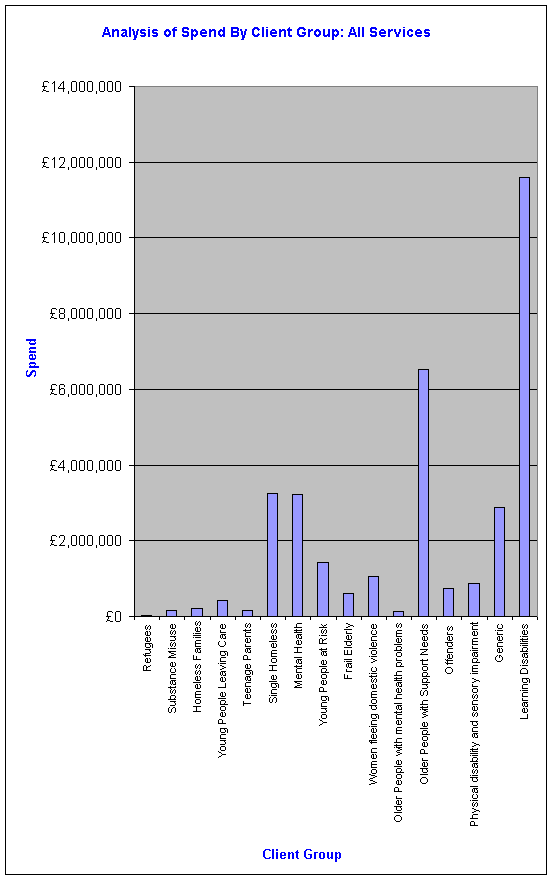
The diagram overleaf indicates the distribution of spending in the period 2003/4 by Primary Client Group as defined by ODPM:
Capacity by Service User Group
The diagram below indicates the capacity in the period 2003/4 by Primary Client Group as defined by ODPM:
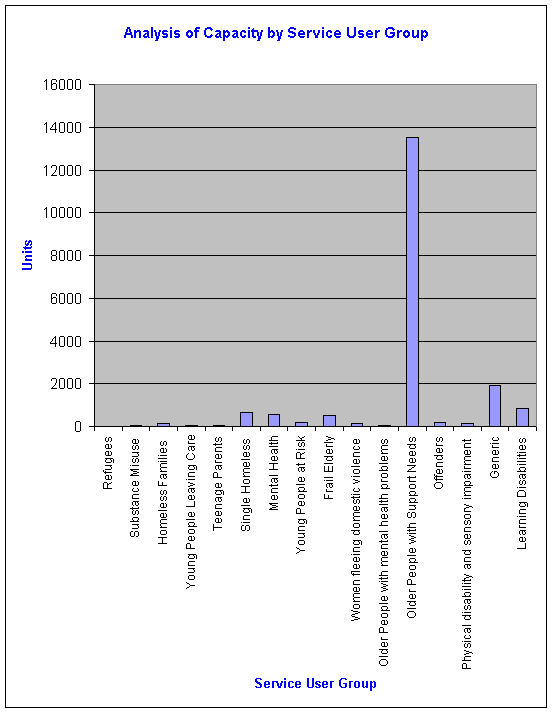
The graph clearly indicates that the majority of provision is for older people with support needs followed by generic services. A second graph has been prepared excluding services for older persons and generic services in order to illustrate the lower capacities relating to other client groups. See Appendix H ( Capacity under 1000 Units)
Service Model Profile
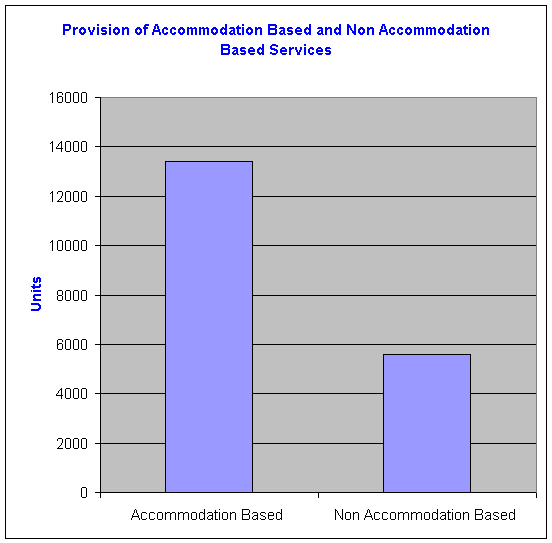
Accommodation-based services represented 79.4 percent (£26.42m) of total County SP spend and 70.6 (13422) percent of total Service Users.
Non-accommodation based services represented 20.6 percent (£6.8m) of total county SP spend and 29.4 (5591) percent of Service Users.
The largest proportion of spend was accounted for by accommodation-based services for People with Learning Disabilities at 31.76 percent (£10.5m) of spend with a Service User base of 3.83 percent (729) of the total number of Service Users.
The category with the largest number of Service Users was accommodation-based services for Older People with Support Needs at 54.44 percent (10350), representing 15.95 percent (£5.3m) of the County SP spend.
Services for Refugees represented both the lowest SP spend and Client Group numbers. Accommodation-based services for this Client Group accounted for 0.04 percent (8) of total Service Users and 0.05 percent (£16k) of total County SP spend.
5.2Distribution of Hampshire Spending by District
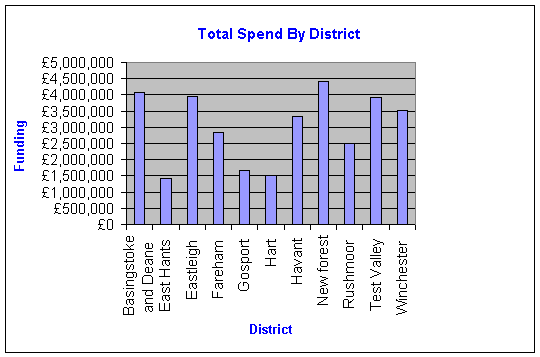
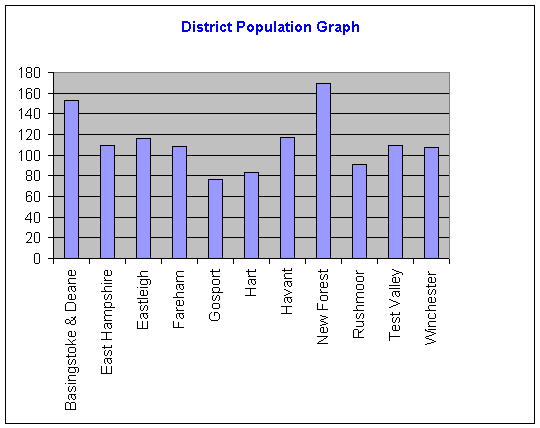
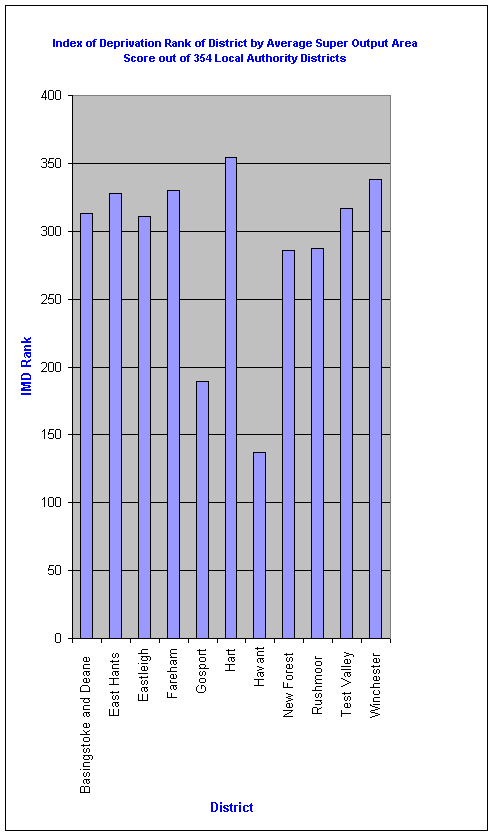
For a full analysis see : Appendix G
5.3 The Cross Authority Picture
Hampshire, along with Portsmouth, Southampton, and the Isle of Wight is a member of the South Central Cross Authority Group (CAG). Matters of concern involving these four authorities are dealt with by the CAG but in the wider context, Cross Authority issues are dealt with bi-laterally with the authority in question. Designated Cross Authority Services include all services for Women Fleeing Domestic Violence and one Offenders service provided by the Langley House Trust.
For more detail on the agreed Cross Authority Statement and an evaluation of the current issues regarding Homeless services refer to Section Eight
Hampshire currently contracts with a total of 142 Providers. The majority of Providers (77.6 %) work with only one Client Group, 9% work 2 Client Groups, 7% with 3 and 6 % with a wider range.
The tables below provide an overview:
Provider Types |
Totals |
Private sector |
47 |
Statutory sector |
11 |
RSL / voluntary sector |
84 |
Spend by Provider Type |
Spend |
Private sector |
£2,183,520.32 |
Statutory sector |
£4,613,632.33 |
RSL / Voluntary sector |
£26,315,091.16 |
Contract Values Range |
Number of contracts in range (Total value of all contracts with Provider) |
Under £10,000 |
26 |
£10,000 - £20,000 |
13 |
£20,000 - £50,000 |
30 |
£50,000 - £100,000 |
19 |
£100,000 - £250,000 |
17 |
£250,000 - £500,000 |
21 |
£500,000 - £1,000,000 |
11 |
£1,000,000 + |
7 |
Small Providers
Hampshire SP wish to ensure that the administrative and monitoring processes imposed on Small Providers take into account the size of the Provider whilst ensuring adequate protection for Service Users and the Administering Authority. A light touch has been adopted in relation to performance monitoring returns and Quality Assessment Forms and service review. A definition has been developed to identify Providers who can be classed as `small'. On the basis of the above it is estimated that 47 Providers of 51 separate services would fall into this category.
See Appendix I
5.5 Changing Pattern of Provision
The picture of provision is largely stable. Minor changes include the withdrawal from SP of two Small Providers whose service was not strategically relevant. Planned changes in the pattern of provision will be implemented through the strategic reviews.
Independent needs analysis research was commissioned by Hampshire SP in January 2004.
Stage One of the project, consisted of a `desktop' review involving collection and review of existing data relating to the housing and support needs of the Client Groups defined by ODPM, supplemented by telephone discussion with the key informants. In April 2004 an interim paper reported on Stage One findings.
Additional more detailed work was subsequently commissioned into four areas of prime concern:
· Homeless Families and Single Homeless People with Support Needs
· People with complex needs, including mental health problems, substance misuse and offenders
· Teenage Parents aged 16 and 17
· Young offenders
These areas were selected on the following basis :
· Results of interim needs research
· Client Groups represented fell within the National and County Steer
· Groups identified were not the subject of statutory responsibility of any other department
· Hampshire supply profile
· The paucity of information on the selected Client Groups
· All Client Groups selected were recognised as priority needs by the Districts.
Stage Two involved primary research; collecting new data and in-house information held by Providers, specialist teams and statutory authorities.
The conclusions reached provided indications relating to the wider picture and were thematic rather than Client Group oriented.
The report established a lack of linkage between the data sets held by various authorities and agencies, lack of aggregated information on housing circumstances and sources of support which together made quantification of needs impossible.
The approach adopted therefore:
· Identified the types of needs not currently being met
· Highlighted the barriers to delivering effective services
· Suggested practical ways forward
Conclusions of Independent Research
No. |
Conclusion |
1 |
There is a need for still further research on gaps in services |
2 |
Despite a recent increase in the provision of generic floating support there is a continued demand for further expansion across several Client Groups |
3 |
There is a need for additional low level housing related support for young offenders and Young People at Risk |
4 |
Lack of housing remains an issue, leading to silt-up |
5 |
There is currently a gap in short term specialist housing support offering 24 hour cover, especially for people with complex needs. |
6 |
Providers are concerned that referrals are made with insufficient information relating to the needs of the prospective service user leading in some cases to difficulties in the placement |
These conclusions will be further explored and addressed appropriately within the strategic reviews.
For full report see: http://www.hants.gov.uk/housingsupport/speople.html
5.7 Prevention Services Grids' (PSGs)'
In examining the supply of SP services throughout the county, `Prevention Services Grids' (PSG's) have been developed to clearly identify the gaps in existing provision. Grids have been completed for each District and have been aggregated to present a County-wide picture. In completing each grid the question being answered is: "Do people in this area have access to the types of service indicated?". See Appendix J
The completed grid identifies gaps in service provision indicating where new services may be required or commissioned over the next five years. Evidence of demand opportunity, viability, value for money and compliance with policy directives will be required to support any development proposal. The existence of a Planning System has also been assessed. The information obtained from these grids will be used to inform strategic reviews. The categories of service model considered include: floating support, emergency short stay, general needs accommodation, HIA and supported lodgings
Locally Identified Priorities
Local priorities were identified prior to the completion of the needs analysis and Prevention Services Grids but they nevertheless remain relevant as they present a clear picture of perceived need at the local level. See Section SIX
| 1. Do you come to any conclusions about the supply of services not covered in the commentary? 2. Which services would you like to see continue to be accommodation-based? (See Policy Framework) 3. Do you think we should maintain a diversity of Service Providers or attempt to achieve better value for money through economies of scale? 4. Do the conclusions of the needs analysis support your views of unmet need or do you have other information ? 5. Do you think the idea of PSG's provides a solid base for the discussion of gap and needs analysis ? |
Section SIX: THE COMMISSIONING PROCESS
In this section we: · Describe the methodology by which we will prioritise existing proposals for new services in 2005-6 · Describe how the prioritisation of proposals for new services will be accomplished through the strategic review process also in this section · Detail a needs statement for each Client Group within the SP programme based on Preventions Service Grids, needs analysis and existing priorities. |
New Services 2005-6
The Shadow Strategy 2003-4 identified a number of priorities that had been discussed and agreed by the District Inclusive Forum and the County Inclusive Forum. Although formally agreed at a local level, these priorities are now being subjected to scrutiny according to five criteria. These are:
· Evidence - is there an established evidenced need for this service that cannot be met by the alternatives available?
· Opportunity - is there an opportunity to develop the scheme or service in the area it is required at this time?
· Viability - will the service be financially viable throughout its intended duration, or will it need other funding sources which have not yet been identified?
· Value - does the intended service achieve wanted outcomes for people at a cost effective and affordable price?
· Policy - is the proposed new service in-line with the Policy Framework as outlined in section four of this five year strategy?
The result of this work will be presented to the County Core Group for a County level priortisation in Summer 2005 in preparation for any additional funding that may be available thereafter. The potential services given priority are listed in the box below:
1 Floating support / Domestic Violence 2 Floating support / Young People (including teenage parents) 3 Floating support / Older persons with support needs 4 Accommodation based / Learning Disabilities & Physical /sensory disabilities. | |
1. Accommodation based or Floating Support / Teenage parents 2. Disability Accommodation and Advice worker 3. Floating support / Learning Disabilities 4. Accommodation based (24 hour Support) Mental Health Problems | |
1. Floating support /Young Persons at risk 2. Floating support Ex Offenders 3. Floating support Women fleeing Domestic Violence 4. Accommodation based /Single Homeless, ex-offenders, substance misuse | |
1. Floating support / Young Persons at risk 2. Floating support / Generic 3. Floating support / DV 4. Accommodation based service / Homeless / ex offenders / Substance misuse | |
1. Accommodation based / Young Persons (Emergency and Advice Scheme) / 1a : (Gosport Only) Extra care sheltered accommodation 2. Accommodation based / Dual Diagnosis Service 3. Enhancement of the Domestic Violence Support Service 4. Floating support /Substance Misuse | |
1. Floating support / ex-offenders and young people at risk of offending 2. Floating support /non-diagnosed mental health problems 3. Floating support / older people with support needs 4. Extra care sheltered accommodation | |
1. Accommodation based service / Mental Health 2. Floating support / Substance Misuse | |
1. Accommodation based service/ ex-offenders 2. Extra care sheltered accommodation | |
1. Accommodation based service / dual diagnosis and substance misuse issues | |
New Services 2006-7 and Beyond
In subsequent years, priorities for investment will be developed by the prevention statement and strategic review process as outlined in Section Eight.
6.2 Client Group Supply and Needs Statements
Related Strategies - how SP links in
· Homelessness Act (2002)
· Regional Housing Strategy 2004/5 to 2005/6
· District and Borough Homelessness Strategies
· District and Borough Housing Strategies
The Homelessness Act (2002) identifies SP as a key partner in developing preventative services for people who may become homeless and supported housing for those who have, The Regional Housing Strategy and local Homelessness and Housing Strategies reflect this. Homelessness Strategies identify SP services as delivering a significant part of provision.
What Supporting People can do
SP can fund a range of services to meet the varying needs of individuals facing homelessness and those who are already homeless. This may include tenancy sustainment services, direct access hostels and night shelters, short term supported housing for single people and families and supported lodgings. SP can also meet the agendas of our strategic partners by;
· Reducing the incidence of tenancy breakdown
· Promoting more stable lifestyles
· Promoting programmes of resettlement
· Reducing the number of crisis admissions to hospital
· Protecting the most vulnerable people from the damage of homelessness
· Reducing the demand for more intensive support and care
Gaps in Supply
Three local authority areas do not have emergency short stay accommodation for Single Homeless people and four do not for Homeless Families. Whilst there are generic floating support services in all areas there is insufficient information to determine the extent to which they address the strategic priorities outlined in LA Homelessness Strategies.
Action Plan
Action |
Timetable |
Lead Officer | |
1 |
Undertake Strategic Review |
2005/6 |
SP Team |
2 |
Implement through service review. |
2006/7 |
SP Team |
3 |
Ensure all homeless hostels and shelters are designated cross authority. |
2005 |
SP Team |
4 |
Ensure people have access to appropriate services |
2006/7 |
SP Team |
B. Learning Disabilities
Related Strategies - how SP links in
· Valuing People: A New Strategy for Learning Disability for the 21st Century (DoH 2001)
A key emphasis within this White Paper is on the development of a wider range of housing and support options for Service Users, including shared ownership, small-scale ordinary housing, and a more strategic approach to service planning and commissioning . These aspirations are wholly consistent with the Supporting People programme in its objective of developing and sustaining the independence of vulnerable people living in the community through the provision of a wider choice of flexible and responsive housing related support services.
What Supporting People can do
Through its active partnership involvement in the county's Locality Implementation Groups and joint working with the Hampshire Learning Disability Partnership Board, the Supporting People Programme can make a contribution to the delivery of the housing and support agenda in respect of this Client Group, in particular the following areas:
· Transition of younger adults with learning disabilities to independent living, enabling people to build on the skills developed through educational services they have accessed.
· Re-settlement opportunities for people to enable them to live independently and closer to their family home.
· Responding to Service Users experiencing crisis and the threat of homelessness.
· Responding to users' housing related support needs as identified through Person Centred Planning.
· Inform local housing allocation processes of the housing need in each locality in respect of people with learning disabilities.
· Easing the pressure on older carers in enabling them to continue living independently through provision of housing related support solutions to their children.
There remains the need to recognise the multiple funded nature of independent living service provision for this Client Group, and the budgetary constraints that exist in respect of both the programme and its partner agencies to ensure that opportunities for people can be developed in a sustainable manner.
Gaps in Supply
The desired model of housing related service provision amongst people with learning disabilities is increasingly being made clear the Person Centred Planning Process: People with learning disabilities want to be able to live in their own homes, often of progressively smaller unit size, including self-contained supported accommodation, with support. This generates a key need for increased floating / visiting support capacity within the programme to enable the delivery of these kinds of living environments. Throughout the county there is additionally limited provision to respond to the needs of people with learning disability who require emergency accommodation.
Action Plan
Action |
Timetable |
Lead Officer | |
1 |
Undertake strategic review of LD services |
2006 |
Local Co-ordinators |
2 |
Implement the outcomes of the strategic review through subsequent individual service reviews |
2006-7 |
Local Co-ordinators & Service Providers |
3 |
Establish systematic service user representation through the Hants SP SURG process. |
2005 |
Local Co-ordinators |
4 |
Encouragement of all Providers to implement Reach Standards within SP Funded services. |
Ongoing |
Hants SP Team & Service Providers |
5. |
Ongoing involvement in LIG planning structures and those associated with the Hampshire Learning Disability Partnership Board |
Ongoing |
Local Co-ordinators and SP Learning Disability Lead Officer. |
Related Strategies - How SP links in
· The National Service Framework (NSF) for Mental Health 1999
· HCC SSD Commissioning Plan, 1999-2004
· The HCC Best Value Improvement Plan 2003 for MH Services
· Report by ROCC on Housing Needs and Mental Health 1998
The NSF does not specifically address housing and support for Mental Health Service Users, except to say that 24 hour supported accommodation should be available in each locality.
The County Commissioning Plan states that: `the main areas of development of social care will continue to be in employment and housing as well as a focus on recognizing the needs of carers'.
The Best Value Improvement Plan proposed `the development of a range of residential care and housing with support in each locality informed by the needs analysis in the ROCC report and improving housing practice in mental health services through joint training'.
What Supporting People Can Do
Through many mechanisms, including the DIF's, DCG's and CCG, SP links in with the housing and support related objectives in the above documents. A local coordinator in the SP Team is a member of the HCC County Mental Health Housing Strategy Group looking at how proposals contained in the Best Value Improvement Plan will be delivered. Local coordinators attend the various Locality Implementation Team meetings.
Gaps in Supply
No obvious gaps exist in the supply of services funded by SP for Mental Health Service Users, but generally, intelligence from stakeholders indicates that the issue of concern is that there is an insufficient quantity of services.
Action Plan
Action |
Timetable |
Lead Officer | |
1 |
Undertake Strategic Review |
2006 |
Local Coordinators |
2 |
Implement outcomes through service reviews |
2007 |
Local Coordinators |
3 |
Continue to liaise with colleagues in Health, SSD and Housing to inform and be informed regarding housing and support needs for this Client Group |
Ongoing |
Lead Coordinator |
D. Offenders
Related Strategies - how SP links in:
· Supporting People, Guidance for the National Offender Management Service
· Tackling Drugs: Changing Lives
· Violence Against Women Initiative
· Reducing Re-offending (Home Office National Action Plan)
· Public Protection and Community Safety, Approved Premises and Offender Housing Strategy For Higher Risk Offender
Home Office research demonstrates a significant factor in preventing offenders from re-offending is a stable home. Suitable supported housing provides the base from which offenders can engage in programmes of supervision, gain employment and training and become part of the community. Housing is at a premium for all groups of people with the cost of home ownership soaring out of more people's reach, relationship breakdown creating a greater demand for housing, social housing stock reducing through right to buy and homelessness rising. Finding suitable supported accommodation for less popular groups such as offenders and returning prisoners becomes an increasingly difficult task with up to 55%, in some areas, of returning prisoners not having a home to return to on release from custody.
Home Office Information
· A homeless prisoner is twice as likely to re-offend as one with a stable home.
· 32% of prisoners are homeless at the time of being taken into custody.
· Nationally up to 55% of prisoners have no stable home to return to.
· Offenders in the community, and who are subject to community based punishments, are significantly more likely to complete their programme of supervision if they live in stable supported accommodation.
· Up to a quarter of offenders living nationally do not have permanent stable accommodation.
· Only a quarter of those people `living with friends' are in employment.
· Offenders with an established address enable the Police and the Probation services to monitor the behaviour of offenders.
What Supporting People can do
Supporting People can intervene in preventing homelessness by offering housing related support to ex-offenders either in their current or new accommodation.
A floating support service directed towards offenders would focus on five key areas
1. Advice, assistance and advocacy with welfare benefits
2. Advice and advocacy on issues such as access to health and community care
3. Practical assistance with moving into new accommodation or improving their current accommodation
4. Referrals to specialist agencies such as drug/ alcohol or Social Services
5. Advice and guidance on budgeting, cooking and cleaning.
Gaps in Supply
Offenders in Hampshire currently have only 0.88% of specialist supported housing and 2.3% of the total Supporting People funding. There is a significant demand for housing related support from ex-offenders.
The outcomes for the community, if ex-offenders are successfully supported in the community, are significant: a reduction in re-offending, a safer community and the successful re-integration of individuals into the community.
Action Plan
Action |
Timetable |
Lead Officer | |
1 |
Reformatting of HAAS |
By April 2005 |
PR |
2 |
Integration of offender services and expansion of current provision |
2008/9 |
SP team |
Related Strategies - how SP fits in
Current research has consistently shown that older people have a strong wish to continue to live in their own homes.
This view is reflected in both the National Service Framework for Older People standards and in the Central Government target;
`to improve the quality of life and independence of vulnerable older people by supporting them to live in their own homes where possible by
· Increasing the proportion of older people being supported to live in their own home annually in 2007 and 2008
· Increasing, by 2008, the proportion of those supported intensively to live at home to 34% of the total of those being supported at home or in residential care.'
Research has also shown that older homeless people can be successfully resettled and that such interventions can have cost-benefits, meet Best Value Principles and save public money.
This is totally in line with the SP preventative programme. In developing the Five Year Strategy, SP and Strategic Partners can influence and manage the local market, encouraging existing and new Providers to provide for the needs of older people.
What Supporting People can do
Home Improvement Agencies play a key role in enabling older people remain in their own homes by assisting them to get the repairs and adaptations needed. All eleven Boroughs and Districts in Hampshire now have active joint funded Home Improvement Agencies.
It is recognised that although living in a safe, adapted property goes a long way towards enabling older people to live in their own homes, some individuals may also need some form of housing related support.
Community Alarms provide many individuals with a cost effective and unobtrusive way of receiving a low level support service.
For those who need additional support, particularly at times of crisis or transition, there is at least one floating support service in all eleven Boroughs and Districts that older people can access and which would focus on three key areas:
1. Advice, assistance and advocacy with welfare benefits
2. Practical assistance with moving into new accommodation or improving their current accommodation
3. Referrals to specialist agencies such as HIA, Health or Social Services
Some older people will chose to move into sheltered housing where support would normally be provided by the scheme manager and an alarm service.
Gaps in Supply
It is often said that there is an overprovision of sheltered housing, evidenced by the difficulty that many Providers face in filling vacancies. Our view is that this is not necessarily the case. Where sheltered housing is modern, well located, and accessible it is popular. Where it is old fashioned, with shared toilets, bathrooms and kitchens, badly located and inaccessible, services, are not popular.
Around the County, through service reviews, SP may find that there are many sheltered housing services which are unpopular for all or some of the reasons outlined above. SP also accepts the professional and ethical argument that Supporting People funding should not continue to fund services that Service Users find unacceptable.
SP therefore propose to develop a set of minimum standards for all sheltered housing that is to remain within the SP programme and establish a five year time frame during which all services will aim to come within the standard. Services outside of acceptability will not have contracts renewed after April 2010.
A major issue for partner agencies, and many Service Users, is the lack of appropriate accommodation for older people leaving hospital. Sheltered housing can make a considerable contribution through provision of extra care. Supporting People will contribute to the Health and Social Care agenda by ensuring that the capacity of fully accessible sheltered housing is used to help meet the extra care provision needed in the county.
Action Plan
Action |
Timetable |
Lead Officer | |
1 |
Undertake Strategic Review |
Complete by April 2008 |
SP Team |
2 |
Establish and agree minimum standards for all sheltered housing |
November 2004 |
Alan Hagger |
3 |
Review all sheltered housing against criteria |
April 2010 |
SP Team |
4 |
Identify sheltered housing schemes with the potential to provide extra care services. |
November 2004 |
SP Team |
5 |
Align with hospital discharge and other issues |
November 2004 |
Alan Hagger |
F. Physical Disabilities and Sensory Loss
Related Strategies - How SP links in
The NSF for Long Term Conditions does not set standards in other government departments' areas such as housing, however it does highlight relevant issues emerging from the NSF development process.
A key emphasis within the Hampshire SSD Commissioning Plan for Physical Disabilities and Sensory Services is promoting independence. Priorities for this Client Group include adapted and adaptable housing.
What Supporting People can do
People with physical disabilities and sensory impairments should have choice in accessing housing and support services to meet their individual needs throughout their lifetime, through all tenures and usual routes into housing, within their own communities.
SP is committed to ensuring that people with disabilities have access to good quality comprehensive information about housing opportunities and housing related support services. A pilot scheme is underway in Basingstoke, Eastleigh and Test Valley to compile a register of adapted properties to ensure that these are reallocated to people with disabilities on the housing register, enabling a better use of resources.
Gaps in Supply
This user group has only 0.23% of specialist supported housing and 0.68% of the total SP funding. SP can prevent homelessness or a move to institutional accommodation by offering support to people in their homes. There is one floating support service in all 11 boroughs and districts that can be accessed that focuses on four key areas:
· Advice, assistance and advocacy with welfare benefits
· Practical assistance with moving into new accommodation or improving their current accommodation
· Referrals to specialist agencies such as Health or Social Services
· Advice and guidance on budgeting and life skills.
Action Plan
Action |
Timetable |
Lead Officer | |
1 |
Undertake Strategic Review of All SP funded services people with physical disabilities and sensory loss |
By April 2010 |
Local Coordinators |
2 |
Ensure that all people with disabilities and sensory loss have access to housing support services. |
By April 2010 |
Local Coordinators |
3 |
Ensure that people with disabilities and sensory loss have access to information on supported housing or housing related support services. |
By April 2010 |
Lead Coordinator |
G. Substance Misuse
Related Strategies - how SP links in
· National Drugs Strategy
· Hampshire DAAT Strategic Statement 2004 - 2007
· Community Safety Partnership Strategies and action plans.
What Supporting People can do
Through the provision of supported accommodation and low level housing related floating support services, SP can compliment the work of more specialist treatment and rehabilitative services. In doing so it can assist in reducing dependency and enable more settled patterns of living
Gaps in Supply
Whilst most areas in Hampshire indicate that there are services for people who misuse substances these are in the main primarily homelessness services that individuals may access through other routes.
Action Plan
Action |
Timetable |
Lead Officer | |
1 |
Undertake Strategic Review of services for people who misuse substances. |
2006/7 |
Local Co-ordinators |
2 |
Implement the outcomes of strategic reviews through service review process. |
2007/8 |
Local Co-ordinators |
H. Women Fleeing Domestic Violence
Related Strategies - how SP links in :
· Safety and Justice: The Government's Proposal on Domestic Violence (Home Office 2003)
· Local Authority Homelessness Strategies
· Local Authority Community Safety Strategies
The SP Guide to Accommodation and Support Options for Households Experiencing Domestic Violence. (ODPM 2002) describes the role of SP in the approach to domestic violence as set out in the Government's Proposal
What Supporting People Can Do
Through a variety of mechanisms, including the District Inclusive Forums, District and County Core Groups, Supporting People links in with the housing and support related objectives contained in the above documents. Local Coordinators in the Supporting People Team are members of most Domestic Violence Forums in Hampshire.
Gaps in Supply
There are women's refuges in all districts and boroughs in Hampshire. Housing-related support in refuges is funded through SP.
Specialist floating support for women experiencing domestic violence is notably absent from two of the districts/boroughs (Hart and Rushmoor) and in some districts the specialist floating support/outreach services are not funded by Supporting People but through the Local Authority (e.g. Basingstoke), or through alliances with several organisations. Some districts have very little outreach - e.g. in East Hants there is only five hours a week of this type of support.
Action Plan
Action |
Timetable |
Lead Officer | |
1 |
Undertake Strategic Review of all SP funded services for DV |
By April 2007 |
Local Coordinators |
2 |
Implement the outcomes of the Strategic Review through local service reviews |
By April 2008 |
Local Coordinators |
3 |
Continue to liaise with colleagues in Local Authorities, Health and Social Services to inform and be informed regarding housing and support needs for this Client Group |
Ongoing |
Lead Coordinator |
Related strategies - how Supporting People links in
Supporting People can make a positive contribution in assisting Partner Agencies in delivering objectives within the following strategies:
_ Youth Justice Strategy/YOTS strategy
_ Quality Protects
_ Homelessness Act 2002
_ The Children Leaving Care Act 2000
_ Teenage Pregnancy Strategy
What Supporting People can do?
There is a clear link between inadequate housing and incidents of re-offending and Supporting People can have a positive impact by providing floating support and tenancy support services to prevent incidents of homelessness for Young Offenders. In addition to this Supporting People funds specific accommodation based services to work with Young Offenders on addressing their housing related support needs.
The Quality Protects Programme is a key part of the Government's wider strategy for tackling social exclusion. It focuses on working with some of the most disadvantaged and vulnerable children in our society. Those children looked after by councils; in the child protection system; and other children in need. Supporting People can contribute to the Quality Protects programme by ensuring that Young People can access Supported Housing and eventually more permanent housing with attached Floating Support. Floating Support services can help ensure that families maintain their existing housing and are therefore better placed to receive specialist complementary services funded by our statutory partners.
The Homelessness Act 2002 places a duty on local authorities to accept homeless 16 and 17 year olds as being in priority need without having to demonstrate vulnerability. Supporting People services can work with 16 and 17 year olds in either accommodation based services or Floating Support. The provision of floating support services to people at risk of homelessness will prevent tenancy failure and contribute to delivering the local housing authorities strategy of reducing the numbers of people living in temporary accommodation.
SP currently funds accommodation based services for Vulnerable Young People. These services can be accessed by all Young People who require these services although Social Services retain the financial responsibility for funding the placement of Young People to whom they have a statutory responsibility.
Floating support services can provide support to Teenage Parents to ensure they are able to maintain their accommodation. Supporting People also funds accommodation based services for Teenage Parents.
Gaps in Supply
There is a lack of emergency short term accommodation for Young People around the County. Many districts do not have 24 hour staffed accommodation based services specifically for Young People. Young People (16/17 year olds) are currently excluded from many accommodation based services around the County.
Action Plan
Action |
Timetable |
Lead Officer | |
1 |
Undertake strategic review of Young People services |
2006/7 |
Local Co-ordinators |
2 |
Implement the outcomes of strategic reviews through service review process |
2007/8 |
Local Co-ordinators |
3 |
Meet with Providers and other stakeholders to review the policy of excluding 16/17 year olds from some accommodation based services |
2005 |
Lead Co-ordinator |
4 |
Research the effectiveness of generic floating support in meeting the needs of teenage parents |
2005 |
SP Team |
| 1. Do you accept the criteria we are using for prioritising existing bids? 2. Do you have any comments on any of the Client Group Statements? 3. Do you think that we should continue to consider previous priorities for new development outside of the strategic review process? |
Section SEVEN: MONITORING AND REVIEWS
In this section we: · Explain how ongoing performance and quality is monitored · Outline the review methodology · Report on progress to date and outcomes · Set out the way in which Hampshire SP tackles issues arising from reviews though setting of objectives, timescales and ongoing monitoring. · Map out the future of the review process in the light of the introduction of the strategic reviews. |
Performance
The performance of all contracted services is monitored on a quarterly basis through the submission and analysis of performance returns (PI's). These measure service availability, utilisation, and staffing as a percentage of that contracted for. All services are expected to meet the following targets:
· Availability 100%,
· Utilisation 90%,
· Staffing 95%.
Where performance falls below these standards, Providers are initially given an opportunity to improve. Failing that, a contract default notice is served. In a small number of cases where improvements have not been forthcoming, reductions have been negotiated to the contract. Performance information is uplifted to ODPM on a quarterly basis. From January 2005, targeted audit visits will be made to services to check and improve the accuracy of PI returns.
Quality
A key aspect of the introduction of the Supporting People programme is the aim of improving the quality of housing related support services by way of the annual completion of the Quality Assessment Framework (QAF) for each service. Six core objectives are currently self assessed by Providers and the eleven supplementary objectives will gradually be introduced from 2005.
Action plans are requested from services where their own, or the SP team's assessment does not meet the minimum level required, and the implementation of these plans is monitored.
As with performance information, self assessment and SP team assessment scores for the QAF are uplifted to ODPM on a quarterly basis.
7.2 Service Review Methodology
In line with ODPM requirements Hampshire SP have developed a review timetable to enable all funded services to be reviewed by 31st March 2006. To assist service Providers in adapting their processes to the new SP regime, the timetable for the first round of service reviews was Provider based.
Apart from one large Provider with whom the process was piloted in the first quarter of 2003, other Service Providers included in the first year's programme were selected on a risk basis. Following guidance issued by the ODPM, a detailed review methodology has been developed which examines the following aspects of each funded service:
1. Strategic Relevance - this determines whether the service fits the overall objectives of the SP programme and conforms with objectives identified in the local SP strategy.
2. Current & Future Demand - aims to identify those services where there is evidence either of low demand at the present time, or due to foreseeable changes this is likely to occur in the near future.
3. Quality - by means of the self assessment form (the Quality Assessment Framework) backed up by targeted visits to validate returns. Services failing to meet a number of minimum standards are identified.
4. Performance - three aspects of performance are monitored on an ongoing basis; service availability, utilisation, and staffing, acceptable standards are set for each. This information can used to calculate hourly rates, demand and contract compliance.
5. Cost Effectiveness - assessed by two methods; by cost per hour of support delivered, (a maximum of £20 is considered reasonable) and on a Client Group and service type basis by reference to the upper quartile cost of all similar services in the SE Region. (Appendix K) Overriding these two conditions, consideration is given to allowing discretion in exceptional circumstances on a case by case basis.
To ensure that Service Providers understood the process, a series of day long workshops was run in six locations around the county. Notification of the forthcoming reviews and a summary of the process is sent out six weeks before the commencement of the review, and detailed guidance four weeks before.
After each aspect of the service has been examined, any concerns identified during the course of the review will be addressed by the introduction of individual action plans, mainly relating to issues of quality and performance. Action plans set clear objectives and specify timescales in which they are to be achieved. Monitoring of these action plans is ongoing. Review reports are issued in respect of each service, summarising the outcome of each part of the review and drawing attention to any action required.
During the course of the first year of the programme 241 services provided by 44 separate Providers were included in the review programme. Of these 51% (124) provided services for people with learning disabilities, 15% (37) for people with mental health problems, and 6% (14) for young people at risk. The remaining services 66 services reviewed were spread across all other Client Groups, with all of these being less than 5% of the total.
All reviews programmed to be undertaken during this year (2003/04) were carried out as scheduled. The net outcome of these reviews was that contracts were terminated in respect of one service, and the Providers of a further two services decided they did not wish to re-contract on the grounds that they were not strategically relevant to the SP programme.
Following review, funding was also withdrawn from 22 Registered Care Homes that had been in receipt of SHMG, on the grounds that they did not fall within the SP programme, and so were no longer eligible for SP funding. Of the remaining 219 services it is proposed to offer a new contract at a reduced level of funding in respect of 106 services. In cases where there are ongoing concerns regarding the service being provided, this will be in the form of a short term contract.
In addition to changes in contract values arising as a result of the service review, a number of services are to be re-configured. In some cases the focus of the Client Group has been refined and changed, similar services operated by the same provider in close proximity have been grouped together as one.
7.5 Achieving Measurable Outcomes
The provision of more focused PI returns since April 2004 will enable all services post-review to be given service specific objectives and targets, based on delivering measurable outcomes.
Agreed at a service level, these will vary according to Client Group and service type, but will focus on measuring how each service contributes to the SP preventative agenda, for examples:
· In services for older people a reduction in unplanned admissions to hospital,
· In services for homeless people an increase in planned move on and tenancy sustainment.
Success in meeting these targets will be monitored for the duration of the contract through quarterly PI returns. Information from returns will feed into the strategic review process enabling the most effective forms of service delivery to be identified.
This process will continue to apply to all services in this initial three year round of reviews. In April 2006 a different approach will be adopted, with all services scheduled for review not on the basis of the service provider, but on the basis of the Client Group served. The results of the strategic review will set the context for the service review and better allow issues of strategic relevance, and current and future demand to be considered in the wider context.
With the introduction of strategic reviews, service reviews (and consequently the contract length) will in some cases diverge from the three year norm. Early modelling of the proposed new basis for reviews indicates that this is likely to be marginal, with few if any of the intervals between reviews being extended beyond 3 ½ years, or reduced below 2 ½ years.
Target | |
1 |
All initial service reviews to be completed by 31st March 2006 |
2 |
All reviewed services to meet the minimum quality standards by 31st March 2006 |
3 |
All services post review to have service specific objectives and targets by 31st March 2006 |
| 1. What service specific objectives and targets do you think should be set to ensure the delivery of measurable outcomes ? 2. Is it acceptable for the period between service reviews to differ as a result of the introduction of the strategic review process? ( i.e. the period may be extended beyond 3 ½ years, or reduced below 2 ½ years)? 3. Do you agree with the proposal to move towards Client Group based reviews ? |
In this section we: · List the eight objectives for the SP programme for the next five years. · Describe the five year strategy and review process in detail. · Present the annual development plan for 2005-6 which includes key objectives and relates them to the five year programme. · Describe the methodology being used for financial planning · Describe Hampshire's policy on charging for SP services. · Present proposals for the achievement of the reduction and growth in the SP budget of between 5 and15%. · Show the relevance of the principles of best value to the SP programme · Acknowledge the need for refining benchmarking of costs of services. · Present the Hampshire approach to risk and contingency planning. |
8.1 Overarching Objectives 2005 - 2010
Five Year Plan - Overarching Objectives | |||
Objective |
Detail |
Officer Responsible |
Target Date |
1 |
Implement revised service and strategic review process |
County Manager / SP team |
2009 |
2 |
Improve awareness of and access to SP services |
SP Team |
2005-2008 |
3 |
Implement Communications and Partnership Strategy |
County Manager |
With immediate effect |
4 |
Undertake research into needs of BME groups |
SP Team |
2005-2008 |
5 |
Link in with capital funding sources : · Regional Housing Board · Housing Corporation · Registered Social Landlords |
County Manager |
On going |
6 |
In partnership with Portsmouth and Southampton and Isle of Wight adopt a Cross Authority approach to services of mutual concern. |
SP Team |
On going |
7 |
Undertake strategic review of Home Improvement Agencies to identify the best model for delivery of this service. |
Lead Coordinator/ |
October 2005 |
8 |
Review legal framework for decision making processes between the AA and CCG. |
HCC legal Services and CCG |
2006 |
9 |
Develop Rural Policy. |
SP Team |
2010 |
The Supporting People Five Year Strategy also contains an Annual Action Plan. Each element of the Action Plan relates to one of the overarching objectives set out above.
Objective 1: Implement Revised Service and Strategic Review Process
Objective One of the Five Year Development Plan introduces a strategic approach to commissioning, monitoring, and reviewing SP services through the Policy Framework, Prevention Statements and strategic reviews,
Subsequent service reviews will be used to implement the necessary changes, ensuring that the function of SP services equates with the intentions outlined in the strategy and supported by the findings of the strategic reviews of each Client Group. The chart below illustrates the structure of the process to be adopted.
Hampshire SP Policy Framework

Client Group Prevention Statements

Strategic Reviews

Strategic Review Action Plan

Service Reviews
Remodelling or Re -Commissioning

Service Action Plan and
Service Objectives set
 Performance and outcome monitoring
Identifying & Implementing Strategic Objectives
On 1 April 2003, Hampshire Supporting People inherited over 800 services previously funded by legacy sources. During the first three years of the programme all services were reviewed by provider according to the five criteria set down by the ODPM.
The outcome of this by 31st March 2006 will be:
· That all funded services meet the minimum quality criteria
· Meet the minimum standard for utilisation
· Individually satisfy value for money criteria
· That the overall programme is funded within budget
What it has not been possible to address strategically in this first round of service reviews is:
· What are the preferred form/s of service type
· What specific objectives do stakeholders wish to see met
· What distribution/spread of services do stakeholders wish to see
· How does the current service provision match this vision
· How does current supply match demand and need
· Are services fully accessible to BME users
· Priorities for change/development
To address these issues, and from that to set the strategic context for the second round of individual service reviews from 2006 - 2009, it is proposed to institute a series of strategic reviews.
In summary, the purpose of the strategic review is to enable a District and County-wide view to be taken of the existing provision of services on a Client Group basis, and from this to plan how these might be reshaped for the future, and to inform and direct commissioning decisions.
The outcome of the process will set the strategic context in which individual service reviews and commissioning decisions will take place.
Each strategic review will take place over a period of six months, and will occur in the year prior to the service reviews of services for the Client Group concerned. Following its completion, the outcome of this review will be circulated to all service Providers in advance of their individual service review, and will form the context in which these reviews take place.
A major focus of these subsequent service reviews will therefore be on implementing the outcomes of these strategic reviews, by reshaping and decommissioning existing services. From this priorities for development will also be identified and ordered.
The process itself will be based at a District level, with the findings aggregated and prioritised at a County level. The process will be based on:
· Identifying the key requirements of statutory stakeholders
· Refining and improving knowledge of needs
· Obtaining the views of service providers
· Obtaining the views of Service Users and their representatives
Each District based strategic review will produce as its outcome its own District report. These will them be aggregated, and the objectives contained within them prioritised at the county level to form the overall Hampshire SP view.
The process is based on the active involvement of stakeholders, Service Providers, and Service Users who will be consulted throughout the process, using both established fora and specially convened meetings. At the end of the process the outcomes will be signed off by the local District Inclusive Forum and Core Group.
The proposed timetable for these strategic reviews is:
2005/06 Homeless services (inc those classed as generic or for refugees)
Learning disability services
2006/07 Mental health services
Substance misuse services
Young persons services
2007/08 Older people's services
Offenders services
Physical disability services
Domestic violence services
Further details of the process, including more detailed timelines and resource requirements can be found at Appendix M
Success of these reviews will be measured by the extent to which all funded services in 2010 more closely fit the requirements of stakeholders.
Individual success criteria will be set at the outset for each Client Group strategic review.
Objective 2: Improve Awareness of and Access to SP Services
SP recognises the need to improve awareness of and access routes into SP services.
Supported Housing Panels exist in some, but not all, districts (See PSG's), providing an effective means of monitoring and managing initial access to SP services and resettlement, ensuring they are accessed efficiently and appropriately. Additionally, panels provide a means of gathering important needs information.
It is proposed to encourage the development of SHPs' in all districts. SP will consult with relevant district authorities, stakeholders and Providers with a view to the expansion of this approach.
The ODPM approach to the HUB services system will be investigated and it is further intended to develop a Directory of Services through the local District
A Directory of Services in Fareham and Gosport has existed for some time and work is on going to develop similar directories in Basingstoke and Eastleigh. It is proposed that further work will be undertaken to produce similar directories for the remaining Districts of the County
Objective Three: Implement Communications and Partnership Strategy
SP has developed a revised Communications and Partnership strategy. (See Section Three and Appendix D) SP recognises the need to maintain excellent communications with Partners, Stakeholders and Providers at all levels in order to undertake strategic reviews, manage change and achieve positive outcomes which contribute to the preventative agenda.
Meetings will be held as detailed in Section Three and Appendix D
Objective Four: Undertake Research into the Needs of BME Groups
Research (Primary and Secondary) will be undertaken into the needs of BME groups as part of each strategic review and by analysis of the client record data. The results will be included in the final reports of each strategic review and will be used to inform the resulting action plan.
Objective Five: Link in with Capital Funding Sources
As a member of the South East Regional implementation group, HIOWLA, SHOG and through the medium of the DCG SP has established effective links to sources of capital funding. SP will look to build on these links, to plan effectively and flexible to take advantage of all opportunities which may arise.
Objective Six: Cross Authority Issues
See below.
Objective Seven: Undertake Strategic Review of HIA's
County-wide access to HIA services was achieved in January 2005. Services are currently provided by three separate Providers, two of whom have jointly contracted to provide the new service established in East Hants, Test Valley and Winchester. Contracts are held jointly, with SP SSD (HCC) and the Districts working in partnership and contributing to the contract funding.
Existing contracts will expire in 2007; a strategic review of HIAs will be undertaken prior to this date to enable the services to be re-tendered with a view to establishing one count-wide service in an appropriate format.
Objective Eight: Review of Legal Framework
Legal Services are in the process of a review of the decision making processes between the CCG and AA. A report is expected in 2005, the results of which will be considered by the CCG.
Objective Nine: Develop Rural Policy
Hampshire is a diverse county with both urban and rural areas, each of which face differing issues and problems. As with the approach to establishing the needs of BME groups, it is proposed to consider the needs of Service Users in rural areas such as New Forest and East Hampshire within the scope of the strategic review. Those on low incomes and experiencing other problems, find their difficulties are compounded by isolation or social exclusion and lack of services or difficulty in accessing services due to inadequate transport. Furthermore there is an impact upon the delivery of floating support services which face increased costs and reduced capacity due to the distances involved in delivery. Homelessness has been increasing in rural areas.
Action plans will include an approach to rural issues relevant to the needs of each Client Group.
8.2 Annual Development Plan 2005-2006
Immediate Priorities for Change
ANNUAL OBJECTIVE |
TASK |
Intended Outcome |
TARGET DATE |
RELATED 5 YEAR OBJECTIVE | |
1 |
Establish Supported Housing Panels |
Consult with district authorities/Providers |
Improved access to and awareness of SP services. |
March 2006 |
2 |
2 |
Improve awareness of and access to SP services |
Develop SP policy on access and awareness issues Investigate ODPM approach to HUB |
Improved access to and awareness of SP services Improved partnership working and integration of support services in line with the prevention statements |
Ongoing (2005-2008) |
2,3 |
3 |
Ensure SP is represented in all relevant partnership |
Co-ordinators to undertake partnership responsibilities |
Improved access to and awareness of SP services Improved partnership working and integration of support services in line with the prevention statements |
March 2005 |
1,2, 3, 5 |
4 |
Undertake strategic review of : · Homelessness · Learning Disability services |
Introduce strategic reviews by Client Group Move to client group based review timetable |
SP services which match identified need and deliver appropriate models of support in the correct locations Implement the Strategic Review Action Plan |
2005/6 March 20051 |
1, 4, 6, 9 |
5 |
Work to wards the achievement of a balanced budget |
Maintain accurate financial modelling Adopt suitable financial methodology |
To ensure balanced budget is achieved, to include allowance for discretion and contingency |
Ongoing |
|
6 |
Move to hours based contracts |
New Hours based contract to be introduced post review |
Fixed expenditure Maximised flexibility (Provider to work within agreed parameters re service capacity) |
Immediately |
|
7 |
Develop Agreed Prevention Statements for the remaining Client Groups |
Prevention Statements will be drafted for each Client Group to translate the policy framework and form the basis of each strategic review |
Improve partnership working and maximise measurable outcomes |
April 2005 |
1, 2 |
8 |
Review partnership structures |
This is underway and a report is awaited. To be submitted to CCG for consideration |
Improved partnership working Confirm relation ship between AA and CCG |
2005 |
|
9 |
Benchmarking to be undertaken re HIAs |
In partnership with Foundations, work to be undertaken on Performance and monitoring standards HIA |
Agreed standards for performance and monitoring of HIA's Accurate data for consideration with in Strategic and service reviews |
April 2006 |
1, 7 |
NOTE : In the light of recent announcements this section will be revised
when more information is available
In 2003/4 the SP programme budget for Hampshire was £33.634,572 reducing to £33.466,366 in 2004/5. The budget for 2005/6 is £31.5m. No confirmed figures are yet available for the remaining years of this strategy.
In order to address the budget shortfall resulting from the reduction grant for 2004/5 the Commissioning Body adopted the following measures to be applied post
review in the calculation of the renewed contract values:
·Application of a £20 an hour funding cap
·Application of the relevant South East Regional Quartiles
· Housing related support is limited to a maximum of 17.5 hours per week
In addition the CB agreed that :
· Where there is a low demand for services there should be a reduction in funding or if appropriate the service should not be re-commissioned
·To Impose scheme by scheme "efficiency savings" following service reviews
·To remove SHMG from residential care services within a managed process
Discretion
In developing this methodology it was recognised that discretion may be required in setting the new contract value. Provision has been made for this with the financial forecast. Cases are dealt with on an individual basis in discussion with Providers and the views of stakeholders are taken into account.
Summary of Intended Spend 2005/6
Note : To be updated
Steady State Contract
In order to provide financial stability for both the Administering Authority and Providers, SP has adopted a new model of contract , the Steady State Contract, to be issued post review. SP will contract with Providers for a fixed number of hours of support at a fixed price. The service capacity is agreed in post review discussions with each Provider.
For details of the reasons for moving to the new contract please see Appendix L
The revised contract has been prepared in consultation with the County Legal Services Department and widely consulted upon via the County Inclusive Forum and Providers Reference Group.
Charging Policy
Hampshire does not charge Service Users directly for SP services but instead pays only for those who are eligible. Those who are ineligible for SP funding continue to pay Providers as was the case prior to the introduction of the programme in 2003.
To ensure no-one was worse following the introduction of Supporting People, the AA has commissioned the CAB to carry out financial assessments in borderline cases to establish an individuals eligibility for SP funding.
Principles of Best Value - Managing SP Resources
Best value principles have been adopted to ensure SP provides the support services required at a suitable price. Hampshire SP (the AA), has a duty placed upon it by ODPM to review all contracted services and set challenging targets for improving them. Best Value Principles adopted within the review process provide the opportunity to identify these improvements by:
· Challenging why we provide the service and whether it can be done in a better way.
· Comparing our methods, practices and costs with partners, south east regional quartiles, other AA's (SP teams), and the business and voluntary sectors
· Consulting colleagues, Service Users, partners and stakeholders on what they think about the service and their ideas for improvement
· Competing with other organisations on price and quality through selective tender process
The SP team will continue to promote prudent financial management and to improve cost effectiveness with a view to increasing value for money. This will involve ensuring that procurement practice supports the cost efficient delivery of quality services and best practice in relationships with Providers, stakeholders and partners.
8.4 Risk And Contingency Planning
In order to manage risks to the programme, risk management principals have been applied and a Risk Register and report prepared covering all aspects of the programme. The Risk Register is used as a practical tool on an ongoing basis to ensure risks are identified and appropriate actions or systems put in place to reduce or eliminate risk. A `Risk Report' is produced on a periodic basis to manage identified risks and appropriate action taken in consultation with CCG and strategic partners.
A copy of the risk register is attached at Appendix M
8.5 Cross Authority Statement
Cross Authority Groups are intended to be a mechanism for monitoring cross-authority service usage and for wider cooperation and collaboration around the commissioning, management and delivery of services on a joint / cross authority basis.
Robust, meaningful cross-authority targets have not been set by ODPM but there is an expectation that opportunities for cross-authority working and solutions should be identified and pursued where that is the most appropriate means of providing effective and efficient services and meeting local needs. The CAG provides this opportunity for effective joint working across authority boundaries and a structured way for members to manage a range of issues including but not exclusively, cross authority access to services.
The view of the ODPM is that where a vulnerable group is mobile by nature (such as people fleeing domestic violence or people who are homeless) there is a benefit to planning and managing service provision across a broader area. It is important to ensure the correct level and mix of provision - particularly where linked to hostel or refuge provision - across the region as a whole, rather than for the individual authorities to have identical provision within their own boundaries.
A joint, shared strategic approach will provide benefits both to authorities - by allowing them to jointly fund and manage a more effective range of services - and to Service Users - for whom there would be a better service range.
For this reason the CAG intends to agree a local list of designated services to include provision for women fleeing domestic violence, direct access hostels and move on provision.
Where there is a low level of need (including specialist support) in a particular authority area which is uneconomic to deliver except when aggregated across the group of authorities this may be addressed through the CAG by a jointly commissioned and funded service, to ensure efficient use of available funds and maximise the level of service provision.
Cross-authority working undertaken to date includes the remodelling of HAAS (Hampshire Accommodation and Advice Service) across the region. The final contract will be held jointly by CAG members.
Further Opportunities to improve value for money through aggregation of Supporting People contracts across the local region may be explored within the context of the strategic reviews, e.g. in the case of HIA's.
The Wider Picture
Where matters of cross authority concern arise involving SP funded provision in neighbouring counties and districts, not part of the cross Authority Group (Dorset, Surrey, East Sussex, Wiltshire) they will be dealt with bi-laterally on a case by case basis. Issues which may arise between Hampshire and these authorities are likely to concern direct access provision.
Links are also maintained with SP teams in other two tier authorities who have common needs and issues.
Cross Authority Statement
The following Cross Authority Statement has been agreed by the Hampshire, Isle of Wight, Portsmouth and Southampton Cross-Authority Group:
Hampshire, Isle of Wight, Portsmouth and Southampton Supporting People Cross-Authority Group Statement
The Cross Authority Group comprises:
· Hampshire County Council,
· Isle of Wight Council,
· Portsmouth City Council
· Southampton City Council.
Joint Working
The combined Supporting People budgets across the four areas total around £60 million (2004/05). The four authorities cover an area with a population of nearly 1.7 million people. Of these, over 35,000 vulnerable people are supported to maintain their accommodation and to maximise their independence within their local communities. The Cross Authority Group (CAG) aims to maximise the value of this resource and provide the best possible services.
Each of the partner authorities recognises the differences in approach which have arisen because of the diverse nature of the authorities and the different demographic profiles which exist.
Joint working is required where:
· People move across local authority boundaries to access services
· Services are provided across boundaries
· Service Providers work across those boundaries
· The opportunities to secure additional resources come from joint commissioning and consortium working
· Economies of scale can be achieved
Terms of Reference for the Cross Authority Group
Terms of reference have been agreed which set parameters for:
· How the CAG will work together
· Identifying key areas for joint working
· Identifying opportunities for joint commissioning
· Respecting differences
· Sharing a voice on national issues, where appropriate.
This agreement is subject to annual review and the development of an annual plan for managing joint working practice.
The following objectives have been identified:
We will aim to :
1. Influence the legislative, national and regional policy and funding framework that impacts upon Supporting People services.
2. Develop an annual work plan for the group.
3. Where a service is funded by more than one authority then a joint approach will be agreed through CAG to commission, monitor and review that service.
4. Where those services are reviewed the results will be made available to CAG.
5. Where the host authority is planning a significant change to a service which is listed by the CAG, the CAG will be consulted and its agreement sought.
6. CAG will consider together any proposals for the commissioning of new services intended for user groups that cross authority boundaries, such as Direct Access Hostels and Women's Refuges.
7. Maximise inward investment and ensure the effective use of resources through joint working and joint provision.
8. Develop an effective communication and collaborative network with common stakeholders.
Member authorities have previously undertaken joint training, information gathering and have consulted on contracting issues, and it is expected to build on these over time.
Quarterly meetings will be chaired by ROCC, an independent charity providing training, consultancy and support, operating across the authority areas.
Cross-authority Services
A number of services have been officially designated as `cross-authority' services:
· services which meet the needs of women fleeing domestic violence
· one service for ex offenders
Changes to these services will only be enacted with the agreement of the Office of the Deputy Prime Minister (ODPM).
The CAG will agree a list of services that are of concern to all or more than one member of the CAG. Where those services are reviewed the results will be made available to CAG. In the event that the host authority plans to change the model of service, the funding of the service, or access to the service, the CAG will be consulted and its agreement sought. In addition CAG will consider together any proposals for the commissioning of new services intended for user groups that cross authority boundaries, such as Direct Access hostels and women's refuges.
In this way CAG will ensure services are maintained that are strategically relevant to the local areas, meet local needs and relate to the wider authority areas.
Limitations of Joint Working
It is recognised that each CAG member will develop its own strategic priorities which may not coincide with joint initiatives. The role of joint working is to complement local priorities, to achieve the best possible services and outcomes for Service Users, and to achieve economies of scale where possible.
Regional working
The four authorities are members of the South East Regional Implementation Group (SERIG). All CAG members may wish to attend SERIG meetings, where only one representative from the four authorities is present, that authority will report back to the local group.
National issues
Where appropriate, the four authorities may also wish to tackle wider, national issues together, where it is in the interests of the CAG and more can be achieved by joint working to present arguments rather than acting as separate authorities.
Locally Designated Cross Authority Services
The following criteria were used by ODPM to determine whether a Supporting People service should be designated as `cross authority':
· All accommodation based services which provide for women at risk of domestic violence as their Primary Client Group
· Services which provide for high risk offenders - e.g. many services provided by the Langley House Trust
· Services which cater for a very specialist combination of needs - e.g., a service for Chinese elders with mental health problems
· Services which offer national coverage - e.g. specialist brain injuries services, of which there are only one or two in England.
In addition to the two Hampshire services officially designated under these criteria as cross authority (Langley House trust and Fareham and Gosport Family Aid ) the following services have been identified locally:
District |
Service |
Capacity |
Basingstoke |
Domestic Violence Refuge Direct Access Provision |
17 Units 20 Units |
Eastleigh |
Domestic Violence Refuge |
9 Units |
East Hampshire |
Domestic Violence Refuge |
7 Units |
FAREHAM & GOSPORT |
Direct Access & Move on Provision Domestic Violence Refuges |
26 Units 12 Units |
Havant |
Domestic Violence Refuge |
6 Units |
Hart & Rushmoor |
Direct Access & Move On Provision Semi Independent Accommodation Hampshire Supported Lodgings Floating Support (Substance Misuse) |
26 Units 7 Units 11 Units 40 ( FS) |
New Forest |
Domestic Violence Refuge |
10 Units |
Test Valley |
Direct Access Provision Domestic violence Refuge |
12 Units 22 Units |
Winchester |
Direct Access Provision |
24 Units |
Note : The HAAS service ( 100 Units) will also be designated | ||
A full list of all services considered to have cross authority significance within the South Central Region will be agreed in the course of 2005.
1. Do you agree with the current timetable of strategic reviews or do you think the timetable needs to be ordered differently ? If so please advise proposed changes. 2. Do you think adequate time has been allowed to enable all stakeholders to participate in the strategic review process ? 3. Many service user groups receive services through homeless routes. Do you agree that homelessness services should be strategically reviewed first? 4. Should we move away from the current Client Group definitions ? 5. Which services do you think should be locally designated as Cross Authority ? |
Appendices
Appendix A: Pipeline Services
Appendix B: Progress against Objectives
Appendix C: Decision Making Structure
Appendix D: Communications Structure
Appendix E : Involving Service Users
Appendix F : HCC Community Strategy
Appendix G: Supply Analysis
Appendix H: Chart-Capacity under 1000
Appendix I : Small Providers
Appendix J: Prevention Services Grids
Appendix K: South East Regional Quartiles
Appendix L: Steady State Contracts
Appendix M: Strategic Review Process
Appendix N: Risk Register
Appendix O: Demographics
Appendix P: Consultation Programme
Appendix Q: References
Glossary
Consultation
Provider |
Scheme Name |
Client Group |
Additional Capacity |
Date Opened |
Fernhill |
Fernhill EMI Unit |
Older people with mental health problems |
21 |
April 2003 |
Stonham |
East Hants Women's Refuge |
Women fleeing Domestic Violence |
2 |
April 2003April 2003April 2003 |
Stonham |
NF Young People West (Vincent/Compton Rd) |
Young people at risk |
6 |
Not yet open |
Ashley Homes |
Drug & Alcohol |
Substance Misuse /Complex needs |
8 |
May 2004 |
SFT |
Penn House & Flats |
Substance Misuse / Complex needs |
11 |
December 2003 |
Stonham |
NF Young People East (Rumbridge St) |
Young people at risk |
12 |
Not yet open |
Carr Gomm |
Penn House Replacement |
Mental Health |
7 |
Feb 2004 |
Pavillion |
Place Court |
Frail Elderly |
52 |
April 2003 |
Signature |
New Lane |
Mental health and generic |
12 (6 +6) |
November 2003 |
Stonham |
Eastleigh Women's Refuge |
Women fleeing Domestic Violence |
9 |
August 2003 |
Sarsen |
Test Valley Foyer - Move On |
Young people at risk |
6 |
March 2004 |
Atlantic |
Lawn Road |
Homeless families with support needs |
2 |
March 2003 |
HVHS |
Oakley Lodge |
Homeless families with Support needs |
8 |
August 2004 |
Emmaus |
Emmaus Replacement |
Single homeless with support needs |
7 |
May 2004 |
SFT |
Young Parents Project |
Teenage parents |
6 |
November 2003 |
Stonham |
New Forest Women's Refuge West |
Women fleeing Domestic violence |
5 |
April 2004 |
Atlantic |
Derby Road (Desborough Road Flats) |
Homeless families with support needs |
15 |
November 2003 |
Atlantic |
Twyford Road |
Homeless families with support needs |
6 |
July 2004 |
Drum |
Tenancy Support Service |
Single homeless with support needs |
12 |
November 2003 |
Andover Crisis & Support |
Andover Crisis & Support Centre |
Women fleeing domestic violence |
13 |
May 2004 |
Stonham |
Mary Rose Court Extension |
Single homeless with support needs |
4 |
August 2004 |
Appendix B: Progress against Objectives Since 2003
Objective |
Progress to date |
Comments | |
1 |
Ensure the effective implementation of the Supporting People programme |
Objective met |
Legacy data translated effectively into payment schedules and efficient payment system in place by 31 March 2003 All contracted support services were in payment of Supporting People grant from 6 April 2003 Comprehensive picture of supply has now been established Procedural and complaints policies in place to deal with disagreements |
2 |
Implement and complete to schedule an effective timetable of reviews, all services to be reviewed by March 2006 |
Objective met |
All reviews have commenced on schedule. Year One reviews successfully completed and new contract values agreed by May 2004
|
3 |
Undertake a comprehensive analysis of need |
Ongoing research |
Independent needs analysis was commissioned and completed by September 2004. The conclusions will be further explored within the strategic reviews scheduled to be undertaken
|
4 |
Develop rural policy |
Objective not met |
This objective will be carried forward to the five year plan |
5 |
Establish needs of BME groups |
Ongoing research |
Needs of BME Groups will be examined within the strategic review process Client record data to be analysed |
6 |
Develop user involvement |
Objective met |
User Involvement group ; SURG established in April 2004, chaired by SP this group meets quarterly. Terms of Reference include consultation and research roles |
7 |
Review SP decision making processes |
Ongoing |
SP is working with County Legal Services to ensure decision making processes adequately involve all stakeholders and deliver clear outcomes in accordance with the strategic direction of programme |
Appendix C: Decision Making Structure
District Inclusive Forum

District Core Group






County Inclusive Forum
COUNTY CORE GROUP
(CB)

Service User Reference Group


SP Team / AA

Appendix D: County Level Communications and Partnership Structure
Level One Level Two Level Three
Health
County Manager to meet bi-annually with
representative from Health.
Lead Coordinator to support the implementation of linked agenda priorities
ROCC
County Manager to meet quarterly with Director of ROCC


Providers / Stakeholders
County Manager and stakeholder representatives to attend expanded County Inclusive Forum (CIF)


Probation
County Manager to meet bi-annually with
representative from Probation
Lead Coordinator to support implementation of linked agenda priorities
Hampshire Supporting People Website
Full range of SP background detail and latest information to be available, regularly updated and providing practical support and information to users


Social Services Department
County Manager to meet quarterly with:
· Deputy Director Social Services
· Assistant Director Adult Services
· Supported Housing Manager
Lead Coordinator to support implementation of linked agenda priorities

Appendix E: Service Users - Three Levels of Communications
Approaches to Consultation
SP wishes to encourage a broad methodology for obtaining a wide range of views. To achieve this the use of primary methods of consultation will be encouraged - standard methods of information seeking such as one to one interviews, focus groups and questionnaires and secondary methods where individual or group views are sought through more abstract approaches such as drama projects, art and design, theme days and special events.
As stated above, SURG are currently developing a broad policy on consultation in the review process. A draft document will be submitted to the CCG in March 2005 setting out a consultation process that will include processes such as:
· SURG presentations to users at services due for review in a following quarter
· Questionnaires covering all aspects of a service review
· A phone line for users to discuss issues relating to Supporting People
Work will start in April next year on developing policy on involving Service Users in the commissioning process.
Hard to Reach User Groups
The Hampshire SP team have been working closely with ROCC to develop a methodology for involving "hard to reach" people in the strategic decision making of SP. As well as providing an overall strategic response to engaging hard to reach groups this project has also produced good practice models for engaging views from hard to reach groups including rough sleepers, night shelter users and young people in temporary accommodation.
The Hampshire SP Team have adopted the `Guidance for Commissioners on Consulting with Hard to Reach Users' and use it as a background document for all work through SURG on developing policy in this area. The report can be found by going to the links below
REPORT - www.rocc.org.uk/report.pdf
GUIDANCE - www.rocc.org.uk/guidance.pdf
The Three Levels
Strategic Level
Sets out how views are sought to better inform the planning and commissioning of services and how service user consultation can be used to better identify need and gaps analysis for new and existing services.
Service Level
Supporting People Teams have a requirement to involve at least 10% of Service Users in the review process. Qualitative discussions are being held with Service Users as part of the service review process. Service Users are be able to tell the Supporting People Team at validation visits and shortly via stakeholder pre review information, what they like or dislike about their service and what works and what doesn't.
Providers are required to provide evidence of their user involvement strategies and set out how their Service Users are involved at the service level.
Personal Level
Service Users must have the opportunity to express their views through a wide range of mechanisms, confidential and non confidential, directly to the Supporting People Team. Such mechanisms include confidential phone lines, mail boxes, email facility, minority language formats, pictorial formats, day centre facilities etc. Service Users Support Plans should also evidence a high degree of one to one consultation on the delivery of their support service. The Hampshire SP Whistle Blowing Policy is open to all users of contracted services.
LEVEL 1 STRATEGIC LEVEL
SURG/POLICY AND CONSULTATION
SP TEAM STRATEGIC & SERVICE REVIEWS

LEVEL 2 SERVICE LEVEL
SURG PRESENTATIONS AND CONSULTATION
SP TEAM VALIDATION VISITS

LEVEL 3 PERSONAL LEVEL
SURG CONSULTATION AND PHONE LINE
SERVICE SUPPORT PLANING
SP PHONE LINE
Appendix F: Hampshire Community Strategy (Extract)
Priorities Relevant to SP
The key priorities identified within the Hampshire Community Plan relevant to SP are:
1.Tackling deprivation
· Develop an accurate picture of where the areas of need are by mapping health, education, employment, transport and other issues that affect the quality of life
· Focus efforts and align strategies, programmes and resources to address these areas
· Lobby regional and contract government for support to LSPs in addressing local priorities
2. Improve accessibility
· Improve access in its broadest sense (i.e. transport; IT solutions; access to services; geography; equality of access) and agree a common approach
· Promote and disseminate information to the public to improve awareness of existing services.
3. Reducing Inequalities
· Develop a partnership approach to addressing equality and diversity issues
· Help raise the self esteem of young people through promotion of, for example, connexions, the youth service and family learning
· Focus on prevention rather than cure through promoting healthy lifestyles and focus on public health issues such as obesity, smoking, drug and alcohol abuse
Appendix G: Supply Analysis
County Level Data
Analysis of Capacity by Service User Group : All Service Types |
||||||||
|
|
|
|
|
Accommodation Based |
Non Accommodation Based |
Totals |
Total as % of County Provision |
Refugees |
8 |
0 |
8 |
0.04 | ||||
Substance Misuse |
5 |
55 |
60 |
0.32 | ||||
Homeless Families |
84 |
35 |
119 |
0.63 | ||||
Young People Leaving Care |
56 |
0 |
56 |
0.29 | ||||
Teenage Parents |
16 |
25 |
41 |
0.22 | ||||
Single Homeless |
402 |
265 |
667 |
3.51 | ||||
Mental Health |
403 |
175 |
578 |
3.04 | ||||
Young People at Risk |
101 |
100 |
201 |
1.06 | ||||
Frail Elderly |
440 |
72 |
512 |
2.69 | ||||
Women fleeing domestic violence |
93 |
45 |
138 |
0.73 | ||||
Older People with mental health problems |
22 |
15 |
37 |
0.19 | ||||
Older People with Support Needs |
10350 |
3175 |
13525 |
71.14 | ||||
Offenders |
56 |
131 |
187 |
0.98 | ||||
Physical disability and sensory impairment |
89 |
44 |
133 |
0.70 | ||||
Generic |
568 |
1353 |
1921 |
10.10 | ||||
Learning Disabilities |
729 |
101 |
830 |
4.37 | ||||
|
| |||||||
TOTALS |
|
|
|
|
13422 |
5591 |
19013 |
100 |
Table 22 |
||||||||
Analysis of Spend by Service User Group : All Service Types |
|||||||||
Client Group |
|
|
|
|
Total County Spend Non Accommodation Based |
Total County Spend Accommodation Based |
Total Spend |
Total as % of County Spend | |
Refugees |
£0.00 |
£16,916 |
£16,916 |
0.05 | |||||
Substance Misuse |
£97,110.00 |
£71,272 |
£168,382 |
0.51 | |||||
Homeless Families |
£79,986.00 |
£121,780 |
£201,766 |
0.61 | |||||
Young People Leaving Care |
£0.00 |
£431,076 |
£431,076 |
1.30 | |||||
Teenage Parents |
£51,111.00 |
£117,228 |
£168,339 |
0.51 | |||||
Single Homeless |
£782,107.00 |
£2,469,732 |
£3,251,839 |
9.77 | |||||
Mental Health |
£384,432.00 |
£2,826,298 |
£3,210,730 |
9.65 | |||||
Young People at Risk |
£411,244.00 |
£1,019,758 |
£1,431,002 |
4.30 | |||||
Frail Elderly |
£34,849.00 |
£560,506 |
£595,355 |
1.79 | |||||
Women fleeing domestic violence |
£84,310.00 |
£977,768 |
£1,062,078 |
3.19 | |||||
Older People with mental health problems |
£63,747.00 |
£74,532 |
£138,279 |
0.42 | |||||
Older People with Support Needs |
£1,209,060.00 |
£5,307,838 |
£6,516,898 |
19.58 | |||||
Offenders |
£288,180.00 |
£447,078 |
£735,258 |
2.21 | |||||
Physical disability and sensory impairment |
£225,056.00 |
£652,353 |
£877,409 |
2.64 | |||||
Generic |
£2,125,206.00 |
£758,132 |
£2,883,338 |
8.66 | |||||
Learning Disabilities |
£1,025,347.00 |
£10,572,147 |
£11,597,494 |
34.84 | |||||
TOTALS |
|
|
|
|
£6,861,745 |
£26,424,414 |
£33,286,159 |
100 | |
Table 21 |
|||||||||
Comparison of South East Regional Funding and Hampshire Funding
Client Group |
|
|
|
% of Total SE Regional SPF funding for this SU Group |
% of Total Hants SP Funding for this SU Group |
Variance |
Hants Funding as % of Regional Funding Levels |
Refugees |
|
|
|
1 |
0.05 |
-0.95 |
5.00 |
Substance Misuse |
|
|
|
2 |
0.51 |
-1.49 |
25.50 |
Homeless Families |
|
|
|
2 |
0.61 |
-1.39 |
30.50 |
Young People Leaving Care |
3 |
1.31 |
-1.69 |
43.67 | |||
Teenage Parents |
|
|
|
1 |
0.51 |
-0.49 |
51.00 |
Single Homeless |
|
|
|
15 |
9.85 |
-5.15 |
65.67 |
Mental Health |
|
|
|
14 |
9.72 |
-4.28 |
69.43 |
Young People at Risk |
|
5 |
4.33 |
-0.67 |
86.60 | ||
Frail Elderly |
|
|
|
2 |
1.80 |
-0.20 |
90.00 |
Women fleeing domestic violence |
3 |
2.72 |
-0.28 |
90.67 | |||
Older People with mental health problems |
0 |
0.42 |
0.42 |
100.00 | |||
Older People with Support Needs |
18 |
19.74 |
1.74 |
109.67 | |||
Offenders |
|
|
|
2 |
2.23 |
0.23 |
111.50 |
Physical disability and sensory impairment |
2 |
2.45 |
0.45 |
122.50 | |||
Generic |
|
|
|
7 |
8.73 |
1.73 |
124.71 |
Learning Disabilities |
|
26 |
35.02 |
9.02 |
134.69 | ||
Table 19 |
|||||||
Note: the figures above are based on first year SP contract payments for services. Additionally, service user numbers, funding within each district and overall client group totals include non-accommodation based services and varying types of accommodation based services. | |||||||
Total Spend and Number of Service Users by District | ||||||||||
District |
|
|
|
Number of Service Users |
Spend |
Average Weekly Unit Cost | ||||
Basingstoke and Deane |
|
2352 |
£4,064,305 |
£33.14 | ||||||
East Hants |
|
|
|
1444 |
£1,428,866 |
£18.98 | ||||
Eastleigh |
|
|
|
1861 |
£3,946,737 |
£40.67 | ||||
Fareham |
|
|
|
1365 |
£2,835,813 |
£39.85 | ||||
Gosport |
|
|
|
1037 |
£1,661,353 |
£30.73 | ||||
Hart |
|
|
|
921 |
£1,520,551 |
£31.66 | ||||
Havant |
|
|
|
1940 |
£3,339,596 |
£33.02 | ||||
New Forest |
|
|
|
1640 |
£4,408,167 |
£51.55 | ||||
Rushmoor |
|
|
|
2186 |
£2,485,309 |
£21.81 | ||||
Test Valley |
|
|
|
2469 |
£3,913,110 |
£30.40 | ||||
Winchester |
|
|
|
1803 |
£3,517,887 |
£37.42 | ||||
Table 18 |
||||||||||
SUMMARY TABLE |
|
|
Number of Service Users |
Spend | ||||||
Accommodation Based Services |
13,422 |
£26,424,414 | ||||||||
Non Accommodation Based Services |
5,591 |
£6,861,745 | ||||||||
Overall number of Service Users |
|
|
19,013 |
£33,286,159 | ||||||
Accommodation Based Services
Analysis of Spend : Accommodation Based Services | ||
Service User Group |
Total County Spend on Accommodation Based Services |
Total Number of Service Users |
Learning Disabilities |
£10,572,147 |
729 |
Older People with Support Needs |
£5,307,838 |
10350 |
Mental Health |
£2,826,298 |
403 |
Single Homeless |
£2,469,732 |
402 |
Young People at Risk |
£1,019,758 |
101 |
Women fleeing Domestic Violence |
£977,768 |
93 |
Generic |
£758,132 |
568 |
Physical Disability and Sensory Impairment |
£652,353 |
89 |
Refugees |
£560,506 |
8 |
Frail Elderly |
£560,506 |
440 |
Offenders |
£447,078 |
56 |
Young People Leaving Care |
£431,076 |
56 |
Homeless Families |
£121,780 |
84 |
Teenage Parents |
£117,228 |
8 |
Older People with Mental Health problems |
£74,532 |
22 |
Substance Misuse |
£71,272 |
5 |
TOTAL |
£26,968,004 |
13414 |
District Data
Number of Service Users and SP Spend by Service User Group | |||||||||
Learning Disabilities ( LD) |
Service Users |
Spend |
% of Total County Acc based LD SU's |
% of County Acc based Spend on LD |
% of Total SP SU's |
% of Total SP spend |
Av Weekly Unit Cost | ||
Basingstoke and Deane |
86 |
£989,559 |
11.80 |
9.36 |
0.45 |
2.97 |
£220.68 | ||
East Hants |
|
|
84 |
£608,324 |
11.52 |
5.75 |
0.44 |
1.83 |
£138.89 |
Eastleigh |
|
|
75 |
£1,713,149 |
10.29 |
16.20 |
0.39 |
5.15 |
£438.09 |
Fareham |
|
|
55 |
£773,037 |
7.54 |
7.31 |
0.29 |
2.32 |
£269.57 |
Gosport |
|
|
23 |
£203,989 |
3.16 |
1.93 |
0.12 |
0.61 |
£170.10 |
Hart |
|
|
45 |
£438,404 |
6.17 |
4.15 |
0.24 |
1.32 |
£186.85 |
Havant |
|
|
91 |
£1,070,851 |
12.48 |
10.13 |
0.48 |
3.22 |
£225.69 |
New Forest |
|
|
104 |
£2,236,243 |
14.27 |
21.15 |
0.55 |
6.72 |
£412.40 |
Rushmoor |
|
|
33 |
£433,671 |
4.53 |
4.10 |
0.17 |
1.30 |
£252.04 |
Test Valley |
|
|
73 |
£1,463,875 |
10.01 |
13.85 |
0.38 |
4.40 |
£384.60 |
Winchester |
|
|
60 |
£641,045 |
8.23 |
6.06 |
0.32 |
1.93 |
£204.91 |
� |
729 |
�10,572,147 |
�278.14 | ||||||
TOTAL |
729 |
£10,572,147 |
|
|
3.83 |
31.76 |
£278.14 | ||
Table 1 |
|||||||||
Mental Health (MH) |
|
|
Service Users |
Spend |
% of Total County MH SU's |
% of County Spend on MH |
% of Total SP SU's |
% of Total SP Spend |
Av Weekly Unit Cost |
Basingstoke and Deane |
35 |
£280,448 |
8.68 |
9.92 |
0.18 |
0.84 |
£153.68 | ||
East Hants |
|
|
6 |
£14,579 |
1.49 |
0.52 |
0.03 |
0.04 |
£46.60 |
Eastleigh |
|
|
32 |
£90,765 |
7.94 |
3.21 |
0.17 |
0.27 |
£54.40 |
Fareham |
|
|
8 |
£61,789 |
1.99 |
2.19 |
0.04 |
0.19 |
£148.13 |
Gosport |
|
|
48 |
£253,116 |
11.91 |
8.96 |
0.25 |
0.76 |
£101.14 |
Hart |
|
|
42 |
£87,740 |
10.42 |
3.10 |
0.22 |
0.26 |
£40.07 |
Havant |
|
|
65 |
£535,395 |
16.13 |
18.94 |
0.34 |
1.61 |
£157.98 |
New Forest |
|
|
22 |
£279,391 |
5.46 |
9.89 |
0.12 |
0.84 |
£243.57 |
Rushmoor |
|
|
61 |
£587,629 |
15.14 |
20.79 |
0.32 |
1.77 |
£184.76 |
Test Valley |
|
|
34 |
£190,283 |
8.44 |
6.73 |
0.18 |
0.57 |
£107.34 |
Winchester |
|
|
50 |
£445,163 |
12.41 |
15.75 |
0.26 |
1.34 |
£170.76 |
� |
403 |
�2,826,298 |
�134.51 | ||||||
TOTAL |
|
403 |
£2,826,298 |
|
|
2.12 |
8.49 |
£134.51 | |
Table 2 |
|||||||||
Homeless Families (HF) |
Service Users |
Spend |
% of Total County HF SU's |
% of County Spend on HF |
% of Total SP SU's |
% of Total SP Spend |
Av Weekly Unit Cost | ||
Basingstoke and Deane |
28 |
£26,460 |
33.33 |
21.73 |
0.15 |
0.08 |
£18.12 | ||
East Hants |
|
|
2 |
£3,946 |
2.38 |
3.24 |
0.01 |
0.01 |
£37.84 |
Eastleigh |
|
|
0 |
£0 |
0.00 |
0.00 |
0.00 |
0.00 |
- |
Fareham |
|
|
15 |
£26,730 |
17.86 |
21.95 |
0.08 |
0.08 |
£34.18 |
Gosport |
|
|
0 |
£0 |
0.00 |
0.00 |
0.00 |
0.00 |
- |
Hart |
|
|
0 |
£0 |
0.00 |
0.00 |
0.00 |
0.00 |
- |
Havant |
|
|
0 |
£0 |
0.00 |
0.00 |
0.00 |
0.00 |
- |
New Forest |
|
|
0 |
£0 |
0.00 |
0.00 |
0.00 |
0.00 |
- |
Rushmoor |
|
|
0 |
£0 |
0.00 |
0.00 |
0.00 |
0.00 |
- |
Test Valley |
|
|
0 |
£0 |
0.00 |
0.00 |
0.00 |
0.00 |
- |
Winchester |
|
|
39 |
£64,644 |
46.43 |
53.08 |
0.21 |
0.19 |
£31.79 |
� |
84 |
�121,780 |
100.00 |
�27.81 | |||||
TOTAL |
|
84 |
£121,780 |
|
|
0.44 |
0.37 |
£27.81 | |
Table 3 |
|||||||||
Offenders (Offs) |
|
|
Service Users |
Spend |
% of Total County OFF's SU's |
% of County Spend on Off's |
% of Total SP SU's |
% of Total SP Spend |
Av Weekly Unit Cost |
Basingstoke and Deane |
0 |
£0 |
0.00 |
0.00 |
0.00 |
0.00 |
- | ||
East Hants |
|
|
0 |
£0 |
0.00 |
0.00 |
0.00 |
0.00 |
- |
Eastleigh |
|
|
5 |
£28,035 |
8.93 |
6.27 |
0.03 |
0.08 |
£107.54 |
Fareham |
|
|
0 |
£0 |
0.00 |
0.00 |
0.00 |
0.00 |
- |
Gosport |
|
|
8 |
£48,609 |
14.29 |
10.87 |
0.04 |
0.15 |
£116.53 |
Hart |
|
|
0 |
£0 |
0.00 |
0.00 |
0.00 |
0.00 |
- |
Havant |
|
|
0 |
£0 |
0.00 |
0.00 |
0.00 |
0.00 |
- |
New Forest |
|
|
0 |
£0 |
0.00 |
0.00 |
0.00 |
0.00 |
- |
Rushmoor |
|
|
0 |
£0 |
0.00 |
0.00 |
0.00 |
0.00 |
- |
Test Valley |
|
|
0 |
£0 |
0.00 |
0.00 |
0.00 |
0.00 |
- |
Winchester |
|
|
43 |
£370,434 |
76.79 |
82.86 |
0.23 |
1.11 |
£165.22 |
� |
56 |
�447,078 |
130.23 |
0.42 |
1.69 |
�153.12 | |||
TOTAL |
|
56 |
£447,078 |
|
|
0.29 |
1.34 |
£153.12 | |
Table 4 |
|||||||||
Older People with Support Needs (OPSN) |
|
|
Service Users |
Spend |
% of Total County OPSN SU's |
% of County Spend on OPSN |
% of total SP SU's |
% of Total SP Spend |
Av Weekly Unit Cost |
Basingstoke and Deane |
1076 |
£404,593 |
10.40 |
7.62 |
5.66 |
1.22 |
£7.21 | ||
East Hants |
|
|
904 |
£218,835 |
8.73 |
4.12 |
4.75 |
0.66 |
£4.64 |
Eastleigh |
|
|
1341 |
£690,420 |
12.96 |
13.01 |
7.05 |
2.07 |
£9.87 |
Fareham |
|
|
816 |
£478,762 |
7.88 |
9.02 |
4.29 |
1.44 |
£11.25 |
Gosport |
|
|
664 |
£616,090 |
6.42 |
11.61 |
3.49 |
1.85 |
£17.80 |
Hart |
|
|
467 |
£258,469 |
4.51 |
4.87 |
2.46 |
0.78 |
£10.62 |
Havant |
|
|
1149 |
£604,963 |
11.10 |
11.40 |
6.04 |
1.82 |
£10.10 |
New Forest |
|
|
1134 |
£674,040 |
10.96 |
12.70 |
5.96 |
2.02 |
£11.40 |
Rushmoor |
|
|
894 |
£205,007 |
8.64 |
3.86 |
4.70 |
0.62 |
£4.40 |
Test Valley |
|
|
511 |
£584,961 |
4.94 |
11.02 |
2.69 |
1.76 |
£21.96 |
Winchester |
|
|
1394 |
£571,698 |
13.47 |
10.77 |
7.33 |
1.72 |
£7.87 |
� |
10350 |
�5,307,838 |
77.11 |
20.09 |
�9.84 | ||||
TOTAL |
|
10350 |
£5,307,838 |
|
|
54.44 |
15.95 |
£9.84 | |
Table 5 |
|||||||||
Single Homeless (SH) |
Service Users |
Spend |
% of Total County SH SU's |
% of County Spend on SH |
% of Total SP SU's |
% of Total SP Spend |
Av Weekly Unit Cost | ||
Basingstoke and Deane |
131 |
£656,332 |
32.59 |
26.58 |
0.69 |
1.97 |
£96.09 | ||
East Hants |
|
|
22 |
£52,119 |
5.47 |
2.11 |
0.12 |
0.16 |
£45.44 |
Eastleigh |
|
|
6 |
£33,802 |
1.49 |
1.37 |
0.03 |
0.10 |
£108.05 |
Fareham |
|
|
46 |
£448,939 |
11.44 |
18.18 |
0.24 |
1.35 |
£187.18 |
Gosport |
|
|
0 |
£0 |
0.00 |
0.00 |
0.00 |
0.00 |
- |
Hart |
|
|
0 |
£0 |
0.00 |
0.00 |
0.00 |
0.00 |
- |
Havant |
|
|
0 |
£0 |
0.00 |
0.00 |
0.00 |
0.00 |
- |
New Forest |
|
|
0 |
£0 |
0.00 |
0.00 |
0.00 |
0.00 |
- |
Rushmoor |
|
|
33 |
£300,159 |
8.21 |
12.15 |
0.17 |
0.90 |
£174.45 |
Test Valley |
|
|
34 |
£493,717 |
8.46 |
19.99 |
0.18 |
1.48 |
£278.50 |
Winchester |
|
|
130 |
£484,664 |
32.34 |
19.62 |
0.68 |
1.46 |
£71.50 |
� |
402 |
�2,469,732 |
3.00 |
9.35 |
�117.83 | ||||
TOTAL |
|
402 |
£2,469,732 |
|
|
2.11 |
7.42 |
£117.83 | |
Table 6 |
|||||||||
Women at risk of domestic violence (DV) |
|
|
Service Users |
Spend |
% of Total County DV SU's |
% of County Spend on DV |
% of Total SP SU's |
% of Total SP Spend |
Av Weekly Unit Cost |
Basingstoke and Deane |
17 |
£153,673 |
18.28 |
15.72 |
0.09 |
0.46 |
£173.37 | ||
East Hants |
|
|
9 |
£81,926 |
9.68 |
8.38 |
0.05 |
0.25 |
£174.59 |
Eastleigh |
|
|
7 |
£100,569 |
7.53 |
10.29 |
0.04 |
0.30 |
£275.55 |
Fareham |
|
|
6 |
£54,917 |
6.45 |
5.62 |
0.03 |
0.16 |
£175.54 |
Gosport |
|
|
3 |
£17,572 |
3.23 |
1.80 |
0.02 |
0.05 |
£112.34 |
Hart |
|
|
0 |
£0 |
0.00 |
0.00 |
0.00 |
0.00 |
- |
Havant |
|
|
6 |
£62,363 |
6.45 |
6.38 |
0.03 |
0.19 |
£199.34 |
New Forest |
|
|
10 |
£113,880 |
10.75 |
11.65 |
0.05 |
0.34 |
£218.41 |
Rushmoor |
|
|
6 |
£69,234 |
6.45 |
7.08 |
0.03 |
0.21 |
£221.31 |
Test Valley |
|
|
22 |
£210,903 |
23.66 |
21.57 |
0.12 |
0.63 |
£183.86 |
Winchester |
|
|
7 |
£112,731 |
7.53 |
11.53 |
0.04 |
0.34 |
£308.87 |
� |
93 |
�977,768 |
0.69 |
3.70 |
�201.64 | ||||
TOTAL |
|
|
93 |
£977,768 |
|
|
0.49 |
2.94 |
£201.64 |
Table 7 |
|||||||||
Young People at Risk (YP @ R ) |
Service Users |
Spend |
% of Total County YP@R SU's |
% of County Spend on YP @R |
% of Total SP SU's |
% of Total SP Spend |
Av Weekly Unit Cost | ||
Basingstoke and Deane |
10 |
£176,042 |
9.90 |
17.26 |
0.05 |
0.53 |
£337.63 | ||
East Hants |
|
|
0 |
£0 |
0.00 |
0.00 |
0.00 |
0.00 |
- |
Eastleigh |
|
|
6 |
£59,885 |
5.94 |
5.87 |
0.03 |
0.18 |
£191.42 |
Fareham |
|
|
0 |
£0 |
0.00 |
0.00 |
0.00 |
0.00 |
- |
Gosport |
|
|
10 |
£68,458 |
9.90 |
6.71 |
0.05 |
0.21 |
£131.30 |
Hart |
|
|
0 |
£0 |
0.00 |
0.00 |
0.00 |
0.00 |
- |
Havant |
|
|
39 |
£274,077 |
38.61 |
26.88 |
0.21 |
0.82 |
£134.78 |
New Forest |
|
|
0 |
£0 |
0.00 |
0.00 |
0.00 |
0.00 |
- |
Rushmoor |
|
|
0 |
£0 |
0.00 |
0.00 |
0.00 |
0.00 |
- |
Test Valley |
|
|
27 |
£280,623 |
26.73 |
27.52 |
0.14 |
0.84 |
£199.34 |
Winchester |
|
|
9 |
£160,673 |
8.91 |
15.76 |
0.05 |
0.48 |
£342.40 |
� |
101 |
�1,019,758 |
0.75 |
3.86 |
�193.64 | ||||
TOTAL |
|
101 |
£1,019,758 |
|
|
0.53 |
3.06 |
£193.64 | |
Table 8 |
|||||||||
Frail Elderly (FE) |
|
|
Service Users |
Spend |
% of Total County FE SU's |
% of County Spend on FE |
% of Total SP SU's |
% of Total SP Spend |
Av Weekly Unit Cost |
Basingstoke and Deane |
51 |
£66,042 |
11.59 |
11.78 |
0.27 |
0.20 |
£24.84 | ||
East Hants |
|
|
34 |
£90,385 |
7.73 |
16.13 |
0.18 |
0.27 |
£50.99 |
Eastleigh |
|
|
120 |
£156,678 |
27.27 |
27.95 |
0.63 |
0.47 |
£25.04 |
Fareham |
|
|
0 |
£0 |
0.00 |
0.00 |
0.00 |
0.00 |
- |
Gosport |
|
|
0 |
£0 |
0.00 |
0.00 |
0.00 |
0.00 |
- |
Hart |
|
|
49 |
£49,898 |
11.14 |
8.90 |
0.26 |
0.15 |
£19.53 |
Havant |
|
|
0 |
£0 |
0.00 |
0.00 |
0.00 |
0.00 |
- |
New Forest |
|
|
94 |
£112,524 |
21.36 |
20.08 |
0.49 |
0.34 |
£22.96 |
Rushmoor |
|
|
92 |
£84,979 |
20.91 |
15.16 |
0.48 |
0.26 |
£17.72 |
Test Valley |
|
|
0 |
£0 |
0.00 |
0.00 |
0.00 |
0.00 |
- |
Winchester |
|
|
0 |
£0 |
0.00 |
0.00 |
0.00 |
0.00 |
- |
� |
440 |
�560,506 |
3.28 |
2.12 |
� | ||||
TOTAL |
440 |
£560,506 |
|
|
2.31 |
1.68 |
£24.43 | ||
Table 9 |
|||||||||
Generic (GEN) |
|
|
Service Users |
Spend |
% of Total County Gen SU's |
% of County Spend on Gen |
% of Total SP SU's |
% of Total SP Spend |
Av Weekly Unit Cost |
Basingstoke and Deane |
83 |
£341,911 |
14.61 |
45.10 |
0.44 |
1.03 |
£79.01 | ||
East Hants |
|
|
10 |
£58,403 |
1.76 |
7.70 |
0.05 |
0.18 |
£112.01 |
Eastleigh |
|
|
22 |
£54,792 |
3.87 |
7.23 |
0.12 |
0.16 |
£47.77 |
Fareham |
|
|
2 |
£34,184 |
0.35 |
4.51 |
0.01 |
0.10 |
£327.81 |
Gosport |
|
|
5 |
£41,042 |
0.88 |
5.41 |
0.03 |
0.12 |
£157.43 |
Hart |
|
|
0 |
£0 |
0.00 |
0.00 |
0.00 |
0.00 |
- |
Havant |
|
|
0 |
£0 |
0.00 |
0.00 |
0.00 |
0.00 |
- |
New Forest |
|
|
6 |
£84,926 |
1.06 |
11.20 |
0.03 |
0.26 |
£271.47 |
Rushmoor |
|
|
440 |
£142,874 |
77.46 |
18.85 |
2.31 |
0.43 |
£6.23 |
Test Valley |
|
|
0 |
£0 |
0.00 |
0.00 |
0.00 |
0.00 |
- |
Winchester |
|
|
0 |
£0 |
0.00 |
0.00 |
0.00 |
0.00 |
- |
� |
568 |
�758,132 |
4.23 |
2.87 |
�25.60 | ||||
TOTAL |
568 |
£758,132 |
|
|
2.99 |
2.28 |
£25.60 | ||
Table 10 |
|||||||||
Young People Leaving Care (YPLC) |
|
|
Service Users |
Spend |
% of Total County YPLC SU's |
% of County Spend on YPLC |
% of Total SP SU's |
% of Total SP Spend |
Av Weekly Unit Cost |
Basingstoke and Deane |
0 |
£0 |
0.00 |
0.00 |
0.00 |
0.00 |
- | ||
East Hants |
|
|
5 |
£33,875 |
8.93 |
7.86 |
0.03 |
0.10 |
£129.94 |
Eastleigh |
|
|
1 |
£13,518 |
1.79 |
3.14 |
0.01 |
0.04 |
£259.26 |
Fareham |
|
|
9 |
£147,201 |
16.07 |
34.15 |
0.05 |
0.44 |
£313.69 |
Gosport |
|
|
0 |
£0 |
0.00 |
0.00 |
0.00 |
0.00 |
- |
Hart |
|
|
13 |
£8,954 |
23.21 |
2.08 |
0.07 |
0.03 |
£13.21 |
Havant |
|
|
0 |
£0 |
0.00 |
0.00 |
0.00 |
0.00 |
- |
New Forest |
|
|
28 |
£227,528 |
50.00 |
52.78 |
0.15 |
0.68 |
£155.85 |
Rushmoor |
|
|
0 |
£0 |
0.00 |
0.00 |
0.00 |
0.00 |
- |
Test Valley |
|
|
0 |
£0 |
0.00 |
0.00 |
0.00 |
0.00 |
- |
Winchester |
|
|
0 |
£0 |
0.00 |
0.00 |
0.00 |
0.00 |
- |
� |
56 |
�431,076 |
0.42 |
1.63 |
� | ||||
TOTAL |
|
56 |
£431,076 |
|
|
0.29 |
1.30 |
£147.64 | |
Table 11 |
|||||||||
Older People with mental health problems (OPMH) |
|
|
Service Users |
Spend |
% of Total County OPMH SU's |
% of County Spend on OPMH |
% of Total SP SU's |
% of Total SP Spend |
Av Weekly Unit Cost |
Basingstoke and Deane |
0 |
£0 |
0.00 |
0.00 |
0.00 |
0.00 |
- | ||
East Hants |
|
|
0 |
£0 |
0.00 |
0.00 |
0.00 |
0.00 |
- |
Eastleigh |
|
|
21 |
£52,995 |
95.45 |
71.10 |
0.11 |
0.16 |
£48.40 |
Fareham |
|
|
0 |
£0 |
0.00 |
0.00 |
0.00 |
0.00 |
- |
Gosport |
|
|
0 |
£0 |
0.00 |
0.00 |
0.00 |
0.00 |
- |
Hart |
|
|
0 |
£0 |
0.00 |
0.00 |
0.00 |
0.00 |
- |
Havant |
|
|
0 |
£0 |
0.00 |
0.00 |
0.00 |
0.00 |
- |
New Forest |
|
|
1 |
£21,537 |
4.55 |
28.90 |
0.01 |
0.06 |
£413.06 |
Rushmoor |
|
|
0 |
£0 |
0.00 |
0.00 |
0.00 |
0.00 |
- |
Test Valley |
|
|
0 |
£0 |
0.00 |
0.00 |
0.00 |
0.00 |
- |
Winchester |
|
|
0 |
£0 |
0.00 |
0.00 |
0.00 |
0.00 |
- |
� |
22 |
�74,532 |
0.16 |
0.28 |
� | ||||
TOTAL |
|
22 |
£74,532 |
|
|
0.12 |
0.22 |
£64.98 | |
Table 12 |
|||||||||
Physical disability and sensory impairment (PD) |
|
|
Service Users |
Spend |
% of Total County PD SU's |
% of County Spend on PD |
% of Total SP SU's |
% of Total SP Spend |
Av Weekly Unit Cost |
Basingstoke and Deane |
0 |
£0 |
0.00 |
0.00 |
0.00 |
0.00 |
- | ||
East Hants |
|
|
8 |
£725 |
8.99 |
0.11 |
0.04 |
0.00 |
£1.74 |
Eastleigh |
|
|
27 |
£324,776 |
30.34 |
49.79 |
0.14 |
0.98 |
£230.70 |
Fareham |
|
|
1 |
£13,985 |
1.12 |
2.14 |
0.01 |
0.04 |
£268.22 |
Gosport |
|
|
0 |
£0 |
0.00 |
0.00 |
0.00 |
0.00 |
- |
Hart |
|
|
3 |
£53,818 |
3.37 |
8.25 |
0.02 |
0.16 |
£344.06 |
Havant |
|
|
2 |
£30,719 |
2.25 |
4.71 |
0.01 |
0.09 |
£294.58 |
New Forest |
|
|
7 |
£108,410 |
7.87 |
16.62 |
0.04 |
0.33 |
£297.03 |
Rushmoor |
|
|
0 |
£0 |
0.00 |
0.00 |
0.00 |
0.00 |
- |
Test Valley |
|
|
41 |
£119,920 |
46.07 |
18.38 |
0.22 |
0.36 |
£56.10 |
Winchester |
|
|
0 |
£0 |
0.00 |
0.00 |
0.00 |
0.00 |
- |
� |
89 |
�652,353 |
0.66 |
2.47 |
� | ||||
TOTAL |
89 |
£652,353 |
|
|
0.47 |
1.96 |
£140.58 | ||
Table 13 |
|||||||||
Alcohol |
|||||||||
Basingstoke and Deane |
0 |
�0 |
0.00 |
0.00 |
|||||
East Hants |
0 |
�0 |
0.00 |
0.00 |
|||||
Eastleigh |
0 |
�0 |
0.00 |
0.00 |
|||||
Fareham |
0 |
�0 |
0.00 |
0.00 |
|||||
Gosport |
0 |
�0 |
0.00 |
0.00 |
|||||
Hart |
0 |
�0 |
0.00 |
0.00 |
|||||
Havant |
0 |
�0 |
0.00 |
0.00 |
|||||
New forest |
0 |
�0 |
0.00 |
0.00 |
|||||
Rushmoor |
0 |
�0 |
0.00 |
0.00 |
|||||
Test Valley |
0 |
�0 |
0.00 |
0.00 |
|||||
Winchester |
0 |
�0 |
0.00 |
0.00 |
|||||
0 |
�0 |
0.00 |
0.00 |
||||||
0 |
�0 |
0.00 |
0.00 |
||||||
Substance Misuse (SM) |
Service Users |
Spend |
% of Total County SM SU's |
% of County Spend on SM |
% of Total SP SU's |
% of Total SP Spend |
Av Weekly Unit Cost | ||
Basingstoke and Deane |
0 |
£0 |
0.00 |
0.00 |
0.00 |
0.00 |
- | ||
East Hants |
|
|
0 |
£0 |
0.00 |
0.00 |
0.00 |
0.00 |
- |
Eastleigh |
|
|
0 |
£0 |
0.00 |
0.00 |
0.00 |
0.00 |
- |
Fareham |
|
|
0 |
£0 |
0.00 |
0.00 |
0.00 |
0.00 |
- |
Gosport |
|
|
5 |
£71,272 |
100.00 |
100.00 |
0.03 |
0.21 |
£273.39 |
Hart |
|
|
0 |
£0 |
0.00 |
0.00 |
0.00 |
0.00 |
- |
Havant |
|
|
0 |
£0 |
0.00 |
0.00 |
0.00 |
0.00 |
- |
New Forest |
|
|
0 |
£0 |
0.00 |
0.00 |
0.00 |
0.00 |
- |
Rushmoor |
|
|
0 |
£0 |
0.00 |
0.00 |
0.00 |
0.00 |
- |
Test Valley |
|
|
0 |
£0 |
0.00 |
0.00 |
0.00 |
0.00 |
- |
Winchester |
|
|
0 |
£0 |
0.00 |
0.00 |
0.00 |
0.00 |
- |
� |
5 |
�71,272 |
0.04 |
0.27 |
� | ||||
TOTAL |
|
5 |
£71,272 |
|
|
0.03 |
0.21 |
£273.39 | |
Table 14 |
|||||||||
Refugees (Ref's) |
|
|
Service Users |
Spend |
% of total County Ref's SU's |
% of County Spend on Ref's |
% of Total SP SU's |
% of Total SP spend |
Av Weekly Unit Cost |
Basingstoke and Deane |
0 |
£0 |
0.00 |
0.00 |
0.00 |
0.00 |
- | ||
East Hants |
|
|
0 |
£0 |
0.00 |
0.00 |
0.00 |
0.00 |
- |
Eastleigh |
|
|
0 |
£0 |
0.00 |
0.00 |
0.00 |
0.00 |
- |
Fareham |
|
|
0 |
£0 |
0.00 |
0.00 |
0.00 |
0.00 |
- |
Gosport |
|
|
0 |
£0 |
0.00 |
0.00 |
0.00 |
0.00 |
- |
Hart |
|
|
0 |
£0 |
0.00 |
0.00 |
0.00 |
0.00 |
- |
Havant |
|
|
0 |
£0 |
0.00 |
0.00 |
0.00 |
0.00 |
- |
New Forest |
|
|
8 |
£16,916 |
100.00 |
100.00 |
0.04 |
0.05 |
£40.55 |
Rushmoor |
|
|
0 |
£0 |
0.00 |
0.00 |
0.00 |
0.00 |
- |
Test Valley |
|
|
0 |
£0 |
0.00 |
0.00 |
0.00 |
0.00 |
- |
Winchester |
|
|
0 |
£0 |
0.00 |
0.00 |
0.00 |
0.00 |
- |
� |
8 |
�16,916 |
0.06 |
0.06 |
� | ||||
TOTAL |
|
8 |
£16,916 |
|
|
0.04 |
0.05 |
£40.55 | |
Table 15 |
|||||||||
Teenage Parents (TP) |
Service Users |
Spend |
% of Total County TP SU's |
% of County Spend on TP |
% of Total SP SU's |
% of Total SP Spend |
Av Weekly Unit Cost | ||
Basingstoke and Deane |
0 |
£0 |
0.00 |
0.00 |
0.00 |
0.00 |
- | ||
East Hants |
|
|
0 |
£0 |
0.00 |
0.00 |
0.00 |
0.00 |
- |
Eastleigh |
|
|
0 |
£0 |
0.00 |
0.00 |
0.00 |
0.00 |
- |
Fareham |
|
|
0 |
£0 |
0.00 |
0.00 |
0.00 |
0.00 |
- |
Gosport |
|
|
0 |
£0 |
0.00 |
0.00 |
0.00 |
0.00 |
- |
Hart |
|
|
4 |
£42,886 |
25.00 |
36.58 |
0.02 |
0.13 |
£205.63 |
Havant |
|
|
6 |
£28,764 |
37.50 |
24.54 |
0.03 |
0.09 |
£91.94 |
New Forest |
|
|
0 |
£0 |
0.00 |
0.00 |
0.00 |
0.00 |
- |
Rushmoor |
|
|
6 |
£45,578 |
37.50 |
38.88 |
0.03 |
0.14 |
£145.69 |
Test Valley |
|
|
0 |
£0 |
0.00 |
0.00 |
0.00 |
0.00 |
- |
Winchester |
|
|
0 |
£0 |
0.00 |
0.00 |
0.00 |
0.00 |
- |
� |
16 |
�117,228 |
100.00 |
0.12 |
0.44 |
�140.52 | |||
TOTAL |
|
16 |
£117,228 |
|
|
0.08 |
0.35 |
£140.52 | |
Table 16 |
|||||||||
Non Accommodation Based Services
Analysis of Spend : Non Accommodation Based Services | |||||||
Service User Group |
|
|
|
|
|
Total County Spend |
Total Number of Service Users |
Refugees |
£0.00 |
0 | |||||
Substance Misuse |
£97,110.00 |
55 | |||||
Homeless Families |
£79,986.00 |
35 | |||||
Young People Leaving Care |
£0.00 |
0 | |||||
Teenage Parents |
£51,111.00 |
25 | |||||
Single Homeless |
£782,107.00 |
265 | |||||
Mental Health |
£384,432.00 |
175 | |||||
Young People at Risk |
£411,244.00 |
100 | |||||
Frail Elderly |
£34,849.00 |
72 | |||||
Women fleeing domestic violence |
£84,310.00 |
45 | |||||
Older People with mental health problems |
£63,747.00 |
15 | |||||
Older People with Support Needs |
£1,209,060.00 |
3175 | |||||
Offenders |
£288,180.00 |
131 | |||||
Physical disability and sensory impairment |
£225,056.00 |
44 | |||||
Generic |
£2,125,206.00 |
1353 | |||||
Learning Disabilities |
1,025,347 |
101 | |||||
TOTAL |
|
|
|
|
|
£6,861,745 |
5591 |
Table 20 |
|||||||
District Data: Number of Service Users and SP Spend by Service User Group | |||||||||
Learning Disabilities (LD) |
Service Users |
Spend |
% of Total County Floating LD SU's |
% of County Floating Spend on LD |
% of Total SP SU's |
% of Total SP Spend |
Av Weekly Unit Cost | ||
Basingstoke and Deane |
4 |
£26,656 |
3.96 |
2.60 |
0.02 |
0.08 |
£127.81 | ||
East Hants |
|
|
16 |
£32,117 |
15.84 |
3.13 |
0.08 |
0.10 |
£38.50 |
Eastleigh |
|
|
0 |
£0 |
0.00 |
0.00 |
0.00 |
0.00 |
- |
Fareham |
|
|
0 |
£0 |
0.00 |
0.00 |
0.00 |
0.00 |
- |
Gosport |
|
|
11 |
£124,221 |
10.89 |
12.12 |
0.06 |
0.37 |
£216.59 |
Hart |
|
|
31 |
£250,490 |
30.69 |
24.43 |
0.16 |
0.75 |
£154.97 |
Havant |
|
|
1 |
£3,395 |
0.99 |
0.33 |
0.01 |
0.01 |
£65.11 |
New Forest |
|
|
6 |
£145,733 |
5.94 |
14.21 |
0.03 |
0.44 |
£465.84 |
Rushmoor |
|
|
22 |
£270,282 |
21.78 |
26.36 |
0.12 |
0.81 |
£235.63 |
Test Valley |
|
|
0 |
£0 |
0.00 |
0.00 |
0.00 |
0.00 |
- |
Winchester |
|
|
10 |
£172,453 |
9.90 |
16.82 |
0.05 |
0.52 |
£330.75 |
� |
101 |
�1,025,347 |
�194.71 | ||||||
TOTAL |
|
101 |
£1,025,347 |
|
|
0.53 |
3.08 |
£194.71 | |
Table 1 |
|||||||||
Mental Health (MH) |
|
|
Service Users |
Spend |
% of total County MH SU's |
% of County Spend on MH |
% of Total SP US's |
% of Total SP Spend |
Av Weekly Unit Cost |
Basingstoke and Deane |
60 |
£84,380 |
34.29 |
21.95 |
0.32 |
0.25 |
£26.97 | ||
East Hants |
|
|
25 |
£56,193 |
14.29 |
14.62 |
0.13 |
0.17 |
£43.11 |
Eastleigh |
|
|
4 |
£40,871 |
2.29 |
10.63 |
0.02 |
0.12 |
£195.97 |
Fareham |
|
|
0 |
£0 |
0.00 |
0.00 |
0.00 |
0.00 |
- |
Gosport |
|
|
0 |
£0 |
0.00 |
0.00 |
0.00 |
0.00 |
- |
Hart |
|
|
3 |
£16,662 |
1.71 |
4.33 |
0.02 |
0.05 |
£106.52 |
Havant |
|
|
14 |
£42,988 |
8.00 |
11.18 |
0.07 |
0.13 |
£58.89 |
New Forest |
|
|
0 |
£0 |
0.00 |
0.00 |
0.00 |
0.00 |
- |
Rushmoor |
|
|
6 |
£24,464 |
3.43 |
6.36 |
0.03 |
0.07 |
£78.20 |
Test Valley |
|
|
40 |
£11,558 |
22.86 |
3.01 |
0.21 |
0.03 |
£5.54 |
Winchester |
|
|
23 |
£107,316 |
13.14 |
27.92 |
0.12 |
0.32 |
£89.49 |
� |
175 |
�384,432 |
�42.13 | ||||||
TOTAL |
|
175 |
£384,432 |
|
|
0.92 |
1.15 |
£42.13 | |
Table 2 |
|||||||||
Homeless Families (HF) |
Service Users |
Spend |
% of Total County HF SU's |
% of County Spend on HF |
% of Total SP SU's |
% of Total SP Spend |
Av Weekly Unit Cost | ||
Basingstoke and Deane |
0 |
£0 |
0.00 |
0.00 |
0.00 |
0.00 |
- | ||
East Hants |
|
|
0 |
£0 |
0.00 |
0.00 |
0.00 |
0.00 |
- |
Eastleigh |
|
|
0 |
£0 |
0.00 |
0.00 |
0.00 |
0.00 |
- |
Fareham |
|
|
0 |
£0 |
0.00 |
0.00 |
0.00 |
0.00 |
- |
Gosport |
|
|
0 |
£0 |
0.00 |
0.00 |
0.00 |
0.00 |
- |
Hart |
|
|
0 |
£0 |
0.00 |
0.00 |
0.00 |
0.00 |
- |
Havant |
|
|
0 |
£0 |
0.00 |
0.00 |
0.00 |
0.00 |
- |
New Forest |
|
|
0 |
£0 |
0.00 |
0.00 |
0.00 |
0.00 |
- |
Rushmoor |
|
|
0 |
£0 |
0.00 |
0.00 |
0.00 |
0.00 |
- |
Test Valley |
|
|
35 |
£79,986 |
100.00 |
100.00 |
0.18 |
0.24 |
£43.83 |
Winchester |
|
|
0 |
£0 |
0.00 |
0.00 |
0.00 |
0.00 |
- |
� |
35 |
�79,986 |
100.00 |
�43.83 | |||||
TOTAL |
|
35 |
£79,986 |
|
|
0.18 |
0.24 |
£43.83 | |
Table 3 |
|||||||||
Offenders (Off's) |
|
|
Service Users |
Spend |
% of Total County OFF's SU's |
% of County Spend on Off's |
% of Total SP SU's |
% of Total SP Spend |
Av Weekly Unit Cost |
Basingstoke and Deane |
25 |
£36,948 |
19.08 |
12.82 |
0.13 |
0.11 |
£28.35 | ||
East Hants |
|
|
0 |
£0 |
0.00 |
0.00 |
0.00 |
0.00 |
- |
Eastleigh |
|
|
13 |
£57,755 |
9.92 |
20.04 |
0.07 |
0.17 |
£85.21 |
Fareham |
|
|
11 |
£19,835 |
8.40 |
6.88 |
0.06 |
0.06 |
£34.58 |
Gosport |
|
|
10 |
£50,337 |
7.63 |
17.47 |
0.05 |
0.15 |
£96.54 |
Hart |
|
|
25 |
£36,948 |
19.08 |
12.82 |
0.13 |
0.11 |
29.35 |
Havant |
|
|
11 |
£19,835 |
8.40 |
6.88 |
0.06 |
0.06 |
£34.58 |
New Forest |
|
|
11 |
£29,574 |
8.40 |
10.26 |
0.06 |
0.09 |
£51.56 |
Rushmoor |
|
|
0 |
£0 |
0.00 |
0.00 |
0.00 |
0.00 |
- |
Test Valley |
|
|
25 |
£36,948 |
19.08 |
12.82 |
0.13 |
0.11 |
28.35 |
Winchester |
|
|
0 |
£0 |
0.00 |
0.00 |
0.00 |
0.00 |
- |
� |
131 |
�288,180 |
#DIV/0! |
2.34 |
4.20 |
�42.19 | |||
TOTAL |
|
131 |
£288,180 |
|
|
0.69 |
0.87 |
£42.19 | |
Table 4 |
|||||||||
Older People with Support Needs |
|
|
Service Users |
Spend |
% of Total County OPSN SU's |
% of County Spend on OPSN |
% of Total SP SU's |
% of Total SP Spend |
Av Weekly Unit Cost |
Basingstoke and Deane |
430 |
£72,085 |
13.54 |
5.96 |
2.26 |
0.22 |
£3.22 | ||
East Hants |
|
|
158 |
£67,214 |
4.98 |
5.56 |
0.83 |
0.20 |
£8.16 |
Eastleigh |
|
|
50 |
£40,500 |
1.57 |
3.35 |
0.26 |
0.12 |
£15.54 |
Fareham |
|
|
126 |
£29,337 |
3.97 |
2.43 |
0.66 |
0.09 |
£4.47 |
Gosport |
|
|
100 |
£17,000 |
3.15 |
1.41 |
0.53 |
0.05 |
£3.26 |
Hart |
|
|
129 |
£49,595 |
4.06 |
4.10 |
0.68 |
0.15 |
£7.37 |
Havant |
|
|
541 |
£540,459 |
17.04 |
44.70 |
2.85 |
1.62 |
£19.16 |
New Forest |
|
|
90 |
£30,000 |
2.83 |
2.48 |
0.47 |
0.09 |
£6.39 |
Rushmoor |
|
|
0 |
£0 |
0.00 |
0.00 |
0.00 |
0.00 |
- |
Test Valley |
|
|
1551 |
£362,870 |
48.85 |
30.01 |
8.16 |
1.09 |
£4.49 |
Winchester |
|
|
0 |
£0 |
0.00 |
0.00 |
0.00 |
0.00 |
- |
� |
3175 |
�1,209,060 |
56.79 |
17.62 |
�7.30 | ||||
TOTAL |
|
3175 |
£1,209,060 |
|
|
16.70 |
3.63 |
£7.30 | |
Table 5 |
|||||||||
Single Homeless (SH) |
|
|
Service Users |
Spend |
% of Total County SH SU's |
% of County Spend on SH |
% of Total SP SU's |
% of Total SP Spend |
Av Weekly Unit Cost |
Basingstoke and Deane |
56 |
£280,085 |
21.13 |
35.81 |
0.29 |
0.84 |
£95.92 | ||
East Hants |
0 |
£0 |
0.00 |
0.00 |
0.00 |
0.00 |
- | ||
Eastleigh |
0 |
£0 |
0.00 |
0.00 |
0.00 |
0.00 |
- | ||
Fareham |
170 |
£264,582 |
64.15 |
33.83 |
0.89 |
0.79 |
£29.85 | ||
Gosport |
0 |
£0 |
0.00 |
0.00 |
0.00 |
0.00 |
- | ||
Hart |
0 |
£0 |
0.00 |
0.00 |
0.00 |
0.00 |
- | ||
Havant |
5 |
£80,258 |
1.89 |
10.26 |
0.03 |
0.24 |
£307.86 | ||
New Forest |
18 |
£90,235 |
6.79 |
11.54 |
0.09 |
0.27 |
£96.15 | ||
Rushmoor |
0 |
£0 |
0.00 |
0.00 |
0.00 |
0.00 |
- | ||
Test Valley |
0 |
£0 |
0.00 |
0.00 |
0.00 |
0.00 |
- | ||
Winchester |
16 |
£66,947 |
6.04 |
8.56 |
0.08 |
0.20 |
£80.25 | ||
� |
265 |
�782,107 |
4.74 |
11.40 |
�56.60 | ||||
TOTAL |
|
265 |
£782,107 |
|
|
1.39 |
2.35 |
£56.60 | |
Table 6 |
|||||||||
Women at risk of domestic violence (DV) |
|
|
Service Users |
Spend |
% of Total County DV SU's |
% of County Spend on DV |
% of Total SP SU's |
% of Total SP Spend |
Av Weekly Unit Cost |
Basingstoke and Deane |
0 |
£0 |
0.00 |
0.00 |
0.00 |
0.00 |
- | ||
East Hants |
|
|
20 |
£24,411 |
44.44 |
28.95 |
0.11 |
0.07 |
£23.41 |
Eastleigh |
|
|
0 |
£0 |
0.00 |
0.00 |
0.00 |
0.00 |
- |
Fareham |
|
|
0 |
£0 |
0.00 |
0.00 |
0.00 |
0.00 |
- |
Gosport |
|
|
20 |
£29,149 |
44.44 |
34.57 |
0.11 |
0.09 |
£27.95 |
Hart |
|
|
0 |
£0 |
0.00 |
0.00 |
0.00 |
0.00 |
- |
Havant |
|
|
0 |
£0 |
0.00 |
0.00 |
0.00 |
0.00 |
- |
New Forest |
|
|
5 |
£30,750 |
11.11 |
36.47 |
0.03 |
0.09 |
£117.95 |
Rushmoor |
|
|
0 |
£0 |
0.00 |
0.00 |
0.00 |
0.00 |
- |
Test Valley |
|
|
0 |
£0 |
0.00 |
0.00 |
0.00 |
0.00 |
- |
Winchester |
|
|
0 |
£0 |
0.00 |
0.00 |
0.00 |
0.00 |
- |
� |
45 |
�84,310 |
0.80 |
1.23 |
�35.93 | ||||
TOTAL |
|
|
45 |
£84,310 |
|
|
0.24 |
0.25 |
£35.93 |
Table 7 |
|||||||||
Young People at Risk (YP@R) |
Service Users |
Spend |
% of Total County YP@R SU's |
% of County Spend on YP @ R |
% of Total SP US's |
% of Total SP Spend |
Av Weekly Unit Cost | ||
Basingstoke and Deane |
0 |
£0 |
0.00 |
0.00 |
0.00 |
0.00 |
- | ||
East Hants |
|
|
0 |
£0 |
0.00 |
0.00 |
0.00 |
0.00 |
- |
Eastleigh |
|
|
0 |
£0 |
0.00 |
0.00 |
0.00 |
0.00 |
- |
Fareham |
|
|
100 |
£411,244 |
100.00 |
100.00 |
0.53 |
1.24 |
£78.87 |
Gosport |
|
|
0 |
£0 |
0.00 |
0.00 |
0.00 |
0.00 |
- |
Hart |
|
|
0 |
£0 |
0.00 |
0.00 |
0.00 |
0.00 |
- |
Havant |
|
|
0 |
£0 |
0.00 |
0.00 |
0.00 |
0.00 |
- |
New Forest |
|
|
0 |
£0 |
0.00 |
0.00 |
0.00 |
0.00 |
- |
Rushmoor |
|
|
0 |
£0 |
0.00 |
0.00 |
0.00 |
0.00 |
- |
Test Valley |
|
|
0 |
£0 |
0.00 |
0.00 |
0.00 |
0.00 |
- |
Winchester |
|
|
0 |
£0 |
0.00 |
0.00 |
0.00 |
0.00 |
- |
� |
100 |
�411,244 |
1.79 |
5.99 |
�78.87 | ||||
TOTAL |
|
100 |
£411,244 |
|
|
0.53 |
1.24 |
£78.87 | |
Table 8 |
|||||||||
Frail Elderly (FE) |
|
|
Service Users |
Spend |
% of Total County FE SU's |
% of County Spend on FE |
% of Total SP US's |
% of Total SP Spend |
Av Weekly Unit Cost |
Basingstoke and Deane |
0 |
£0 |
0.00 |
0.00 |
0.00 |
0.00 |
- | ||
East Hants |
|
|
0 |
£0 |
0.00 |
0.00 |
0.00 |
0.00 |
- |
Eastleigh |
|
|
0 |
£0 |
0.00 |
0.00 |
0.00 |
0.00 |
- |
Fareham |
|
|
0 |
£0 |
0.00 |
0.00 |
0.00 |
0.00 |
- |
Gosport |
|
|
0 |
£0 |
0.00 |
0.00 |
0.00 |
0.00 |
- |
Hart |
|
|
0 |
£0 |
0.00 |
0.00 |
0.00 |
0.00 |
- |
Havant |
|
|
0 |
£0 |
0.00 |
0.00 |
0.00 |
0.00 |
- |
New Forest |
|
|
0 |
£0 |
0.00 |
0.00 |
0.00 |
0.00 |
- |
Rushmoor |
|
|
72 |
£34,849 |
100.00 |
100.00 |
0.38 |
0.10 |
£9.28 |
Test Valley |
|
|
0 |
£0 |
0.00 |
0.00 |
0.00 |
0.00 |
- |
Winchester |
|
|
0 |
£0 |
0.00 |
0.00 |
0.00 |
0.00 |
- |
� |
72 |
�34,849 |
1.29 |
0.51 |
|||||
TOTAL |
|
72 |
£34,849 |
|
|
0.38 |
0.10 |
£9.28 | |
Table 9 |
|||||||||
Generic (Gen) |
|
|
Service Users |
Spend |
% of Total County Gen SU's |
% of County Spend on Gen |
% of Total SP US's |
% of Total SP Spend |
Av Weekly Unit Cost |
Basingstoke and Deane |
260 |
£399,421 |
19.22 |
18.79 |
1.37 |
1.20 |
£29.46 | ||
East Hants |
|
|
141 |
£86,813 |
10.42 |
4.08 |
0.74 |
0.26 |
£11.81 |
Eastleigh |
|
|
131 |
£488,136 |
9.68 |
22.97 |
0.69 |
1.47 |
£71.47 |
Fareham |
|
|
0 |
£0 |
0.00 |
0.00 |
0.00 |
0.00 |
- |
Gosport |
|
|
128 |
£173,862 |
9.46 |
8.18 |
0.67 |
0.52 |
£26.05 |
Hart |
|
|
85 |
£175,577 |
6.28 |
8.26 |
0.45 |
0.53 |
£39.62 |
Havant |
|
|
10 |
£45,530 |
0.74 |
2.14 |
0.05 |
0.14 |
£87.32 |
New Forest |
|
|
75 |
£190,494 |
5.54 |
8.96 |
0.39 |
0.57 |
£48.71 |
Rushmoor |
|
|
476 |
£205,438 |
35.18 |
9.67 |
2.50 |
0.62 |
£8.28 |
Test Valley |
|
|
25 |
£39,820 |
1.85 |
1.87 |
0.13 |
0.12 |
£30.55 |
Winchester |
|
|
22 |
£320,115 |
1.63 |
15.06 |
0.12 |
0.96 |
£279.07 |
� |
1353 |
�2,125,206 |
24.20 |
30.97 |
�30.13 | ||||
TOTAL |
|
1353 |
£2,125,206 |
|
|
7.12 |
6.38 |
£30.13 | |
Table 10 |
|||||||||
Young People Leaving Care |
|
|
Service Users |
Spend |
% of Total County YPLC SU's |
% of County Spend on YPLC |
% of Total SP US's |
% of Total SP Spend |
Av Weekly Unit Cost |
Basingstoke and Deane |
0 |
£0 |
0.00 |
0.00 |
0.00 |
0.00 |
- | ||
East Hants |
|
|
0 |
£0 |
0.00 |
0.00 |
0.00 |
0.00 |
- |
Eastleigh |
|
|
0 |
£0 |
0.00 |
0.00 |
0.00 |
0.00 |
- |
Fareham |
|
|
0 |
£0 |
0.00 |
0.00 |
0.00 |
0.00 |
- |
Gosport |
|
|
0 |
£0 |
0.00 |
0.00 |
0.00 |
0.00 |
- |
Hart |
|
|
0 |
£0 |
0.00 |
0.00 |
0.00 |
0.00 |
- |
Havant |
|
|
0 |
£0 |
0.00 |
0.00 |
0.00 |
0.00 |
- |
New Forest |
|
|
0 |
£0 |
0.00 |
0.00 |
0.00 |
0.00 |
- |
Rushmoor |
|
|
0 |
£0 |
0.00 |
0.00 |
0.00 |
0.00 |
- |
Test Valley |
|
|
0 |
£0 |
0.00 |
0.00 |
0.00 |
0.00 |
- |
Winchester |
|
|
0 |
£0 |
0.00 |
0.00 |
0.00 |
0.00 |
- |
TOTAL � |
0 |
�0 |
0.00 |
0.00 |
0.00 |
0.00 |
|||
Table 11 |
|||||||||
Older People with mental health problems |
|
|
Service Users |
Spend |
% of Total County OPMH SU's |
% of County Spend on OPMH |
% of Total SP US's |
% of Total SP Spend |
Av Weekly Unit Cost |
Basingstoke and Deane |
0 |
£0 |
0.00 |
0.00 |
0.00 |
0.00 |
- | ||
East Hants |
|
|
0 |
£0 |
0.00 |
0.00 |
0.00 |
0.00 |
- |
Eastleigh |
|
|
0 |
£0 |
0.00 |
0.00 |
0.00 |
0.00 |
- |
Fareham |
|
|
0 |
£0 |
0.00 |
0.00 |
0.00 |
0.00 |
- |
Gosport |
|
|
0 |
£0 |
0.00 |
0.00 |
0.00 |
0.00 |
- |
Hart |
|
|
0 |
£0 |
0.00 |
0.00 |
0.00 |
0.00 |
- |
Havant |
|
|
0 |
£0 |
0.00 |
0.00 |
0.00 |
0.00 |
- |
New Forest |
|
|
15 |
£63,747 |
100.00 |
100.00 |
0.08 |
0.19 |
£81.51 |
Rushmoor |
|
|
0 |
£0 |
0.00 |
0.00 |
0.00 |
0.00 |
- |
Test Valley |
|
|
0 |
£0 |
0.00 |
0.00 |
0.00 |
0.00 |
- |
Winchester |
|
|
0 |
£0 |
0.00 |
0.00 |
0.00 |
0.00 |
- |
� |
15 |
�63,747 |
0.27 |
0.93 |
� | ||||
TOTAL |
|
15 |
£63,747 |
|
|
0.08 |
0.19 |
£81.51 | |
Table 12 |
|||||||||
Physical disability and sensory impairment (PD) |
|
|
Service Users |
Spend |
% of Total County PD SU's |
% of County Spend on PD |
% of Total SP US's |
% of Total SP Spend |
Av Weekly Unit Cost |
Basingstoke and Deane |
9 |
£69,670 |
20.45 |
30.96 |
0.05 |
0.21 |
148.47 | ||
East Hants |
|
|
0 |
£0 |
0.00 |
0.00 |
0.00 |
0.00 |
- |
Eastleigh |
|
|
0 |
£0 |
0.00 |
0.00 |
0.00 |
0.00 |
- |
Fareham |
|
|
0 |
£0 |
0.00 |
0.00 |
0.00 |
0.00 |
- |
Gosport |
|
|
2 |
£17,908 |
4.55 |
7.96 |
0.01 |
0.05 |
£171.73 |
Hart |
|
|
0 |
£0 |
0.00 |
0.00 |
0.00 |
0.00 |
- |
Havant |
|
|
0 |
£0 |
0.00 |
0.00 |
0.00 |
0.00 |
- |
New Forest |
|
|
0 |
£0 |
0.00 |
0.00 |
0.00 |
0.00 |
- |
Rushmoor |
|
|
0 |
£0 |
0.00 |
0.00 |
0.00 |
0.00 |
- |
Test Valley |
|
|
33 |
£137,478 |
75.00 |
61.09 |
0.17 |
0.41 |
£79.90 |
Winchester |
|
|
0 |
£0 |
0.00 |
0.00 |
0.00 |
0.00 |
- |
� |
44 |
�225,056 |
0.79 |
3.28 |
� | ||||
TOTAL |
|
44 |
£225,056 |
|
|
0.23 |
0.68 |
£98.10 | |
Table 13 |
|||||||||
Alcohol |
|||||||||
Basingstoke and Deane |
0 |
�0 |
0.00 |
0.00 |
|||||
East Hants |
0 |
�0 |
0.00 |
0.00 |
|||||
Eastleigh |
0 |
�0 |
0.00 |
0.00 |
|||||
Fareham |
0 |
�0 |
0.00 |
0.00 |
|||||
Gosport |
0 |
�0 |
0.00 |
0.00 |
|||||
Hart |
0 |
�0 |
0.00 |
0.00 |
|||||
Havant |
0 |
�0 |
0.00 |
0.00 |
|||||
New forest |
0 |
�0 |
0.00 |
0.00 |
|||||
Rushmoor |
0 |
�0 |
0.00 |
0.00 |
|||||
Test Valley |
0 |
�0 |
0.00 |
0.00 |
|||||
Winchester |
0 |
�0 |
0.00 |
0.00 |
|||||
0 |
�0 |
0.00 |
0.00 |
||||||
0 |
�0 |
0.00 |
0.00 |
||||||
Substance Misuse |
|
|
Service Users |
Spend |
% of Total County S M SU's |
% of County Spend on S M |
% of Total SP US's |
% of Total SP Spend |
Av Weekly Unit Cost |
Basingstoke and Deane |
0 |
£0 |
0.00 |
0.00 |
0.00 |
0.00 |
- | ||
East Hants |
|
|
0 |
£0 |
0.00 |
0.00 |
0.00 |
0.00 |
- |
Eastleigh |
|
|
0 |
£0 |
0.00 |
0.00 |
0.00 |
0.00 |
- |
Fareham |
|
|
0 |
£0 |
0.00 |
0.00 |
0.00 |
0.00 |
- |
Gosport |
|
|
0 |
£0 |
0.00 |
0.00 |
0.00 |
0.00 |
- |
Hart |
|
|
0 |
£0 |
0.00 |
0.00 |
0.00 |
0.00 |
- |
Havant |
|
|
0 |
£0 |
0.00 |
0.00 |
0.00 |
0.00 |
- |
New Forest |
|
|
0 |
£0 |
0.00 |
0.00 |
0.00 |
0.00 |
- |
Rushmoor |
|
|
45 |
£81,144 |
81.82 |
83.56 |
0.24 |
0.24 |
£34.58 |
Test Valley |
|
|
10 |
£15,966 |
18.18 |
16.44 |
0.05 |
0.05 |
£30.62 |
Winchester |
|
|
0 |
£0 |
0.00 |
0.00 |
0.00 |
0.00 |
- |
� |
55 |
�97,110 |
0.98 |
1.42 |
� | ||||
TOTAL |
|
55 |
£97,110 |
|
|
0.29 |
0.29 |
£33.86 | |
Table 14 |
|||||||||
Refugees |
|
|
Service Users |
Spend |
% of Total County Ref's SU's |
% of County Spend on Ref's |
% of Total SP US's |
% of Total SP Spend |
Av Weekly Unit Cost |
Basingstoke and Deane |
0.00 |
0.00 |
0.00 |
0.00 |
0.00 |
0.00 |
- | ||
East Hants |
|
|
0.00 |
0.00 |
0.00 |
0.00 |
0.00 |
0.00 |
- |
Eastleigh |
|
|
0.00 |
0.00 |
0.00 |
0.00 |
0.00 |
0.00 |
- |
Fareham |
|
|
0.00 |
0.00 |
0.00 |
0.00 |
0.00 |
0.00 |
- |
Gosport |
|
|
0.00 |
0.00 |
0.00 |
0.00 |
0.00 |
0.00 |
- |
Hart |
|
|
0.00 |
0.00 |
0.00 |
0.00 |
0.00 |
0.00 |
- |
Havant |
|
|
0.00 |
0.00 |
0.00 |
0.00 |
0.00 |
0.00 |
- |
New Forest |
|
|
0.00 |
0.00 |
0.00 |
0.00 |
0.00 |
0.00 |
- |
Rushmoor |
|
|
0.00 |
0.00 |
0.00 |
0.00 |
0.00 |
0.00 |
- |
Test Valley |
|
|
0.00 |
0.00 |
0.00 |
0.00 |
0.00 |
0.00 |
- |
Winchester |
|
|
0.00 |
0.00 |
0.00 |
0.00 |
0.00 |
0.00 |
- |
� |
0 |
�0 |
0.00 |
0.00 |
� | ||||
TOTAL |
|
0.00 |
0.00 |
0.00 |
0.00 |
0.00 |
0.00 |
- | |
Table 15 |
|||||||||
Teenage Parents |
|
|
Service Users |
Spend |
% of Total County TP SU's |
% of County Spend on TP |
% of Total SP US's |
% of Total SP Spend |
Av Weekly Unit Cost |
Basingstoke and Deane |
0 |
£0 |
0.00 |
0.00 |
0.00 |
0.00 |
- | ||
East Hants |
|
|
0 |
£0 |
0.00 |
0.00 |
0.00 |
0.00 |
- |
Eastleigh |
|
|
0 |
£0 |
0.00 |
0.00 |
0.00 |
0.00 |
- |
Fareham |
|
|
0 |
£0 |
0.00 |
0.00 |
0.00 |
0.00 |
- |
Gosport |
|
|
0 |
£0 |
0.00 |
0.00 |
0.00 |
0.00 |
- |
Hart |
|
|
25 |
£51,111 |
100.00 |
100.00 |
0.13 |
0.15 |
£39.21 |
Havant |
|
|
0 |
£0 |
0.00 |
0.00 |
0.00 |
0.00 |
- |
New Forest |
|
|
0 |
£0 |
0.00 |
0.00 |
0.00 |
0.00 |
- |
Rushmoor |
|
|
0 |
£0 |
0.00 |
0.00 |
0.00 |
0.00 |
- |
Test Valley |
|
|
0 |
£0 |
0.00 |
0.00 |
0.00 |
0.00 |
- |
Winchester |
|
|
0 |
£0 |
0.00 |
0.00 |
0.00 |
0.00 |
- |
� |
25 |
�51,111 |
100.00 |
0.45 |
0.74 |
�39.21 | |||
TOTAL |
|
25 |
£51,111 |
|
|
0.13 |
0.15 |
£39.21 | |
Table 16 |
|||||||||
Appendix H: Capacity By Service User Group where Capacity is under 1000 Units
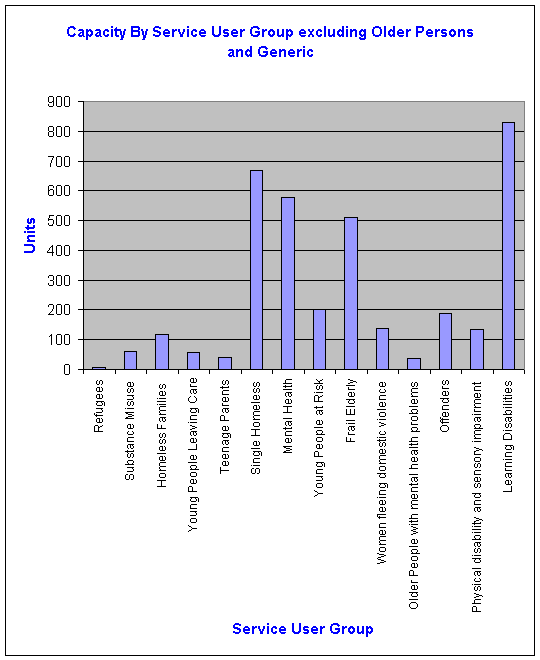
Appendix I: Definition of a Small Provider
Hampshire Supporting People wish to ensure that the processes that they impose on Providers in terms of information requests take into account the size of the provider whilst at the same time ensuring adequate protection for Service Users and the Administering Authority.
To take account of these conflicting demands, Hampshire has developed a set of criteria to identify Providers who can be classed as `small'. Qualifying Providers will be subject to a light touch in terms information requirements such as the Performance Information Returns and Quality Assessment Forms and service review.
To be classed as a Small Provider, all of the following criteria must be satisfied:
1. The service provider does not have a Supporting People contract with any other Authority.
2. The service provider is contracted by Hampshire SP to provide no more than two separate services.
3. The total number of Service Users in the contracted service does not exceed 12
4. The total value of the Hampshire SP contract does not exceed £40,000 pa
5. The total number of staff in a contracted service delivering housing related support is less than 2 FTE.
Appendix J: Preventative Services Grid - County Overview
KEY B: Basingstoke & Deane E: Eastleigh HE: East Hants F&G: Fareham & Gosport H: Havant H&R: Hart & Rushmoor NF: New Forest TV : Test Valley W: Winchester |
Floating Support |
Emergency Short Stay |
24 Hour Supported Accommodation |
Low Support / Accommodation based |
Supported Lodgings or Adult Placement |
Home Improvement Agency |
Supported Housing Panel | |||||||||
Frail Elderly |
B E EH F+G H H&R NF TV |
H&R
|
B E EH F+G H H&R - TV W |
B E EH F+G H H&R NF TV (1) W |
B E EH F&G H H&R NF TV Jan05 W |
B H&R | ||||||||||
Offenders |
B E EH F+G H H&R NF TV W |
B F+G W |
B F+G TV W |
B E EH - H H&R NF TV W |
B H TV W | |||||||||||
Floating Support |
Emergency Short Stay |
24 Hour Supported Accommodation |
Low Support / Accommodation based |
Supported Lodgings or Adult Placement |
Home Improvement Agency |
Supported Housing Panel |
||||||||||
Older Persons with Mental Health Problems |
B E EH F+G H NF TV W |
F&G |
B E F&G TV W |
B EH H TV W |
B E EH F&G H H&R NF TV Jan05 W Jan 05 |
B | ||||||||||
Older persons with Support Needs |
B E EH F&G H H&R NF TV W |
F&G H&R |
B E F&G H&R TV W |
B EH F&G H NF TV W |
H |
B E EH F&G H H&R NF TV W |
B H&R W | |||||||||
People with Physical Disabilities |
B E EH F&G H NF TV W |
F&G TV |
B E TV |
E EH H H&R NF |
B E EH F&G H NF |
B H TV W | ||||||||||
Floating Support |
Emergency Short Stay |
24 Hour Supported Accommodation |
Low Support / Accommodation based |
Supported Lodgings/Adult Placement |
Home Improvement Agency |
Supported Housing Panel |
||||||||||
People with Alcohol Problems |
B E EH F&G H NF TV W |
B F&G TV |
B F&G TV W |
B EH H TV W |
B H TV W | |||||||||||
People with Learning Disabilities |
B E EH F&G H H&F NF TV W |
F&G H&R TV W |
B E EH F&G H H&F NF TV W |
B E EH F&G H H&F NF TV W |
B F&G H H&R NF |
B EH H |
B H TV W | |||||||||
People with Mental Health Problems |
B E EH F&G H H&F NF TV W |
B F&G TV |
B F&G H H&R |
B E EH F&G H H&F NF TV W |
H NF TV |
B EH H |
B F&G H TV W | |||||||||
Floating Support |
Emergency Short Stay |
24 Hour Supported Accommodation |
Low Support / Accommodation based |
Supported Lodgings or Adult Placement |
Home Improvement Agency |
Supported Housing Panel | ||||||||||
Refugees |
B EH F&G H TV W |
B EH F&G H TV W |
B F&G TV W |
B EH F&G H NF TV W |
B H TV W | |||||||||||
Single Homeless |
B E EH F&G H H&R NF TV W |
B EH F&G H&R TV W |
B F&G H&R TV W |
B E EH F&G H H&R TV W |
B |
B H H&R TV W | ||||||||||
Homeless Families with Support Needs |
B E EH F&G H H&R NF TV W |
EH F&G H&R TV W |
H&R |
B E EH F&G H H&R TV W |
B H H&R | |||||||||||
Floating Support |
Emergency Short Stay |
24 Hour Supported Accommodation |
Low Support / Accommodation based |
Supported Lodgings or Adult Placement |
Home Improvement Agency |
Supported Housing Panel | ||||||||||
Teenage Pregnancy |
B E EH F&G H H&R NF TV W |
H&R TV |
F&G H&R TV |
B EH H H&R TV |
B F&G H H&R TV W | |||||||||||
Women fleeing Domestic Violence |
B/3 E EH F&G H H&R NF TV W |
B E EH F&G H&R TV W |
B E EH F&G H H&R TV W |
B EH F&G H NF TV |
B H&R TV W | |||||||||||
Young People at Risk |
B E EH F&G H H&R NF TV W |
H&R TV |
B F&G H&R W |
B E EH F&G H H&R NF TV |
B EH F&G H |
B EH F&G H H&R NF TV W | ||||||||||
Young People Leaving Care |
B E EH F&G H H&R NF TV W |
F&G H&R |
B F&G H&R W |
B E EH F&G H H&R NF TV |
B EH F&G H |
B EH F&G H H&R NF TV W | ||||||||||
Appendix K: South East Regional Quartile Range
(by Client Group & Accommodation Type)
(weekly cost per person)
Client Group |
Accommodation Type |
Lower Quartile |
Upper Quartile |
Frail Elderly People |
Very Sheltered Housing |
£27.00 |
£50.00 |
Sheltered Housing |
£16.00 |
£34.00 | |
Generic Services |
Unregistered Adult Placement |
£255.00 |
£328.00 |
Supported Housing |
£50.00 |
£171.00 | |
Floating Support |
£41.00 |
£92.00 | |
Homeless Families with Support Needs |
Supported Housing |
£13.00 |
£93.00 |
Offenders or People at risk of offending |
Supported Housing |
£112.00 |
£268.00 |
Older People with Support Needs |
Very Sheltered Housing |
£13.00 |
£43.00 |
Supported Housing |
£4.00 |
£37.00 | |
Floating Support |
£26.00 |
£64.00 | |
Sheltered Housing |
£4.00 |
£15.00 | |
People with a Physical or Sensory Disability |
Supported Housing |
£11.00 |
£169.00 |
Floating Support |
£54.00 |
£205.00 | |
People with Drug Problems |
Supported Housing |
£77.00 |
£212.00 |
People with Learning Disabilities |
Unregistered Adult Placement |
£175.00 |
£258.00 |
Supported Housing |
£130.00 |
£401.00 | |
Floating Support |
£85.00 |
£432.00 | |
Registered Adult Placement |
£84.00 |
£137.00 | |
Residential Care Home |
£25.00 |
£254.00 | |
People with Mental Health Problems |
Supported Housing |
£78.00 |
£207.00 |
Floating Support |
£42.00 |
£99.00 | |
Residential Care Home |
£64.00 |
£248.00 | |
Single Homeless People with Support Needs |
Supported Housing |
£55.00 |
£177.00 |
Floating Support |
£42.00 |
£70.00 | |
Teenage Parents |
Supported Housing |
£123.00 |
£208.00 |
Supported Housing / Floating Support |
|||
Women at Risk of Domestic Violence |
Supported Housing / Refuge |
£177.00 |
£274.00 |
Young People at Risk or Leaving Care |
Supported Housing |
£93.00 |
£249.00 |
Floating Support |
£39.00 |
£107.00 | |
Foyer for Young People |
Foyer for Young People |
£80.00 |
£198.00 |
Appendix L: Steady State Contracts
SP has adopted a new model of contract, the Steady State Contract, to be issued post first review. Steady State contracts define capacity in terms of the number of hours provided, rather than defining service capacity in terms of units or individuals.
Following service reviews, capacity is agreed with the Provider. If demand exceeds capacity the Provider may be encouraged to bid to increase capacity through District Core Groups. Such bids will be judged against other bids for increasing capacity or new services.
Benefits
_Financial liability is planned and predictable
_Investment can be co-ordinated and strategic
_The programme can be administered without large amounts of administrative labour
Appendix M: Strategic Reviews - `A 12 Step Process'
Purpose
The purpose of the strategic review is to enable a district and county wide view to be taken of the existing provision of services on a Client Group basis, and from this to plan how these might be reshaped for the future, and to inform and direct commissioning decisions.
Summary
Current provision (supply) can be assessed in terms of capacity (units & hours), service type, nature, objectives, location, accessibility, quality & age of buildings etc. This assessment can then be compared against the requirements of the Supporting People partnership, and their preventative agendas (as identified in the preventative statements), and where it exists, robust information on need.
The outcome of the process will be a strategic context in which individual service reviews and commissioning decisions can take place. This context needs to address the following:
· What are the preferred form/s of service type
· What specific objectives do stakeholders wish to see met
· What distribution/spread of services do stakeholders wish to see
· How does the current service provision match this vision
· How does current supply match demand and need
· Priorities for change/development
Timescales
All strategic reviews will need to be completed within tight timescales of no more than six months. For timings throughout the process, see Annexe A. Where circumstances allow, two separate Client Group services may be subject to a strategic review at the same time.
Resources
For practical purposes, the county has been divided into the following nine areas on which the district strategic reviews will be based: Basingstoke, East Hants, Eastleigh, Fareham & Gosport, Hart & Rushmoor, Havant, New Forest, Test Valley, Winchester. The calculation of the time required of all SP staff to conduct the reviews has been calculated on this basis.
12 Step Process
1. Send out initial letter (Example at Annex C), to all interested parties explaining in outline the process that is about to be embarked on. Include with this explanatory letter a clear timetable, and the relevant preventative statement (similar to service review 6 week letter). Provide 4 weeks notice of, and invite them to attend the initial meeting
2. Produce baseline district supply data in format described above
3. Hold initial meeting of Providers, Users, and other interested partners to explain in depth the process and what the end objective is. (For the first strategic review statutory stakeholders should also be invited, unless they have been approached separately, and had the process explained. After having gone through the process once however they are unlikely to attend subsequent meetings).
This meeting should also be used to take the opportunity to intelligence gather (i.e. collect anecdotal evidence
).
At this meeting you should have available and discuss details of all existing relevant services - the baseline district supply data.
Dates should be set for the second and third meetings
4. Within 5 working days of the initial meeting a questionnaire (Example at Annexe D) should be sent out to the statutory stakeholders, along with the preventative statement, and the baseline district supply data. Recipients should be asked to:
a. Translate the relevant Client Group Prevention Statement into practical terms applicable to their locality and/or the county (their vision)
b. Assess how they think that current services fit into this vision
c. Identify what is required locally to change to meet `their vision'; is it more/less services; is it services of a different type; is it a different structure, different location etc
5. Within 5 working days of the initial meeting a questionnaire (Example at Annexe E) should be sent out to the Providers of all services to this Client Group (ie all those identified in the baseline district data) along with the relevant preventative statement. Recipients should be asked to:
a. Identify how their services fit into the framework outlined in the preventative statement and how they contribute to meetings the objectives set out in
it
b. Identify how their services could fit/could fit better, into the framework, and meet the objectives more fully in 12 months time
6. Draw together all existing knowledge on need, undertake intelligence gathering
7. Collate & analyse returned questionnaires, conduct impact assessment and compile all needs knowledge and intelligence gathered.
8. Hold second meeting of stakeholders, providers, users, and other interested parties to present initial findings. These should clearly state:
a. What they are
b. What their implications are/impact assessment
c. What else we need to know
d. Where there are any existing County level `givens', and what they are
A summary of this should then be produced for a brief consultation period
9. Hold a third meeting to present the final conclusions
10. Aggregate findings at a county level
11. Present final report in standardised format summarising findings to CCG for endorsement
12. Feedback locally on overall County view to DCGs, and DIFs
Timescale Event Activity
Week 1 Issue Initial Letter
|
Produce baseline district supply data
|
Week 5 Hold First meeting
|
|
Week 6 Issue Questionnaires
|
Assemble needs knowledge
|
Week 10 Deadline for return of Questionnaires
|
Collate & Analyse questionnaires
|
Week 12 All Questionnaires returned
|
Collate & Analyse questionnaires
|
Draw up first draft of findings
|
Week 16 Hold Second meeting
|
Receive consultation feedback
|
Draw up conclusions
|
Week 20 Hold Third meeting
|
Aggregation of district conclusions
|
Production of County wide strategic context
|
Week 24 Present to CCG
|
Production of County wide strategic context
|
And Then Present to DCGs
And DIFs
Hampshire Supporting People Stakeholder Strategic Questionnaire
Client Group:
Period of Review:
Name of person completing questionnaire:
Organisation:
Position in organisation:
Date completed:
The purpose of this questionnaire is to assist the Hampshire Supporting People team in assessing how well the current level of service provision
for {Insert client group} meets the needs of you and the other statutory stakeholders.
Before answering the questions below, please ensure that you have read
the enclosed preventative statement and that your answers take account
of the context it sets.
The answers you provide, along with other information and views obtained
as part of this exercise, will be used to inform both how existing services are shaped or re-shaped, and also the overall commissioning process.
What do you want ?
1. What are the main strategic priorities for you in terms of delivering housing related support services to this Client Group ?
2. What are the key objectives that you would like to see services for this Client Group deliver on ?
3. What is your preferred model of service delivery for meeting these objectives (if these vary according to different objectives, please state all)
4. Are there any models of service delivery that you would not wish to see ?
How are current services delivering ?
5. Do you consider that all of the services listed are contributing towards the achievement of these objectives ?
6. If yes, please list in order of the contribution you feel that they are making, including the objective(s) you feel they are helping to achieve
7. Are there any services which you consider do not currently contribute to achieving these objectives ?
8. Which, if any, of your key objectives do you not feel are currently being met ?
9. How do you consider current services could be altered to better meet your key objectives ?
Are current services the `right' ones ?
10. Do you consider that all of the services listed conform to your preferred form of service delivery ?
11. If you answered no in respect of any service, please explain why
12. Do you consider that the services listed are, broadly speaking in the right locations ?
13. If you answered no in respect of any service, please explain why
14. Do you consider that for those services described as `accommodation based', that the accommodation is fit for the purpose described ?
15. If you answered no in respect of any service, please explain why
How does the current supply match needs ?
16. Overall, how well do you consider the overall supply of services matches demand ?
17. If you consider that demand is greater than supply, please state what you have based this view on (please attach any hard evidence you may have)
18. Overall, how well do you consider the current balance of service type matches demand ?
19. Are there any existing services for which you consider demand is substantially greater than others ?
20. If yes, do you know of any reasons for this ?
21. Are there any existing services for which you consider demand is significantly lower than others ?
22. If yes, do you know of any reasons for this ?
23. What would you consider are the priorities for change within current services ?
24. What would you consider are the priorities for development ?
25. Finally, is there any further information you would like to give us that you feel would be helpful in developing a strategic assessment of services for this Client Group ?
Hampshire Supporting People Service Provider Strategic Questionnaire
Client Group:
Period of Review:
Name of person completing questionnaire:
Organisation:
Position in organisation:
Date completed:
The purpose of this questionnaire is to assist the Hampshire Supporting People team in assessing how well the current level of service provision for {Insert Client Group } meets the needs of the statutory stakeholders, and fits the objectives of the Supporting People programme
Before answering the questions below, please ensure that you have read the enclosed preventative statement and that your answers take account of the context and objectives it sets.
The answers you provide, along with other information and views obtained as part of this exercise, will be used to inform both how existing services are shaped or re-shaped, and also the overall commissioning process.
1. Please list all the services you provide for this Client Group , including their type and capacity
2. Please state what the objectives are for each of the services listed above
3. Please state how each of the services listed above contribute to the objectives set out in the SP preventative statement for this Client Group
4. Please state which of the primary objectives included in this preventative statement you most directly contribute to (and how)
5. How do you feel you could make changes to your service over the next twelve months to better meet these objectives ?
6. Do you feel that your services are correctly located geographically ?
7. If you provide an accommodation based service do you feel that the accommodation is adequate for the purposeIf not why not
8. Do you feel that there is a greater demand for the type of service you provide than can currently be met ?
9. If your answer was yes, what evidence do you have to support this view
Finally, is there any further information you would like to give us that you feel would be helpful in developing a strategic assessment of services for this Client Group ?
Ref no. |
Date identified |
Risk Category |
Consequence of risk occurring |
Score |
Actions to manage risk (incl. timescales and deadlines) |
Risk owner |
1 |
Time ; quality; people; resources ;costs safety ; Service Users; service providers; perception of SP |
High Medium Low |
Eliminate; reduce; transfer; tolerate ; contingency |
Staff member responsible for the actions identified | ||
1.1 |
09 June 2004 |
Failure to deliver agreed strategy due to lack of consensus |
Failure to meet ODPM requirements Programme implementation delayed Services threatened Financial instability |
High |
Accurate project planning Extensive consultation Appropriate allocation of resources Communication and Partnerships structures Conflict resolution procedure in place |
SP Lead Officer |
2 |
Financial Management |
|||||
2.1 |
9 June 2004 |
Inaccurate financial forecasting |
Budget overspend / under spend may result in the inability to plan for potential over/ under spend Incorrect payments to providers Inability to implement 5 year strategy |
High |
Monthly budget monitoring Accurate working practices Undertake regular reconciliations Accurate and timely amendments from Providers Spot checking of provider amendments |
SP Finance Officer |
2.3 |
9 June 2004 |
Introduction of financial cap (£20 per hour and quartiles) |
Providers unable to operate at new rate Services collapse |
High Medium |
Use of discretion where possible / appropriate Contingency planning and planned closures |
CB/ County Manager |
2.4 |
9 June 2004 |
Significant reduction in SP grant |
Budget overspend |
High |
Effective financial planning - see above Planned closures/ reductions in contract capacities Termination of contracts |
County Manager Review Coordinator Contracts and Finance Coordinator |
3 |
SP Contracts |
|||||
3.1 |
9 June 2004 |
Fixed capacity contracts unacceptable to Sheltered Housing providers |
Contracts not agreed with Sheltered Housing Providers Instability of Sector |
Medium |
Specific contract considered to address issues of concern |
County Manager |
3.2 |
9 June 2004 |
Contract compliance -Providers fail to comply with requests for data |
Review process delayed Incorrect payments made Services fail to deliver appropriate support per contract |
Medium Medium Medium |
Contract Monitoring Issue of default notices Contract monitoring |
Review Coordinator |
4 |
Reviews |
|||||
4.1 |
9 June 2004 |
Risk of legal challenge to SP decisions / reviews |
Financial consequences - new contract value delayed Workload - DCG/ CCG involved in considering the complaint If successful wider implications for the long term management and delivery of the programme |
Medium Low Medium |
Conflict resolution policy Ensure all decisions are soundly based and accurately recorded Clear guidance issued to all parties Precise criteria set and published |
SP Lead Officer Review Coordinator Local coordinator SP lead Officer Review Coordinator CCG |
Operational delivery of the programme |
||||||
6 |
Service Providers |
|||||
6.1 |
9 June 2004 |
Financial changes to contract values |
Provider/ service may be non viable Threats to stability of sector Provider redundancies Services withdrawn - Service Users unable to access services |
Low Low Low Medium |
Limit impact wherever possible through use of effective planning and communication with strategic partners / identify other funding sources Use of discretion in awarding contract values Management of process timescale - phase in Effective contingency planning Partnership working |
Review Coordinator / Finance Team |
6.2 |
9 June 2004 |
Underlying financial structure unsound |
Financial collapse of provider |
Low |
Accreditation of providers Contingency planning |
County Manager / Finance team Local Coordinator |
6.3 |
9 June 2004 |
Inability of provider to deliver on review outcomes |
Default notice issued New provider to be found to assume responsibility for SU's Contract termination |
Follow up monitoring post review / Repeat Validation visits Contingency planning to identify procedure to locate alternative provider - tendering process in place
Clear process to be identified to be adopted including guidance on appropriate grounds |
Review Coordinator Review Coordinator Review Coordinator | |
6.4 |
9 June 2004 |
Failure to comply with action plans |
Failure to improve quality Risk to Service Users / staff Default on SP contract |
Strict monitoring of compliance with required actions
Clear tender process identified |
Review Coordinator
Review Coordinator |
A
Appendix O: Hampshire's Population
Demographic Information
Hampshire is a two-tier authority comprising 11 Districts or Borough Councils and 251 parishes as shown in Fig 1 below.
Fig I:
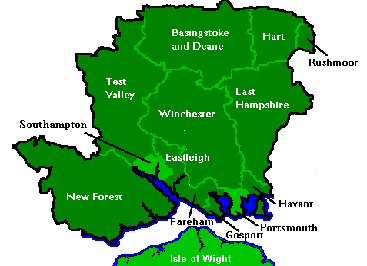
Although not part of the administrative county, Southampton, Portsmouth and the Isle of Wight have a significant impact on transport connections, employment and travel to work, housing, education and economic needs.
Population
The third largest county in England (after Kent and Essex) Hampshire has a population of just over 1.25 million people with an age profile similar to that of the rest of UK. A combination of urban and rural areas (10% urban / 90 % rural), the majority ( 87%) of the population live within urban areas.
Age and Gender Profile
Close examination of the age structures throughout the county reveals that the New Forest has the highest elderly population and is markedly different from the rest of the county. Population growth projections, based on the most recent Government guidance on new dwellings requirements, are relatively low (3.4 per cent between 2001 and 2011): In line with the national profile Hampshire faces an increase in the number of older persons aged over 65. This will be countywide but the percentage increases will be highest in those districts with relatively low proportions in the retirement age groups in the base year, for example, Basingstoke, Hart and Rushmoor. Nevertheless, New Forest will still contain the largest proportion of older persons. Importantly for Supporting People services, growth of almost 40 per cent is expected in the over-85 age group in the period up to 2011.
In the period 1991 to 2001, the County's population increased by 62,000 or 5.3 per cent. The population of Eastleigh increased by 9,700, and there were net gains of over 8,000 in New Forest, Test Valley and Winchester. There were population increases in all other districts except Havant, where the population declined by almost 3,000, and Gosport, where the population size remained static. These changes in population will mean increased demand for support services in the growing areas although predicting the nature of the required support is difficult.
Fig 2 : Population data for Hampshire by age and gender:
Population data for Hampshire by age and gender |
Age Range Total Males Females |
0 - 4 72178 37053 35125 |
5 - 9 79425 40804 38621 |
10 - 14 82365 42306 40059 |
15 - 19 74971 39289 35682 |
20 - 24 62496 32703 29793 |
25 - 29 72690 36655 36035 |
30 - 34 89235 43724 45511 |
35 - 39 99891 48972 50919 |
40 - 44 93167 46664 46503 |
45 - 49 82659 40841 41818 |
50 - 54 92241 45721 46520 |
55 - 59 75909 37597 38312 |
60 - 64 61744 30357 31387 |
65 - 69 55663 26780 8883 |
70 - 74 50153 23239 26914 |
75 - 79 41424 17355 24069 |
80 - 84 28563 10721 17842 |
85 - 89 16728 5247 11481 |
90 and over 8601 2015 6586 |
Totals 1240103 608043 632060 |
Source: ONS 2001 Census Data
Fig 3:
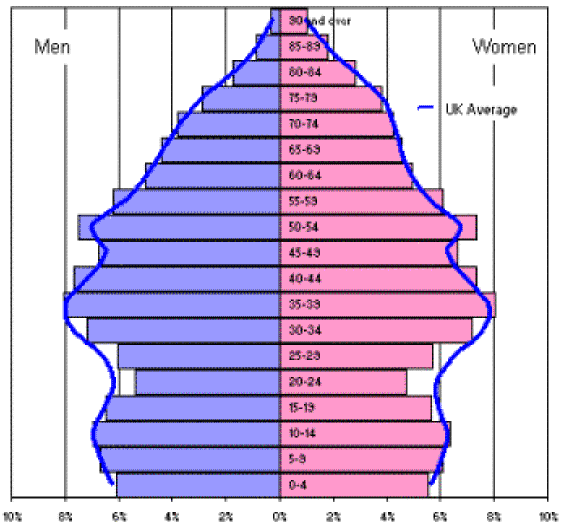
Source: ONS 2001 Census Data
Index of Deprivation
Although Hampshire is generally a relatively prosperous county, there are significant areas of deprivation. The 10% most deprived areas in Hampshire fall within the 40% most deprived nationally. 24 of these 82 areas are within the worst 20% nationally. These areas are in the districts of Havant, Gosport, Fareham, Rushmoor and the New Forest
The indices of multiple deprivation encompass seven topics; six of these topics - income, employment, health, education, crime and living environment all produce a similar geographical pattern based upon urban concentrations. The seventh indicator, access to housing and services, tends to produce a pattern of deprivation in rural areas due to difficulties encountered in accessing services.
The table below lists the ranking of the districts according to the average in each district
Fig 4 : Average Super Output Area rank / IMD
District |
Indices of Deprivation rank order of district by average Super Output Area Score (out of 354 local authority districts) |
Basingstoke and Deane |
313 |
East Hants |
328 |
Eastleigh |
311 |
Fareham |
330 |
Gosport |
189 |
Hart |
354 |
Havant |
137 |
New Forest |
286 |
Rushmoor |
287 |
Test Valley |
317 |
Winchester |
338 |
Rural Deprivation
Areas of rural deprivation do exist within Hampshire but they remain hidden due to the dispersed nature of rural communities and the high numbers of people in rural areas who are not deprived.
In contrast, based upon the Geographical Access to Services Index, most of Hampshire's rural wards are in the top twenty percent of the most deprived wards in England and almost all are in the top fifty percent. Those on low incomes and experiencing other problems find their difficulties are compounded by isolation or social exclusion and lack of services or difficulty in accessing services due to inadequate transport. Furthermore there is an impact upon the delivery of floating support services which face increased costs and reduced capacity due to the distances involved in delivery. Homelessness has been increasing in rural areas.
Urban Deprivation
Of the urban areas in the county, Havant, with sixteen of the 20 most deprived areas in Hampshire, falls within the forty percent most deprived districts in England. Pockets of relative deprivation also exist in more affluent areas such as Winchester, Hart and the New Forest. Not all are recognized using the average score on the indices of deprivation due to the level at which data is produced.
Investigation at ward level shows the twenty most deprived areas are situated within Havant and Gosport. Those four with the highest scores are concentrated within the Leigh Park area of Havant. Warren Park (Havant) is ranked 286 out of 8414 wards in England, in the top 3.5% and 3 other wards are amongst the 10% most deprived in England. The area is ranked top in the IMD table for Hampshire in terms of income, employment, education and housing.
Strong links exist between IMD and rates of teenage pregnancy, combined with the population data from the 2001 census this is clearly evidenced and supported by local research. Undertaken at ward level, investigation will produce a picture as follows
Health of the Population
Health indicators for Hampshire are generally good compared with England as a whole, there is, however, a significant variation reflecting the area's wide socio-economic inequalities. The incidence of mental health problems is increasing: One in four of the population will have a mental health problem at some time in their life. In Hampshire this means that over 130,000 people aged 18-64 will be receiving help for a mental health problem at any one time. The level of teenage pregnancy, while being under the English national average, is higher than the national rate for any western European country.
Unemployment Statistics
Unemployment in Hampshire is consistently below the national average. The latest figures show the unemployment rate in Hampshire at 0.9 per cent, compared with the national average of 2.3 per cent. There are significant differences within the county, with average earnings higher in the north than in the south. Full-time workers in North Hampshire earn approximately £140 a week more than full-time workers in South East Hampshire. This has an impact upon service costs.
Black and Ethnic Minority Population
At 2.2% of the total population, Hampshire has a much smaller proportion of its population within ethnic groups than England (9.1%) and a lower rate than the South East Region (4.9%). The proportion of Hampshire's population within ethnic minority groups is uniformly low across the whole county, with only Rushmoor having more than four percent from all other backgrounds.
Generally the ethnic minority population of Hampshire is dispersed, meaning there are few or no established communities.
Indian, Pakistani, and Chinese made up the largest non-white ethnic groups in Rushmoor; Indian, Black Caribbean and Chinese were the largest groups in Basingstoke. However, each of these groups amounted to less than one per cent of the district populations. Numerically, the only two groups to exceed one thousand people are the 1,190 people of Indian ethnic origin in Basingstoke, and 1,010 people also of Indian ethnic origin in Eastleigh.
These percentages should be viewed in the context of the national averages. In 2001, 7.77 per cent of the population of England were from the ethnic minorities (excluding those of mixed race), compared with 6.19 per cent in 1991. Indians made up over 2 per cent of the population of England in 2001, and Pakistanis 1.44 per cent. Nowhere in Hampshire therefore, approaches the national average proportion of their populations in the ethnic minority groups.
Fig 5: Population by Ethnic Origin 2001 (percentages)
Area |
Total Population |
White |
Mixed |
Asian or |
Black or |
Chinese or other ethnic group |
Percentage of people in ethnic groups | ||||||
152,573 |
96.56 |
1.03 |
1.23 |
0.57 |
0.61 | |
109,274 |
98.35 |
0.65 |
0.40 |
0.19 |
0.41 | |
116,169 |
97.42 |
0.70 |
1.18 |
0.18 |
0.51 | |
107,977 |
98.26 |
0.60 |
0.48 |
0.15 |
0.51 | |
76,415 |
98.34 |
0.61 |
0.46 |
0.21 |
0.36 | |
83,505 |
97.69 |
0.72 |
0.81 |
0.26 |
0.53 | |
116,849 |
98.54 |
0.57 |
0.40 |
0.15 |
0.34 | |
169,331 |
98.86 |
0.50 |
0.25 |
0.12 |
0.29 | |
90,987 |
95.57 |
1.08 |
1.75 |
0.63 |
0.97 | |
109,801 |
97.93 |
0.65 |
0.74 |
0.20 |
0.48 | |
107,222 |
97.84 |
65 |
0.69 |
0.25 |
0.56 | |
1,240,103 |
97.80 |
0.70 |
0.74 |
0.27 |
0.50 | |
Source: Office for National Statistics, 2001 Census
Appendix P: Record of Consultation
Policy Framework Consultation
Group Consulted |
Health |
Hampshire Probation |
Hampshire County Council / SSD |
Basingstoke & Deane |
East Hants |
Eastleigh |
Hart & Rushmoor |
Havant Havant |
New Forest |
Winchester |
Test Valley |
Fareham |
Gosport |
Core Strategy Group |
Drug Action Team |
Service User Reference Group (SURG) |
Hampshire Community Strategy Partnership |
SP Strategy Group |
SP Team |
Strategy Consultation
Forum |
County Core Group |
Core Strategy Group |
District Consultation |
Stakeholders / CIF |
Strategic Partners |
Hampshire Teenage Pregnancy Partnership 2004 -2006 County Action Plan Summary Version |
SSD Supported Housing Commissioning Plan |
Hampshire Community Strategy |
Hampshire Corporate Strategy |
A Profile of Hampshire |
Census Statistics |
DAT BME Needs Assessment |
AA Administering Authority. This is the Social Services
Department of Hampshire County Council.
Accommodation Housing-related support service, which is specifically linked to
Based service identified accommodation, where loss of occupancy means loss of support service.
Accommodation- A housing-related support service, which is linked to specific
Based service with accommodation & offers a floating support, resettlement Floating support outreach service, as part of the overall package. For example, a
hostel or supported housing with intensive on-site support, which also offers a move-on or resettlement service.
Accreditation A process for assessing the viability and competence of an
organisation and formally recognising their ability to provide
services.
BME Black and Minority Ethnic Groups.
Best Value Central Government's value and quality policy.
CAG Cross Authority Group.
CCG County Core Group
CIF County Inclusive forum
Client Group A classification applied to a person according to their support
needs. A person may fall into a number of classifications.
DAAT Drug and Alcohol Action Team
DCG District Core Group
DoH Department of Health
DIF District \inclusive \forum
Extra Care
Floating support A housing-related support service that is not tied to any specific accommodation.
HAAS Housing Accommodation and Advice Service
HC Housing Corporation
HIA Home Improvement Agency, often also known as `Care and Repair' services. These are floating support services available across different tenures designed to enable people to remain in their own homes for as long as they wish and to promote independent living. HIA services are usually focused around practical support related to the accommodation - such as maintenance and adaptations - but often also provide a wider range of services such as advice, advocacy and signposting to other support services.
HIOWA Hampshire and Isle of Wight Authorities Association
Interim Contract SP contract issued with effect from 31 March 2003 -First review
Lifeline Alarm Service
NHS National Health Service
ODPM Office of the Deputy Prime Minister
PCT Primary Care Trust
Performance
Indicator Specific information used in a planned way to measure and
(PI) assess performance.
SECOND DRAFT APPENDICES
Pipeline service A service that was planned to come online after 1st April 2003, but which had a firm funding commitment before then.
Provider Organisation providing a Supporting People service.
QAF The Quality Assessment Framework for Supporting People -
QAF defines service objectives (core and supplementary) against which Providers can carry out self-assessments.
Registered Care Care services registered under the auspices of CSCI
RHB Regional Housing Board
ROCC Umbrella group for voluntary sector Providers
RSL A Registered Social Landlord registered with the Housing
Corporation as a housing association. Most, but not all, RSL's are housing associations and not all housing associations are RSLs.
Service Review A review of the strategic relevance, quality, performance and cost-effectiveness of a Supporting People service prior to the expiry of its contract.
Service users The term "Service Users" is used throughout to refer also to Carers and advocates where applicable. It is important that, in consulting and involving Service Users, Providers also seek the views of Carers and Advocates where Service Users may not be able to participate fully.
Service User Group Classification applied to a person according to their support
needs. A person may fall into a number of classifications
SHA Strategic Health Authority
SHMG Supported Housing Management Grant
Sole traders Sole traders are individual support Providers who are not working for a charity, housing association, limited company or other type of organisation but are working for themselves, often in their own home, and not employing any housing-related support staff. Examples of sole traders are supported lodgings or adult placements where there is no overarching organisation.
SP Supporting People
SSD Social Services Department
Steady State Post first review period
Stakeholder Individual, organization or body which has an interest in SP
Supporting People Programme to deliver housing-related support services to
vulnerable people through a single funding stream, administered by local authorities according to the needs of people in their area.
Supporting People
Grant The grant provided to local authorities to pay for the costs of
support services from April 2003.
Transitional The transitional system for the payment of support costs through
Housing the housing benefit system. This system ended on the introduction Benefit of Supporting People in April 2003
.
SECOND DRAFT APPENDICES
Client Group Abbreviations :
DV |
Women at risk of domestic violence |
MH |
People with mental health problems |
YP @ R |
Young people at risk |
YPLC |
Young people leaving care |
OP |
Older persons with support needs |
PD |
People with a physical or sensory disability |
OPMH |
Older persons with mental health problems / dementia |
FE |
Frail elderly |
Gen |
Generic |
HFSN |
Homeless families with support needs |
Off's |
Offenders or people at risk of offending |
SH |
Single homeless with support needs |
SM |
Substance misuse |
TP |
Teenage parents |
LD |
People with learning disabilities |
Ref's |
Refugees |
CONSULTATION
Hampshire Supporting People Five Year Strategy 2005 - 2010
Please complete and return to either :
Or :
Sue Robbins,
Supporting People
Capitol House
12-13 Bridge Street
Winchester
SO23 0HL
Consultation - Section ONE |
| 1. Is the structure of the document clear and accessible ? 2. Has the consultation carried out been inclusive of all interested parties ? 3. Are the overarching objectives specific measurable accurate realistic and timely (SMART) ? 4. Are there additional objectives we need to consider / include ? |
Consultation - Section TWO |
| 1. Are you aware of any developments or new services that have not been listed in this section ? 2. Do you have any suggestions to contribute to the further development of HIA's and handyperson services in Hampshire ? |
Consultation - Section THREE |
| 1. As an excellent authority, should Hampshire retain the current working arrangements between the Commissioning Body and the Administrating Authority, in particular the `Memorandum of Understanding'? 2. Can we improve on the SP decision-making process at the County and District levels? 3. Does the improved communications structure adequately include all the various groups and agencies: is it too onerous ? 4. Can we improve involvement of Service Users? 5. Are the links clear and concise / relevant ? 6. Are there other funding sources we need to explore ? |
Consultation - Section FOUR |
| 1. Do you think the emphasis on prevention is correct? 2. Should there be a different funding structure for long and short term services? 3. Do you agree with the concept of Prevention Statements ? 4. Should we include Prevention Statements for all SP Client Groups within the strategy? 5. Is there anything else you would like to see included within the Prevention Statement? |
Consultation - Section FIVE |
| 1. Do you come to any conclusions about the supply of services not covered in the commentary? 2. Which services would you like to see continue to be accommodation based? (See Policy Framework) 3. Do you think we should maintain a diversity of service Providers or attempt to achieve better value for money through economies of scale? 4. Do the conclusions of the needs analysis support your views of unmet need or do you have other information ? 5. Do you think the idea of PSG's provides a solid base for the discussion of gap and needs analysis ? |
Consultation - Section SIX |
| 1. Do you accept the criteria we are using for prioritising existing bids? 2. Do you have any comments on any of the Client Group Statements? 3. Do you think that we should continue to consider previous priorities for new development outside of the strategic review process? |
Consultation - Section SEVEN |
| 1. What service specific objectives and targets do you think should be set to ensure the delivery of measurable outcomes ? 2. Is it acceptable for the period between service reviews to differ as a result of the introduction of the Strategic review process? ( i.e the period may be extended beyond 3 ½ years, or reduced below 2 ½ years.)? Do you agree with the proposal to move towards Client Group based reviews ?3. |
Consultation - Section EIGHT |
| 1. Do you agree with the current timetable of strategic reviews or do you think the timetable needs to be ordered differently ? If so please advise proposed changes. 2. Do you think adequate time has been allowed to enable all stakeholders to participate in the strategic review process ? 3. Many service user groups receive services through homeless routes. Do you agree that homelessness services should be strategically reviewed first? 4. Should we move away from the current Client Group definitions ? 5. Which services do you think should be locally designated as cross authority services ? 6. Annual objectives - Do you agree these objectives or wish to see alternatives? |