
Archived decisions

Hampshire Fire & Rescue Service
Best Value Review of Workshops
Version 1.3
28th February 2005
CONTENTS
Page
5 WORKSHOP FACILITIES AND STAFF 1212
8 CURRENT SERVICES PROVIDED 1414
10 SPECIAL APPLIANCES AND FIRE APPLIANCES 1515
11 LIGHT/ANCILLARY VEHICLES 1717
13 HX RADIOS, BLUE LIGHTS AND TWO-TONE AUDIO SYSTEMS 1919
16 DEFECT REPAIRS AND EMERGENCY INCIDENTS 2121
21 PERFORMANCE INDICATORS (PIs) 2525
1
2.1 Introduction
2.1.1 The main objective of the review process was to evaluate the effectiveness and appropriateness of HFRS Workshop arrangements (see Appendix 1).
2.1.2 The aims and scope of the review as set out in the Terms of Reference presented to the Performance Review Committee on the 21st April 2004 was to "identify opportunities and action plans for improving the way the Service provides vehicle maintenance and repair at its central workshops". 1
2.2 Workshops Facilities and Staff
2.2.1 The workshops were originally built in the early 1950's and the increase in fleet size and complexity of vehicles has now overstretched the current facilities. With the prospect of a move towards a purpose built facility in the Headquarters site the opportunity was taken to review the opportunities for improving the way we provide this essential part of the organisation.
2.2.2 As the fleet increased so has the number of workshops maintenance staff increased and commensurately, the training needs and qualification requirement of these people.
2.2.3 Aiding the management of workshops are a variety of administrative and support staff. These in turn are supported by an IT based Fleet Management System which has reached the end of its life and is being replaced by a more modern and efficient system called `TRACE'. During the Review much of the data was queried as to its accuracy and relevance. It is envisaged that, together with a revised management approach the new system will improve the accuracy and timelines of management data. There are a number of recommendations related to the management of information - please see section 2 for clarification.
2.2.4 The current workshop facility is split into three main areas:
(1) |
Mechanical |
- |
Maintenance and repair of vehicles and mechanical equipment |
(2) |
Electrical |
- |
Maintenance and repair of electrical components |
(3) |
Allied Trades |
- |
Specialist equipment maintenance/repair. Vehicle body repairs and refurbishment |
2.2.5 Visits were made to 4 other fire and rescue services, three of whom retained an in-house workshop facility. Substantial variance was noted in a number of areas, notably vehicle fit-out and refit.
2.2.6 To assist clarity and aid identification of strengths and weakness in the work area, the review looked individually at the following specific vehicle types and conducted a `4C' approach to each of them.
2.3 Specialist and Fire Appliances
2.3.1 From the outset of the review it became clear that, because of the specialist nature of our vehicles, we would have difficulty in locating a company that could provide the range of services currently provided by Workshops. Even breaking these services down e.g. mechanical servicing, chassis service created difficulties. For example, some vehicles carry two engines, one to power the vehicle and one to act as an emergency standby; in this case a main dealership would have to sub-contract the servicing of the standby engine. Similarly any work on the chassis would prove more costly because of the specialist vehicle bodywork and hydraulics fitted.
2.3.2 Currently we service our fire appliances over and above that recommended by the manufacturer, the Fleet Manager justifying this on grounds of the speed and load these vehicles are expected to meet.
2.3.3 Cost comparisons between Workshops and outside organisations showed substantial differences. However, it became apparent that because of issues surrounding the way Workshops currently record times etc these comparisons might not be accurate.
2.3.4 Notable inconsistencies were apparent particularly regarding the times allocated to servicing and maintenance tasks, it is believed that this is due to incorrect coding of tasks and categorisation of jobs. This in turn, prevented the calculation of accurate costs and comparisons.
2.3.5 Visits were made to four other fire and rescue services. One of these had outsourced their vehicle maintenance but were critical of the level of service they were receiving and the costs incurred. Comparison with the other three workshops visited revealed substantial time differences for vehicle fit outs. Investigating this further , a survey revealed that all of those (15) responding used a peg-board system of fit out. Time comparisons showed this method took a quarter of the time currently taken by our Workshops.
2.4 Light/Ancillary Vehicles
2.4.1 It was noted that we conduct additional servicing over and above that recommended by the manufacturer. There were many instances where activities had been miscoded or amalgamated. This meant that accurate comparisons were difficult with external contractors. What was clear was the absence of set times for set pieces of work, e.g. 3 hours for a clutch change.
2.5 Officers Cars
2.5.1 All officers cars are provided by the individual officer either on a purchase or lease arrangement. We are not aware whether these vehicles are serviced over and above the manufacturers recommendations despite these vehicles being predominantly the ones that travel at speed to incidents.
2.6 HX Radios, Blue Lights and Two-tone Audio Systems
2.6.1 Generally the in-house facility is more cost effective, although comparison with outside organisations identified methods of fitment that if introduced in HFRS, should prove even more economical.
2.7 Mobile Phones
2.7.1 A survey sent to all fire and rescue services recorded that 80% (of responders) used external contractors for fitment of mobile phones. Reviewing costs, it was noted that the in house facility was £95-100 more expensive per vehicle. When surveyed, staff felt the time their vehicle was in Workshops was unduly long.
2.8 Ladders
2.8.1 Currently ladders are tested by `traditional' methods and do not meet the manufacturer's recommendations. It was considered essential that full compliance with the manufacturer's guidance be implemented as soon as practical.
2.9 Job Records
2.9.1 Considerable difficulty was encountered in obtaining accurate information from the outgoing Fleet Management System.
2.10 Job Codes
2.10.1 Difficulty was encountered in obtaining accurate information. Commonly, many items were assigned to one code preventing the extraction of data. It was found that Workshops use 37 codes as opposed to the industry standard of 99 component codes, which then itemized into more detailed codes.
2.11 Consultation
2.11.1 A principal element of any review is consultation. This review sought the views of station staff, officers and Workshops personnel. Vehicle time away from stations was a common issue as was the absence of information on what was happening. 79.4% of officers encountered problems with equipment fitted to their vehicles and again the time their vehicle was in Workshops was a negative issue for some officers. Workshops staff, interestingly, felt there was a need for better communication and tighter control of the time in the workplace. Staff were concerned over the personal facilities in which they have to operate.
2.12 Performance Indicators
2.12.1 Prior to the review, Workshops did not have any performance indicators with which they could measure their performance. The visits to the other fire and rescue services identified some which could be adapted for Workshops use.
2.12.2 Reviewing productivity revealed that 29.66% of Workshops hours in 2003/04 were non-productive. Whilst this figure includes leave there are still a large percentage of hours which remain unproductive. A factor of this can be attributed to sickness, which was 17.3 days in 2002/03. This was reduced to 11.6 days per technician (all staff = 9.7, fire-fighter = 8.5) in 2003/04. This downward trend continued into the first 2 quarters of 2004/05 (1.2 days per technician in each quarter).
2.13 Stock
2.13.1 Workshops stock levels were reviewed and there are apparent opportunities for using imprest stock to reduce the losses incurred in stock becoming obsolete.
2.14 Planning
2.14.1 Due to the emergency nature of the fleet repair facility and the priority to keep the `red fleet' available, planning work ahead is fraught with difficulty and can be upset by a simple accident involving a fire engine. However, opportunities were identified for improving planning.
3.1 The review team's principal recommendation is that a Workshops facility should remain in-house. This viewpoint is based both on the evidence gathered during the review and historical data currently available. However, in order to improve the workshops facility and to achieve best value, the recommendations below must be implemented (see 2.4-2.24).
3.2 Cessation of Workshops in its entirety is not a tenable option due to the cost and quality implications of procuring an outside contract. However, there are some elements of activity within Workshops, which could invite either collaboration with outside organisations or outsourcing.
3.3 Fire and Specialist Appliances
3.3.1 The review team recommended that servicing and maintenance of fire and specialist appliances remain in house, subject to the inclusion of the improvements detailed below. Due to the difficulty in accurately calculating costs, recommendations for the servicing and maintenance is derived from by other factors, such as down time and service requirements (see 10). Cost analysis is inhibited by errors in recording and the ability to separate costs (see 11.4). Comparative data used (see Appendix 4) must be evaluated alongside these issues and likely inaccuracies.
3.4 Ancillary Vehicles
3.4.1 It was impossible to establish the true cost of servicing and maintaining ancillary vehicles due to the inaccuracy of data available (see 11), but analysis of repair costs where there is less opportunity for error, suggests that Workshops are likely to be currently more expensive in this area (see Appendix 4). Analysis of validated system data will establish the feasibility of continuing to service these vehicles in-house.
3.4.2 It is recommended that the current facility for servicing and maintenance of ancillary vehicles be analysed over the coming year in light of the performance and control recommendations below (see 2.8 to 2.14, and 2.17-2.18).
3.4.3 It is recognised that additional servicing activity seeks to improve the reliability of both the frontline and ancillary fleet. However, due to the variation between fire service workshops, the value of continuing to complete additional servicing for low use ancillary vehicles should be re-evaluated (see 11.5.2).
3.4.4 The recommendations below will allow Workshops to implement clearer, more detailed methods of recording and monitoring of performance. This will assist in the implementation of controls to identify occasions where time and content exceed accepted deviation limits and highlight areas for improvement, reassessment and development needs.
3.4.5 If the recommendations are implemented fully, Workshops will have the ability to provide accurate cost analyses, which in turn will enable benchmarking with outside organisations and other fire and rescue services.
3.5 HX Radio, Blue Lights and Two Tones - Officers Cars
3.5.1 The cost of fitment of HX Radio, Blue Lights and Two Tones by the in-house workshops facility is substantially lower than outside organisations (See Appendix 4). Due to the specialist/singular nature of this activity, there is less room for other activities to be assigned to these codes in error. Therefore it is recommended this activity continues to be provided by HFRS Workshops.
3.5.2 Comparison with outside contractors demonstrated the potential cost savings to be made by utilising different methods of fitment (see 13). It is recommended that this method (already used by HFRS Workshops in some cases) should be extended to all officer and non-uniform fitments to capitalise on this saving.
3.6 Fitting of Mobile Phone Hands Free Kits - Officers and Non-Uniform
3.6.1 Similarly to the fitment of radios, lights and two tone audio systems above, it is evident that there is no margin for error in relation to the recording of this activity. As a result, the review was able to accurately compare the cost of fitment with outside organisations.
3.6.2 Analysis of historical data revealed that Workshops are unable to compete, in cost terms, with outside suppliers for the fitment of mobile phone hands free kits. The principal reason for this is that the variety of vehicles requiring fitment mean special kits and tools need to be constantly updated. It would be impossible to purchase all the requisite tools for individual vehicles and therefore workshops have to improvise, sometimes resulting in increased work times. If recipients of Service mobile phones were required to have one make and model of vehicle, this would overcome the difficulty of fitment. However, such a move falls outside of the remit of this review.
3.6.3 The use of an external contractor offers a saving of between £90-£100 per fitment (depending on supplier chosen). There are currently 297 officers and non-uniform staff with service mobile phones who qualify for a car fitment. In addition there are 27 ancillary vehicles requiring fitment and 75 appliances (totalling 400).
3.6.4 The Review Team are aware of the national `Fire Link'2 project, which is involved in the implementation of a national radio system and the supply and fitment of this. This upgrade to this radio system is expected to negate the requirement for mobile phones to be fitted to appliances. This will provide national guidance as to the supply/fitment of this equipment (either internally or externally). This may also transfer to the supply and fitment of mobile phones. The project is due for completion in 2006/07.
3.6.5 Due to the substantial saving to be made it is recommended that fitment of mobile phones to officers, non-uniform and other ancillary vehicles is outsourced to an external supplier and reviewed following completion of the `Fire Link' project.
3.6.6 The Financial Rules and Regulations state that where there is an overall cost of £5k-50k, at least 3 tenders should be sought. In the period prior to completion of the `Fire Link' project, the number of new fitments required will not reach the £5k limit. It is good working practice that where costs fall below £5k, but the cost remains substantial that a minimum of 3 quotes are obtained, which have been acquired during the review.
3.7.1 Analysis of service and maintenance reports highlighted difficulties in extracting accurate information from the Workshop database. Large variation in work times for the same activity, meant that accurate averages could not be ascertained, thus distorting labour costs and suggesting that time had been allotted incorrectly. In addition, parts had been incorrectly allocated to service job codes, which required manual deletion (see 18).
3.7.2 It is recommended that the new TRACE computer system must be used to assist the accurate recording of activity and performance (see section 6.4.4). To facilitate this, it is essential that a sufficient number of the Vehicle Maintenance and Reporting Standard (VRMS) codes, used by the system, be adopted Workshops to allow analysis of costs. The database should be structured to allow deletion or deny part allocation to incorrect codes.
3.7.3 It is recommended that Workshops and Fleet Management should undertake the development of the system jointly; in order to ensure the TRACE system can fulfil the requirements of both management teams. This should be completed in conjunction with 2.8 and 2.9 below.
3.8.1 It is recommended that the number of job cards in use for each vehicle be substantially reduced to avoid confusion and inaccuracy, in conjunction with improvement in coding (see 2.7).
3.8.2 There is sufficient room to include all relevant activities on one record and this would make paperwork less labour intensive, and allow the work on each vehicle to be clearly identified, irrespective of the number of trades completing the work (e.g. allied and mechanical).
3.8.3 The review also recommends that technicians complete job cards by recording the task completed and not by code. On inputting the data the administrators can then establish the correct VRMS code to use. This will assist in reducing the potential for work to be coded incorrectly and enable a sufficient number of codes to be adopted.
3.8.4 As a result of the review, and in conjunction with the forthcoming implementation of the TRACE computer system (see 6.4), the Workshops Manager has instigated a reduction in the number of job cards used. It is proposed that technicians will complete one daily work card, used to transfer information to the computer system using one unique job reference for the vehicle.
3.8.5 To ensure that information meets service requirements, development of recording methods should be jointly undertaken by both the Workshops and Fleet Management, in conjunction with the implementation of the TRACE computer system and new job codes (see 2.8 and 7.4). It is essential that a clear audit trail exists.
3.9 Activity Monitoring and Targets
3.9.1 The reports produced by the current computer system were unable to inform the review in relation to current costs or performance. It is recommended that the outputs of the TRACE system be continually reviewed to drive any necessary changes, to ensure Workshops can both monitor their performance, and provide a comprehensive breakdown of cost elements.
3.9.2 The International Conference of Mechanical Engineering (ICME) produces manuals which inform workshops and fleet managers of the expected times and tolerances for servicing and all repairs of HGV, LGV and light vehicles.
3.9.3 It is recommended that the manuals listed below be used by Workshops and Fleet Management to establish expected work times and tolerances.
_ ICME Manual Cars 2005
_ ICME Manual Heavy Commercial Vehicles 2005
_ ICME Manual Light Commercial Vehicles 2005
3.9.4 There are some differences in maintaining the Service's vehicles compared to those standard commercial vehicles. Where variation does exist, this can be taken into consideration and work times and tolerances modified.
3.9.5 Implementing the above measures will allow management to monitor performance against the standard deviation and agreed tolerances, to identify occasions where these have been exceeded. In turn, this will allow management to investigate reasons for this deviation and identify future training needs/procedural changes. Management Information should be produced for this purpose on request of the Fleet Manager.
3.10 Time Management
3.10.1 In order to reduce non-productive time, and to accurately record the time spent on servicing and maintenance tasks to allow competitive comparison, it is essential that the way in which this is recorded is changed. In order to improve activity monitoring and allow direct comparison with outside organisations, it is recommended that the use of a decimal clock be investigated.
3.10.2 Current recording methods allow technicians to record their working day by 15-minute intervals. The difficulty in using this method means that if several small jobs are carried out on a vehicle, each one will be recorded as 15 minutes spent. This in turn will mean that the total time spent on a vehicle service or repair, may appear longer than is necessary. This also applies to administrative tasks, which may inaccurately augment the amount of non-productive time.
3.10.3 An alternative method to this would be to reduce the periods of time used from 15 minutes to 6 (i.e. a10th of an hour). This would mean that technicians would record their time more accurately. This in turn means that time can be allocated much more specifically for the actual job. Rather than having quarter of hour slots for a 5 -10 minute job, this can be analysed more specifically. Over time management will be able to establish actual time required for individual activities.
3.11.1 It is recommended that Workshops continue to employ the local performance indicators established during the review to assist in the performance and improvement planning (see Appendix 12). These should form part of the suite of local performance indicators currently published by the Service.
3.11.2 Targets should be set to reduce the amount of non-productive time. This will be assisted by the improvements in planning (see 2.12) and improvements in administration (see 2.8 and 2.9).
3.11.3 It is also recommended that contact should be made through the family group performance improvement network, to establish agreed performance indicators. This will allow benchmarking between services, and encourage sharing of best practice.
3.12.1 The review identified areas of potential improvement to assist in the annual planning process (see 23). It is recommended that current planning methods be updated, combined with analysis of historical requirements for the repair of defect and accident damage, to calculate potential necessary resources. In addition, accident information should be forwarded by Fleet Management to Training School to allow further assessment of training requirements to take place, where stations/watches have high accident records.
3.12.2 Due to the nature of the work that workshops undertake, there are uncontrollable increases and decreases in the unscheduled workload. Scheduled work should therefore be examined and critical paths established, so that non-critical tasks can be used to offset periods of low activity.
3.12.3 Future plans should be created in liaison with the Fleet Manager, who controls the scheduling of annual and 3 monthly servicing aligned with modifications and `new-builds'.
3.12.4 It is recommended that comprehensive build and equipment stowage specifications are provided to Workshops prior to build. Any necessary changes must be kept to a minimum and be agreed with the Fleet Manager. (see 23.6)
3.13 Stock Levels
3.13.1 Following the findings of this review (see 22), it is recommended that an independent assessment of current stock levels and ordering processes is undertaken to ensure that auditors recommendations are met as laid out in the `Confidential internal audit report - creditors' 2003/043.
3.13.2 To ensure best value is maintained, it is also recommended that the possibility of acquiring imprest stock for commonly used supplies, be investigated further through potential suppliers (see 22).
3.13.3 Further to the above, it is recommended that the potential for combined purchasing capabilities be investigated in conjunction with the Regional Fire Board.
3.14 `Fit-Out' and Modification Methods
3.14.1 It was identified that potential cost savings and reduction to build times could be made by modernising the way in which Workshops `fit-out' fire appliances and other specialist vehicles, by the use of `pegboards', as used by other fire and rescue services (see 10.2.4). This would in turn transfer to modifications which would no longer require the creation of new brackets by Workshops staff.
3.14.2 It is recommended that `pegboards' be introduced to enable these improvements to be made. It is additionally recommended that investigation should be made into the installation of original shelving and pegboards, by manufacturers/bodybuilders at the initial build stage. This might be complimented by joint working with partner fire and rescue services who have already capitalised on this methodology of fitment.
3.15.1 It is recommended that Workshops trial the system used by South Wales Fire and Rescue Service, whereby an apprentice or GDA accompanies the mechanic to the 3 monthly service. This will free up technical resources to complete other work. (see 10.2.5)
3.16 Ladder Testing
3.16.1 It is recommended that all future ladder tests should be completed to manufacturer's recommendations (see 15). Workshops currently test ladders using traditional less scientific methods of testing. This change will both protect the safety of operational and workshop staff and reinforce the reliability of the ladders, and is less likely to be a `negative' factor in the event of a detailed investigation.
3.17.1 The review team recognises the Fleet Manager fully justified many of the additional activities undertaken as part of the servicing of the ancillary fleet (see Appendix 8). However, due to the variation in servicing activity between fire services (see 11.5.2), it is recommended that the servicing of non-emergency ancillary vehicles continues to be re-evaluated with possible collaboration with other services or private enterprise (see 2.17).
3.18.1 Consultation with service users and staff focused attention on areas, which were felt to be insufficient, as well as those areas in which workshops perform well.
3.18.2 A lack of communication between workshops and station staff exists and station staff are not informed of the necessary work required on the vehicle and time this will take (see16.3.3). As a result it is recommended that workshops administration staff introduce a level of customer service to inform the station of the expected completion time and potential delivery. This will only be possible if controls have been implemented to ensure agreed work times and tolerance levels have been set (see 2.9). All work should be entered into the vehicle log book/separate record sheet so that all station staff are aware of the work undertaken.
3.18.3 It is also recommended that a satisfaction questionnaire be used to ascertain where any quality issues arise and to also identify where additional communication with users is required (see 19.3). A suggested format for this has been supplied by Workshops (see Appendix 15). To avoid unnecessary paperwork, it is suggested that this questionnaire be created as an electronic form emailed to the Officer in Charge of the station
3.18.4 It is also essential to ensure that staff can easily contact Workshops regarding quality of fitments should problems arise after this has been completed.
3.19.1 The visits undertaken by the review team to other fire and rescue service workshops, demonstrated that there are many similarities between them. Nonetheless, there were obvious differences in some working practices (see 10.2.4 and 11.5.2).
3.19.2 It is recommended that workshops and fleet management continue to develop communications with other services to share best practices and to explore the possibility of regional collaboration (see 2.22).
3.20 Staff Training
3.20.1 It is recommended that the qualifications of staff should be reviewed by HFRS Training Department, to schedule the completion of a Vehicle Inspectorate (VOSA) course for all staff who have not undergone a full reassessment in the last 4 years (see 5.5-5.7).
3.20.2 When due for reassessment, technicians must undertake the `Fire Service - Best Practice Course' to replace the `Inspection Standards and Procedures Course' previously completed. This course is directed towards fire service vehicles and does not apply to solely commercial vehicles.
3.20.3 The review team also supports the proposal by the Fleet and Workshops Managers to seek the IRTEC License for all technicians. This license promotes confidence in the Workshops capability, and provides the means to pursue opportunities for collaboration with other fire and rescue services and outside organisations.
3.20.4 The receipt of the IRTEC license is wholly dependent on staff being fully trained and qualified to a specified standard. It is therefore recommended that 2.21.1-2.21.2 be completed before the IRTEC license is sought.
3.21.1 It was observed during the review that the amount of non-productive hours has not decreased irrespective of the external work completed.
3.21.2 In light of the recommendations in the Fire Service White paper (see 9.2), is it recommended that the benefits of external work be reviewed against the potential opportunity for future collaboration with other fire and rescue service workshops (see 8.7).
3.22 Security
3.22.1 The review team are aware of the nationally ongoing security measures, commenced as a result of the increased risk of terrorism. All necessary efforts must be made to ensure that any requirements drawn from this project are adhered to. In addition, any future outsourced/collaborative work involving fire service vehicles, must ensure necessary security precautions have been taken.
3.23 Continuous Improvement
3.23.1 To ensure that the recommendations have been sufficiently integrated into workshops working practices, and to allow for competitive review of costs/performance, it is recommended that a full management review is conducted 1 year from completion of the review by an independent assessor. This will ensure that all management controls have successfully implemented and determine the feasibility of continuing to service and maintain ancillary vehicles in-house.
3.24 Management Structure
3.25 It is felt that the organisational and management arrangements of the Transport Section and Vehicle Workshops could be combined. This would enable a more integrated approach to the management of the vehicle fleet. It would provide clearer direction through a simplified structure , which in turn will assist in ensuring consistency in expectations and approach. It is therefore recommended that the management structure be reviewed with this aim in mind .
4.1 The Local Government Act 1999 places a statutory duty on local authorities to demonstrate Best Value. In order to do this the Fire Authority must show that its services meet the needs and priorities of the population, in the most efficient, effective and economic manner.
4.2 The Review of Workshops has been approached with an open mind and a commitment by the Review Team Members to carry out an extensive and rigorous review of the existing method of providing the workshops facility.
4.3 The review focussed on the processes and procedures behind the key areas of Workshops. These included the build of new appliances, maintenance and servicing of all vehicles, modifications and the fitting of electrical items such as telephones and blue lights.
4.4 Reviewing current practices, processes, systems resources and structural arrangements used within the Workshops function, the review aims to establish a means of continuous improvement in the way these services are provided and delivered. The review addressed the 4 C's - Challenge, Consult, Compare and Compete resulting in the emergence of various options to improve the current level of Service provision.
4.5 The table in Appendix 1 of this report outlines the method used to address the 4 C's, in which the review:
4.6 Challenged: why and how the services were being provided;
4.7 Compared: the workshops facility with other Fire and Rescue Services and the private sector;
4.8 Consulted: employees and service users (both internal and external), and other Fire and Rescue Services with a view to setting challenging performance targets;
4.9 Competed: where fair competition could be sought. The review commented if this could be embraced as a means of securing efficient and effective services.
4.10 Not to be under-estimated, the key findings of the Best Value Review envelop issues such as resources (environmental, human and financial), work practices and regulatory requirements.
4.11 This report summarises the key findings of the review, outlines the recommendations for improvement and the actions proposed for implementation.
5.1 Second to fire-fighters, a fire service vehicle is one of the most important assets to the Fire Service, without which it is unable to operate effectively. The maintenance of fire service vehicles is not an option, but an essential requirement if the service is to prove efficient and reliable, as well as create public confidence. The public expects a well trained professional organisation. They rely on fire service personnel arriving at an incident quickly and with a vehicle and equipment capable of performing the duty entrusted to them.
5.2 In order to meet incident response targets, set by the Service as part of our Integrated Risk Management Plan (IRMP), the vehicles must be reliable and in good working order. A high quality specialist fleet assist us in meeting these targets. In addition, the excellent appearance of our vehicles promotes the Fire Service and improves public confidence.
5.3 The level of maintenance required on a fire service appliance and its equipment is generally higher than that of a commercial fleet due to the nature of its use. This is because unlike a commercial vehicle, fire service appliances always carry their maximum load and may experience periods of inactivity followed by protracted and strenuous periods of activity.
5.4 Some of these vehicles also incorporate a number of non-standard items such as the back-up engine used on aerial ladder platforms. These items also require maintenance to the highest standard to ensure the safety of both our staff and the public.
5.5 Ongoing quality standards are greatly influenced by those specified and accepted for new vehicles. In effect, the care and maintenance of fire service vehicles is expected to achieve "as new" standards throughout the life of the vehicle. Such standards are central to the ethos of a well run Fire Service, which will look to the vehicle service schedule and maintenance organisation to sustain them. Service workshop's staff, being an integrated part of the same organisation, will understand this culture and their own quality standards will be influenced by the conditions affecting of the vehicles presented for maintenance.
5.6 The legislation covering the construction and use of vehicles contains a number of exemptions for vehicles and appliances used for fire-fighting purposes, or constructed as fire-fighting vehicles4. Separate legislation and guidance applies to these vehicles, and this identifies areas where claims and prosecutions could arise where infringements occur. (See Appendix 13)
5.7 It is 8 years since the CFOA (CACFOA) Appliance, Equipment and Uniform Committee launched the Best Practice document on Vehicle Maintenance for Fire Service vehicles. The document has continued to be developed since that time, with the support and endorsement of the Vehicle Inspectorate and the Institute of Road Transport Engineers. As such it presents an authoritative set of recommendations and standards that aim to ensure legal compliance and an accepted standard of operations from the fire service fleet. This document is reproduced approximately every 3 years. The latest version received is the 2000 edition, but the Fleet Manager awaits the 2003 edition, to be issued shortly.
5.8 The Service must also ensure a `duty of care' towards their employees. This duty includes the maintenance of operational equipment, ladders, pumps and tools as well as the vehicle itself, to avoid unnecessary injury. It is the responsibility of the Service to ensure that adequate preventative measures have been taken to avoid potential hazards whilst using the vehicles and their equipment.
6 WORKSHOP FACILITIES AND STAFF
6.1 The Workshops buildings were built in 1954 following the advent of the Hampshire Fire Brigade, and were designed to maintain and repair a fleet of 90 vehicles. This fleet has since increased to 235 vehicles, approximately 100 of which are Volvo Fire Appliances with remainder consisting of support vehicles from a variety of manufacturers and models. These all require specialised maintenance, repair and servicing, which continues to be carried out by the Workshop staff.
6.2 Due to the increased number and complexity of vehicles, the Workshops have seen staff increase from 10 to 32.
6.3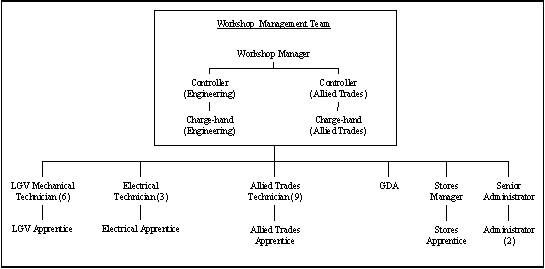 The Workshops Organisational Structure is shown below:
6.4 The increase in vehicle numbers and their size mean that the present accommodation has become less appropriate. The difficulty in manoeuvrability has affected both health and safety and productivity. The layout of the workshop restricts the amount of work that can be carried out and it is difficulty to maintain a safe working area.
6.5 Whilst not specifically part of the Terms of Reference for the review, the review team took the opportunity to examine the appropriateness of the current facilities. The limitations of the current site were evaluated by the Workshops management team for this purpose (see Appendix 11). It is envisaged that any newly built facility could engineer out these deficiencies, leading to savings in time and money.
7.1 The Service uses fire appliances as well as other fleet vehicles from a variety of manufacturers, which require our Workshops staff to have diverse expertise to maintain and service these vehicles.
7.2 To ensure staff are of a competent level to assess the roadworthiness of fire appliances, all have completed Vehicle Inspectorate (VOSA) `Inspection Standards and Procedures' course provided by the Vehicle Inspectorate5. This has since been replaced by the `Fire Service Best Practice Inspection Course'6. This course is more suitable than the `Inspection Standards and Procedures Course', which only incorporates commercial HGV vehicles. The fire service course includes the same training as the other course but also incorporates training in relation fire service vehicles as well as the CFOA best practice document.
7.3 The Workshops Manager advised that no formal reassessment has taken place in recent years. On examination, the last recorded completion of the `Fire Service Best Practice Inspection Course' was in October 2000.
7.4 On reviewing the Vehicle Inspectorate (VOSA) website it was apparent that VOSA also advised that they recommend a periodical reassessment by the Inspectorate every 3 to 4 years, to ensure these methods continue to be used effectively. If it is intended to maintain the VOSA qualifications, a reassessment of all staff will need to take place.
7.5 The Fleet and Workshops Managers have also examined the potential for staff to acquire the IRTEC licence, a qualification also pursued by South Wales Fire and Rescue Service and supported by CFOA7. It is a recognised safety and competence qualification in the repair and maintenance of vehicles and tests the competence of technicians against a quality standard that satisfies the European Standard EN45013. An advantage of this licence is that it is only valid for 5 years, at which time staff "will be required to undertake a full initial assessment" again8. It is important however to remember this is not a course, but a test of competence and should not replace other formal training of Workshops staff (see Appendix 14).
8.1 Stores
8.1.1 The Workshop has its own dedicated stores manager who is responsible for the procurement of supplies to support the workshop in its daily operations. The prime function is to maintain sufficient supply of vehicle spares and materials to allow for the scheduled servicing of vehicles and the construction of stowage of new vehicles.
8.2 Administrative Support
8.2.1 A dedicated administrative team processes all orders and payments for the Workshop. They are also responsible for the data entry of all work undertaken on to the Fleet Management System (FMS).
8.3 General Duties Assistant (GDA)
8.3.1 The GDA is responsible for the cleanliness of the workshop site and performs routine maintenance of the buildings and is also responsible for the collection of spare parts and materials for the repair and maintenance of vehicles where required.
8.3.2 The GDA must hold a LGV licence to enable them to assist in the movement of vehicles.
8.4.1 Due to difficulty implementing the existing FMS system in Fleet Management (based at HQ) as well as Workshops, a new fleet management system (TRACE) has been installed at both sites. This will allow synchronisation of data, therefore omitting the need for duplication.
8.4.2 At the time of the review, Workshops are not using the new system and all cost/labour data has been provided using the old software.
8.4.3 The set-up of the existing computer system means that reports are based on vehicle type (i.e. Water Tender, Water Tender Ladder), rather than by chassis, and does not allow reports to be produced by model (Volvo FL6, FL7). This means it is difficult to distinguish where common defects have occurred on a particular make/model of vehicle and potentially avoid these. This also makes identification of maintenance/servicing costs by model particularly manually intensive.
8.4.4 Implementing `TRACE' will have the following benefits:
_ The Fleet Manager & his team and the operations department can input vehicle/equipment details and retrieve information as required at HQ. The same information will be available to Workshops saving administration and duplication of vehicle data on multiple systems.
_ The system will interface with and transfer information to the SAP system used by Finance. This will remove the need for invoice payments to be produced by Workshops administrative staff.
_ Work completed for external organizations will be recorded and invoices produced automatically.
_ As a windows based system, information can be easily transferred to other windows based software (e.g. ExcelTM) to allow easier analysis of figures and consequently improved planning.
_ The software uses industry standard job codes. By using these codes instead of the current codes (see 18), clearer breakdown of tasks can be made and better comparison with other brigades and external suppliers.
9.1 The current provision of vehicle maintenance is provided in-house at the Service Workshop facilities in Winnall, Winchester. For a full list of work undertaken, refer to Appendix 2.
9.2 The Workshops is split into 3 areas:
9.3 Mechanical
9.3.1 Responsible for all mechanical maintenance and servicing of the fleet, including the repair of most mechanical accidental damage and defects.
9.4 Electrical
9.4.1 Responsible for all electrical aspects of the fleet, including the fitment of blue-lights and two-tone devices.
9.5 Allied Trades
9.5.1 Multi-skilled technicians to carry out vehicle bodywork in respect of `fit-out' of vehicles, refurbishment and re-spray and accident repair to bodywork.
9.5.2 This department also carries out annual routine service and repair to vehicle bodywork, water tank and stowage as well as servicing and testing of all ladders carried by the vehicles.
9.6 Defects and Accidents
9.6.1 In addition to the planned work undertaken by the Workshop staff, they are also asked to respond to a number of defects, both during the day and outside of normal working hours. Some of these will not be urgent defects and will simply be recorded in preparation for the vehicles annual service. However, others may require immediate attention, in order to make the vehicle roadworthy (see 16).
9.7.1 The expertise of HFRS Workshops and specialist repair and maintenance of fire fighting appliances has resulted in outside agencies/establishments requesting HFRS service their vehicles.
9.7.2 The Workshop's commitment to the HFRS fleet remains the topmost priority, but during periods of downtime, it has been possible to complete other income generating private work (see Appendix 2).
9.7.3 The Workshop will continue to undertake external work where it does not interfere with normal operations. There is no active pursuit of external work.
10.1 There is currently no regional management board overseeing regional development of Workshops and the potential to collaborate and share resources.
10.2 The Fire Service White Paper published in June 2003 "identified large benefits from collaboration between brigades"9. It also informs us "there has been little evidence that the fire service, as a whole, has pursued"..."collaboration arrangements for vehicle maintenance"1.
10.3 During the review it was found that there was evidence to suggest that other services were amenable to better collaboration, and the potential exists for HFRS vehicle workshops to undertake vehicle maintenance for other FR&S should scheduled work and facilities allow at a later date.
11 SPECIAL APPLIANCES AND FIRE APPLIANCES
11.1 Challenge and Competition
11.1.1 Reviewing the ways in which we service and maintain our special appliances as well as the cost involved in doing so, highlighted the difficulty in comparing ourselves with outside organisations. In many cases `standard' activities carried out on Specialist and Fire Appliances will take longer and prove more costly to perform, than on a conventional truck chassis layout. This is due to criteria such as, access restrictions caused by specialist bodywork layout and the fitment of ancillary equipment and systems. For this reason it was not possible to draw a precise comparison.
11.1.2 This is demonstrated in the case of the Aerial Ladder Platforms which require our Workshops staff to service 2 engines, one being the ancillary engine required to act as back-up for the hydraulic platform. The quotes supplied by Volvo do not incorporate this engine and does not allow for the necessity to move the platform to allow access to the main engine. This itself will require specialist equipment.
11.1.3 A number of the service schedules completed by HFRS Workshops were reviewed prior to the review and forms part of an ongoing process of evaluation undertaken by Fleet Management. Where possible the review team challenged the servicing and maintenance of vehicles, where differences emerged between the way in which HFRS Workshops service our engines and how the manufacturers do this themselves.
11.1.4 Details of differences between the manufacturer's service schedule and that of HFRS Workshops identified during the review was supplied to the Fleet Manager, who was able to provide justification to support this variance (see Appendix 8).
11.1.5 Whilst the current layout of HFRS Workshops means it is often difficult to carry out servicing and maintenance on vehicles without unnecessary movement around the workshops, it remains the only provider, which can offer a single point of maintenance and service for our specialist appliances.
11.1.6 Outside providers can complete most of the required tasks, but appliances would need to be transported from one provider to another in order to service the engines, bodywork and hydraulics. This would remove the appliance for increased periods from the front-line. Additional costs would also be incurred in transporting the vehicle from one site to another.
11.1.7 A cost comparison was made between HFRS Workshops and outside organisations for major servicing and some common repair items (see Appendix 4). Whilst this financial information illustrates a substantial difference between Workshops and outside suppliers, issues in the recording method within Workshops mean that this comparison may not be accurate (see 11.4).
11.1.8 There is a considerable inconsistency in time allocated to servicing and maintenance tasks, which distorts the average figure used to supply a cost. This is believed to be due to incorrect allocation of time to codes and categorisation of jobs which does not allow adequate breakdown of tasks (see 18). The standard deviation for servicing of both fire appliances and light vehicles (see Appendix 5), demonstrates the difficulty in establishing an average cost and therefore a meaningful comparison.
11.1.9 Management staff had not previously identified the variation in allocated time and therefore procedures had not been put in place to remedy this. The introduction of the TRACE system must resolve this issue to allow future comparison (see 6.4 and 14 and recommendations 2.8-2.10).
11.2 Comparison with other Fire and Rescue Services
11.2.1 Visits were made to 4 fire and rescue service workshops, (2 within the family group), of which 1 had outsourced work to an external organisation.
11.2.2 The Fire and Rescue Service that outsourced their facility to a nationally known private company was highly critical of the service they have received and the cost implications to the fire service. In light of this an interest was shown in HFRS Workshops tendering for some/all of this work should the opportunity arise in the future (see 9).
11.2.3 Of the 3 in-house workshops, comparison of working practices suggested that a substantial time variance exists in relation to fit-out and re-fit of our fire appliances.10
11.2.4 Further communication with South Wales and other fire and rescue services within the UK, revealed that of the 15 services who provided detailed fit-out/stowage details, all used the peg-board system. This uses detachable pegs fitted into shelves to allow easier movement of stowage. The shelves were either fitted by the vehicle supplier, prior to receipt or by their own workshops. This allows fit-out/re-fit to be completed in up to a quarter of the time taken using the traditional methods of stowage currently adopted by HFRS Workshops.1 (please see recommendation 2.14)
11.2.5 3 monthly servicing of appliances was another area in which HFRS Workshops differed to some fire and rescue services. In the case of South Wales, due to the nature of the work, a GDA or apprentice is sent to accompany the technician to station services rather than another technician leaving one technician to concentrate on other work1. If HFRS Workshops adopted a similar practice, this would enable one technician to concentrate on other areas of servicing and maintenance. (see recommendation 2.16)
12.1 HFRS light/ancillary vehicles are used for a variety of purposes, those, which are used for solely conventional use, and those, which attend emergency incidents. (Complete record of HFRS ancillary fleet - see Appendix 3).
12.2 It should be noted that due to the infrequent use of some vehicles, it is necessary to carry out the servicing of vehicles based on time elapsed rather than mileage.
12.3 Challenge
12.3.1 During the review it became evident that there were a number of activities included in the service schedules, which do not form part of the manufacturer's recommended service. This made it necessary to breakdown the service costs in order to compare ourselves with outside contractors. Activities included in the HFRS service, outside of the manufacturer's service were considered by the Fleet Manager and supporting rationale provided (see Appendix 8).
12.3.2 The ODPM (Office of the Deputy Prime Minister) Expectations document requires that "the cost of maintaining appliances and major items of equipment will be recorded in disaggregated format to show the labour and material costs, and will form an important element of fleet and equipment management information."11
12.3.3 Instances were found where parts required as a result of defects were incorrectly recorded under the service job numbers. This meant that these had to be manually removed to calculate our costs. The computer generated reports also included codes that did not relate to servicing activity and therefore presented distorted information. All additional activity times were removed in order to provide a more realistic comparison with our competitors, but it is believed that a substantial number of hours continued to be incorrectly allocated to service job codes (please see 11.4.2 below and recommendation 2.9).
12.4.1 Comparison was made between service tasks completed and the labour costs associated with them, and from this, a large variance in cost became apparent between our service costs and those of some outside contractors (see Appendix 4)12.
12.4.2 It was originally believed that the variance in cost solely originated from the additional activities undertaken as part of the Service's endeavours to improve the performance and safety of our vehicles.
12.4.3 Further investigation showed substantial difference in the labour hours used to complete the service, above the estimated time associated with the additional activities completed by HFRS. Closer analysis showed that our basic service times varied significantly from one to another. An example of the deviation in our service times is shown in Appendix 5.
12.4.4 This could be attributed to a number of factors:
_ Work undertaken as a result of defects found during the service may have been incorrectly coded under the service code.
_ Job cards not completed until all work has been completed (including defects and modifications), resulting in time being inappropriately assigned. (Please see 17)
_ Service Schedules are followed to complete tasks, but no time constraints are allocated to individual activities such as servicing or repair work. Because of this, no controls exist to enable monitoring of performance times.
12.4.5 The introduction of the TRACE computer system should enable closer monitoring of activity times and future analysis. This system uses trade standard codes, which can be directly compared with outside organisations.
12.4.6 In order to produce disaggregated maintenance and repair costs13, sufficient codes must be adopted by Workshops to show clear delineation of tasks (see recommendation 2.8).
12.4.7 Repair costs were less complicated to establish due to the nature of the work. There were no other parts or time to be allocated to the task, and therefore this presents a more genuine cost comparison. However, the potential still exists for staff to be diverted onto other frontline work and time not reallocated to the new job due to the number of job cards/codes. Therefore these figures must be treated with a degree of uncertainty.
12.4.8 A comparison of available costs is shown in Appendix 4.
12.5 Comparison
12.5.1 Visits to other fire service workshops did not indicate any immediate differences in the way in which we service our ancillary fleet. However, due to the differences determined between our service content and those of outside organisations, further information was sought from these sources.
12.5.2 Responses indicate that whilst other fire service workshops also base their service schedules on time as well mileage, there are no additional service activities carried out for ancillary vehicles, above the manufacturer's recommendations. This is with the exception of tyres, which in one case are replaced before the legal limit of 1.6mm. Additionally, one fire and rescue service stipulated that they do not allow pool cars to go more than 6 months without a full safety check due to the lack of care by drivers.
12.5.3 Due to the lack of uniform performance measures (see 20), across fire service workshops, there is no comprehensive evidence to demonstrate if this has negative consequences on reliability.
12.5.4 Additional sharing of data and best practices with other service workshops will enable Workshops and Fleet Management to continue to revise service schedules, whilst enabling monitoring of the benefits and value of all service activities (please see recommendation 2.17)
13.1.1 Officers use their own cars, serviced by outside garages. Officers take their cars to HFRS Workshops for fitment of blue-light and two-tone equipment, as well as mobile phones.
13.1.2 Frontline appliances must always take priority and therefore officer's cars may take longer to fit than is preferable (see 19.4.4). In addition, because there are so many makes and models of vehicle, it would be uneconomical for Workshops to stock equipment for all. As a result Workshops staff may have to improvise where tools are not readily available to avoid unnecessary damage, therefore extending the time taken to complete the task.
13.2 Comparison and Competition
13.2.1 As HFRS workshops do not service or maintain officer cars, no comparison can be made with other fire and rescue services or competition sought. The maintenance of HX radios, blue lights, audio systems and mobile phone fitments is discussed in 13 and 14 below.
14 HX RADIOS, BLUE LIGHTS AND TWO-TONE AUDIO SYSTEMS
14.1 The results of the questionnaire sent to all fire and rescue services14, revealed that of those who responded 36.36% fitted their radios in-house and 50% were fitted by external contractors. The remainder did not have radios fitted to officer's cars. The review team sought to establish if fitment by workshops was cost effective.
14.2 Quotes were sought to fit radios, blue lights and audio systems as one installation. Whilst difficult to find, the cost of fitment by an external supplier was more expensive than internally (see Appendix 4).
14.3 The service offered externally demonstrated the different ways in which the fitment of this equipment could be completed, which raised the potential for amendments to workshops fitment procedures.
14.4 Currently officer's can have either a board located to the back of the rear seat using a bracket where connection plugs, fuse boxes, relays and radio amps etc. are positioned to allow changing of components, or alternatively, components are hidden around the vehicle in different positions, dependent on the vehicle make and model.
14.5 Using the board method of fitment enables installation to be achieved more quickly and changing of components (e.g. new models) becomes easier. The cost saving of using this method externally was illustrated through a 7.14% decrease in price. Due the reduction in installation time, it is conceivable that a similar decrease in price would be possible internally. This would equate to a saving of £69 per vehicle. Another advantage of employing this method of fitment would be the ability to prepare boards prior to fitment. This could be completed during periods of down-time, thus reducing costs further.
14.6 If a standard method of fitment were adopted this would offer both benefits in time of cost and time. HFRS Officers have either lease cars or their own private vehicles. The amount of time personal vehicles are retained at workshops was a common concern raised by officers through the workshops survey. Using a standard method would allow for private vehicles to be retained at workshops for less time. The quality of fitment of some equipment could also be improved by experience learned from using a standard method, which was an area, which received both positive and negative responses.15 Using a bracket as per manufacturer's recommendations would limit any potential damage as with all fitment of equipment. Currently where private vehicles are used, officers are reimbursed £140, to allow for the fitment of these items to their vehicle16.
15.1 The results of the questionnaire sent to all fire and rescue services17 revealed that 80% of respondents use external contractors to fit their mobile phones, 15% have their phones fitted internally and 5% did not have mobile phones fitted.
15.2 Analysis of quotes supplied by external suppliers show that HFRS Workshops are £95 to £100 more expensive per vehicle (dependent on supplier chosen). The number of officers and non-uniform staff who have service mobile phones and are offered a car-kit equates to 297, with an additional 27 ancillary vehicles requiring fitment. Whilst not all eligible members of staff have a car-kit fitted, this is a substantial saving. In addition to this there are 75 appliances with mobile phones fitted.
15.3 Of the quotes received, some companies have their own workshops or would be happy to fit at our premises. One supplier, already associated with HFRS Information Services department, fits the car kit at the individual's home or workplace with no additional mileage charges (as per quote18).
15.4 Fitment of mobile phones forms a small part of Workshops work. This factor, added to the variety of vehicles mean it would be impossible to purchase all the requisite tools for individual vehicles and therefore workshops have to improvise, sometimes resulting in increased work times.
15.5 The length of time vehicles are held at workshops is a concern for both uniform and non-uniform staff. However, workshops priority must be to maintain the frontline fleet.
15.6 If this work was out-sourced, Uniform staff would still be required to have the HX radio, blue-light and audio warning systems fitted at workshops, but an approved supplier could fit a car kit at their convenience. Non-uniform staff would not be required to visit workshops and subsequently be without transport for any length of time. This would also remove the indirect cost to the Service of the officer/non-uniform staff time lost during delivery/collection of the vehicle.
16.1 Current servicing of ladders is achieved using traditional methods. However, whilst annual inspections and testing continues to be carried out on ladders, testing has not been developed in line with manufacturer's recommendations.19
16.2 The manufacturer provides a uniform set of standards for inspection; repair and testing which ensure ladders are maintained in good working order. To ensure ladders meet with manufacturer's safety guidelines and to protect workshop and operational staff against potential injury, and legal criticism in the event of an enquiry. It is essential that servicing and maintenance be adopted in line with manufacturer's recommendations.
17 DEFECT REPAIRS AND EMERGENCY INCIDENTS
17.1 Workshop technicians are contracted to attend defects, where urgent repairs are required to make an appliance roadworthy. These were analysed for 2 months during the review to demonstrate the number and types of defects repaired during this period. This equated to on average 6 defects (mechanical, electrical or allied) per day, but rose to as many as 12 per day (including `out of hours'). Of these defects, 37.08% of them fell outside of normal working hours.20 24.7% of these were mechanical with 36.7% being either electrical or allied trades. Not all of these were urgent defects and would require immediate attention.
17.2 There are also a small number of vehicle accidents that occur, some of which may also require urgent attention. In the test period from 1st August - 30th September there were 17 accidents. Whilst these are investigated, monitoring of occasions where these accidents involve the same station/watch would assist identifying where training needs may exist. Of the 17 accidents that occurred 4 of these involved the same station.
17.3 In addition to the above, workshop technicians/supervisors attended 55 HFRS incidents of 5 or more pumping appliances in 2003/04. To do this they have received specific training on `fire ground' procedures and provide an important support role, which includes emergency repairs of appliances and generators.
17.4 Where a vehicle has an urgent defect(s), or accidental damage, it is always a priority to maintain our frontline fleet. The appliances are replaced by a spare vehicle, but repairs are carried out as soon as possible. This can take one or more technicians from their scheduled work, depending on the severity of the problem.
17.5 Because the number of defects and time required to repair vehicles varies daily, it is difficult to determine the resources required to respond to these incidents. Management currently allocate resources based on previous experience, which does not involve statistical analysis of previous work. However, it would be possible to analyse time spent on both defects and accidents over the previous year to better enable planning of scheduled activity and resources (see 23).
17.6 It is not possible to accurately calculate the cost of an external contractor to respond to our `out of hours' defects as we cannot assume the time taken would amount to the same as our own. However, it is possible to look at the additional costs incurred.
17.7 For each `out of hours' call out there would be an initial call-out charge of £45.00. From April to September 04, duty fitters were called out on 165 occasions, which would equate to an additional cost of £7425.00. This would be supplementary to the hourly costs of £57 labour and £15 service van per hour (£72 per hour total). This hourly rate is substantially higher than the current £36.89 Workshops hourly cost.
18.1 When a vehicle comes to Workshops for any work, job cards are created to enable technicians to record the time spent on each activity undertaken. This can be in excess of 10 double-sided cards for one vehicle.
18.2 This causes unnecessary administration and increased likelihood of errors. This information is also recorded on the technician daily work record and therefore information is often duplicated. The necessity to complete so many job cards as well as an individual record tends to postpone completion of these until after the job has finished, and this may lead to incorrect coding and allocation of time.
18.3 The introduction of the `TRACE' system, means job codes will change and therefore job records will need alteration to correspond with these changes (see 18). In order to ensure management information is recorded as accurately as possible, these will need to be kept to a minimum. Additional training will be required by technicians and controllers to ensure these are completely correctly.
18.4 Implementation of the TRACE system must assist in a reduction in administration that allows the controllers to verify entries made by the technicians. Controllers are currently inhibited from completing their duties by the amount of administration required to sustain existing workloads. Reports should be produced to plot the recorded tasks against agreed target completion times and tolerances. This will enable any errors to be quickly recognized and areas of concern and/or training needs identified.
19.1 The current job codes used by workshops are independent of industry standard (see Appendix 9). These will be altered to correspond with the industry standard VRMS codes used by the TRACE computer software.
19.2 The extent of the deviation in work times for each servicing or repair activity suggests that both allied and mechanical codes have been incorrectly allocated. This may be due to the way in which some activities can be reported under more than one code, e.g. a brake check could be coded under either of these mechanical codes:
· 703 - Steam clean/brake test/smoke test/refuelling/filling water tank/pump test
· 101 - Service
19.3 In addition, where there are many items assigned to one code, it is difficult to identify the time/costs allocated to an individual task. This means that costs of servicing and maintenance tasks could not be separated, preventing analysis of both cost and performance.
19.4 The job codes assigned to Allied Trades are less detailed, but the inconsistency in service times suggest that tasks are still coded incorrectly (see Appendix 5). It is possible that because the codes are more generalized there is a tendency to report all tasks using one code. This also creates difficulties in extracting servicing and maintenance into their component parts.
19.5 The codes employed by the TRACE computer system will standardise the way in which tasks are separated. The VRMS standard codes have 99 component categories, which are then separated into more detailed codes. Workshops currently use 22 Allied and 15 mechanical unique codes. When implementing the TRACE computer system, it is essential that sufficient codes be adopted by workshops to clearly separate servicing, maintenance and repair tasks to allow comparison with other fire and rescue services and outside organisations. (refer to 11.4.2 and recommendations 2.8-2.10).
20.1 3 surveys were conducted during the review in order to establish the views of staff and service users21. These questionnaires were sent to:
· Station Manager and Watches
· Officers and Non-Uniform users
· Workshops Staff
20.2 These surveys assisted in highlighting areas where potential exist or where improvements can be made.
20.3 Service Delivery - Appliances
20.3.1 The survey of station staff, received responses from 17 stations. Whilst this was not as high as was hoped, it provided some understanding of the opinions of our operational staff. It is unclear if the stations that did not respond are happy/unhappy with the current service provided or if a level of apathy exists in regard to the completion of questionnaires and their effectiveness in informing change. Please note the assumptions included in this report are based on the evidence provided.
20.3.2 The majority of respondents felt that Workshops provide a good service to users in respect of vehicle and equipment repairs and 100% felt that workshops staff are courteous and polite.
20.3.3 There is some dissatisfaction with the amount of time fire appliances are away from the station for service maintenance. 82.35% of respondents felt this was too long. The amount of defects on an appliance will vary; influencing the amount of time the vehicle is away from the station. It is believed that the dissatisfaction with the time taken is due to infrequent communication with station staff, in relation to the work being completed on their vehicle.
20.3.4 Emergency One who supply our new fire appliances provide a satisfaction survey to ensure the satisfaction with their service. Workshops could employ a similar monitoring process to ensure quality is maintained.
20.3.5 When comparing ourselves with the targets set by Essex for their own Workshops, we perform favourably (Appendix 12). However, it is recognised that there is a need to inform operational staff of the work necessary and the length of time this will take. Please refer to recommendation 2.9.
20.4 Service Delivery - Officer and Non-Uniform Staff Vehicles
20.4.1 The survey of Officers and Non-Uniform staff indicates a good level of satisfaction with the service provided. 89.3% felt that Workshops provide a good service.
20.4.2 There were mixed reactions from staff regarding the quality of fitments and damage to users own vehicles. The survey indicates that 79.2% of users have had problems with the equipment and fitting to their vehicles. However, whilst the questionnaire shows that only 1 of the respondents have had their problem resolved, the majority of respondents expressed they felt Workshops provided a good service and that they were fully consulted upon prior to fitment.
20.4.3 This indicates that problems occurred after fitment took place, and has not subsequently been drawn to the attention of workshops staff. This may be due to insufficient channels through which to contact workshops to report these problems (recommendation 2.19).
20.4.4 In addition, 18.5% of respondents felt that the time taken to fit out their vehicles was too long and therefore may not wish to return their vehicles to workshops for further work. Officer and non-uniform staff vehicles cannot always be completed quickly during high levels of appliance defects and accidents, which must take priority (see 12.1.2).
20.5 Workshops Staff
20.5.1 Workshops staff were asked to answer a number of questions commenting on different areas of workshops. These were:
_ Management |
_ Staff: potential improvements, how could achieve best value |
_ Facilities |
_ Areas w/shops are efficient/inefficient |
_ Health & Safety |
_ Most rewarding/unrewarding tasks |
_ Other issues/comments |
_ How defects can be avoided |
20.5.2 Respondents did express a general concern that better communication is required within workshops22 as well as tighter controls of time in the workplace.
20.5.3 Respondents applauded the diversity of work carried out and the system in which urgent defects are dealt with. However, there were several negative comments regarding the personal facilities within which they have to operate (see 5.5).
20.5.4 Themes were established from all the comments made and these can be used to inform any internal changes and also to offer suggestions for improvement23.
21.1 The review team wanted to challenge working practices to ensure not only are we competitive with commercial organisations, but also with other similar fire services in the UK.
21.2 To achieve this, 4 other Fire Services were visited, 2 of whom are within Hampshire's family group.24 Of these South Wales, Essex and West Yorkshire have `in-house' workshops, whereas Royal Berkshire has outsourced the maintenance and service of their fleet.
21.3 The table below shows the size of the fleet and number of technicians for each Service.
Fire Service |
HGV |
Total Fleet |
Number of Technicians |
Vehicles per Technician |
HGVs per Technician |
Royal Berkshire25 |
External Contractor |
External Contractor |
External Contractor |
External Contractor |
External Contractor |
|
111 |
250 |
22 |
11.36 |
5.05 |
|
114 |
235 |
18 |
13.06 |
6.33 |
|
125 |
180 |
14 |
12.86 |
8.93 |
West Yorkshire |
134 |
217 |
22 |
9.86 |
6.09 |
21.4 On reviewing the table above it is evident that each service has a similar number of technicians in comparison with the number of HGV vehicles. However, the number of technicians compared to the total fleet is more variable. It is here that HFRS Workshops appear to have slightly more resources than outside fire and rescue services. This factor however, is influenced by the activities carried out (e.g. amount of in-house work undertaken) and the turnaround times agreed. Therefore this data can only act as an indicator and not an authoritative guide.
21.5 The findings of the visits to other Fire and Rescue Services have been incorporated in the report, detailed under the workshops activity to which they relate. For detailed notes of the visits, see Appendix 6.
22 PERFORMANCE INDICATORS (PIs)
22.1 Prior to the review, the HFRS Workshop did not have a written set of indicators, upon which they are measured. The Family Group and the fire services visited were all asked to provide details of the performance indicators they use to measure their workshop, to assist in developing these for HFRS.
22.2 Indicators were provided by Cheshire, Cleveland, Essex, Kent and South Wales. 26 Although a visit was made to West Yorkshire, no performance indicators were available.
22.3 Data has been populated for HFRS Workshops for the PIs relating to servicing of vehicles used by Essex FRS. These look at the amount of time taken to complete the major service of Water Tender Ladders (WRL), and Water Tenders (WRT), against an agreed target. For the purpose of the review, we used the target of 22 days set by Essex (see Appendix 12). Please note, this timescale includes all defects and modifications, but does not include non work days.
22.3.1 Analysis of this data highlighted that performance has decreased against this target over the last 2 years. We are also less likely to meet this target when servicing WRLs than WRTs. Whilst the WRLs are our rescue vehicles, there are only 32 of these with 7 reserve vehicles, compared to 44 WRTs with only 6 reserves.
22.3.2 Continued monitoring of this data would facilitate prompt identification of further slippages in this performance, which could ultimately affect our frontline vehicles. Drawing attention to patterns where we have been unable to meet the target, allows for further investigation to establish if changes in planning, and/or working practices, would assist in improving our performance. This would also permit benchmarking with Essex and other fire and rescue services using this PI.
22.3.3 Specialist appliances vary between fire services, but the development of similar targets for these vehicles (which do not have reserves), would enable us to monitor and develop procedures to maximise our performance.
22.4 Other indicators recorded during the review were:
_ Productive and non-productive hours
_ Defects versus number of fire calls
_ Average number of days/shifts lost to sickness
_ Workshops Cost/Gross Income
22.5 Productivity
22.5.1 From the above indicators (21.4) it was possible to establish that the level of defects appears to be unaffected by the increases/decreases in fire calls. Whilst a number of these calls may have been unattended by a fire service vehicle, it indicates that the annual servicing of vehicles and 3 monthly checks has prevented a significant increase.
22.5.2 Analysis of the workshop hours have shown that non-productive hours over the last 3.5 years remains high. However, a small proportion of this, whilst not considered workshop activity can be attributed to retained calls (including catering and incident command units.)
|
2001/02 |
2002/03 |
2003/04 |
2004/05 |
Non-productive |
29.44% |
30.60% |
28.35% |
29.66% |
% of hours retained calls |
0.64% |
0.98% |
0.92% |
0.96% |
Non-productive minus retained |
28.80% |
29.62% |
27.43% |
28.70% |
The above table shows the non-productive hours as a percentage of the total hours available. It is important to note that this time includes annual leave, which will account for a substantial amount of hours. A full breakdown of the working hours can been seen in Appendix 12.
22.5.3 Included in the non-productive hours is the level of sickness, which was considered high. In 2002/03, this was 17.3 days per technician, compared to 10.3 days per staff member across all HFRS staff. This reduced to 11.6 days in 2003/04 although considerably higher than the 9.7 days recorded for all staff, and 8.5 days lost per wholetime fire-fighter27.
22.5.4 The level of sickness during the first half of 2004/05 is recorded as 1.2 days lost to sickness per quarter. This decrease has been assisted by the involvement of occupational health to ensure that sickness is being monitored effectively, and that personnel are being provided the necessary support where required.
22.5.5 The comparison of income against the total cost of Workshops showed that last year Workshops achieved £51,713 gross external income against the £1,195,383 total cost. Although this figure does not include direct (wages, transport, supplies, materials) or indirect costs (support staff wages, premises, support services, capital charges and stock holding), this work does attempt to offset a little of the costs involved in maintaining the Workshops. It also provides and element of work to be completed during periods of low activity (see recommendation 2.21).
23.1.1 HFRS currently purchases stock to ensure that we have sufficient supplies of commonly required items. Conversely however, there are occasions when items we hold in stock become obsolete due to the development of new or improved products. This creates a cost to the Service for both the item and its disposal.
23.1.2 Of the 3 fire and rescue services visited, who have their own workshops, all sites visited used imprest stock to supply frequently used items. Using imprest stock means that stock levels are checked regularly and `topped up' by the supplier. This means that the user is only be charged for the items they use, and items no longer required can be returned to the supplier at minimal or no cost. The disadvantage of this is that the purchase price is a little higher than the current method of purchasing stock.
23.1.3 If the use of imprest stock was found to be viable, this would reduce overheads and disposal costs and ensure that stock could be updated as soon as new/improved items were available without incurring costs normally associated with old stock.
23.1.4 There is currently no division of tasks held at workshops and varying levels of stock exist, which do not necessarily correspond with current need. Delivery times mean that there may not be a need to store such large quantities of some stocks.
23.1.5 The 2003/04 audit of creditors, conducted by auditors from Hampshire County Council insists that in order to ensure that "only goods and services required by HFRS are ordered"... "orders are authorised by an officer within any relevant designated limits" and that "limitations are placed on the types and quantities of goods and services ordered by specific requisitioners"28.
23.1.6 A review of workshops stock levels, authorisation limits and hierarchy will need to take place to ensure these recommendations are being met, to ascertain the required levels of stock, and to inform any decisions made regarding potential use of imprest stock.
23.1.7 A recent survey conducted by Oxfordshire Fire and Rescue Service highlighted variation in price for the same goods when purchased by individual fire and rescue services29. In accordance with the Fire Service White Paper30, the potential for regional collaboration should be pursued further to explore combined buying capabilities.
24.1 The Workshop's Management Team currently produces a year's plan for Allied Trade `fit-out' and refurbishment work. This was developed to include all of the Allied Trade workload.31 This includes planned `new-builds' (on purchase of new vehicles requiring modification) and refurbishments (see Appendix 7). No plan currently exists for Mechanical technicians as the majority of their workload consists of the annual and 3 monthly servicing. Schedules for these activities are produced by Fleet Management (see Appendix G).
24.2 The plan consists of columns symbolizing each technician's time. In each cell details of the work they will be completing is indicated by either the registration of the vehicle, new build number or a description of the task (i.e. servicing).
24.3 The current plan contains cells, which are left blank, but are designated to defects and any accidental damage. The estimation for this is sourced from previous experience, but does not include any analysis of system data.
24.4 The data available incorporates both the number of defects and the time the technician spends on this assignment. Interrogation of this data would enable the management team to supplement their plan with factual information, illustrating the expected workload against known `peaks and troughs' over previous years.
24.5 The current plan does not clearly display the critical path. Priority is given to repair and then servicing above new-build, refurbishment and modification (unless urgent). If the critical path was used as the basis of future planning, it would be possible to maintain the non-critical items alongside repair of defects and accident damage as they occur. This would allow for occasions where the levels of defects and accidental damage were above/below expectations (see recommendation 2.13).
24.6 To ensure that Workshops planning is effective, they require receipt of comprehensive build and equipment stowage specifications prior to the build. Any subsequent necessary changes to these specifications need to be kept to a minimum, to avoid unnecessary work and material waste. The Fleet Manager must agree all changes to specifications to ensure that information given to Workshops is not contradictory.
1 |
Objectives | ||
2 |
Workshops activities | ||
3 |
Fleet list | ||
4 |
Cost comparisons | ||
5 |
Annual service times/standard deviation 2003/04 | ||
5.1 |
Volvo FL6 | ||
5.2 |
Vauxhall Astra | ||
5.2.1 |
Mechanical and Allied Trades service times | ||
5.2.2 |
Mechanical service times | ||
5.2.3 |
Allied Trades service times | ||
5.3 |
Ford Transit | ||
5.3.1 |
Mechanical and Allied Trades service times | ||
5.3.2 |
Mechanical service times | ||
5.3.3 |
Allied Trades service times | ||
5.4 |
Land Rover | ||
5.4.1 |
Mechanical and Allied Trades service times | ||
5.4.2 |
Mechanical service times | ||
5.4.3 |
Allied Trades service times | ||
6 |
Visits to other Fire and Rescue Services: | ||
6.1 |
Essex Fire and Rescue Service | ||
6.2 |
Royal Berkshire Fire & Rescue Service | ||
6.3 |
South Wales Fire and Rescue Service | ||
6.4 |
West Yorkshire Fire & Rescue Service | ||
7 |
Planning: | ||
7.1 |
Allied Trades Work Plan (Workshops Management) | ||
7.2 |
Mechanical Service Schedules | ||
7.2.1 |
Annual service schedules (Fleet Management) | ||
7.2.2 |
3 monthly service schedules (Fleet Management) | ||
7.2.3 |
Annual service schedules - ancillary vehicles (Fleet Management) | ||
8 |
Service schedule - Justification for variation from manufacturer's recommendations | ||
9 |
Job Codes | ||
9.1 |
Allied Trades | ||
9.2 |
Mechanical | ||
10 |
Consultation: | ||
10.1 |
Questionnaires: | ||
10.1.1 |
Station and Watch Questionnaires | ||
10.1.2 |
Officer/Non-uniform User Questionnaire | ||
10.1.3 |
Workshops Staff Survey | ||
10.2 |
User Comments: | ||
10.2.1 |
Station staff | ||
10.2.2 |
Non-uniform/Officer | ||
10.2.3 |
Workshops staff | ||
11 |
Workshops Management - Evaluation of current facilities | ||
12 |
Performance Indicators | ||
12.1 |
% of occasions where annual service of WRL and WRT is under 22 days (including all defects/modifications) | ||
12.2 |
Productive/Non Productive Hours | ||
12.2.1 |
Productive Hours Scheduled | ||
12.2.2 |
Productive Hours Non-Scheduled | ||
12.2.3 |
Non Productive Hours | ||
12.2.4 |
% of Workshop Hours that are Non Productive | ||
12.3 |
Defects versus number of fire calls | ||
12.4 |
Average number of days/shifts lost to sickness | ||
12.5 |
Workshops Cost/Gross Income | ||
13 |
Regulations and Guidance Index | ||
14 |
IRTEC License Information | ||
15 |
Satisfaction Survey | ||