
Archived decisions
Hampshire County Council Education Policy Review Committee 15 March 2005 Progress Report on School Attendance Report of the County Education Officer |
Item 12 |
Contact: Rita Crowne (Principal Education Welfare Officer) 01962 845770
e-mail: [email protected]
1. Summary
1.1 This report brings members up to date on progress in supporting school attendance. It outlines the benefits for children when they attend school regularly and punctually and the key role which Hampshire County Council as Local Education Authority ("the LEA") and in particular the Education Welfare Service has in promoting regular attendance. The Report contains details of the attendance levels in Hampshire Schools compared to those of its statistical neighbours as well as national averages. It also includes information about current initiatives which are being undertaken in order to improve the levels of school attendance.
1.2 In particular, this report advises that on 9 December 2004, the Executive Member for Education endorsed a recommendation that the County Education Officer, on behalf of the County Council and having regard to any consultation responses, be empowered to adopt a Code of Conduct for the issuing of Penalty Notices in respect of unauthorised absence.
1.3 On 23 December 2004, the County Education Officer approved the adoption of a Code of Conduct for the issuing of Penalty Notices in respect of unauthorised absence (copy attached as Appendix A).
1.4 This report contributes directly to five of the six key aims of Hampshire's Corporate Strategy. Achieving high attendance directly impacts on pupils' levels of academic attainment and hence on maximising life opportunities. Pupils who leave school equipped with life skills and high levels of academic achievement are more able to contribute positively to the economic and social wellbeing of the country. This leads to young people achieving economic prosperity. Those young people who are positively engaged in their education are less likely to be the disaffected youth who are prone to engage in criminal activity. Good attendance therefore will develop young people who will contribute to building strong and safe communities. By improving services to achieve an effective attendance policy, this ensures the widest possible levels of inclusion. Finally, an effective attendance policy provides the opportunity to develop counsellors and staff in the use of appropriate skills, knowledge and resources for the benefit of all school aged children in Hampshire.
2. Legal Background
2.1. Parents/carers must secure full-time education for children of compulsory school age. This education can be secured either by registering the child at school or at home in another setting with an approved education programme. When a child is registered at school, parents/carers are committing an offence if they fail to ensure the regular and punctual attendance of their child at the school at which the child is registered unless the absence has been authorised by the school or one of the limited statutory defences applies. Only by regularly and punctually attending school will a child benefit fully from his or her education. Children who do not attend school regularly may become the victims of crime or may themselves become involved in crime.
2.2. In cases where a child is not receiving full-time education or if a child who is registered at a school is not attending regularly and punctually, the LEA is empowered to take the following legal action:
· Serving a School Attendance Order - the Education Act 1996, section 437
· Prosecuting for failing to comply with a School Attendance Order, section 443 of the 1996 Act, or for failing to secure the regular attendance of a registered pupil - section 444 of the 1996 Act.
· Applying for an Education Supervision Order - the Children Act 1989, section 36
· Issuing a Penalty Notice for failing to ensure regular attendance of a registered child - the Anti-Social Behaviour Act, section 23
2.3 Section 23 of the Anti-Social Behaviour Act 2003 empowers authorised officers of the Local Education Authority, headteachers (and deputy and assistant headteachers if authorised by them) and the police (including community support officers and accredited persons) to issue Penalty Notices in cases of unauthorised absence from school.
2.4 The Education (Penalty Notices) (England) Regulations 2004 require each local education authority, in consultation with all of the above `authorised persons', to develop a code of conduct for issuing Penalty Notices. Any person issuing a Penalty Notice must do so within the terms of the Code of Conduct.
3. Initiatives and Actions to Improve Attendance
3.1 Although school governing bodies, school staff, parents/carers, children themselves and the local community all have a role to play in promoting regular school attendance, the County Council has a key part to play in providing advice and support in school attendance matters. The lead role within the County Council for providing this advice and support is undertaken by the Education Welfare Service.
3.2 The Education Welfare Service has provided schools with detailed guidance on how to promote and improve attendance as well as what action to take when there are concerns about a child's attendance. This guidance is entitled `Achieving High Attendance'.
3.3 The Department for Education and Skills (DfES) has advised that analysis of attendance and attainment data at pupil level shows a strong correlation between absence and attainment for individual pupils, even after other significant factors have been taken into account.
3.4 All schools are encouraged by the Education Welfare Service to set targets for improving attendance and to challenge parents/carers whose children are absent from school, where the absence is not for a valid reason.
3.5 The Department for Education and Skills collates absence statistics from schools and provides summaries for each Local Education Authority. The DfES has identified that there is a strong correlation at school and pupil level between free schools meals and rates of absence. They have also identified those schools where the level of absence is higher than the average level for school in the same Free School Meal banding. The Education Welfare Service is currently working in partnership with colleagues from the Hampshire Inspection and Advisory Service, to offer additional advice and support to those schools.
3.6 In dealing with individual cases of poor attendance, the Education Welfare Service seeks to engage directly with the child and his/her parents in order to assess how the problem can be resolved. Where possible and in most cases, the Education Welfare Officer will subsequently agree a `contract' with the family. This contract will include details of the actions that will be taken by the parents, child and other persons, including professionals, in order to improve the child's attendance.
3.7 In some cases, where more specialist help is required, the Education Welfare Officer will try to help the family resolve issues which contribute to the attendance problem by referring the child/family on to an appropriate agency. Other more complex cases may require intervention by a number of professionals from different disciplines.
3.8 The LEA was one of the first local education authorities in the country to use Family Group Conferences as a method of helping families who are experiencing problems with school attendance. This initiative involves empowering families, by including the extended family network, to come up with a plan which will address the child's attendance problem. The EWS and Family Group Conference Project Manager are currently looking at how this method of support can be made more effective.
3.9 The Education Welfare Service continues to work in partnership with officers from Hampshire Constabulary in organising `Truancy Sweeps' throughout the county on a regular basis. Most of the children `stopped' during the schemes are in the company of an adult. Further their absences have usually been authorised, primarily for medical appointments or illness. The `sweeps' nevertheless are effective in raising public awareness about the importance of school attendance. They also reinforce that attendance is a legal requirement.
3.10 Parenting Groups, specifically for parents whose children are not regularly attending school, are being developed by the Education Welfare Service in Partnership with the Parent Development Team as another means of supporting parents/carers in helping them resolve difficulties they are experiencing in respect of their child's school attendance. Attendance at such groups are either at the direction of a court (following conviction under the Education Act 1996, section 444) or on a voluntary basis.
3.11 Given the corporate responsibilities for Looked After Children, the Education Welfare Service has liaised with Social Services and the Team for the Education of Children in Care and will be working towards ensuring that non-attendance by Looked After Children can be highlighted at an early stage with the view to preventing patterns of non-attendance being established.
3.12 Liaison has also taken place with the Youth Offending Team where there are serious problems of non-attendance with school aged young people who have become involved in criminal activity. Systems are being established whereby the Education Welfare Service will be contacted at an early stage of involvement by the Youth Offending Team to work in partnership in situations where patterns of non-attendance have already become established. This is an important developmental area of work as these young people are at high risk of becoming disaffected and further involved in criminal activity rather than improving their life chances by education/training opportunities.
3.13 In cases where parents/carers refuse or fail to cooperate with the advice and support offered by the Education Welfare Service and the child's attendance/punctuality remains poor, the Education Welfare Service may, on behalf of the LEA, take the necessary legal action in an attempt to resolve the problem. The Education Welfare Service has a rigorous procedure for dealing with persistent non attendance which has seen the number of parental prosecutions rise significantly over the last four years. Amendments to the existing procedure have been made to bring it in line with the "fast-track to prosecution" initiative which is being promoted by the DfES.
3.14 As indicated, recent legislation has empowered the officers of the LEA, as well as other `authorised persons' to issue Penalty Notices to parents/carers in respect of their child's unauthorised absence. The following sections (4-6) outline the current position in respect of this initiative.
4. Penalty Notices and the Code of Conduct
4.1 Although current sanctions to enforce regular attendance exist under the Education Act 1996 and the Children Act 1989, the introduction of Penalty Notices by the government is aimed at offering a swift intervention which may be used to combat cases of unauthorised absence before the problem becomes too entrenched.
4.2 A Penalty Notice can be issued to a parent in the circumstances set out in the Code of Conduct. The penalty is £50 if paid within 28 days of receipt of the notice, rising to £100 if paid after 28 days but within 42 days of receipt. Failure to pay the penalty in full by the end of the 42 day period will automatically result in a prosecution for the offence to which the notice applies, unless the Penalty Notice is withdrawn (which can only be done in limited circumstances).
4.3 As stated, the LEA is required by legislation to adopt a Code of Conduct for the issuing of Penalty Notices in respect of unauthorised absence in Hampshire. Before doing this, the LEA must have undertaken consultation in accordance with the legislation. The DfES indicated that all LEAs should have a Code of Conduct in place by 31 December 2004. A failure to do so may have resulted in the Secretary of State requiring the LEA to prepare a draft Code for his approval.
4.4 The purpose of the Code of Conduct is to ensure that these new powers are applied consistently and fairly across the area of the LEA and that suitable arrangements are in place for the administration of the scheme. In drawing up the Code of Conduct, LEAs must comply with the relevant legislation and have regard to the guidance issued by the DfES.
5. The Code of Conduct - Consultation
5.1 A consultation document was issued to all headteachers of maintained schools in Hampshire, their Governing Bodies and the Chief Constable of Hampshire Constabulary. Responses to this consultation were required to be returned by 17 December 2004. The period of consultation was at least four weeks. In addition, as part of the consultation process, an earlier draft of the Code of Conduct had been circulated to Primary and Secondary Headteachers Standing Committees (Inclusion) for their comments.
6. The Code of Conduct - The Current Position
6.1 In order to comply with the deadline imposed by the DfES , on 9 December 2004 the Executive Member for Education empowered the County Education Officer to make the decision in respect of adopting a Code of Conduct for Hampshire.
6.2 On 23 December 2004, the County Education Officer decided on behalf of the County Council, taking into account the consultation responses, to adopt the Code of Conduct set out in Appendix A, which was effective from 1 January 2005.
6.3 In recognition of the relatively short consultation period, the County Education Officer decided that a full review of the operation of the Code of Conduct and the effectiveness of Penalty Notices should take place six months after implementation of the Code of Conduct. All persons consulted were informed of this planned review, which will take place in June 2005.
7. Statistical Analysis
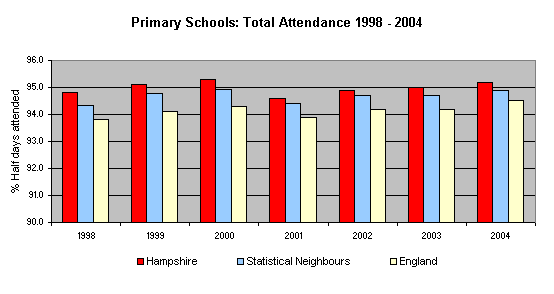
7.1 From the absence statistics collated by the DfES, it can be seen that, for Primary schools maintained by the LEA, the total attendance (measured as a percentage of half days attended) for the last academic year (2003/04) rose for the third consecutive year and now stands at 95.2%. This compares very favourably with our statistical neighbours who had an attendance figure of 94.9% and with the national average of 94.5%.
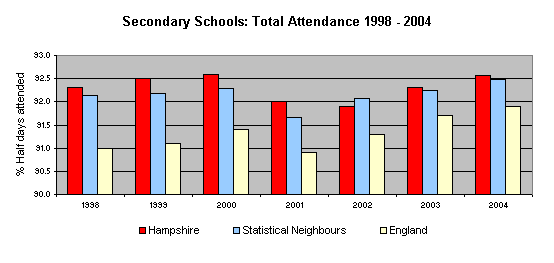
7.2 For Secondary schools maintained by the LEA, in 2003/04 the total attendance rose for the second consecutive year and now stands at 92.6%. This compares with 92.5% for our statistical neighbours and 91.9% for the national average.
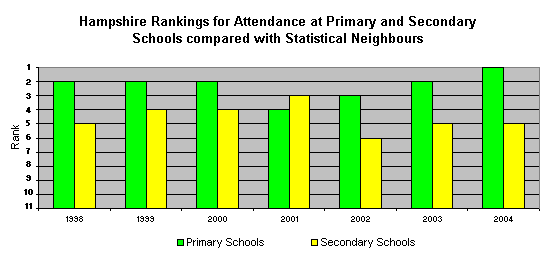
7.3 The achievement of the primary schools puts Hampshire in first place (out of eleven) amongst our statistical neighbours. On a similar basis, the secondary schools achieved fifth place.
7.4 The combined average attendance for primary and secondary schools in Hampshire in 2003/04 was 94.00%. The calculation of this average was weighted according to the number of primary and secondary pupils. This figure places Hampshire (which is the third largest LEA in the country as measured by total pupil numbers), 16th out of 150 Local Education Authorities for attendance.
7.5 The national Public Service Agreement (PSA) target is to reduce overall absence by 8% over 5 years from the base point of 2002/03. For that year the combined average primary and secondary absence figure for schools in Hampshire was 6.24%. Accordingly, the targets set for Hampshire are:
2004/05 6.03% overall absence
2005/06 5.92% overall absence
2006/07 5.81% overall absence
2007/08 5.71% overall absence
7.6 These figures have been incorporated into the Education Department Plans for the respective years.
7.7 In those cases where individual pupil attendance falls to 80%, the school is expected to refer the case to the Education Welfare Service. In the last full academic year (2003/04), over 2,800 such referrals were made representing 1.7% of the total number of pupils on roll.
7.8 Attendance improved in 73% of the cases referred to the Education Welfare Service after initial intervention by the Education Welfare Officer.
7.9 During the course of the year, 254 cases were referred for prosecution and of these 226 were prosecuted. 188 were found guilty and of these 113 were fined, 42 were given a Parenting Order, 9 received a Community Punishment Order and 3 received a custodial sentence. The others received either a conditional or an absolute discharge.
7.10 During the course of the year, 247 pupils were referred to the Schools Counselling Service and 84 for Family Group Conferencing.
7.11 Finally, as a separate exercise, 22 Truancy sweeps were carried out resulting in 549 children being stopped, 355 of whom were accompanied by a parent or carer. 230 were of primary school age and 319 of secondary school age. The most common explanations for their absence were sickness (132), Inset Day (90), medical appointment (68) and truanting (58). 81 were returned to school accompanied by an Education Welfare Officer or the Police.
7 County Council Policy Requirements.
7.1 Legal Implications - the LEA is required under section 23 of the Anti-Social Behaviour Act 2003 to put in place a Code of Conduct for the issuing of Penalty Notices in respect of unauthorised absence. In doing so, the LEA is required to comply with the Education (Penalty Notices) (England) Regulations 2004, and to have regard to the guidance issued by the Department for Education and Skills.
7.2 Financial Implications - the LEA will incur additional work both due to the administration of the Penalty Notice process and the likely increase in the numbers of parental prosecutions which will take place following non-payment of Penalty Notices. An additional part-time (0.5FTE) Scale 5 admin post will therefore be required. The estimated cost is:
Salary (pro rata based upon midpoint for Scale 5 post) £10,773
Cost of Training and IT Support ( £200 + £300) £ 500
Total £11,273
Funding will be provided from adjustments to a number of previously agreed Standards Fund projects and will be subject to review.
8.3 Personnel Implications - the recruitment using normal selection procedures of a EWS court admin support officer (Scale 5, 0.5 FTE).
8.4 Community Cohesion, Inclusiveness & Partnership Working - the Education Welfare Service seeks to raise awareness of school attendance and its significance within the community as a whole. Initiatives such as `truancy sweeps' facilitate this. The Education Welfare Service records the personal details of all children referred to it including their ethnic origin, first language etc.. Issues around the underachievement of minority groups are actively addressed when they arise. For example, the Education Welfare Service has two Traveller Education Welfare Officers in post and two Teacher Advisers for Traveller children. Their role is to actively promote and encourage the attendance of children from within the traveller community and to advise and develop specific materials for teaching staff to ensure the inclusion of children. The current work of the Education Welfare Service requires working in partnership not only with parents/carers but also with colleagues from other agencies/disciplines including school staff, Social Services (in helping to promote and safeguard the welfare of children), the Health Services, Connexions and the Police.
8.5 Crime Prevention Issues - children who do not attend school are more likely to become involved in crime or may become the victims of crime. They may be exposed to an increased risk of substance abuse. Improved school attendance will reduce the likelihood of these crime linked issues. If taking the initiatives and actions outlined in this report is effective in reducing unauthorised absence, it is anticipated that this may not only lead to a reduction in juvenile crime but may also help prevent children and young people becoming the victims of crime.
8.6 Impact Assessment - race and equality impact assessment has been considered in the development of this report and no adverse impact has been identified.
8.7 Views of the Local County Councillor - this report provides information on a country-wide basis. Views of local or individual councillors have not, therefore been sought.
Recommendations:
· That the Education Policy Review Committee note this Report.
· That the Education Policy Review Committee note that, on 23 December 2004, the County Education Officer, empowered by the Executive Member for Education on behalf of the County Council, adopted the attached Code of Conduct for the Issuing of Penalty Notices in respect of Unauthorised Absence.
Section 100 D Local Government Act 1972 - background papers
The following documents disclose facts or matters on which this report, or an important part of it, is based and has been relied upon to a material extent in the preparation of this report.
NB The list excludes:
1) Published Works
2) Documents which disclose exempt or confidential information as defined in the Act.
None