
Archived decisions
Progress Report on the Educational Achievements of Children Looked After in Hampshire | |||
Contact: Rachel Hughes, 01962 845232, [email protected]
1 Summary
1.1 This report provides an overview of the issues affecting the educational achievement of Children Looked After in Hampshire. The report contains detailed analysis of the performance of Children Looked After, compared with national targets and statistical neighbours. Most importantly the report describes how key factors around service delivery are addressed, with proposals for improvement in order to ensure the County Council provides good outcomes for children and young people.
1.2 This report contributes directly to five of the six key aims of the Corporate Strategy. Supporting and promoting the educational achievement of Children Looked After directly impacts on maximising life opportunities. Children Looked After are amongst the most vulnerable groups and as corporate parents it is essential to work to reduce the impact of discrimination through the provision of high quality, accessible learning and caring services. Children Looked After have a role to play in achieving economic prosperity and in building strong and safe communities. Through educational achievement children's life chances are increased and they are enabled to make a more positive contribution. The report demonstrates a need to improve services to meet this challenge and develop councillors and staff so that they have the appropriate skills and knowledge to ensure that the County Council can fulfil effectively its role as corporate parent to Children Looked After.
2 Who are Children Looked After? - Legal definitions
2.1 The legal requirements for Children Looked After are defined by the 1989 Children Act. There are three main categories:
A Care Order is made by the court following a series of reports and assessments which places the child in the care of the local authority.
An Interim Care Order is temporary and is imposed whilst court ordered assessments and reports take place. This often leads to a full care order being made.
A child is accommodated by the local authority with agreement by either the parent or the child. There are no court proceedings and parents retain parental responsibility.
2.3 Parental responsibility is an important legal issue as it determines who has rights, duties, powers and responsibilities in respect of a child. It may not be the person who is looking after the child on a day to day basis. A Care Order does not remove parental responsibility from a parent: it is often shared between the parent(s) and the local authority. This means that parents continue to have a right to contribute to plans and decisions about their child's care including their education. As such they have to be consulted and involved as much as possible in key decisions
2.4 The Children Act 1989 placed greater emphasis on keeping families together, therefore those who become looked after tend to require more complex services for support.
3 Why are Children Looked After a priority?
3.1 Under the 1989 Children Act the Local Authority has a duty to safeguard and promote the welfare of all Children Looked After . A critical dimension to this is their education. Hampshire County Council is required to act as the `Corporate Parent'; this means acting in a way that any good parent would. The new 2004 Children Act gives the Local Authority an additional duty to promote and support the educational achievement of Children Looked After. This extends beyond Children's Services, to all departments within the Authority and to other agencies outside the County Council who, from April 2005, will be under a new `duty to co-operate'.
3.2 There are approximately 60,000 children in care across England, with just under 1000 in Hampshire at any one time. The time spent in care varies widely. Some groups are over represented; nationally boys make up about 56%, children from ethnic minorities about 10%. Children in care are also more likely to come from families in lower socio-economic groups and especially children whose mother has spent time in care. A recent study by the National Children's Bureau1 showed that a quarter of girls who have been looked after become parents by the time they reach the age of sixteen, and half of them become mothers within 18-24 months of leaving care.
3.3 Children Looked After tend to have lower levels of achievement, experience higher levels of exclusion and move schools more often because of changes of care placement. Many Children Looked After are vulnerable and often present complex issues which need to be addressed. Appropriate support for these children and systems which are responsive to their complex needs will also benefit other children and communities.
3.4 Most children are in care because of abuse or neglect or for family reasons; very few children, less than 10%, are in care because of their own behaviour. The majority experience psychological problems resulting from their life experiences.
3.5 About two thirds live with foster parents with the other third living either in children's homes or with their own families. There is an increasing trend in Hampshire for children to be placed in `kinship care' arrangements, where they are placed with members of their extended family. This brings many benefits, most notably giving children stability and continuity of both care and education. Approximately 25% of children have to live outside Hampshire because of a shortage of care placements within the County.
3.6 About 27% have statements of special educational needs, 10 times the rate of their peers. The causes and effects of this are complex.
3.7 A third of rough sleepers have been in care and a quarter of adults in prison have spent some time in care. This figure increases to as much as half of young people in young offender institutions.
3.8 It is thought that improving the education, training and employment levels of care leavers to that of their peers would save £300 million over 3 years2.
3.9 Under the Children Act 2004 all local authorities have a duty to support and promote the educational achievement of Children Looked After. New guidance is expected to include stricter rules about changes to care placements which require a change of school. Children placed in other LEAs pose particular difficulties as the receiving LEA (unless the child has a statement of special educational needs) is responsible for providing the child with education. This can make it difficult to ensure they receive full time, high quality education provision. To reduce the numbers of children being sent miles away from their home authority, it is likely that Hampshire children requiring specialist services must be placed within the South East Region. There is also a new ministerial steer towards an even greater role for parents. This is likely to emphasise the need to ensure that all Children Looked After are not disadvantaged by a lack of parental involvement.
4 Measuring success
4.1 The new framework for the inspection of children's services (currently the subject of government consultation) is likely to require detailed reporting on how far services are working together to secure positive outcomes for children. Successful outcomes for agencies including Education and Social Services are interdependent. For example, improvements in the performance indicator for increasing the number of looked after children achieving 5 GCSES A*-C and care placement stability are linked. In any Annual Performance Assessment and Joint Area Review, services both to Children Looked After and those children with learning difficulties and disabilities will be examined in detail.
4.2 The achievement of children looked after is also celebrated throughout the year with a series of prize giving events to recognise individual academic and personal success.
5 The Team for the Education of Children in Care
5.1 This multi disciplinary team was set-up in January 2003 with five officers, 2.5 full time equivalent advisory teachers and 2 education social workers. Since then it has grown to include a manager, a senior educational psychologist, seven learning support assistants and a small administration team. The team are mostly funded by a combination of Standards Fund, Social Services secondments and Public Service Agreement money. All contracts and secondments are due to end March 2006. The Team currently costs £400,000 only £150,000 of which is from base budget. Hampshire County Council contribute £114,000 as the 50% contribution to the Standards Fund. It would therefore cost an additional £136,000 to fund the Team entirely from the base budget
5.2 The multi-disciplinary working helps to ensure that children, young people and their families are given swift and simple access to the complementary skills of a range of people working together. It also enables access to focussed, specialised support. It is important that professionals within the Team have continuous professional development, appropriate clinical and professional supervision, management, and clear lines of accountability.
5.3 The aim of the Team for the Education of Children in Care is to promote and support the education of all children and young people in public care in Hampshire schools as well as Hampshire children placed in other local authorities. The Team supports children to achieve their potential, working with other agencies, helping children access appropriate education provision, targeting those at risk, and providing advocacy for young people. Children Looked After have the same range of ability as other children and there should be high expectations of them. Children Looked After have contact and involvement of a number of agencies and communication is vital. For example the Team works closely with Swanwick Lodge Secure Unit to broker educational provision for young people on release.
5.4 DfES guidance advises that each child and young person should be provided with between 21 and 24 hours of provision per week, depending on their age. Bespoke packages often need to be brokered to match individual needs.
5.5 The Team works with schools to provide advice and to support proactive policies and procedures. Each school should have a designated teacher for Children Looked After and the Team support schools and teachers with up to date training and advice.
5.6 The Team also works with young people to ensure that they have the same educational opportunities as their peers despite missing large periods of school and experiencing changes of school place. The Team provides advice and support for young people, individually or in groups. It is vital to identify those at risk of exclusion and to provide support to help prevent this. It is important to listen to children and tailor services to their needs as emphasised by the Children Act and the green paper `Every Child Matters'.
5.7 Support is provided beyond the national curriculum to help the children access activities outside the school day. Children Looked After can sometimes experience more obstacles in accessing these opportunities than their peers and the Team works with schools and other agencies to promote an enriched school life.
5.8 Due to the high number of agencies often involved the Team has developed local networks to support all of those working with Children Looked After, including agencies external to the authority such as Connexions.
5.9 The Team advise carers how to support their children with their education, eg the need for good attendance at school, homework to be completed on time, as well as up to date information about admissions and exclusions procedures. The Team holds monthly meetings for the education representatives in children's homes where education issues are discussed and information and good practice shared. The Team supports foster carers by contributing to their regular networks meetings and writing and delivering the training for new foster carers. The Team is now jointly offering consultations with an educational psychologist for those carers who have a particular difficulty with an aspect of their child's education or would like specific advice on how best to support their young person's educational progress.
5.10 The Education Support Service within the Social Services Department comprises 3.5 teachers and provide similar services. Each member of the Education Support Service is managed by a Family Support Team Manager and deemed to be part of the staffing establishment of Family Support Team. The Departments are jointly addressing issues of overlap and ways to improve deployment.
6 Personal Education Plans
6.1 All Children Looked After should have a Personal Education Plan (PEP), completed annually and reviewed every six months. The views of Children Looked After should be at the centre of this plan with a range of other agencies contributing to it. It should: ensure access to services and support, contributing to the stability of the school place; signal particular special educational needs and ensure that they are catered for; establish clear goals for the educational life of the child; and provide a record of achievement and progression, especially for children who experience high numbers of placement changes.
7 Achievement at KS4 in comparison with our statistical neighbours 3 2002/3
7.1 The following graphs represent how well Children Looked After in Hampshire performed in comparison with their peers, and other local authorities. It should be noted that in many cases the looked after cohort is very small and can distort figures through the achievement levels of just a few children. 2002/3 is the most recent year for which full comparative information was available at the time of writing.
7.2 All of our statistical neighbours scored between 95% and 97% achieving 1 GCSE A*-G for their main cohort. Hampshire achieved well in comparison with other authorities, with the second lowest gap between achievement levels of Children Looked After and their peers, as indicated below. 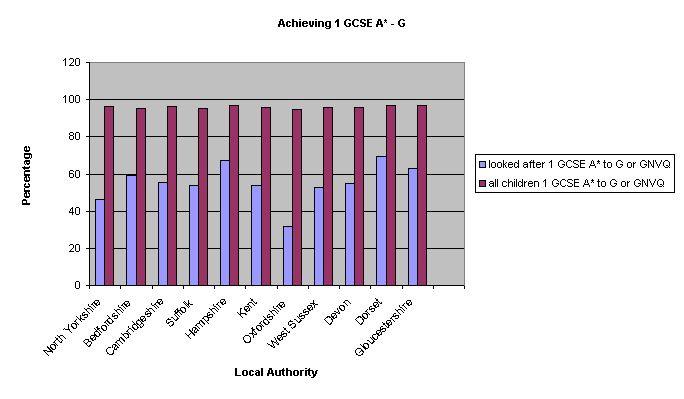
7.3 The chart below shows that Hampshire also performs well alongside other authorities for those children achieving 5 GCSEs A* - G. Hampshire has the highest levels of achievement of both the looked after and the main cohort compared to statistical neighbours. However there was still a 37% difference in performance between Children Looked After and their peers in Hampshire. 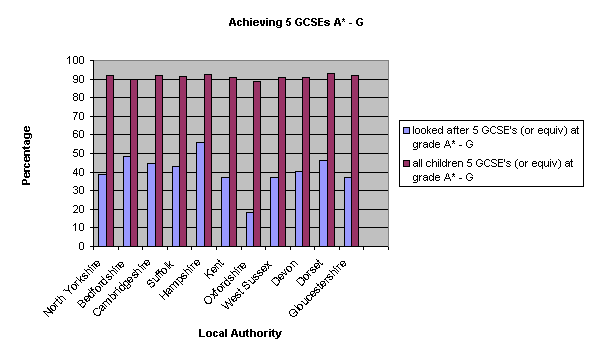
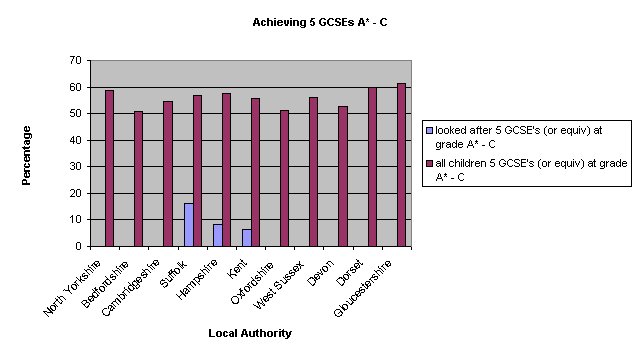
7.4 As can be seen below, Hampshire is just one of three authorities where any Children Looked After achieved 5 GCSEs A*-C. However with just 8% of Children Looked After achieving this level the difference is 50% compared to other children in Hampshire.
8 Achievements in Hampshire 2003/4 KS1 to KS4
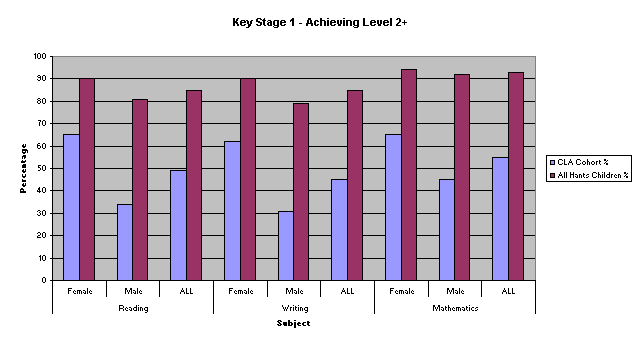
8.1 The chart below refers to a cohort of 55 Children Looked After who took KS 1 SATS in 2004. The `All' figures refer to the full cohort of approximately 14,000 children. As well as the relatively poor performance at this earliest stage it should be noted that the differences in achievement for boys and girls is marked, especially in the areas of reading and writing. Girls consistently out-perform boys at this age.
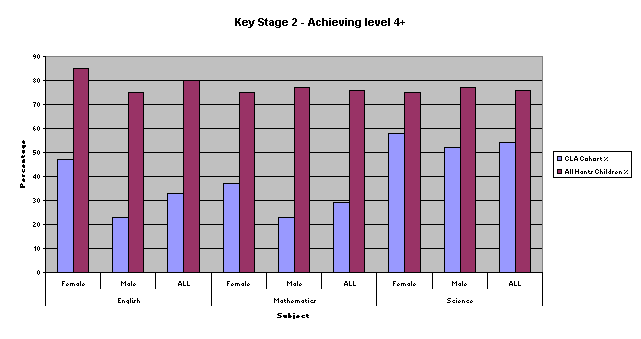
8.2 In the chart below there were 49 Children Looked After who took KS 2 SATS in 2004 . The national target is for the outcomes for these 11 year olds to be at least 60% as good as their peers in English and maths. In Hampshire the performance was 41% as good as their peers for English and 38% as good as their peers for maths. The performance of Children Looked After in science appears to be closer to their peers than in other subjects.
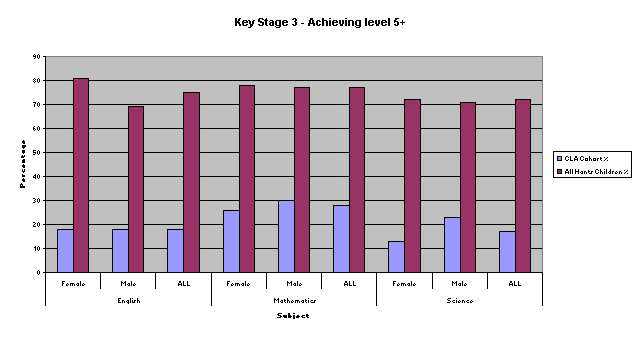
8.3 The chart below refers to a cohort of 89 Children Looked After who took KS 3 SATS in 2004. There is a national target of 50% for 14 year olds to achieve a level 5 in their key stage 3 SATs. In Hampshire last year the performance was 19% for English and 28% for maths as can be seen below. For the first time boys are seen to outperform girls, though this is not the county wide trend.
8.4 The graph below shows the performance of all Children Looked After in Hampshire schools, as well as Hampshire children placed in other authorities. One of the key foci for this group is the proportion that become disengaged from education with the target being no more than 10% reach school leaving age without having sat an exam. In fact 34% of those Children Looked After educated in Hampshire schools did not sit any exams. This increases to 58% for Hampshire Children Looked After educated in other authorities. The difference for those placed in other authorities is marked. This may be partly explained because children in care placements outside of Hampshire may have more complex needs or they may have missed large periods of school. It is also more difficult to monitor children in other authorities and support them in school in the way we can if they are placed in Hampshire.
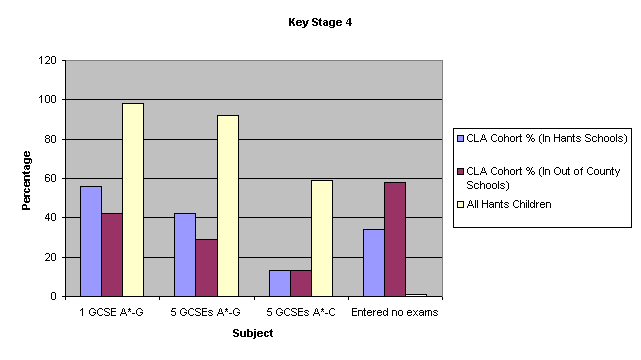
8.5 Reducing the number of Children Looked After who leave school with no qualifications to below 10% is a contentious target because a disproportionate number of Children Looked After have special educational needs which may prevent them from achieving at this academic level. However Hampshire recognises that achievement for all children is important and is currently developing accreditation through `p' levels for those children with moderate and severe learning difficulties and disabilities.
8.6 The local Public Service Agreement target for Children Looked After achieving 5 GCSEs A*-G was 69%. The cohort in 2004 achieved 42%. The target for those achieving 5 GCSEs A*-C was 21%, and achievement was 13%, up from 9% in 2003. As 34% had statements of special educational needs, with 31% attending a special school, the over representation of Children Looked After with learning difficulties is evident. 16% were in part time EOTAS provision. It is interesting to note that compared to KS 1 the achievement gap between boys and girls narrows, with boys outperforming girls in some cases.
8.7 Of those children who did achieve 5 GCSEs A*-C all were in foster care, had experienced no care or school placement moves in years 10/11 and attended a mainstream school. These represent the critical success factors.
8.8 Since the development of the County's specialist care leavers' service (CLASS), the numbers of young people engaged in education, training and employment have substantially improved, in recognition of `our' duty to improve the life chances of young people living in and leaving local authority care, up to the age of 21 (24 in education). The January 2005 statistics indicate that CLASS currently supports 391 young people and is in regular contact with 93% of them. Of those: 50% are in education and training, 22% are in employment, 13% are unemployed, 9% are full time parents and
4% in custody. Of the young people in education, 10 students are at university, with a further 4 taking gap years.
8.9 Hampshire performs quite well on most measures against its statistical neighbours but the County Council's approach is to strive for higher standards for all children whatever their comparative figures.
9 Removing barriers to achievement
9.1 Measures in place to improve stability so that children do not move home or school, especially at critical times such as when they are sitting their SATS or in Years 10 and 11 are likely to be of significant benefit.
9.2 Children Looked After need to remain engaged with school work. This can be achieved with quicker admissions, increased attendance and full time provision. Schools need support to develop personalised learning programmes which suit the needs of every looked after child. More training would help carers support their child's education.
10 Improvements
10.1 Effective planning and intervention requires up to date information to be exchanged across departments at all levels. The Social Services County Placement Forum is the key group. The manager of the Team for the Education of Children in Care attends this group regularly to ensure education is a key consideration when determining a child's care placement.
10.2 The `Corporate Action Partnership for Looked After Children' (CAPLAC) is an overarching group which works across all sections of the authority. This is a multi-agency strategic group which seeks to ensure that the entitlement to education of young people in public care is upheld on the corporate parent principle. The focus of this group is currently being revised to provide better accountability and support to those working with Children Looked After.
10.3 The `Children Looked After Support Panel' (CLASP) is a multi-agency panel that meet every month to discuss and assist in securing educational placements for Children Looked After. The cases that are presented often require extraordinary and exceptional solutions, beyond conventional procedures to cater for their complex needs.
10.4 To avoid time out of school it is essential that Children Looked After can be admitted into school with minimum delay. New guidance has been issued from the DfES on `hard to place pupils' and Children Looked After are a category within this guidance. Protocols are being developed to ensure that schools work in partnership to admit hard to place pupils, and that children requiring admission are shared equitably. However it should not be assumed that all Children Looked After are hard to place as many have the potential to achieve well and make a very positive contribution to any school.
10.5 In the academic year 2003-4 Children Looked After in Hampshire were permanently excluded at a rate six and half times higher than their peers. Though high, this is still lower than national trends where children looked after are excluded at ten times the rate of their peers. It is proposed that as well as working closely with schools with preventative measures, the Team supports carers with the process of exclusion and advocate strongly as corporate parents.
10.6 It is proposed that a new model is developed to collect attendance data for children looked after. The proposed system is more proactive and looks at attendance data on a regular basis to identify where individual children's patterns of attendance is starting to decrease. Appropriate interventions can then be made an early stage, with the support of the Education Welfare Service to help to rectify the issues and to bring them back into school.
11 Legal Implications
11.1 None
12 Financial Implications
12.1 Please refer to paragraph 5.1
13 Personnel Implications
13.1 None
14 Impact Assessment
14.1 The work of this team is essential to the equality of opportunities agenda.
15 Crime Prevention Issues
15.1 There is a danger of stereotyping Children Looked After as more likely to commit offences and this needs to be avoided. The baseline proportion of children aged 10-17 cautioned or convicted is 3.6% nationally. The figure for Children Looked After is 10.8%4. Few Children Looked After do not engage in crime and to reduce the numbers even further efforts are being made to ensure that Children Looked After are fully engaged in education with a full time school place, and positive recreational activities after school.
Recommendations
1. That the Committee note the content of this report and welcome the new and ongoing work of the Team for the Education of Children in Care.
Section 100 D - Local Government Act 1972 - background documents
The following documents discuss facts or matters on which this report, or an important part of it, is based and have been relied upon to a material extent in the preparation of this report.
NB: the list excludes
1. Published works
2. Documents which disclose exempt or confidential information as defined in the Act.
None