Archived decisions
Progress Report on the Educational Achievements of Ethnic Minority Children and Children for whom English is an additional language | |||
Contact: Liz Statham, 01256-330195, [email protected]
1 Summary
1.1 This report provides an overview of the issues affecting the educational achievement of ethnic minority children and children for whom English is an additional language. It contains detailed analysis of ethnic minority pupil attainment with reference to national targets and our statistical neighbours, describes the contribution of the Ethnic Minority Achievement service to the achievement of ethnic minority children and children for whom English is an additional language and outlines proposals for improvement.
This report supports the following aims of the Corporate Strategy: Supporting and promoting the educational achievement of ethnic minority children directly impacts on maximising life opportunities by ensuring that every ethnic minority child and child for whom English is an additional language achieves as much as they are able to through school. This enables them to play a part in achieving economic prosperity because of better employment opportunities. Tackling racism, crucially linked with attainment of ethnic minority children and children for whom English is an additional language, helps in building safe and strong communities. The report sets out ways of improving the service and the achievement of ethnic minority children and children for whom English is an additional language.
2 Ethnic minority children and children for whom English is an additional language
Nationally 17% of young people attending maintained schools are from minority ethnic communities. Ethnic minority children make up 3.32% of the Hampshire school population. 1.79% are pupils for whom English is an additional language. 77 languages are spoken by children in Hampshire schools. In 2004-2005 36 schools were new to working with bilingual learners. There are 29 asylum seekers and refugees known to the EMA service currently in Hampshire schools.
There are ethnic minority children and children for whom English is an
additional language in schools all over Hampshire. Employment patterns, the deployment of the armed forces and the political situation in countries of origin produce a changing profile in Hampshire schools. The percentage per school varies from 1% to 20%. Schools in Rushmoor and Basingstoke have the highest numbers. Being isolated from family, community groups and ethnic minority services is a feature of being from an ethnic minority group in Hampshire. Families near the Portsmouth and Southampton borders often use facilities in the cities such as community language classes, race equality network of organisations, adult education facilities and places of worship.
3 Achievement of ethnic minority children and children for whom English is an additional language
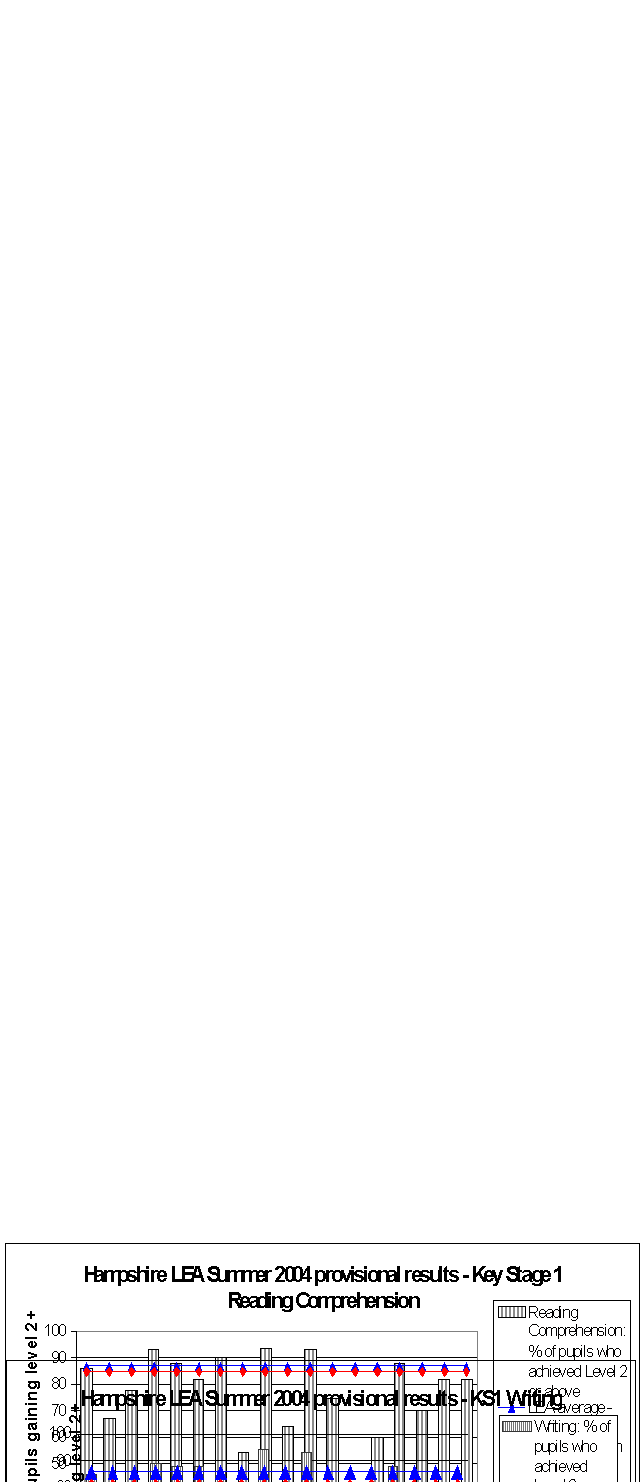
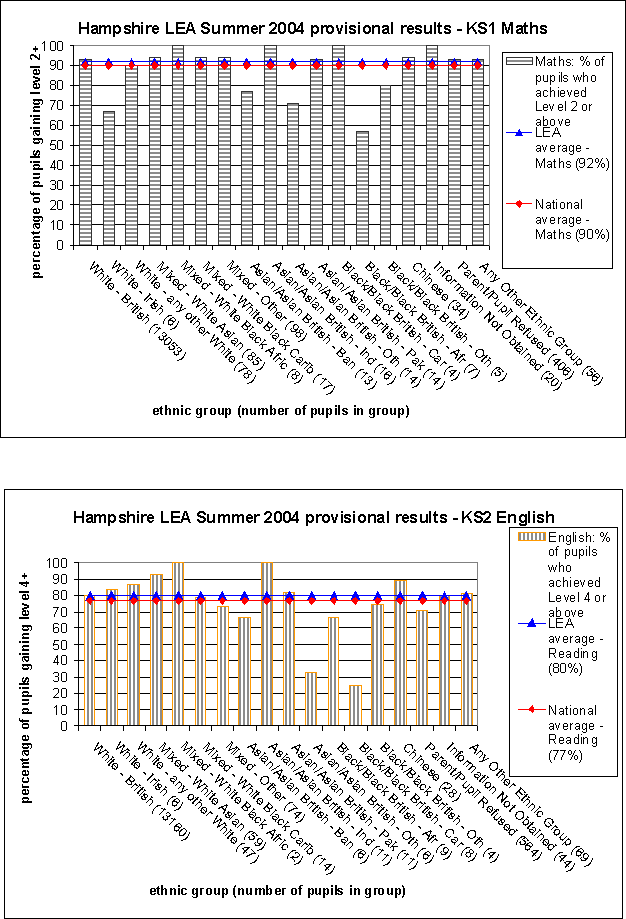
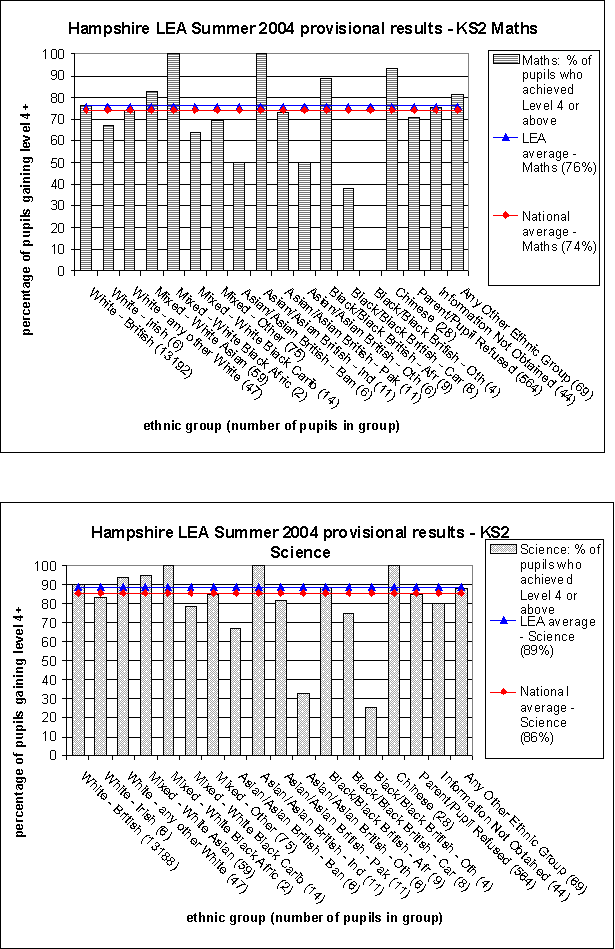
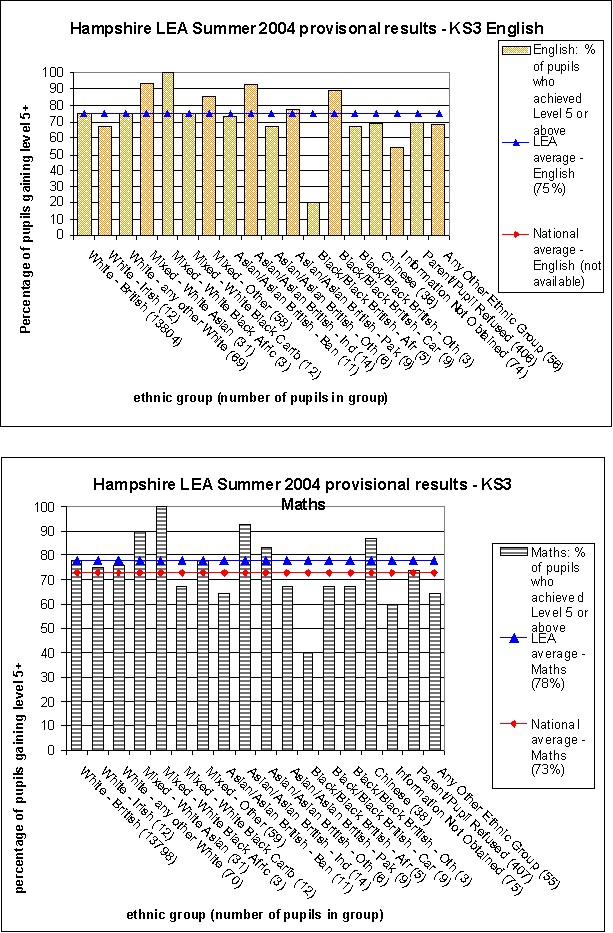
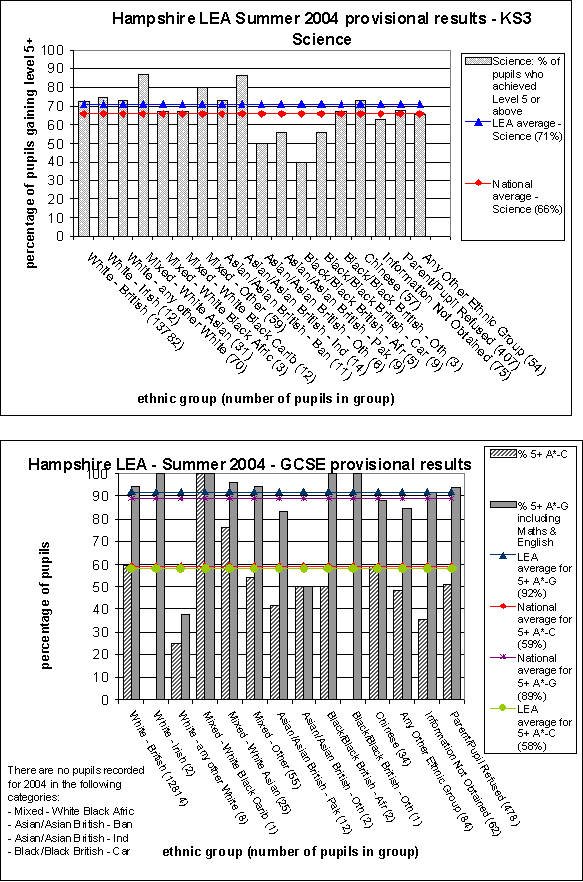
3.1 The graphs in Appendix 1 represent how well ethnic minority pupils performed in summer 2004. It should be noted that the numbers are small and cohort sizes vary from year to year. Comparison of performance of four or five children with a cohort of some 14,000, for example, must be treated with caution. The target for 2004 was to close the gap between county target and attainment of all ethnic minority groups. National results for 2003 by ethnic minority group show that White and Black Caribbean, White and Black African, Pakistani, Bangladeshi, Black Caribbean, Black African, Any other Black background and Any other ethnic group all performed below the 5+A*-C GCSE/GNVQs national average of 50.7%.
3.2 Nationally 2004 results for English GCSE show that Chinese and Indian achievement starts above national average at Key Stage 1 and improves by the end of Key Stage 4. All other groups start below national average at Key Stage 1. Bangladeshi achievement goes up from Key Stage 1 to Key Stage 2, dips at Key Stage 3 and goes up slightly at Key Stage 4. Pakistani achievement is weak at Key Stage 2 but improves slightly at Key Stage 3 and Key Stage 4. Black African achievement is quite strong at Key Stage 2 but it falls away by Key Stage 4. Black Caribbean achievement is steady at Key Stage 1 and Key Stage 2 and then falls significantly in Key Stage 3 and Key Stage 4.
3.3 A focus on Bangladeshi, Pakistani, Black African and Black Caribbean groups in Hampshire shows:
Bangladeshi Key Stage 1 results are still below national or county averages, down in reading, writing and slightly down in mathematics from 2003. Key Stage 2 results are still below national and county averages, have held up in English but dropped in mathematics and science. Key Stage 3 results are up slightly from 2003 in English, very nearly reaching the county average, down in mathematics (well below English and science results) and up in science. There are no results for Key Stage 4.
Pakistani Key Stage 1 results are above national or county averages, up significantly in reading, writing and mathematics from 2003 and are now similar to comparable authority 2003 results. Key Stage 2 results are up in English and now slightly above the county average, though still slightly below the county average for mathematics and below for science. Key Stage 3 results are up from 2003 in English, mathematics and science but Key Stage 4 results are below national and county averages, down from 2003.
Black African Key Stage 1 results are below county averages and they are down across reading, writing and mathematics from 2003. Key Stage 2 results are still below county averages - up in mathematics and science but down in English from 2003. Key Stage 3 results are still well below the county average, down from 2003 significantly in English and maths but the same for science. At Key Stage 4 they are the same or above the county averages.
Black Caribbean Key Stage 1 results are still below the county average and down in reading, writing and mathematics since 2003. Key Stage 2 results are still below the county average, down from 2003 in English, mathematics and science. Key Stage 3 results match the county average in English but are below in mathematics and science but are an improvement in all three subjects from 2003. There are no results for Key Stage 4.
Chinese results are above national averages throughout the key stages but are down from 2003 at Key Stage 1, Key Stage 3 and Key Stage 4.
3.4 Hampshire's 2003 results were generally in line with those of statistical neighbours with similar numbers in each ethnic minority group. Black African and Black Other results were significantly higher in the comparable authority at Key Stage 2. Black African results were markedly lower overall in the comparable authority and Pakistani results were markedly lower in maths.
3.5 There are no significant gender concerns except for Bangladeshi boys at Key Stage 1. Boys are outperforming girls in English, mathematics and science at Key Stage 2 apart from Black African in English and Black Other in science. Bangladeshi and Pakistani boys are achieving more than girls at Key Stage 3.
4 The Ethnic Minority Achievement Service
4.1 The aims of the EMA service are to increase achievement of ethnic minority children, to locate responsibility for achievement of ethnic minority children with schools, to proactively prevent failure for every ethnic minority child. To achieve these aims the service works with children, schools, parents and communities. In any one year it works in approximately 300 schools.
4.2 The service was re-structured in September 2004 and it provides early profiling for all newly arrived pupils. It also provides up to 11 hours total direct support from a bilingual assistant or specialist teacher for all new arrivals in the centrally funded part of the service. The groups supported are the following: Black African, Thai, Bengali, Turkish, Portuguese, Filipino, Nepali, French, Chinese, Spanish, Arabic, Russian, Urdu, German. These groups were the underachieving groups and the groups with most numbers when the re-structuring was planned in spring 2004.
4.3 The service also identifies schools with children at risk of underachieving and works with approximately 25 schools in 2004-2005 on analysing data, planning and working with children and staff to raise achievement. Through a protocol with inspectors a judgement about schools' monitoring of ethnic minority achievement is made available to attached inspectors to inform their validation of school self-evaluation.
4.4 Part of the service is brokered and this supports a pool of experienced and trained staff who are bought in by schools. The brokerage service offers support to schools for all children in other groups, including 86 speakers of 12 Eastern European languages. However, having some languages supported by the central budget and the support for others being brokered for schools does create a two tier system although the quality of support is equally good across both groups. It would cost approximately £100,000 to restore the service to the level of provision before 2004 so as to be able to include 11 hours of new arrival support for all language groups, funded from a central budget, rather than as part of the brokered service.
4.5 The EMA service provides a range of training for school staff. There is staff conferencing on meeting the needs of all new arrivals and class conferencing on integrating newly arrived children. The service is training Hampshire classroom assistants in support for English as an additional language along with Portsmouth City Council and the University of Portsmouth, as one of two national pilot consortiums. The EMA service has also developed diversity training for a range of Hampshire County Council departments, for example regulatory services, libraries and the countryside service. This diversity training supports departments with strategies to improve access for `hard to reach' groups.
4.6 The EMA service consists of specialist teachers, bilingual assistants, a cross cultural counsellor, and administrative staff. In addition project officers deliver externally funded programmes. Examples are homework clubs for the integration of monolingual and bilingual children, access to ESOL classes, and other vocational training for parents, particularly isolated Bengali speaking women. The funding for these projects has come from a range of providers including Children' s Fund, Global Grants, Standards Fund, the Early Years and Childcare Unit and the Adult and Community Learning Unit. Partnership working with a range of agencies enhances provision for ethnic minority children and their families. There is user involvement in the planning of provision.
4.7 The EMA service plays a key role in underpinning provision for ethnic minorities across the education service by providing guidance, interpreting and translation and training.
5 Removing barriers to achievement
5.1 To enable ethnic minority children to achieve their potential Hampshire County Council is required to co-ordinate the collection and analysis of data. This includes monitoring of pupils not registered at school and who are not receiving any other form of support, the performance of pupils who join schools at non-standard times, the improvement of attendance for minority ethnic pupils and attention to issues arising from different contexts, including school places, admissions, asylum seekers and refugees.
5.2 Admissions can be a particular barrier. Newly arrived children, particularly in Year 11, can find obtaining a school place difficult. These children are not `hard to place' in the sense that they are disruptive. Indeed if the 14-19 provision is planned as a continuum then well educated new arrivals should be able to move smoothly into college, training and/or employment often subsequently contributing significantly to the local economy. But, sometimes it takes up to two months for families to find a school place and this reduces rather than enhances integration and educational achievement.
5.3 Although there is good work taking place in some areas there still needs to be better linkage between strategies to support ethnic minority children and children for whom English is an additional language and other key strategies and initiatives, for example the National Primary Strategy and the Key Stage 3 Strategy, the SEN strategy, support for early years, monitoring and challenging schools and support for looked after children.
5.4 Tackling racism is a particular challenge. The effects on families are significant. There is likely to be a knock on impact on achievement as there are clear links between racism and underachievement.
5.5 Children in Hampshire Gurkha families are part of the turbulent school population. As yet there is no national funding for them to take from authority to authority.
5.6 As part of the conditions of the Ethnic Minority Achievement Grant from the DfES, the LEA is required to monitor the use of these funds and its impact on attainment. The service places great emphasis on ensuring that bilingual children are placed appropriately - that is, not in low sets or groups simply because learning has not taken place in English. However, monitoring by a group of external consultants in 2004 showed that expectations still need to be higher. Children placed in low sets and groups may in some cases not find it easy to move up. This can lead to disaffection and consequent underperformance.
6 Improvements
6.1 Achievement in Hampshire is generally good but the County Council will want to achieve more. A number of steps need to be taken and work has already begun.
6.2 Better data needs to be available. It is not sufficient to consider the results at the end of key stages. The progress of individual children needs to be tracked regularly and judgements made about the effect of interventions, by schools and by the EMA service. This would make it possible to identify more accurately the factors leading to underachievement, to track the progress of ethnic minority cohorts across the county, to assess the impact of such things as homework clubs and access programmes for minority ethnic parents on the achievement of children and to investigate if there are significant differences between progress of asylum seekers and other ethnic minority children.
Work is being done to address this. The Council has progression data at pupil level, and hypothetically, it is possible to produce analyses for a range of groups within the overall pupil population, gifted and talented pupils, those with statements of SEN, Looked After Children and children from ethnic minority backgrounds. It is a matter of configuring the resource differently in order to create time for the work to done, and this will be essential for the implementation of the Children Act in Hampshire and for the Children's Authority to discharge its responsibilities.
6.3 It is also important to effect some cultural change. The EMA service is a support service. The responsibility for pupil progress lies with schools and the EMA service exists to help schools to fulfil that responsibility. Currently, provision is not consistent across schools or year groups within them. The new self evaluation and Ofsted inspection regime will place more emphasis on the progress of different groups within the overall school population and the School Improvement Service is already considering how best to support schools through these processes.
6.4 More involvement is needed with community groups and voluntary organisations which are better placed, with local authority support, to obtain external funding, submit proposals and commission delivery. This will take time to develop in Hampshire but the work has already begun and the involvement of users maintained and enhanced.
6.5 The Council has a good track record on tackling racism. There is effective monitoring of racist incidents in schools and the results are regularly reported to the Policy Review Committee. However, it is difficult to know whether some incidents go unreported. The gathering of information and views from pupils themselves has a much higher priority under the Children Act, and its accompanying assessment and inspection regime, and it is likely that better information will be available in the future. For 2005, for example, the Education Department has already agreed with headteacher conferences that specific questions related to racist incidents and bullying will be included in the Pupil Attitude Survey. Further, the Education Department continues to develop and publish curriculum resources for schools to help them to address racism in the context of Rights, Respect and Responsibilities. The most recent resource, Coming Unstuck, has been produced for the upper junior years and more of this kind of work will be needed if the Children's Authority, working in partnership with schools, is to fulfil its responsibilities under the Children Act.
6.6 Steps are being taken by the admissions team to reduce the amount of time it takes to find a school place for newly arrived children.
7 Legal implications
7.1 The authority is required to meet the provisions of the Race Relations (Amendment) Act.
8 Financial implications
8.1 The Ethnic Minority Achievement Service is likely to receive £609,000 in 2005-2006 excluding external funding and school funded services. Hampshire County Council contributes 75% of the total funding, DfES 25% through the Ethnic Minority Achievement Grant. Provisionally the service will receive an additional £27,649 from Standards Fund in 2006-2007 and 2007-2008. The Standards Fund ring fencing for ethnic minority achievement will be reviewed for 2008 onwards in the light of the proposed introduction of single school improvement grant.
9 Personnel implications
Externally funded project officers face potential redundancy during 2005 if further external funding that supports their posts cannot be secured.
10 Impact assessment
The work of the EMA service is essential to equality of opportunity, set out in the Council's policies, and to its implementation of the Children Act.
11 Crime prevention issues
The work of this service contributes fundamentally to crime prevention through supporting access to education and achievement within education, and working with other agencies, Hampshire Constabulary and cross cultural counselling, for example.
12 Views of the Local County Councillor
Not applicable
Recommendations
1 PRC notes this report and commends EMA service for the work carried out in raising ethnic minority achievement.
2 PRC asks the CEO to prepare a policy that includes options for raising achievement of ethnic minority children and children for whom English is an additional language that includes options for raising achievement of ethnic minority children and children for whom English is an additional language and extending data analysis.
Section 100 D - Local Government Act 1972 - background documents
The following documents discuss facts or matters on which this report, or an important part of it, is based and have been relied upon to a material extent in the preparation of this report.
NB: the list excludes
1. Published works
2. Documents which disclose exempt or confidential information as defined in the Act
None
APPENDIX