
Archived decisions
Hampshire County Council Executive Member - Environment 22 March 2005 Project Integra Annual Business Plan 2005-10 and Project Integra Behavioural Change Strategy Report of the Director of Environment |
Item |
Contact: Adrian Lee, ext 7004 email: [email protected]
1. Summary
1.1 The following decision is sought
That the Project Integra Annual Business Plan for 2005-10 be approved, subject to the following additional resolutions agreed at the Project Integra Management Board meeting on 13 January 2005:
1. (i) The Board acknowledging the need for substantial change in the remit of Project Integra, its constitution, scope and executive facility. Such change necessary to be developed and agreed upon in the fiscal year 2005-06 for implementation as soon as is practical to meet the requirements under future CPA accounts, Government Guidelines pertaining to waste partnerships and Gershon efficiency savings.
(ii) That a first draft of a business plan 2006-11 for the entire enterprise of waste collection and disposal be developed by the July meeting, in accordance with the format proposed for Joint Municipal Waste Strategies.
(iii) This first draft plan must include a long term forecast of recovery and waste volumes, facilities, investments, efficiency savings outcomes and financial budget that reflects the total expenditure of the joint service.
2. The Material Resources Strategy, organisation and executive changes, and next phase of procurement to be developed and reported to the July meeting.
3. The following additional text to be inserted at Paragraph 6.2.8:
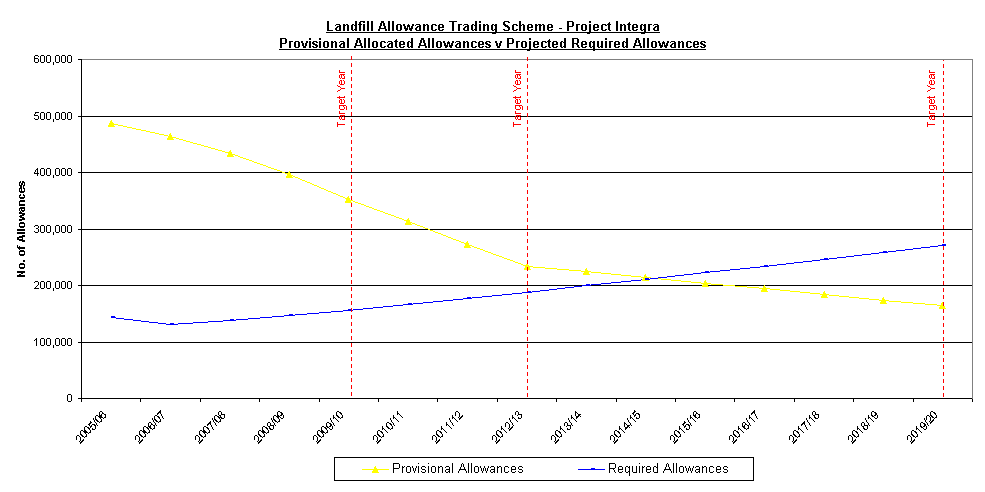
"The financial consequences of not achieving the stretching recycling targets do not take into account the cost implications of ordering and implementing new disposal infrastructure. Under scenario 1, the annual landfill requirements would exceed 200,000 tonnes per year. It is very likely that it would not be sustainable or perhaps even possible to rely on such a high level of landfill disposal. This being the case, further significant investment would be necessary. Clearly, this would add significantly to the overall financial cost burden."
4. The Executive Officer provides the Secretary of State with a statement that:
(i) Expresses the PI Partners' unanimous intention to submit a full and comprehensive JMWMS for Hampshire in April 2006.
(ii) Outlines the steps already in hand to produce a JMWMS.
(iii) The proposed timescale to develop a JMWMS be included in the draft Business Plan 2005-10.
(iv) An Officer Group be convened to oversee the drafting of the JMWMS.
2. Reason
2.1 The decision supports Aims 2 and 5 (Stewardship of the Environment and Improving Services) of the Corporate Strategy by increasing re-use, recycling and recovery, minimising the need for landfill and improving services for re-use and recycling, primarily through the household waste recycling centre network.
2.2 To enable the Project Integra Annual Business Plan for 2005-10 to be adopted by the Project Integra Management Board and, in turn, to enable the vision and long-term strategy to be progressed.
2.3 The Environment Policy Review Committee considered the report on 16 March 2005.
3. Other Options Considered and Rejected
3.1 Taking no action.
4. Conflicts of Interest Declared by the Decision Maker or Other Executive Member Consulted - None.
5. Dispensation granted by the Standards Committee - Not applicable.
6. Reason(s) for the Matter being dealt with if Urgent - Not applicable.
Approved by: Date:
Councillor K B Estlin
Hampshire County Council Executive Member - Environment 22 March 2005 Project Integra Annual Business Plan 2005-10 and Project Integra Behavioural Change Strategy Report of the Director of Environment |
Item |
Contact: Adrian Lee, ext 7004 email: [email protected]
1. Summary
1.1 This report summarises the draft 2005-10 Project Integra (PI) Annual Business Plan but makes observations on how the Plan might be improved.
2. Corporate Strategy
2.1 Achievement of the objectives of this report would help to meet Aims 2 and 5 (Stewardship of the Environment and Improving Services) of the Corporate Strategy by increasing the recycling rate of household waste, increasing level of diversion from landfill and improving the Household Waste Recycling Centre (HWRC) network.
3. Background
3.1 This is the fourth formal Annual Business Plan for PI and is prepared in accordance with PI's constitution. The constitution demands that a draft Annual Business Plan be prepared and approved by the Annual General Meeting of the PI Management Board. The draft Plan is then considered by each of the Partner Authorities. On approval by the Partners, the Plan then becomes the approved Annual Business Plan and forms the framework within which the Board Members may make decisions on behalf of the Partner Authorities. Partner Authorities may approve the draft Plan subject to a reservation in respect of any particular matter on which they have concern.
3.2 The Annual Business Plan is to include a strategy for achieving agreed objectives over the next 12 month period commencing 1 April 2005. It should specify the activities to be undertaken in support of the strategy and contain an assessment of the financial, resource, service, legal and contractual implications.
3.3 This year for the first time the Plan also considers a five-year period 2005-10 and contains some key objectives for that period.
4. The Project Integra Annual Business Plan 2005-10
4.1 The draft Plan is entitled "Commitment to Change" signifying the major changes which Project Integra must deliver if it is to rise to the challenges brought about by increased costs, rising expectations for recycling and re-use, legislative changes and Government-set targets. The draft Plan will be available in the Members' Room and for public inspection at the Information Centre in Winchester. It can also be viewed on the PI website www.integra.org.uk.
4.2 Project Integra's headline objective is to reach a 50% recycling/composting rate by 2010. It aims to achieve this through:
(i) improving participation and capture rates stimulated by a behavioural change strategy;
(ii) adopting best practice in collection technology;
(iii) reducing contamination of collected and processed material;
(iv) collecting a wider range of materials through kerbside collection and HWRCs; and
(v) improving the network of HWRCs.
4.3 PI's vision, agreed by the Management Board in October 2004, is that:
`By 2020, Hampshire has a world class and sustainable material resources system that maximises efficient re-use and recycling and minimises the need for disposal'.
The vision recognises PI's role as one of the four core partners in the development of the Material Resources Strategy (MRS) for the county.
4.4 A key feature of the action plan to help implement the vision and key objectives is the proposal for each partner to produce its own "sub-strategy". The sub-strategies will identify how each partner intends to reach a 40% recycling target, or otherwise maximise recycling and composting. This may include, but not be limited to, the following options:
(i) promoting awareness and behavioural change to increase capture and quality;
(ii) landfill avoidance such as home composting;
(iii) green waste collection;
(iv) kerbside glass collection;
(v) alternate weekly collection;
(vi) improved HWRC facilities; and
(vii) increasing the range of materials collection via HWRCs.
Key Issues and Challenges
4.5 PI faces a number of key challenges over the next five years, including the following issues.
Cost
4.6 The overall cost of waste management in the county is increasing well ahead of the rate of inflation. Waste disposal costs for the County Council alone are set to rise by over £4 million (10%+) in 2005/06. These additional costs arise primarily through fiscal measures introduced by Government, continuing waste growth and the costs of meeting increasing recycling and diversion targets including the implication of key new infrastructure. It is estimated that it is possible to avoid increases in the disposal costs of some £4-£5 million per year by the end of the decade if stretching recycling targets are achieved. This is one of the key challenges facing the PI Partnership at the present time. These issues are reviewed below.
Government Compliance Targets and Fiscal Measures
4.7 The UK generally is heavily dependent on landfill as a primary means of waste disposal. This is environmentally damaging, unacceptable to local communities and is in increasingly short supply. The EU Landfill Directive requires member states to progressively reduce the amount of biodegradable municipal waste going to landfill, with key milestones at 2010, 2013 and 2020.
4.8 In response to this the Government is introducing two key measures. Firstly, it is increasing the cost of landfill tax by at least £3 per tonne per year. Secondly, local authorities that fail to meet targets under the Landfill Directive will be fined £150 per tonne. The operation later this year of all three energy recovery incinerators (Chineham, Marchwood and Portsmouth) will enable PI to stay ahead of its landfill diversion targets for a number of years. However, it is estimated that waste growth will cancel out that advantage in about 10 years time. In order to continue to meet the Directive, it is likely that PI would need additional capacity beyond this year's total to deal with diverting waste from landfill, or seek measures to control waste growth. Please see diagram `Landfill Allowance Trading Scheme'.
Waste Growth
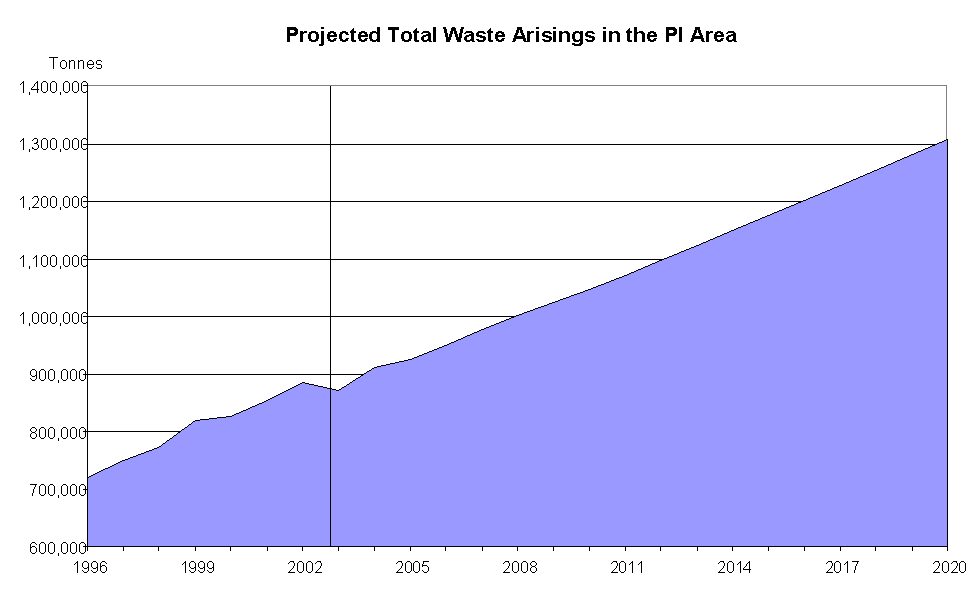
4.9 A study commissioned from Brook Lyndhurst Limited for PI has indicated that household waste is likely to continue to grow at an average rate of 2.4% per annum up to 2020 (without intervention). This equates to an additional 100,000 tonnes of waste every five years, equivalent to more than the capacity of the Chineham Energy Recovery Incinerator or the total output of two average sized districts in Hampshire. Please see diagram `Municipal Waste Arisings PI Area'.
Government Measures to Improve Service Efficiencies
4.10 The Gershon Efficiency Review covers all public sector services and requires them to find savings in public service costs through management efficiencies and more effective use of IT. It is estimated that the collective cost of waste management (including collection and disposal costs) could be reduced by many millions of pounds if organisational change, formal joint working and stretching best practice recycling targets are delivered. This may require further investment to achieve and more detail cost and benefits analysis will be undertaken as part of the joint municipal waste management strategy.
Responding to the Challenges
4.11 The Plan puts forward a number of proposals and measures to deal with these challenges.
Governance
4.12 The Plan notes that there is not a political wish to move forward to a single integrated waste management organisation, but does note other options such as extending joint working arrangements, eg between local authorities, or for collecting particular materials. A current external study is exploring in more detail the potential costs, issues and benefits of such arrangements.
Strategy Development
4.13 The Plan suggests the development by Project Integra of a Joint Municipal Waste Management Strategy for presentation to the Management Board in July 2005. This draft would be the subject of public consultation in the autumn with a view to publishing a final document early in 2006. The strategy would be based broadly on the principles of wider resources management and the partner sub-strategies. It would include strategies for waste minimisation and for encouraging behavioural change to increase recycling.
Extend Kerbside Recycling Collections
4.14 The Plan suggests extension of current kerbside collections including green garden waste, glass and textiles.
Behavioural Change Strategy
4.15 Funding support from the Waste and Resources Action Programme (WRAP) has enabled PI to develop a strategy for encouraging behavioural change amongst residents to increase, re-use, recycle and to minimise the amount of waste entering the waste management system. The County Council is the funded authority, but the bid was made on behalf of the partnership and its delivery involves all partner authorities.
5. Commentary and Issues
5.1 PI's recycling performance has continued to move forward over the last year, with its recycling rate increasing from 24% in 2003/04 to an expected 26% in 2004/05. Funding from Defra has enabled kerbside collections of recyclables to be extended to most parts of the county. An additional 125,000 tonnes of recycling and composting capacity has been delivered with completion of the Alton Material Recovery Facility and expansion of Little Bushy Warren Copse Composting Plant. The full energy recovery capacity of 420,000 tonnes per annum will also be available shortly with completion of the Portsmouth Energy Recovery Facility.
5.2 Despite this, PI and the County Council, as the lead disposal authority, face critical challenges over the next few years to control costs. It is vital for financial and environmental reasons, and to maintain excellence in service delivery, that the landfill diversion targets are met. Project Integra must take action now to make sure that adequate measures for recycling and waste minimisation are put in place by 2013 to ensure that landfill diversion targets are met.
5.3 It is also vitally important that improvements are made to current services to:
(i) optimise the benefit of available processing infrastructure;
(ii) increase recycling performance;
(iii) encourage greater participation in recycling activity;
(iv) control waste growth;
(v) improve the efficiency of service delivery and reduce costs; and
(vi) maintain performance in CPA assessments, meet Gershon efficiency savings, etc.
5.4 These improvements will require much greater and coordinated business and financial planning, including long term forecasting of waste volumes, investments and efficiency savings. In turn, this planning will require Project Integra to make sound business decisions more quickly and efficiently than it is currently able to do. Substantial change to its current constitution, scope and executive facility is needed to achieve this.
5.5 It was with these issues in mind that Hampshire County Council put forward a series of recommendations which the Project Integra Board agreed. These are set out in the Recommendation to this report.
6. Conclusion
6.1 Project Integra is at a cross-roads in its development. If it wishes to maintain its record at the forefront of integrated waste management and meet the significant challenges which it faces, it must make radical change to its constitution, scope and executive facility.
6.2 This change is also essential if the County Council is to plan effectively and meet its long term obligations under the Landfill Directive. The Joint Municipal Waste Management Strategy (JMWMS) and proposed Minerals and Waste Development Framework will address the strategic and planning frameworks needed to meet the directive, and help deliver proposed improvements to the HWRC network. However, the waste collection authorities also need to meet their obligations for cost effective waste services in order to ensure best value for Council Tax payers in Hampshire.
Recommendation
That the Project Integra Annual Business Plan for 2005-10 be approved, subject to the additional resolutions agreed at the Project Integra Management Board meeting on 13 January 2005:
1. (i) The Board acknowledging the need for substantial change in the remit of Project Integra, its constitution, scope and executive facility. Such change necessary to be developed and agreed upon in the fiscal year 2005-06 for implementation as soon as is practical to meet the requirements under future CPA accounts, Government Guidelines pertaining to waste partnerships and Gershon efficiency savings.
(ii) That a first draft of a business plan 2006-11 for the entire enterprise of waste collection and disposal be developed by the July meeting, in accordance with the format proposed for Joint Municipal Waste Strategies.
(iii) This first draft plan must include a long term forecast of recovery and waste volumes, facilities, investments, efficiency savings outcomes and financial budget that reflects the total expenditure of the joint service.
2. The Material Resources Strategy, organisation and executive changes, and next phase of procurement to be developed and reported to the July meeting.
3. The following additional text to be inserted at Paragraph 6.2.8:
"The financial consequences of not achieving the stretching recycling targets do not take into account the cost implications of ordering and implementing new disposal infrastructure. Under scenario 1, the annual landfill requirements would exceed 200,000 tonnes per year. It is very likely that it would not be sustainable or perhaps even possible to rely on such a high level of landfill disposal. This being the case, further significant investment would be necessary. Clearly, this would add significantly to the overall financial cost burden."
4. The Executive Officer provides the Secretary of State with a statement that:
(i) expresses the PI Partners' unanimous intention to submit a full and comprehensive JMWMS for Hampshire in April 2006;
(ii) outlines the steps already in hand to produce a JMWMS;
(iii) the proposed timescale to develop a JMWMS be included in the draft Business Plan 2005-10; and
(iv) an Officer Group be convened to oversee the drafting of the JMWMS.
Section 100 D - Local Government Act 1972 - background papers | |
The following documents disclose facts or matters on which this report, or an important part of it, is based and has been relied upon to a material extent in the preparation of this report. | |
NB the list excludes: | |
1. |
Published works. |
2. |
Documents which disclose exempt or confidential information as defined in the Act. |
TITLE |
LOCATION |
Project Integra Annual Business Plan 2005-10 |
Information Centre, Winchester Project Integra Website www.integra.org.uk |
239/AWL
APPENDIX 1
WASTE VOLUMES AND PERFORMANCE
PROJECT INTEGRA 2004/05 and 2005/06
APRIL 2004 - MARCH 2005 and APRIL 2005 - MARCH 2006 (BVPI definitions)
PROJECTED | ||
2004/05 (tonnes) |
2004/05 (%) | |
Total Waste (Material) Handled |
898,998.09 |
|
Less: Soil and Rubble/Bric-a-Brac |
33,402.73 |
|
Less: Commercial Waste/Clinical & Flytipped |
12,636.72 |
|
Total Household Waste |
852,958.64 |
|
Recycled: |
||
MRF (actual recycled) |
83,962.73 |
|
Green (WCA/UA) |
7,701.27 |
|
Recycling Banks: |
||
Glass |
20,938.59 |
|
Paper |
7,749.84 |
|
Textiles/Other |
1,935.62 |
|
Cans |
0.00 |
|
Third Party |
1,247.72 |
|
Fridges (WCA/UA) |
746.83 |
|
Total Recycled (WCA/UA) |
124,282.59 |
14.57% |
HWRC Recycled |
34,651.71 |
|
Green (HWRCs) |
62,696.95 |
|
Fridges (HWRCs) |
1,826.10 |
|
Total Recycled (HWRCs) |
99,174.76 |
11.63% |
Total Recycled |
223,457.35 |
26.20% |
Recovered: |
||
Energy Recovered |
175,746.33 |
|
MRF Residues (sent for energy recovery) |
4,253.67 |
|
SubTotal |
180,000.00 |
21.10% |
Pyrolysis |
295.93 |
|
Total Recovered |
180,295.93 |
21.14% |
Disposed: |
||
To Landfill |
441,188.72 |
|
MRF Residues |
7,466.16 |
|
Compost Residues |
550.47 |
|
Total Landfilled |
449,205.35 |
52.66% |
Commercial Waste - Based on estimates for 2004/05.
Third party, glass, paper and textiles based on 2003/04 actuals unless 2004/05 actuals available.
HWRC apportionments amended as of September 2005.
APPENDIX 2
BVPI COMPARISONS - SUMMARY
Authority |
% Recycled 2003/04 |
% Recycled 2004/05 |
% Recycled 2005/06 |
Government Target 2005/06 |
Basingstoke and Deane |
16% |
16% |
16% |
30% |
Eastleigh |
30% |
36% |
37% |
30% |
East Hampshire |
32% |
35% |
36% |
24% |
Fareham |
22% |
25% |
31% |
30% |
Gosport |
15% |
25% |
25% |
27% |
Havant |
19% |
21% |
21% |
30% |
Hart |
16% |
24% |
24% |
30% |
New Forest |
24% |
28% |
31% |
30% |
Rushmoor |
16% |
20% |
22% |
24% |
Test Valley |
14% |
20% |
20% |
30% |
Winchester |
17% |
21% |
23% |
30% |
Hampshire |
27% |
30% |
32% |
30% |
Portsmouth |
14% |
18% |
29% |
30% |
Southampton |
11% |
15% |
25% |
24% |
Project Integra |
24% |
26% |
30% |
40%* |
* Internally derived target that exceeds Government targets.
Source: EPA Data and WVSP 2004-2010