
Archived decisions
Hampshire County Council Social Care Policy Review Committee Item 7 30 March 2005 Services for People with a Learning Disability in Hampshire Report of the Director of Social Services |
Contact: |
Richard Parry |
Ext: |
5612 |
E-mail: |
1 Summary
1.1 The purpose of this paper is (1) to advise members of the progress made to date in Hampshire in implementing the 2001 White Paper "Valuing People" and of the key challenges ahead and (2) to gain member approval for the policy changes needed to ensure that Learning Disability Services are fit for the future.
1.2 It sets out the current position both nationally and locally in section 3, the financial pressures and opportunities in sections 4 and 5 and the broad future direction of services in section 6.
2 Introduction
2.1 The white paper "Valuing People: a new strategy for learning disability for the 21st century" (March 2001 DoH) lays out the future vision for learning disability services. This vision reflected the direction of travel set out by Hampshire Social Services in "Changing for Choice" and the "1999-2004 Commissioning Plan". The key principles of Valuing People emphasise the importance of "Rights", "Choice", "Independence" and "Inclusion" for people with a learning disability and promote a model of citizenship and social inclusion. These key principles are reflected in other drivers and performance indicators, which seek to promote citizenship, social inclusion and choice.
2.2 The principles detailed above are fully compatible with, and reflect the ambitions of, the Hampshire County Council Corporate Strategy. In particular, they reflect Corporate Aim 1 (Maximising Life Opportunities) through the promotion of social inclusion and access to community resources, Corporate Aim 3 (Achieving Economic Prosperity) through facilitating increased access to employment and Corporate Aim 5 (Improving Services) through ensuring that services are fit for purpose and reflect current service requirements and ambitions.
2.3 This broad strategy for learning disability services has been impact assessed. It is recognised that larger scale services are less likely to meet the needs of people with a learning disability from black and minority ethnic groups. The future focus on direct payments, use of community resources and individualised service solutions as set out in this report are likely to promote fairer and more equal access to services.
3 Progress to date
3.1 Progress has been made in a number of areas, reflecting the priorities set out in the "1999-2004 Commissioning Plan" and subsequent services plans.
3.2 NHS residential accommodation: Progress has been made towards the closure of the remaining "Locally Based Hospital Units" (LBHUs). These are outdated NHS inpatient services that provide institutional care for people with a learning disability. These re-provision projects are focusing on services in North Hampshire, South West Hampshire and South East Hampshire. Hampshire Social Services has been working closely with NHS colleagues to procure more appropriate, community based accommodation and support for people living in the LBHUs. This includes the provision of care management support, membership of project teams and boards and work with housing and support providers to facilitate the commissioning of new services. It is anticipated that the vast majority of the re-provisioning work will be completed by March 2007 and will represent the achievement of a significant Valuing People objective.
3.3 Modernisation of day services: Valuing People emphasises the need to develop inclusive, community-based alternatives to large-scale day services. Hampshire Social Services manages 11 Day Services for people with a learning disability which provide a total of 1,429 places. Services vary significantly in size, service model and range of services that they provide. The current average unit cost of a place varies between £2,562 and £7,731 per annum. This range reflects differences in unit size and the complexity of need that they support.
Work is already underway to take forward the changes identified in Valuing People with initiatives such as the new resource building in Alton and the development of positive links with the Recreation and Heritage Department of Hampshire County Council to explore the potential offered by the new Discovery Centres. These links have included the formation of a joint group between Recreation and Heritage and Social Services to increase access by people with a learning disability. As a result of this group, Person Centred Planning Training has been delivered to library staff and a member of the learning disability strategic team has provided specialist input into the design of the internal signage at Gosport Discovery Centre. Further inclusion and partnership work is happening all across the County. Pilot "brokerage" projects have been undertaken to develop access to alternative activities for people that more closely reflect personal interests and the resources available in local communities. The success of these pilots has been recognised by other local authorities who have visited the pilot sites.
3.4 Supported Employment: The current arrangements for supported employment have been the subject of internal review and a revised model for supporting people to access employment is being developed. This model will build upon the informal employment opportunities that are available to people with a learning disability in order to improve access to work. The model will see a range of joint working opportunities between day services and voluntary sector organisations, including the hosting of employment services within day services.
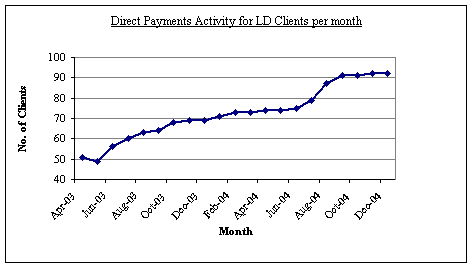
3.5 Direct Payments: There has been an emphasis on promoting the use of direct payments and the number of people in receipt of a direct payment has increased as indicated in the table below. There has been considerable success in promoting direct payments through informal support arrangements within day services and by focussing on young people coming through transition. The data in the graph below is drawn from the data held by the direct payments finance team.
3.6 Advocacy: A number of advocacy and self-advocacy schemes have been established which are helping people with a learning disability to become actively involved in decisions that affect their lives. There are now 15 groups and schemes operating across the county. These groups support people with a learning disability to provide input to a number of local planning groups (LIGs) and to the Partnership Board. A successful self-advocacy day was held last year at which people with a learning disability contributed to the local transport plan. With the support and experiences provided by the self-advocacy services, people with a learning disability are taking part in a number of decision making processes across the county.
3.7 Hampshire Learning Disability Partnership Board: In line with the expectations of Valuing People, a "Partnership Board" has been established which brings together a number of agencies which provide support and services to people with a learning disability. The Partnership Board is currently chaired by an officer of Hampshire Social Services (Jill Stannard) and co-chaired by a person with a learning disability (Stephen Hull). The Partnership Board has representation from both people with a learning disability and family carers.
3.8 Joint working with NHS colleagues: A workshop has been held with PCT colleagues to explore how closer working can be developed between Hampshire Social Services and the Hampshire PCTs in order to make the most efficient use of the resources available to all organisations. The strategic county manager chairs a cross PCT commissioning group which is building upon the output from this workshop. This extends to contributing to a working group that is looking at ways in which Continuing Care can be managed in a more efficient manner. Discussions have begun about the operational integration of care management and specialist health care services with provider NHS Trusts, with the first joint team in place in Eastleigh.
3.9 Partnerships with other organisations: Valuing People emphasises the need for organisations to work together to ensure that people with a learning disability enjoy access to the same services as other citizens. Work has begun to improve access by people with a learning disability to housing and healthcare services. A successful Housing Conference in September 2004 launched a group working with district councils to develop a housing strategy for people with a learning disability.
3.10 Services for younger and older adults: Particular attention is being paid, through joint working with colleagues in children and families and older persons services, to ensuring that people with a learning disability have access to services that reflect their particular age and needs. Investment in Transition Workers (working with younger people) has been made with each area now having a dedicated worker based within adult teams. A Transitions Steering Group is supporting the 7 Transitions Workers to develop consistent best practice across services. 106 young people with a learning disability moved into adult services during the year from 1 April 2004.
3.11 Person Centred Planning: This emphasises the process of capturing an individual's ambitions and aspirations and developing a personalised approach to achieving these. Significant training has been offered to organisations to develop person centred approaches and work is underway to ensure that this is embedded in the practice of organisations, supported by significant investment from a dedicated Person Centred Planning Team.
3.12 Supporting people with a learning disability from black and minority ethnic groups: Research into the needs of this group of people has been undertaken. As a result, some key areas of further work have been identified. In particular, it is apparent that, currently, people from black and minority ethnic groups appear to be under-represented within services. A review of respite services is explicitly identifying service uptake by people from black and ethnic minority groups. Specific work is being undertaken by service managers to better understand the overall usage of services within their areas, the local community groups and potential discrepancies between anticipated and actual demand for services. The move to more individualised, less institutional services will improve performance in this area.
4 Financial Resources: Pressures
4.1 The progress detailed above takes place in a context of some significant resource challenges.
4.2 National research by the Learning Disability Task Force in a report entitled "Financing Improved Services to People with a Learning Disability September 2004" identified a number of key demographic and financial issues.
4.3 It anticipated that the number of adults with a learning disability in the UK will rise from about 796,000 in 2001 to about 868,000 in 2011 and 908,000 by 2021 (increases of 8% and 11% respectively). The number of young people with very complex support needs entering adulthood will increase significantly, reflecting advances in medical technology and changing birth patterns.
4.4 The report found that whilst there have been significant increases in expenditure in NHS spending on secondary care (gross increase of 12% between 2001/2 and 2002/3), this was not reflected in learning disability expenditure (gross increase of 0.9% between 2001/2 and 2002/3). Whilst it has not been possible to obtain local data for this report, it is believed that the local situation is comparable.
4.5 The report cited that in 2003/4, 53% of councils indicated that they would be overspending on learning disability services.
4.6 The report indicates that the review of Supporting People expenditure on people with a learning disability finds little evidence of cost shunting from mainstream services, but instead that funds have been used to transform the quality of life for people with a learning disability in ways that are consistent with government policy. Their recommendation was for an increase in the level of Supporting People funding for people with a learning disability in order to achieve the aims of Valuing People by offering choice and control in accommodation and support.
4.7 The report concluded that there will be increased demand for services for people with a learning disability in a context where expenditure is not increasing in line with demand and new models of working will be required to effectively support people to achieve full citizenship.
4.8 Hampshire Social Services provides and commissions a significant volume of activity for people with a learning disability. In the last complete year for which there is data (2003/4), this amounted to approximately 338,000 bed nights of residential and nursing care and 218,000 person days of day services (data source: community care statistics).
4.9 There have been a number of cost pressures that have adversely impacted on the budget for people with a learning disability.
4.10 The rate of annual uplift demanded by both private and not-for-profit residential and supported living providers has significantly out-stripped the inflation uplifts applied to purchasing budgets. It is estimated that the real annual inflation pressure is about 7% per annum. The limited supply of alternative placements means that there is often limited scope for effective negotiation of costs.
4.11 As noted in paragraph 4.6, the use of Supporting People funding has seen the development of alternative means of accommodation and support for people with a learning disability in line with the principles of Valuing People. Subsequent reductions in the overall Supporting People budgets have resulted in considerable cost pressures to the Social Services Department. Based on information supplied by the Supporting People team, the full year effect of cuts incurred in 2004/05 for 2005/06 will be £1.6m, and they estimate another £226,000 part year effect for new cuts in 2005/06. This presents a significant challenge to both budgets and styles of service delivery. In 2006/07 a further £279,000 of cuts will arise from the full year effect of the cuts which started part way through the 2005/06 financial year, and further cuts may happen, compounding the effect of the initial cuts.
4.12 There have been a number of transfers of funding from the NHS to the Social Services Department under S28a arrangements in order to fund the social care of people formerly in inappropriate long stay NHS accommodation. The new models of support and accommodation provided by these transfers have significantly improved the quality of life for individual service users. These transfers have brought significant cost pressures as a result of increasing demand for services from people who would previously have been accommodated by the NHS. This cost pressure equates to about £1.5m for 2004/5.
4.13 Valuing People emphasises inclusion and the rights of people with a learning disability to enjoy the same services and resources as other citizens. In order for this to happen, other organisations will need to recognise their responsibilities and actively work to enable access by people with a learning disability. Learning disability organisations, particularly Social Services, will need to devote resources to supporting progress in this area. In the shorter term, there are significant pressures resulting from the (rightly) increased expectations of people with a learning disability and their family carers about the volume and nature of services that will be provided to allow people to maximise their potential.
4.14 Continuing Health Care has presented a number of cost pressures, particularly where people's behaviour challenges services and the boundary between health and social care is not clear cut. In addition, considerable energy has been devoted to pursuing applications for Continuing Health Care funding for individual service users.
5 Financial resources: opportunities
5.1 LDDF: this is a funding stream that flows via the Strategic Health Authority and PCTs to the Partnership Board. It is an annual resource that has again been made available for 2005/6. The revenue available in 2005/6 is roughly double that available in 2004/5 and should amount to about £800,000. This has been used to support a range of initiatives including the development of Person Centred Planning. The funding for 2006/7 is not currently known and is not necessarily available year on year as a funding stream.
5.2 Members' Investment in Transitions: advances in medical technology mean that there are increasing numbers of children with complex needs surviving into adulthood. Service changes in recent years see this group of people approaching Social Services, rather than NHS for support. These young people and their carers often have increased expectations about the quality of independent life that they wish to experience and consequent expectations on the level of services that will be provided from early adulthood. Members have recognised the cost pressures that this presents to adult services through increased funding for young people in transition.
5.3 Service Re-modelling: the pressures on learning disability services are such that they can no longer be managed by the budget management approaches that have been historically used. These pressures, combined with the modernisation agenda set out in Valuing People, mean that much more significant service re-modelling is required. This will involve looking to delivering services in different ways, undertaking a different approach to the purchasing of services and looking to directly provide some services. This approach does offer the opportunity to use overall resources in a more efficient way. Some initial investment will be required to develop these approaches and support the services re-modelling process.
6 Future developments
6.1 If Hampshire Social Services is to continue the progress that has been made to date and meet the challenges of implementing Valuing People, a number of key developments are required. These represent an acceleration of existing work as well as new initiatives. Without substantial additional resources being made available, gentle evolution of current services and practice is unlikely to deliver the required outcomes. Many existing services will need to be re-modelled in order that they can continue the sound progress made to date and remain fit for purpose. Whilst there is substantial pressure to deliver an increasing volume and complexity of services within very tightly constrained resources, any reduction in workforce numbers will be counter-productive. Instead, there will need to be changes in working patterns, differing roles for staff, investment in new buildings and the disposal of older, out-dated buildings so that staff can continue to deliver a high quality service. Key to the success of this process will be the retention of the skilled and experienced workforce that Hampshire Social Services enjoys. Staff will be supported to work in new ways that make best use of their skills and experiences in order to maximise the use of community resources and effectively support people with increasingly complex needs.
6.2 Maximising day opportunities: This will be the subject of a subsequent paper to members providing more detailed financial and activity data. This programme is a key component of Valuing People and emphasises the move away from large-scale day services in isolated locations towards individual support to access local community resources, develop social networks and to enter employment. This will need to be underpinned by significant changes in current day services buildings, capital investment in new buildings, the continued development of direct payments and re-modelling of existing supported employment services. The future shape of day opportunities is likely to be local resource centres that offer direct support to people with more complex needs and a resource and signposting service that enables individuals to access local community services. Some day services, notably The Grove in Winchester, the cluster of services in Aldershot and the South East and the new service being built in Alton already broadly meet this model, other services will require significant change. This model moves away from larger scale group service provision and will promote choice, social inclusion and the achievement of individual wishes. Whilst this shift will be consistent with Valuing People, current and historic departmental policy and achieving key performance indicators, it is a more resource intensive method of working.
6.3 Supported employment: A revised model of supported employment is under development and will be the subject of a subsequent report in conjunction with the development of day opportunities. The proposed model will support people with a learning disability to make best use of the informal networks that they have as a means of accessing employment, build upon links with Job Centre Plus and other Department of Work and Pensions initiatives and use existing day services as a resource centre in which to base employment services. This will make best use of the existing knowledge and skills of day services staff.
6.4 Respite opportunities: This will be the subject of a subsequent paper to members detailing the planned financial and activity data. The provision of respite care is an important means of support to carers. Currently, Hampshire Social Services has a significant portfolio of residential respite services that have varying levels of take up. Feedback from services users and carers indicated the value of this provision, but also the need to develop more flexible alternatives to residential respite. Work is underway to identify the optimum volume of residential respite and to develop more flexible alternatives through the use of direct payments, respite vouchers and so on. This will include making best use of the flexible and valued support that is provided by adult placement schemes. A further part of this work will be to identify more effective ways of meeting the demand for "emergency" placements, both to manage short term crises but also to make more appropriate long term placements for individuals following a period of assessment and support.
6.5 Residential accommodation: This will be the subject of a subsequent paper to members detailing the planned financial and activity data. A key resource pressure is the demand for residential care for people with more complex needs. Currently, services for this group of people are purchased in the independent and not for profit sectors. Placement availability is often limited and has very substantial cost implications. The demand for this type of placement is increasing and the level of external supply is inadequate. As part of the respite strategy, it is proposed to review the current learning disability registered residential capacity of Hampshire Social Services with a view to re-modelling existing services and increasing the number of long term residential placements that are delivered in-house. Experience to date has suggested that it is possible to deliver quality, cost effective services in-house to people with more complex needs. Even allowing for any increases in in-house provision, the majority of residential accommodation for people with a learning disability will be provided externally. Improvements are planned for the way in which this is procured in order to establish clearer expectations about quality, greater pricing transparency and ensure that placements offer best value.
6.6 Integration and Partnership Working: Part of the development of working practices will be the move to more formal integrated care management and specialist health care teams, reflecting similar moves that have already occurred within mental health services. An earlier report presented on 29 April 2004 outlined the early work that was being undertaken in this area. More integrated commissioning arrangements ("joint commissioning") with PCTs will also be required to make most effective use of resources across agencies.
7 Conclusion
In order to deliver the ambitions of Valuing People, maintain existing Hampshire Social Services strategy and to ensure that people with a learning disability benefit from Hampshire County Council's Corporate Strategy, significant changes will be required in the services delivered to people with a learning disability. As the largest organisation in Hampshire supporting people with a learning disability, Hampshire Social Services is well placed to lead these changes. They will require us to reflect on our current practice, accept the need for change and to take the opportunities that arise to improve the way in which we plan and deliver services.
8 Recommendations
1. That the Social Care Policy Review Committee recognise the significant service developments made to date and the achievements of staff in implementing the principles of Valuing People
2. That the Social Care Policy Review Committee comments on the strategic direction for learning disability services as set out in section 6 of the main report and further work to move policies forward in partnership with other organisations.
3. That the Social Care Policy Review Committee receives further reports about the specific areas of development as noted in section 6 of the main report and detailed action plans on the specific areas of development.
Section 100 D - Local Government Act 1972 - Background Documents
The Following documents disclose facts or matters on which this report, or an important part of it, is based and has been relied upon to a material extent in the preparation of this report.
None
NB the list excludes:
1. Published works
2. Documents which disclose exempt of confidential information as defined in the Act.