Archived decisions

Hampshire County Council

Buildings, Land and Procurement Panel Draft

5 April 2005

Sustainability Key Project Work 2005/06

Report by the Director of Property, Business and Regulatory Services

Contact: Mike Fitch Ext: 7846 email: [email protected]

How the conclusion in this report fits with the Corporate Strategy

This scheme will impact on the delivery of the following Corporate Aims

Aim 2 - stewardship of the environment - by identifying and progressing sustainability initiatives that will provide a positive impact on the community.

Aim 5 - improving services - by developing sustainability initiatives that will enable improved service delivery.

1

Summary


1.1

The Kyoto accord came into force on 16 February 2005 and requires countries to cut emission of carbon dioxide and other greenhouse gases.


1.2

The UK Government has signed up to the Kyoto accord and set national policy objectives to achieve a reduction in carbon emissions and greenhouse gases throughout the country. By virtue of the Nottingham Declaration on climate change, the County Council has pledged support for the Government on this important issue. The County Council also signed up to Aalborg Commitments in 2004, which unites the County Council with European local governments in a campaign to achieve European Sustainable Cities and Towns.


1.3

This report identifies sustainability proposals for the built estate in 2005/06 to support the UK climate change agenda including:


    · Identifying those buildings with low environmental credentials


    · Working with schools that currently show a pattern of high energy use and developing a programme of energy efficiency measures


    · Monitoring water consumption and identifying water conservation measures


    · Implementing, on a trial basis, the BRE's `Smart Waste' system to selected major capital projects


    · Working with BREEAM a new Environmental Assessment Method for designing and managing new school buildings.


2

Data on Energy Use and CO2 Emissions in the Council's Built Estate


2.1

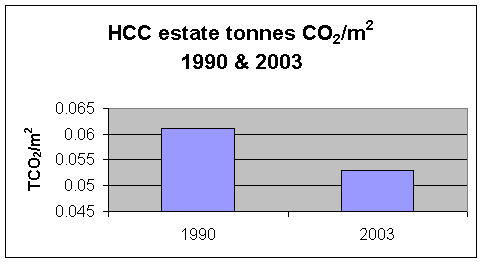
A review of energy use and CO2 emissions over the last 13 years has been completed and is shown in Appendix 1. It should be noted that, due to the wide range of variable data, the information should be viewed as "broad brush" and only be seen as indicative.


2.2

Appendix 1 shows a pattern of increased energy usage since 1990 (about 33%) per unit floor area of the built estate. This is coupled with a decrease (about 22%) in overall carbon emissions.


2.3

Some of the most likely reasons that have contributed to the rise in energy use since 1990 include:


    · Extended hours of buildings usage, particularly school buildings


    · Growth in IT infrastructure and its usage in every day applications


    · Flexible working hours


    · Security enhancements


    · Greater community use of buildings, including flood lit external sports facilities


    · Extensive health and safety regimes, eg legionella management.


2.4

Some of the most likely reasons for a reduction in overall carbon emissions include:


    · More efficient production of energy by main power suppliers


    · Purchase of `Green' electricity


    · Oil to gas conversions and improved boiler controls


    · Improved general energy conservation measures, eg thermal insulation and improved lighting


    · Meeting new Building Regulation Standards for new and recently constructed buildings.


3

Identification of buildings with Low Environmental Credentials


3.1

At this stage buildings with low environmental credentials are those buildings that are below national benchmark energy performance standards. In time this definition could be opened up to look at other factors, including travel and transport. It may be possible to use the Building Research Establishment's new Environmental Assessment Method "BREEAM" to take a wider look at the environmental performance of buildings in the future.


3.2

As indicated above, Appendix 1 suggests a reasonable position of reduced carbon emissions for the built estate. This research has been taken a stage further to look at various groups of buildings, their associated energy use and CO2 emissions to identify and prioritise those buildings with low environmental credentials.


3.3

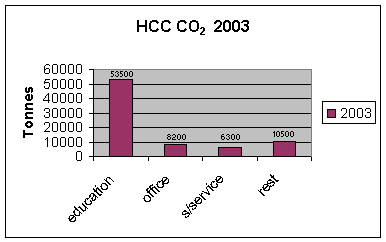
Appendix 2 confirms that the largest consumer of energy is within the Education sector. Correspondingly, the Education estate produces the highest levels of carbon emissions. Therefore, it is proposed to concentrate on the Education estate as a priority. Initial comparison of secondary school energy use data against national benchmark standards for the year April 2002 to March 2003 is set out in the table below.


Number of Secondary Schools

National Benchmark Energy Standards


13

Poor


35

Typical


9

Good


4

Working with Schools


4.1

A comparison of the energy consumption of Community Secondary Schools has been made against nationally published guide figures issued by the Government's Carbon Trust agency. It can be seen from the previous section there are 13 secondary schools that, prima facie, show poor levels of energy performance.


4.2

It is proposed to investigate why these schools perform as they do in terms of energy use. The following five point investigation will take place.


    · Check and verify the accuracy of utility billing information and floor area data used in the calculation of buildings energy performance


    · `Correct' the above information in line with the requirements of the Carbon Trust to take account of the hours of use and local weather conditions


    · Using a good energy performing school as a control, fully investigate high energy use schools


    · Engage the school's local management team in the energy investigation


    · Conduct a detailed study to examine


    _ Thermal performance


    _ Electrical consumption for lighting, small power and IT


    _ Energy efficiency of heating and hot water systems


    _ Hours of use and local management.


4.3

The information collected from the investigation will be used to influence the local management of buildings and develop programmes of energy efficiency measures.


4.4

Once the detail of the investigation is known, it is proposed to share any learning points with the DfES and to seek their support as appropriate. The information may also be shared with the South East Centre for Excellence, other Authorities and schools.


5

Water Conservation


5.1

Water conservation is another important area of sustainability that has to be managed. Water conservation work comprises the following:


    · Reducing leakages from underground mains, and other water systems


    · Installing water reducing technology, ie urinal controls and low flush WCs


    · Providing advice and information on water conservation


    · Working closely with the water utilities and Environment Agency.


5.2

One of the main water conservation measures to date has been to identify, locate and repair underground water leaks. Underground water leakages, if left undetected or unrepaired, can cause significant water loss. Therefore, the first step in the process is to monitor water bills and investigate abnormal billing information.


5.3

In the last five years over £713,000 has been reclaimed from the Water Authorities in respect of `non-return to sewer charges'.


5.4

The Department's work in respect of water conservation was recognised by the Environment Agency when they announced their Water Efficiency Awards for 2003. The County Council received a Special Award for its long term commitment to water efficiency and excellence.


6

Initiatives that Support Waste Management on Construction Sites


6.1

Steps are being taken to manage construction waste associated with the construction of major new buildings. The aim is to reduce the total amount of waste and to increase recycling of materials.


6.2

In order to reduce waste from construction sites, the Department is working with the Building Research Establishment (BRE) and major framework contractors, on a trial basis, to implement the BRE's "SmartWaste" system. This system will provide designers and contractors with detailed knowledge of the construction waste that is produced on a given site, and this information can be used to help reduce future waste and increase recycling. The SmartWaste system is also linked to BRE's BREMAP, which provides details of the nearest recycling and waste management centres relative to the type of construction waste and the location of the site. The advantage of* using BREMAP is that journey distances to and from tips can be kept to a minimum and waste materials are deposited at tips that can best manage them for disposal and recycling.


6.3

The trial is being applied to the following major capital projects:


    · Winchester Early Years Centre


    · Minstead Rural Studies Residential Accommodation


    · John Hunt of Everest New Secondary School


    · New phases of Nurse-Care projects


    · Roofing Framework Contractors.


7

BREEAM for Schools


7.1

The DfES has issued new guidance for Local Authorities making bids on Education projects to the Targeted Capital Fund (TCF) for 2006-08. The guidance requires schemes to achieve an environmental rating of 'very good' when assessed by the Building Research Establishment Environmental Assessment Method (BREEAM).


7.2

BREEAM has been in use for the last fifteen years as an environmental assessment tool for commercial developments and has now been adapted for use on Education projects (BREEAM for Schools).


7.3

BREEAM for schools looks at environmental performance in eight key areas:

    · Management

    · Health and Wellbeing

    · Energy

    · Transport

    · Water

    · Materials and Waste

    · Land use and Ecology

    · Pollution.


7.4

The assessment for the project needs to be carried out by a trained BREEAM Assessor, who rates the projects as:

    · Good

    · Very good (the target level for Schools)

    · Excellent.


7.5

The project is considered in terms not only of design, materials and construction operations, but also performance in use. Projects which require a BREEAM Assessment are:

    · Primary School projects over £0.5 m

    · Secondary School projects over £2.0 m

    · Any scheme which affects more than 10% of the gross internal floor area of a school.


7.6

The impact of BREEAM on developing school projects is not yet fully known. It is likely that the impact will effect design time and construction costs, as well as end users' operations.


8

Conclusion


8.1

Energy consumption has risen by around 33% on a floor area unit basis between 1990 and 2003. Despite this increase in energy consumption, CO2 emissions have decreased by about 22% over the same period.


8.2

The education sector of the built estate is by far the largest consumer of energy and consequently CO2 emissions, based on an assessment of past available records. These figures should be seen as indicative.


8.3

It is proposed to examine the 13 secondary schools showing poor levels of energy performance and develop improvement plans which will produce an improved energy performance.


8.4

This report also identifies a range of established and new initiatives the Department is pursuing to promote sustainability as part of its core activities, e.g. water conservation, construction waste management and Environmental Assessment for new school buildings in line with BREEAM.


9

Recommendations


That the Panel advises the Executive Member for Policy and Resources that approval be given to:


1

the proposal to work with 13 secondary schools with low environmental credentials and develop improvement plans to produce improved energy performance;


2

Continuing to develop and implement the water conservation measures identified in the report;


3

progressing initiatives for working with the BRE in respect of managing construction waste and BREEAM.

Section 100 D - Local Government Act 1972 - background papers

The following documents disclose facts or matters on which this report, or an important part of it, is based and has been relied upon to a material extent in the preparation of this report.

NB the list excludes:

1 Published works

2 Documents which disclose exempt or confidential information as defined in the Act

........................

........................

                      Appendix 1

Indicative Energy Consumption and CO2 Emission

between 1990 and 2003 for the Built Estate of HCC

Illustration (1)
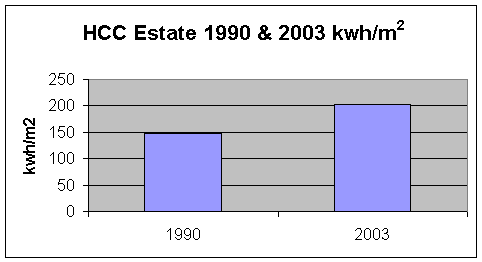
Illustration (2)
Jan 2005

Foot note

The information above is intended as a broad based illustration only and should be viewed as an indicative picture of energy consumption and CO2 emission due to the variable nature of the recorded data.

Appendix 2

Energy and CO2 use in 2003 in Education, Offices,

Social Services and other buildings

Illustration (1)
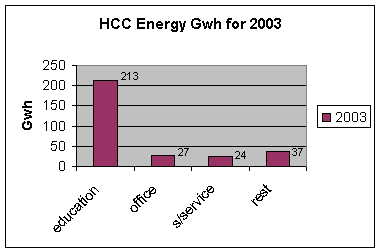
Illustration (2)
Jan 2005

Foot note

The information above is intended as a broad based illustration only and should be viewed as an indicative picture of energy consumption and CO2 emission due to the variable nature of the recorded data.