
Archived decisions
Hampshire County Council | ||
Cabinet |
Item 7 | |
25 April 2005 | ||
Annual Efficiency Statement: Forward-look 2005/06 | ||
Report of the County Treasurer | ||
Contact: Jon Pittam, ext 7400
1. Introduction
1.1 This report sets out the forward-look efficiency plan statement for 2005/06. This is part of the new statutory requirement for an Annual Efficiency Statement.
1.2 The Annual Efficiency Statement (AES) is based on indicative targets against services and cross-cutting themes. These can be amended later when more specific savings have been identified.
1.3 The report sets the context and requirements as discussed at previous Cabinet meetings. At present
· £2.4m cash savings have been identified
· this leaves £4.7m cash savings still to be confirmed
· and £7.1m of non-cashable savings which have not been specified, but should be achievable.
2. Background
2.1 Previous reports have been considered by Cabinet on the framework and process, but for convenience the main points are summarised again in this paragraph.
2.2 A forward plan of efficiency targets for 2005/06 had to be set and returned to the Office of the Deputy Prime Minister (ODPM) by 15 April 2005, with a backward look at achievement of savings required every June (by 15 June 2005 for 2004/05)
Baseline
2.3 The baseline is 2004/05 and this applies for the initial three years (2005/06 - 2007/08) of the Government's proposals for delivering efficiency in local services.
2.4 Against this baseline the requirements are:
· 2.5% per annum efficiency improvements on non-schools revenue and capital spending
· which is £14.2m per annum
· of which 50%, or £7.1m must be in cashable savings
· and against which the proportional indicative split is £6.2m on revenue and £0.9m on capital (though savings need not be pro rata)
· with a total 7.5% efficiency gain in the period 2005/06 to 2007/08
Previous year
2.5 Efficiencies achieved in 2004/05 count against the target, provided that a clear audit trail is available, and that those gains continue throughout the three year period. These will be reviewed by Cabinet in June 2005.
Nature of efficiency gains
2.6 The guidance is clear that efficiency is not about cuts, but is about raising productivity and enhancing value for money.
2.7 Efficiency gains can be achieved by:
· reduced inputs (people, assets, money) for the same outputs
· greater outputs for improved quality (extra service or productivity) for the same inputs
· proportionally more outputs or improved quality from an increase in resources
Not accepted as efficiency gains
2.8 The following cannot be counted:
· re-labelling of activities, transfers from revenue to capital etc
· cuts that reduce services
· increased income from higher prices in fees and charges to the public
Cashable and non-cashable gains
2.9 Cashable gains release resources for allocation elsewhere.
2.10 Non-cashable gains are achieved from improved quality or additional outputs for the same level of resource.
2.11 Lower prices achieved through procurement is an example of a cashable saving. Reduced absenteeism which increases inputs but without allowing staff numbers to be reduced is an example of a non-cashable gain.
2.12 There has to be a quality cross-check to demonstrate that quality of service has been maintained (and cuts in service not made).
Capital
2.13 The two key ways identified to achieve efficiencies in capital spending are:
· to avoid cost overruns
· to obtain more outputs for the same resources
Key points
2.14 The aim is to improve the quality of public services, not simply to cut costs.
2.15 It is about being more efficient in the use of resources which are retained at council level. The spending review plans do not require cash reductions; but some of the lower cash increases (eg highway maintenance) imply that savings must be achieved to avoid overall reduction in service level.
2.16 Given the nature of the Council's budget, savings in procurement and productive time (for front-line staff) have to be top priorities.
3. Draft Efficiency Plan
3.1 The ODPM's efficiency technical note (ETN) for local government contained a suggested template for the forward-look efficiency plans. The return for the County Council considered by the informal Cabinet on 6 March 2005 is as shown in Appendix 1. Since this time the County Treasurer has made representations to the ODPM on the inclusion of magistrates courts in the baseline and the calculation of the capital element of the baseline. The ODPM have agreed to a lower baseline figure and consequently £0.5m lower efficiency target as set out in the body of this report.
3.2 In additional to numerical adjustments to the targets the format of the return has changed due to the requirements of the ODPM's electronic template received following informal Cabinet. This format requires added repetition and reduced clarity, and is attached at Appendix 3. This is the final version of the return submitted to meet the deadline of 15 April 2005.
3.3 The efficiency plan has to set out the:
· strategy for securing efficiency gains
· key actions to be taken during the year
· expected efficiency gains, analysed
- between total and cashable gains
- by services
- and by cross cutting themes
3.4 The cross cutting themes are referred to in the ODPM's guidance as the Gershon work streams and include:
· corporate services (finance, human resources, ICT, procurement functions, legal services etc)
· procurement (for example: purchase of goods and services including utilities, IT, equipment; and contractual services such as social care and highway maintenance)
· productive time (improving the productivity of frontline staff and those who support them)
· transactions (more efficient ways of dealing with customers, streamlining processes, or switching from manual to electronic processing)
3.5 The overall efficiency plan indicative targets can be summarised as:
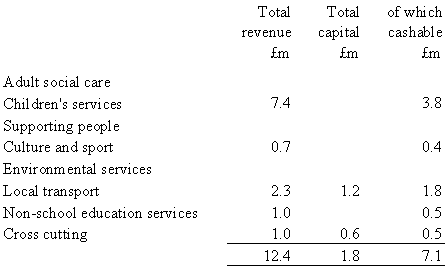

 Table 1 : Efficiency plan - indicative targets
3.6 It is expected that the first annual efficiency statement will be used for information gathering purposes by ODPM, and that each Government department will check that their `shares' are being achieved.
3.7 It is also anticipated that there will be a light touch audit in the first year, with self-assessment, but that the statement will be considered as part of the tighter regime for the audit of the use of resources in the Comprehensive Performance Assessment. Current consultation suggest that an authority will only be `adequate' if it achieves 2.5% efficiency gains - to be good or better requires the achievement of more than 2.5% gains per annum over the three year period.
3.8 The draft plan was considered at the informal Cabinet meeting on 6 April 2005 and the final copy of the plan was agreed by the Leader of the Council, Chief Executive and County Treasurer to meet the 15 April 2005 deadline.
3.9 A significant proportion of the County Council's efficiency gains are expected to be cross-cutting. However, given the tightness of the timescales it is not possible to quantify these in advance of the deadline for the first forward-look. The ODPM recognise the challenges councils will have in this respect as the guidance states that "a caveat will be included in returns for 2005, to note that the statement is a new development with limited good practice available and consequently that results are subject to change".
3.10 Appendix 2 sets out:
· 2005/06 budget comparisons
· savings in 2005/06 budget which meet the definitions required for the AES
· savings in the 2005/06 budget which are still being reviewed to see if they can be included in the detailed action plans which support the AES
· possible areas for longer term review over the three year period.
4. Conclusion
4.1 The AES is some way short of specific actions to achieve both cashable and non-cashable savings targets, but these can be worked up during the year. A small sub-group of Cabinet (the Leader and the Executive Member for performance/efficiency) will work with the Chief Executive, Director of Property Business and Regulatory Services and County Treasurer to develop these actions for agreement with the relevant service Executive Members and Chief Officers.
4.2 It is planned to incorporate the 1.25% cash efficiency targets for 2006/07 into the 2006/07 budget guidelines to enable closer integration of the Annual Efficiency Statement with the budget, recognising that cashable savings will be used to offset other pressures or priorities, or to avoid future strain on the level of council tax.
Recommendation
Cabinet formally endorse the submission of the Annual Efficiency Statement: Forward-look, as amended and re-formatted in Appendix 3.