
Archived decisions
Hampshire County Council Solent Transport Strategy Panel 2 June 2005 Feedback on Local Transport Plan Consultations Report of the Director of Environment |
Item 8 |
Contact: Dominic McGrath, ext 6054 email: [email protected]
1. Summary
1.1 Government guidance on preparing the next Local Transport Plan (LTP) requires consultation with stakeholders as an integral part of the LTP process. The County Council sees consultation and engagement with stakeholders as vital to the preparation of a successful LTP. Consultation seminars and workshops have been held as one part of the process. These consultations have provided valuable information about stakeholders concerns, priorities for their area and an indication of some possible solutions. This report presents information on the outputs from the seminars and workshops, a summary of the emerging key themes and how these outputs are influencing the development of the area strategies and programmes.
2. Introduction
2.1 County Council officers have already collected a considerable amount of information about local problems and opportunities through ongoing dialogue with District Councils, Local Strategic Partnerships and other local stakeholders. This has been complemented by a series of seminars and workshops which focused on problem identification.
3. The Consultation Process
3.1 The following key consultation events have been held during early 2005:
(i) Local Transport Plan Stakeholders Seminar;
(ii) Local Transport Plan Business Seminar;
(iii) Gosport Peninsula Access Panel; and
(iv) Transport Strategy Panel Workshops.
4. Local Transport Plan Stakeholders Seminar
4.1 The LTP Stakeholders Seminar, held on 18 March 2005 at the Guild Hall, Winchester involved delegates representing a wide variety of groups including transport operators and providers, user groups, representatives from disability groups and Hampshire's Youth Parliament. County Council officers provided updates on the LTP preparation process. One workshop session focussed on the area strategies and the second workshop was based on key themes. The summary of issues raised at the Stakeholder Seminar are included in Appendix 1 to this report.
5. Local Transport Plan Business Seminar
5.1 The Hampshire Economic Partnership event held on 9 February 2005 involved key business stakeholders with an interest in transport related issues. After a series of presentations on the LTP these stakeholders were divided into a number of `task groups' which were challenged with answering key questions in relation to transport issues. The summary of issues raised at the stakeholder seminar are included in Appendix 2 to this report.
6. Gosport Peninsula Access Panel
6.1 This Panel consists of Members and officers from Fareham Borough Council and Gosport Borough Council, as well as the County Council. The Panel met on 4 March 2005 for a workshop session to generate in detail a list of transport problems and issues on the peninsula. The nature of the transport issues on the peninsula, particularly concerning accessibility, meant that a further workshop to the one held as part of the Solent Transport Strategy Panel was necessary in order to comprehensively cover all issues. The workshop had a similar format to the Panel workshops, being a joint Member/officer session, with a County Council Chairman and a note taker. The summary of issues raised are included in Appendix 3 to this report.
7. Transport Strategy Panel Workshop
7.1 The Solent Transport Strategy Panel (STSP) met on 3 March 2005 with the main part of the meeting given over to the workshop session. A full list of the comments from the STSP is set out at Appendix 4.
7.2 From the workshop, a number of key themes have been identified that reflect the concerns and priorities of Panel Members. The key themes for STS and how they will be reflected in the next LTP and five year programme are identified below.
8. Key Themes
Key Theme 1 - Access to the Gosport Peninsula
8.1 This continues to be the big issue for local communities, as it was in the first LTP. Access on to the peninsula is clearly identified by stakeholders as a strategy with a number of identifiable problems that need to be tackled. Congestion on the A32 was identified as a concern, as was the uncertainty over the future of the light rapid transit project which would link Fareham and Gosport with Portsmouth, via a tunnel under the harbour.
8.2 Other issues identified included: constraints at major junctions such as Quay Street roundabout, Newgate Lane, M27 junction 11, and the high levels of out-commuting from Gosport with the closure of Ministry of Defence sites. Public transport was identified as being poor quality in terms of frequency and reliability, with more integration of ticketing and services required.
Key Theme 2 - Town Centre Accessibility
8.3 This issue was raised at all of the stakeholder workshops, relating to different towns within their areas. Concerns raised included the general circulation of traffic and congestion in town centres; poor interchange facilities for bus and train services; the location of public transport stops and stations; need for relief roads/improved ring roads; and the need for street audits.
Key Theme 3 - Land Use Policies
8.4 The wider context of land use policies was often raised as an important issue. Location of employment sites and residential areas can have an adverse affect on accessibility and congestion, as can a lack of local facilities. Social exclusion issues were also raised, and it was recognised that non-car users are excluded from certain life opportunities.
Key Theme 4 - Congestion
8.5 Congestion is a major issue across the Solent Transport strategy area. A number of causes of congestion were identified, including the general car culture that has arisen. The cumulative impact of smaller developments, as well as the more readily identifiable impact of major trip generating sites, combined with the lack of realistic or attractive alternatives to the car, junction constraints and peak time and long distance commuting, were identified as causes of congestion.
Key Theme 5 - Impact of the West of Waterlooville Major Development Area
8.6 There were concerns over how the Major Development Area (MDA) would be integrated with the local urban area, particularly the traffic impact. Related to this were concerns that the A3 bus priority corridor would become congested. It was also pointed out that the bus priority measures along the corridor do not continue throughout. Concerns were raised that surrounding areas will be used as `rat runs' by residents of the MDA.
Key Theme 6 - Safety
8.7 The issue of safety for pedestrians and cyclists was raised a number of times. Stakeholders felt that there was inadequate provision of safe crossing places on major roads, poor or unfinished cycle routes, and a problem of speeding traffic across the Solent area. The lack of safe routes to school in many areas is also a concern.
Key Theme 7 - Southampton Airport Hub/Gateway
8.8 The regional significance of Southampton Airport Hub/Gateway was recognised in the consultation workshops. Congestion problems on the nearby motorway network and junctions were seen as a threat to the viability of the hub. Accessibility was seen as a key issue, particularly concerning access to an employment site north of the airport, and the need to construct a new link road - Chickenhall Lane Link Road.
9. Conclusion
9.1 The seminars and workshops have provided a valuable input into identifying the key themes for the next LTP and the development of the capital programme. Members are asked to note the key themes and the comments made at the Panel workshop and seminars, as listed in the Appendices. Members are invited to comment further if they wish.
Recommendation
That the Panel note the key themes and comments as set out in the report and accompanying Appendices.
Section 100 D - Local Government Act 1972 - background papers | |
The following documents disclose facts or matters on which this report, or an important part of it, is based and has been relied upon to a material extent in the preparation of this report. | |
NB the list excludes: | |
1. |
Published works. |
2. |
Documents which disclose exempt or confidential information as defined in the Act. |
TITLE |
LOCATION |
None |
343/DM
Appendix 1
Local Transport Plan Stakeholders Seminar
Workshop 2: Solent Area - Summary of Issues Raised
Key traffic hotspots in Hampshire:
· M27 (Eastleigh to Hedge End)
· North Portsmouth
· Eastleigh - Fareham railway
· Traffic congestion in Portsmouth & Southampton City Centres
Solent Travel to Work by Ward: Bus
Consideration of bus services in cities
Importance of transport hubs: Southampton & Portsmouth
Commuting
+20% commute trips from north of Portsmouth and Fareham to Portsmouth City Centre
+20% Totton & Waterside/Romsey & Eastleigh/Hedge End commute trips to Southampton City Centre
+10% Whiteley (only) to both Portsmouth & Southampton
Solent Transport requirements
· Develop shared priorities
· Identify existing issues
· Build upon successes
· Anticipate future pressures
Port of Southampton
Development pressures
Significant growth in a global shipping market
Largest employer in South Hampshire
Freight handling: expected to grow by +60/70% in next ten years
Road: improved routes to port through city
Rail gauge enhancement (constraints of Southampton Tunnel and others along the route) - Government being lobbied for decision
Journey to work issues:
Local deficiencies in PT network
LRT would facilitate extension westwards to Southampton
Southampton's access is too geographically constrained
Alternatives to M27 as a commuter route required
Whiteley (off Jct.9 of M27)
Poor accessibility (explore alternatives)
Employers struggling with access issues (may affect productivity)
Safety aspects of queuing traffic onto M27 at Jct.9
Social exclusion issues in Fareham/Gosport
Local residents priced out of PT
Govt. should listen to them
Bus reliability in Eastleigh
Improve accessibility to local bus services and reliability of local services
24/7 bus services required in South Hampshire
Public transport in Hampshire
70% are commercially provided bus services
Partnership working with local transport operators (28 million PT trips in Hants pa).
Long term vision for Solent Transport required
Need to determine future priorities
Development of cycle networks
Pedestrians - improved pedestrian routes
Cost of car ownership
Journey to work issues (cost of PT vs. private car). Car ownership is too affordable (cost plateau against rising PT costs)
Developing a Solent Strategy:
HCC to be proactive in PT - joined up thinking with PT operators
Identify commuter routes - increase water transport (e.g. water taxis) across Southampton Water. ABP argue logistical difficulties in running such a service
New developments in Southampton -
· West Quay Phase 3
· Ocean Village redevelopment
· Vosper's regeneration
Idea suggested for a ferry service linking these waterside sites (to be investigated through Solent Transport Partnership)
Importance of cycling - inter-modal links ("quick wins")
Housing development (three housing options proposed by SEERA in draft SE Regional Plan)
Consideration of health impacts, travel planning opportunities at new developments
Baseline requirement for a robust PT network to service and link new developments across South Hampshire - straw poll: about 50% of seminar group attendees travelled to event by PT
Planning restrictions - currently slow-down process for securing new investment
Public education/promotion of transport alternatives and dependency on the private car
Railways - improving access to PT interchanges by `Access Plans for stations'
Parking capacity management
Too many spaces are free to users
Consider workplace parking charging (follow example of Nottingham) - impact of charging (consider alternatives: such as car sharing)
Parking charging for LTP2 is considered in respect of:
· Is there an established political will for implementation?
· What will the public reaction be to this proposal?
· Can employers/private sector businesses take the initiative and develop this idea? Would they be opposed to it?
Group suggested developing such features at Whiteley - Park & Ride facility could be developed around the office park?
Appendix 2
HEP Transportation and Logistics Task Group
`Driving Transport Solutions 2' Conference
9 February 2005
Summary of Task Group Exercise
The Hampshire Economic Partnership event held on 9 February 2005 involved key stakeholders with an interest in transport related issues. After a series of presentations these stakeholders were divided into a number of `task groups' which were challenged with answering four key questions in relation to transport issues;
_ What are the key problems?
_ What solutions should be put in place?
_ What should be the priorities for action?
_ How an economic growth strategy could help resolve transport problems?
This note summarises the outcomes of the task group exercise. A series of problems and solutions were noted and emerging priorities were identified. There was some synergy between problems, solutions and priorities however overall there were a wide range of suggestions which reflects the diversity of stakeholder interests.
Transport problems
An assessment of the feedback from the day indicates a consistent view that high levels of congestion, lack of past investment, poor accessibility and limited integration of transport at all levels have contributed to current transport and travel problems. The failure to properly integrate land use and transport planning was also identified as contributing to the problem while current levels of travel awareness and lack of good quality information for the travelling public was also a commonly held concern. Finally, the provision of adequate facilities to encourage use of alternatives to the car, particularly cycling and walking, also featured as a lower order issue.
Transport solutions
While congestion appeared as a key problem, it was not specifically singled out as a key priority. Instead, the following practical solutions were put forward as priorities for action:
· Information and marketing
- Workplace travel plans
- Timetables
- Journey Planning
- Marketing Strategies
· Minimising the need to travel
- flexible working hours
- tele and video conferencing
- working remotely/from home
· Integrated transport
- Integrated ticketing
- Interchanges
- Integration between government, local authorities and stakeholders
· Integration of land use and transport planning
- Planning growth with transport in mind
- Capture of land value from land/transport planning for investment in strategic transport improvements
- Parking standards
- Developer contributions
· Park and ride
· Engaging with businesses (clusters)
· Road user charging
Summary - How might this influence the development of LTP 2
The range of problems identified is familiar to many of us while the proposed solutions are more surprising. The notable issue is that the priorities for action put forward are focused not so much on capital investment but more on a combination of capital and revenue funded initiatives and structural/organisational change. There is also recognition that the business community can, through alternative ways of working, minimise the need to travel and hence reduce the impact of business travel.
The implications therefore for the second Local Transport Plan are interesting. There is a very clear desire to see `soft policy' or `smarter choice' options (such as information, marketing and business travel planning advice) featuring more highly than in the past. This however presents a challenge in putting the resources in place to deliver this activity which traditionally would not be funded from LTP sources. It is also apparent that capital investment in transport facilities should remain a priority, particularly in relation to transport integration but to a lesser extent in improvements to facilities for cyclists and pedestrians. Finally, in transport planning terms, it is also clear that while businesses recognise there may be a role for demand management measures in future transport plans there is a sense that these should only be considered following delivery of improvements to alternative modes.
In terms of better integration of land use and transport planning the review of the South East Plan at the same point as the preparation of the second Local Transport Plan presents an ideal opportunity to ensure better synergy between the two.
Overall however a clear message emerges from this exercise that an effective second Local Transport Plan relies on the forging of a strong partnership (both at a strategic and local level) between local authorities, the business community and other stakeholders. The challenge therefore is to ensure the mechanisms are in place to enable this to happen.
Appendix 3
Gosport Peninsula Access Panel Workshop
Highway improvements
· Stubbington bypass
- Original version
- `super' bypass - linking with M27
· Fareham town centre strategy (junction model and road strategy)
- Quay Street roundabout
- Salterns Lane
- The Avenue
- Delme roundabout
- Station interchange
· Speedfields and Longfield roundabouts
· Salterns Lane/Mill Road roundabout
· Traffic light phasing
- Local versus through traffic
· Newgate Lane
- Longfield Avenue
- Widening of southern end of Newgate Lane
· M27, junction 11 capacity constraints
· Delme roundabout
- Traffic movements
· Peel Common roundabout
· Lay-bys on Newgate Lane
· Stubbington Lane
· Single occupancy cars
· Access to M27
- Variable speed limits
- Managed motorway
· Brockhurst - Fareham boundary, tidal flows (A32)
· M27, junction 10 - all moves junction
· Consider promoting managed rat running in appropriate locations as relief roads
- Use of traffic calming
· Chain ferry across Portsmouth Harbour for car transport
· HOV lane on A32
· Widening A32
· Cut out arch on railway viaduct at Quay Street roundabout
· Use of spare arch at Quay Street roundabout
· A27
- Speed limits can be confusing
- Linked signals
· Fareham town centre northern ring road
· Cherque Way
- Issues of signing/information
- Strain on surrounding roads
· Signing and information generally
· Traffic management powers
- Accidents
- Road works
- Bad weather
Public transport
· LRT
· Fareham rail station interchange
- Locate bus and rail stations together
- Clear West Street of (some) traffic
- Could promote westward bus links
- Surrounding land uses
- Bus links
· Need for Fareham bus station to be central
· Number of improved bus stops rather than one bus station
· Bus priority on A32
· Improved water transport
- SEEDA funding
- HCC subsidy
- Gosport, Portsmouth, Fareham to Southampton
· Integrated ticketing
· Evaluate alternatives for LRT/disused rail line
· LRT able to carry bicycles
· Improvements to heavy rail's ability to carry bicycles
· Turn up and go services (10 minutes or less)
· Frequency more important than cost of PT
· Bicycle storage facilities at bus stops
· Bicycle hire at stations
· Access to major sites
- Express routes
· Improved evening/weekend services
· Gosport ferry pontoon (replacement)
· Non-car users unable to access services/opportunities
· Co-operation with Portsmouth
- Integrate PT networks
- LRT linkages further afield on Portsmouth side
- A3 linkages
· Integration of services/timetabling
· Quality contracts and associated improvements
· Transport executive
· Wider SHRT
- Interim stage with bus/guided bus
· Heavy rail improvements
- Botley/Netley lines
- Southampton bottleneck
Other measures
· Land use measures
- Employment/housing balance
- Long term strategy
· Skills and training
· Local facilities - more and improved
· Mixed development
· Gosport has relatively low house prices
· Working practices
- Flexi hours
- Work at home
· Need to reduce travel to work
· School travel
· Charging
· Travel planning
· Car sharing at county level
· Car parking charges
· Differentiating costs between car and PT
· Use of Travelcards to soften cost of PT
· Quality of PT
- Facilities on buses
· Free PT
· Bus subsidy
· Marketing/promotion of services
- Targeted at areas where services meet promotional claims (QBPs)
Appendix 4
Solent Transport Strategy Panel Workshops (3 groups)
Gosport Borough Council, Fareham Borough Council
Problems |
Shared Priorities |
General Problems - `Causes' |
|
Too many cars |
Congestion |
Lack of local employment opportunities in Gosport |
Accessibility |
Peninsula Access |
Congestion/accessibility |
Culture - Car Based |
Congestion/accessibility |
Lack of realistic alternatives to the car |
Congestion/accessibility |
Families growing up - more drivers as children reach age 17. |
|
National/background traffic growth |
Congestion |
Lack of opportunity/access for non-car owners |
Accessibility |
Non-staggered working hours |
Congestion |
Planned major development - Havant, Western Wards. |
|
Cumulative impact of smaller development sites |
Congestion |
Local environment - constraint on ability to deliver schemes |
|
Pollution |
Congestion |
Lack of investment/funding |
|
Cars encourage long distance commuting |
Congestion/accessibility |
School pupils travelling longer distance to school, arising from parental choice |
Congestion/road safety |
Area Wide Problems - `Symptoms' |
|
A32 - Traffic Congestion |
Congestion/air quality |
Rat Running - particularly traffic avoiding congestion hotspots |
Road safety |
Public Transport - Quality |
|
Public Transport - Links |
Accessibility |
Public Transport - Cost |
Accessibility |
Public Transport - Information |
Accessibility |
New development on A32 (although employment development may ease traffic) |
Congestion |
A27 - Through Traffic |
Congestion |
School Run - increased traffic levels |
Congestion/road safety |
Parking outside schools |
Congestion/road safety |
M27 - Traffic Congestion |
Congestion/air quality |
Under provision of water transport |
|
Number and phasing of traffic signals |
Congestion |
Unpredictability of journey time (people more accepting of congestion if journey time is consistent). |
Accessibility |
ITS `tried and failed' - traffic levels too great |
|
Signal phasing encouraging traffic to divert through residential areas |
Road safety |
Cyclists using road instead of parallel off-road cycle routes |
Road safety |
Cyclists at night without lights |
Road safety |
Closure of Hasler Hospital - need to travel to QA |
Accessibility |
Possibility that Fareham Community Hospital may not go ahead |
Accessibility |
War Memorial Hospital |
|
Lack of secondary school (and no plans for) in Whiteley |
Accessibility |
Schools serving Park Gate |
Accessibility |
Longer journeys than otherwise needed to access education |
Congestion/accessibility |
Cars parked on the highway |
Road safety/congestion |
Peak Times are spreading beyond morning evening - now much of the day and at weekends |
Congestion |
LRT only serves locations on route |
Accessibility |
Specific Locations |
|
Newgate Lane (particularly approach to Peel Common r/a) - slow traffic and danger to moped riders/cyclists |
Congestion/road safety |
Segensworth Roundabout |
|
Peel Common |
|
Delme Roundabout |
|
Fareham Town Centre - Circulation of Traffic |
Congestion/air quality |
Interchange at Fareham Station |
Accessibility |
Proposed Tesco Development at Quay Street r/a |
Congestion/road safety |
Lack of car parking at transport interchanges |
Accessibility |
Redlands Lane Signals |
|
Speedfields/Longfields Avenue Roundabouts |
|
Mill Road roundabout |
|
B3334 traffic not giving way to traffic joining from Stubbington Lane at roundabout |
Accessibility |
Traffic accessing Western Wards via Hedge End/Botley, avoiding M27 j9 |
|
Institutional |
|
HCC too LRT focussed - not enough attention to other issues |
|
HCC not properly consulted on QA application/traffic assessment - needs to be more pro-active |
|
HCC culture - e.g. accepting off-peak traffic projections, instead of looking at peak impacts |
|
Too great focus on using developer contributions on non-car modes, at the expense of addressing traffic impacts. |
|
HCC not sufficiently willing to advise (direct?) against high traffic generating development |
|
Other Comments |
|
Recognition that Fareham and Gosport share common problems |
|
Need to learn the lessons of last development - e.g. differing patterns of travel associated with Priddy's Hard v Cherque Farm, plus change over time |
|
Acceptance of slow moving traffic |
|
Possible Solutions
· Western Relief Road (incorporating Stubbington Bypass - linking into new M27 junction - `9a')
· LRT
· (The following solutions could apply to a number of routes in the area)
o Investigate provision of `alternating flow' third lane, to provide with flow capacity in the peaks - likely need to include movable barriers
o Variable Speed Limits (as on M25)
o Reduce number of side entries
o Re-phase signals to give greater priority to through routes over side entries
o Ban certain turning movements
· Need for integrated timetabling and ticketing for and in support of LRT
· Keep medical services local. Bring services to local people.
· Guided bus would give greater flexibility
· Provision of transport interchange, with or without LRT. Should include Bus/Rail/LRT/Car parking/Taxi/Kiss-and-Ride
· NB Need for car/cycle parking at LRT stops - although view expressed that this should wait and follow demand (based on experience elsewhere).
Eastleigh Borough Council, New Forest District Council, Test Valley Borough Council
Problem/issue |
LTP2 Objective |
No access to major employment area north of airport |
All four |
Southampton Airport hub |
Accessibility, congestion, air quality |
No eastbound link between j 13 of M3 and j 5 of M27 |
Congestion, air quality |
Congestion on Hamble Lane/Southampton Road |
Congestion |
Capacity issues at junction 5, M27 |
Congestion, air quality, road safety |
Access to Hamble peninsula |
Accessibility |
Air quality, Southampton Parkway - Eastleigh - Leigh Road |
Air quality, congestion |
Disabled access within Eastleigh town - Archers Road bridge |
Accessibility |
Circulating traffic within Eastleigh town centre |
Congestion |
Access between Hedge End and Southampton |
Accessibility |
Public transport information |
Accessibility |
Access across railway at Parkway |
Accessibility |
Winchester Road - speed reduction, pedestrian safety, cycle access |
Road safety, accessibility |
Lack of Safe Routes to Schools |
Road safety |
Lack of financial support for Work Place travel plans |
Accessibility, congestion |
North Baddesley - speeding including Rownhams Rd and Rownhams Lane |
Road Safety |
Bridge at Flexford for Pedestrians and cycles |
Road safety, accessibility |
A3057 - narrow sections, bridges, HGVs |
Road safety |
Romsey rail station - access for disabled/cyclists for Southampton platform - pedestrian access - bus access to town centre |
Accessibility |
Romsey - accessibility and pedestrian safety |
Accessibility |
Completion of cycle routes south of Romsey |
Accessibility, road safety |
Low bridge problems - A3057 |
Road safety, congestion |
Village initiatives (safety, rat running) |
Road safety |
Review of Romsey Movement and Access Study |
Accessibility |
Phase 2 Romsey town centre enhancement scheme |
Accessibility/road safety |
Brokenford Lane and Junction Road pedestrian bridges - Totton |
Accessibility |
Air quality - Totton |
Air quality, congestion |
Peak hour congestion - A326, Staplewood Road and Trotts Lane junctions |
Congestion, road safety |
Rat running on Trotts Lane |
Road safety |
Lorry routeing signage to avoid Beaulieu |
Road safety, accessibility |
A326 crossing - Twiggs Lane to Dibden roundabout |
Road safety |
Twiggs Lane - speeding traffic when used as a rat run |
Road safety |
Access to Eling (especially emergency vehicles) |
Accessibility |
New Forest - speeding traffic |
Road safety |
Severance and poor environmental quality in Totton town centre |
Accessibility |
Accidents on A326 (esp. Holbury) |
Road safety |
Isolation at Calshot/Blackfield |
Accessibility |
Unused capacity on Hythe ferry |
Congestion/accessibility |
Poor pedestrian links in Hythe town centre |
Accessibility |
Localised problems of HGV intrusion, speeding, severance (Marchwood, Calmore, Dibden/open forest) |
Road safety/air quality |
Possible solutions
· Real Time Information for buses (including rural areas)
· Link cycle routes (especially off-road)
· Train connections from local rail stations (e.g. Netley line at Southampton Central, Waterside line re-opening, first train from Romsey is too late)
· More limited stop bus services where there are no trains
· Make better use of minibuses (social services, school etc) for evening use by community
· Make more use of water transport
· Press for freight upgrade - Southampton to West Midlands
· School travel plans
· Workplace travel plans
· Engagement TVBC/HCC re RMAS phase 2
· Barge traffic to Marchwood incinerator
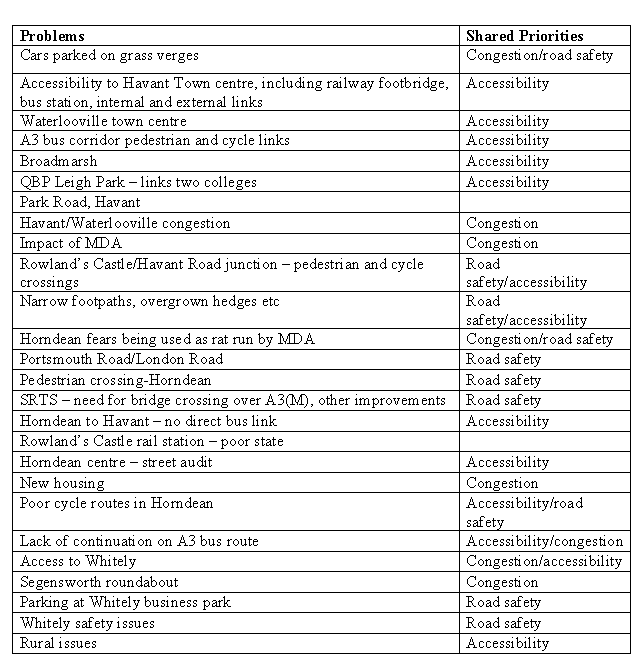 East Hants District Council, Winchester City Council, Havant Borough Council
Possible solutions
· Look at SRTS schemes more strategically
· New Lane/Wakefords Way junction on Bartons Road
· Horndean town centre access programme
343/DM