
Archived decisions
Hampshire County Council Executive Member - Policy and Resources Item 4 IT to support mobile working in Hampshire County Council Report of the Director of Social Services and Head of IT Services |
|||||||
Contact: |
Ken Howard |
Ext: |
7332 |
E-mail: |
|||
1
Executive Summary
This report seeks the endorsement of the Executive Member, Policy and Resources to proceed to the pilot phase of the Flexible and Mobile Working Project. The pilot will cost £115,000 and will be fully funded by the Social Services Department's Information for Social Care Grant.
The brief for this project was framed by the decision of on 24 September 2004 taken by the Executive Member for Social Care, following a recommendation by both the Leader and the Chief Executive of the Council to investigate the options, costs and benefits of introducing mobile working for Social Workers. On 11 November 2004 the Executive Member, Policy and Resources, endorsed this decision of the Executive Member for Social Care to undertake the first two stages of IT Support fro Mobile Working Project and to receive a report on completion of these phases.
In late 2004, trials performed by the Gosport Children and families Social Work team assessed the technical feasibility of mobile working within HCC and Social Services. The trials confirmed that the technology required to improve social worker productivity and enhance the customer experience is available, usable and low-risk.
Work completed to date has concentrated on the technology aspects of mobile working and the optimum products. It has also confirmed that the business processes of social workers in their interaction with clients can be improved using a range of mobile devices including hand held devices such as PDA's and `Blackberries and larger devices such as `Tablet' PCs; the suitability of the device being determined by the tasks that users undertake e.g. a PDA /Blackberry with e-mail for a manager and a `Tablet' PC for a social worker.
The technical findings are applicable to HCC as a whole. Similar business benefits can also be anticipated in other Departments with mobile staff e.g. Education; PBRS ; Environment.
The next stage of the project aims to review and test the mobile working business case by implementing a mobile working pilot. This will assess the likelihood of achieving anticipated benefits, provide further risk assessment and identify an implementation strategy. On completion the Corporate Management Team and Executive Members can then decide whether the business case is justified for full implementation.
There are three main benefits:
· Measurable services improvements (e.g. greater client contact time)
· Measurable savings (e.g. travel costs)
· Less quantifiable benefits (e.g. improvements in morale and retention)
The crux of the business case for full implementation of Flexible and Mobile Working is based on financial benefits. Other very valuable less tangible service and environmental benefits have also been identified. These benefits will be investigated during the pilot and the risks and feasibility of achievement will be assessed. Benefits realisation will be maximised by substantial business re-engineering which will need careful management to implement and sustain. Implementation plans will address this issue. The pilot will involve smaller scale change to working practices. The primary benefits are:
Reduction in mileage claims
It is anticipated that use of mobile technology will reduce social worker travel time and associated mileage costs. This is currently estimated at £200K to £400K per annum. The pilot will confirm the realisable cash saving this represents based on `before and after' mileage of the pilot team.
1.1.1 Property rationalisation
Reorganisation of children's services may necessitate additional investment in property to accommodate relocated integrated teams. The full implementation of this project would increase flexibility of options on office accommodation, ability to respond to increased demand / possible reductions in space for the same workforce. However the extent of the benefits cannot be assessed in the abstract. The pilot team will work with Property Services to assess future potential for savings and/or cost avoidance.
The Fire Service and the Recreation and Heritage Department have also offered use of their buildings (e.g. fire stations, Discovery Centres) as secure `drop in points' for social workers, where access to Hantsnet is planned in the future. This will be investigated
While definitive cash savings cannot be identified during a short pilot with limited numbers, it is anticipated that information on reduced office usage can be collected to inform future work. Any anticipated future savings might then be earmarked for investment in this project or the overall accommodation strategy.
1.1.2 Increased productivity
Mobile working has the potential to enable substantial improvements in staff productivity such as:
o Reduced travel time to and from clients, and from the office (currently estimated at 45 hours per year per care manager)
o Reduced duplication of information handling and administration due to capture of client information at the point of contact (currently estimated at 175 hours per care manager per year)
o Improved customer interaction by allowing the customer to review the information collected and reducing the need for further visits and rework
o Increased `face to face' time with service users resulting in increased volumes of cases handled
o Recruitment and Retention of staff - increase the Council's ability to recruit more easily and retain more staff, thus saving cash and retaining crucial knowledge and experience
Efficiencies such as these will rarely translate into cash savings. However they are measurable, and could enable more service to be delivered with the same number of staff, thereby avoiding some of the future staff growth and associated cost necessary to meet the predicted increase in service demand. The pilot will assess their value in terms of time saved, staff satisfaction and retention, in addition to feedback from customers on the quality of the interaction. Prior to the pilot the amount of face to face contact will be measured. This figure will then be compared to the figure at the end of the pilot and enable a target productivity saving to be set for any subsequent implementation.
1.1.3Non-Quantifiable Benefits
Other non-quantifiable benefits have been identified. Whilst these are less certain and cannot be quantified in cost terms, they are very valuable and strongly support the County Council's objectives. They include:
· Improved morale of staff who perceive this way of working as empowering and facilitating work-life balance and working flexibility
· Decreased environmental impact of car usage through reduced miles driven
· Increased perception of service quality by service users
· Increased speed and efficiency of process for Social Services cases, increasing capability to reach CSCI targets for 3 star authorities.
· Information becomes available to all who need it
· Other Council initiatives such as Contact Centres, Electronic Document and Record systems become more easily implemented with stronger business benefits.
Overall the changes will help to modernise the service in ways which are essential for the best performing social services of the future.
The pilot stage will involve implementation of mobile working to 15 users within busy client-facing environments such as a Reception and Assessment Team. It will run in a parallel to a similar pilot in the Fire service and use a corporate common technology platform where possible.
Prior to the pilot, benchmarking on productivity, travel time and time spent on client visits will be measured so that valid comparisons of the effects of mobile working can be measured.
The key objectives of the pilot stage are to:
o Prove that tangible cost savings in areas such as mileage claims can be achieved and sustained
o Confirm that benefits resulting from improved staff productivity can be achieved, and to assess their potential for improved efficiencies and possible cost savings
o Enable target productivity time savings (e.g. face to face contact with clients) to be set for any subsequent implementation
o Further assess the potential for rationalisation or improved use of accommodation that could result from a wide implementation of mobile working
o Develop a full risk analysis to inform decisions on future phases of the project. This will include assessing the robustness and acceptability of the technology and reviewing staff willingness to change the way they work.
o Fully assess the operational suitability of different mobile devices for specific types of settings
o To develop recommendations for future phases of the project, either in terms of a business case to proceed or a recommendation to halt the project at this stage.
In working closely with IT Services, this pilot will also help with the wider needs of the County Council in testing technologies to support mobile and flexible working patterns in other departments and providing a framework of criteria that other departments could adopt in considering the potential cost benefits of more flexible working arrangements.
The pilot will cost £115,000 and will be funded by the Social Services Department's Information for Social Care Grant. The pilot will complete by November 2005. A full report on the conclusions and recommendations will be presented to CMT in December 2005.
If the pilot is successful for Social Services any consideration of further roll out will need to be seen in the context of Members priorities for the new Children and Adults directorates and the interrelationship with other priorities, particularly the development of contact centres and the Council's human resources policies for flexible working.
The Executive leader, Policy and Resources, is asked to endorse the project approach and consider a further report with recommendations for future phases in January 2005.
2 Background
The brief for the project was framed by the decision taken by the Executive Member for Social Care, following a recommendation by both the Leader and the Chief Executive of the Council to investigate the options, costs and benefits of introducing mobile working for Social Workers.
The overall project has been divided into phases - Phases 1 and 2 (Requirements, Design, Proof of Concept and the Business Case) were completed and are the subject of the paper "Mobile Working Business Case v1.0". The findings of the work completed by IBM, Anite and IT Services are documented. This specifies the business drivers, benefits case and technical requirements for the support of mobile working across the whole authority. The work is centred mainly on the Social Services as the Department with the most to gain from this change.
The Proof of Concept work in late 2004 involved trials of mobile devices by the Gosport Children and families Social Work team as well as an assessment the technical feasibility of mobile working within HCC and Social Services. The trials confirmed that the technology required to improve social worker productivity and enhance the customer experience is available, usable and low-risk.
Work completed to date has concentrated on the technology aspects of mobile working and the optimum products. It has also confirmed that the business processes of social workers in their interaction with clients can be improved using a range of mobile devices including hand held devices such as PDAs and `Blackberries and larger devices such as `Tablet' PCs; the suitability of the device being determined by the each user's role e.g. a PDA /Blackberry with e-mail for a manager and a `Tablet' PC for a social worker.
More detail of the findings from the Proof of Concept work is given in Appendix 1.
Phase 3, a Pilot in the Social Services Department, is recommended to start as soon as possible. Subject to its outcome and funding Phase 4, full roll out to approximately 1000 social care workers could commence in 2006.
3 Options For Mobility in Hampshire County Council
The accepted principle of achieving effectiveness and efficiency from Mobile Working is centred on the need to electronically capture and process information at the point of contact. No other means of recording and capture will achieve the full benefits for an organisation. Accordingly, options have been limited to providing portable computing to mobile staff.
Other options considered within the project were centred on sharing of HCC office space, for example to enable HCC staff to `drop in' to convenient designated HCC offices to access Hantsnet information systems rather than returning to their primary base. While delivering some benefits this does not support the principle above and has therefore been excluded from further examination as part of this project
Benefit estimates included in this paper are based on a fully deployed portable device with mobile connection to core central networks. This represents the greatest utility to the worker and offers the largest opportunity for business efficiency gain. The proposed pilot will also include assessment of the comparative value of working with and without the mobile network connection facility.
3.2 Indicative Costs of Options
Indicative costs to Social Services of the options described above for implementation to 1000 social care staff are:
Level |
Set-Up Costs £m |
Per Annum Costs £m |
1 - Mobile Devices |
2.1 |
0.6 |
2 - Mobile Devices + Connection |
3.0 |
1.1 |
These indicative costs include an allocation for Project and Change Management. They are yet to be properly validated by market appraisal and are based on a good faith discussion with a supplier of such equipment. Proper procurement processes and / or negotiation may alter these costs either upwards or downwards. These costs include the costs of the pilot stages 1&2.
Estimates of the benefits stream indicate that savings at a rate of 2-3 times the running costs will be realised.
4 Benefits Case
Enabling staff with mobile technology will meet all six aims of the Council by:
· Increasing the capacity of workers with improved systems and greater flexibility, enhancing quality of service and potentially increasing the number of cases handled within the same budgets;
· Decreasing the amount of paper, driven mileage for unnecessary journeys and office space used, reducing the overall environmental impact of Council service delivery;
· Improving the perception of Hampshire as a thriving and forward-looking authority thereby offering potential to attract investment to the area;
· Increasing the access of staff to core systems, to work increasingly flexible work patterns, Hampshire has the opportunity to offer greater work-life balance to staff whilst maintaining its quality and quantity of service. Also many staff will feel that they are valued and trusted.
In examining the benefits, it clear that office space is a key cash saving source that theoretically becomes available with increased mobility and reduced dependency upon office-based systems. However, under the charging mechanism adopted by the authority, office space use is only returned as cashable savings if the whole office building is freed. This severely restricts the opportunity to cash in the 33% saving in floor space suggested by the benefits review The lengthy timescales on such savings are, due to the nature of property transactions of this type and savings are likely to take years to come to fruition.
With the forthcoming Children's Services reorganisation, a separate project is underway to examine the opportunities to bring Education and Social Services accommodation together. This project will inevitably take some time to complete, but is more likely to be able to achieve the rationalisation of office space required to generate savings.
It is therefore proposed that this project will work with the PBRS review to assist in ensuring that space use is maximised and the opportunity of that project is therefore increased by the implementation of mobile working and potentially desk-sharing.
With the exception of recruitment and mileage savings (£200k to £400k p.a.) and long term property cost reductions, the `cashable' savings identified will not be realised through actual cash savings but through increased productivity. These productivity gains should enable future increases in service demand to be met with less additional expenditure on staff. Delivery of these benefits will require strong management commitment and focus on sustaining the improved business processes and thereby achieving targets for increased efficiency.
The following table sets out a schedule of the savings expected from this project, once fully implemented across Social Services. These are categorised by their propensity to provide cash, non-cash and efficiency benefits.
Outcome |
Benefit |
Measurable |
Cashable |
Efficiency gain |
Strategic | ||||
Enhanced corporate image/branding |
Improved customer perception of HCC |
_ |
||
More flexible/adaptable organisation |
Ability to move more quickly to respond to changes in the political agenda and service needs |
_ |
_ | |
Improved partnership working and information sharing capability |
Information captured at point of contact enables faster, more accurate and more effective data use |
_ |
_ |
_ |
Strengthen performance management culture |
Ability to measure performance in management of service interactions |
_ |
_ |
_ |
Help retain "excellent" CPA rating |
Increased service user/citizen focus. e-government targets met. |
_ |
||
Efficiency and/or Quality of service | ||||
Service User interaction transaction details are logged at point of contact, improving information quality and timeliness of availability |
Efficiency gain - timeliness of data availability for review / decision |
_ |
_ | |
Service-User facing staff are empowered by information systems and processes |
Efficiency gain -reduces travel and office-based time, increased capacity of professional workers/specialists |
_ |
_ |
_ |
Improved case handling capacity with less time spent travelling to / from office and in re-entering data to systems on return to office |
Efficiency gain - higher agent productivity, fewer new staff required to cover increasing demand |
_ |
_ |
_ |
Processes re-engineered to add value to service users and eliminate waste and failure demand (e.g. repeat calls). Common processes underpinning all offices. Faster completion of customer transactions end-to-end |
Customer satisfaction Efficiency gain - reduced cost per customer transaction |
_ |
_ |
_ |
Processes automated end-end, technical integration with the back office |
Efficiency gain - eliminate/reduce manual processing and duplication of data handling / entry |
_ |
_ |
_ |
Use of core systems - Swift, Outlook, Hantsweb / Hantsnet, available where needed |
Efficiency gain - reduced duplication of systems and data (capital and revenue cost saving) |
_ |
_ |
_ |
The IBM study was completed in December 04 and is based on investment cost estimates that have subsequently been reduced. Therefore these forecasts have now been reviewed internally in the light of the revised costs and changed pilot approach.
In addition to the estimated long term savings from property rationalisation the estimated annual savings in excess of £2.5m, rising to over £4m in year 6 are now projected to be available from the full implementation. These savings are projected on the ability to improve efficiency of workers by decreasing the duplication involved in case completion, reduced travel time, reduced administration (non-case) time.
Net Present Value (excluding property savings), as determined by use of 5%pa investment rate and using estimated cash flow, is positive after three years and after four years is £4.3m. Three year Net Present Value will turn negative if (and all other factors remain constant):
· Set-up costs increase by 155%
· Annual running costs increase by 150%
· Projected efficiency gains fall by 45%
Internal Rate of Return (Return on Capital) is forecast at 22% at year 3, 28% at year 4, settling at around 30% over following years.
Investment is staged to fit rollout profile, which is set to a maximum of 150 new users per quarter. Total capital investment is estimated at c£3m, with a maximum of £1.8m in any one financial year.
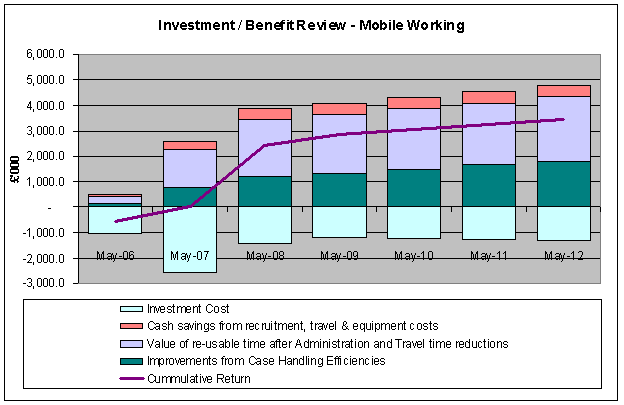
A Profile of these investment and resulting savings is presented below.
NB: Investment Cost = Capital Investment plus Revenue Running costs
Cash Savings from Recruitment Travel and Equipment = reduction in current revenue spend on expensed travel, office based IT equipment and a marginal reduction in recruitment costs
Value of Reusable time = hours not spent travelling and in administration of paper files
Improvements from Case Handling = reduction in double or triple-handling of information
** Property gains are not included in these benefit estimates
5 Pilot Project Plan
The key objectives of the pilot stage are to:
o Prove that tangible cost savings can be achieved and sustained in areas such as mileage claims
o Confirm that benefits resulting from improved staff productivity can be achieved, and to assess their potential for improved efficiencies and possible cost savings
o Enable target productivity time savings (e.g. face to face contact with clients) to be set for any subsequent implementation
o Further assess the potential for rationalisation or improved use of accommodation that could result from a wide implementation of mobile working
o Develop a full risk analysis to inform decisions on future phases of the project. This will include assessing the robustness and acceptability of the technology and reviewing staff willingness to change the way they work.
o Fully assess the operational suitability of different mobile devices for specific types of settings
o To develop recommendations for future phases of the project, either in terms of a business case to proceed or a recommendation to halt the project at this stage.
A 15-user pilot over ten weeks is proposed, to start in late summer. Working practices will be modified to take full advantage of the technology supplied. The involved teams are:
Gosport Children & Families Reception and Assessment Team who, like all C&F teams have been using Swift since its delivery in April 2004. The team is under a particularly high `bombardment' rate and is coping with this workload with vacancies in the team. The team are keen to explore more efficient ways of working but are not especially IT proficient or indeed necessarily comfortable with the existing system input requirements.
Representative Staff from the Adult, Older Persons and Children Sectors
There are several other teams, both in Social Services and within other departments who can also provide substantial learning and provide benefit cases, such as Hospital based teams, Case Review teams, Education's HIAS and SEN teams.
Hampshire Fire and Rescue Service are actively looking at their mobile requirements and undergoing an options review. Their needs are, on initial review, very similar to those within our business review of HCC departments.
It is proposed that the first stage is primarily conducted at Gosport where some of the equipment is already in place and the team are familiar with the devices and some of the software.
Staff from other sectors will also be involved to ensure the business case if fully validated.
The first stage should be for a maximum of 10 weeks, to allow sufficient time for training, familiarisation, evaluation and review.
1.1.4 Milestone Summary
Milestone |
Duration |
Due Date for completion |
Stage One (assumes 3rd May 05 start) |
||
Pilot Initiation |
21 days |
tba |
Equipment & Technical |
40 days |
|
Business Process |
20 days |
|
Training |
27 days |
|
Pilot Period (including support set-up) |
78 days |
|
Feedback & Evaluation |
50 days |
|
The pilot will include a Reception and Assessment (R&A) team, where the workload is centred on the handling of new cases presented to Social Services and the subsequent assessment of the needs of the service user presented. Following the rollout of the Adult and Older People Swift version in January, all cases in progress within the department are recorded in Swift and managed to completion through the workflow therein.
The pilot will be able to test the Swift Mobile Assessment software that enables the capture of information in the service user's presence using one of two devices. These devices are the Tablet PC and a Personal Digital Assistant (PDA). These devices were identified as the most suitable for the tasks by the Phase 2 work by IBM and IT Services.
In order that a comparison of devices and network connection is possible, it is proposed that the pilot will initially consist of 15 users, using Tablet PC's and PDA's. Half of each of the devices will be capable of connecting to the core systems remotely using GPRS (General Packet Radio Service, a form of radio connectivity for data, similar to Mobile Phone services). In this way, it should be possible to test the benefits of GPRS as well as providing stronger evidence of the device capabilities.
The preference for Tablet PC's is founded on the understanding that every other Social Care project described earlier has used the devices in preference to the PDA. Many have started with PDA's but switched to Tablet PC's to gain further benefits of utility and to increase usability for staff.
Success measures for the pilot will be based on key increases in efficiency, reduction in overall costs and are detailed further below. These will also be tested against a control group where current working style measures will be capable of comparison with pilot outcomes.
1.1.5 Evaluation Method
Evaluation will be against pre-determined criteria, agreed by the Project Board. Outcomes from the pilot will be measurable and meet success criteria before further steps are taken towards enlarged pilot or rollout. The impact of the pilot will be compared to the original cost and benefit estimates. The results will be compared with a similar group, acting as the control group, who will be working using existing practices, processes and technology.
These criteria include:
· Increased `face to face' contact with clients
· Caseload handling efficiency gains - more cases in same time OR same caseload handled more quickly to release time for other tasks
· Reduced time wastage through un-required travel
· Reduced duplication of case and/or data handling
· Staff feedback of satisfaction / perceived benefits
Full consideration must be given to the impact of the changes being made by the team, especially in the early weeks, to ensure fair measurement.
1.1.6 Evaluation Reporting
Reporting will be through progress checks throughout the pilot stage to be included in pilot project progress reports, with formal collation of outcomes started at week 6 towards a full report and submitted to the project board. The outcomes from Stage 1 will be used to set targets and measures for Stage 2. These targets will include the amount of face to face contact with clients following implementation of mobile and flexible working.
The following table represents the estimates for the first stage pilot costs. It should be noted that these costs have been discussed but not yet confirmed with IT Services and other suppliers.
1.1.7 Stage One Pilot - 15 Users
Item |
Subtotal | |
Anite Fees, licences, Training and support |
£ 35,300 | |
Implementation Costs - ITS / IS |
£ 43,500 | |
Devices |
£ 8,300 | |
Infrastructure |
£ 24,600 | |
GPRS/3G Cards / Phones |
£ 3,000 | |
Sub Total |
� 114,112 | |
Total |
£ 114,700 |
No additional resources are suggested for the operational staff involved in the pilot and it must be recognised that this may present issues for the operational capability in the early stages.
6 Recommendation
The Executive Member, Policy and Resources is asked to endorse the project approach and consider a further report with recommendations for future phases in January 2006.
Section 100 D - Local Government Act 1972 - background documents
The following documents discuss facts or matters on which this report, or an important part of it, is based and have been relied upon to a material extent in the preparation of this report.
None
7 A1 Background
In Phase 2, a proof of concept was completed to provide clear evidence that the technology proposed by the research and analysis is feasible and to assess risks and costs. This work was completed in December 2004 and the summary of undertakings, and outcomes is detailed below.
The proof of concept for mobile working was scoped to include:
· Brief trial (up to 10 days) by the Gosport C&F Social Work team - using a variety of devices, comprising 1 laptop and 4 Tablet PC's, 2 Personal Digital Assistants (PDA's);
· Connectivity enabled for wireless networks (Aruba style to core HCC network);
· Connectivity enabled for telephony based external connection, such as GPRS / 3G;
· The devices capable of connecting to core IT2000 functionality, including Outlook and Swift
· The devices capable of working off-line using Swift and supporting the mWork forms capability offered by Anite
The PoC set-up will be sufficiently robust to act as demonstration facilities for the road show / change management communication process.
The team have each used at least one of the devices to examine
o the best fit to their needs
o whether one device is capable of providing for the mobility needs of all workers
o whether portability is an issue
o usability factors such as information capture, battery life and the utility of having access to off-line systems
The Proof of Concept was focussed mainly on proving that the technology described in the mobility architecture design is available today, that the software is real and usable and that the risk of the project would be contained within the project management and not within the development of new technology or software.
The Proof of Concept devices were delivered to the team in December 2004. A summary of the feedback from their evaluation is provided below.
1.1.8 A4.1 Time to Complete Assessments
It confirmed that the end-to-end mobile process is quicker than the desk-top version (i.e. data collection, form completion and output of findings). The Social Workers who have used the mobile version are able to demonstrate that in some cases while still with the service user, capturing the information electronically and reviewing the results reduces the overall time involved with the assessment aspect. The layout of the mobile version of the assessment form is also well presented and would be easier to present to service users.
1.1.9 A4.2 Quality of records
Current practice is for notes to be taken by hand and then taken back to the office for transcription into Swift. Given the number of visits and fast-changing priorities for these workers, there is a risk that unclear notes and time-delay will reduce the overall quality of the information captured. This risk is substantially minimised by recording on a mobile device at the point of collecting the information.
1.1.10 A4.3 Other key tasks
· Information Provision - the ability to access information sources such as the internet whilst with the service user will bring advantage in circumstances where insufficient details of specific need are know before the visit. Currently information is searched for and printed before a visit or retrieved and sent/delivered after return to the office.
· Minuting Meetings - currently meeting notes are taken by hand and typed up later; this could be avoided by electronic capture in the meeting
1.1.11 A4.4 Time Criticality
Under the existing standards, Initial Assessments should be completed within 7 days of referral (DIS 1704) and this measure is one of those included in the CSCI service ratings. This is a target which is presenting significant issues to Reception and Assessment (R&A) teams. Electronic information capture would significantly help this standard to be met in more cases.
A4.5 Device Considerations
The first impression of devices was that the PDA offered the best fit to needs - being light, portable and easily hidden whilst still functioning as fully as the Tablet PC's.
With more extensive use however, the drawbacks for social care staff of the smaller PDA devices became clearer with Tablet PC's becoming the preferred choice. Smaller screen size and the slightly less effective screen scribing style of the PDA were seen as limitations to long term use.
However for some other mobile workers, e.g. managers, OT Technicians, etc. the smaller devices such as PDAs or `Blackberries' can provide substantial benefit at less cost.
While a laptop was used for the trial, it should be clear that these have not been adopted for this kind of mobile working by any other Social Services Department we are aware of, due mainly to the following reasons:
· "Barriers" - the screen of traditional laptops form artificial barriers between worker and service user
· "speed of use" - the handwriting recognition benefit of Tablets gives workers a natural transition between current and new information capture
· "signature capture" - the capability of the worker to capture a signature at the point of contact (rather than type, print and drive back to the service user), frees their time, reduces expense costs and increases speed of process as defined by the DIS1704 standard
The ability to connect with central "Office" systems such as E-mail and Calendar are also seen as key enablers for effective mobile working. There are many examples of Social Worker time wasted due to lack of knowledge of a change in an appointment or circumstance where such connection would have saved undue waste of time and expensed mileage.