
Archived decisions
Hampshire County Council Environment Policy Review Committee 23 June 2005 Audit of Street Lighting Report of the Director of Environment |
Item 12 |
Contact: Julian Higgins, ext 7034 email: [email protected]
1. Summary
1.1 This report considers the findings of the recent structural survey of street lighting columns in conjunction with the assessment within Hampshire County Council's Risk Management System of the risk of column collapse. It also outlines progress in exploring methods for funding street lighting column replacement.
2. Corporate Strategy
2.1 This report supports Aims 2 and 4 (Stewardship of the Environment and Building Strong and Safe Communities) of the Corporate Strategy by maintaining and improving the quality of the night-time environment for road users.
3. Background
Structural Condition of Street Lighting Columns
3.1 The street lighting columns are regularly surveyed to assess their condition. The survey takes the form of a visual and tactile inspection and classifies the condition into one of four categories depending on the type of column or severity of deterioration. The full survey report is attached as an appendix. The conclusions from the report are as follows:
(i) The present lighting stock continues to deteriorate at a steady rate with the level of Category 3 (worst condition) corrosion damage remaining steady at about 1% but with Category 2 (moderate condition) at 5% and Category 1 (minor deterioration) at 5%.
(ii) At present the County Council owns approximately 117,500 columns generally manufactured from concrete and steel. The vast majority of these columns will need to be replaced within the next 50 years. In addition the Council's lighting stock continues to increase at a rate of approximately 1.1% per annum.
(iii) The total replacement cost of the County Council's lighting stock is estimated at approximately £120 million. Although there is a significant backlog to be overcome, the issue of replacing the existing column stock is not a one-off problem but a continuing annual commitment that needs to be tackled. Only by the provision of the correct level of funding to the base street lighting budget will this issue be fully addressed. This will be determined through the Asset Management Planning process underway, which covers all highway assets, and will be reported on at a future meeting.
Risk Assessment
3.2 Whilst there is a column replacement programme in place, funding is insufficient and 42% of Hampshire lighting columns are past their design life (compared to a national average of 32%). At the current rate of column replacement, the number exceeding their design life is going to increase. The Corporate Risk Management Process lists Street Lighting Column Collapse in the Medium to High Risk category.
Ownership of Street Lighting Columns on the Highway
3.3 The County Council currently owns approximately 117,500 street lights and maintains a further 12,000 on behalf of other local district, borough, parish and town councils. At present the County Council is the only Hampshire authority to fund an annual replacement programme.
Methods for Funding Street Lighting Column Replacement
3.4 Various methods for the funding of street lighting column replacement are currently being explored, including Private Finance Initiative, prudential borrowing, leasing arrangements, Local Transport Plan funding and revenue support.
4. Conclusions
4.1 The existing street lighting stock condition is continuing to steadily deteriorate. The number of street lighting columns exceeding their design life continues to increase.
4.2 Existing replacement and funding levels are insufficient to deal with the rate of decline.
4.3 A report will be prepared for Members to discuss the funding arrangements at a future meeting.
4.4 The issue of non-highway authority lighting column structural decline needs to be addressed.
Recommendation
That the Policy Review Committee considers the report and draws appropriate issues to the attention of Cabinet Members.
Section 100 D - Local Government Act 1972 - background papers | |
The following documents disclose facts or matters on which this report, or an important part of it, is based and has been relied upon to a material extent in the preparation of this report. | |
NB the list excludes: | |
1. |
Published works. |
2. |
Documents which disclose exempt or confidential information as defined in the Act. |
TITLE |
LOCATION |
Structural Condition of Street Lighting Columns |
Environment Department |
313/JH
APPENDIX
CONCLUSIONS FROM THE REPORT ON STRUCTURAL CONDITION OF STREET LIGHTING COLUMNS
1. Introduction
1.1 This report assesses the present structural condition of street lighting columns and other illuminated street furniture within the county.
1.2 The rolling programme of biannual visual inspections provides a continual assessment of the structural condition of all lighting columns managed by the County Council.
1.3 In the last year approximately £2 million has been spent replacing ageing columns, whilst, at the same time, improving lighting standards. This is now starting to show positive results with the overall number of defective columns reducing over the last two years (figure 1).
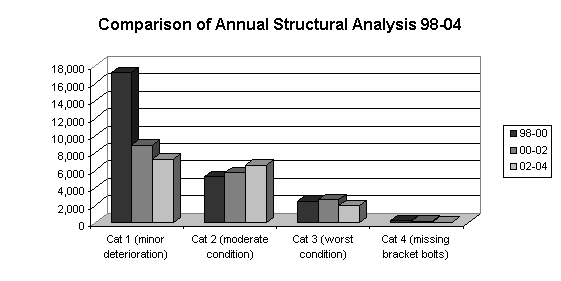 Figure 1
2. Stock Profile
Street Lighting Columns
2.1 The stock profile - see figure 2 - indicates a predominance of steel columns but there are also a significant number of concrete columns. The areas of most concern remain those columns installed prior to 1975 or where the design life expectancy has been exceeded. For the most part concrete and galvanised steel columns only have a 25 year design life. Figure 2 incorporates an estimate of the quantity of columns which are beyond this limit.
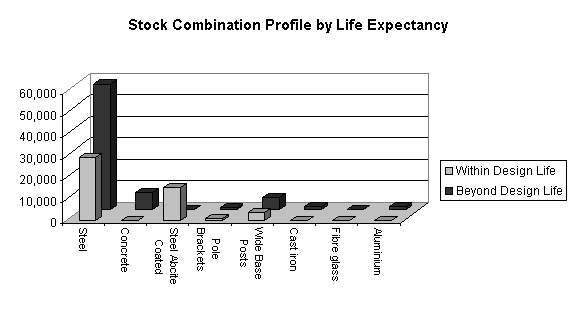 Figure 2
Illuminated Signs
2.2 Illuminated sign and bollard replacement continues, in the main, due to accident or vandal damage and is still being covered by the maintenance budget. However, the number of illuminated signs is still increasing ahead of growth in street lighting due to traffic calming measures being put into place. Engineers have to balance the road safety requirements of utilising illuminated signs against the ongoing maintenance costs and their respective benefit. Also they have to take into consideration safety aspects, in case of lamp failures and power cuts, where reflective signs, particularly in rural situations, may be more appropriate.
2.3 The maintenance budget will be used to start the process of reducing illuminated signage through the revised Traffic Signs Regulations and General Directions 2002 to reduce maintenance expenditure for the future. The average pay back period from de-illumination being five years.
3. Stock Condition - Street Lighting Columns
3.1 Over the last two years all lighting columns have been inspected but it should be remembered that this is specifically a visual and tactile inspection based on past experience and a detailed booklet issued to contractor's operatives. At present none of the stock has been inspected utilising a comprehensive non destructive technique since to date any technique has not proved reliable and is unable to provide more than a three or four year prediction of life before retesting is required.
3.2 The visual inspection procedure is still currently assessed as being better than any other mechanical process available at the present time but this issue continues to be kept under review.
3.3 As with previous years the severity of corrosion/damage has been split into four categories and covers both concrete and steel columns:
Category 1: minor cracks or surface rust/peeling paintwork.
Category 2: deep cracks/swelling or considerable rust corrosion apparent.
Category 3: major loss of material/rust holes or severe deep pitted rust corrosion and severe cracks in concrete.
Category 4: this category is used to identify British Steel columns with specific physical characteristics which are known to give rise to internal corrosion of the column shaft.
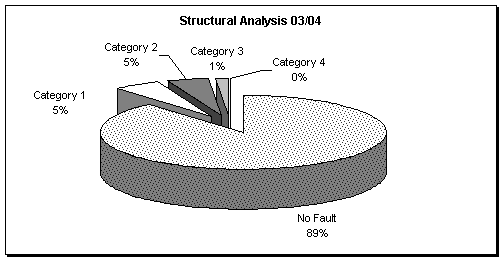 Figure 3
3.4 Figure 3 (above) shows the results of the structural analyses of the County Council's lighting stock. Columns in Categories 3 and 4 are those which have been assessed as requiring complete replacement within the next three years.
3.5 In addition it is evident that columns protected only by galvanising, installed in the mid 1970s, are now showing signs of deterioration as the final weathering of the galvanising is completed, leading to rust corrosion on the windward side of columns in exposed locations, particularly close to the coast.
3.6 Inspection reports from Fareham, Gosport and Havant indicate an increase in the number of structural defects in steel columns over 30 years old.
Risk Assessment
3.7 A Corporate Risk Assessment was initially carried out in September 2002. This was reassessed in January 2004 and again in November 2004 with the following results:
Impact Rating |
September 2002 |
January 2004 |
November 2004 |
Without Controls |
95 |
90 |
60 |
With Existing Controls |
28 |
54 |
44 |
With Proposed Controls |
27 |
Although the revised assessment method shows a decrease in the impact rating, the report also notes that, whilst with significant investment to replenish aged stock, the likelihood of collapse is reduced, current controls are inadequate and the percentage of stock beyond its design life is growing.
4. Reports of Lighting Column Collapse or Emergency Removal
4.1 Between 1998 and 2004 there have been 69 recorded incidents of columns either collapsing or being removed from site on an emergency basis due to their condition. Of these, 14 columns have collapsed into the highway with one causing damage to a car, whilst a further 55 columns were removed on an emergency basis due to concern related to their condition. Figures 4-6 (below) summarise these incidents.
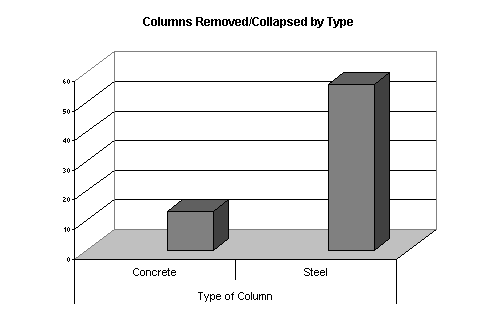 Figure 4
Figure 4 (above) shows the predominance of collapsed steel columns over concrete units of a similar age.
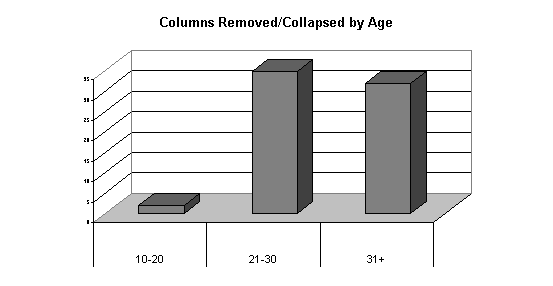 Figure 5
Figure 5 above shows that columns within the 21-30+ age range have had the highest number of failures.
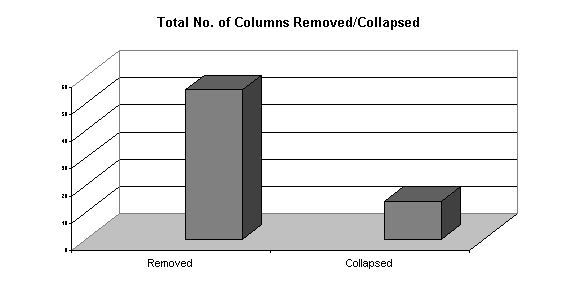 Figure 6
4.2 In most cases columns in danger of imminent failure were identified by the maintenance visual inspection and thus the number of units actually collapsing has been kept to a minimum. There have been no personal injuries.
4.3 Whilst there have been no incidents of catastrophic failure affecting concrete columns - in comparison to steel - the number of units showing signs of serious cracks, etc has risen sharply.
4.4 By comparison steel column failures have arisen due, in the main, to corrosion occurring within the column shaft.