
Archived decisions
Contact: Paula Crompton Ext: 5454 email [email protected]
How the conclusion in this report fits with the Corporate Strategy This scheme will impact on the delivery of the following Corporate Aims Aim 4 - Building strong and safe communities - by working with others to build strong, safe and sustainable communities Aim 5 - Improving services - by improving our performance to deliver services and manage resources |
2.3 |
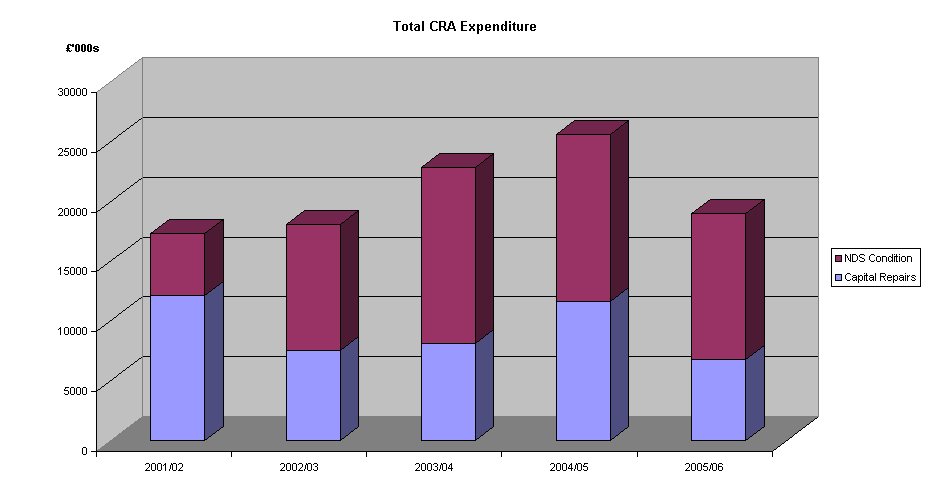
The proposed budget for 2005/6 requires expenditure to be managed carefully to build sufficient capacity for future work plans eg Ashburton Court redevelopment, whilst continuing to address the highest priorities within the strategic risk assessment. Capital repairs allocation for 2005/6 is £11m which will be targeted at reducing maintenance liabilities such as major engineering replacements, recladding and external redecorations and asbestos management. There is no `additional resource' available in 2005/06 or resources carried forward from previous years which will mean that expenditure on some of the risks will be reduced. Table 1 in section 2.1 illustrates these financial pressures. |
||
2.4 |
Resources delegated to schools continue to increase and currently exceeds funding available to the landlord for maintaining the built estate. The Government has indicated there will be two further years (06/07 and 07/08) of NDS Modernisation investment, but beyond this the picture is uncertain. At present there is still a significant NDS programme and schools receive £16.5m of devolved capital, placing Hampshire as probably the highest spending authority in England. Communications with headteachers on the landlord's strategic risk assessment priorities, and close partnerships with schools through the service level agreement, will help guide expenditure of devolved capital towards the highest AMP priorities. It will be essential in a context where overall resources may decline that a focus is maintained on high risk activity. | ||
2.5 |
The proposed budget allocation of £6.4m in Table 1 (para 2.1) represents the optimum balance between expenditure to meet statutory requirements (eg asbestos inspection and Electrical T & I programmes) and addressing the £250m condition liability (over 5 year) across the estate. This approach enables progress with the strategic risks and compliance with statutory inspections to be balanced with essential maintenance programmes, while high priority maintenance programmes, improvements and capital schemes in non-education buildings will have to be implemented at a slower rate. | ||
3 |
Risk Management Strategy 2004/5 | ||
3.1 |
The strategic risk assessment and performance framework for the Built Estate for 2004/05 is attached at Appendix 2, with a commentary on each risk category to demonstrate progress. Members agreed the rank order of risks highlighted in Appendix 2 in November last year. This section of the report summarises progress which has been made on a range of key activities over the last 12 months. Progress has been good with considerable investment allowing work to proceed across all the high risk activities. | ||
3.2 |
Key performance indicators for 2004/5 | ||
· NDS funding is continuing to support the improvement to fire detection systems at secondary schools (On target to install 18 new fire alarms by August 2005) | |||
· Implementation of extensive structural fire precautions work at Bishops Waltham House following member approval in January 2005 ( Total scheme cost of £455,000, excluding fees jointly funded between PBRS and Social Services. All surveys have been completed according to agreed programmes. A costed programme confirming investment priorities is attached at Appendix 3. · Work is underway to revise the Fire Safety Manual to include new legal guidance when the ODPM introduces the proposed Fire Reform Order later this year. Delays to the introduction of the legislation has required the revision to the timescale for publishing the manual. · The first 12 month cycle of the asbestos inspection programme was completed in April 2005 on time and to cost to ensure compliance with legislation. The second annual programme is currently underway. · To support the implementation of capital projects including the new fire alarm installation in schools, asbestos surveys were undertaken to identify the location and type of asbestos, thus improving the quality of the data within the asbestos register. Available resources and difficulty finding competent service provider has caused slippage in the planned performance. The programme will be adjusted to suit available resources and is recommended to be completed in 2010, instead of 2008 as previously reported. · A role profile for the new post of Construction Health and Safety manager has been developed for evaluation and future recruitment. · Work has commenced to draw up the new Term Engineering Contract which will be implemented in April 2007. Whilst still encompassing programmed maintenance regimes as well as breakdown and repair call-outs, it is hoped to include an element of minor works. Typically these could include provision of additional socket outlets and data points. · Electrical test and inspection programmes are implemented to best practice to a maximum five year rolling programme. Testing of specific installations including swimming pools and sports pitch floodlighting are now subject to more frequent tests, up to three years, to meet with best practice. · Legionella management continues to improve with a reduction in the numbers and levels of detection. At any time a number of `hot spots' properties are identified, where detection levels are higher than normal which require investigation. Recent workshops were arranged by the Landlord for Social Services managers to reinforce the need for robust day to day management of legionella; response from those attending was positive. Work is continuing to eliminate the highest risks within water systems. Introduction of a log book provides a formal record of flushing, work undertaken by contractors, maintenance activities and visits by Hampshire Scientific Services to improve the arrangements for monitoring performance at each property. · Planned replacement of the cooling tower at Three Minsters Houses is due to be completed during 2005. The replacement of systems at Winchester Law Courts and Southsea offices are currently under review. Discussions are being held with the DCA on the former and the uncertainty of the long-term future of the latter has put any replacement system on hold. | |||
4 |
Fire Safety Strategy and partnership with Hampshire Fire and Rescue Service (HFRS) | ||
Section 100 D - Local Government Act 1972 - background papers
The following documents disclose facts or matters on which this report, or an important part of it, is based and has been relied upon to a material extent in the preparation of this report.
NB the list excludes:
1 Published works
2 Documents which disclose exempt or confidential information as defined in the Act
BLPP June 2005
Appendix 1
Graph 1 - allocation of CRA resources over last four years and budget provision for 2005/06
Appendix 2
Property Services Strategic Risk Register
Summary of ten highest risks WITH controls in priority order also illustrating current performance
Level of risk |
Area of risk |
Risk Owner |
Position |
Traffic light to illustrate performance |
High |
Fire including arson |
M Kent |
1 |
Amber |
Medium |
Asbestos disturbance |
P Crompton |
2 |
Green |
Medium |
Condition of building fabric |
M Fitch |
3 |
Amber |
Medium |
Failure to manage contractors & supply chain |
J Duggan |
4 |
Green |
Medium |
Swimming pool plant failure |
K Woodward |
=5 |
Amber |
Medium |
Electrical services failure |
K Woodward |
=5 |
Green |
Medium |
Detection of Legionella |
K Woodward |
=7 |
Green |
Medium |
Glazing and window safety |
M Fitch |
=7 |
Amber |
Medium |
Mechanical Services failure |
K Woodward |
9 |
Amber |
Low |
Professional Quality Assurance |
S Clow |
10 |
Amber |
Commentary on top ten risks including a discussion on the risk associated with structural collapse, currently ranked in position 13.
Summary of performance criteria:
Red - reactive performance. Resources (people time or money) required to significantly improve risk management controls. Urgent action required.
Amber - proactive and reactive performance. Progress is being made but specific improvement required.
Green - Meeting best practice. Issues require little managerial attention until next review.
Fire including arson | |||
In recognition of changing legislation and the increasing cost of arson in daytime premises, fire safety, including arson, has been ranked the top risk to the built estate over the past three years . Improving fire safety is inextricably linked to the local management of fire and use of the buildings, which is the responsibility of the service department and manager in control of the building. Current performance for the landlord is assessed as amber. | |||
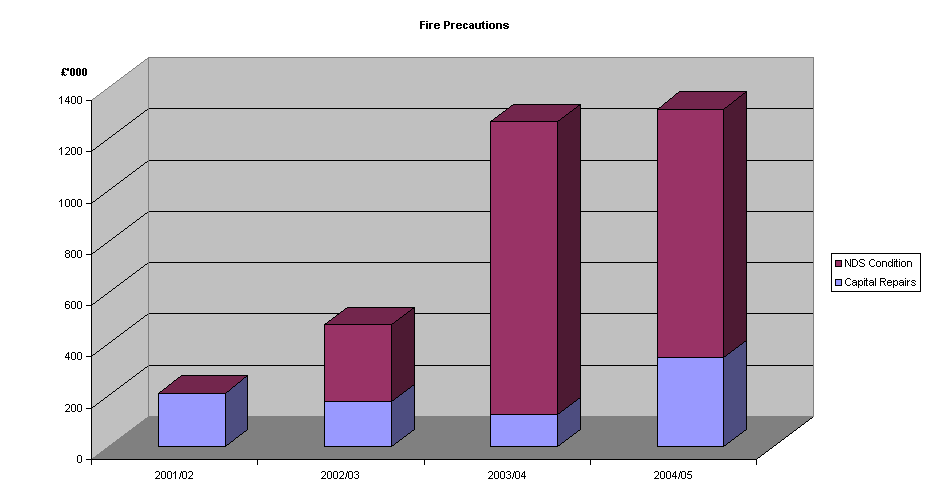
Agreed actions 2004/5 Outcomes 2004/5 Implement agreed programme of structural fire precaution work to residential older persons homes following structural fire precaution surveys Programmes completed for Malmesbury Lawn and on site for Bishops Waltham House Innovative new risk based approach being developed to replace fire surveys Implement agreed NDS programme Installation of fire detection to 18 Secondary schools and other minor improvements in hand for completion August 2005 Revise and reissue Fire Safety manual for local managers Manual in draft but delayed to respond to proposed Fire Reform Order Appoint full time departmental lead manager for fire and revise line management arrangements and set up operational team Lead manager appointed summer 2004 and operation team established. HFRS Partnership developed. Response HFRS enforcement notices All notices implemented to timescale agree with HFRS Despite significant progress in the last 12 months, a green performance assessment is not anticipated until 2008, subject to available resources. Appendix 1, graph 2 provides an evidential base for expenditure over the past 4 years. Funding for 2005/6 will be maintained at £370,000 from capital supported by additional NDS funding in schools. |
|||
Asbestos disturbance | |||
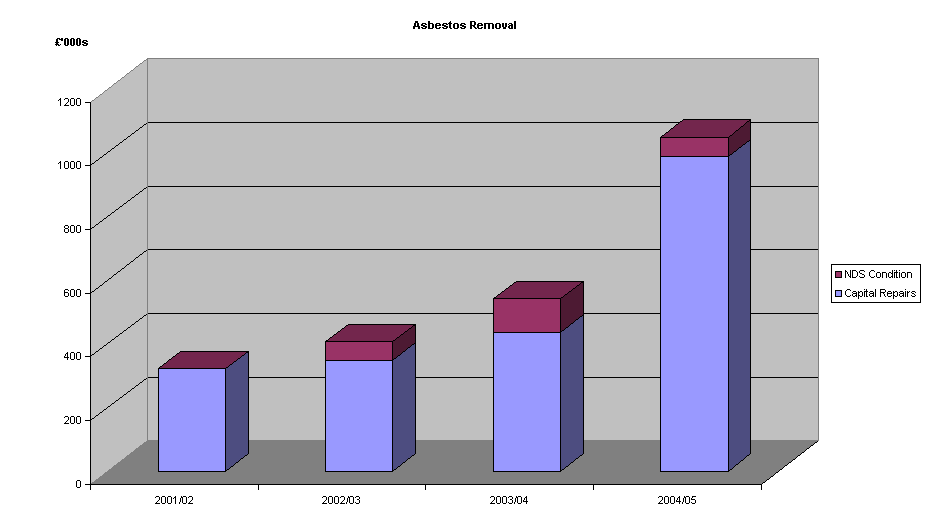
Ranked in second place as a medium risk with a green performance rating. Agreed actions 2004/5 Outcomes 2004/5 Implement coordinated annual inspection programme across the estate Year one of inspection programme completed to time and within cost Improve quality of survey information (commence year 1 of 5 year programme in April 2005) High priority surveys completed to support capital programmes. Costs exceeding funding and performance of consultants was poor. Provide information to building users and occupiers to ensure that all buildings, in which the County Council has an interest, complies with the law Letter sent to building users to confirm liability and responsibility for leased buildings./ Publish asbestos register in 100% of buildings All buildings provided with an annual copy of the asbestos register To maintain continuous improvements and meet new legislative requirements, a senior manager leads an integrated team of staff from Regulatory and Property Services to deliver an ambitious asbestos management strategy: Table 1 in section 2.1 and Appendix1 , graph 3 illustrates the significant capital resources diverted from landlord programmes to implement new legislation. Additional funding of £400k was allocated in 2004/05 to launch the new asbestos inspection programme and support improvements to the asbestos register. Table 2 confirms that this level of investment cannot be maintained in 2005/06 and thus the re-survey programme will be adjusted over 7 years, from 5 previously reported. To make the best use of available resources, a risk-based inspection programme is under development, subject to Member approval, which deviates from statutory compliance but provides a pragmatic risk based programme in line with other strategies for fire and Legionella. A new procurement strategy for competent service providers has been developed to ensure best value and acceptable performance from service providers. Finally several NDS projects within the 2005/06 programme involve the removal of asbestos from high risk areas before refurbishment. The asbestos removal strategy, although costly will reduce the future liability for asbestos repairs in areas such as changing rooms where pupils are largely unsupervised and there is historical evidence of damage to asbestos wall covering and ceilings. It is anticipated that an asbestos removal strategy will reduce expenditure on repairs and inspections in the medium to longer term. |
|||
Condition of building fabric | |||
Ranked in third place as a medium risk for the past two years, with an amber performance rating, this risk covers many issues relating to the maintenance and improvement to both internal and external parts of buildings. Where a separate heading features, for example electrical services, these risks are excluded from the assessment. Agreed actions 2004/5 Outcomes 2004/5 Implement agreed NDS programmes NDS programme due for completion in August 2005 Implement agreed capital programmes in community buildings Capital programme implemented Appoint consultant to survey further 20% of non-education estate. Surveys completed for Social service Children homes and Register offices. Surveys planned for office accommodation. Investment programmes for SCOLA recladding, external redecorations, reroofing etc all serve to reduce liabilities associated with condition of buildings. Condition of buildings (5,000 buildings across 1,000 sites) is an area of risk that requires significant capital investment if downward pressure on this risk is to be maintained. Significant progress has been possible in controlling this area of risk as a result of the NDS Condition funding received from the DfES over the last three years. Landlord resources during 2005/06 will be reduced by 66%, diverting resources to other strategic risks, providing a `patch and repair' strategy for community buildings that do not benefit from NDS funding. Despite considerable investment in building condition, a green performance assessment is not anticipated until 2008, subject to the current level of resources being made available annually. |
|||
Failure to manage contractors and supply chains | |||
Failure of contractors and supply chains represent a high risk and is ranked fourth on the risk register for 2004/05. The construction industry encompasses a wide range of activities, hazards, materials, techniques, employment patterns and contractual arrangements. Nationally, far too many people are injured on construction sites or have their health damaged by construction work. Despite robust checks on the competence and resource of all approved contractors, the understanding of health and safety by construction workers is still in some cases limited, and unless closely managed by Principal Contractor, together with robust arrangement with building occupiers, provides a potential liability for the County Council as client. | |||
Agreed actions 2004/5 Outcomes 2004/5 Establish multi-disciplinary forum for feedback on H&S procedures and processes including staff, contractors and consultants. Monthly health and safety report to Operational meeting regarding performance. Forum established with selected registered contractors. Appointment of a Construction Health and Safety Manager Role profile developed for evaluation and future recruitment. Funding offset against reducing consultant input. Establishing term contract for minor works Strategy established for implementation 2005/06 Complete health and safety files at end of project to time and to acceptable standard Practice note on the Building Manual, to include the Health and Safety Fire, prepared and issued Implement health and safety training in line with industry standards eg National card certification. Annual training programme in place. First multi-disciplinary team have gained CSCS accreditation Significant improvements have been made over the past two years and emphasis is now being placed on consolidating arrangements to maintain current performance, and the identification of minor improvements. |
|||
Swimming Pool Plant Failure | |||
Limited resources allocated to repair and maintenance of swimming pools historically has seen an overall deterioration in condition illustrated by increased risk rating and amber performance assessment (moved from 9th position in 2003/04 to =5th position in 2004/05). Funding delegated to schools was part of the Education Committee's revenue budget. A recent review conducted by Education, estimated that minimum capital funding of £1.8m would be required to bring pools up to an adequate standard for health and safety. Further consideration is being given to the funding, safety and asset management to identify a strategy to improve condition of swimming pool facilities. Members will be advised of the strategy at a future meeting. Agreed actions 2004/5 Outcomes 2004/5 Implement capital programme Surveys of indoor pools completed to inform a capital programme. Survey of outdoor pools in progress prior to recommisioning following winter shutdown. Capital programme deferred until resources available Implement improved maintenance programme Systematic maintenance contract developed for pools. Database for annual pool inspection developed and in use. Subject to the review findings, agreement of a Hampshire strategy and approval of funding (yet to be determined), a programme to upgrading pools to an acceptable Hampshire standard will commence to control risks to pool users. Until this time the Council remains vulnerable to accidents and liability from pool users, especially vulnerable people such as those with a disability, babies and young children, and older persons. |
|||
Electrical Services Failure
Ranked as fifth risk on the Property Services risk register with a green traffic performance assessment for the past 2 years. The risk describes fixed electrical installations across the estate, where the greatest risk is associated with vandalism or accidental damage to sockets and fittings.
Agreed actions 2004/5 Outcomes 2004/5 Establish Test and Inspection programme with increased frequencies for community buildings, swimming pools and floodlighting to meet with best practice Electrical test and inspection programmes are implemented to best practice to a maximum five year rolling programme. Testing of specific installations including swimming pools and sports pitch floodlighting are now subject to more frequent tests to meet with best practice. Develop inventory of lightning protection systems and programme for test and inspection Data gathering is continuing as there is currently no consolidated database detailing all lightning protection systems. Implement annual inspection programme for electrical terminations, breakers and switch fuse devices Visual inspection currently being undertaken as part of the Engineering Term Contract, but a separate regime is being investigated Having made considerable improvement in the past eighteen months it is proposed to maintain current performance at green within existing resources. |
Detection of Legionella | |||
Assessed as a medium risk in seventh position, an improved green performance rating since Autumn 2003 illustrates significant achievement. The table below confirms agreed action and current performance: Agreed actions 2004/5 Outcomes 2004/5 Eliminate repeated Legionella detections in older persons homes Generally levels of detection have remained stable with 5 homes where Legionella is still detected. Generally levels of detection have reduced in the high risk properties demonstrating that management action is effective. Replace all wet cooling towers by 2005 Cooling towers in Three Minsters House are being replaced during 2005. Capital projects at Winchester Law courts and Hampshire Scientific services have been deferred from this year's programme until funding is available from the DCA and in the case of the Southsea offices, the long term future of the building is determined. Review all risk assessments on a two yearly cycle Risk assessment completed for high risk premises, and others being reviewed for medium risk premises Deliver workshops for Social Services managers. Workshops delivered in autumn 2004 Budget and professional resources have been identified and requested to support the replacement of the remaining three cooling towers within the Castle Complex and a building in Southsea. A bid of £420,000 for additional resource was made against the contingency for 2004/5, but the programme was delayed due to unforeseen circumstances. Funding has been allocated for 2005/6 to support the replacement of cooling towers within the Castle Complex. The programme at Southsea will be deferred until 2006/07 until the long term future of the building is determined. The current testing regime and risk management arrangement for cooling towers complies with L8 and there have been no recorded legionella test failures. The capital programme, if approved, will reduce the risk rating from medium. |
|||
Glazing and Window Safety | |||
Ranked in equal seventh position and amber performance rating, this risk describes window failure or damage to glazing which can create injury to building users or contractors. The rank order has increased from thirteenth to seventh position following an improved understanding of the risk and potential liability associated with windows. The following table confirms the key actions and performance during 2004/05: Agreed actions 2004/5 Outcomes 2004/5 Revise guidance for local managers Implement agreed NDS programme Replacement of Warwick windows and Scola Cladding programmes using NDS funding due for completion August 2005.. Implement agreed capital programme for community buildings Research with glazing industry if full glazing surveys can be provided for community buildings |
|||
This risk is a delegated responsibility of schools under Local Management of schools (LMS) however technical guidance has been provided and support provided through Management Partnership meetings. Although progress is made in schools using NDS funding, little progress can be made in the community buildings due to limited available capital resources.
Mechanical Services Failure | |||
Ranked in ninth position with an amber performance rating, an internal review of performance identified some improvements and this has created an increased risk rating from sixteenth position in 2003/04 following the annual review. This risk covers mechanical engineering plant which has the potential for fire and explosions associated with failures, and bring about the closure of operational buildings. Agreed actions 2004/5 Outcomes 2004/5 Revise Corporate Policy and guidance for local managers Revised corporate policies approved and launched April 2005 Develop programme to service and replace safety valves Funding of £600k identified to implement the inspection programme in 2005/06. Consideration is being given to the funding, safety and asset management of this risk to improve performance over the next 12 months. |
|||
Professional Quality Assurance | |||
This risk covers human error leading to the potential for third party damages, significant costs and customer dissatisfaction. Embracing in-house arrangement to ensure bet practice and high levels of performance, this risk covers health and safety procedures, quality assurance, financial arrangements and technical controls. Key actions to improve performance planned for 2004/5 are listed below: Agreed actions 2004/5 Progress 2004/5 Develop the Technical Review programme Programme rolled out across all professional groups in a consistent manner following a successful pilot. Establish multidisciplinary forum for feedback on in-house procedures and process including staff, contractors and consultants. Contractor forum established under another agenda. Forum for staff and consultants programmed each year in Design Unit and Property Management. Improving technical standards and audit procedures will further reduce risk of claims and liability and ensure achievement of best practice. |
|||
Structural collapse and temporary buildings | |||
Previously assessed as a medium risk in seventh position in 2003/04 with a green performance rating, this risk has reduced to thirteenth place reflecting the improvement over the past 2 years. Pro-active risk based surveys of permanent and temporary buildings ensure that all buildings remain safe to occupy, reducing the risk of collapse and injury to building users, while quarterly reports to senior managers provide data on survey findings, identify resources for remedial actions and review departmental performance. | |||
Key actions to maintain current performance are summarised below: Agreed actions 2004/5 Progress 2004/5 Continue inspection of buildings under 40m2 Inspection programme is continuing to time and to cost. Implement prioritised capital repair programme Prioritised capital repair programme is being implemented to meet available resources. Defective wall ties to Scola Buildings identified through survey has provided pressure on resources to fund the repair programme estimated at £2m. Agree duty holder and strategy for fixed equipment, eg climbing walls, hoists, Data gathering is continuing to determine duty holders and practical arrangements to implement the strategy. |
|||
Following the identification of a workmanship defect on SCOLA buildings with masonry panels, a sum of £400k has been allocated in 2005/06 to commence a remedial works programme. Sites are being identified using a risk-based process to identify the highest priorities for implementation over a five year programme subject to funding. The use of capital resources to remove poor condition, temporary buildings in the next 4 years will reduce the cost of inspections and eliminate risk in the foreseeable future. Having made considerable improvements in the past eighteen months it is proposed to maintain current performance at green using in-house resources. |
|||
Appendix 3
Estimated expenditure to implement the outputs of Residential Fire Precautions Surveys
Child Services (13 No.) |
Crossways |
Cypress Lodge |
Eastleigh Children's Home |
Glendalyn Children's Home |
Godbey House |
Mead Children's Home |
Merrydale |
Milesdown Children's Home |
St Mary's Children's Home |
Stonecroft |
Sunbean's Respite Care Unit |
Swanwick Lodge |
Verdi Close Children's Home |
Estimated expenditure £300, 000 |
Appendix 4
Draft Agreement Between Hampshire Fire and Rescue Service and Hampshire County Council For the Effective Reduction of Fire Risk in Hampshire County Council Premises
1. Introduction
This document forms an Agreement between the Hampshire Fire and Rescue Service (HFRS) and Hampshire County Council (HCC) designed to ensure that both parties contribute their available resources to maximum effect in a structured and focused way to achieve the desired outcomes of effective reduction of fire risk in Hampshire County Council premises and service delivery. This Agreement is not intended to create a legally binding relationship between the parties.
2. Relevant Key Objectives
The key objectives of the HFRS Integrated Risk Management Plan which are relevant to this Agreement are to:
· Achieve a reduction in the number of fire deaths and injuries.
· Achieve a reduction in the number of fires started deliberately.
· Achieve a reduction in the number of fires and unwanted alarms of fire that occur.
The key objectives of HCC are:
· Improvement in the management of risk to all personnel using or entering HCC premises from injury and loss of life due to fire.
· To minimise the risk of losses from fire.
· To maximise the awareness of fire in corporate and local management and operational activities.
· To ensure the safety of staff and building users consistent with the County Council's Corporate Risk Assessment for Buildings.
3. Common Objectives
Analysis of the key objectives from each organisation shows that a set of mutual objectives can be defined as follows:
· To reduce the risk of fires in HCC premises.
· To increase the awareness of key issues in Fire Safety management within HCC premises including arson prevention and the reduction of unwanted fire alarms.
· To concentrate resources on reducing risk from fire in high life risk premises.
· To mitigate the effects of fires that do occur by ensuring appropriate human responses through local management and the provision of appropriate improvements to structural fire precaution measures and through a risk based assessment methodology the installation of automatic sprinkler installations into new and refurbished buildings, where resources permit.
4. Resources Commitments
HFRS will incorporate into its Risk Management activities the use, where deemed necessary, of specialist officers dedicated to HCC premises on a consultancy basis, this may include arrangements for permanent secondments. The remit of these Officers will be to support local managers in identifying fire risks and improving responses together with advice and guidance on risk assessments for building projects. It is envisaged that this will be complementary to the traditional inspections and enforcement role that the HFRS has. Any secondment or consultancy arrangement will be the subject of a specific formal appointment between the parties to define the scope, definition and any fee arrangements.
HFRS will provide support to, and engage in, training for HCC staff where necessary to achieve the objectives. The cost of this will be determined over time and agreed between the parties.
HCC will incorporate into its general Health & Safety Management activities a Fire Safety Agenda to compliment the HFRS Risk Reduction activity by concentrating on training and cultural issues.
HCC will ensure that fire safety is a priority in the design and refurbishment programmes of its premises and both parties will take a proactive stance in early consultation with the HFRS Officers when considering potential design solutions.
Resource commitments, both staff and financial, will be subject to availability and prioritisation as agreed by the respective members and executives.
5. Key Objectives
This Agreement is intended to build on the partnership working already commenced between the two parties in relation to fire precautions and fire management improvement.
The Agreement aims to deliver the following outcomes over a three year period:
- A reduction in the risk of deaths or injuries due to fire in HCC premises.
- A raising of awareness and skills of the Service Managers in relation to fire safety and unwanted fire alarm signals.
- A reduction in the risk of fires in HCC premises and an improvement in the detection and containment of fires in HCC premises.
- A reduction in the number of deliberate fires in HCC premises.
- A continuing improvement in risk assessment in relation to structural fire precautions in building projects and a continuing commitment to consider automatic sprinkler installations, where relevant, based on established methodology.
- A facility within the HFRS risk management information system to demonstrate the effectiveness of this agreement
6. Signatories