
Archived decisions

Regulatory Services
Service Plan
2005 - 2006

This Service Plan is issued under the authority of:
.......................................................................
Dr Paul Berryman
Head of Science & Food Standards
For Regulatory Services Management Team
This Service Plan forms part of the Official Quality System of Hampshire County Council's Regulatory Services.
Copy Number: ----- Issued to:----------------------------------------
Regulatory Services, Mottisfont Court, High Street, Winchester SO23 8ZE
Tel: 01962 841841. www.hants.gov.uk/regulatory
1 |
Management Summary1.1. Introduction 1.2. Performance and plans 1.3. Finance 1.4. Performance indicators 1.5. Accommodation |
Page3 4 4 5 5 |
2 |
Where are we now?2.1. Corporate Context 2.2. Recent Achievements 2.3. Financial performance 2.4. Customer feedback 2.5. Trends |
6 6 7 7 7 |
3 |
What are we trying to achieve?3.1. Vision. 3.2. Mission statements. 3.3. Values. 3.4. Quality policy. 3.5. Key challenges. 3.6. Critical success factors 3.7. Dependencies |
9 9 10 10 10 11 11 |
4 |
Our Service Improvement and development plans4.1. This year's goals 4.2. Risk based approach to planning. 4.3. Implementing the plan through project management. 4.4. Performance monitoring 4.5. Marketing plans 4.6. Review against the Service Plans 4.7. Variation from the plan 4.8. Areas of improvement. |
12 12 13 13 14 15 15 15 |
5 |
Our staff plan5.1. Organisation structure 5.2. Staffing allocation. 5.3. Staff development plan. 5.4. Internal communications |
16 16 16 17 |
6 |
Appendices1. Links to Corporate Strategy 2. SWOT Analysis 3. Allocation of resources |
18 23 24 |
HAMPSHIRE COUNTY COUNCIL. REGULATORY SERVICES.
SERVICE PLAN 2005-2006.
1. Management Summary
1.1. Introduction
As a multi-faceted part of the Property Business & Regulatory group, Regulatory Services comprises four key services:
· Trading Standards Service
The aim of Trading Standards is to enforce fair trading, food standards and product safety laws via inspection, sampling, advice to businesses and the public and sampling and testing of consumer goods. It also enforces weights and measures legislation and animal health and welfare standards.
· Registration Service
The aim of the Registration service is to provide a customer-focussed service to the public for the registration of births, deaths and marriages. It also conducts a range of celebratory ceremonies for the public, including citizenship, remembrance and baby-naming.
· Hampshire Scientific Service
The primary aim of the Scientific Service is to help protect the public by utilising accredited scientific testing facilities. It provides a statutory Public Analyst Laboratory Service for the County Council in order to enforce food & agriculture safety laws. It also provides scientific advice and consultancy services in the areas of product safety and environmental health and hygiene.
· Accredited Community Safety Service
The aim of the Community Safety Service is to improve community safety and wellbeing by reducing and deterring low level crime. In addition to help improve the physical environment by reducing and preventing littering, fly-tipping, graffiti and abandoned cars.
This document sets out the Service Plan for Regulatory Services for 2005-6.
1.2. Performance and Plans
In 2004-5, Regulatory Services launched a number of new services to the public including the introduction of Citizenship and Remembrance Ceremonies, a Healthy Eating Campaign, the new Accredited Community Safety Service and a Quick Response Team to address doorstep selling issues.
In 2005-6, Regulatory Services will continue to provide essential statutory services for the public together with a range of customer-focussed initiatives to build strong and safe communities.
Registration Services will extend its range of ceremonies to include Civil Partnerships and will introduce an on-line booking system as part of the e-government initiative.
Scientific Services will further improve income streams by offering 12 new food sampling programmes to customers and by extending its customer base to include East Sussex County Council after a successful tendering process.
Trading Standards will develop its Buy with Confidence, Protecting Older People and Healthy Eating campaigns and remodel the website and advice service.
The Accredited Community Safety Service will be further developed to provide public reassurance to Hampshire residents by combating antisocial behaviour.
1.3. Finance
· In 2004-5, Regulatory Services achieved a planned underspend of £100,000 on an overall cash limited budget of £4.2 million. This will be carried forward to fund the installation of CCTV in our Community Safety Officer's patrol vehicles. Excellent income streams were achieved by Registration (£1.26m), Scientific Services (£1.23m) and Trading Standards (£0.31m).
· For 2005-6, Gershon Savings of £86,000 are required for Regulatory Services. This will be achieved via vacancy management, additional income and careful cost management. An additional £86,000 of non-cashable savings will also be identified including a £35,000 efficiency saving at the laboratory following last year's successful Lean Manufacturing programme.
· Regulatory Services Management Group (RSMG) is responsible for the allocation and delegation of budgets allocated for Regulatory functions within the defined cash limits.
· The budget for 2005-6 is given below in figure 1.
Figure 1. Regulatory Services Budget for 2005-6.
Function |
Budget, (£,000) |
Trading Standards |
3,068 |
Scientific Service |
15 |
Registration Service |
339 |
Community Safety Service |
1,165 |
TOTAL |
4,587 |
The Capital Budget for 2005/06 is £45,000. This will be used to purchase operational and scientific equipment.
1.4. Performance indicators
Regulatory Services performed well against its performance targets. Key indicators included:
· The Food Standards Team inspected 100% of Hampshire's high risk food premises and was amongst the highest authorities for food sampling.
· Trading Standards satisfied BV PI 166 by achieving 100%.
· CIPFA Trading Standards statistics for 2004 showed that Hampshire was above the upper quartile for planning and modernisation. Trading Standards will continue to strive to be among the best in the UK.
· Trading Standards piloted the DTI's new peer review process for the south east region and produced a 3-year improvement plan. It will also aim to achieve upper quartile results against new DTI performance measures.
· The Scientific Service satisfied quality and innovation performance indicators but will be looking for further improvements against income and turnaround targets in 2005-6.
Further details on performance targets are given in individual service plans.
1.5. Accommodation
In 2005-6, plans will be drawn up to:
· Relocate the Trading Standards Service from Fareham, Basingstoke and Winchester to a single site. The aim is to realise further savings to cover 2006-8 Gershon efficiency targets.
· Relocate the Scientific Service from the Portsmouth City Council - owned building in Southsea to a new site. The aim is to improve layout and productivity and avoid a potential bill of £500,000 needed to renovate the roof and climate control systems. A detailed business case will be prepared.
· Implement a systematic refurbishment programme to upgrade Register offices.
2. Where are we now?
2.1. Corporate Context.
Hampshire County Council's Corporate aims are:
Aim 1 |
Maximising life opportunities |
Aim 2 |
Stewardship of the environment |
Aim 3 |
Achieving economic prosperity |
Aim 4 |
Building strong & safe communities |
Aim 5 |
Improving services |
Aim 6 |
Developing councillors and staff |
Appendix 1 shows how each of the four services link to these corporate objectives.
2.2. Recent Achievements
Regulatory Services has responded to the changing needs of the community in Hampshire by improving access for consumers and the business sector to our legal advice and enforcement teams. In addition, there have been several new initiatives, and outcomes, notably:
· Launch of the Community Safety Service to provide public reassurance to our residents by combating antisocial behaviour.
· Promoting healthy living by providing nutritional advice through the "Food - the Choice is Yours" Campaign.
· Taking a national lead with the introduction of Citizenship Ceremonies.
· Identifying £35,000 efficiency savings via the Scientific Service's Lean Manufacturing initiative.
· Protecting older people in their homes by introducing a Quick Response Team to deal with rogue traders. The team saved £70,000 for members of the public.
· Securing a number of new Public Analyst contracts including Nottinghamshire, East Sussex, West Sussex and Essex County Councils after competitive tender.
· Introducing Remembrance Ceremonies as civil alternative to funeral services.
· Clamping down on the sale of alcohol, cigarettes, solvents and other age-restricted products to Hampshire children.
· Identifying a serious case of fraud in the selling of sand and ballast resulting in a £15,000 fine.
· Introduction of a new customer feedback system for Registration Services.
· Highlighting a major problem with excess packaging of Easter Eggs, some products consisting of only 14% egg and 86% packaging.
· Reducing and deterring under-age drinking in public places, vandalism and related anti-social behaviour.
2.3. Financial Performance
The outturn for Regulatory Services, (excluding Coroners Service), for 2004/05 is given below:
Function |
Cash limit |
Final figures |
Over/ (Under) |
£000 |
£000 |
£000 | |
Trading Standards (Income c. £0.31m) |
3049 |
2982 |
(67) |
Scientific Service (Income c. £1.23m ) |
26 |
102 |
76 |
Registration Service (Income c. £1.26m) |
348 |
342 |
(6) |
Community Safety Service |
750 |
648 |
(102) |
TOTAL |
4173 |
4075 |
(99) |
2.4. Customer feedback
Surveys of businesses and consumers that had used our Trading Standards services showed very high levels of satisfaction. Businesses: 74% very satisfied and 26% fairly satisfied. Consumers: 65% and 21%).
Customer review meetings with laboratory clients showed excellent feedback relating to quality and value for money. However some clients felt that sample turnaround should be quicker. A key target for 2005-6 will be 95% samples completed within 28 days.
Registration Services introduced a customer feedback card system last summer. Many customers have responded with favourable comments and suggestions. Negative feedback was extremely rare but very useful.
2.5. Trends
Key trends for the Community Safety Services are:
· Under-age drinking and related anti-social behaviour.
· The need for a policy change to allow officers to issue fixed penalty notices to young people from 14 to 17 years of age.
· Permission from the Chief Constable for officers to issue penalty notices for behaviour likely to cause harassment, alarm or distress.
Key trends for the Trading Standards Service are:
· Increased demand for Healthy Eating information
· Under age sales of tobacco, alcohol etc still a problem
· Changes in consumer advice delivery
· New Licensing Act duties
· New explosive storage and supply regulations
· New Animal Welfare Bill, could effect our team
· New proposal for Consumer and Trading Standards Agency could affect our Service
Key trends in Registration include:
· Increased range of ceremonies for the public
· Changes in IT systems
· Introduction of ID cards.
Key trends for the laboratory are:
· Increased demand for electronic reporting
· Customer require quicker turnaround
· Increased numbers of authorities are tendering for Public Analyst Services. Increased cost competitiveness required.
· New technologies available for testing - need new skills and new equipment.
· Improved coordination of activities needed to reflect widening customer base.
3. What are we trying to achieve?
This section sets out the Vision, Mission and Values of Regulatory Services. Our commitment to continuous improvement is encapsulated in our Quality Policy.
3.1. Vision
The Regulatory Services vision is:
To be recognised as leaders of service excellence for the people and businesses of Hampshire.
This simple statement carries four key messages:
· Recognition - we want to achieve high awareness and trust with our key stakeholders by providing maximum impact, accessible, valued services
· Leaders - we want to be innovative and engage enthusiastically with the modernisation agenda.
· Service - we want to focus on service delivery driven by customer needs, not professional interests
· Excellence - we want to strive for continuous improvement through high quality staff, trained and developed to achieve their full potential.
3.2. Mission Statements
Our seven key missions are to:
· Improve the quality of life through assisting and encouraging confident and knowledgeable consumers and business
· Protect and support the public and businesses of Hampshire by promoting and enforcing safety and metrology laws and working in partnership to improve health and reduce accidents
· Ensure a fair trading environment through the promotion and enforcement of fair trading laws
· Promote and enforce animal health & welfare and food & agriculture safety laws and encourage the healthy eating agenda.
· Apply scientific expertise to protect the health, safety and economic interests of the public
· Provide an efficient and effective Registration Service meeting the needs of the local community
· Build safe and strong communities through the patrols and other activities of our Accredited Community Safety Officers.
3. 3. Values
· Be customer focused.
· Encourage teamwork and partnerships.
· Support innovation.
· Continuously improve our performance.
· Deliver positive outcomes by concentrating on what we do best.
3. 4. Quality Policy
· Our quality policy, which is encapsulated within our vision, mission and values, is to ensure that we provide services that offer best value and reflect the needs of all our stakeholders.
· We are committed to continuous improvement in all that we do and will operate within a framework of "total quality" embracing the principles and practices of relevant quality models. We aim to achieve and maintain external registration for our quality management system covering all of the services that we provide.
· We recognise that our staff is our most important asset and we will encourage and provide opportunities for everyone to develop their full potential consistent with service objectives and related personal goals.
3.5. Key challenges
· Managing budget pressures - delivering service improvements whilst also realising cash savings
· Business planning/income streams - marketing the Registration and Scientific Services to customers to maximise income streams.
· Office accommodation - preparing business cases for the relocation of Trading Standards and Scientific Services to optimise future performance.
· Flexible working - adopting innovative new work practices to improve efficiency, effectiveness and work-life balance.
· Succession planning - identifying future specialists, innovators and leaders to address the impending shortage of skills resulting from retirements and staff turnover. Also maximising the opportunities arising from the new pay & benefits system.
· Hampton report - responding to the challenge of streamlining inspection and regulatory functions and accommodating the requirements of new Consumer & Trading Standards Agency and Animal Health Agency.
3.6. Critical success factors.
· Effective change management relating to relocation, reorganisation and succession planning.
· Excellent customer relations
· Retention of key staff, particularly qualified Trading Standards Officers, Public Analysts and specialists.
· Acquisition of new customers
· Efficient resource management to get more outcomes for the same level of investment.
· Performance in the upper quartile in relation to national comparators
3.7. Dependencies
Dependencies over which Regulatory Services have no control are:
· The outcome of the County Council's Pay & Benefits review
· The outcome of the Hampton Review , which includes formation of a new Consumer and Trading Standards Agency and a new Animal Health Agency. Both of theses Agencies could have a key impact on the way we deliver our services.
· The proposed expansion of the Police Community Support Officer programme could affect the deployment of our ACSO's.
· Permission from the Chief Constable for ACSO's to issue penalty notices for disorder relating to antisocial behaviour.
· Potential loss of income if Government regulates for self-verification of petrol pumps. (already approved in principle).
· IT Services costs, which rose steeply last year.
· Government Legislation regarding product recall could affect our role.
· Gershon savings for other authorities could reduce sampling budgets which has a direct influence on income streams for the Scientific Service.
· Guidance from the General Register office could affect the delivery of Registration Services.
4. Our Service improvement and development plans
4.1. This year's goals.
In 2005-6, several major themes will dominate the agenda and will require the Service to meet either national initiatives or local policies.
The functional Service Plans give detailed objectives for each Service, but our overall key priorities are:
· Further developing the Accredited Community Safety Officer Service.
· Remodelling the Advice Service following the launch of Consumer Direct South East in 2005.
· Further developing the "Choosing Health" campaign, to promote healthy eating, reduced smoking and sensible alcohol consumption.
· Developing systems to embrace the new schemes, legislation and ceremonies effecting the Registration Service. Civil partnerships will be introduced in December 2005.
· Meeting e-government target BVPI 157 - introducing on-line booking systems in the Registration Service.
· Improving cost-effectiveness at Hampshire Scientific Service by implementing a new marketing plan.
· Improving sample turnaround times for laboratory customers, by utilising efficiencies identified through the Lean Manufacturing process.
· Expanding the Buy with Confidence scheme to become the South East model.
· Expanding operational capability to protect older and vulnerable individuals.
4.2. A Risk Based Approach to Service Provision.
Several of the above initiatives will require resources to be redeployed. In some cases it will be necessary to risk assess the impact of redeploying resources whilst at the same time having to respond to requests, complaints and ensure the appropriate level of compliance with fair and equitable trading policies.
For 2005-6, our inspection and enforcement work will be prioritised as follows:
1. Accredited Community Safety work
2. High risk animal health work
3. High risk environmental safety work
4. High risk food premises
5. High risk product safety premises
6. Medium risk animal health premises
7. Medium risk environmental safety premises
8. Medium risk food premises
9. Medium risk product safety premises
10. All other work
4.3. Implementing the Plan through Project Management
The Service Plan was designed after consultation with staff, service users and management. In order to implement the risk-based approach described above it was decided therefore to adopt a project led approach.
The following documents give strategy and overview for each functional area together with project details.
· Trading Standards National Performance Service Plan
· Food Service Plan
· Registration Service Plan
· Scientific Services Business Plan
· Community Safety Service Plan
Procedure RS 005 sets out the guidelines to be adopted for the management and performance of projects.
4.4. Performance Monitoring.
Internal and external monitoring will be conducted to assess the Service's performance of the plan on a quarterly basis.
· BS EN ISO 9001 Quality Standard: Advice, Trading Standards and Science functions are externally registered with BSI to this standard.
· Peer review and Inter-Authority Auditing: Where appropriate, peer review will be conducted through a programme of audits with regional trading standards services.
· Laboratory accreditations: Scientific Service is UKAS accredited to the EN ISO/ IEC 17025 standard and participates in external proficiency schemes. E.g. FAPAS. Official Food Enforcement Laboratory for both analysis and microbiological examinations.
· Community Legal Services: Accredits our Advice Service.
· BV166. Trading Standards Best Value performance indicator (DTI).
· DTI Performance Measures. Link to TS National Performance Framework
· GRO: HM Inspectorate for Registration audit our Register Offices.
4.5. Marketing Plans.
The key marketing activities planned for 2005-6 for each service are summarised below:
Hampshire Scientific Service:
· New Client Liaison Officer post to improve customer services
· Client Forum meeting in September to discuss sampling initiatives
· Monthly sampling campaigns
· New coordination systems
· Tendering for Pubic Analyst contracts
· Exhibitions and promotions, including Trading Standards Conference in Brighton in June 2005
· Press releases
· Develop existing services
· Sell environment services externally
· New status for Toy Safety approvals - DTI approval to check toys for manufacturers.
Registration Service
· Development of Website.
· Addition of "Virtual tours" of each Register Office on the website.
· New ceremonies - including Civil Partnerships
· Introduction of on-line booking.
Trading Standards
· Promotion of Weighbridge test unit and bulk fuel test unit services to other authorities
· Petrol pump verifications
· Providing Advice service for other authorities
· Increasing But with Confidence income
Community Safety Service
· Further publicity for the service
· Local launch in Basingstoke
· Marketing through survey process
4.6. Review against the Service Plans.
The County Council operates an Executive Panel structure, which includes a set of policy review committees. These committees are responsible for monitoring performance against service plans, performance indicators and best value targets. In addition, the management team monitor performance as follows:
On a quarterly basis, the Service Plans will be monitored to establish:
· Delivery of projects against target.
· Outcomes of campaigns and promotional activities.
· Actual resource allocation versus projected allocation.
· Responses to complaints.
· Reactive work, prosecutions and investigations.
· Financial performance against budgets and income targets.
At annual management review meetings, the Service Plans will undergo:
· Assessment against the previous year's plan to measure improvement.
· Evaluation of outcomes.
· Assessment of performance against Performance Measures.
· Review of financial performance.
Each year, Regulatory Services achievements will be published in an Annual Review.
4.7. Identification of any variation from the Service Plan.
At the quarterly review meetings any variance in the plan will be examined and the reason considered. These variances will be documented and where additional "non - planned" work has met the desired objective this will be recorded. The implementation of the Plan will be reviewed at RSMG, in particular the balance between pre-planned and reactive work. Appropriate action will be taken to ensure that the overall plan is achievable.
Key quality objectives are identified at annual Quality Management Reviews.
4.8. Areas of Improvement.
Where the review process identifies areas for improvement or development these will be implemented as appropriate.
Staff are encouraged to present ideas to improve services via the Eureka scheme, the IPP process and staff meetings.
A key objective of Regulatory Services is to continuously improve the quality, efficiency and effectiveness of its services.
5. Our staffing plan
5.1. Organisational structure.
Regulatory Services report through the Director of Property, Business and Regulatory Services to the Cabinet Lead Member for Policy and Resources.
The current relationship between County Council Members and the four Regulatory functions is shown below:
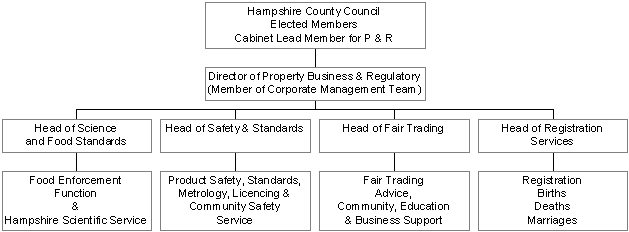
The four Heads shown above make up the Management Team of Regulatory Services. This Team set overall Enforcement Policy and, in conjunction with senior managers, formulates the overall Service Plan.
5.2. Staffing Allocation.
Appendix 3 summarises the allocation of front-line staff to the various Regulatory Services functions for 2005/06. Further details are given in the documents listed at section 4.3. The balance between pre-planned and unplanned reactive work is regularly reviewed at Regulatory Services Management Group meetings (RSMG) to enable appropriate adjustments to be made.
5.3. Staff Development Plan.
Property, Business & Regulatory Services has Investors in People status. Training needs are identified by examining:
· Operational requirements arising from the Service Plan
· Individual needs highlighted at individual performance plan (IPP) meetings.
· Short term needs
All staff will receive an Individual Performance Assessment, to link personal goals to departmental objectives. Clear target setting and monitoring of outcomes will be an essential part of the new Pay & Benefits system. Training and Development needs are assessed at this time and throughout the year as updates are carried out. In addition, the Service will establish team training needs arising out of the team plan.
Various methods are used to meet identified training needs, including:
· Day release courses
· On the job training
· In-house short courses
· External short courses (e.g. LACORS, TSI, GRO, professional bodies and Universities).
Training must be approved before it is undertaken and training outcomes are evaluated after the event.
5.4. Internal Communications.
The key communication mechanisms within Regulatory Services include:
· A series of staff meetings, some weekly , some quarterly , focussing on performance and delivering key messages
· Regular functional team meetings, including cross cutting issues and presentations form other functional groups.
· Hantsnet - RSMT Minutes; Minutes of other meetings; e-mail
· Publications such as PBR Exchange, Spotlight and Hampshire Now.
· The Eureka system
· Departmental and Service meetings. E.g. SMG and RSMG.
DISTRIBUTION LIST.
Copy No |
Holder |
1 |
Andrew Smith, Director. |
2 |
Paul Berryman |
Note: The Plan will be available electronically for all staff and will also be published on the Regulatory Services website for access by businesses and the general public. | |
Appendix 1. Links to Corporate Strategy.
1. Trading Standards Service
Corporate Aims |
Maximising life opportunities |
Stewardship of the environment |
Achieving local prosperity |
Building strong and safe communities |
Improving Services |
Developing councillors and staff | |
Mainly delivered by |
Education Social Services Recreation & Heritage |
Environment Recreation & Heritage |
Education Environment Economic Development |
Environment Education |
All departments | ||
What we do is: |
Consumer Education through the Advice Service, Leaflets and Web information. Consumer Education in schools through `Lifesmart' in all secondary schools and Junior Citizen for younger pupils. |
Work with the Environment Agency on Petroleum storage. Enforce Petroleum legislation ( leaks ). Enforce Packaging legislation ( excess waste) Protocol with Police to help enforce `overweight' HGV provisions. |
Business Advice to all Hampshire businesses. Special service provided to 700 `Home Authority' companies and 400 Buy With Confidence companies. Wide range of Business information through Factsheets and Web. Enforcement of a wide range of Trading Standards legislation to support compliant businesses |
Community based projects to protect vulnerable groups and individuals. Protect public from unsafe products. Reduce `underage' sales of alcohol, cigarettes, solvents and fireworks. |
Competency scheme in place for all staff. Three externally accredited Quality Marks held by Trading Standards. We have an ethos of continuous improvement. Follow EFQM model Strive to achieve 100% against BV166 Develop consultation with stakeholders Peer assessment and benchmarking Quality systems and internal audits | ||
Our other policies & strategies complementary to the corporate aims are: |
Service plans for Advice, Fair Trading, Food, Safety and Standards |
Service plans for Safety and Standards. Sustainable Development Plan. |
Service Plans for Business Support |
Service Plans for Community projects. |
We have quality procedures for all parts of the service. National Performance P.Is. Best Value Improvement Plan. Community Legal Services Improvement Plan. Communication Action Plan. `E' Government Action Plan. Equalities Action Plan. Health and Safety Action Plan. BS ISO 9001 Improvement Plan. Management Review Action Plan. |
We are an Investor in People organisation with high priority to developing individual competencies | |
2. Registration Service
Corporate Aims |
Maximising life opportunities |
Stewardship of the environment |
Achieving local prosperity |
Building strong and safe communities |
Improving Services |
Developing councillors and staff | |
Mainly delivered by : |
Education Social Services Recreation & Heritage |
Environment Recreation & Heritage |
Education Environment Economic Development |
Environment Education |
All departments | ||
What we do is: |
Collate statistical information for the Office of National Statistics for use in forward planning of health and education needs for the local area and nationally |
Improving and increasing information available via world wide web has reduced amount of paper brochures issued. |
Licensing and supporting approved premises increases business opportunities. Maintaining high quality register offices encourages business into the local area. Increasing choice by providing discretionary celebratory services to increase business opportunities |
Introduction of Citizenship ceremonies to welcome applicants into the local area and provide related education in partnership with local districts and communities. |
A commitment to keep up to date with all new legislation and initiatives and maintain continuous improvement. Linked to this a robust training needs analysis is in place for service provision and all staff individually. We have an ethos of continuous improvement. Follow EFQM model | ||
Our other policies & strategies complementary to the corporate aims are: |
Service plan provides for links to community strategy To support the social welfare of the local areas. |
Service plan includes facilitating new development opportunities to enable local communities to access the services and facilities they need. Future projects include raising awareness of customers on related environmental issues. |
Service Plan for Implementing new legislation and services |
Service Plan provides for links to Community Strategy. |
Service plan includes implementing quality procedures for all parts of the service not already covered by the Registrar General. National Good Practice Guide Performance P.Is and Benchmarking.. Best Value Improvement Plan. Communication Action Plan. `E' Government Action Plan. Equalities Action Plan. Health and Safety Action Plan. Management Review Action Plan. Registration 5 year service plan. |
We are an Investor in People organisation with high priority to developing individual competencies. | |
3. Hampshire Scientific Service
Corporate Aims |
Maximising life opportunities |
Stewardship of the environment |
Achieving local prosperity |
Building strong and safe communities |
Improving Services |
Developing councillors and staff |
Mainly delivered by : |
Education Social Services Recreation & Heritage |
Environment Recreation & Heritage |
Education Environment Economic Development |
Environment Education |
All departments | |
What we do for them is: |
We apply scientific expertise to protect public health and promote environmental safety. A statutory Public Analyst and Food Examiner service is provided to Hampshire County Council and other Local Authority clients. We also provide specialised scientific services to customers in the areas of microbiology, asbestos management, environmental science and product safety. | |||||
Our policies & strategies complementary to the corporate aims are: |
We Implement a staff performance development programme. |
We carry out projects which are in the Corporate Sustainability Plan: · Waste management services for Environment Dept. · H&S services for County Council departments · Legionella monitoring in Hampshire buildings · Hygiene checks on Hampshire school meals. |
· We support Hampshire's food businesses and promote good quality food production · We promote scientific and technological businesses in Hampshire |
We carry out statutory Public Analyst services for the purposes of: · Promoting good public health · Reducing crime relating to food, environmental and product safety laws |
We compete in the marketplace to supply Public Analyst work to other Local Authorities. This helps to accrue economies of scale and offer a more cost effective service to the County Council. We carry out a wide range of internal and external audits/reviews to monitor and improve services. We are externally accredited to: · ISO 9001:2000 · ISO/IEC 17025 · EN 45004 · IIP |
We have a staff performance development programme and are committed to the Investors in People Standard. |
4. Accredited Community Safety Service.
Corporate Aims |
Maximising life opportunities |
Stewardship of the environment |
Achieving local prosperity |
Building strong and safe communities |
Improving Services |
Developing councillors and staff | |
Mainly delivered by |
Education Social Services Recreation & Heritage |
Environment Recreation & Heritage |
Education Environment Economic Development |
Environment Education |
All departments | ||
What we do is: |
Work with Social Services and Education, to change behaviour and educate people to take responsibility for their actions. Develop an education package for schools in this respect. Dedicated website on role of ACSO. |
Improve the physical environment by reducing and deterring graffiti, litter, fly-tipping and abandoned cars. |
Assist retail businesses blighted by groups of youths who can intimidate customers. Help businesses generally by high visibility patrolling and the use of cctv to prevent and report crime. |
Provide community reassurance and deter and reduce antisocial behaviour by high visibility patrolling communities. Issue advice or FPN as appropriate. Reduce `underage' drinking in public places. Work closely with the police, local authorities, and other agencies and provide evidence relating to anti-social behaviour and crime. |
Externally accredited by Hampshire Police A commitment to Investors in People Aspire to accreditation to recognised quality systems Emphasis on communicating with the public and business Reliance on outcome-based service planning techniques
Continuous improvement and striving for excellence | ||
Our other policies & strategies complementary to the corporate aims are: |
Report to Committee. |
Report to committee Sustainable Development Plan |
We have quality procedures for all parts of the service. Communication Plan. `E' Government Plan. Equalities Action Plan. Health and Safety Action Plan. BS ISO 9001 Improvement Plan. Management Review Action Plan. |
We are an Investor in People organisation with high priority to developing individual competencies | |||
Appendix 2. SWOT Analysis. Regulatory Services.
Strengths |
Weaknesses |
· Good customer base for HSS & Registration. · Good customer feedback. · Good client relationships. · High level of expertise & quality. · Range of services. · Good partnerships e.g. Hants-Kent scientific Services, TSSE. · High level networks: FSA, DTI, UKAS, LACORS etc. · New marketing and selling skills. · Support of members. · New Accredited Community Safety Officer (ACSO) service. · Good Communications. |
· Keeping pace with new technology. · Turnaround times for laboratory tests. · Old fashioned work procedures: invoicing, sample handling, ordering, budget monitoring. · Laboratory building facilities poor. · Image a little tired. · Still a need to broaden range of services. · Depth in expertise still reducing in some areas due to staff turnover. |
Opportunities |
Threats |
· Expansion of Buy With Confidence scheme · Reprofiling of advice team · New markets and Service areas · New Registration Services · The Health Agenda: school dinners, allergens, Glycaemic Index (GI) diet. · Press releases to highlight achievements · TSI conference & promotions · New lab building to improve productivity. · Partnerships · University links - research or lectures. · 24 hour working. · Private sector markets for laboratory. · Food market high profile. More new food products & technologies available. (e.g. GM, novel foods, nutraceuticals, functional foods) · Automation of labour intensive work to reduce costs |
· Budget pressures. · New Government Agencies proposed in Hampton Report: Consumer and Trading Standards Agency (CTSA) and Animal Health Agency. · Regionalisation. · Contracting out of in-house services. · Laboratory competitors. · Rapid changes in customer requirements. · Poor state of lab building. |
Appendix 3. Allocation of Resources to different functional areas.
The following table summarises the number of operational officer days allocated to each functional area for 2005-6. A more detailed breakdown can be found in each functional service plan, which allocates resources on an individual project basis.
Function |
Example Projects |
Person-days |
Advice, Community & Education |
· Consumer Advice Line · Protecting Older People project · Buy with Confidence · Website development · Talks to community groups · Junior Citizen |
2365 |
Animal Health & Welfare |
· Inspections · Investigations · On farm feeds · New Forest Pony Sales |
600 |
Community Safety |
· Patrols · Investigations & prosecutions · Education resources for schools |
6408 |
Environmental safety |
· Petroleum licensing · Explosives & firework storage |
563 |
Fair Trading |
· Credit · Quick Response Team/Scams · Complaints · Unroadworthy vehicles · Markets · Investigations & prosecutions · Programmed inspections |
2049 |
Food & Agriculture |
· Sampling & Analysis · Inspections of food businesses · Internet food sales · Healthy Eating promotion |
1109 |
Metrology |
· Verification of weighing machines · Weighbridges · Pump inspections |
388 |
Product Safety |
· Under age sales · Inspections of businesses · Electric blanket testing |
1634 |
Science |
· Public Analyst work · Microbiology · Product safety testing. E.g. toys. · Environmental safety work. · Scientific Advice |
2288 598 634 352 528 |
Registration |
· Births · Deaths · Marriages · Alternative ceremonies |
|
TOTAL |
19516 |