
Archived decisions
Appendix
Staffing and Funding of the Emergency Planning Unit post implementation of the Civil Contingencies Act
A Report by the County Emergency Planning Officer
1. Post implementation of the Civil Contingencies Act 2004 (CCA), currently scheduled for November 2005, the County Council will have a range of new or enhanced duties and responsibilities to undertake.
2. The new Act has come into being for a number of reasons. The predecessor to this Act was the Civil Defence Act 1948 which required county authorities to prepare for a hostile attack by an enemy state, the 1993 amendment had catered for the need to plan for civil emergencies but September 11th 2001 had highlighted the need for planning for emergencies to be much more robust. Furthermore the Government's review of emergency planning during 2000 and 2001 showed how inconsistent emergency preparedness was across the United Kingdom and demonstrated the need for a sound framework nationwide.
3. In order to gain compliance with the Act the staffing structure of the Emergency Planning Unit (EPU) and associated funding need to be reviewed as the current structure, staffing level and funding is insufficient to allow the EPU to meet all of its requirements.
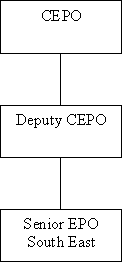
4. The current staffing structure is:
CEPOP

Deputy CEPO





The main focus of the current structure has been mainly focused around working with our partners in District Authorities, preparing them for their role in responding to emergencies. Each of the four Divisional Emergency Planning Officers (DEPOs) supports 3 District Councils (one has just two) and is responsible for producing their plans, delivering training and exercises etc. Additional responsibilities upon the Unit were shared around the team, these included COMAH (chemical industry) plans, Pipeline plans, Radiation Emergency Plans, MACR (military site) plans, Voluntary Agency Liaison, Hampshire Major Emergencies Co-ordinating Committee liaison (at various levels and working groups, Aldermaston, Various Cross Border groups, Farnborough International Airshow, Portsmouth City Council liaison, Southampton City Council Liaison, Hampshire Search and Rescue Committee, Hampshire Flood Steering Group, Oil and Chemical Pollution, etc etc. (this is not an exhaustive list but a flavour of the nature, variety and breadth of work of the team.
5. The funding arrangements up to 31st March 2005 were as follows:
£299,000 |
Civil Defence Grant (Direct Grant Aid from HM Government) |
47,800 |
Contribution from the County Council |
£346,800 |
Total cash limit |
£376,800 |
Gross budget including contribution from fees and charges |
6. The Act, unlike its predecessor, places statutory duties upon district authorities for emergency planning, but recognising both existing good practice and best value, it allows district authorities to contract their county authority to deliver these services for them. All of Hampshire's districts have agreed that they wish the County Council to undertake this role. In return they will fund the County Council circa £220,000 per annum collectively to provide this service.
7. Traditionally, as outlined in Para 4 above, the main focus of the work of the EPU was external to the County Council, mainly in providing a service to the Districts which previously we were grant funded by central government to deliver. Under the CCA considerably more attention will need to be paid to improving the resilience and emergency preparedness of the County Council itself.
8. The EPU will need to work much more closely with all Departments of the Authority. This work will cover two specific aspects: firstly emergency planning, i.e. how Departments (and the County Council corporately) deploy staff and resources and undertake decision making to effectively respond to emergencies to mitigate the effects of emergencies upon both the population and environment of Hampshire; and secondly Business Continuity Planning, i.e. how Departments (and the County Council corporately) continue to deliver services both internally and externally whilst coping with an emergency or loss of key resources e.g. IT, staff or buildings. Annex B highlights some of the key areas where enhanced activity is required.
9. The proposed new structure for the Emergency Planning Unit to allow it to meet the requirements of the Civil Contingencies Act is as follows:
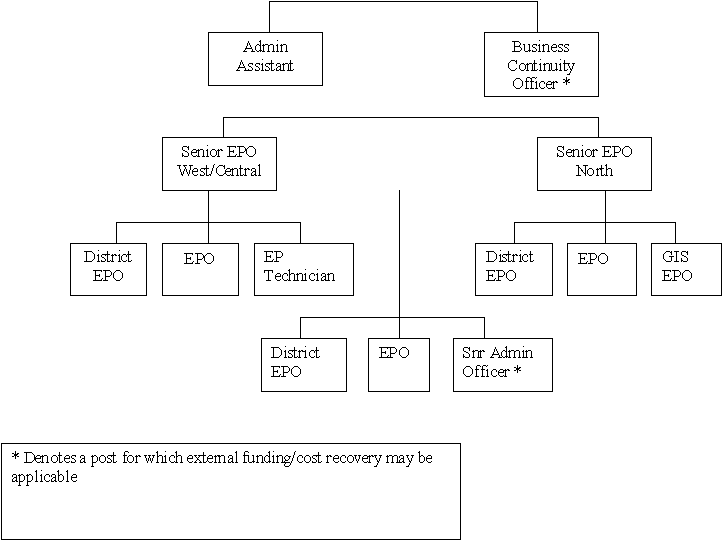
11. The County Emergency Planning Officer has proposed a new structure which requires a total funding of £672,920. As outlined in paragraph 3. above £220,000 of this will be funded by the Districts, additionally external funding/cost recovery can be applied to parts of two posts within the new structure reducing the commitment by £46,000, leaving a balance of £406,920 to be funded by the County Council. The existing cash limit of the unit is £346,800 leaving a shortfall of £60,120.
Funding required = £672,920
Comprised of:
District Funding £220,000
Current Cash Limit £346,800
Cost Recovery £ 46,000
Shortfall £ 60,120
12. With specific reference to the Districts contribution of £220,000, this will fund the following:
3 bespoke District EPOs @ £28,439 mid scale point = £85,300
Livex Exercise contribution, 11 x £500 £ 5,500
Portsmouth CC GIS Exercise Support £ 4,000
LRF Secretariat Contribution £ 3,000
70% of 3 SEPOs @ £35,596 mid scale point £74,500
25% of admin Officer time mid scale point £ 5,310
10% CEPO & DCEPO time at mid scale point £10, 000
10% of other EPO time, 3 x 28439 at mid point £ 8,500
Training/ Exercising costs inc Easingwold & incidentals £24,000
------------
£220,110
13. Recommendation
The County Council agrees to meet the shortfall of £60,120 within the budget of the Emergency Planning Unit thus allowing the proposed structure to be implemented and the EPU begin the task of working to the new Civil Contingencies Act.
Annex
Identified Areas of Increased Activity required by the EPU internally
1. Corporately, Across all Departments
Briefings, and where necessary exercises, for all staff on emergency planning, including inductions for new staff
Briefing, and exercises, for Elected Members on related EP issues
Ensuring a consistent County Council response to emergencies
2. Chief Executives
Corporate Communications
Ensuring Press Office Staff and internal communications officers are prepared to respond effectively, i.e. work with other agencies external to the Authority in warning, informing and advising the public of emergencies, and ensuring staff of the County Council are aware and properly advised.
Legal Services
Being confident that legal services are prepared for their roles, particularly post emergency at the public enquiry stage.
Economic Development
We need to work very closely with colleagues from Economic Development, particularly in the delivery of the duty to promote the concept of Business Continuity Planning to the commercial sector.
Other Sections
Clearly other sections of the Department have skills and experience which could be harnessed in the event of an emergency to help the authority respond effectively, particularly the wide range of skills within the Resources Section and also Democratic Services. The County Information Centres and their staff are clearly a resource which, with proper planning, could be of enormous use during emergencies.
3. PBRS
Trading Standards - Working with and training for emergency response the Accredited Community Safety Officers.
Animal Welfare - Preparing jointly for emergencies such as Rabies, foot and mouth, blue tongue, swine fever etc.
Scientific Services - Preparing to respond to emergencies where sampling/monitoring or other similar services could be of benefit, particularly CBRN emergencies.
Transport Management - Ensuring plans are in place to augment the potential transport needs following emergencies.
Print Services - Planning for speedy leaflet preparation and distribution to meet the challenge of warning, informing and advising the public. Producing post emergency information sheets for distribution.
3. Social Services
The EPU has always worked very closely with the Social Services section and undertaken a large amount of planning, training and exercising. As such a high degree of preparedness has been achieved. Following the creation of the New Children's Services and Adult Services departments we need to re-examine that work and ensure all of our planned responses fit with the new structures.
4. Children's Services
As outlined above we need to ensure all staff are appropriately prepared for their emergency roles.
The Government leaflet distributed in 2004 highlighted the requirement for every school to have a critical incident/emergency plan. Most of Hampshire's schools do not have such a document. Many of them have approached the EPU for help in developing this work which unfortunately to date we have not been able to achieve. However with increased staff resources this is a priority area to be addressed. The aim is to ensure all 540 of our schools are properly prepared to respond to any emergency or critical incident which befalls them, but looking especially at incidents such as Dunblane. A similar approach needs to be taken with reference to our Children's Homes.
5. Adult Services
Recent major incidents have shown the need to have ready responses to deal with the trauma faced by survivors, particularly the bereaved. We need to ensure we maintain our preparedness in this area, and strive to improve our ability to respond effectively.
The Act requires us to pre identify all vulnerable members of our communities and ensure our plans cater for their needs.
6. Environment Department
Highways/Roads - Working with our colleagues from Environment we need to ensure preparedness for problems affecting our road network, including flooding, winter conditions, events etc.
We need to work more closely with Environment on the issue of Oil and Chemical Pollution, clean up of the coastline and disposal of oily and chemical waste.
Passenger Transport Executive requires input on planning and preparations for meeting the transport needs following emergencies by co-ordinating the public transport operating companies.
7. Treasurer's
Ensuring that systems and procedures are in place to undertake proper accounting for expenditure during and following emergencies.
8. IT
The IT department have a significant role in two areas, firstly assisting with our requirement to warn inform and advise the public via electronic means and especially via our web site and secondly to ensure the IT infrastructure works and can support the Authority's emergency response mechanisms.
9. Human Resources
We need to ensure our HR Department are prepared to deal with all issues pertaining to our own staff during emergencies, including having arrangements for communicating with staff. There may also be a role in supporting bereaved relatives of staff. The Employee Support Line personnel may also have capacity to assist in any response. Health and Safety is another significant area where closer working is both essential and desirable.
10. Recreation and Heritage
We clearly need to understand more about the potential risks we face from our activities in this area, the problems associated with the Basingstoke Canal have clearly demonstrated this. Events which the County Council are involved in also need to be properly planned for. Libraries and other facilities can be utilised, with proper plans, for assisting in emergency response e.g. as information points etc.
The above is not intended to be an exhaustive list, indeed the Emergency Planning Unit is aware that it is not totally familiar with all the operations and Sections of all the departments of the County Council. What is clear is that a work programme needs to be established to begin tackling some of these issues, working with departments in drawing up plans and training and exercising appropriate staff.