
Archived decisions
Contact: Chris Locke, 330 6038, e-mail: chris.locke@hants .gov.uk
Jane Page, ext 6862, e-mail: [email protected]
1 Summary
This report:
a) outlines an overall strategy of `growing our own' staff for the future which builds on existing practice in departments, and
b) proposes three council-wide schemes under this approach:
· a graduate development scheme (30 places for existing staff on a one year development programme) ;
· a fast track future leaders scheme (10 places for existing managers on a 2 year programme); and
· a work experience scheme (60 places on various short term schemes).
The business case is made around ensuring our future supply of skilled staff, savings on external recruitment and learning costs, better retention and return on staff investment and better productivity. The proposed schemes would cost under £200k and would be run by a full time Grow our Own schemes co-ordinator and part time administrator based in the HR department, in partnership with managers in departments. The success of the schemes would be expected to impact on indicators such as recruitment costs, workforce diversity, long term vacancies and retention rates.
1.1 This supports aims Aim 6 - developing councillors and staff and Aim 5 - improving services of the Corporate Strategy. `Growing our own' can be an effective and efficient method of resourcing the Council's staff needs, and helps ensure improvements to services through staff having the appropriate skills, knowledge and attitudes to deliver.
More specifically, the proposals are expected to
· maximise the potential and corporate capability of graduates we employ either on occupational training schemes or in other jobs
· ensure a continued supply of high calibre and well experienced managers for future leadership roles
· widen the appeal and accessibility of our jobs to a more diverse range of potential recruits
· support the development of our image as an employer and the principles Investors in People.
2 Hampshire Own Grown - a strategic approach to Growing our Own skilled staff for the future
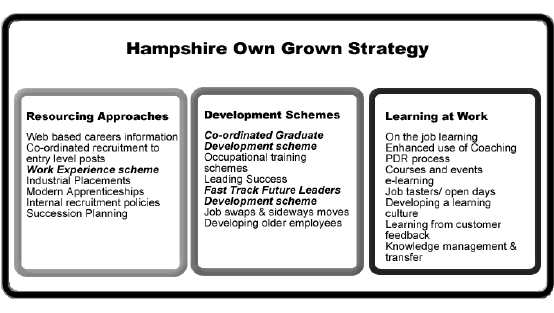
2.1 The authority is increasingly adopting a `grow our own' strategy, initially because of recruitment difficulties but now also recognising that a) it represents a cost effective way of ensuring a continued supply of staff with the skills, knowledge and attitudes we need for the future, and b) that it makes good business sense to develop and make best use of our people's potential. The chart below sets out an overall approach to `growing our own'. The approach falls into three main streams each covering a number of activities or objectives.
· Resourcing
· Development schemes
· Learning at work
2.2 This report deals with proposals to integrate and extend work already taking place on three of the activities under the above headings: work experience, graduate development and fast track future leaders development. Other topics will be further developed in the future, supported by the HR Department.
3 Business case
The business benefits of developing our own staff to make use of their potential and enable them to take on increasing responsibilities are already acknowledged in many departments and include:
· Savings on external recruitment (c £2,500 per recruit) and reduced drop in productivity due to `learning curve' costs
· More effective performance due to internally developed and focussed knowledge and expertise, including better fit with culture and values
· Better return on the investment already made on internal staff
· Reduced impact of recruitment difficulties - whether due to skill shortages, market pay factors or SE region costs pressures
· Improved recruitment and retention through an enhanced reputation as a good developer of people
· Improved recruitment through broader appeal as an employer to a more diverse pool of potential recruits
· Increased diversity in senior level posts
· Reduced risks from loss of expertise due to retirements and turnover, by more systematic knowledge transfer and succession planning
· Improved `agility' to respond to the changes and challenges of the future
· Meeting aspects of the corporate strategy such as developing employment opportunities for local people including young people, older people and minority or under-represented groups.
We now have the opportunity to build on work already underway and extend the approaches across the county council to achieve a more flexible and integrated programme, in particular with schemes for graduate development, development of future leaders, and work experience.
4 Graduate Development Scheme
Why |
We already take on many graduates to jobs throughout the county council, including c 30 pa as trainees for specific occupations. Retention of young people is an issue for some areas. This scheme would help develop the generic and corporate skills of the most able graduates so they could provide a pool of expertise to take on more demanding jobs in the future. |
What |
30 places on a one year development programme of workshops, mentoring and coaching, project work and job shadowing/ tasters, alongside their normal jobs, to develop knowledge of local government, HCC services, partnership working, corporate and policy issues and management skills. |
Who |
Open to any permanent employee who is a graduate or equivalent, in a post under PO level. |
How |
Programme co-ordinator based in HLC with manager support from departments; annual selection process to a 30 place cohort. Selection criteria to ensure equal and fair access and to be developed with managers. Programme could involve 10-15 days per year off the job learning. Evaluation criteria would be set and the programme effectiveness reviewed. |
How much |
£28,350 pa for 30 places, including half time scheme co-ordinator. |
5 A Fast Track Future Leaders Programme
Why |
Future changes in public services such as the Children Act, community strategies, and partnership arrangements will place significant demands on our future leadership capacity. Nearly 50% of senior staff (ie HMF+) are over 50 and many are likely to retire in the next 10-15 years. Women and people from minority ethnic groups are under-represented in the top 5% of earners. This programme would develop those with potential for senior management so that they could take part in the selection process for our leaders of the future, and would also enhance management capacity in current roles. |
What |
10 places for a 2 year programme of development experiences, both inside and outside the county council, such as courses, action learning, project management, mentoring, placements or secondments, to develop public service leadership skills and knowledge. The programme would be tailored to individuals, linked to Leading Success outcomes and the PDR process. |
Who |
Open to county council managers from all backgrounds with 5 years + professional, technical or supervisory experience, including 2 years + experience of managing a function or service. |
How |
Programme co-ordinator in HLC with senior manager support from departments; biennial selection process to a 10 place cohort. Participant would remain in substantive post but might spend significant time away from the job. Selection criteria would ensure equal and fair access and would be based on specific criteria which CMT should help devise. Evaluation criteria would be set and the programme effectiveness reviewed. |
How much |
£143,100 pa for 10 places, including course fees, £10k pppa contribution to backfilling and half time scheme co-ordinator. |
6 Work Experience
Why |
To reinforce the image of the county council as a significant employer with a variety of career pathways and development opportunities; to encourage children, students, returners to work or early retirees from diverse backgrounds to consider LG occupations; to provide an additional source of recruits, especially from under-represented groups; and to provide opportunities for looked after children. |
What |
A variety of work experience programmes, including industrial placements, vacation work, links with local schools, colleges and Project Trident, which would link to resourcing strategies such as careers fairs or open days/taster days. |
Who |
For potential job seekers without recent or relevant workplace experience; priorities would be to encourage a diverse range of participants from under-represented groups, looked after children, and to increase attraction to our shortage occupations. |
How |
Programme co-ordinator in Resourcing Centre or HLC with placement supervision in departments. Evaluation criteria would be set and the programme effectiveness reviewed. |
How much |
£21,900 pa including half time administrator, induction events for 60 places pa and publicity materials. |
7 Conclusions
Taken together these proposals provide opportunities at all levels of the organisation and are an efficient way forward to lay a good foundation for Grow our Own development schemes.
The effectiveness of the schemes would be assessed on the basis on indicators such as:
· Retention rate for scheme participants
· Promotion rate for scheme participants
· Improved workforce diversity indicators, including for the overall workforce and the top 5% of earners
· Reduced external recruitment costs
· Reduced number of long term vacant posts
· Reduced turnover amongst young people and those with under 3 years service.
8 Legal implications
8.1 None
9 Financial implications
6.1 The total cost of these proposals is £193,350 pa.
10 Personnel implications
10.1 The above financial implications include 1.5 fte staff to develop and run the schemes.
11 Impact assessment
11.1 An initial equalities impact assessment shows that the schemes are intended in part to increase diversity in our workforce, but that equal and fair access in practice will need to be considered when designing the selection criteria
12 Crime prevention issues
12.1 None
13 Views of the Local County Councillor
10.1 None
Recommendations
Approval is sought for:
· A Graduate Development Scheme
· A Fast Track Future Leaders Programme
· A Work Experience Programme
· The approval of an allocation from the contingency sum in the current year's budget sufficient to meet the part year cost of introducing the schemes in 2005/06
the above three schemes will:
_ Maximise the potential and corporate capability of graduates already employed by the county council ( £28,350 pa for 30 places)
_ Provide fast track development of potential senior managers as leaders for the future (£143,100 pa for 10 places)
_ Develop links with schools, colleges and potential recruits through work experience programmes (£21,900 pa for 60 places)
The next steps, after initial support for the proposals and subject to final funding approval, would be to discuss the recommendations in more depth with relevant staff in departments to ensure key local considerations are built in, and then to recruit the Grow our Own Schemes Co-ordinator and administrator to start the development work. With investment of under £200k in 2005/06 initial work setting up the above schemes could be completed and the schemes underway by Autumn 2005. Recommendation
Section 100 D - Local Government Act 1972 - background documents
The following documents discuss facts or matters on which this report, or an important part of it, is based and have been relied upon to a material extent in the preparation of this report.
None.