
Archived decisions
Contact: Jos Creese, Ext. 7436; [email protected]
Index: Executive Summary
1. Context of this Report
2. Supporting the Corporate Strategy
3. Progress against Last Year's Targets
4. e-Government and Transformation
4.1 Best Value Performance Indicator BVPI157
4.2 e-Government Progress during 2004/05
4.3 Next Steps in e-Government
4.4 Business Continuity and Risk Management
5. Finances and Value for Money
5.1 How is the money spent?
5.2 Hantsnet (IT2000) Costs
5.3 Transparency of Costs
5.4 Future Costs
5.5 Efficiency Savings
6. Satisfaction with IT Service
6.1 How IT user satisfaction is measured
6.2 What are IT customers saying?
6.3 SAP
7. Staffing and IT Governance
7.1 IT Staffing
7.2 IT Governance
8. Looking Ahead - Priorities for 2005/06
8.1 Specific Themes
8.2 Main Project Areas
8.3 Technology Priorities
Appendix 1 Glossary of Terms (Paragraph 1.7)
Appendix 2 Priority Services Outcomes (Paragraph 4.1.3)
Appendix 3 Summary of IT Services' 5 Year Financial Projections (Paragraph 5.4.3)
Appendix 4 Estimates Staffing Levels in IT Teams (Paragraph 7.1.1; 7.1.4)
Executive Summary
This report examines the performance of IT across the County Council over the last 12 months, whilst looking ahead to the themes and priorities for the coming year.
The assessment of performance is based on:
· Achievements - what has been delivered that has significantly benefited the County Council and the public we serve?
· Customer Satisfaction - what is the perception of front line services and service managers of IT?
· Value for Money - how well are we performing compared with organisations in financial and non financial terms?
There were too many IT projects during 2004/5 to list them all, but they encompass the decommissioning of the mainframe and associated systems replacement, new e-service applications, SAP rollout (now part of IT Services), the SWIFT project for Social Services, and a range of services for schools. Targets set last year are reviewed.
IT Services takes the risks and manages the investment in corporate infrastructure projects supported by a financial plan and business plan. Many such projects are highly complex and challenging (eg. HPSN, SAP, IT2000, mainframe decommissioning), especially in a corporate environment. IT Services has, in every instance, repaid those investments as projects completed.
Generally, projects have been delivered successfully to time and budget, although inevitably with such a large programme (and, as I noted in my last Annual Report, the risks we are taking as a result), there have been some difficulties. Improving SAP usability is a high priority, as is the successful rollout of an e-recruitment system. For 2005/6 the Swift social care system will be extended to consider the needs of Children's Services generally, and development of Hantsweb as a platform for transactional service delivery will conclude.
The County Council is out-performing the majority of both the private and public sector in terms of `value for money' from IT. This is demonstrated by independent external benchmarking and internal scrutiny by the IT Finance Group reporting to the e-Government Steering Group. The County Council has one of the lowest level of unit cost of IT per user, the lowest planned increase in IT spend for 2005/06 in the South East and lower levels of service overheads than most County Council departments. Hantsnet desktop technology (IT2000) is estimated to be saving the County Council in excess of £2m a year over and above `best practice' in normal PC networks for organisations of our size. Some service managers still need help to understand the total costs of technology ownership in a corporate environment. It is proposed that the IT Finance Group now turns its attention to departmental IT costs, having scrutinised IT service costs for the last 18 months.
For 2005/6 there will be a greater focus on efficiency savings and measurable service improvements enabled by technology. Much of this will be derived from using technology to change the way things are done, rather than automating manual processes. IT must be seen as a productivity driver underpinning the `Gershon' efficiency agenda, with IT investments and change programmes demonstrating measurable value and adopting the guidelines recently agreed with the e-Government Steering Group. This requires a move beyond seeing IT as a `costly fact of delivering services' to becoming a `key differentiator' to achieving outstanding services, with benefits being quantifiable wherever possible. More innovative use of IT will be required to realise efficiency improvement and service improvement
The results of an independent review of customer satisfaction with IT across the County Council were pleasing. Despite challenges associated with the rollout of new systems such as SAP, there are high levels of satisfaction. The survey indicated priorities to be IT training and skills, more involvement of users in the initiation of IT systems, improvements in SAP usability and transparency in IT costs. These are being addressed.
e-Government targets for 2005 are within reach, despite some risks emerging. The greatest overall risk to the County Council's e-Government programme lies in its dependence on the Contact Centre strategy. It is reassuring that this has now been endorsed by CMT. More generally, greater partnership working is needed across Hampshire local authorities to reduce the cost of e-services, for example through shared service centre projects. The lack of willingness of some local authorities to support this `join up' is a concern.
Key themes for the coming year are identified in the report (section 8), including technical priorities. IT must be used more strategically, both corporately and by departments. Not infrequently, requirements are based on a narrow view of what currently exists or what experience leads departments to believe is possible. Greater innovation is required, along with a greater emphasis on shared priority themes with perhaps less focus on local project requirements. This includes more collaborative projects with partners and may require a re-assessment of how initiatives are funded.
Another theme is to secure greater value from existing investments in technology (HPSN, Hantsnet, SAP, SWIFT, etc), changing working practices to maximise the return on investment. This will require a level of IT support, service availability and resilience beyond what has previously been acceptable
Both internally and in the way we provide services to the public, the development of self-service and personalised electronic services tailored to the needs of the individual, is becoming a high priority. This will require greater consistency between delivery channels (electronic and more traditional) as well as greater information sharing and partnership working across public sector organisations in Hampshire. Technology changes will be needed to be able to achieve this (eg. security and authentication), and there must be a willingness to enable and empower our own workforce and the public where practicable.
The report also looks at IT structures and skills. Expectations of public services and the changing needs of the County Council (eg. supporting Children's Services) require IT to adapt in terms of skills and structures. IT professionals need to be able to lead change programmes, in mixed teams with third party suppliers and service professionals, with creativity and innovation. It is these skills which enable effective partnership between IT and service departments, controlling the risks and maximising the benefits from IT investments.
Overall, the County Council remains well placed to deliver against its own e-government and IT targets, the demands of the public and the external targets set by government and the ODPM in particular. Much of the technology infrastructure is funded, and there is a low cost IT base. But there is a need to harness the opportunities afforded by technology in new and innovative ways rather than continuing to strive for marginal efficiency and effectiveness improvements without changing existing ways of working. Transforming the way the county council delivers its services, underpinned by technology, is the main challenge ahead.
1. Context of this Report
1.1 This annual performance report examines IT performance over the last year across the County Council generally and the performance of the IT Services Department in particular. It aims to:
· be an objective assessment - `warts and all', of what is going well and where improvements are targeted;
· be useful to anyone with an interest in the cost, value for money and performance of IT at the County Council, from members and chief officers, to end users of services and IT professionals working for the County Council;
· be available to all - including supplier and external public sector partners;
· focus on value for money and the contribution IT makes to the performance of County Council services, not about technology in isolation.
1.2 In addition to the `bread and butter' of delivering IT operational services in support of corporate and departmental needs, there are some specific areas which are currently directing the priorities for IT investment:
· The Children Act - the need to deploy IT to deliver integrated services;
· CPA - the contribution of IT to high performing services, and the frameworking proposals linking e-Government priority service outcomes;
· the Contact Centre strategy for the County Council;
· `Gershon' - the delivery of efficiency savings in all areas of the County Council which demands new technology and working practices;
· e-Government- the focus on `transformation', not just targets;
· Flexible and mobile working - how technology can support new ways of working;
· Major Programmes underway - maximising value from SAP, Hantsweb, and electronic public services;
· Information management and exploitation - both for performance management and compliance with freedom of information legislation.
1.3 It is estimated (from the Mori survey of residents and Office of the National Statistics) that over 60% of Hampshire residents use the internet regularly and a significant number are aware of Hantsweb. The public increasingly demand, either from Hantsweb or through intermediaries, electronic services which:
· Are easy to use and designed with their individual needs in mind;
· Are available at times which suit them, not traditional office open hours;
· Link across related services seamlessly, avoiding the need for multiple calls;
· Deliver services faster and more cheaply.
1.4 Changing public expectations will drive e-service investments in IT and will require strategic thinking from service managers in adapting and redesigning some current service delivery models.
1.5 The term `e-Government' may gradually disappear after 2005 and the focus for IT will demonstrating efficiency gains and public service improvements resulting from investments made. Efficiency and service improvements will often mean:
· changing business processes and the way people work;
· changing how the County Council delivers services;
· changing how we use resources such as accommodation.
1.6 This year's report therefore has a strong emphasis on IT costs and value for money. I hope all service managers will read it to understand what has been achieved and what remains to be tackled to maximise the value of IT investments across the County Council.
1.7 Although this report tries to avoid jargon, a glossary is attached at Appendix 1.
2. Supporting the Corporate Strategy
2.1 Effective exploitation of technology and the changes it enables is key to nearly every aspect of the County Council's performance. IT contributes in three ways:
· The development and support of high value and effective IT services and solutions - this is the traditional IT functional role, and remains essential. It includes running SAP, Hantsweb, Hantsnet and the many hundreds of County Council applications;
· Contribution to wider service planning, policy and strategy, including the Corporate Strategy and many corporate initiatives. Service managers need help to harness the potential of technology to maximise service performance and this will be essential for future CPA rating. It also can protect the County Council's interests in the face of regionalism and unitary government;
· Leadership and support for transformation and change programmes enabled by technology. Examples include `Gershon' efficiency savings, Children's Services, the SAP programme, the Contact Centre strategy, flexible working and e-Service developments. Such changes must be properly planned and effectively executed.
2.2 In these ways, IT and the `e-Government and IT Strategy' supports each of the County Council's six key aims and the Corporate Strategy generally.
3. Progress Against Last Year's Targets
3.1 As predicted in last year's Annual IT Performance Report, 2004 has been one of the busiest yet for IT professionals with the decommissioning of the last remaining `mainframe' technologies whilst implementing new systems and securing the value from them. At the same time, operational IT systems and services must continue to deliver excellent performance.
3.2 Targets which were set for 2004/05 included:
· Completing the SAP/Enterprise roll out, and delivering the savings targeted in the business realisation plans: The SAP roll out programme to over 11,000 staff is virtually complete, and the Benefits Realisation Programme has delivered annual savings (not just IT) as planned. The focus now is on usability and process improvement to deliver better value and acceptance, and as a result information quality improvements (see below);
· A major overhaul of Hantsweb, in terms of design and developing electronic service transactions: Following proposals to CMT, the programme of work is well advanced. Recent achievements include the redesign of the top page, implementation of e-forms and workflow products, the launch of the new web publishing system, search engine improvements, the launch of a partnership Catalogue of Services, a new events diary, and the replacement of the Cousin community database;
· The SWIFT social care system: This represents a major programme of work, and has delivered each phase successfully - a remarkable feat for IT/business professionals working on a complex change programme, more work is needed to ensure the system is fully stabilised;
· `Implementing e-Government' (IEG) and the BVPI157 targets: This remains on target with good progress in all departments (see below);
· Putting in place a corporate strategy and business plan for Contact Centres and Customer Relationship Management (CRM): This is now underway and a strategy approach has been endorsed by CMT;
· Implementation of the Members' IT plan: 97% of Members are now on-line, and nearly all have agreed to use electronic communication. Work is underway to enable Members to have their own web pages, and a range of technologies are being provided specifically to meet Members' needs.
3.3 Other notable achievements during the year include:
· Completing the mainframe decommissioning by end March 2005 with no service interruptions;
· A `Silver Surfers' public event was run in the Spring to encourage `digital inclusion' of older people, and over 350 people attended;
· Hantsnet web interface (HWI) was delivered to all schools to support SAP and new IT services to schools.
· New technologies were introduced to support flexible working, (eg. Hantsnet PDA, and the `Hantsnet Passport' services);
· Establishing the next stages of HPSN including the SEGfL (South East Grid for Learning) services for schools and wider partnership options;
· Upgrade of the core network and the security infrastructure to increase resilience and protect the County Council's information assets and systems is underway;
· Reduced IT unit costs of the (IT2000) Hantsnet service, and amongst the lowest planned cost increase for IT in local authorities in the South East for 2005/06;
· The `Learn.IT' e-learning suite to help everyone understand and use technology;
· Over 40 new business applications were implemented for departments;
· Occupational Therapy Direct has delivered significant benefits to Social Services' clients.
3.4 There are many other operational IT achievements which are often unnoticed, yet are central to the functioning of the County Council. A few statistics provide an insight:
· no significant virus incidents occurred over the year despite nearly 900,000 virus attacks which were successfully dealt with;
· we received over 15 million emails in the year and successfully filtered nearly 4 million `spam' emails from reaching desk tops;
· Hantsweb received an average of 7 million page accesses per month and was quoted in the Press as `by far the busiest local authority web site';
· The IT Help Desk handled over 150,000 calls and emails asking for assistance.
3.5 The current scale and pace of IT change will last for at least 18 months although some levelling off is likely to occur during 2005/06. Difficult decisions will be needed to defer desirable activities which deliver lower value in service or financial terms. The business basis in which IT Services operates makes those decisions more transparent.
4. e-Government and Transformation
4.1 Best Value Performance Indicator BVPI157
4.1.1 The focus on the delivery of the key performance indicator BVPI157 (making all services available electronically), remains a major challenge, requiring:
· leadership from across the County Council's service departments;
· investment in core technology infrastructure (mostly now funded);
· major corporate projects to be in place or completed, such as `customer relationship management' (CRM), content management tools and the SAP ERP programme.
4.1.2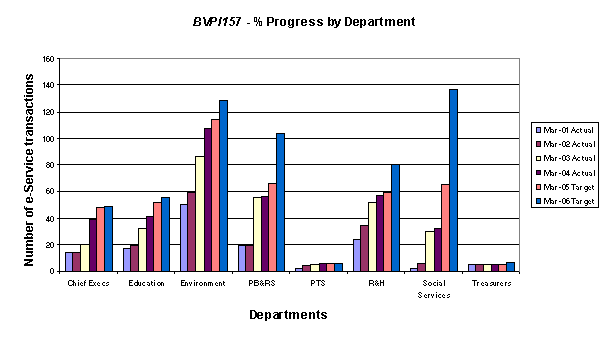 The County Council remains on course to meet the target at the end of 2005 and progress has been reported to CMT:
4.1.3 The BVPI157 target is not an end in itself. The ODPM has acknowledged this by introducing a range of `Priority Service Outcome' targets, defining e-Government results required from the councils. This will also form a more direct part of CPA assessment in future and represents a challenge to departments in some areas. (See Appendix 2).
4.2 e-Government Progress during 2004/05
4.2.1 Alongside BVPI157, and general IT developments (it is arguable that everything in IT is e-Government related), the following summarise the main e-Government programme developments during the last 12 months:
· a detailed e-Government Route Plan is in place showing the actions required to meet the BVPI157 and `Priority Services Outcomes' targets (see Appendix 2);
· each department has completed its own self assessment of progress, risks and commitments against this route plan;
· the Hampshire and Isle of Wight partnership (HIOW) `e-Government programme' funded by ODPM has concluded with a range of successful projects which are now being further developed;
· a corporate e-payments project is underway;
· a `Contact Centre strategy' and business plan are now progressing;
· a `fast track' electronic forms service has been set up by IT Services to support departments' needs for forms based e-services;
· a programme of work to transform Hantsweb into a more user-focused, transactional site is underway, with significant improvements delivered.
4.3 Next Steps in e-Government
4.3.1 Some local authorities which are apparently ahead of the County Council in BVPI157 have in practice made services available electronically as a `face lift' to existing working methods. These have achieved the desired `ticks in boxes' (and publicity) but have not necessarily solved the bigger problems which are:
· demonstrating real value for money from the e-service investments made in terms of reduced operating costs or tangible services improvements;
· transformation in the way services are managed and delivered by removing old working practices and layers of traditional service bureaucracy, integrating technology into service planning and strategy;
· delivering sustainable electronic services which the public choose to use (as measured by take up levels).
4.3.2 It is these targets which the County Council has set for its IT investments and e-Government programmes beyond meeting the BVPI157 targets. This will require continuing commitment across the County Council to:
· integrate e-Government plans with the County Council's Community and Corporate strategies;
· increase consultation with the public about electronic service design and the development of Hantsweb;
· develop closer working with other public sector bodies who can act as intermediaries on behalf of the County Council by accessing information and systems, such as the Citizens Advice Bureaux;
· Continue to change the way we organise services with greater flexibility to deal with cross-cutting issues;
· Integration with annual efficiency plans.
4.3.3 Nationally available e-Government infrastructure (for example from the 22 national projects) will also be used, provided these meet needs and are affordable. A variety of national initiatives have so far failed to deliver savings or service quality improvements so careful scrutiny will be needed. However, adopting solutions developed elsewhere is good practice if these can reduce our costs and accelerate the rate of change.
4.4 Business Continuity and Risk Management
4.4.1 As the County Council implements e-services, so the public expect high availability of those services, including out of normal office hours. This will require:
· the necessary layers of support - technology, departmental systems management, contact centre and service specific professionals;
· e-services to be designed for high availability - contingency planning, redundancy and resilience;
· integration of IT planning with service continuity plans;
· identification of the most critical applications in support of the public, reflected in the way that we provide and prioritise support;
· that the costs of business continuity and risk management are factored into e-service ongoing revenue support costs.
4.4.2 IT Services is reviewing the IT Service Level Agreement (SLA), working with departments to identify the necessary `out of hours' support for the County Council's most critical applications. Additionally IT support groups must work more closely with service managers to ensure effective business continuity arrangements for IT are in place. This includes measures to:
· reduce unplanned downtime;
· increase protection and recovery from potential disasters;
· ensure risks and non-IT `work arounds' are considered.
5. Finances and Value for Money
5.1 How is the money spent:
5.1.1 IT Services takes the risks and manages the investment in corporate infrastructure, supported by a financial plan and business plan (with return on investment) agreed with the County Treasurer. In every instance IT Services has, over a period of time, repaid those investments. In the future IT Services will explore new ways of funding such investments, for example by using `Unsupported Borrowing'.
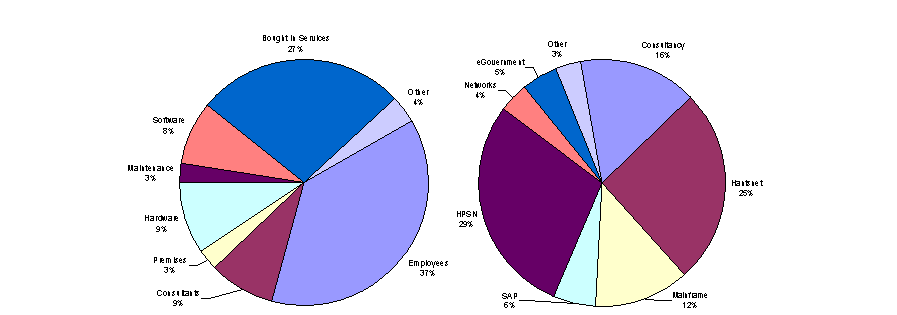

5.1.2 Turnover for IT Services in 2004/05 was just under £32m. IT Services has met its financial plans for 2004/05, recovering the planned deficit to support the investment in IT2000, HPSN and a variety of other infrastructure areas. Additionally, IT Services is now supporting the SAP Benefits Realisation programme, and is on track to deliver the IT efficiency savings from this, including £200,000 savings in 2004/05.
5.1.3 Nationally there has been significant increase in IT expenditure in local government (averaging 40% increase in the last two years alone) and an increasing number of IT professionals supporting e-Government projects and programmes. This reflects the increasing role of IT to business and service performance, also mirrored across the private sector. Based on the SOCITM independent review of costs and performance commissioned in 2004, the County Council now have some solid comparative data against which to assess and compare IT costs.
5.1.4 Notably, the County Council has the lowest planned increase in IT revenue spend in the South East for the coming year (2½% compared with the average of 6%). This is reassuring in terms of IT cost control, although departments will wish to examine whether they are being optimistic in avoiding IT investment to reduce overall costs.
5.1.5 Spending on IT per employee in the County Council is higher than average (£2646 compared with the median for all authorities of £2542), but spending per IT user is lower by nearly 20% (£1655 compared with the median for all authorities of £2023). This includes external users. This indicates that whilst the County Council spends slightly more than average on IT overall, this is because of far greater adoption of technology, and indeed the important measure of cost per user demonstrates far greater efficiency than average.
5.1.6 The reasons for lower costs are broadly:
· very low Hantsnet costs (IT2000) (see below);
· lower costs as a result of a strong in-house team with controlled reliance on external services;
· economies of scale (we are a large council so costs of business administration and overheads are lower, and we can demand lower prices in the market place);
· the business basis on which IT Services operates, which exposes costs, drives down overheads, and demands ownership of the value of IT investments by departments;
· the scrutiny of IT costs by the IT Finance Group, and departments through transparency and comparison of work.
5.1.7 Departments and IT users are often unaware of this high level of financial performance, and with the exposure of IT costs in IT service charges, and the pressures on service budgets, IT Services spends much time dealing with departments questioning IT costs. It is hoped that this report will provide greater reassurance to service managers across the County Council.
5.2 Hantsnet (IT2000)Costs
5.2.1 The main desk top costs of accessing Hantsnet - the HCC `Thin Client' technologies which we call `IT2000' - are on average less than 70% of the costs incurred by the best performing equivalent in the private and public sectors (source Gartner1 2004).
5.2.2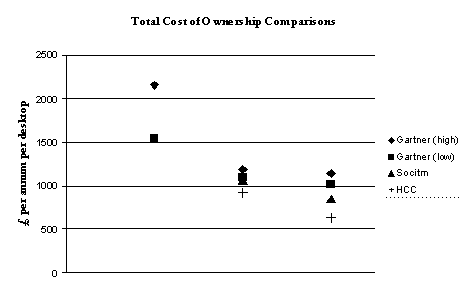 From SOCITM2 2004 figures, the `Total Cost of Ownership' of desktop (Hantsnet) connections in the County Council is estimated at £461 compared to a local authority average of £713. Also, the County Council has by far the highest ratio of desktops to technical support specialists than any other local authority surveyed (HCC - 671 desktops support per support specialist compared with an `Upper quartile' all local authorities of 131 desktops support per support specialist). The following diagram includes both SOCITM and Gartner comparisons:

5.2.3 Further, from SOCITM 2004 figures, the County Council's average cost of support per workstation is £68 compared with an average of £205 for all authorities and £210 in the South East. The efficiency savings are even more pronounced when compared with well managed PC (rather than `thin client') network across all industries where the best performing networks still cost around £320 per desktop per annum more than Hampshire County Council costs - a total estimated annual saving of more than £2m per annum.
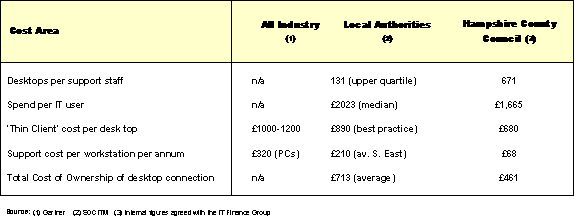
5.2.4 It is usually a lack of an understanding of the `total cost of ownership' of IT in a corporate environment which leads to a belief that `corporate IT is expensive' - an issue in nearly every organisation. Excluding wide area networking (WAN), typically those costs for Hampshire County Council are made up as follows:
Direct Costs: |
Hardware - purchase cost, upgrade, maintenance, spares etc. - |
14% |
Software - purchase cost, maintenance, annual licensing - |
13% | |
Indirect Costs: |
Network (not WAN); Traffic management and planning; Security; Support (Help Desk, 2nd & 3rd level); user administration; Hardware configuration and deployment; Disk and File management; Storage capacity planning and management; Backup, archive and recovery; Operating system management and support; Software deployment; Application deployment, management and support; Performance monitoring and tuning; Disaster recovery planning and testing; Internet access and associated systems (eg. firewall, spam and content filtering); System research evaluation and planning; Supplier contract management; Account management - |
68% |
Overheads: |
Accommodation; Finance; Management; Procurement, etc - |
5% |
5.2.5 It is difficult to make direct comparisons with other organisations, since most typically have a greater proportion of PCs and also there are variations on how costs are accounted for. However, the proportion of costs above are in line with industry expectations. From Gartner Research, direct corporate IT are typically 20-30% (compared with 27% above for Hampshire County Council), and indirect and overhead costs 70-80%; our expenditure breakdown fits within these ranges.
5.2.6 Not surprisingly, Hampshire is used by SOCITM as an example of best practice and by our main supplier of the thin client technology (Citrix) as an example of the cost performance which can be achieved from `thin client' technology.
5.2.7 It is questionable whether such a low cost base is sustainable without damaging quality of support, and the Hantsnet (IT2000) support teams are under very considerable pressure to meet all the demands placed upon them, while keeping costs low. Lower prices are only likely to be secured by reducing quality and may require departments to think differently about how they adapt service plans to justify further IT investment.
5.3 Transparency of Costs
5.3.1 IT costs are very visible in the Hampshire County Council - above the line charges on departments which are readily (and vigorously) scrutinised. This is a practice being more and more widely adopted by the private sector, and is one reason why the County Council's IT costs are comparatively low. Last year I set as a target in the Annual Report the need for greater transparency in IT costs and prices, in response to:
· requests from customer departments for further explanation of IT costs (so avoiding repeating reviews of the same items);
· increasing spend on IT in turn squeezing departmental budgets and so requiring high visibility of costs and demonstration of value;
· the importance of the in-house service operating with more openness than a private sector supplier, to ensure it retains the trust of the services it supports.
5.3.2 A number of actions have been taken to address this:
· A cross-departmental Finance Working Group was set up;
· A SOCITM review was undertaken, benchmarking IT costs with the majority of other local authorities;
· Specific exercises have been undertaken to review the majority of IT services prices, with external comparisons where feasible;
· Future plans include benchmarking with private sector companies.
5.3.3 This has been a major commitment in time and effort, but it has been worthwhile in terms of improved customer feedback about openness, and also in demonstrating high value for money from the existing County Council IT services generally. Service costs which have been scrutinised during 2004/05 by the IT Finance Group include:
· |
Overall IT Services prices for 2005/06 |
· |
The SAP charging model |
· |
Hantsnet (IT2000) costs (and flat screens) |
· |
PDA managed service |
· |
IT consultancy services |
· |
GIS provision and support. |
5.3.4 Such scrutiny has helped to explain why the total costs of IT investment is often higher than the apparent `High Street price'. But more work is needed to help service managers to understand IT costs - the hidden but very real costs of IT investment (eg. support, resilience, security, service infrastructure, network, management, supplier management, training, upgrades, flexibility for future changes, etc). It is also important in some areas that the discussion moves to `quality' not cost - if `quality' of what is delivered does not meet expectations and address business needs, then cost will always become an issue.
5.4 Future Costs
5.4.1 Pressure to increase IT investment by departments is likely to continue during 2005/06 because:
· technology investment is needed to release the savings envisaged by the `Gershon' efficiency review;
· departments have not yet concluded their e-Government programmes, the latter stages of which may prove the most demanding;
· the demands for more staff to have access to Hantsnet directly or indirectly;
· demands for technology to enable changes in the way we work and deliver services improvements (eg. flexible and mobile working, shared information systems, contact centres, etc.);
· a backlog of departmental IT plans as a result of the focus on SAP, mainframe decommissioning and the e-Government targets in recent years. (See section 8.1).
5.4.2 Any demands for greater expenditure on IT must be tempered by affordability and the expected return on investment. Despite the County Council having lower levels of planned IT spend for 2005/06 than the majority of local authorities in the South East, Members and service heads will still be concerned about budget pressure caused by IT spend. IT unit costs can then continue to fall, and more quickly than industry averages. For 2005/06 IT Services has reduced desktop Hantsnet (IT2000) prices by 6%.
5.4.3 In particular, IT Services can help by encouraging:
· a focus on exploiting investments already made, (SAP, IT2000, new systems, etc) resisting avoidable new IT expenditure;
· departments to plan their IT expenditure ahead, and avoiding unexpected new investments not already planned in budgets;
· departments to continue to be exposed to the true costs of IT and have the opportunity to decide how limited resources should be used;
· comparisons to be made with the private and public sector practices and costs can readily be made by operating on a full business unit basis;
· departments to justify their IT investment in terms of public service benefits and efficiency savings;
· IT cost overheads to be driven down in order to maximise the value of investments;
· the IT Finance Group to continue to scrutinise and challenge all IT costs.
5.4.4 A summary of IT Services 5 year financial plans is attached at Appendix 3.
5.5 Efficiency Savings
5.5.1 IT lies at the heart of much of the efficiency review and `Gershon'. Demands for greater efficiency will put pressure on IT budgets because IT is frequently the key to efficiency. IT Services will contribute to efficiency savings in three ways:
· Ensuring IT adoption across the County Council is meeting needs and delivering excellent value for money whether from the IT Services department or elsewhere;
· Helping departments to harness the opportunities of technology to improve their service efficiency (eg. automation and self-service, e-procurement, flexible working, e-recruitment, transactional services on line, exploiting new service channels, partnership working, etc);
· Contributing to corporate strategic thinking and organisational change, which lies at the heart of modernisation and improved corporate performance (eg. cross-service collaboration, common payment and CRM processes etc).
5.5.2 Scrutiny of IT investment must include a step to ensure expected benefits and savings are in reality delivered. This will often stimulate more radical change to improve services rather than merely supporting traditional ways of working, and proposals must adequately demonstrate the capability to deliver this. Corporate guidance has been developed to support IT investment proposals for change programmes reflecting the fact that all IT projects are in reality service projects using technology. Without demonstrating adequate rigour, such proposals must be rejected. To help with this it is now proposed that the IT Finance Group turn attention to departmental costs of IT, having scrutinised IT service costs over the past 18 months.
6. Satisfaction with IT
6.1 How IT user satisfaction is measured
6.1.1 IT Services measures satisfaction with IT across the County Council through:
· A random electronic survey of 500 Hantsnet users each month;
· IT account teams meeting regularly with customers to discuss performance and needs;
· The Help Desk monthly report of problems and issues;
· Satisfaction ratings for of each IT project or commissioned work;
· An independent survey and comparison with other local Authorities carried out in 2004 by the Wolverhampton business School on behalf of SOCITM.
6.1.2 Based on these, IT Services works to improve its performance and has developed and agreed Customer Satisfaction Improvement Plan with departments.
6.2 What are IT Customers Saying?
6.2.1 The SOCITM customer satisfaction benchmarking is based on a detailed survey comparing results with over 200 other local authorities, including the majority of County Councils. Overall results for the County Council indicate that there are relatively high levels of satisfaction with IT, but variations exist between departments and between key groups.
6.2.2 High performance in comparisons with other local authorities (near or at the maximum for all County Councils) includes:
· Overall service quality as reviewed by respondents;
· The degree to which IT meets management and operational needs;
· Up to date technology, believed to be ahead of most organisations;
· IT performance improvement and management over the last year;
· Good problem diagnosis and resolution;
· Senior IT management providing `visionary leadership'.
6.2.3 These results are more pleasing given the amount of technology change the County Council has undergone in recent years - HPSN, IT2000 roll out, SWIFT and SAP. Not unexpectedly, there were comments in the survey about the discomfort resulting from the introduction of SAP, and this is a target area for improvement following the successful rollout (see below).
6.2.4 The IT Services' Customer Satisfaction Improvement Plan is centred on the areas of least satisfaction compared with other local authorities (although none is lower than average):
· Involving end users more in the early stages of IT service and system development, and setting priorities for investment;
· Improving the effectiveness of IT training and awareness;
· Continuing to improve the transparency of IT costs and prices (see below);
· Being more responsive to needs;
· Making SAP easier to use, reflecting comments in the survey (see below).
6.2.5 IT training continues to require attention - the County Council provides more IT training than average but achieves lower satisfaction ratings. This is known to have a knock-on effect to IT satisfaction generally. An action plan is being developed in conjunction with HR, and the work in developing IT e-learning solutions during 2004 should also provide a positive impact.
6.2.6 In being more responsive to needs, IT has a difficult balancing act to achieve:
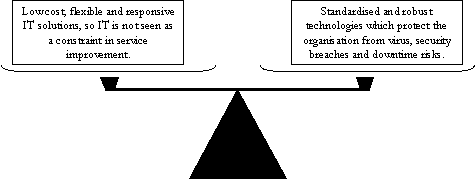
6.2.7 This balance can only be achieved by IT working in close partnership with the services it supports, to ensure accurate reflection of requirements in solutions and to help service managers understand the wider context of the application of technology in a complex business environment.
6.3 SAP
6.3.1 The SAP Enterprise Resource Planning (ERP) programme has been a major undertaking, arguably one of the biggest programmes of change within the County Council. The majority of the rollout programme for SAP has concluded, and the emphasis has shifted to exploitation and the Benefits Realisation Programme.
6.3.2 11,000 people across the organisation are now connected to SAP. Over £450m worth of services will have been procured through SAP during 2004/05, of which over £118m has been delivered through e-Procurement. Over 90,000 people are now paid through the SAP payroll system. The scale of adoption of SAP in financial terms makes the previous system, FMS, look small by comparison.
6.3.3 There is however some concern across the County Council over how easy SAP tools are to use, and this is reflected in the customer satisfaction survey (see above). If the County Council is to realise the full benefit of our SAP strategic commitment, it is essential that the tools are easy to use and the underlying business processes are seen as appropriate and efficient. This includes adoption of `self-service' and local responsibility for information management, whilst using consistent corporate processes. Improving perceived usability will maximise the benefits of the investment that has been made.
6.3.4 A SAP usability programme is being developed which will:
· review and simplify screen designs wherever possible creating increased consistency across the different SAP modules;
· implement the SAP `portal' technology - the ability to make the whole SAP environment `look and feel' like the rest of Hantsnet, rather than a separate application in its own right;
· help departments to review and simplify business processes where necessary.
6.3.5 If this project is to succeed it is important that departments and IT Services take a fresh look at the way we work, and are willing to review some of the business processes that were originally agreed.
7. Staffing and IT Governance
7.1 IT Staffing
7.1.1 The skills required of IT professionals are changing. In addition to technical expertise, general skills such as change management, business leadership, communications and strategic planning are essential in senior IT positions. It is these skills which create effective partnership between IT and service departments. Drawing in professionals from all parts of the County Council to work in IT programmes is becoming standard practice and the total number of staff working in IT teams across the County Council is as a result estimated to be over 450 (see Appendix 4). Business focussed IT professionals can act as catalysts and leaders on change programmes.
7.1.2 Where we choose to retain an in-house IT team we must nurture and retain high levels of skills and performance, and the ability to recruit and retain the best professionals is key to this. Skills include the creativity and innovation to help departments clarify their needs, supporting strategic planning and controlling risks in dealing with technology investments. Recruitment and retention remains a challenge, and I have already raised the risks of planned Pay and Benefits changes in this respect in reflecting the changing role of IT in a modern organisation, and a decline relative position regarding IT pay.
7.1.3 IT Services continues to reorganise itself to reflect changing needs and changing technology. During 2004 the following changes took place:
· The Enterprise Team joined IT Services to achieve integration of SAP with other IT and e-Government developments now that HPSN and IT2000 are complete;
· The Hantsweb team was absorbed into a Web Services Group providing a web design and e-forms service, as well as Hantsnet/Hantsweb redevelopment;
· An outsourcing partnership is being considered for some SAP support to overcome recruitment and retention problems due to salary levels;
· The e-Government team has been strengthened to lead on the initial phase of the Council's `Contact Centre programme' and e-Government programmes;
· Matrix structures around project based activities have been trialled in preparation for wider changes in 2005/06;
· A project support office has been introduced to reduce project overheads and increase consistency of project methods and therefore quality of delivery (the `PlanIT' programme);
· Closer links are gradually forming with the separate Education IT department (EdICT), to improve efficiency, although more remains to be done to truly integrate IT functions.
7.1.4 There will be more change in the coming year. IT Services has been preparing itself for a more radical restructure, and the pressure for increased efficiency and coordination of IT activities are likely to encourage departments to consider the level of IT skills they can afford to employ directly in their own departments (as shown in Appendix 4).
7.1.5 `Children's Services' in particular create an opportunity to review both the number of IT professionals employed and how they can best be organised to meet the needs of the new services. Any changes should increase efficiency and ensure that IT remains close to the services it supports.
7.2 IT Governance
7.2.1 The governance arrangements for IT and e-Government programme now in place appear to work well - accountability is clear, and there is a range of external scrutiny and controls:
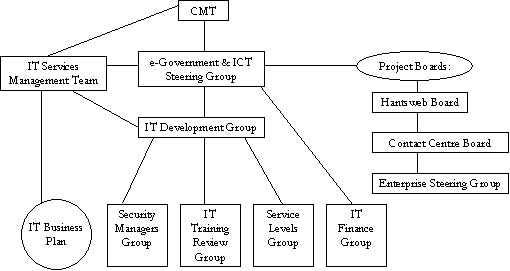
8. Looking Ahead - Priorities for 2005/06
8.1 The following summarise the specific themes for the IT contribution over the coming 12-18 months, led by corporate and departmental needs and based on the earlier analyses in this report:
· IT must be used more strategically both corporately and by departments. Not infrequently requirements are based on a narrow view of what currently exists or what experience leads departments to believe is possible. This inhibits development of innovative solutions.
· There needs to be a greater emphasis on shared priority themes for IT investments and less focus on local project requirements. This includes more collaborative projects with external partners, and may require a reassessment on how some initiatives are funded, and the allocation of IT budgets.
· IT must be used as a productivity driver, contributing directly to Gershon savings and demonstrating value in each and every investment . This requires some departments to move beyond seeing IT as a `costly fact of delivering service' towards it being seen as `a key differentiator' central to achieving outstanding public services.
· Concentration on information management - strategy, policy, tools and techniques to increase the value of electronic information to front line staff, management, and partnership working.
· Increasing value from existing investments. After substantial investment in new technologies (HPSN, IT2000, SAP, systems replacing mainframe applications, e-services, SWIFT, etc) the County Council must concentrate on maximising the return on investment from these, changing working practices as required to achieve this.
· Development of self service and personalised e-services, consistent across service areas for both internal use and use directly by the public, partners and service intermediaries. This includes transactional services on Hantsweb.
· There is a need to change IT structures and re-skill IT professionals in support of changing needs of the County Council - the Children Services, change programmes, and the themes above already mentioned.
8.2 The main projects areas driving these themes include:
· Children's Services and Adult Services
· Gershon
· SAP usability (screen designs, function, business processes and support/training)
· SWIFT Social Care system rollout completion
· Flexible Working
· CPA and its links to IT
· Contact Centre Strategy
· e-Government and IT strategy update and further e-service delivery
· Members' IT
· e-Learning and IT awareness/training, especially for middle and senior managers
· Development of schools systems to meet new DfES statutory information requirements.
8.3 The technology priorities supporting these project areas include:
· Completion of the underlying security and authentication enabling (for example), authentication for e-services, partnership working, mobile working and access from home.
· Completion of the Hantsweb improvement plan ensuring robustness of services and design changes to meet the needs of the public and intermediary services providers;
· Development of HPSN and exploitation, with a renewed direction beyond the current core contract, positioning HPSN as the public services network of choice;
· Consolidation of central disk space and processing capacity treating entire storage and processing resources as a single resource which can be flexibly allocated across systems and services and also reduces cost;
· Development of easy to use and efficient flexible working technologies linked to existing infrastructure to support home and remote working, wireless and secure connections via other networks;
· Standardising on software platforms especially around the SAP environment;
· Centralising supplier management (contracts, supplier liaison, licensing agreement and software planning) - currently spread across the organisation;
· Consolidating wide area network management into IT Services, working with 3rd party suppliers (eg. South East Grid for Learning and Synetrix, Unisys);
· Completion of Core Network Replacement project, supporting increased resilience, flexibility and security.
· Increasing the resilience of technology infrastructure from the computer suite through to the technical support layers for applications;
· Moving towards a single IT Help Desk for all IT issues across the County Council merging existing arrangements, adopting standard software, problem management and performance management;
· Reviewing 3rd party supplier partnerships, and reducing to a minimum number whilst strengthening those relationships;
· Widening adoption of the Hantsnet document management system whilst planning for future DMS acquisition;
· Implementing new technologies supporting the `thin client' Hantsnet services increasing the value of investments made to date;
· Upgrading and replacing central telephone switch facilities, both to support Contact Centre developments and also to modernise and improve the computer integrated telephony services provided;
· Concluding the rollout of Web Publishing System `content management software' across the organisation for both Hantsnet and Hantsweb;
· Development of the Hants and Isle of Wight shared technologies - shared secure environment, extranet, etc;
· Developing new technology services for schools to add value to the existing network links and SAP provision;
· Upgrading Hantsnet Office desktop tools, including enterprise search tools, email, and other functions;
· Developing core storage architectures for data warehousing.
Recommendations
It is recommended that:
i. This report and the e-Government progress being made is noted and endorse the wider contribution of IT to corporate strategy, policy and performance (Section 1-4).
ii. The work and progress in 2004/05 in IT generally, and in particular the demonstration of value for money (Section 3-5) is noted.
iii. The direction and priorities which the report proposes for 2005/06 (Section 8) is endorsed.
Appendix 1
Appendix 2
ODPM Priority Service and Transformation Outcomes for Local e-Government
These targets have been set with the intention of helping Councils improve the delivery of services to citizens and business - enhancing process efficiency and embedding e-Government within the mainstream of organisation changes. In terms of the CPA 2005 framework proposals, Councils performing well will need to have achieved the `required' and `good' priority outcomes as a minimum:
PTO
Benefits |
· |
One stop housing and council tax benefits (CRM) |
Required |
· |
Citizens able to check eligibility for council tax benefit |
Required | |
· |
Mobile office service using technology from home |
Good | |
· |
Targets for processing of council tax and housing benefit |
Excellent | |
· |
Pre-qualification process on line for benefits |
Excellent | |
Support for Vulnerable People |
· |
Online information about access to local care |
Required |
· |
Remote web or mediated access out of hours for care packages |
Required | |
· |
Systems to support joined up working across multiple agencies |
Good | |
· |
Joint assessment using mobile technology in the field |
Good | |
· |
Targets for improved customer satisfaction |
Excellent | |
Supporting New Ways of Working |
· |
email and internet provided to all members and staff |
Required |
· |
ICT support for home working for council staff and members |
Required | |
· |
Access to home remote working facilities |
Required | |
· |
Establishment of an e-skills training programme |
Good | |
· |
Targets for efficiency saving resulting from new ways of working |
Excellent | |
Accessibility of Services |
· |
Self service/mediated access to services outside working hours |
Required |
· |
Implementation of CMS for web content creation/management |
Required | |
· |
Adoption of ISO15489 for electronic records and management |
Good | |
· |
Conformance with W3C web accessibility initiative standards |
Good | |
· |
Compliance with e-GIF |
Good | |
· |
Targets for efficiency savings for improved accessibility of services and information |
Excellent | |
High Take-up of Web-based Transactional Services |
· |
Publication of internet service standards and performance |
Required |
· |
Monitoring of performance of website and regional web portals |
Required | |
· |
Establishment of internet targets measuring customer take-up |
Good | |
· |
Adoption of recognised guidance on usability and design |
Good | |
· |
Take up targets for migration of services to e-access channels |
Excellent | |
Making it Easy for Citizens to do Business with the Council |
· |
Systems in place to ensure effective and consistent CRM |
Required |
· |
All email and e-form acknowledgements to include a unique reference number |
Required | |
· |
100% of email enquiries responded to in one working day |
Required | |
· |
The integration of CRM with back office enabling workflow |
Good | |
· |
Facilities to support single notification of change of address |
Good | |
· |
Targets for percentage of public enquiries about council services resolved at first point of contact |
Excellent |
Appendix 3
Summary of IT Services 5 Year Financial Projections
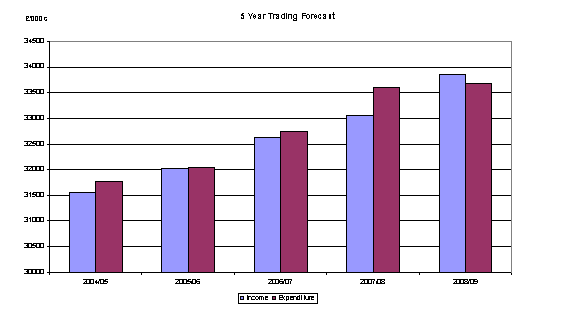
*
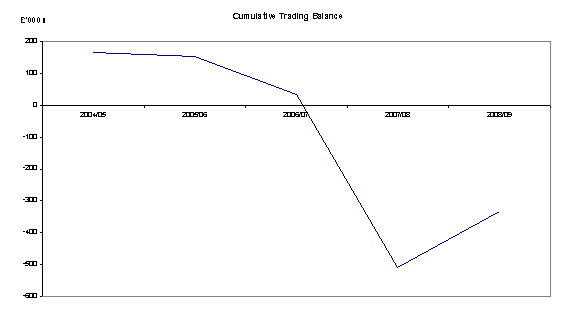
* nb. There is an anticipated requirement to increase spend on software licensing in 2007/08 and a mechanism to smooth this investment will be found.
Appendix 4
Estimated Staffing Levels in IT Teams1
Department |
FTE |
Funded by |
e-Government (ITS)2 |
9.6 |
P&R |
Consultancy and Business Solutions (ITS) |
101.75 |
Service charges |
Service Delivery (ITS) |
137.3 |
Service charges |
Business Support (ITS) |
20.87 |
Service charges (indirect) |
Visit (ITS) |
4.54 |
External business |
Enterprise SAP (ITS) |
37.55 |
Corporate and service charges |
Environment (IT) |
8.62 |
Departmental budgets |
Chief Executives |
3 |
Departmental budgets |
Social Services IT |
49.5 |
Departmental budgets |
Education IT (EdICT) |
81.33 |
Schools and departmental budgets |
PBRS Local IT |
8 |
Department budgets |
Recreation and Heritage (IT) |
6.72 |
Department budgets |
Total |
468.78 |