Archived decisions
Hampshire County Council Environment Policy Review Committee 22 July 2005 Passenger Transport Strategy Report of the Director of Environment |
Item 11 |
Contact: Keith Willcox, ext 6997 email: [email protected]
1. Introduction
1.1 This report sets out the outline Passenger Transport approach in the second Local Transport Plan. It also outlines the likely financial pressures in the next few years and broad options for managing future budget pressures, together with an indication of pilot work under way to optimise the future deployment of resources. It invites the Committee's views on the future strategic options.
2. Corporate Strategy
2.1 This report supports Aim 1 (Maximising Life Opportunities) of the Corporate Strategy by prioritising support for public transport services for people to access employment, education, shopping and medical facilities.
3. Passenger Transport Strategy
3.1 It is important to consider the role of passenger transport within the context of the provisional second Local Transport Plan (LTP). This is due to be submitted to Government by the end of July 2005 and will be followed by a full LTP by the end of March 2006. The provisional LTP concentrates on the County Council's transport strategies and processes - the full LTP will set out more detail of the measures to be adopted and the targets that will be achieved by them.
3.2 The provisional LTP proposes a balanced set of measures to improve transport. In particular, it seeks to enhance quality of life by:
(i) Improving accessibility to services
(ii) Tackling congestion
(iii) Improving transport-related air quality
(iv) Improving road safety
3.3 Passenger transport has a role to play in helping to achieve these aims, especially on accessibility and congestion. Bus and rail services can help to reduce congestion by providing an effective alternative to the car for some journeys. They can also help to tackle problems of poor accessibility for people who do not have access to a car.
Congestion
3.4 However, a key theme of the proposed LTP is that it needs to be realistic. The car will remain the dominant mode of travel within Hampshire for the foreseeable future. Traffic levels are predicted to rise across all roads. Improvements to passenger transport services can help to reduce the rate of growth in traffic, but will not, on their own, solve problems of congestion. The provisional LTP does not claim that there will be a substantial shift away from the car to other modes.
3.5 The modelling information underpinning the LTP suggests that significant modal shift is not likely until congestion levels reach considerably higher levels than currently. Accordingly, the LTP proposes the development of improved bus and rail services over the longer-term as rising levels of congestion create a market for them. In the meantime, improvements should be targeted on routes that are reasonably heavily used, which is often in urban areas.
3.6 A pilot scheme is also being developed to consider the potential to introduce school buses, similar to the yellow school buses commonly used in America.
Accessibility
3.7 The LTP is also realistic about accessibility. The Government has provided an accessibility auditing database, known as Accession. This aims to model theoretical journey times to key services by a combination of walking and public transport. However, the initial results of this work need to be viewed with considerable caution. There are problems of unreliable data and software faults. The software is also aimed at theoretical accessibility. Some areas that are apparently inaccessible by public transport may have limited problems to address because they have high levels of car ownership. Equally, there may be areas that have worse accessibility than suggested by Accession, because of timetabling problems, cost, and lack of information.
3.8 The LTP therefore takes a more holistic and realistic approach to accessibility than required by the Government. In particular, the LTP:
(i) Considers accessibility to a wider range of services than the narrow range of destinations required by the Government (healthcare, education, employment and shops);
(ii) Investigates actual rather than theoretical accessibility. This includes providing better information to residents of all the travel options open to them;
(iii) Considers non-transport measures to improve accessibility, such as location of services, home deliveries, phone and internet access, design of services, etc.
3.9 The role of conventional passenger transport in improving accessibility needs to be carefully judged. It can be very expensive to provide scheduled or demand-responsive bus services to remote locations, especially to access services that may be needed infrequently, such as hospitals. A more cost-effective solution may be to provide some services directly to the community, such as through expanded use of mobile libraries and the use of community and schools buildings.
Passenger Transport Strategy
3.10 The passenger transport strategy is therefore evolving, as more information becomes available about the relative benefits of different types of activity and expenditure. The intention is that the results of pilot studies will be available to inform the development of the full LTP, including the capital and revenue expenditure programmes and the associated LTP targets.
4. Future Funding
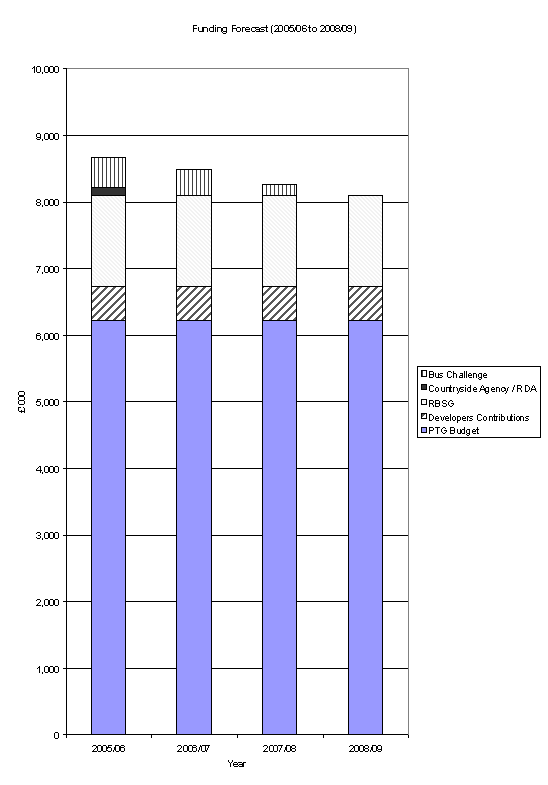
4.1 The appendix illustrates the forecast funding situation for future years. This forecast, at current prices, assumes that the Passenger Transport Group revenue budget remains constant over future years. Whilst this overall position would be relatively stable, some funding sources expire over future years, which add to ongoing industry cost pressures.
4.2 The table below illustrates the forecast pressures on the bus budget over the next three years based on the existing provision of services. This table assumes that services are adjusted to absorb the pressures in any year. Any budget pressure not managed in a given year would need to be added to the cost pressures for subsequent years.
Forecast Pressures on Bus Budget
05/06 |
06/07 |
07/08 |
08/09 | |
Re-tendering pressures |
140,000(1)* |
210,000(2) |
200,000(2) |
210,000(2) |
Commercial Deregistrations |
210,000(1) |
200,000(3) |
200,000(3) |
200,000(3) |
Withdrawal of External Funding (Bus Challenge) |
50,000 |
250,000 |
400,000 | |
Pressure |
350,000(4) |
460,000 |
650,000 |
810,000 |
(1) Actual Cost
(1)* Actual Costs with minor cuts in Gosport/Fareham
(2) Based on 10% estimate
(3) Estimate, based on variable recent experience
(4) Addressed in Report
4.3 As the level of external funding will be reduced in future years, at the same time as costs rise, priority will need to be focused on options and areas that deal with the most severe problems and/or that benefit the greatest number of people, with particular weighting applied to disadvantaged groups.
4.4 With increasing bus industry costs and uncertainty over Government revenue funding for bus support it is critical that Hampshire County Council demonstrates that:
(i) it is achieving value for money;
(ii) subsidy payments are open and transparent;
(iii) the spending is undertaken within the context of the strategy objectives;
(iv) the optimum balance is achieved between conventional and unconventional services;
(v) the relationship between secured and commercial services achieves the best possibly efficiency; and
(vi) that the monies are being used to maximise the ability to meet the unmet needs of Hampshire residents.
5. New Approach
5.1 Work is progressing with Consultants on a new framework to evaluate future service support. This is initially being developed as a pilot in the Basingstoke and Alton areas and will be able to test out the options discussed in Section 6 of this report. The framework is being developed from:
(i) consideration of the transport policies and objectives of Hampshire County Council;
(ii) a needs based assessment;
(iii) the establishment of appropriate accessibility criteria (in advance of the DfT's Accession model going live); and
(iv) linking of the framework delivered to appropriate value for money tests.
5.2 It will assist in answering some of the fundamental questions which need to be asked, eg Are the travel needs being met? Is the current allocation of funds correct? Does it provide best value for money? It will assist the assessment of different options in terms of both mode and level of service. The model will also enable the assessment of service development proposals aimed at modal shift.
5.3 The model will complement the `Accession' accessibility planning software commissioned by the Government. Accession will identify the problem areas in terms of accessibility. The new model will then identify the most appropriate and cost-effective solutions to address these problems.
5.4 The facilities chosen are those identified for the accessibility planning process which forms the cornerstone of the Second Round Local Transport Plan (LTP2), viz:
(i) food shopping;
(ii) schools and post-16 further education;
(iii) health facilities, primary (community) and secondary (mainly outpatients); and
(iv) employment opportunities.
5.5 A further category, that of access to social and leisure activities, has also been considered, to represent the principal trip purpose outside the normal commercial `working day'.
5.6 Once the model has been validated it can be used in other areas of the county, following consultation with District Councils and Local Strategic Partnerships, to optimise the spending on passenger transport services.
5.7 The new approach will establish what efficiencies may be achievable on an area basis. It is possible that this will be sufficient alone to address the future cost pressures anticipated. If not, however, then the Committee's views are invited at this early stage on what strategic options are most important to retain.
6. Strategic Options
6.1 In seeking best value from the council's expenditure on passenger transport subsidy, and absorbing the pressures it is necessary to consider a range of possible options for future implementation in order to guide the direction of the new framework approach. The table below lists key strategic choices and includes a low, medium or high impact rating on various criteria. It also includes indicative figures of potential County Council budget savings. Option A is recommended. Option B is a possibility, but has relatively `low' budget saving opportunities. Options C, D and E are all possible. Options D and E have least impact on employment, educational and health based trips, but would adversely affect the accessibility of leisure activities. Options F and G are also possible, but the County Council's budget savings would be reduced as external funds currently contribute to these services. It is important to note that any reductions in service provision is likely to have some adverse impact on the BVPIs and LTP2 targets. Subsidised services account for 30% of services, with 20% of passengers carried by bus.
Future Options |
Increase in Congestion |
Reduction in Accessibility |
Reduction in Travel Choice |
Reduction in Quality of Life |
HCC Budget Saving Indicative Figures |
A) Even more efficient use of budget by enhanced monitoring to ensure value for money |
Low |
Low |
Low |
Low |
Low |
B) Reduce the frequency of some subsidised services |
Low |
Low |
Low |
Low |
Low |
C) Review all lowest performing subsidised services |
Medium |
Medium |
Medium |
Medium |
Medium |
D) Review Sunday services |
Low |
Low |
Medium |
Medium |
Medium |
E) Review all Weekday evening services |
Low |
Low |
Medium |
Medium |
Medium |
F Review all Cango services when funding expires |
Low |
Medium |
Medium |
Medium |
Low in short-term (external funding) rising to medium |
G) Review all Dial-a-Ride and Call and Go services |
Low |
Medium |
High |
High |
Medium (District Council contributions) |
Low budget saving up to £200,000
Medium budget saving £200,000-£700,000
6.2 The table above illustrates varying indicative County Council budget savings depending on the option chosen. However, it is evident that the likely budget pressures can be met by implementing a combination of the options outlined.
6.3 It is suggested the actual combination required should be determined on a basis of minimal impact on passenger numbers and non-essential trip making activities. The new framework model discussed in Section 5 will be utilised to determine the precise combinations.
6.4 Some budget efficiencies could be redirected to address social inclusion objectives more strongly, ie:
(i) investigating what opportunities exist to support travel by particular user groups such as:
(a) 16-19 year olds, reduced fare travel;
(b) over 60s (now to be free travel off-peak from April 2006);
(c) low income families; and
(d) special events and attractions.
6.5 Other ideas being considered include:
(i) Seeking lower tender prices by capital funding vehicles, ticket machines, scheduling and other back-office functions. In essence a spend-to-save initiative. This will improve standards and remove uncertainties for small operators and could cut costs and tender prices for all operators.
(ii) Fully exploiting external funding opportunities such as DfT initiatives including `Kickstart' and the `Transport Innovation Fund' (TIF). Also scope for sponsorship, in relation to information provision, especially printed publications.
Recommendation
That the Committee comments on the future strategic options in order to guide the direction of the new framework approach.
Section 100 D - Local Government Act 1972 - background papers | |
The following documents disclose facts or matters on which this report, or an important part of it, is based and has been relied upon to a material extent in the preparation of this report. | |
NB the list excludes: | |
1. |
Published works. |
2. |
Documents which disclose exempt or confidential information as defined in the Act. |
TITLE |
LOCATION |
Working File |
Environment Department Room 228 |
446/KAW
APPENDIX