
Archived decisions
Hampshire County Council Environment Policy Review Committee 22 July 2005 Term Maintenance Contract (Raynesway) Highway Performance Report of the Director of Environment |
Item 7 |
Contact: Alan Giles, ext 7712 email: [email protected]
1. Summary
1.1 The Highways Term Maintenance Contract (TMC) was awarded to Raynesway Construction Southern (RCS) in May 2002. The contract was for an initial five year period with options for up to three, one year extensions. The annual value of the works carried out under the contract is currently running at £32 million (2004/05).
1.2 This report updates Members on the progress of the TMC over the past year. It summarises the performance of the contractor Raynesway Construction Southern, the results of public surveys relating to the service, partnering initiatives and the future of the contract.
1.3 The contractor has maintained an improvement in the standards of service delivery during 2004/05 (Year 3 of the contract) and public survey responses also indicate a good level of service. Partnership working to identify and implement efficiency savings continues to be developed. In particular the setting up of working groups under the Government sponsored Construction Lean Improvement Programme (CLIP) is likely to enable further improvements in contract efficiencies.
2. Corporate Strategy
2.1 This report supports the following Aims of the Corporate Strategy:
(i) Aim 5 (Improving Services) by presenting the performance results for scrutiny; and
(ii) Aim 6 (Developing Councillors and Staff) by keeping Members up to date with progress on the Highways TMC.
3. Introduction
3.1 This report summarises the performance of the Highways TMC over the past financial year. It also explains the various initiatives that Hampshire County Council highways staff and Contractor's staff are jointly working on to find improved ways of delivering the service.
3.2 The delivery of highway maintenance services in Hampshire requires a close degree of working between the Highways Network Management client staff of Hampshire County Council and the contractor. Client staff manage the regular inspections of the highway network in order to assess its condition. Maintenance programmes are then prepared based upon maintenance need and available budgets. Highway inspection and budget coordination as well as general contractual management is carried out by Headquarters based staff. Day to day operational management of works orders and scheme supervision is carried out by the local Highway Teams. These are grouped under the four main Highway Units - North, East, South and West, with sub-units usually based in each district, often in district council offices.
3.3 It should be noted that the Highways Network Management staff are also involved in a wide range of other highway activities, eg dealing with Utility works, regulation activities (skips, scaffolding, obstructions), road closures, highway search information, etc which are not directly associated with the management of the TMC.
4. Contractor's Performance
4.1 The contract allows for two main types of works. Firstly, conventional schedule of rates items. The client staff will design a scheme and then build up a list of individual work items necessary to build the scheme, these items already being priced at tender stage by the contractor. Works orders are placed and the scheme is remeasured after completion to allow for any slight differences between the ordered and final quantities. The contract also includes a second type of arrangement called Performance Works. These relate to a list of maintenance items that the contractor is required to ensure remain at a satisfactory standard for the duration of the contract. For example this includes dealing with potholes, sign cleaning and road markings, etc on the `A' Road network. This method of working requires the contractor to inspect and assess the maintenance need themselves and carry out all necessary works within a fixed budget each year. The idea being that this method avoids the duplication of inspection and supervision work by client staff and could generate efficiency savings. However this method is relatively new in highway maintenance contracts and value for money assessments still need to be made.
4.2 With regard to the contractor's performance, experience gained in the first year of the contract (2002/03) enabled a joint working group of Hampshire County Council and RCS staff to identify and agree the Key Performance Indicators (KPIs) that would be used to measure performance in Year 2 (2003/04). Data obtained in Year 1 enabled suitable base levels for those indicators to be established and for improvement targets for Year 2 to be set.
4.3 Details of the KPIs, the target levels and the actual performance improvements achieved in 2003/04 are given in Appendix 1. The performance was considered satisfactory, in that the required number of performance targets were met. (The target number of 13 indicators out of 14 was exceeded for minimum standards and the target number of 7 out of 14 exceeded for stretching targets.)
4.4 In the light of further experience in Year 2 of the contract, the Performance Indicators were slightly modified and the method of calculating improvements was altered to provide a better method of assessment. This allowed for less dependence upon performance in individual months and more on the achievement of steadily improving performance averaged over a complete year of the contract. Hence the revised calculation method for Year 3 KPIs is slightly more complicated but it is felt that the results provide a better demonstration of annual performance.
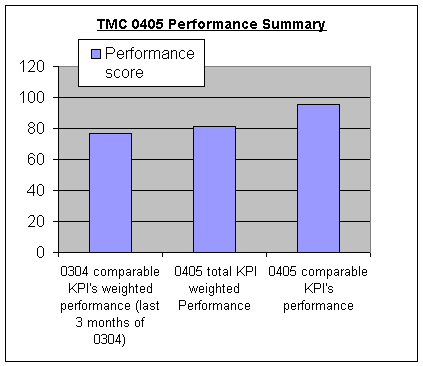
4.5 Details of the KPIs, the target levels and the actual performance improvements achieved in Year 3 (2004/05) are given in Appendix 2. For a number of the newer items, there was insufficient base data from Year 2 to enable accurate target setting for Year 3. Instead target levels were set which were sufficiently higher than estimated earlier performance to ensure they were stretching targets and hence give the contractor a strong incentive for improvement. The new assessment method showed that an overall improvement in performance in accordance with the agreed targets had been met. Performance in Year 3 is assessed at 81% compared with 77% in year 2. This indicates how close RCS were to meeting the `Stretching Targets' (for which they would have scored 100%) compared with just meeting the minimum targets (for which they would have scored 0%). On the basis of performance, ie sustained improvements over Years 2 and 3 of the contract, a one year extension to the original five years of the TMC, in accordance with the original intentions of the contract can be recommended. Other factors will also be taken into account in this decision, which is intended to be made by the Executive Member for Environment: South Hampshire and Resource Management in September 2005.
4.6 The improvements to performance arise from client and contractor's staff working together to analyse the performance results and identify problem areas. This may be anything from poor performance by a particular contractor's gang (thus needing additional contractor staff training), poor programming (needing more time being spent on priorities and advance planning), poor supply of information by the client staff to the contractor (needing additional client staff training) or delays to invoicing (needing changes to paperwork and IT systems), etc.
4.7 There are regular meetings between client and contractor's staff (weekly for local highway staff looking at specific scheme issues, monthly between Assistant Chief Engineers looking at larger schemes and local programmes of work, and quarterly between Chief Engineers and senior management from RCS looking at any county-wide issues). This enables issues at every level to be investigated jointly by the most appropriate staff from both organisations and for the best solutions to be identified and implemented as quickly as possible.
5. Public Survey Information
5.1 As well as collecting technical data about the operational performance of the contractor, public survey information is also collected. This is done in two main ways, through questionnaires issued by Hampshire County Council and RCS to local residents during works and by analysing telephone calls and correspondence received by the County Council.
5.2 Public Opinion Survey data regarding the general condition of the highway network is not included in this report. This is because it generally relates to factors beyond the scope of the contactor's responsibilities (eg things such as the level of highway maintenance budgets, traffic management policies, etc) and not necessarily to contractor's performance.
5.3 Correspondence and telephone calls relating to contractors performance received by Hampshire County Council:
2003/04 68 complaints 4 compliments
2004/05 66 complaints 16 compliments
Over 2004/05 there were 15,280 individual works orders raised. Given that people are more likely to complain than send a compliment, the above results are considered satisfactory.
5.4 Once letters of complaint and compliments relating to RCS are recorded on the County Council database, they are then forwarded to RCS to deal with. Letters received by RCS have therefore not been reported since this may result in a degree of double counting. The method of recording letters received directly by RCS will be reviewed to avoid this in the future.
5.5 Hampshire County Council questionnaire results from vehicle crossing works:
Questionnaires returned 364 (2004/05)
Average score 73% (on a scale of `poor' = 0% and `excellent' = 100%)
Vehicle crossing questionnaires were only introduced last year and there is no comparative data for previous years.
5.6 RCS questionnaire results from larger maintenance schemes (see Appendix 3 for details):
Questionnaires returned 269 (since September 2003)
Average performance now for all returns is 86% satisfactory response.
Performance for first 134 returns (approximately September 2003 to September 2004) is 80% satisfactory response.
Performance for recent 135 returns (approximately September 2004 to present) is 90% satisfactory response.
Hence showing an improvement in public satisfaction with the contractor's performance over the past year.
6. Members' Concerns
6.1 Both County Council client staff and RCS are keen to ensure that any concerns expressed by Members about performance issues are properly addressed as quickly as possible. Where such issues relate to specific schemes then this is generally best dealt with directly by the local highways staff concerned. Where the issues relate to county-wide or contractual issues, then Headquarters staff can help.
6.2 Although there have been occasional instances of problems raised by Members about specific schemes, these are relatively few. Weedkilling was raised by some Members as more of a county-wide issue and measures were taken during the 2004 season to improve performance. A new performance indicator has now been included, to ensure that weedkilling is monitored on a more formal basis. Reports from client staff over the first few months of the summer have indicated a good performance so far this season.
6.3 One of the recommendations of this report is to invite the participation of Members in looking at the Performance Indicators that they would like to see in a future highway maintenance contract. Those indicators presently used to measure performance are of a fairly technical nature and it would be useful to know what additional indicators Members would like to suggest.
7. Partnership Initiatives
7.1 As part of the continuing partnership ethos of the TMC, Hampshire County Council and RCS have produced a Joint Business Plan which details the various aspects of the TMC work where there are opportunities for joint efficiency savings and to promote the sustainability and recycling policies of the County Council. Please see Appendix 4.
7.2 The Joint Business Plan is intended to identify those aspects of the contract where both County Council and contractor's staff are equally involved in the activity concerned and can work together in a joint team to identify efficiency savings, avoidance of duplication and other service improvements. The items cover a wide range of activities from operational delivery of services, to joint staff training and the production of joint newsletters.
8. Construction Lean Improvement Programme
8.1 This is a national programme supported by Government, to encourage more efficient working practices in the construction industry. It builds on work done by groups such as Movement for Innovation and Sustaining Construction.
8.2 The CLIP analysis techniques are particularly suited to many of the highway maintenance operations, which involve a mixture of input from both client and contractor's staff, again with opportunities to identify and eliminate duplication and put in place more efficient ways of working. The methods require us to analyse in detail the various tasks undertaken to deliver a particular service (eg Winter Maintenance), to look at the times taken for each of the individual tasks and then to think about better ways of achieving the desired end results. The use of the CLIP technique in the Street Lighting Contract has resulted in some fairly radical and innovative changes to working practices with considerable opportunities for efficiency savings. (A progress report on the Street Lighting Contract will be presented to this Committee in the autumn.)
8.3 Presently five CLIP Working Groups are looking at various issues.
CLIP Group |
Main Issues |
· Emergency Response |
Streamlining of emergency reporting line, which is currently too long. Rationalisation of different night and day call-out procedures. Review of response resources and discussion on wider use of `call centres'. |
· Surface Dressing Programming/Pre-Patching |
Opportunities to simplify design and use of processes that will optimise budgets and thus remove as many roads from the "needing work" list as possible. |
· `A' Road Inspections |
Avoidance of duplication and variation in working methods across the county (hence looking for best practice), route optimisation, data storage, retrieval/flow of data between organisations. |
· Works Orders |
Reduction in number of site visits, streamlining of invoicing process, swifter exchange of information, early contractor involvement in design process. |
· Winter Maintenance |
Planning of winter maintenance routes, ownership and maintenance of plant, exchange of information relating to routes treated |
9. Sustainability and the Use of Recycled Materials in Highway Maintenance Schemes
9.1 One of the major successes of this contract has been the development of recycling techniques in highway maintenance schemes. Examples of the techniques used include:
(i) Foamix (use of excavated blacktop from highway maintenance works to produce new blacktop).
(ii) Infra-Red Patching (re-heating the surface of the road to enable it to be smoothed and levelled, avoiding the need for excavation).
(iii) Recycling of excess surface dressing chippings (avoiding waste and minimising the use of high quality aggregates for roadworks).
9.2 Over the next few years there will be a steady increase in the amount of Incinerator Bottom Ash from the County Council's Energy from Waste Incinerator sites becoming available. There may be opportunities to use this material in the production of road surfacing material, through partnership arrangements with RCS and its surfacing sub-contractor Foster Yeoman. Thus the Highways TMC will be making a significant contribution to the County Council's corporate sustainability policies and to Gershon efficiency saving requirements.
9.3 The pioneering work done through the TMC is also having wider benefits. Utility companies are now beginning to use these materials and techniques and local developers will be encouraged to do the same.
10. Contract Costs
10.1 In Year 1 of the contract, highway maintenance expenditure was approximately £25 million. In Year 2 expenditure was approximately £30 million. In Year 3 expenditure was approximately £32.4 million, due to additional Government funding through the Local Transport Plan in addition to the extra £3.5 million allocated to highway maintenance by the County Council. At this level in Year 3, a 1% rebate was triggered. Unfortunately the overall maintenance budget for 2005/06 (Year 4) is about £2 million less than Year 3. Although consideration is being given to what other work could be put through the TMC, it is not known at this stage if the 1% rebate level of approximately £30 million will be reached again in Year 4.
10.2 In addition to the 1% rebate triggered by a larger contract value, there is provision within the contract for the annual Variation of Price (inflation) payments to also be capped. Negotiations are ongoing between the County Council and RCS to agree the exact details of how the calculation will be made for both deductions. Hence there is the opportunity within the contract for some efficiency savings to be made, which could potentially be up to 2%, in a year with a high turnover and higher inflation.
10.3 The partnership approach to the contract has meant that both sides have had a much more open approach to dealing with valuation and claims issues and avoided anything escalating into a dispute situation. Valuation issues have been kept to a minimum and mainly relate to clarification of quantities and some other issues which have occurred since the start of the contract. A number of the valuation issues are still in the process of being resolved through negotiation, including the Turnover Rebate and Inflation Deduction mentioned above. Of the 14 main issues dealt with so far, they have resulted in additional payments to the contractor of just over £200,000 and rebates paid back to the County Council by the contractor of just over £560,000. It should also be pointed out that the staff numbers involved in managing the contract and dealing with valuations, both from the County Council and RCS, are minimal compared with other similar contracts. This again demonstrates the advantages of a partnership approach which can be very efficient in terms of the administration of such a large contract.
11. One Year Extension to the Term Maintenance Contract
11.1 The Highways Maintenance TMC was awarded to RCS in May 2002, initially for a five year period. The contract included the option to award up to three, one year extensions, subject to agreement between the client and contractor, and to the contractor demonstrating continuous improvement and the achievement of agreed performance targets.
11.2 An assessment of the agreed performance indicators for Contract Year 2 (2003/04) and Contract Year 3 (2004/05) shows that the contractor has met the required targets. A report to the Executive Member for Environment: South Hampshire and Resource Management is being prepared to decide whether to award a one year extension up to April 2008. It will contain details of any outstanding contractual or financial issues. The Buildings, Land and Procurement Panel will be consulted on this report.
Recommendations
1. That the Committee considers the performance of the Term Maintenance Contractor.
2. That the Committee considers nominations for a future working group with officers to look at Performance Indicators for the next Term Maintenance Contract.
Section 100 D - Local Government Act 1972 - background papers | |
The following documents disclose facts or matters on which this report, or an important part of it, is based and has been relied upon to a material extent in the preparation of this report. | |
NB the list excludes: | |
1. |
Published works. |
2. |
Documents which disclose exempt or confidential information as defined in the Act. |
TITLE |
LOCATION |
Term Maintenance Contract Documents |
Environment Department Room 409 |
429/AG
APPENDIX 1
HIGHWAYS TERM MAINTENANCE CONTRACT KEY PERFORMANCE INDICATORS 2003/04
List of Key Performance Indicators used for assessment of additional one year extension to the Hampshire County Council Highway Term Maintenance Contract
KPI No |
KPI Description |
Minimum Target Achieved Y/N |
Stretching Target Achieved Y/N |
KPI 1 |
Starting Works on Time |
Y |
N |
KPI 3 |
Attending Emergency Orders within 1 hour |
Y |
Y |
KPI 4 |
Winter Maintenance Response Times |
Y |
N |
KPI 5 |
Customer Complaints (number of claims received by Raynesway Construction Southern) |
Y |
Y |
KPI 7 |
Invoice Submission (taken from 5-10 random orders) |
Y |
Y |
KPI 9 |
Health and Safety (Accident Frequency Rate) |
Y |
Y |
KPI 10 |
General Performance |
Y |
Y |
KPI 11 |
Recycling (Annual Target) |
Y |
Y |
KPI 12 |
Cleaning of Illuminated Signs (percentage signs reaching target) |
Y |
Y |
KPI 13 |
Repair of Minor Defects (percentage defects/kilometre) |
Y |
Y |
KPI 15 |
Maintenance of Road Markings (percentage lines reaching target) |
Y |
N |
KPI 16 |
Maintenance of Highway Structures |
Y |
Y |
KPI 17 |
Maintenance of Gullies and Catchpits (percentage gullies reaching target) |
Y |
N |
KPI 18 |
Maintenance of Rural Grass (percentage splays, etc reaching target) |
Y |
Y |
Total Targets Achieved |
14 |
10 | |
Total Targets Required |
13 |
7 | |
APPENDIX 2
TERM MAINTENANCE CONTRACT KEY PERFORMANCE INDICATORS FOR 2004/05
|
|
|
|
Performance in the blue zone would be | |
|
|
exceptionally good |
|
|
100% - 0405 Average Proposed |
|
|
Stretching Target |
|
|
Range within which performance |
|
|
is being measured |
70% |
|
0% - 0405 Average Proposed |
|
|
Absolute Minimum performance |
|
|
|
|
|
|
|
|
|
|
|
|
|
|
Performance within the red zone is |
|
|
not acceptable |
|
|
|
|
|
|
|
|
|
|
|
|
|
|
|
|
|
|
0% |
|
|
|
|
|
APPENDIX 3
PUBLIC SURVEY INFORMATION
Questionnaires issued to the public by RCS relating to its larger maintenance schemes
Question |
Yes |
No |
No Comment |
1. Did our team keep you informed? |
|||
2. Is the quality of work satisfactory? |
|||
3. Was adequate provision made for pedestrians? |
|||
4. Was adequate provision made for motorists/road users? |
|||
5. Was access to your property adequately maintained? |
|||
6. Do you consider works were carried out in a professional manner? |
|||
7. Do you consider works were carried out in a timely fashion? |
Scoring was +1 for Yes; -1 for No; nothing for no comment.
Hence maximum score was +7, minimum score was -7 for each questionnaire.
Performance is recorded from September 2003 to now (269 returns).
Splitting the returns by date shows:
Average performance now for all returns is +5.1 (equivalent to 86% positive response)
Performance for first 134 returns (approximately September 2003 to September 2004) = +4.22 (80% positive)
Performance for recent 135 returns (approximately September 2004 to present) = +5.66 (90% positive)
Hence showing an improvement in public satisfaction with the contractor's performance over the past year.
APPENDIX 4
JOINT BUSINESS PLAN ITEMS AND PROGRESS
Joint Business Plan Items |
Progress | |
Monitor feedback and improvement | ||
1. |
Set up and agree Key Performance Indicators |
Agreed for current year of contract |
2. |
Monitor and review results and feedback to all staff |
Feedback on TMC performance given to a range of weekly and monthly joint meetings. Remedial actions agreed and monitored. |
3. |
Set up regular customer surveys and react to feedback. |
Questionnaires for the public in place for vehicle crossings and larger maintenance schemes. |
4. |
Set up regular staff surveys and react to feedback. (To monitor staff satisfaction with partnership issues) |
To follow CLIP workshops (see Section 8 in main report) |
5. |
Review Public Survey information and react to feedback on `Speed of repair'. (This item was raised in one of the public opinion surveys) |
RCS trialling larger gang size to help speed up work. |
6. |
Review Hampshire performance against other Authorities (BVPIs, SECSIG, Benchmarking club, etc) and react to feedback. |
Visits to be arranged following CLIP Workshops to other top performer authorities in order to compare working methods. |
Improve communications and information to customers | ||
7. |
Set up roadworks database on the web for access by staff and customers. |
Elgin Streetworks web system up and working enabling public to see planned roadworks in Hampshire. |
8. |
Joint Communication Plan. |
County Council and RCS staff working together to produce joint timetable for PR. Joint Newsletter to be produced autumn 2005. |
Public Safety | ||
9. |
Investigate options to allow RCS to rectify safety related defects when spotted (pot holes, etc). |
Trial set up in North and East Highways Units. |
Provide an environmentally sustainable maintenance regime | ||
10. |
Programme works to maximise opportunities for recycling. |
All staff instructed to use recycling techniques as the first option. |
11. |
Set up and monitor use of `sustainable' contract items. |
Quarterly reports to Chief Engineers' meetings. |
12. |
General promotion of the use of recycling techniques (Induction, Guidance Notes, Seminars, etc). Set up road shows to visit Highways Units offices and depots |
Second major seminar held at Winchester Guildhall 23 February 2005, attended by County Council and staff. Smaller seminars being held at local offices. |