
Archived decisions
Hampshire County Council Cabinet 25 July 2005 Hampshire Minerals and Waste Development Framework: `Core' Planning Strategy - `Issues and Preferred Option' Consultation Paper Report of the Director of Environment |
Item |
Contact: Richard Read, ext 6727 email: [email protected]
1. Summary
1.1 The report sets out the background to the process for developing a minerals and waste `core' planning strategy and how a consultation paper on `Issues and Options' is required. The report outlines the principal issues that are addressed in the consultation paper and recommends that it be published for public comment.
2. Background
2.1 The County Council, in partnership with Portsmouth and Southampton City Councils, last year approved a Minerals and Waste Development Scheme for preparing a number of `development documents' that will comprise a Hampshire Minerals and Waste Development Framework. Under the Development Scheme the County Council has already published a Statement of Community Involvement that sets out how the County Council will engage with the community and other interests over the preparation of mineral and waste planning policy and planning applications.
2.2 The next `development document' under the Scheme is the `Core' Planning Strategy. As part of the preparation of this document the County Council has orchestrated a major stakeholder engagement exercise with various public, business and environmental interests during the last 18 months under the banner of `the Material Resources Strategy'. An output of this work has been the publication of `More from Less' which sets out the aspirations of the stakeholders.
2.3 The Core Strategy will take into account these aspirations. However, it also needs to address other considerations: Government and regional planning policy; technical data; and appraisals known as an Integrated Sustainability Appraisal. It also has to formally consult the public generally and the attached draft `Issues and Preferred Option' consultation paper, which includes a `Key Diagram', is the means by which this will be done.
3. Consultation
3.1 It is proposed that the County and City Councils publish the `Issues and Preferred Option' consultation paper on the `core' minerals and waste planning strategy at the end of September. The paper is a consultation which puts before the public for comment various issues (see below) concerning the planning of mineral extraction and waste management facilities. None of the conclusions in the paper or the technical working documents commit either the County Council or City Councils to a policy or action.
3.2 The `Issues and Preferred Option' document is an evolving document. In particular it also has to be approved by Portsmouth and Southampton City Councils' Cabinets, and they could have some comments which may need to be accommodated. Furthermore, parts of the document, such as Sections 15 to 17, remain to be completed. A Joint Members' Panel has been convened as a forum for discussion and agreement of these issues. The County Council is represented by the Executive Member for Environment: North Hampshire and Spatial Strategy. It is proposed that approval of Sections 15 to 17, which have yet to be completed, are authorised to be agreed by the Executive Member for Environment: North Hampshire and Spatial Strategy, following consultations with the Joint Members' Panel.
3.3 The consultation will take place over a period of six weeks, commencing from 30 September 2005 and finishing in mid November. The consultation document will be publicised in the local press and `Hampshire Now' and will be made freely available at libraries, Information Centres and on Hantsweb. Subsequently a report will be made on the public comments that will feed into the preparation of the Core Strategy. This document will then be submitted to the respective Councils for approval and submitted to the Government in May 2006. From this point on the `submitted' Core Strategy will be official policy of the Councils and used for determining planning applications and other decisions on the development and use of land related to minerals and waste management.
4. Principal Issues and Preferred Option
4.1 Although the consultation paper covers a number of background policy and factual matters related to minerals and waste planning, it will put before the public some substantive concerns on which the County Council will need eventually to make a decision. Although the County Council may have a predisposition to some of these, it is only fair that all interests are given a chance to make comments. Also, until all the information is available, especially from the conclusions of the various appraisals that need to be undertaken, and which the County Council is statutorily required to take into account, the County Council will need to keep an open mind.
4.2 Although the issues and option consultation paper is part of preparation process for Hampshire County Council and Southampton and Portsmouth City Council policy it has to take into account European, national and regional policy. Regional planning policy as emerging is particularly important. Currently the Secretary of State's proposed modifications to the Regional Minerals and Waste Management Strategies, which will form part of the South East Plan once adopted, are awaited. In the meantime the strategies as proposed for alteration are taken at face value as a policy context and appropriate reference made in the Issues and Option consultation. If in due course modifications are proposed by the Secretary of State before publication, the Issues and Option consultation paper will be changed appropriately.
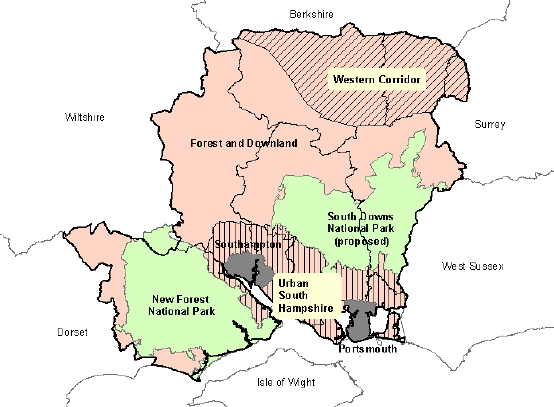
4.3 The Issues and Option consultation paper is a `spatial planning' document and it addresses matters that vary for different parts of Hampshire. In recognition of the geographic diversity the paper refers to varying `spatial areas': Urban South Hampshire, Forest and Downlands, and the Hampshire Western Corridor, as well as sub areas within Southampton and Portsmouth; the New Forest National Park and proposed South Downs National Park. These areas are illustrated by the diagram below:
4.4 The overarching vision presented in the consultation paper is that there should be a long term reduction in use of natural resources in Hampshire and that this will be realised by better use of materials, particularly in construction, more recycling and reduced landfill. In realising this vision a number of options were considered and assessed through an Integrated
Sustainability Appraisal (ISA) process (a legal requirement). The strategic option that performed best on balance and, given the current situation, is that recommended in More from Less, namely:
(i) behaviour change achieved to maximise reuse, recycling and recovery;
(ii) overall year-on-year waste growth reduced to 1% by 2010 and 0.5% by 2020;
(iii) an overall recycling rate of 60% by 2020;
(iv) cost of recycling to private and public sectors is optimised;
(v) net self-sufficiency in dealing with all waste arisings by 2016;
(vi) materials and energy recovery maximised from unavoidable waste;
(vii) use of landfill for all waste materials reduced to a minimum practicable level by 2020;
(viii) demand for new minerals reduced to minimum practicable levels, with extraction of land-won sand and gravel reduced as far as practicable;
(ix) new sites and facilities provided to meet needs in a sustainable and efficient way; and
(x) a supportive policy framework and all sectors of the community involved in delivering solutions and change.
The consultation paper reflects these principles.
4.5 Within the context of this main option the following issues are addressed in the consultation paper as of particular relevance for the development of minerals and waste management facilities for the period until 2020.
Growth in Resource Use
4.6 It is proposed that future management capacity for Hampshire will be provided on the basis of declining waste growth so that by 2010 it will be 1.5% per annum; 0.5% per annum by 2020 and 0% by 2025. Although waste growth has been at 3% per annum, there are a number of pressures that are likely to reduce this level but additional local and regional interventions will be required. Accordingly, the proposed growth rates appear reasonable but will need to be closely monitored and reviewed if necessary. It should be noted that the growth rates are the same as that proposed in the Regional Waste Management Strategy.
4.7 With regard to minerals the proposed apportionment proposed by the Regional Minerals Strategy of 2.63 million tonnes per annum for land won aggregate production is adopted. However, there is a view that use of land won aggregates overall could be in decline. Rising costs of extraction or new taxes could be the cause of this trend which must be closely monitored so that planning policy can be changed if required.
Sustainable Design and Development
4.8 A way to help secure a decline in demand for land won aggregate use could be by the use of more sustainable design and construction techniques. A way in which this trend could be fostered could be for local authorities to promote them through planning policy, development control and procurement strategies. In a similar vein design of new development could facilitate recycling and resource recovery by integrating appropriate waste management facilities, eg bin storage, neighbourhood recycling points in development.
4.9 As part of addressing the sustainable waste management challenge, stretching recycling and composting targets should be introduced. The Regional Waste Management Strategy proposes overall a recycling rate of 60% and this is proposed as a preferred option for Hampshire. Likewise, as part of an overall strategic sustainability package, the use of water and rail-borne transport of waste should be encouraged, by identification of appropriate transhipment points to enable more energy efficient movement of materials.
Waste Management Capacity
4.10 As a basic principle every geographic county should look after its waste, therefore Hampshire, including Southampton and Portsmouth, should provide sufficient waste management capacity to meet their arisings. It is also proposed that the capacity should be apportioned to each sub area in order to minimise the distance it has to travel. The amounts of capacity are still to be finalised but this is likely to be a big step change in terms of volumes to be handed locally, particularly for wastes produced by the industrial and commercial sector.
4.11 Hitherto, Hampshire has been managing some of London's waste. This pattern of waste movement is likely to continue in the short to medium term. In the longer term Hampshire should not be providing residual waste management capacity for London because of the distance from the metropolitan area. However, as part of a regional commitment, the Hampshire Western Corridor may need to provide for an appropriate level - if the Secretary of State so decides when adopting the Regional Waste Management Strategy - of London's waste which will be dealt with in a similar manner to that arising locally. The amount to be provided would be minimised by 2016 to a small proportion of residual wastes that cannot be managed within London.
Residual Wastes and Landfill
4.12 Notwithstanding increased recycling and pressures to reduce landfill, there will still be a significant amount of residual waste to be managed. This could be catered for by planning for a large capacity of waste processing plant - thermal facilities, mechanical biological treatment, etc for `non-hazardous waste', with landfill to deal with the residuals after processing (approximately 5.7 million tonnes capacity between 2005-2020). Alternatively, significantly more landfill could be planned, but the former course is preferable. However, whichever approach is chosen some additional landfill capacity will need to be identified as `preferred areas'. The options for siting these would be either within `Landfill Potential Areas' or more geographically limited `Mineral Resource Areas' - both illustrated on the `Key Diagram'. The latter option in effect would limit landfill to the mineral sites in need of restoration and this approach is preferable in order to limit the landscape and amenity impact of this form of waste management activity.
4.13 It is recognised that not all construction, demolition and excavation wastes can be recycled and some provision for final disposal is needed. However, it is proposed that there is no need to provide any further separate landfill sites for this material. It should be used as a restoration medium for mineral sites, material for non-hazardous landfill engineering, building and other operations.
Strategic Facilities
4.14 Not all waste management facilities can be locally based to serve local communities as some operations require large units serving a wide area. It is proposed that Hampshire should make provision for a certain level of such facilities within the capacity levels for meeting net self-sufficiency - see above. Such facilities could include specialist construction waste (contaminated soils) plant, incinerator ash disposal sites, waste wood processors, end of life vehicles plant, hazardous wastes sites. Hampshire would provide an appropriate share of such facilities which would be located to provide good access to transport links and it is anticipated most of these will be located within Urban South Hampshire or the Hampshire Western Corridor.
Mineral Supply
4.15 Hampshire has a range of mineral resources - gravel, sharp sand, soft sand, clay, chalk, oil and gas. The most widely exploited are the gravel and sand deposits largely for construction aggregate purposes. These are an important supply but there are substitutes or alternatives to supplying aggregate needs - limestone imports by rail from the Mendips, sea borne granite from Scotland, marine gravels from the English Channel and recycled construction and demolition wastes. In recent years land won production has declined and there has been an increase in recycled aggregate. Notwithstanding this, the South East England Regional Minerals Strategy (proposed alterations) has `apportioned' to Hampshire a production level from land won sources of 2.63 million tonnes per annum. This apportionment has been scrutinised at an Examination in Public into the Strategy at which a case for reducing Hampshire's apportionment was considered. The Panel report on the Examination rejected this case. The Secretary of State has yet to make a final decision on this matter.
4.16 It is proposed however, to divide the apportionment into a `local apportionment' so that there is a better balance between the supply of minerals and their use. The options for creating a local apportionment are:
Urban South Hampshire (tonnes per annum) |
Hampshire Western Corridor (tonnes per annum) |
Forest and Downland (tonnes per annum) |
Hampshire (tonnes per annum) | |
MRS Aspiration |
460,000 |
602,500 |
1,567,500 |
2,630,00 |
Recent Supply Pattern |
460,000 |
520,000 |
1,650,000 |
2,630,000 |
Preferred Option |
950,000 |
520,000 |
1,160,000 |
2,630,000 |
4.17 Subject to which local apportionment is chosen, preferred areas for aggregate production will be selected from the Mineral Resource Areas identified on the Key Diagram for the period until 2020.
4.18 Regarding other minerals it is proposed that there be a sufficient supply of clay to meet the needs of craft brick production at the remaining brickworks for up to 25 years. For chalk it is proposed to safeguard sufficient capacity to meet needs for agricultural lime, traditional building and construction supplies. Finally, it is proposed that oil and gas exploration and production should, in line with Government policy, be supported in all parts of Hampshire, subject to environmental safeguards.
Locational Issues
4.19 There are a number of location issues that the consultation paper addresses:
(i) Waste management sites, excluding landfill, should be located close to where wastes are produced and well related to the strategic transport network, to help minimise the transport of waste. The exceptions might be facilities serving large populations - strategic and or regional installations - and those that might be involved in re-manufacture, eg electronic dismantling plant, where location closer to markets may be more appropriate.
(ii) Major developments for housing, business, etc should provide for both strategic and local waste management infrastructure. These developments are opportunities to design in waste management sites to a modern standard taking into account all the appropriate criteria for access, landscaping, stand-offs from sensitive uses. It is proposed that design briefs for these areas should take account of this requirement.
(iii) Each proposal will need to be examined on its merits and, given the strong imperative to achieve self-sufficiency by 2016 and avoid landfill, speed will be of the essence. However, as a conceptual framework in the process of identifying sites and/or locations, after identifying sites within planned major developments the following search sequence should be adopted:
(a) within existing or proposed employment land and brownfield land (including agricultural buildings and yards); and
(b) greenfield sites, including `green belt' in special circumstances.
(iv) The co-location of minerals and waste management developments as `resource recovery parks' to exploit synergistic use of by-products, wastes, resources and infrastructure be supported.
(v) Restrict minerals and waste development in the National Parks and Areas of Outstanding Natural Beauty, in recognition of the special character and needs of these areas.
(vi) To prioritise the identification of `preferred areas' for mineral extraction on the basis of the following objectives (in no particular order):
(a) provide new planned development without sterilising mineral resources;
(b) opportunity for landfill;
(c) biodiversity objectives for priority habitats and species;
(d) security of mineral supply;
(e) climate change mitigation measures - shoreline managed retreat;
(f) secure settlement edges against further development; and
(g) water storage.
Safeguarding
4.20 Many existing mineral processing and waste management facilities are under pressure from alternative developments, particularly in Southampton and Portsmouth where several wharves provide opportunities for redevelopment. Alternatively, regeneration schemes create neighbour pressure on existing facilities because of incompatible activities. Beyond this, potential mineral reserves can be sterilised by new developments. Accordingly provision needs to be made to protect these resources and facilities, so due consideration can be given to their public interest value before incompatible planning decisions are made.
4.21 In addition to highlighting the above, the consultation paper will put forward an outline of the proposed `core strategy' document and a set of draft policies.
5. Conclusions
5.1 The `Issue and Preferred Option' consultation paper on the `Core' Planning Strategy for the Hampshire Minerals and Waste Development Framework sets out a variety of issues for the public to comment on. None of the contents of the paper commit the County Council to any policy position. Accordingly it is recommended that the document be approved for the purpose outlined.
Recommendations
1. That the `Issues and Preferred Option' Consultation Paper for the Hampshire Minerals and Waste Development Framework: `Core' Planning Strategy be approved with background technical evidence for publication and comment in accordance with Regulation 25 of The Town and Country Planning (Local Development) (England) Regulations 2004.
2. That the Executive Member for Environment: North Hampshire and Spatial Strategy, working with relevant Members from Portsmouth and Southampton City Councils, be authorised to approve draft policies, development control criteria and any local development orders, provided these are consistent with the Core Strategy framework.
3. That the Director of Environment, in consultation with the Executive Member for Environment: North Hampshire and Spatial Strategy, be authorised to make appropriate amendments and updates to the Consultation Paper, provided that these do not change the overall direction, shape and emphasis of the document, and do not raise any significant new issues.
Section 100 D - Local Government Act 1972 - background papers | |
The following documents disclose facts or matters on which this report, or an important part of it, is based and has been relied upon to a material extent in the preparation of this report. | |
NB the list excludes: | |
1. |
Published works. |
2. |
Documents which disclose exempt or confidential information as defined in the Act. |
TITLE |
LOCATION |
Technical Document Working File |
Environment Department Room 130 |
423/RR Rpt