
Archived decisions
Hampshire County CouncilHealth Overview and Scrutiny Committee Item 7 26 July 2005 Proposals to Develop or Vary NHS Services Report of the Chief Executive |
Contact: Denise Holden ex 7338
e-mail: [email protected]
1. Summary and Purpose
1.1. The purpose of this report is to alert Members to proposals from the NHS to vary or develop health services provided to people living in the area of the Committee.
1.2. Proposals that are considered to be substantial in nature will be subject to formal public consultation. The nature and scope of this consultation should be discussed with the Committee at the earliest opportunity.
1.3. The response of the Committee will take account of the Framework for assessing Substantial Change and Variation in Health Services agreed by the Hampshire, Isle of Wight, Portsmouth and Southampton Joint Committee in March 2005. This places particular emphasis duties imposed on the NHS by Section 11 of the Health and Social Care Act 2001.
1.4. This Report is presented to the Committee in 2 parts:
_ Items for information: these alert the Committee to forthcoming proposals from the NHS to vary or change services. This provides the Committee with and opportunity to determine if the proposal would be considered substantial and assess the need to establish a formal joint committee
_ Items for action: these set out the actions required by the Committee to respond to proposals from the NHS to substantially change or vary NHS services.
1.5. This report and recommendations provide members with an opportunity to influence and improve the delivery of health services in Hampshire and therefore support the delivery of Aim 5 (Improving Services) of the Corporate Strategy.
Items for Information
2. Mid and South West Hants Cluster: surgical services reconfiguration
2.1. At the last meeting of the SHA it was reported that good progress was being made with agreeing the clinical model for the surgery. Additional work was required with regard to finances. The proposal was not yet ready to go to formal consultation.
3. The Future of Health Services in Fareham and Gosport
3.1. The meeting scheduled with Peter Viggers, MP for Gosport was scheduled for the 7 July but was subsequently cancelled and rescheduled for the 18 July.
3.2. The Chairman has therefore written, once again to the responsible Minister asking that this issue is dealt with as a matter of urgency. A copy of the letter was previously circulated to members and is attached at Appendix One
4. South East Hampshire Capacity Plan
4.1. The SHA has confirmed its commitment to meeting Section 11 duties and that the capacity map is intended to provide an overarching umbrella strategic framework. Each proposal will be developed locally and be subject to consultation with partners, including the Committee.
4.2. The revised capacity plan for South East Hampshire has not yet been considered by the SHA.
5. Acute Paediatric Services/Maternity Services Review
5.1. The SHA has signalled its intention to review these services across Hampshire and the Isle of Wight.
5.2. External consultants have been contracted to lead this work.
5.3. No additional information is yet available, nor is it clear how this work will mesh with proposals for local maternity services currently being developed by the PCT clusters in south east and south west Hampshire.
Items Requiring Action
6. Winchester and Eastleigh Healthcare NHS Trust/ Mid Hants PCT: Changes to Rehabilitation Services at Andover Hospital
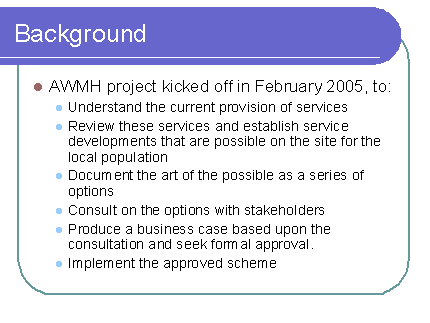
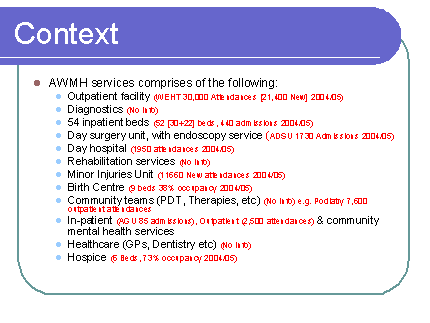
6.1. The Committee has now received the consultation document setting out proposals for developing rehabilitation and a range of other non-acute services currently provided at Andover War Memorial Hospital. This was prepared in conjunction with an independent input from `Finnamores'. The background to this work is attached at Appendix Two.
6.2. In addition to issues raised previously the Committee will be seeking additional information on:
_ The support for the proposal by the relevant P&PIFs, service users and carers
_ Whether the necessary infrastructure is in place to provide the level of rehabilitation support necessary in a community setting.
_ The monitoring procedures in place to ensure that the service operates as expected
_ The provision of dental, pathology and diagnostic services in support of the service model identified in the proposal
_ The type of day surgery to be undertaken
_ The continuation of hospice service
_ The provision of services at the birth centre
7. East Hampshire PCT: Changes to community service configuration in Emsworth and Havant
7.1. The Committee has previously stated its support for service modernisation that will deliver timely services as locally as possible and prevent older people having to be admitted to hospital. The proposal subject to consultation by EHPCT is attached at Appendix Three and members have already indicated that they will expect the following points to be addressed:
_ the `fit' of this work with the proposals on the future of community services in Fareham and Gosport
_ Continued engagement with key stakeholders, including staff, GPs, P&PIFs, social services and district councils
_ Clarity regarding the impact on other services providers, including social services
_ The additional community services to be put in place to support people in their own homes
7.2. Taking account of the previous work with key stakeholders within the communities affected, and the pressing financial issues that need to be addressed, the Chairman has agreed to a consultation period of two rather than three months, commencing on the 20 July. This is subject to the PCT:
_ attending the next meeting of the Committee to give Members full details of the engagement process
_ outlining the views expressed by local people about the proposal
_ confirming the way in which these views have informed the identification of a preferred way forward
7.3. Any additional recommendations made by the Committee during the consultation process, or at the September meeting will be taken into account by the Trust Board before a final decision is made.
7.4. The option remains for the Committee to refer this issue to the Secretary of State if members are of the view that the way forward is not in the interests of the health service in the area.
8. Maternity Services in South East Hampshire
8.1. The final report and recommendations of the Joint Committee is attached with the agenda. The findings, conclusions and recommendations from the Joint Committee are included at Appendix Four.
8.2. The Joint Committee did not accept the options put forward by the lead PCT and has asked for further work to be undertaken to address the issues identified.
8.3. A further meeting has been convened on 4 August to consider the response of the lead PCT to the recommendations of the Joint Committee.
9. South West Alliance- Community Strategy Services for Older People
9.1. The South West Alliance (comprising Eastleigh and Test Valley South PCT and New Forest PCT) attended a special meeting of the Committee on the 7 July 2005 to share progress to date with developing proposals for reconfiguring services for older people.
9.2. The resulting consultation document has now been published and can be accessed on http://www.newforestpct.nhs.uk/foi/publicinfo/olderpeopleconsult/olderpeopleconsult.pdf The formal consultation will conclude on the 30 September.
9.3. Hard copies are also available from Denise Holden.
10. North Hampshire PCT: Changes to the Configuration of Services at Alton Community Hospital
10.1. NHPCT wrote to the Chairman on the 14 June outlining steps taken to protect standards of care as a result of staff shortages at Alton Community Hospital, particularly with regard to recruiting to Health Care Assistant grades.
10.2. The 12 GP beds provided for local people have remained open, as have 12 beds for older people.
10.3. The PCT is now intending to work with local people to remodel the services provided by the hospital to maintain the 24 beds and provide alternative support services to older people living in the area. The initial approach proposed by the PCT is attached at Appendix Five
11. South West Hampshire PCTs: Out of Hours Consultation
11.1. Further to the presentation at the last meeting, PCTs in the South West have launched a formal consultation on the provision of out of hours services in the area. The full document is attached at Appendix Six . The consultation process is due to conclude on the 27 September
11.2. Additional information has been requested with regard to :
_ The scope of the consultation (i.e. is the focus on the management change following the termination of the contract with Primecare or the actual pattern of OOH services to be provided across the area).
_ Confirmation that the walk in and out of hours centres identified in the document will be preserved and work will be undertaken to ensure that the population affected is able to easily access out of hours services
_ Confirmation that the funding exists to fund the services described in the consultation document
_ Confirmation that the services described will be fully linked with other work taking place with regard to unscheduled care
12. Southampton City PCT: Modernising Community Services
12.1. The PCT has gone to public consultation on the configuration of services rehabilitation services for older people. The full proposal is attached at Appendix Seven.
12.2. It is not clear how the needs of people living in Eastleigh who will be affected have been taken into account or how this links with the consultation launched by the South West Alliance on the 11 July.
12.3. The following information has been requested
_ The number of people living in the area of the Committee that would be affected by the proposal
_ Confirmation that the proposal is supported by the South West Alliance PCT
_ The impact of the proposal on access to these services for people living in Eastleigh
_ The range of services affected in terms of in-patients, out-patients and diagnostics
_ The additional support to be provided in the community setting for Eastleigh patients should the service relocate to the Royal South Hampshire Hospital
_ The costs of currently providing these services and the anticipated savings from implementing these changes
_ Confirmation of the range and scope of section 11 engagement in developing the proposal
12.4. Eastleigh Borough Council, Southampton City Council HOSC and the ETVSPCT P&PIF have been apprised of the issues raised by the Committee
13. Portsmouth City PCT: Changes to substance misuse services
13.1. The PCT has advised the Committee of proposals to improve services for people who require treatment. These are attached at Appendix Eight
13.2. Discussions will now take place with Portsmouth City HOSC and other key stakeholders to determine if this is a substantial change to service provision.
14. Portsmouth City PCT: Changes to low secure services rehabilitation services
14.1. The PCT has advised the Committee of proposals to remodel the provision of low secure services in south east Hampshire. These are attached at Appendix Nine
14.2. Discussions will now take place with Portsmouth City HOSC and other key stakeholders to determine if this is a substantial change to services.
Recommendations
Items for Information
15. Mid and South West Hants Cluster: surgical services reconfiguration
15.1. The Committee is up-dated on progress with developing the surgical service proposal at its next meeting.
16. Future of Health Services in Fareham and Gosport
16.1. The Committee be apprised of the response from Lord Warner.
17. South East Hampshire Capacity Plan
17.1. Members are advised of the next draft of the capacity plan
18. Acute Paediatric services/maternity service review
18.1. Members are advised of the full business plan developed to support this work.
Items for Action
19. Winchester and Eastleigh Healthcare NHS Trust/ Mid Hants PCT: Changes to Day Surgery and Rehabilitation Services
19.1. Members receive the response from WEHT to the issues set out in 6.2
19.2. Members review the consultation and engagement process with input from the relevant P&PIFs, dist councils and other key stakeholders
19.3. Additional questions from Committee members are directed to WEHT through Denise Holden up to a week prior to the closing date of the consultation.
20. East Hampshire PCT: changes to community service configuration in Emsworth and Havant
20.1. The report back to members from the PCT on 27 September takes account of the points raised in 7.1 above.
20.2. The PCT confirms the work undertaken to secure the views of local people and key stakeholders and sets out these have informed the preferred option to be presented to the Board.
20.3. Further questions from members about the proposal will be directed to the PCT through the Trust Board up to the 14 September. Members will have a further opportunity to ask any additional questions at the meeting on the 27 September.
21. Maternity Services in South East Hampshire
21.1. Members receive a copy of the final report of the joint committee.
21.2. The response of the lead PCT to the Joint Committee, and any further action recommended by that Committee, will be shared with members at the next meeting.
22. South West Alliance Community Strategy
22.1. Additional questions and queries from members to the PCT will be directed through Denise Holden up to and including 27 September.
22.2. The relevant P&PIFs and District councils are invited to comment on the robustness of the consultation process.
22.3. The links with this consultation, and that being conducted on the same patient group by Southampton City PCT are clearly set out by the PCT.
23. North Hampshire PCT: Changes to the Configuration of Services at Alton Community Hospital.
23.1. Members consider, taking account of the framework for assessing substantial service change:
_ the range and scope of the consultation process
_ the extent to which local people have been engaged in developing and shaping the proposal
_ the range of options presented.
23.2. Comments questions and feedback received will be summarised for the consideration of members at the next meeting.
24. South West Hampshire PCTs: Out of Hours Services
24.1. Members consider the response of the PCT to the questions raised at 11.2.
24.2. The views of the relevant P&PIFs and District Councils on the proposals will be invited.
24.3. Comments from members to the PCT will be agreed on 27 September.
25. Southampton City PCT: Modernising Community Services
25.1. The Committee receives a response to the issues raised at 12.3.
25.2. The response of the South West Alliance PCT to 22.3 is clear
25.3. The views of key stakeholders about the robustness of section 11 involvement and engagement in developing the proposal are invited.
26. Portsmouth City PCT: Changes to substance misuse services
26.1. Members are apprised of the views of Portsmouth City HOSC and the relevant P&PIFs regarding whether to changes planned are substantial and therefore to be subject to formal consultation.
26.2. The views of social services on the proposal are invited.
27. Portsmouth City PCT: Changes to low secure rehabilitation services
27.1. Members are apprised of the views of Portsmouth City HOSC and the relevant P&PIFs regarding whether to changes planned are substantial and therefore to be subject to formal consultation.
27.2. The views of F&GPCT, EHPCT and social services on the proposal are invited.
Section 100 D - Local Government Act 1972 - background papers
The following documents disclose facts or matters on which this report, or an important part of it, is based and has been relied upon to a material extent in the preparation of this report.
NB the list excludes:
1. Published works
2. Documents that disclose exempt or confidential information as defined in the Act.
File Location
None
Hampshire County Council Appendix One
Health Overview and Scrutiny Committee: 29 July 2005
The Future of Health Services in Fareham and Gosport: Letter to Lord Warner; 8 July 2005
 I am writing further to my letter of 12 May to the Secretary of State for Health and your response of 23 May regarding our request that proposals for configuring health services in south east Hampshire are referred to the Independent Reconfiguration Panel.
There has been extensive correspondence between us and your Department. This matter was originally referred to the former Secretary of State for Health on the 31 January. We clearly set out why we considered that the scope for local action had been exhausted, the issues of concern to the Hampshire County Council Health Overview and Scrutiny Committee and the reasons why we felt that an independent assessment of proposals for developing health services in south east Hampshire was in the interests of both local people and NHS organisation. We also expressed the pressing need for a prompt decision to support the forward planning of health service configuration in the area.
The issues that we have raised are complex and wide-ranging, however if the wrong decision is reached we believe that health services in south east Hampshire will be significantly compromised. This is not a party political issue. The decision to refer this matter to you was unanimously supported by members from all political parties. Local people, Local Authorities and local MPs have been consistent, clear and united about their concerns in this respect. Having waited in excess of six months for a response to our request we were dismayed to hear that your meeting scheduled for the 7 July with the local MP Peter Viggers and Gosport Borough Councillors was cancelled.
Planning for service change has been suspended pending your decision but in the meantime the situation has continued to deteriorate. The attached letter from the Ministry of Defence to our local social service department makes it clear that work is proceeding with regard to withdrawal from the Royal Haslar Hospital (RHH) in March 2007, as well as the removal of resource from that site prior to this date. The Private Finance Initiative contract for the Queen Alexandra Hospital remains unsigned, some 18 months after the intended completion date. This will mean that the planned reprovision of secondary care services following the closure of RHH is unlikely to be possible, leaving the local population without access to acute care. Other factors, such as the financial problems of NHS services in Hampshire and the Isle of Wight have also deteriorated significantly since our initial referral.
We are clear about the need for health services to change and evolve and strongly support the intention to put patients and the public at the heart of decision making. The delay in deciding whether to refer our decision is damaging not only the principles underpinning current policy relating to patient and public involvement but also public confidence about the accountability of public sector services.
As you state in your letter of the 23 May this matter needs to be dealt with as quickly as possible. It is now mid July and we are no further forward. I am therefore, once again, asking that you give our request your immediate and urgent attention. As stated previously I would be pleased to provide any additional background information that you consider would facilitate this process.
Hampshire County Council Appendix Two
Health Overview and Scrutiny Committee: 29 July 2005
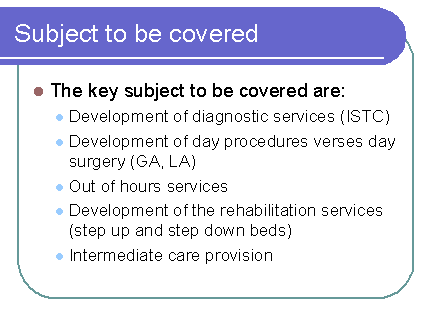
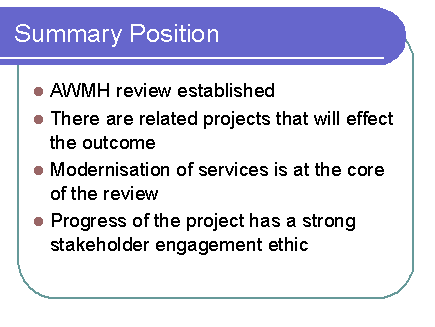
WEHT: Proposals for Rehabilitation services at Andover War Memorial Hospital
|
|
|
|
|
|
|
|
|
|
|
|
Hampshire County Council Appendix Three
Health Overview and Scrutiny Committee: 29 July 2005
East Hampshire PCT: Changes to community service reconfiguration at Emsworth and Havant

The future of services at
Emsworth Victoria Cottage Hospital &
Havant War Memorial Hospital
Contents
Summary
About the PCT and the local area
Demands and expectations
Meeting demands and challenges
The use of community hospital beds
Options for change
The preferred option
Details of the proposal
Emsworth and Havant hospitals: the future
The benefits for patients and the local NHS
Conclusion
Questions and Answers
The consultation process
We'd like to know your views
Summary
This document looks at the use of inpatient beds at Havant War Memorial and Emsworth Victoria Cottage hospitals and proposes changes to the way these and a range of outpatient services are organised. In addition, it examines how primary and community services could best be reshaped to meet the health needs of local people.
A number of factors have combined to create the need for change. East Hampshire Primary Care Trust (PCT) is expected to deliver nationally directed improvements in services. Locally, we must prepare to meet increased demands from a growing and ageing population and to deliver the best value for money from the resources available to it. Importantly, we have a substantial financial deficit, and need to make difficult decisions in order to achieve financial balance.
We have looked carefully at what we do, and from where we offer care, to be sure that we provide services that meet these challenges. We are scrutinising all of the services we provide, to ensure they are cost effective and efficient. One of the areas we have reviewed is the use of our in-patient beds. Overall, the beds we provide are not run at maximum efficiency. Also, a proportion of these beds is currently occupied by patients who could have been better cared for elsewhere. For some, this would be a nursing home, but for many it would be their own home. We are therefore reviewing the way we use all the beds we provide, and the numbers of beds that we should continue to run.
This review includes the in-patient beds at Havant and Emsworth, where there are two community hospitals in relative proximity, and where bed utilisation is below the optimum level. We had already looked at consolidating these beds onto one site in future, but the severity of our financial position means we have had to look at this issue more urgently.
This document therefore encompasses the options for change and recommends that inpatient beds for Havant and Emsworth are provided from the Havant War Memorial Hospital, and that inpatient and minor injuries services close at Emsworth Victoria Cottage Hospital. In parallel, it proposes that outpatient services transfer to Emsworth from Havant. As a result, patients in this area who need a community hospital bed will be admitted to Havant War Memorial Hospital, whilst Emsworth will develop physiotherapy, occupational therapy and outpatients services and continue to provide a base for support services. Emsworth GPs who currently admit patients to Emsworth Hospital would retain rights to admit patients to Havant War Memorial Hospital and the staff who currently provide inpatient and minor injuries services would be redeployed.
Bed use and readmission rates would be closely monitored and we will work with GPs and community teams to provide alternative services for patients. Working with the local community and NHS staff, we have also developed ideas for changes and improvements to the way services are delivered to provide a better combination of hospital and community services for Emsworth and Havant residents.
The proposals contained in this document are now subject to a formal period of consultation with the local community. We are seeking views from a wide range of groups and individuals with an interest in the development of services locally and comments are invited by September 21st 2005.
Partly as a result of the financial difficulties faced by both organisations, East Hampshire PCT and Fareham & Gosport PCT have combined their management teams and work jointly on the future shape and delivery of local health services as a "Cluster". The review of in-patient beds which preceded this proposal has been carried out by both PCTs working jointly. East Hampshire PCT, however, remains an independent statutory organisation and therefore is responsible for carrying out this consultation, in line with its duty under Section 11 of the Health and Social Care Act (2002.)
I. About the PCT and the local area
East Hampshire Primary Care Trust (PCT) serves a population of approximately 195,000 people living in Petersfield, Denmead, Havant, Waterlooville, Emsworth, Hayling Island and surrounding areas.
With a budget of some £195 million, we provide a range of hospital, primary care and community health services, employing a total of 1,873 people and working with 27 GP practices, 31 pharmacists, 23 opticians and 29 dental practices. We also commission specialist and secondary care from large acute trusts and other providers.
1. Services Provided by the PCT
These services are provided by East Hampshire PCT for its local residents:
· Community Hospitals
· District Nursing
· Health Visiting
· School Nursing
· Child and Family Therapy
· Physiotherapy
· Occupational Therapy
· Health Promotion
The PCT also provides some services for residents across Portsmouth and South East Hampshire:
· Elderly Medicine
· Elderly Mental Health
· Specialist Child and Family Therapy
· Community Dental
· Palliative Care
Partnership arrangements
We have developed excellent relationships with Hampshire County Council, the area's borough and district councils and local voluntary bodies, helping to deliver seamless health and social care and harnessing the energies of different organisations and agencies to improve people's health.
Demands and expectations
National requirements
PCTs are required to deliver an ambitious series of improvements as part of their obligations under the NHS plan and National Service Frameworks (NSFs). These include better performance and quality standards, improvements in intermediate care, better access to services, better management of chronic and long term illnesses, more appropriate and localised care and improvements in clinical facilities.
a) A vision for better health in old age
A vision of future services for older people has been developed nationally by the Department of Health (DoH) and is set out in the National Service Framework for Older People. This states that care should be `person centred', offer greater choice and encourage responsibility for self-care. Services should bridge the gap between hospital and home, have a single assessment process and a high level of integration. The NHS should offer timely treatment after needs have been identified or if there is a crisis. It also states that services should be organised to promote an active life and to support work with local councils on specific programmes for disease prevention.
Providing value for money
East Hampshire PCT is facing enormous financial and service pressures as witnessed by a £5.9m deficit last year and continuing cost pressures to maintain services as they currently exist. The deficit has to be repaid and we are required to live within our budget. It therefore makes sense to look at all the services where we spend our funds and especially those we directly manage, and thus can influence, such as community services, elderly medicine and community hospitals. We spend £45m in these areas each year.
As part of this review, we looked to see where we could reduce unnecessary costs through modernising services to patients and make better use of our assets (such as buildings). We looked in particular at our major costs such as community hospitals to see whether we could provide more appropriate treatment closer to home and take out underlying costs. Furthermore, our review showed that some environments were poor for treating the patients involved - especially as these were often older people.
There were several outcomes from this review and one of those was a conclusion that significant costs could be released from the consolidation of in-patient and outpatient services at Havant and Emsworth hospitals. The environment in Emsworth Hospital is poor for elderly patients and the nature of the building (for example, operating on two floors) is not suitable for 21st century care.
Other measures are being taken elsewhere as part of our financial recovery plan, hence this proposal is one of several underway.
b) Changing local needs
Over the coming years, the demands on the local NHS for more and improved health care are expected to intensify. This requires us to provide care in the most efficient and effective way, making best use of our resources.
Latest projections (November 2004) indicate that the number of people in the East Hampshire and Havant Council areas will increase by 1.4% to 226,716 between 2001 and 2026 (although it should be recognised that this area is not coterminous with PCT boundaries). The most significant change during this period, however is the increase in the number of people aged over 55 years, with forecasts estimating that this age group will represent about 36% of the total population in East Hampshire by 2026 compared to 27% now.
Set against this, advances in medical care are also increasing the opportunities to provide services in a way that reduces the time people spend in hospital, and avoids unnecessary admission to hospital.
c) Building a healthy future
These changes and challenges provide the NHS in this area with a clear agenda for modernisation. There is an opportunity to reshape primary and community services in order to improve the quality of care delivered in people's homes, minimise wherever possible the need for hospital admission and offer the best possible value for money. Changes to the way services are organised at Emsworth and Havant War Memorial Hospitals are an essential and integral part of this process.
II. Meeting demands and challenges
We have looked carefully at what we do and the way we use resources to meet the challenges set out above.
We have:
· examined whether the most clinically and cost effective use of beds was being achieved
· assessed whether current systems secured the best care in the most appropriate settings for older people
· identified opportunities to improve local services in line with national directions for older people services.
Local doctors, nurses and therapists have carried out a number of audits into the use of our 400 inpatient beds (those in community hospitals and those provided by our Older People and Elderly Mental Health services). A review of these audits showed that we were not using beds to maximum effect. Overall, beds were under occupied and around a quarter (23%) were being occupied by patients who could have been cared for within their own home.
Some patients could have been discharged from hospital more quickly if they had received appropriate community support. Indeed, many could have avoided admission in the first place if the right services had been accessed in the community.
We have invested heavily in local initiatives and now have in place a comprehensive range of community and primary care services. However, as yet, we have not reduced expenditure on inpatient beds and we are therefore incurring `double running' costs on both beds and our new community based services. This has contributed significantly to our financial difficulties.
The use of community hospital beds (excluding maternity beds)
There are three community hospitals in the area covered by East Hampshire PCT: Emsworth Victoria Cottage Hospital, Havant War Memorial Hospital and Petersfield Community Hospital.
Petersfield Community Hospital, in the north of the PCT area, provides a total of 44 beds for a complex range of cases (including stroke and general rehabilitation, and intermediate and respite care). Emsworth Victoria Cottage and Havant War Memorial hospitals, in the south of the PCT area, provide a total of 38 intermediate care beds and each offers a minor injuries service.
· map showing location of community hospitals (East Hampshire PCT)
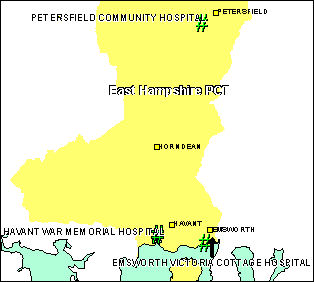
The audit of in-patient beds (referred to previously) concentrated solely on measures of effectiveness, such as current service activity and costs, and the best use of resources. The beds at Emsworth and Havant demonstrated the greatest disparity from the optimum. The review revealed that together they had the lowest bed occupancy rates of all at hospitals in the area and suggested that, given their relatively close proximity, it would be possible to consolidate in-patient beds at just one of the sites.
It is this suggestion that forms the basis of this particular consultation document and, given the location of the two hospitals, much of the focus for this consultation will be on services provided by East Hampshire PCT. However, the scope of the bed audit, and indeed the need to make financial savings, are both much broader issues, and will potentially affect services not just further afield in East Hampshire but within Fareham and Gosport PCT too.
a) The effectiveness of inpatient beds at Emsworth and Havant
The table below shows the number and type of beds available, and how often they are occupied. It also shows the number of minor injuries treated at both Emsworth and Havant hospitals.
The optimum bed occupancy rate for community hospitals is calculated nationally at 90%. Neither hospital achieved this figure during the last year. Minor injury services at Emsworth operate seven days a week (8 am till 8 pm). The attendance is very low, averaging 10 patients per week, and, because of low usage, there are no dedicated staff working solely in the minor injury clinic. Instead, staff are drawn away from their ward duties whenever a patient attends the clinic with a minor injury.
The bed audit carried out by the PCT also indicated that 30% of patients currently in the beds could have been cared for in a different environment, either their own home or a nursing home. At Emsworth, four of the 15 beds are located separately on the ground floor and have previously been closed because of the difficulty of providing nursing care safely and cost-effectively.
(1) Beds |
Function |
Bed occupancy |
Minor injuries seen (2004/05) | |
Havant War Memorial Hospital |
23 |
Intermediate Care Minor Injuries Out patients |
80% |
1,013 |
Emsworth Victoria Cottage Hospital |
15 (11 currently operational)* |
Intermediate Care Minor Injuries Out patients |
69% |
538 |
b) The need for change
It is clear that we have to look again at the number and configuration of in-patient beds at the two hospitals. This is because:
· the capacity we have is underused
· the length of stay of patients in these hospitals can be further improved
· a proportion of patients currently using the beds can be cared for in other environments, including their own homes
· the current configuration of beds across two small hospitals does not enable the best use of staff and other resources
· we have to ensure that our resources are used to better effect
· investment has been made in primary and community services to enable more people to be cared for out of hospital, but we are continuing to run the same number of beds.
III. Options for change
Three broad options become apparent if we are to tackle these problems and secure more cost effective services of good quality. These are summarised in the table below, which also lists potential advantages and disadvantages.
Option |
Reasons for this option |
Reasons against this option |
1. Do nothing |
· No change for admitting GPs, local patients and staff |
· Beds are not fully utilised · Some patients continue to receive care in hospital when they could receive it in another environment · Expenditure is high in relation to the use of beds |
2. Close Emsworth in-patient beds and consolidate in-patient beds at Havant War Memorial Hospital |
· Consolidate in-patient beds onto one site allowing best use of staff and other resources · Ensure that remaining in-patient beds are used to maximum effect complemented by community services · Delivers cost savings and better value for money |
· May lead to some increased admissions to Portsmouth Hospitals Trust · Increased demand on community services |
3. Close Havant War Memorial beds and consolidate beds at Emsworth Victoria Cottage Hospital |
· Reduce expenditure on in-patient beds and consolidate staffing |
· Emsworth is smaller than Havant in both population and the number of available beds, and beds are not as well configured · Emsworth Hospital does not have its own catering service (it is provided from Havant) |
N.B. Minor injuries services in Emsworth are currently provided by staff from the in-patient ward. If the beds at Emsworth are closed, it would not be possible to maintain this service economically, given the low numbers of attendance.
IV. The preferred option
We face a very serious financial position. The "do nothing" option therefore has to be discounted, in view of the costs of maintaining in-patient services and the option to provide services in a more cost effective way. Of the two remaining options, consolidating in-patient beds at Havant War Memorial Hospital is the preferred option on the basis that:
· More in-patient beds can be retained in Havant than in Emsworth (23 compared to a maximum of 15)
· The layout of the beds at Havant is easier to run, and therefore more cost effective
· The population of Havant is greater than that of Emsworth
· Havant has its own catering service whereas Emsworth does not
· The outpatient services at Havant are provided on the second floor (with no lift) making access difficult for patients and visitors.
Emsworth Victoria Cottage Hospital provides excellent care to many people and is well respected and supported by the local community. However, Emsworth has the lowest occupancy rate of all three of the area's community hospitals largely because it cannot offer an appropriate environment for modern day in-patient care.
We believe option two is the best of the options available. Our proposal is therefore to: close Emsworth Victoria Cottage Hospital's in-patient beds and minor injuries services, and consolidate in-patient beds for Havant and Emsworth at Havant War Memorial Hospital.
On the basis of consultation that has already taken place with local stakeholders about this proposal, the following changes are also proposed to run in tandem with the changes to the in-patient beds and minor injuries services. These changes are designed to mitigate the effects of the closure, and make the best use of the facilities at both hospitals.
· transfer all outpatient services from Havant to Emsworth
· maintain and develop physiotherapy, occupational therapy and outpatients services at Emsworth
· continue to provide a base for support services, e.g. district nurses and specialist nurses, at Emsworth
· admit patients who require a community hospital bed to Havant War Memorial Hospital
· ensure Emsworth GPs retain rights to admit patients to Havant War Memorial Hospital
· continue to provide a minor injuries service at Havant War Memorial Hospital [in addition to the full A&E service that Portsmouth Hospitals Trust provides on a 24 hour, seven-day-a-week basis at Queen Alexandra Hospital in Cosham]
· redeploy staff who currently provide in-patient and minor injuries services to other NHS services, including Havant War Memorial Hospital.
In addition we will:
· monitor the use of beds at Havant War Memorial and Petersfield hospitals to ensure capacity meets demand
· monitor re-admission rates into acute services and any additional impact there may be on social care providers
· work with GPs and community teams to provide support for patients to enable them to return to or remain in their own homes. A proportion of the savings from the closure of the in-patient beds and minor injuries service at Emsworth will be used to enhance this support.
V. Details of the proposal
Financial implications
The cost of providing in-patient and minor injuries services at Emsworth Hospital for a full year is summarised below.
£ | |
Staffing and related costs |
£338,196 |
Utilities consumption |
£3,500 |
Maintenance costs |
£1,300 |
Catering costs |
£37,800 |
A. TOTAL |
£380,796 |
Set against this, the additional costs associated with the change are in the order of £50,000. These include mileage allowances, the training and re-skilling of staff, replacing the minor injuries service and enhancing rehabilitation and community services. A contingency sum has also been assumed in case of any increased usage of services provided by other partners.
It is therefore estimated that the proposal would release £300,000 a year of recurring savings.
a) Implications for staff
There are 24 staff (14 whole time equivalent) providing in-patient and minor injuries services at Emsworth Victoria Cottage Hospital.
The knowledge, skills and experience of these staff are too valuable to lose. We will develop in consultation with staff and their representatives a plan for managing the change process. This will involve interviews to determine individual skills and options. Every effort will be made (using our Redeployment Policies) to match staff to vacancies elsewhere.
Every effort will be made to avoid redundancies.
Managing risks
Any change to services involves some risks but those associated with reductions in bed numbers require careful planning and delivery. The main risks associated with this proposal are managing unexpected changes in demand, and ensuring that preparatory work is completed on time, to schedule and to budget.
Bed capacity. The need for inpatient beds may change. For example, there could be an increase in the number of patients readmitted from the community to Portsmouth Hospitals NHS Trust or the nursing home sector may experience additional demands on capacity. New developments and therapies may create higher than expected demand for district nursing or therapy and other community services. These pressures will need to be acknowledged if they occur and managed accordingly. The bed occupancy rates at both Havant and Emsworth hospitals, combined with the results of the bed audits, demonstrate sufficient capacity to manage this potential problem. However, clinical and managerial teams will work closely with GPs and community staff to monitor admissions, readmissions and any workload changes.
Timetable and workload. The planning and implementation of these changes mean substantial additional work. In particular, it will be essential to ensure that all those with an interest in the project have an opportunity to be involved in and influence it. A plan for patient and public involvement has been drawn up with, and agreed by, community representatives, including Patient and Public Involvement Forum members and local residents.
Costs. Some of the costs associated with the proposal are difficult to quantify, for example the cost of meeting any increase in admissions to Portsmouth Hospitals NHS Trust. Others are more predictable, such as increases in the cost of community support services. To ensure that a firm control is kept on expenditure, managers and the PCT's finance team will monitor admissions and expenditure on a monthly basis, and a contingency sum has been set aside.
VI. Emsworth and Havant hospitals: the future
Previous plans for the development of services had envisaged the comprehensive replacement of primary, community and social care services in the area before any permanent closure of in-patient beds at Emsworth Victoria Cottage Hospital. It is now clear that, in view of our financial position, this approach is not sustainable.
However, following consultation and engagement work with the local community, we believe that the hospital building at Emsworth should provide a hub for existing and new developments in local services. This proposal recommends that the hospital continues to provide physiotherapy, occupational therapy and outpatient services and a base for support services. If this proposal were to go ahead, community and outpatient services would need to be reshaped further.
A workshop was held recently as the first stage in a process to involve staff and patient representatives in decisions about the future of the hospital. It was attended by hospital staff, local GPs, members of the Public and Patient Involvement Forum, social services staff, the area's councillor, the hospital's League of Friends and local residents. Amongst the suggestions made was the running of in-patient services from Havant War Memorial Hospital and all outpatient services from Emsworth, which lie at the heart of this proposal.
A range of options for the delivery of future services has been assessed against both national and local criteria:
· the four key principles of the National Service Framework for Older People
o Ensure person centred care, increased choice and responsibility for self care
o Ensure services are joined up and bridge the gap between hospital and home
o Ensure services respond to needs in a timely way
o Ensure that services promote health and an active life
· cost and clinical effectiveness of services
· encompass the successful initiatives already in place locally.
a) Proposed Model of Care
The proposal offers a range of alternatives to meet the needs of different patient groups in the most effective and appropriate way. A range of options was designed with key clinical and support staff including:
· ward, outpatient and community nursing
· medical input from the Emsworth practice and Older Peoples' Services
· Social Services input form Hampshire and West Sussex
· therapies
· service managers
· local patient and residents groups, Havant Borough Council and East Hampshire Patient and Public Involvement Forum
The proposal will allow us to:
· increase bed occupancy at Havant War Memorial Hospital to 90%. This will provide capacity for Havant and Emsworth patients who require a community bed
· set up an Assessment and Rehabilitation service on White Ward at Emsworth Hospital to be funded from the overall savings of the project
· enhance district and community nursing roles and skills with additional training to include:
o Core nursing and assessment skills
o I/V/I therapy in patients homes
o Palliative care
· work with Western Sussex PCT to ensure our commissioned service is relevant to the needs of patients registered with the Emsworth GP practice who have a West Sussex postcode
· redirect minor injuries patients from Emsworth to Havant
· use rapid response services to support rehabilitation and the wider range of admission avoidance schemes currently under development. This team is already in operation and has nursing, therapy, social services and medical input.
· discuss with consultants the options for moving outpatient clinics from Havant to Emsworth
It is envisaged that the proposals outlined above will require funding of approximately £50,000 (full year effect) generated from the savings made.
The benefits for patients and the local NHS
There are some evident economic factors behind our proposal to close inpatient beds at Emsworth. But there is also clear evidence, both nationally and internationally, that patients:
· want alternatives to hospital admission
· currently stay in hospital longer than is necessary
· in some cases, rehabilitate and recover more quickly at home
Therefore, providing more cost effective and efficient health services that can also adapt to the changing needs of the local population will also deliver some benefits for patients.
VII. Conclusion
It is recommended that Emsworth Victoria Cottage Hospital close its inpatient and minor injuries services and that these be provided by Havant War Memorial Hospital.
This will allow beds at Havant to be used to maximum effect, make better use of nursing and other expertise effectively and make best use of available resources.
VIII. Questions and Answers
During the period leading up to the consultation, the East Hampshire Primary Care Trust took several opportunities to talk to the public about the issues facing Emsworth Victoria Cottage Hospital and the concerns that they had about how the Trust might address these issues.
The list of questions and answers below is based on these discussions and may help address some key concerns.
Q
Decision. Why has Emsworth become the priority for closure?
a) A
The PCT has been required to put forward a number of schemes to help tackle the serious financial position they both face. A number of these relate to the use of in-patient beds, whether in community hospitals, nursing homes or other services such as those for Older People and Elderly Mental Health. The Emsworth proposal is the first of these to be put forward for public consultation. Apart from the financial position there are a number of reasons for this:
· the hospital environment no longer meets the requirements of effective, modern inpatient care
· the resultant reduction in bed occupancy because of this
· high cost per bed in relation to other inpatient environments
· operational issues such as the lack of catering facilities.
Q
Demand. What if demand for beds cannot be met by the capacity at Havant War Memorial Hospital? Will this lead to increased admissions to an acute hospital bed? Will the changes lead to increased demand for community nursing and therapy services?
A
Having reviewed the number of beds that are occupied at any one time and the length of time individuals spend in the beds, it is believed that there is enough capacity at Havant War Memorial Hospital. Admissions to an acute hospital will only happen when it is clinically right that it does. Community nursing and therapy services will be refocused to ensure that their services are directed to those who will most benefit from them.
Q
GP support. Is there support from GPs and consultants for the service model suggested?
A
There is support from local GPs and Elderly Care Consultants to develop more effective models of care for older people.
Q
Optimum occupancy. What is considered to be the optimum occupancy rate for these beds in a community hospital setting. There is conflicting information regarding the effectiveness of occupancy rates that exceed 85-90%.
b) A
Within the acute sector, it is agreed that 85% is the optimum occupancy level for bed usage. However, because patient need is different within the community setting, 90% occupancy levels are considered more appropriate.
Q
Nursing home capacity. What is the capacity in the Emsworth/Havant area to provide this option for patients in a timely way given potential shortages in nursing home beds.
A
It is believed that there is just enough capacity within the local area for nursing home placements. However it is acknowledged that this situation will be greatly improved when Hampshire County Council commissions Emsworth House.
Q
Community services. What is the cost and range of the enhanced community services that are envisaged. As currently presented there seems to be an very little investment in providing the levels of community services required to meet the needs of people in their own homes. Is the PCT confident that the staff required to provide the enhanced community service can be recruited? What are the intended targets for accessing the enhanced community services and how will these be delivered?
c) A
By refocusing our current community services (including community geriatricians, nurses and therapists) we believe that there will be little requirement for major investment. An investment of £50,000 will be made to enhance the current workforce with support and technical staff. A £30,000 contingency sum will be held to meet unforeseen impacts on other providers of health and social care.
Q
Other services. Has the impact of the proposal on other service providers (such as Social Services) been evaluated and are there any implications for access to NHS continuing care services?
A
There should be no impact on access to NHS continuing care. We will be monitoring any impact on Social Services but our belief is that, as most of the patients will be treated at home for short recovery periods, the current services can cope. (These are not rehabilitation or continuing care beds and the audit of in-patient beds showed they need quite low level support).
Q
Transport. What about issues relating to transport between Emsworth and Havant?
A
Havant and Emsworth are about two miles apart and there are good rail and bus links between the two towns.
Q
Cost. Won't it cost more money to treat people at home than at local community hospitals?
A
There is clear evidence from research in the National Service Framework that it is both more cost effective and clinically effective when people are cared for in the most appropriate setting.
(a) The consultation process
We will consult formally on this proposal between July 21 and September 21, 2005, with a large number of organisations and individuals concerned with the development of local services. We will also hold public meetings in different parts of the area to hear the views of local people. These meetings will be on:
· date, time and location tbc
· date, time and location tbc
· date, time and location tbc
Further copies of this document can be obtained by:
· Writing to:
(i) Emsworth/Havant Consultation Coordinator
East Hampshire Primary Care Trust
3rd Floor
Raebarn House
Hulbert Road
Waterlooville
PO7 7GP
· Downloading it from our website (see below)
If you wish to comment on the proposals, you can do so in a number of ways. You can:
· Attend one of the public meetings being organised across the area and discuss your ideas with us directly. We would be very pleased to hear them
· Email your comments to us at [email protected]
· Visit our website and click on the appropriate link
o East Hampshire Primary Care Trust - www.easthampshirepct.nhs.uk
· Write to us c/o:
(ii) Emsworth/Havant Consultation Coordinator
East Hampshire Primary Care Trust
3rd Floor
Raebarn House
Hulbert Road
Waterlooville
PO7 7GP
· Complete and return the feedback form in this document.
What happens when you receive my comments?
All comments will be logged so that we avoid missing any points that are raised and have a full record of what is being said or asked. If you ask a question, it will be passed to a senior manager or clinical professional so that they can contact you and answer any points of concern.
The issues raised by your comments and questions will be carefully analysed. We will bring together similar views so that the full weight of common observations is clear, identify pressing concerns and list specific queries and thoughts. A report capturing these opinions, comments, ideas and questions will be produced and sent to the area's Overview and Scrutiny Committee.
This will be presented to the members of the PCT board before they make decisions about the future of the hospitals. It will be available to the public and from our website.
In addition, it will be presented at the board meeting of the PCT, which will be held in public, when the future of the hospitals is decided. This means that you, the media and others with an interest in the matter will be able see if comments or concerns have been heard and addressed.
ALL COMMENTS SHOULD BE RETURNED TO US BY 21st September 2005.
To whom is the document being distributed?
We are distributing this consultation document widely to gain the views of the public and other
stakeholders in the area:
· Members of staff directly responsible for services
· Statutory organisations, including local authorities and social services
· Department of Health
· Professional bodies
· Neighbouring NHS organisations
· Local MPs
· GPs
· Voluntary Organisations
· Citizens Advice Bureaux
· Community Groups
· PPI Forums
· Overview and Scrutiny Committee
· Emsworth Residents Association
· EVCH and HWMH leagues of friends
A full list is available by writing to us at the above address.
We'd like to know your views
You can use this form to let us know your views on the proposal. Please continue overleaf or on a separate sheet if you wish. Your comments should be sent to the address below so that we receive them on or by 21st September 2005.
Your Name (optional): ______________________________________________________________________
Your Address (optional): ______________________________________________________________________
What would you like to tell us about this proposal?
Please return this form by 21 September 2005 to:
Emsworth/Havant Consultation Coordinator
East Hampshire Primary Care Trust
3rd Floor
Raebarn House
Hulbert Road
Waterlooville
PO7 7GP
Please tick this box if you would like to receive an acknowledgement: _
Hampshire County Council Appendix Four
Health Overview and Scrutiny Committee: 29 July 2005
Maternity Services in South East Hampshire: Report of the Joint Committee, Key Findings and Recommendations
Findings
1. The Committee supports the view that pregnancy is not an illness and that services should be designed around women's needs. They recognise that maternity services should focus on providing optimal care for every woman and baby as well as offering women support and information, so they can make their own decisions and choices about care during pregnancy, in childbirth and in the care of the newborn infant.
2. The Committee has also taken cognisance of the National Service Framework for Children and Families which outlines the expectation that mothers should have as normal a pregnancy and birth as possible, with medical interventions recommended to them only if they are of benefit to the women or her baby. The Committee has heard on a number of occasions throughout the scrutiny process that midwife led units in the district are being promoted specifically to meet this objective.
3. The Committee considers that it is vital that women are assessed through out their pregnancy to enable them to make an informed choice about their care and place of birth, whether it is in a birth centre or a hospital.
4. The Committee accepts that there are a number of challenges, such as a shortage in trained doctors and neonatal nurses, facing maternity services across Hampshire and the Isle of Wight. However, the Committee strongly believes that proposals to reorganise services should be wholly based upon the needs of the local population and members have been unable to satisfy themselves that a robust needs assessment was undertaken prior to the development of the two options.
5. The Committee recognises that those residents of Portsmouth City Council who live off Portsea Island and the residents of Havant (approximately 155,000) do not have easy access to a local birth centre. The Committee notes that a new birth centre co-located at QAH could meet their need and provide ease of access.
6. The Committee has also noted, however, that the results from the NHS's own engagement with local groups indicated that women in South East Hampshire felt that women on Portsea Island should have a choice of a birth centre remaining in their immediate neighbourhood. This was also supported by a number of contributors to the scrutiny process.
7. In considering the options the Committee has noted that the results from the NHS's engagement strategy indicated that the majority of GPs felt that the birth centre should be co-located at QAH, while 13% supported retaining a stand-alone birth centre on the St Mary's Hospital site. However, the Committee does not know how many GPs were consulted.
8. The Committee has heard overwhelmingly from key local stakeholders and user groups that the Mary Rose Birth centre should remain as a stand-alone unit on Portsea Island. This has also been the clear message from the public and staff during the NHS's own consultation process. The Committee has also been particularly interested to hear that both midwives and the MSLC support the retention of a stand-alone unit on Portsea Island.
9. The Committee has also heard strong support from contributors to the scrutiny process for a stand-alone birth centre to remain on the Portsea Island in addition to a co-located unit being provided at QAH. The Committee is surprised that this option does not seem to have been considered by the local NHS.
10. The Committee was concerned to hear from the local NHS that they also accepted that by relocating the Mary Rose Birth Centre to QAH a certain amount of choice could be taken away from Portsea Island mothers. It is the Committee's view that this would not correlate to the stated objective of the local NHS which is to offer women `a range of choices that meet their needs and minimises the risks involved in giving birth' and their stated aim to `increase the proportion of births outside a main hospital unit through the continued development of birth centres and participation in the Department of Health Birth Choices Project'.
11. Many of the contributors to the scrutiny process voiced their concerns about the travel implications for women if the Mary Rose Birth Centre were to be relocated to QAH. The Committee were interested to hear that Portsmouth Hospitals Trust was in the process of carrying-out a travel survey at the Birth Centre. Results from April indicated that a substantial majority of respondents had travelled to the Centre using their own transport. A similar majority indicated that they would not have changed their travel plans if the centre had been co-located at QAH. The Committee welcomes these findings but notes that the sample of women questioned was very small (30) and there is no indication of the places of residence of the respondents.
12. The Committee was interested to learn from an obstetrician that he and his colleagues had no preference towards a co-located unit or a stand alone unit, but that they did feel that there was a "culture to interfere" in maternity wards. The Committee has also noted, however, that many women giving birth in mid wife led maternity wards with obstetrician help available would not require it and still have normal, natural births.
13. The Committee is unclear about why the local NHS has presented two options for the future of the Mary Rose Birth Centre now if they have also undertaken to consider a business case for providing a stand-alone unit in the future if the relocation to QAH takes place.
14. The Committee has noted that, despite acknowledging that demand would be sufficient for a stand-alone birth centre on Portsea Island to be cost-effective the local NHS has rejected this option declaring that' this would represent an increase in capacity beyond that expected to be required and, in the current financial climate, resources are not available to support it'. Again, the Committee has been unable to establish the reasoning behind this, as they have not had sight of the relevant business case.
15. The Committee is concerned that the NHS has not given due consideration to the ways in which maternity services are provided in other districts in the region nor to the different modelling options that could be utilised if a stand alone unit was provided on Portsea Island.
16. The Committee notes that an additional change to maternity services in the district is proposed by Fareham and Gosport PCT who plan to close down Blackbrook Birth Centre and replace with it with a 12 bed Birth Centre in the new Fareham Community Hospital. The Committee recognises that this proposal will have an additional impact on the overall provision of services across the district.
17. Whilst noting that the local NHS carried-out some public and patient engagement prior to the launch of the consultation document the Committee does not consider that this complies with the consultation requirements of Sections 7 and 11 of the Health and Social Care Act.
18. The Committee is also concerned that many of the contributors to the scrutiny process felt that the consultation by the local NHS on the options was `too little too late.' Members are particularly concerned to have heard that midwives do not appear to have been consulted until the publication of the consultation document, and that the views of many hard to reach groups have not been obtained.
Conclusions and Recommendations
19. The options presented in the consultation document were not, in the view of the Committee, comprehensive in that other models of providing safe and accessible maternity services had not been fully explored and associated costings realistically tested.
20. Although the Committee recognised that the co-located unit would extend choice for some of the population affected, the impact on women and families using the services on Portsea Island had not been assessed, nor had account been taken of the well-recognised deprivation indices for this population. Without this information the Committee was of the view that the impact of the move to co-locate the Mary Rose Unit could be disproportionate.
21. Members of the Committee were firmly of the view that women should have access to a choice of maternity services that were as local as possible and provided a safe environment in which to give birth. In this respect it was disappointing that greater consideration had not been given to the scope for designing the new main obstetric unit at QAH to provide a suitable homely and relaxed environment in which midwife led deliveries could take place with medical intervention available if required. This vision was described by the obstetrician who gave evidence to the Committee but was not reflected in the consultation document. Similarly no modelling had taken place to determine the number of beds that would be needed to support a stand alone midwife- led unit on Portsea Island, the options for siting this and appropriate costings.
22. The Committee heard little clinical evidence supporting the preferred option and widespread support from local people and health professionals for the retention of a stand-alone unit on Portsea Island. These points, and those outlined above mean that the Committee is not able to support the preferred option to co-locate the Mary Rose Unit at QAH.
23. The Portsmouth, Hampshire and Isle of Wight Joint Health Overview and Scrutiny Committee would therefore make the following recommendation to the Portsmouth City Teaching PCT, East Hampshire PCT and Fareham & Gosport PCT and Portsmouth Hospitals NHS Trust:
24. That a stand-alone birth centre be retained on Portsea Island and further consideration is given to the points raised above as findings and conclusions in formulating further proposals.
Hampshire County Council Appendix Five
Health Overview and Scrutiny Committee: 29 July 2005
NHPCT: Changes to the configuration of services at Alton Community Hospital
NORTH HAMPSHIRE PRIMARY CARE TRUST
DEVELOPMENT OF ALTON COMMUNITY HOSPITAL
Background
Throughout June 2005 NHPCT have temporarily closed 24 of the available 48 beds at Alton Community Hospital in response to severe and continuing staffing shortages among both trained and untrained staff. In consultation with the hospital matron, the Director of Nursing made a clinical decision not to use agency staff as this does not allow the PCT to maintain the quality of service for patients that is required, and is more expensive than we can afford. The number of permanent staff that we have in post at present can fully staff a complement of 24 beds in total (one ward).
We have tried to recruit in the area over the past year and have found this very difficult. The problem is mainly at Health Care Assistant level, the staff group who make up the bulk of the staffing covering the wards. Alton is an area of nearly full employment and we are competing in a very small pool against other agencies (such as social services who have similar problems) and other, bigger, private organisations such as supermarkets.
IX. The PCT have implemented a temporary model of care on the ward with support from both geriatricians and local GPs while the longer-term model is being planned.
Whilst the decision to close temporarily these beds has been made in the first instance on clinical grounds, the PCT has been considering the future use of the beds at the hospital for sometime. Working with the Department of Health, the PCT undertook an audit of bed usage (Balance of Care) across the whole PCT area in October 2004 and this indicated that the length of stay for patients in the Consultant geriatrician beds in Alton was very high - an average of 53 days. This was not the case for the 12 beds within the hospital used by local GPs, where the average length of stay was shorter
In response to this, we have over the last few months, piloted a different approach to the management of the beds through the use of a nurse consultant. This has shown that if we focus our efforts on returning patients to a level of independence and manage their care with a clear plan for discharge, the length of stay can be significantly reduced. We would now like to remodel services at Alton hospital to provide care aimed at maintaining the independence of older people and would like to add in a consultant-led medical day assessment centre so that people do not need admission to receive a full multi-disciplinary assessment - a major call on bed usage. We believe this offers a better service for our patients.
The fact that the PCT is working to correct a significant financial deficit cannot be ignored. The PCT is reviewing how it spends the money allocated to us, making the most of all resources. Given the evidence that emerged from the Balance of Care review, it is the responsibility of the PCT to ensure local health services represent value for money. This will clearly be a key factor that will need to be considered as the PCT works with the local community in developing a future model of service for the Alton Community.
Process
The PCT is absolutely committed to the principles of engagement and involvement set out in Section 11 of the Health and Social Care Act 2001. The process will evidence the case for change and the impact that this change may have on service users.
To date we have engaged with staff at Alton Community Hospital, local GPs, Consultants, Social Services, local councillors, the Mayor of Alton, the Friends of Alton Community Hospital and the Patient and Public Involvement Forum about the proposed developments.
Our intention is to engage with, and involve as many stakeholders as possible over the coming months to understand the views of the local community and involve them in the development of the future model of care.
A key stakeholders group will shortly be established to help plan the process of engagement, involvement and the development of proposals for the future.
Hampshire County Council Appendix Six
Health Overview and Scrutiny Committee: 29 July 2005
South West Hampshire Out of Hours Services: Consultation Document
Southampton City Primary Care Trust, Mid Hampshire Primary Care Trust
South West Hampshire PCT Alliance (Eastleigh & Test Valley South and New Forest)
working in partnership
The West Hampshire Out of Hours Service
Public Consultation Document
1. Summary
1.1 This document outlines our proposals to provide an Out of Hours service for The West Hampshire PCT cluster (made up of Southampton City, Eastleigh and Test Valley South, New Forest and Mid Hampshire PCTs). Since July 2004 the Out of Hours service for these residents has been provided in conjunction with Primecare.
1.2 The PCT cluster has listened to local people and is working towards managing and delivering the service locally, and intends to run the majority of the services itself. The PCT cluster will be responsible for ensuring the everyday service is delivered to a high standard by closely monitoring performance, and will be responsible for employing the doctors.
1.3 The partners involved in this project are undertaking formal public consultation for 12 weeks between Friday 17 June and Friday 9 September to see what local people think of our proposals.
1.4 This document is available from the Southampton City PCT website at www.southamptonhealth.nhs.uk/outofhours, with links from the other PCT websites or by contacting the Project Team (see the `Contact us' section at the end of this document for details)
1.5 We are advertising the document and consultation period to the residents of the West Hampshire PCT cluster. The information will be circulated widely to:
· Doctors surgeries & Health Centres
· Out of Hours Primary Care Centres
· Walk-In Centres
· Pharmacists
· Minor Injuries Units
· Accident & Emergency departments at Southampton & Winchester
· Local authorities
· MPs
· Southampton and Hampshire Overview & Scrutiny Committee
· Patient Forums
· Libraries
· Local media.
2. Background
Unscheduled Care is the term applied to calls on to the NHS requiring attention outside the normal range of routinely booked appointments. This can range from 999 calls to the ambulance service, through patients attending A&E, Minor Injury Units and Walk-in-Centres to urgent visits or appointments with GPs. The Out-of-Hours service fits into Unscheduled Care as the provision of GP services outside the normal surgery hours.
The Out of Hours service is there for you to call when you need to see a GP outside of surgery opening hours. For example, Monday to Thursday from 6.30pm to 8am and Friday from 6.30pm until Monday morning at 8am.
You should be calling the Out of Hours service when your health causes you serious concern, but your life is not at risk.
The Out of Hours service is not there to provide you with a repeat prescription if you haven't remembered to collect one from your GP surgery during its opening hours. If you have run out of your medication, are uncertain of which service to choose or you are concerned about other health issues, you may wish to ring NHS Direct, on 0845 4647, their telephone helpline for advice. Staff can give you confidential health advice and information on all types of health problems and conditions. They can also give you advice on what to do next and help you choose the most appropriate NHS service to use if you are unsure. Lines are open 24 hours a day, 7 days a week.
There are other NHS services available to you, such as an NHS Walk-in Centres, a Minor Injuries Units or NHS Direct.
Walk-in Centres are located at:
· Bitterne Walk-in Centre, Commercial Street, Bitterne on 023 8042 6356
· Shirley Walk-in Centre, Howard's Grove, Shirley on 023 8079 0000
Minor Injuries Units are located at:
· Andover War Memorial Hospital, Charlton Road, Andover on 01264 358811
· Lymington Hospital, Southampton Road, Lymington on 01590 677011
3. The Issue
We listened to what local people wanted, and public opinion was saying that they wanted a healthcare service locally. The PCT cluster decided that the best way to manage the services was to have more control over it and bringing it locally helps us to accomplish that.
4. The Proposal
The PCT cluster has listened to local people and is working towards managing and delivering the service locally, and we intend to run the majority of the services, including the employment, supervision and support of the doctors, public involvement, clinical governance, complaints and performance management. Hampshire Ambulance Service has been approached to provide the call handling, telephone assessment and patient transport, because of their expertise in these areas. This decision will offer us the opportunity to improve the way out of hours service can be provided The PCT cluster will be responsible for ensuring the everyday service is delivered to a high standard.
The PCT cluster and Hampshire Ambulance Service propose to start the new service on Tuesday 27 September 2005.
The main difference you will notice is that there will be a new local number for you to call instead of phoning Primecare in Birmingham. We will publicise this number widely once it has been selected.
The main aim is for you to be able to receive advice and care as easily as possible when your doctors' surgery is closed.
We intend to have fewer steps in the system, enabling you to get help from a healthcare professional sooner. We hope that instead of speaking to a number of different people, continually answering questions about your or your relatives condition, and then waiting for someone to call you back, our plan is that you will speak to one person who will then arrange for you to speak to a doctor or will point you in the right direction for treatment. This will reduce the distress that patients feel during what is generally a worrying and upsetting time.
During the changeover we will be making every effort to minimise the effect on our patients.
How will the new service work?
If you need help and advice you will ring a local number. The call handler will ask you questions about your condition and will record the details on our database. It may be that you need advice from one of our clinical team, in which case you will be passed through to a health professional to give you the necessary support and advice you need. If your condition requires a face-to-face consultation, a visit can be made for you at a local Primary Care Centre, or if required, you will be visited in your home by a GP or a trained health professional.
You may be given an appointment for a Primary Care Centre. These are located across the county:
· Bitterne Walk-in Centre
· Southampton Primary Care Centre at Southampton General Hospital
· Fordingbridge
· Lymington
· Andover
· Winchester
· Hythe
· Romsey
If you are too unwell to attend a Primary Care Centre and need a visit at home, this will be arranged for you and you will be given an estimate of how long you can expect to wait, depending on the seriousness of your condition. The three time frames:
· Within 1 hour
· Within 2 hours
· Within 6 hours
You will also be advised to call back if you are concerned that the person requiring a visit is becoming more unwell.
Will it be a doctor that sees me?
In the modern NHS the focus is on training a flexible workforce with a flexible approach to working. Breaking down professional and traditional boundaries is central to modernising patient care. Our aim is that patients receive the highest standard of care, by an appropriately trained person, at an appropriate time, in the most appropriate setting. Instead of traditionally having a doctor visit you, we may send to an Emergency Care Practitioner, who have received additional training within hospital, classroom and community settings. Their role is to support GPs in the Out of Hours service and their skill mix compliments other existing practitioners/clinical teams that are currently working to provide unplanned care within the community.
5. Your Views Count
We would like to hear your views and receive your comments about the changes we are planning to the Out of Hours service. It is important to us to make sure the service meets your needs. Wherever possible we will incorporate your ideas.
There are quality standards that we need to achieve - http://www.out-of-hours.info/downloads/quality_requirements.doc. We are committed to making sure that we meet these standards and rely on the people that use the service to let us know if the service we are providing needs to be improved.
6. Contact Us
For general information about the proposals, please see the Q&A section on our website www.southamptonhealth.nhs.uk where you can also complete our online comment form. Alternatively you can send your comments and questions courtesy of Heather Snook, PA to the Head of Unscheduled Care at:
Southampton City Primary Care Trust
Trust Headquarters, Western Community Hospital
William Macleod Way
Southampton, SO16 4XE
Via email at [email protected] or by telephoning us on 023 8029 6951.
7. Timescale
The consultation will run from Friday 17 June to Friday 9 September 2005.
8. Feedback
If you would like to feedback information to us about the consultation or the Out of Hours service in general please do not hesitate to contact us.
Hampshire County Council Appendix Seven
Health Overview and Scrutiny Committee: 29 July 2005
Southampton City PCT: Consultation Document
Modernising Community Services
1. Summary
1.1 The NHS Plan, published in 2000, details plans to reform the NHS giving people a health service fit for the 21st century, designed around the needs of the patient. Older people use the NHS more than any other group, and the Plan details how to provide them with both better and new services. The Plan proposed investment in providing new intermediate care services to allow older people to live more independent lives. Another part of the Plan is to form closer working relationships with Social Services to prevent patients, particularly the elderly, falling through the gaps between services or being left in hospital when they could be safely treated in their own home.
This document outlines our proposals to reconfigure hospital and community services so that patients receive the best possible care in the best place for them.
1.2 We propose to achieve this by considering a number of changes as follows:
· Re-locating elderly rehabilitation beds run by Southampton City Primary Care Trust (PCT) to the Royal South Hants hospital site to allow patients of Hampshire Partnership NHS Trust to relocate from Allington House into the Tom Rudd Unit.
· The opening of our long awaited joint project with Southampton City Council, the Northlands Nursing home, which will open in July 2005. The transfer of more acute medicine and elderly beds from the management of Southampton University Hospitals NHS Trust to the management of the PCT on the Royal South Hants hospital site.
· Two new Primary Care Centres through the LIFT (Local Improvement Finance Trust) project. One centre on the Western Community hospital site and a similar scheme on the Moorgreen hospital site. (For more information on the LIFT project see our website, via email at [email protected] or contact SW Hants LIFT Team on 023 8029 6917)
1.3 The PCT is undertaking a formal public consultation for 12 weeks between Friday 24 June and Wednesday 21 September 2005 to see what local people think of our proposals. (Note - the LIFT project is already undertaking formal consultation see our website for more details.)
1.4 The proposals should be considered alongside proposals from the South West Hampshire PCT Alliance to expand and develop community based services for older people in the New Forest, southern Test Valley and Eastleigh. These proposals are subject to public consultation and further details can be obtained from:
The Consultation Office, New Forest PCT Headquarters,
8 Sterne Road
Tatchbury Mount, Calmore
Southampton, SO40 2RZ
Or by emailing: [email protected]. Alternatively you can telephone 0238087 4352
1.5 This document is available from the Southampton City PCT website, www.southamptonhealth.nhs.uk or by contacting Sue Skerry, PA to the Director of Primary and Community Care (see the `Contact us' section at the end of this document for details.
1.6 We are advertising the document and consultation period to the residents of Southampton. The information will be circulated widely to:
· Staff
· Doctors surgeries & Health Centres
· Out of Hours Primary Care Centres
· Walk-In Centres
· Pharmacists
· Accident & Emergency departments at Southampton
· Primary Care Trusts in Eastleigh and Test Valley South, New Forest and Mid Hampshire
· Local councils
· Southampton and Hampshire Social Services
· MPs
· Southampton Overview & Scrutiny Committee
· Patient Forums
· Libraries
· Local media.
2. Background
There has been an increasing awareness over the last few years that the Hampshire and Isle of Wight health service has to radically change hospital and community services in order to modernise and redesign services. The focus of care is increasingly targeted towards keeping people in their own home wherever possible, avoiding admission to hospital, where treatment can be given in a different way, and offering more services available locally from primary care rather than secondary care. It is planned that our proposed initiatives will not only improve accessibility and quality of care for patients, but will also increase efficient use of NHS resources in order that the local NHS becomes financially viable.
3. The Proposals
The PCT proposes to re-locate elderly rehabilitation beds from the Tom Rudd Unit at Moorgreen hospital to the Royal South Hants hospital site. This is fulfilling the PCTs long-term goals to bring Southampton patients back to Southampton for their treatment. This will provide opportunities to make better use of our hospital buildings, providing better nursing and medical cover and improved diagnostic facilities. This move would then enable Hampshire Partnership Trust (the local provider of mental health services for older people) to re-locate their Older Peoples Mental Health wards and services from other parts of the Moorgreen site.
The comprehensive survey of all inpatient bed use across Hampshire found that at any one time, there were up to 400 patients in hospital who could be cared for in a more appropriate setting - either supported at home or perhaps in a nursing home or similar facility. Using this information we plan to reduce the number of elderly care beds that we provide. The opening of the Northlands Nursing Home, West Row Road, Southampton, in July 2005 has also had an impact on the number of beds we need to provide. Due to the shortage of nursing home places in the Southampton area, the PCT provided additional beds to look after those patients that we were unable to provide nursing home beds for. With the opening of Northlands, these beds are no longer needed.
The PCTs long term vision for the Moorgreen hospital site is to provide a new community hospital for the east of Southampton, which will include inpatient beds. Phase one of that vision, in the LIFT project proposals, details plans for a Primary Care Delivery Centre centring on chronic disease management. It will provide an expanded range of community services, enabling more complex care to be managed in a community setting, allowing rapid access to local diagnostic services and relieving pressure upon the city's acute care facilities. The project team is committed to delivering the NHS modernisation agenda and improving local patient services by unlocking the potential within primary care for more care at home and in the local community.
4. The Issues
1. If these proposals are taken forward, the PCT will no longer be providing elderly rehabilitation beds at Moorgreen hospital until a new community hospital is built on the site.
2. Elderly people living in the east of Southampton will have their rehabilitation provided at the Royal South Hants hospital.
5. What decisions have already been taken?
If the relocation of elderly rehabilitation beds at Moorgreen hospital takes place, they will be moved to the Royal South Hants hospital site by autumn 2005.
If the PCT relocates services from the Tom Rudd Unit, then Hampshire Partnership Trust will move their Older Peoples Mental Health wards from Allington House and the old hospital block into the Tom Rudd Unit.
There will a reduction in bed numbers, as evidenced by the comprehensive audit carried out last year and because of the opening of the Northlands Nursing Home in July 2005. The bed numbers are yet to be decided.
6. Your views count
We would like to hear your views and receive your comments about the changes we are planning. It is important to us to make sure that our services meet your needs. Wherever possible we will incorporate your ideas. We are particularly interested in finding out your thoughts on the following:
1. Are there any other services or facilities, other than those mentioned in this document, that you would like to see provided on the Moorgreen site?
2. Are there any other services or facilities for the Royal South Hants hospital site, other than those mentioned in this document, that you would like to have at a "city centre hospital"?
7. Contact us
For general information about the proposals, please see our website www.southamptonhealth.nhs.uk where you can also complete our online comment form. Alternatively you can send your comments and questions to Sue Skerry, PA to the Director of Primary and Community Care at
Southampton City Primary Care Trust
Trust Headquarters, Western Community Hospital
William Macleod Way, Southampton, SO16 4XE
Or via email at [email protected] or by telephone on 023 8029 6950.
8. Timescale
The consultation will run from Friday 24 June to Wednesday 21 September 2005.
9. Feedback
We will be grateful for all responses received and will produce the results of the consultation on our website within eight weeks of the deadline for responses. If you would like us to send you a copy of the findings directly please indicate this and provide your postal or email address when you respond.
10. Glossary of Terms
Hampshire County Council Appendix Eight
Health Overview and Scrutiny Committee: 29 July 2005
Name of Responsible (lead) NHS Body: Portsmouth City Teaching Primary Care Trust. Brief Description of the Proposal: To bring the local substance misuse service in patient provision in line with national Models of Care for Substance Misuse as published by the Department of Health 2002. Description of Population affected: Clients over the age of 18yrs, registered with a G.P, who are physically dependent on one or more classes of Drugs and/or Alcohol who need to be Physically withdrawn. Many people with substance use dependence have difficulty achieving abstinence in the community. The Inpatient programme is therefore intended for those drug misusers whose needs require supervision in a controlled medical environment. Confirmation of Health Overview and Scrutiny Committees contacted: Name of key stakeholders supporting the proposal: The proposal will be jointly developed between Portsmouth City PCT, the two other local PCTs, and Social Service. The proposed re-provision has already received support in principle from both the PCT's Executive Team and from the local Drug Action Teams (DATs). Date: To be approved at Executive Board Level prior to setting date |
Hampshire County Council Appendix Nine
Health Overview and Scrutiny Committee: 29 July 2005
Name of Responsible (lead) NHS Body: Portsmouth City Teaching PCT Brief Description of the Proposal: Close Cheriton Unit (8 bedded low secure rehabilitation) in order to manage the withdrawal of £900,602 by East Hampshire ants and Fareham & Gosport PCTs from the City hosted Low Secure Services agreement Description of Population affected: Portsmouth City, East Hampshire and Fareham & Gosport Confirmation of Health Overview and Scrutiny Committees contacted: Name of Key stakeholders supporting the Proposal: Portsmouth City Teaching PCT Professional Executive Committee Date: 8 June 2005 |