
Archived decisions
APPENDIX 1
Hampshire Minerals and Waste Development Framework
Statement of Community Involvement
September 2005

PLANNING AND COMPULSORY PURCHASE ACT 2004
The Town and Country Planning (Local Development) (England) Regulations 2004
Notice of Submission to the First Secretary of State
with regard to the
Statement of Community Involvement
Development Plan Document Matters and Statement as required by Regulation 28
Hampshire County Council has prepared a Statement of Community Involvement as part of the Hampshire Minerals and Waste Development Framework. It sets out how the Hampshire community will be involved in the preparation of the Minerals and Waste Development Framework and in the determination of planning applications. When adopted the Statement of Community Involvement will form part of the Minerals and Waste Development Framework. The Statement of Community Involvement covers the administrative area of Hampshire County Council.
The Statement of Community Involvement has been submitted to the First Secretary of State for independent examination before an Inspector. Before this takes place further comments are invited. Copies of the Statement of Community Involvement are available for inspection from 1 November 2005 free of charge at Hampshire County Council's Environment Department offices at The Castle, Winchester during normal office hours Monday - Thursday 8:30 a.m. to 5:00 p.m. and Friday 8:30 a.m. to 4:30 p.m. Copies have also been deposited at County Council Information Centres and public libraries throughout the County, and at Hampshire District Council offices. The document is also available to view on the County Council web site www.hants.gov.uk/mineralsandwaste.
Representations in respect of the Statement of Community Involvement are now invited and these should specify the matters to which they relate. Response forms are available at locations where the document has been deposited, as well as on the website. Representations may be accompanied by a request to be notified at a specified address when the recommendations of the Inspector appointed to carry out an examination of the Statement of Community Involvement are published, or the Statement of Community Involvement is adopted by Hampshire County Council, or both.
All representations should be made in writing and sent either to the Minerals and Waste Planning Group, Environment Department, Hampshire County Council, The Castle, Winchester SO23 8UD, or by e-mail to [email protected]
Only those representations that are made in writing and arrive at the postal or e-mail addresses specified above within the period of six weeks starting on 1 November 2005 and ending at 5:00 pm on Wednesday 14 December 2005 will have a right to be considered.
Minerals and Waste Planning Group
Environment Department
Hampshire County Council
C
ontents
Page No. | |
Statement of Community Involvement - Summary |
4 |
The new planning system |
6 |
Who needs to be involved in the planning process? |
8 |
Table 1: Consultee groups, skills and interests |
9 |
Links to Community Planning |
11 |
Preparing for Community Involvement |
13 |
The Minerals and Waste Development Framework |
14 |
Planning applications |
18 |
Management |
22 |
Appendix 1 - Consultees Appendix 2 - Table 2: Options for community involvement |
23 26 |
Glossary |
27 |
S
tatement of Community Involvement - Summary
1 What is the Statement of Community Involvement?
1.1 The Statement of Community Involvement is a statutory planning document which Hampshire County Council is required to prepare. It describes how Hampshire County Council will involve the local community in preparing and reviewing the various parts of the new Hampshire Minerals and Waste Development Framework, and in determining planning applications. More information on Hampshire County Council's planning responsibilities are set out in paragraph 20.1. The timetable for producing the Statement of Community Involvement is set out at paragraph 8.4.
2 What is the Hampshire Minerals and Waste Development Framework?
2.1 The Government has recently introduced new legislation (the Planning and Compulsory Purchase Act 2004) which is intended to make the planning system more efficient and relevant to local people. This Act has changed the planning system, replacing the old style County Structure Plan and Minerals and Waste Local Plan with a Minerals and Waste Development Framework.
2.2 The Hampshire Minerals and Waste Development Framework will be made up of a number of separate documents. Some will be prepared jointly with Southampton City Council and Portsmouth City Council (as minerals and waste planning authorities), and some will be prepared separately by each Council. The Statement of Community Involvement will be prepared separately.
3 The local community.
3.1 Getting the local community involved in the planning process is seen as a priority by the Government, who want local planning authorities like Hampshire County Council to make it easier for everyone to be involved in planning decisions in their local area. New planning legislation requires councils to take steps to actively try to involve the local community in planning issues.
4 Who are the local community?
4.1 The local community is seen as anyone who is affected by decisions made by Hampshire County Council on planning for minerals and waste in Hampshire and its own development, and includes:
· Individuals
· Interest groups
· Voluntary and community groups
· Residents Associations and Action Groups
· Business, including minerals and waste operators
· District, Parish and Town Councils
· Landowners/agents
· Statutory bodies
· 'Hard to reach' groups
5 How will the local community be involved?
5.1 There are various ways of getting the Hampshire community involved. The Statement of Community Involvement describes how Hampshire County Council propose to involve the local community at each stage of preparing the Hampshire Minerals and Waste Development Framework, and in coming to decisions on planning applications.
6 The Statement of Community Involvement
6.1 Copies of the Statement of Community Involvement are on the Hampshire County Council Minerals and Waste Planning Group website at:
www.hants.gov.uk/mineralsandwaste
6.2 Copies are also available from the Environment Department Reception of Hampshire County Council at The Castle in Winchester. If you are having difficulty obtaining a copy, please contact the Minerals and Waste Planning Group:
· by telephone on 01962 846746
· by e-mail at [email protected]
· or by writing to:
Minerals and Waste Planning
Environment Department
Hampshire County Council
The Castle
Winchester SO23 8UD
T
he new planning system
6
7 Minerals and Waste Development Framework documents
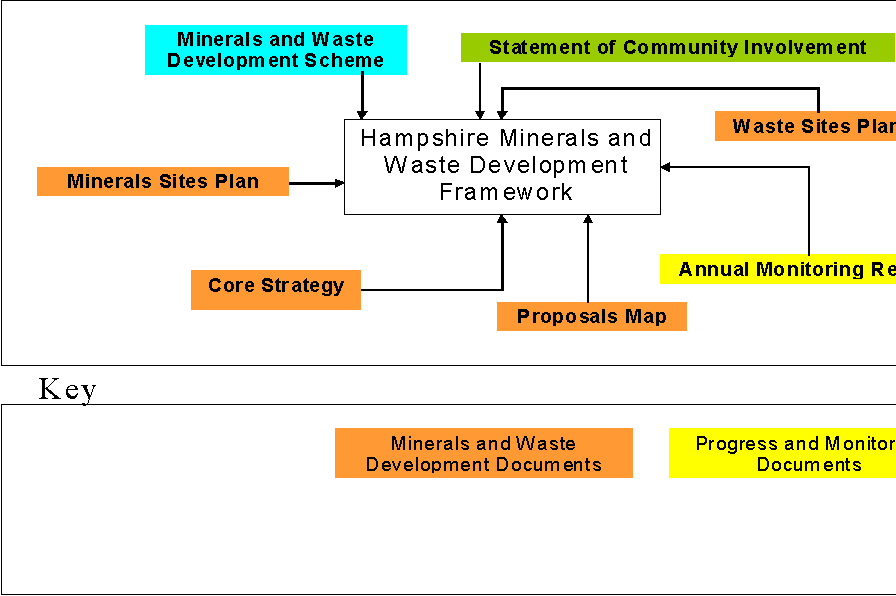
7.1 As a result of the changes to the planning system, Hampshire County Council will produce a Minerals and Waste Development Framework instead of the old structure plan and minerals and waste local plan. This Framework, which will take account of national and regional minerals and waste policy, is a `folder' or collection of separate planning documents. It will guide Hampshire County Council in determining county-related planning applications, as set out in paragraph 20.1. Figure 1 on p.8 illustrates how the bits of the Hampshire Minerals and Waste Development Framework fit together.
7.2 Hampshire County Council, working jointly with Portsmouth City Council and Southampton City Council, will produce the following parts of the Minerals and Waste Development Framework over the next three years:
· the Hampshire Minerals and Waste Core Strategy will set out the general approach to planning for minerals and waste in Hampshire over the period to 2020.
· the Mineral Sites Plan will identify areas and sites for mineral provision (e.g. sand and gravel, clay, chalk) and producing recycled minerals (e.g. crushed concrete and builders' rubble).
· the Waste Management Sites Plan will identify areas and sites for waste disposal and managing resources (e.g. recycling materials instead of sending them to landfill).
7.3 To assess the effects of these plans on the environment and local communities, Hampshire County Council will produce a sustainability report, which summarises the findings of the strategic environmental assessment and sustainability appraisal. These are explained in more detail in section 15, and the glossary. The Sustainability Report will go out to public consultation.
7.4 Hampshire County Council will also produce an Annual Monitoring Report, reviewing how effectively the different bits of the Minerals and Waste Development Framework have been implemented and providing statistical information on planning permissions. This Annual Monitoring Report will be jointly produced with Portsmouth City Council and Southampton City Council. The results of the monitoring will be used to trigger reviews of the documents of the Minerals and Waste Development Framework.
7.5 Hampshire County Council has already prepared the Hampshire Minerals and Waste Development Scheme. This is a project timetable which gives information and details about the preparation and review of all the various minerals and waste development documents. The County Council's Minerals and Waste Development Scheme does not cover the Portsmouth City Council and Southampton City Council areas. These Councils have each prepared their own separate minerals and waste development schemes.
7.6 The Minerals and Waste Development Scheme is especially useful for anyone wanting to be involved in planning decisions, as it sets out when each minerals and waste development document will be available for formal consultation. Hampshire County Council's Minerals and Waste Development Scheme is available online, at www.hants.gov.uk/mineralsandwaste. Other minerals and waste development documents, as they are produced, will also be available here.
7.7 Otherwise, please use the contact details in paragraph 6.2 for further information. The Minerals and Waste Development Scheme will be monitored and updated as new planning documents need to be produced, or changes to the timetable are required.
7.8 The separate Local Development Schemes prepared by Portsmouth City Council and Southampton City Councils are available from those Councils. Their respective website addresses are:
www.portsmouth.gov.uk/living/3858.html
and
www.southampton.gov.uk/environment/development-control/planning-policy/default.asp#0
7.9 Working arrangements with the New Forest National Park, who are also a minerals and waste planning authority are still being finalised. The National Park Authority may be contacted on 023 8028 4144 or via their website: www.newforestnpa.gov.uk/nfnpa/contactus.cfm
8 The Statement of Community Involvement
8.1Hampshire County Council has to produce a document known as the Statement of Community Involvement. This describes how Hampshire County Council will involve the local community:
· in preparing, altering and reviewing the various parts of the new Minerals and Waste Development Framework and;
· in determining planning applications for minerals and waste developments, and developments relating to the County Council's statutory duties.
8.2 The Statement of Community Involvement will cover the administrative area of Hampshire County Council, but not the areas of Southampton or Portsmouth City Councils. It will describe how Hampshire County Council will meet the legal requirements to ensure public involvement in the planning process, who should get involved, when, and how people can be involved. It will also describe how, after the County Council will provide feedback to the public.
8.3 Southampton and Portsmouth City Councils will also be producing Statements of Community Involvement, describing how each Council will seek to get their own local communities involved in the most effective way. Since each Statement of Community Involvement will be specifically focussed on the administrative area of each Council, there will be some differences in the approaches used to reach out to local communities. However, each Statement of Community Involvement will be consistent in their approach to involving the local community in the development of the Hampshire Minerals and Waste Development Framework.
8.4 The Statement of Community Involvement is required to go through the following community involvement stages, set out in the timetable below:
Statement of Community Involvement - Timetable
· June to July 2005: first statutory 6 week consultation period
· November 2005: SCI submitted to Government for independent examination, following
· November 2005 - January 2006: second statutory 6 week consultation
· May 2006: public examination in front of an independent Planning Inspector, after which the Inspector will prepare a report on what the final version of the Statement of Community Involvement should contain
· August 2006: Hampshire County Council will adopt the Statement of Community Involvement with any changes required
·The Statement of Community Involvement will then become a statutory planning document, and Hampshire County Council will be committed to following the procedures it contains.
· The Statement of Community Involvement will be reviewed and monitored through the County Council's Annual Monitoring report, and updated as necessary.
Figure 1: How the Hampshire Minerals and Waste Development Framework fits together
W
ho needs to be involved in the planning process?
9
10 The local community
10.1 For minerals and waste planning in Hampshire, how is "the local community" made up? It is suggested that it includes:
· anyone who is affected by or relies on the production of minerals , and
· anyone affected by or involved in the production, recycling or disposal of waste .
10.2 Since most people who live or work in Hampshire rely on minerals and produce waste, the local community therefore covers just about all of the people, groups and organisations who live, work or spend time in Hampshire. It also includes, where relevant, Hampshire's neighbours. Together, these are sometimes called `stakeholders', since they are all affected by decisions on planning and therefore all have a `stake' or an interest in the planning process.
10.3Since they are affected by planning decisions, stakeholders need an opportunity to make their views known before planning decisions are made. It is necessary to first of all identify who these stakeholders are. Table 1 below has divided the overall body of stakeholders into a series of groups to indicate the range of consultees.
10.4 Further information on consultees is provided in Appendix 1.
Table 1: Consultee groups
Interest groups (e.g. Hampshire Wildlife Trust, CPRE, Council for National Parks, RSPB) |
Residents Associations and Action Groups (e.g. Fleet Pond Society, Yateley Society) |
Business (including minerals and waste management operators and their trade bodies, the construction industry and economic bodies e.g. Chambers of Commerce) |
District, Parish and Town Councils |
Landowners (individual and corporate), agents |
Statutory and other consultees (e.g. Government agencies, Environment Agency, Countryside Agency, English Nature, Highways Agency, other planning authorities, Public Utilities) |
Individuals |
'Hard to reach' groups (currently being identified) |
9.5 Planning legislation1 sets out the Specific Consultation Groups, including statutory agencies, organisations and Government Departments, that Hampshire County Council must contact. It also identifies General Consultation Bodies (e.g. voluntary, racial, ethnic and other interest groups) who may be contacted. Appendix 1 has more information on the members or potential members of these `consultation bodies'.
9.6 Contacting the specific statutory consultees is generally straightforward, and can be done in a number of ways. Local and community groups can be more difficult to identify and reach, but the local knowledge they have is vital in coming to a decision on the planning strategy for an area.
9.7 Even more difficult to identify and contact are the 'hard to reach' groups. These may include:
· minority ethnic and faith groups
· minority communities, including gypsies and travellers
· commuters
· the physically disadvantaged
· those who cannot read
· the homeless
· young people and old people
· people with limited access to transport
· people with limited access to information technology
· owners of second homes in Hampshire
· tourists/visitors
· long-term carers
· some rural residents or communities
9.8 For any specific planning document or any planning application being determined, the relevant 'hard to reach' groups will be identified and contacted as appropriate. Relevant voluntary groups or community organisations will be contacted where necessary. Table 2 of Appendix 2 includes more information on approaches to be used in contacting stakeholders.
L
inks to Community Planning
10 The Community Strategy
10.1 The Government introduced the Local Government Act in 2000, giving local authorities increased responsibility for promoting the economic, social and environmental well-being of their area. This is achieved through developing Strategic Partnerships (umbrella organisations which bring together community representatives and key agencies such as fire, police, local government services and so on) and producing a Community Strategy.
10.2 The Community Strategy is a fairly new document which is meant to provide an opportunity for all parts of the local Hampshire community to flag up their needs and priorities. The Hampshire Community Strategy, Shaping our future together - a Community Strategy for Hampshire 2004 - 2007, has been developed by the Hampshire Strategic Partnership and will help to improve the quality of life for Hampshire communities. With the Community Strategy and Hampshire Strategic Partnership in place it will then be easier for inputs from the local community to influence the decisions of the County Council and other service providers, and to make a contribution to sustainable development.
10.3 The Hampshire Community Strategy is available online at:
www.hampshirestrategicpartnership.org.uk/
10.4 The Hampshire Strategic Partnership (see Appendix 1 for details of membership and further information) is the Local Strategic Partnership (see Glossary on p. 26 for definition) for Hampshire. It is a wide-ranging and diverse partnership that was set up to oversee the implementation and development of the Hampshire Community Strategy. The Community Strategy relies on building and maintaining partnership across the Hampshire community, and provides a good opportunity for local communities (including the public, private, voluntary and community sectors) to express their wishes and opinions about, and to influence the work of, the minerals and waste planning authority.
10.5 The Hampshire Community Strategy has established the following vision for Hampshire:
"Hampshire will be a prosperous and attractive county for all, where economic, social and environmental needs are met in the most sustainable way and the quality of life and sense of community of present and future generations are improved"
together with four underlying themes:
· Strong and Safe Communities
· Health and Well-Being
· Economic Prosperity and Life-Long Learning, and
· Environment, Infrastructure and Transport.
The Government would like to see greater integration between community strategies and the planning documents of the new planning system.
10.6 Hampshire County Council will identify the sections of the Hampshire Community Strategy (e.g. recycling and waste minimisation under the Environment, Infrastructure and Transport theme) which are related to spatial planning, and which can be delivered either fully or partially through the Minerals and Waste Development Framework.
10.7 Wherever possible the production and review of the parts of the Minerals and Waste Development Framework will be integrated with the work of the Community Strategy, and the Hampshire Strategic Partnership will be consulted on the content and approach of the Hampshire Minerals and Waste Development Framework.
10 More from Less
10.2 More from Less is a document which outlines community wishes and aspirations for the future of minerals and waste planning and management in Hampshire, Portsmouth and Southampton. It was produced following a community stakeholder dialogue process (where stakeholders were given the opportunity to discuss relevant issues in group meetings) which began in September 2003 and ran until February 2005. More from Less is available online at:
10.3 The stakeholder dialogue process brought together representatives from many sectors of the local community, together with a wide range of business interests and representatives from Hampshire County Council, Portsmouth City Council, Southampton City Council and Project Integra (a partnership of Hampshire Districts, the City Councils and the County Council, responsible for dealing with household waste).
10.4 The vision of More from Less is to:
"change the way we use material resources2 to maximise efficiency and minimise wastage".
10.5 This vision will be achieved through four aims:
· To extract primary materials only where it can be shown that the need cannot be met in a more sustainable way
· To change minds and behaviours to use all resources efficiently and minimise wastage at all stages of production and consumption
· To maximise opportunities for business and the community to reuse, recycle and compost such waste to produce sustainable products, wherever waste is produced
· To recover value from and dispose of unavoidable waste using sustainable means, as far as possible avoiding the land filling of biodegradable / recyclable waste
10.6 More from Less is all about trying to manage material resources (including minerals and waste) in Hampshire. It introduces a different way of doing business, of thinking about how resources are used in Hampshire use resources and what happens to the 'waste' that is produced. A lot of time and effort on the part of stakeholders drawn from across the Hampshire community and beyond has gone into preparing the More from Less document.
10.7 The Minerals and Waste Development Framework is one of the most important ways of meeting the wishes and aspirations expressed by the stakeholders during the production of More from Less. The ongoing community involvement required for the Minerals and Waste Development Framework will build on and develop the community involvement that has already taken place.
T
he Minerals and Waste Development Framework
11 Planning Documents to be prepared
12.1 The preparation of each Minerals and Waste Development Framework document is broken down into a series of stages, as set out in planning legislation. The legislation also sets out what community involvement and consultation must be carried out at each stage.
12.2 As described in the Minerals and Waste Development Scheme (the project plan), the following four planning documents will be prepared over the next three years.
· Statement of Community Involvement
· Core Strategy
· Minerals Sites Plan and
· Waste Management Sites Plan
As already noted, the Minerals and Waste Development Scheme was approved in March 2005. It came into effect following a Hampshire County Council decision on 21 July 2005.
12 Stages of preparation of these documents
12.1 The stages that each document has to go through during its preparation, together with the community involvement required at each stage, are set out below:
12.2 Preparation of Preferred Options:
· The 'Preferred Options' are the range of potential approaches put forward by Hampshire County Council and Portsmouth and Southampton City Councils for providing minerals and dealing with waste in Hampshire.
· At this stage, the planning authorities are required3 to informally consult and involve various stakeholders and consultees. The planning authorities will also publish an initial Sustainability Report (also known as a Scoping Report) for consultation.
12.3 Publication of Preferred Options
· Having taken into account the community input received, the planning authorities will select the preferred options for dealing with waste and providing minerals, and then publish these for a formal (statutory) consultation period of six weeks4, using the approaches set out in the Statement of Community Involvement to involve the local community.
· The Sustainability Report (the document which is produced when a Sustainability Appraisal is carried out) sets out the likely significant effects of all options considered and those selected. This will also be published for comment.
12.4 Submission of Development Plan Document
· After taking the further comments received into consideration, the development plan document will be finalised and formally submitted to Government by the planning authorities.
· This is followed by another statutory period of consultation for six weeks during which further comments from consultees are invited, again in line with the approach of the Statement of Community Involvement.
· The final Sustainability Appraisal report will also be submitted, and is subject to consultation.
· The planning authorities will be required to show how they have managed community involvement and how they have dealt with comments received during the consultations5. Further information on feedback by the County Council is set out in paragraph 19.3.
12.5 Further statutory consultation
· For the Minerals and Waste Management Sites Plans, if representations have been made which propose alternative sites to those identified in the development plan document, or if boundary changes to sites are proposed, the planning authorities will advertise these immediately and there will be a further six week consultation period6.
12.6 Public examination
· The planning authorities are required to publicise the time and venue for the Examination, and any other information considered helpful to the relevant community.
12.7 Inspectors Report and adoption
· When received, the Inspector's Report will be published and publicised. This will include putting in on the Minerals and Waste website, and using whatever other methods are appropriate.
· When the development plan document is formally adopted, the local community will be informed. The information will be published on the Minerals and Waste website, and notices will be placed in local newspapers.
14 Specific techniques for Community Involvement
14.1 The following approaches will be used by Hampshire County Council in involving the local community in preparing Minerals and Waste Development Framework planning documents:
· Notice of the consultation will be placed on the Hampshire County Council Minerals and Waste Planning web site www.hants.gov.uk/mineralsandwaste together with details of where and when the document being consulted on may be inspected or copies obtained.
· This information will also be available through Hampshire County Council Information Centres and libraries.
· A press notice containing details of the consultation will be issued to local newspapers. Use will also be made of the County Council newspaper (Hampshire Now), along with district and parish magazines, where appropriate. Local radio and TV will also be used, where appropriate.
· Notification of the consultation will be given to statutory consultees and to other interested parties by letter or by email and their views invited.
· Neighbouring properties surrounding specific sites identified in the Sites Plans will be individually notified when final draft versions of these plans are submitted to Government.
· Similarly, neighbouring properties of sites submitted for consideration during the second consultation of the Sites plans will also be individually notified. In both cases, this will be done by sending a letter to properties which are within 50 metres of the proposed site in urban areas or 100 metres from the application site in rural areas. Additional notification beyond these areas is at the discretion of the planning officer.
· Use will be made of meetings with stakeholders and other interested parties, as appropriate. These may be one to one meetings, as appropriate. A written record of all discussions will be made.
· Copies of the consultation document will be sent to the statutory consultees and also be made available to the public on the Hampshire County Council Minerals and Waste Planning web site.
· During opening hours at the County Council Offices, Information Centres, District Councils and at libraries hard copies will be available for inspection.
· The timing of the consultation period will be set out in the Notice of Consultation.
· All responses should be made by letter, e-mail, formal questionnaire or pro-forma response and received by the consultation deadline. Late representations will not be considered.
· Other response formats (e.g. verbal) will be considered where appropriate, such as with hard to reach groups.
14.2 Table 2 in Appendix 2 links these (and other) techniques to the specific stages of preparing Minerals and Waste Development Framework planning documents.
15 Strategic Environmental Assessment/Sustainability Appraisal
15.1 The Core Strategy, the Minerals Sites Plan and the Waste Sites Plan require the preparation of an environmental report under the strategic environmental assessment (SEA) Directive. This requirement will be combined with Sustainability Appraisal in a process known as Integrated Sustainability Appraisal. The combined report produced will be known as a Sustainability Report.
15.2 Integrated Sustainability Appraisal is a relatively technical process. The initial scoping report will be circulated to statutory consultees and selected stakeholders only. The interim and finished Sustainability Reports will be subject to public consultation, along with the relevant development plan document.
15 Supplementary planning documents
15.1 There are other documents within the Minerals and Waste Development Framework known as supplementary planning documents. Supplementary planning documents do not have an examination before an Inspector, but community involvement is a key part of their production. Hampshire County Council do not propose to produce any supplementary planning documents in the next three years. However, should supplementary planning documents be prepared in the future, the community involvement process will:
· Use stakeholder events to focus and develop the scope, content and early versions of the supplementary planning document, possibly including a focus group of interested parties with a particular expertise in the relevant field
· Publish a draft for a period of public consultation (6 weeks) and publish a statement of representations received and the County Council's response
· Put the document on the Minerals and Waste website, and use the media to publicise it
· Write to relevant interested stakeholders, including specific consultees
· Publish a statement of conformity with the statement of community Involvement when the supplementary planning document is adopted
· Carry out a sustainability appraisal during the preparation of the supplementary planning document and publish the findings
17 Plain English
17.1 Hampshire County Council will seek to ensure that as far as possible all written communications associated with the Minerals and Waste Development Framework and planning applications are written in Plain English and where considered appropriate they will be subject to a Plain English audit.
18 Equalities
18.1 In line with the requirements of the Race Relations Act 2000 and the Equality Standard for Local Government, the emerging Hampshire Minerals and Waste Development Framework will be subject to a Race and Equalities Impact Assessment during 2005/2006, in order to identify and eliminate any disadvantage associated with disability, gender and race.
18.2 As a minimum standard, all documents and information produced will be available, on request, in other languages and in other formats such as Braille, large print and audio versions. Relevant voluntary and community groups will be involved where helpful and appropriate.
20.0
19 Reporting Back
19.1 All representations made during a consultation will be logged and acknowledged, using e-mail as far as possible.
19.2 Once a consultation exercise has been completed the comments received together with points raised will be analysed and a summary of the comments will be made publicly available on the Hampshire County Council Minerals and Waste Planning web site, and at the County Council Environment Department Offices.
19.3 At a later stage feedback will be provided showing how views received from the consultation have been taken into account, and what actions resulted from the consultation comments. This is a statutory requirement, observed before a document is submitted to the Government. Any or all of the following methods may be used:
· Publishing the information online
· Publishing information in Hampshire Now
· Issuing press releases and statements
· Providing copies of the feedback at Hampshire County Council Environment Department offices
· Contacting respondents directly
23
P
lanning applications
24
20 Introduction
20.1 The planning applications which Hampshire County Council deal with are `County Matters' and County Council developments. There are three types of `County Matter.' These are:
· Applications for mineral working and associated development and
· Applications for treating, storing, processing and disposal of waste.
· Applications for ancillary and minor developments associated with minerals and waste sites
20.2 County Council developments are those related to the County Council's statutory duties, including schools, libraries, social services facilities and highways.
20.3 This section of the Statement of Community Involvement considers how the County Council will publicise and consult on the planning applications it deals with, and how the local community will be involved in the consideration of these applications.
21 Minimum requirements
21.1 There are minimum standards for advertising planning applications which are set out in the Town and Country (General Development Procedure) Order 1995. The requirements vary according to the nature of the application as follows:
21.2 If the application is accompanied by an Environmental Statement7, is a Departure from the Development Plan8 or would affect a public right of way it must be publicised by a site notice9 displayed for at least 21 days and a notice in a local newspaper.
21.3 If the application is not one of the above but is a `major' application it is publicised by a site notice displayed for at least 21 days, neighbour notification10 and a notice in a local newspaper. `Major' applications are all minerals and waste applications, applications for buildings creating 1000 square metres or more floor space or where the site area is 1 hectare or more. `Minor' applications (i.e. anything not major) must be publicised by either a site notice or neighbour notification.
21.4 In addition the Planning (Listed Buildings and Conservation Areas) Act 1990 requires that proposals which affect a Listed Building or appearance of a Conservation Area are advertised by a site notice and notice in a local newspaper.
22 Current publicity
22.1 Hampshire County Council already exceeds the minimum requirements in publicising planning applications, in particular by carrying out neighbour notification as well as site notices. When a valid planning application is received the County Council undertakes the following publicity:
· A notice is placed in a local newspaper (allowing at least 21 days for comments to be made):
_ for all minerals and waste applications
_ if the application is accompanied by an Environmental Statement
_ if it is a Departure from the Development Plan
_ if it affects a public right of way
_ if it is any other `major' application, and
_ if it affects the setting of a Listed Building and/or the character or appearance of a Conservation Area.
· A notice is placed on site (allowing at least 21 days for comments to be made) for all applications.
· Neighbour notification is undertaken for all applications. This is done by sending a letter to properties which are within 50 metres of the application site in urban areas or 100 metres from the application site in rural areas. Additional notification beyond these areas is at the discretion of the case officer.
· A briefing note is produced for all major minerals and waste applications and major County Council applications. The briefing note sets out brief details of the application, relevant planning policies in the statutory development plan, lists consultees and providing the likely Committee date11 or likely date when the application would be determined under the delegation procedure12.
· The application and all supporting information is available for public inspection at Hampshire County Council's Environment Department at The Castle, Winchester, during normal office hours. The application will also be available on the web site at: www.hants.gov.uk/mineralsandwaste
· The local County Councillor is notified of the application and given a copy of the briefing note.
· Copies of the application are sent to the relevant District Council where they will be registered by the Council, allocated a specific application number and will be available for the public to examine at the District Council offices. Comments may be made direct to Hampshire County Council, or via the District Council. The District Council is also formally consulted.
· The views of specific consultees (e.g. Highway Authority, Environment Agency, District Council, Environmental Health Officer, English Nature, airfield operator) are requested as appropriate. Consultees are given a copy of the briefing note, if available, and have 21 days to respond.
· Copies of the application are sent to the relevant Parish or Town Council together with the briefing note if available, and consultation letter. Adjoining Parish or Town Councils are consulted when the application is adjacent to their boundaries, or the proposal will clearly have an impact on them. Residents' Associations are consulted when known to have an interest in the site.
23 E-Government
23.1 The County Council is developing e-government facilities which will further extend the publicity and information about planning applications.
23.2 There will be a dedicated web site for Minerals and Waste Planning. Part of the web site will be for Development Control, making information on planning applications available to the public. The public will be able to view the planning application documents, to make their representations by e-mail, to see consultation responses, to view the relevant County Council policies, to view the reports and recommendations and view the Decision Notice. A copy of the Annual Report will be on the website also.
23.3 It will also be possible for applicants to download application forms and to submit planning applications online. Whilst it is currently possible to view some information from various County Council websites and make representations by e-mail, the dedicated website will be designed to be user friendly and provide a single location for all relevant information.
24 Commenting on Planning Applications
24.1 Anyone can make comments on a planning application. Comments can be made in writing by letter or by e-mail to [email protected] or via the website when operational. Arrangements are also made to ensure that comments sent to the District Council are forwarded to the County Council.
24.2 A minimum of 21 days from the publicity date of the application are normally allowed for representations to be made and later ones will only be taken into account if prior agreement for late submissions has been made.
24.3 Comments can be to support, to object or to make a general observation about the proposal. A name and postal address must be provided for the comments to be accepted, anonymous representations cannot be accepted. All comments will be kept with the application and will therefore be available for viewing by the applicant and the public. All written representations will be acknowledged, and the name and address entered on the planning application database.
24.4 Non-contentious applications are determined by the Director of Environment under the County Council delegation arrangements, and a report will be written that will address the planning issues and material considerations. The report will be available for public inspection, and will be available on the web site. Non-contentious applications are those which do not give rise to substantive or irreconcilable planning objections.
24.5 When an application is referred to the Regulatory Committee, people who have made representations will be informed when the application is on the Agenda and informed of the County Council's deputation procedure. Applicants and the members of the public have the right to make a deputation directly to the Regulatory Committee. District Council officers and Councillors cannot make a deputation, however Parish Councillors can make deputations on behalf of their communities.
24.6 Current information on making deputations to Committee is available on-line at:
hantsnet2000.hants.gov.uk/TC/chiefexecs/democraticprotocols/deputations.html
24.7 All those who have made representations will be informed of the County Council's decision on the application. All those consultees who have made representations will be told of the decision made. Statutory consultees will get a copy of the decision notice. In the future, this service will be carried out through use of e-mail where appropriate.
25 Pre-application discussions
25.1 The County Council encourages developers to enter into pre-application discussions with the Council to establish the information that will be required, identify key issues and policies. The County Council also supports developers undertaking early community consultation, particularly for large scale proposals.
25.2 This provides the local community the opportunity to influence the developers proposals. Public exhibitions and displays by the developer to explain their proposals are encouraged, particularly for major schemes.
26 Liaison Panels
26.1 The County Council encourages the formation of local Liaison Panels for major or controversial sites. These provide a forum for discussing operational issues between the operator, the County Council (as Planning Authority) and representatives of the local community.
26.2 These Liaison Panels are either administered by the County Council where resources permit, or organised by the operator. A list of the current Liaison Panels is provided in the Minerals and Waste Annual Report (Minerals and Waste Planning in Hampshire Annual Report 2002/03 and Annual Report 2003/04). The latter is available on the Minerals and Waste website.
M
anagement
28
27 Staff Resources
27.1 The Minerals and Waste Development Framework will be jointly prepared by the Hampshire County Council, together with planning policy colleagues from Portsmouth and Southampton City Councils. Minerals and Waste planning applications within Hampshire County Council's administrative boundary will be dealt with by Hampshire County Council.
27.2 Planning applications within the administrative areas of Portsmouth and Southampton City Councils will be dealt with by those Authorities. Their contact details are:
· Planning Services
Portsmouth City Council
Civic Offices
Guildhall Square
Portsmouth
Hants, PO1 2BG
Tel: 023 9283 4334
email: [email protected]
· The Duty Officer
Development Control Service
Southampton City Council
Ground Floor
Civic Centre
Southampton
SO14 7LS
Tel: 023 8083 2603 or 023 8083 3318
email: [email protected]
27.3 Where appropriate, Hampshire County Council will appoint consultants to supplement the work of either of these teams. Appointment of consultants will be carried out, where applicable, in discussion with Portsmouth and Southampton City Councils and in accordance with Hampshire County Council guidance.
27.4 Future flexibility will be required in integrating Hampshire, Portsmouth and Southampton Councils with the New Forest National Park Authority and the South Downs National Park Authority (following confirmation of the latter as a national park). These national park authorities will be Minerals and Waste Planning Authorities. Final arrangements for working with them have yet to be determined.
27 Finance
27.3 Financial resources required to prepare the Minerals and Waste Development Framework will be included in an overall budget, which includes proportional contributions from Hampshire County Council and the two City Councils.
A
ppendix 1: Consultees
The following is a list of the broad types of statutory and other consultees. A full list is not included here as it will be subject to change as the County Council adds or removes consultees.
A full and up-to-date list of consultees is available on the Hampshire County Council Minerals and Waste website at:
www.hants.gov.uk/mineralsandwaste
Statutory Consultees
Government Departments and Agencies
· Countryside Agency
· Department for Environment, Food and Rural Affairs (DEFRA)
· English Nature
· Environment Agency
· Government Office for the South East (GOSE)
· Highways Agency
· Historic Buildings and Monuments Commission for England (English Heritage)
· Ministry of Defence
· Office of the Deputy Prime Minister (Minerals and Waste Division)
· South East England Regional Assembly (SEERA)
· South East England Development Agency (SEEDA)
· Strategic Rail Authority
· Hampshire and Isle of Wight Strategic Health Authority
Local Authorities (including Parish Councils) within Hampshire
Local Authorities (including Parish Councils) adjoining Hampshire
Service Agencies, Public Utilities, Statutory Undertakers
Other Consultees
Other Minerals Planning Authorities in the South East Region
Selected members of the United Kingdom and European Parliaments
Minerals and Waste Management Operators
Landowners
Interest Groups/Voluntary Groups
Community and Residents Groups
Other Organisations
Hampshire Strategic Partnership
· Army
· Business Link Wessex
· Churches Together in Hants & IOW
· Community Action Hampshire
· Hampshire Ambulance Services
· Hampshire Association of Parish and Town Councils (HAPTC)
· Hampshire Coalition of Disabled People
· Hampshire County Council
· Hampshire Economic Partnership
· Hampshire Fire & Rescue Service
· Hampshire Police
· Hampshire and Isle of Wight Environment Agency
· Hampshire and Isle of Wight Association (HIOWA)
· Government Office for the South East (GOSE)
· Learning & Skills Council
· RAF
· Royal Navy
· South East England Development Agency (SEEDA)
· Southampton University Hospitals
· Sport England
· Stagecoach Bus Company
· Hampshire and Isle of Wight Strategic Health Authority
· Strategic Rail Authority
· Youth Parliament
For more information on the Community Strategy, visit the website: www.hampshirestrategicpartnership.org.uk
Preparation Stages |
Preparation of Preferred Options |
Publication of Preferred Options |
Submission of development plan document |
Further Consultation on 'Omission Sites' |
Public Examination |
Inspector's Report and Adoption | ||||||||
Options for Community
|
(including informal [Reg. 25] consultation) |
(including first statutory [Reg. 26] consultation) |
(followed by second statutory [Reg. 28] consultation) |
Minerals and Waste Management Sites Plans only |
||||||||||
Use of newsletter (where appropriate) to publicise details (distributed via website, mail and e-mail) |
_ |
_ |
_ |
_ |
_ |
_ | ||||||||
Make consultation documents available for inspection at local authority offices, libraries and online |
_ |
_ |
_ |
_ | ||||||||||
Notifying neighbouring properties of sites to be considered at the Examination |
_ |
_ |
||||||||||||
Formal written consultation |
_ |
_ |
_ |
_ |
||||||||||
Send hard copies of relevant documents to statutory consultees (and to any other stakeholders requesting them) |
_ |
_ |
_ |
_ |
_ |
_ | ||||||||
Letter, e-mail to statutory consultation bodies (listed in Regulations) with links to documents on website |
_ |
_ |
_ |
_ |
||||||||||
Letter, e-mail to general / informal consultees, with links to documents on website |
_ |
_ |
_ |
_ |
||||||||||
Use of the internet (e-mail shot, putting documents and statutory notices on our website, use of response forms via the internet) |
_ |
_ |
_ |
_ |
_ |
_ | ||||||||
Responding to stakeholder inquiries (by post and e-mail) |
_ |
_ |
_ |
_ |
_ |
_ | ||||||||
Acknowledging respondents representations and notifying them of our response
|
_ |
_ |
_ |
_ |
||||||||||
Use of the media (e.g. local press, radio, television) to publicise and promote community involvement |
_ |
_ |
_ |
__ |
_ |
_ | ||||||||
Leaflets/brochures - mailed out or placed in public places, such as libraries |
_ |
_ |
_ |
_ |
_ | |||||||||
Use of public exhibitions/ displays/stalls/road shows - for Sites documents only, and where considered appropriate |
_ |
_ |
||||||||||||
Use of focus groups (selected groups of participants with particular characteristics) where considered appropriate |
_ |
_ |
_ |
|||||||||||
Use of interactive stakeholder workshops, e.g. `enquiry by design' and `planning for real' exercises, possibly done via internet (where considered appropriate) |
__ |
|||||||||||||
Area forums (standing groups with geographical remit) - these may be used for Sites documents |
_ |
_ |
_ |
_ |
||||||||||
Encourage stakeholders to make use of Planning Aid services (advertised by link on web site) |
_ |
_ |
_ |
_ |
_ |
|||||||||
Use of a steering/advisory group |
_ |
_ |
_ |
_ |
_ |
_ | ||||||||
 Development Plan Document
  Involvement
G
lossary
Annual Monitoring Report: Produced by Hampshire County Council, this Report will review and assess the implementation of the Minerals and Waste Development Scheme, and how effectively the policies in the Hampshire Minerals and Waste Development Framework are being achieved.
Community Strategy: The Local Government Act 2000 requires local authorities to prepare a Community Strategy. It sets out the broad vision for the future of the local authority's area and proposals for delivering that vision.
Core Strategy: One of the development plan documents within the Hampshire Minerals and Waste Development Framework, the Core Strategy sets out the long-term spatial vision for the Minerals and Waste Planning Authority area and the strategic policies and proposals to deliver that vision.
Engagement: Entering into a deliberative process of dialogue with others, actively seeking and listening to their views and exchanging ideas, information and opinions. Unlike `mediation' or `negotiation' engagement can occur without there being a dispute to resolve.
Enquiry by Design: This process helps reach agreement between groups that would normally hold differing aspirations by bringing them together and focusing on the sustainability and quality of the urban environment itself. All concerns - technical, political, environmental and social - are tested and challenged by the design itself, so that design leads rather than follows the process.
Inspector's Report: This will be produced by the Planning Inspector following his/her Independent Examination of the development plan documents and will be binding on the County Council.
Local Strategic Partnership: Non statutory, non-executive body bringing together representatives of the public, private and voluntary sectors. For Hampshire, the LSP is called the Hampshire Strategic Partnership and is responsible for preparing the Community Strategy.
Mediation: Intervention into a dispute by an acceptable impartial neutral person whose role it is to assist the parties in dispute to reach their own mutually acceptable settlement. It is essentially a voluntary procedure, and proceedings are confidential to the participants; any settlement however can be made public with the agreement of all parties.
Minerals and Waste Development Plan Document: Spatial minerals and waste related planning documents that are subject to independent examination. There will be a right for those making representations seeking change to be heard at an independent examination.
Minerals and Waste Development Scheme: Sets out the programme for the preparation of the minerals and waste development documents. Must be submitted to Secretary of State for approval within six months of the commencement date of the Act regardless of where they are in terms of their current development plan.
Minerals and Waste Development Framework: Comprises a portfolio of minerals and waste development documents which will provide the framework for delivering the spatial minerals and waste planning strategy for the area.
Negotiation: Process of reaching consensus by exchanging information, bargaining and compromise that goes on between two or more parties with some shared interests and conflicting interests. Negotiation is likely to be part of the process of mediation, but can also happen outside of any formal mediation and without the assistance of a neutral person.
Office of the Deputy Prime Minister (ODPM): The Government department with responsibility for planning and local government.
Planning Aid: Voluntary provision by planners of free and independent professional advice on planning to individuals or groups unable to afford to pay for the full costs of such advice. Planning Aid includes the provision of training so that its clients can be empowered through better understanding of how the planning system works and the development of skills that enable them to present their own case more effectively.
Proposals Map: Illustrates the policies and proposals in the development plan documents and any saved policies that are included in the Minerals and Waste development framework.
Public consultation: A process through which the public is informed about proposals fashioned by a planning authority or developer and invited to submit comments on them.
Site-specific allocations and policies: Allocations of sites for specific or mixed uses or development. Policies will identify any specific requirements for individual proposals.
Supplementary Planning Document: Policy guidance to supplement the policies and proposals in development plan documents. They will not form part of the development plan or be subject to independent examination.
Statement of Community Involvement: Statutory planning document which sets out how and when the community can get involved in the preparation of planning documents. The Statement of Community Involvement is subject to independent examination.
Strategic Environmental Assessment/Sustainability Appraisal:
Sustainability appraisal is a systematic and repeated appraisal process, incorporating the requirements of the Strategic Environmental Assessment Directive (European Union `SEA Directive' 2001/42/EC). The purpose of sustainability appraisal is to appraise the social, environmental and economic effects of the strategies and policies in any minerals and waste development document from the outset of the preparation process. This will ensure that decisions are made that accord with sustainable development.
All references to sustainability appraisal must be taken to include the requirements of the Strategic Environmental Assessment Directive. The sustainability appraisal documents are not part of the Minerals and Waste Development Framework, they are supporting documents.