
Archived decisions
APPENDIX 1
Hampshire Fire and Rescue Service
Consultation on Core Values
Public Consultation
Introduction
The Service consultation provider - Opinion Research Services (ORS) - was commissioned to consult the public and stakeholders about the scope and content of its proposed core values.
It was agreed that four focus groups would be conducted, three with members of the public and one with stakeholders (businesses and community groups).
Participants in the group were divided in terms of gender, age, social, economic and professional status, ethnicity and housing tenure. ORS were satisfied that the results of the consultation were broadly representative of public opinion.
Methodology
To stimulate discussion, attendees were invited to discuss their positive and negative experiences of organisations in general in order to clarify factors, behaviours or values that generate good and bad experience.
Hampshire's four draft values were them summarised and used as a platform for further discussion. Issues raised for each of the draft values are summarised below:
Value 1 : Service to the Community
HFRA should consider specifically how it:
· Communicates with all stakeholders in writing and spoken plans
· Promotes its image as part of the community by being pro-active in providing support and advice.
Senior management needs to be assured that staff promote a caring and sensitive image when interacting with people outside the organisation.
Obviously, an authoritarian and accusatory manner is not acceptable. The Service has to be seen as approachable for advice, and it should reassure people that they will be dealt with promptly and courteously.
The Service should be seen to work in the community to reduce danger by encouraging the public to take more responsibility for their safety.
The accessibility of stations, their ability to provide local information, and the involvement of fire service staff in local activities was considered very important.
Hampshire Fire and Rescue Service should continue to consult all sectors of the community. While it is important to educate and inform the young and elderly, in particular, the Service has to be seen to be universally inclusive.
Good communication is becoming an essential part of the role of all Fire Service personnel and Hampshire Fire and Rescue Service may wish to consider how to promote these skills.
Value 2 : People
The most important issues arising from discussion on this `value' were that the Hampshire Fire and Rescue Service should:
· Overcome the fallout from the industrial dispute
· Be seen as a fair employer/ recruiter - both for current and prospective employees - particularly by being responsive and not `bureaucratic'.
· Promote tolerance and mutual understanding amongst its staff - so they show good humour and not take offence unduly.
Some participants felt the Government did not deal well with the strike and this view has been projected onto the management - and they were doubly concerned because they are inclined to believe fire-fighters to be underpaid.
In the eyes of the public, the overall implications of the values are to treat everyone consistently, with quiet efficiency, and to avoid controversy.
Value 3 : Diversity
The discussion on diversity was the most extended of the four groups of core values. Particular issues discussed included:
Right to privacy: all the groups recognised that there are some important limits on what people can properly say and do - and they made no absolute distinction between employment, on the one hand, and private life, on the other. But short of people being convicted of criminal offences or advocating violence towards minorities, the groups favoured freedom of expression over what they saw as the potential imposition of `political correctness'.
They should distinguish private and public views (home and work), to consider how they talk and think at work and with whom they will be working.
They have to keep their views to themselves when working with the public as they have to represent the Service.
The brigade has to consider their position and have to deal with insulting behaviour on its own terms, not on basis of political opinions.
Employment Quotas: They also discussed whether employment quotas should be set for minority groups. There was agreement that everybody should face exactly the same tests and that insisting on quotas and positive discrimination was not acceptable.
Values as Qualifications for Employment: It was recognised that the Service may wish its employees to `sign up' in some way to its values - and may say that those who cannot accept the values should not apply for employment in the Service. However, in relation to core values being used to `select' or `qualify' appropriate candidates for employment in the fire service, there was no support for the idea that people's private views should be investigated - though it was allowed that candidates could legitimately be asked,
In your working duties, do you undertake to fulfil your role in accordance with the following values......?
Some felt that people should accept the rules when they join, provided they are formulated properly to cover all groups of people equally. Some said that wrong thinkers can rightly be excluded because there is a risk their opinions will be made obvious, but even more felt the Service should not try to control what people think.
Other important points emphasised included:
· The ideal of a multicultural service should not erode the commitment to selection on strict merit.
· Staff from different backgrounds should be encouraged to mix and understand each other.
· The Service should promote fairness, equality and diversity - but within a framework that is not insensitively `politically correct'.
· The Service should emphasise the importance of good staff behaviours in work rather than appear to monitor private lives and beliefs.
· Strong leadership should promote the proper values.
Value 4 : Improvement
This value was confirmed by public expectations of the fire service, but subject to the following key points - that Hampshire Fire and Rescue Service should encourage:
· The exercise of initiative - with mistakes being treated as opportunities for improvement rather than issues for blame.
· Staff to improve by learning new skills.
· Managers to walk and talk.
Publication
A full copy of this report is contained on the website under: www.hantsfire.gov.uk/manage/hfra/index.php
Employee Survey
Methodology
In April 2005 Opinion Research Services (ORS) were commissioned to conduct an Employee Survey. The survey was sent to all 1,675 employees and 628 responses were received yielding an 37% response rate.
Section 7 of the survey sought the views of our staff on the proposals for core values for the Service.
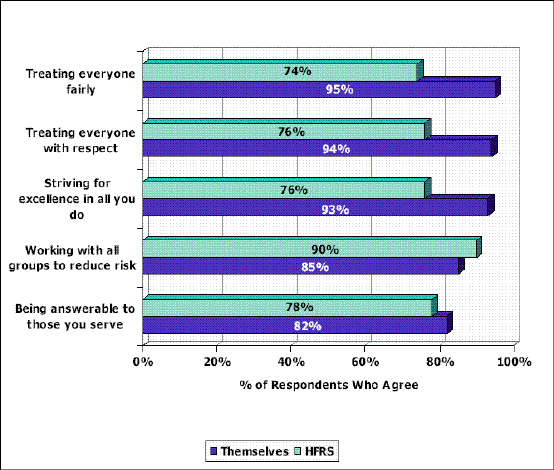
Respondents were asked how they saw their own actions and those of HFRS in serving the community. Respondents generally view themselves more favourably than HFRS, but the majority of respondents also feel that HFRS is committed to serving the community.
Opinions on Serving the Community at HFRS
People and Diversity Values
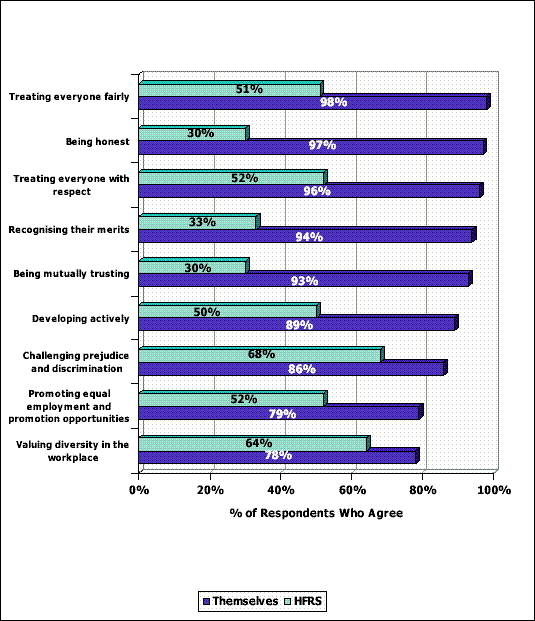
Respondents were also asked how they treat fellow employees and how HFRS treats its employees. This reflects the valuing of people and diversity in the Core Values.
This generated much bigger differences between how they perceive their own actions and those of HFRS. The majority of respondents feel committed to treating their fellow employees well. However, they feel that HFRS does not appear to be as committed to treating its own employees well.
Only 30% feel HFRS is committed to being honest and mutually trusting with its employees, and only 33% feel HFRS recognises the merits of its employees. It is the full/ part-time and operational employees who are most likely to feel that HFRS is uncommitted to treating its employees well.
Opinions on Working with Fellow Employees and the
Treatment of Employees at HFRS
 .
.
Personal and Organisational Improvement/ Development Value
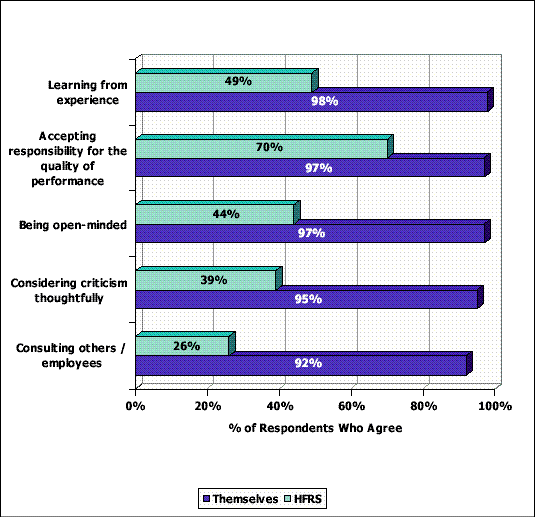
The problems with communication are further emphasised when analysing the results for personal and organisation development. Respondents feel they are committed to personal development with over 90% reporting commitment to each issue.
However, less than 50% feel HFRS is committed to learning from experience, being open-minded, considering criticism thoughtfully and consulting with employees.
Again, it is the full/ part-time and operational employees who are most likely to feel that HFRS is uncommitted to treating its employees well.
Opinions on Personal and Organisational Development at HFRS
Publication
The full Employee Survey (2005) will be placed on our website shortly pending review by the Service Management Team.