
Archived decisions
CONSULTATION
Draft Framework for the Hampshire Local Area Agreement |
"promoting sustainable communities" |
Introduction
In June this year, partners in Hampshire were invited to develop a Local Area Agreement with the Government as one of 66 second round pilots.
The Local Area Agreement provides an exciting opportunity for Hampshire partners to work with Government to ensure that more effective action can be taken to deliver top priority outcomes for Hampshire's communities.
The LAA provides new scope for service improvements between partners and Government, for example by addressing barriers to delivery, by aligning resources and funding streams, and by simplifying performance reporting requirements.
The LAA Guidance encourages the development of activity across 4 blocks.
· Children and Young People
· Healthier Communities and Older People
· Safe and Strong Communities
· Economic Development and Enterprise
Hampshire's LAA is however a "single pot" LAA which enables us to structure what we want to achieve in a more flexible way.
This initial consultation draft focuses on a range of the outcomes and a small number of priority areas for action. These will form the basis of more detailed work in terms of the opportunities the LAA provides, specific targets and indicators.
This draft has been approved by the newly established LAA Member-level Board and the process is being managed by a Chief Officer-level LAA Executive. These arrangements have been established following an earlier consultation. The Hampshire Strategic Partnership also has a key role in ensuring that the Agreement supports the Hampshire Community Strategy and in this regard is working with the 11 Local Strategic Partnerships across the County. Hampshire County Council will be the financially accountable body for the LAA.
The process of developing a LAA is inevitably complex given the wide range of partners involved across Hampshire. There are also several aspects where the LAA will need to link with important partnership arrangements beyond the boundaries of the County Council, for example linking with the developing work of the Partnership for Urban South Hampshire, particularly around the economic development outcomes and the work being developed under the Rural Pathfinder. However, the potential benefits from improved partnership working and concerted action on issues which are central to the quality of life of our communities will be worth the effort.
It should be recognised that this is the beginning of what will become a rolling process which will be subject to an annual refresh. This initial document has been prepared in a short timescale in the context of complex partnership arrangements across Hampshire. It should therefore be seen as an initial set of draft proposals which may be developed further over time. The document also focuses on the general direction of the LAA at this stage. Much further, detailed work will needed to be conducted around the initial priorities in this consultation.
Methodology
Work was undertaken by a number of lead agencies initially through the four original LAA blocks to identify the key outcomes for Hampshire's communities (the improvements to quality of life we are collectively trying to achieve) together with some suggested targets and indicators (specific things we want to see improved and how those are measured) . The outcomes were drawn from a range of sources including community strategies, national and local plans and strategies and work undertaken to date on Hampshire's second round Local Public Service Agreement. Some potential targets and indicators are set out at Appendix 1)
There is a wide range of strategies, plans and activities already in place at the strategic and local levels which are already helping to deliver these outcomes (See Appendix 3).
This work was presented to a pre-consultation Challenge Event held on 18th August 2005, involving some 85 delegates. The Event provided an opportunity to comment on this initial work and to consider how best the LAA might be developed to reflect the key issues in Hampshire.
At this event, a good deal of feedback was provided to further shape the outcomes and it was agreed that it was not helpful to frame these within the 4 LAA Blocks. This document therefore presents the headline outcomes within the sustainable communities model.
The Challenge Event also sent a clear message (which supports the view of the LAA Executive), that the LAA should not try to encompass everything, but it should focus on a small number of Cross-Cutting Priority Areas for Action. These have been assessed to explore whether the LAA is an appropriate mechanism for taking them forward. This consultation asks partners and stakeholders to comment on the proposed outcomes and the suggested Cross-Cutting Priority Areas for Action.
The consultation will help shape the framework of the LAA which will be developed further and submitted to Government Office SE as a basis for negotiation. The LAA will develop over the next few months and there will be further opportunities to comment throughout future stages as well and to become involved in the necessary, more detailed work on action planning.
Vision for Hampshire's LAA
The Hampshire LAA provides an opportunity to improve the effectiveness of partnership working in a number of key areas which will in turn have a significant impact on the outcomes we are collectively trying to achieve.
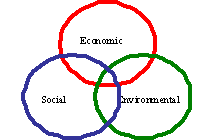 The wide ranging nature of the LAA outcomes can best be described within the framework of the sustainable communities model. Sustainable communities are where economic, social and environmental outcomes are achieved for current and future generations. There is significant interdependence between these outcomes and it forms the cornerstone of the legislation under which community planning process and the work of Local Strategic Partnerships operate.
Community Strategies are in place at the County and District level across Hampshire. These strategies are aimed at promoting economic, social and environmental well-being in line with the Government's vision for Sustainable Communities. Key outcomes which these strategies are aiming to achieve are set out in Appendix 2.
What outcomes are we trying to achieve?
The headline outcomes based on the feedback from the LAA Challenge event are presented below, mapped to the respective sustainability objectives.
HEADLINE OUTCOMES FOR HAMPSHIRE
Econ |
Soc |
Env | ||
1. |
The safety and development of children and young people, and their families, within their local communities is ensured |
O |
O |
|
2. |
Standards of achievement in education are improved |
O |
O |
|
3. |
Children and young people are encouraged and supported to achieve their potential. |
O |
O |
|
4. |
Life chances of Children Looked After are improved. |
O |
O |
|
5. |
Residents of Hampshire lead healthy lives with fewer inequalities, and are able to make healthy lifestyles choices |
O |
O |
O |
6. |
The quality of life and independence for vulnerable, older people in Hampshire is improved |
O |
||
7. |
There is strong participation in local decision making and service delivery |
O |
||
8. |
There is fair access to affordable and safe housing, especially for vulnerable people and families |
O |
O |
|
9. |
Safety and health in the workplace is improved and there is increased employment for disadvantaged groups |
O |
O |
|
10. |
There are lower levels of violence crime, and anti-social behaviour. |
O |
O |
|
11. |
There are reduced levels of persistent re-offending, including by persistent young offenders and offenders on Drugs Intervention Programmes |
O |
O |
|
12. |
There is less harm caused by substance misuse to individuals, their families and the wider community. |
O |
O |
O |
13. |
People feel safer |
O |
O |
O |
14. |
Roads and journeys are safer |
O |
O | |
15. |
The quality of local built environments and local heritage is maintained and improved |
O |
O |
O |
16. |
Communities are strengthened with increased capacity and levels of volunteering |
O |
O |
O |
17. |
Workforce needs, including skills are met |
O |
O |
|
18. |
Land is made available and used appropriately |
O |
O |
O |
19. |
Business, enterprise and innovation is effectively supported |
O |
O |
|
20. |
Waste is reduced and there is more efficient use of natural resources |
O |
O |
O |
21. |
There is improved accessibility to goods, people and places |
O |
O |
O |
22. |
There is good access for all to a wide range of cultural, leisure and learning facilities with widespread take up. |
O |
O |
O |
23. |
There is a reduced impact on climate change with effective planning for its effects |
O |
O |
O |
24. |
The environment and habitats are effectively protected and managed |
O |
O |
O |
25. |
Rural communities are effectively supported |
O |
O |
O |
Cross-Cutting Priority Areas for Action
The Challenge Event supported the view of the LAA Executive that the LAA needs to focus on a small number of Cross-cutting Priority Areas for Action where co-ordinated and concerted activity will deliver a step improvement in performance leading to an improvement in the range of outcomes listed above.
In developing these Cross-Cutting Priority Areas for Action, it is important to consider:
- What evidence is there to support this being considered as a priority?
- Why is this appropriate for the LAA? (eg. where there may be particular opportunities to overcome current barriers to progress, where funding streams and budgets might effectively be aligned or pooled, and where we might identify how the Government may enable progress).
- What outcomes will this help achieve and how should this be measured?
Follow up discussion and analysis between those who had led on the original blocks agreed that the Areas for Action should be capable of addressing issues relevant across Hampshire, or to targeted vulnerable communities or individuals, based on evidence of need and that the approach to targeting would be addressed within the more detailed action planning process.
Based on the feedback from the Challenge Event, and using these criteria, an initial list of Cross-cutting Priority Areas for Action has been drafted and is set out below. (An analysis against the criteria is provided in the Annex at the end of this document).
Cross-Cutting Priority Areas for Action - Initial list
A - Address substance misuse (drugs and alcohol) B - Improve educational achievement C - Promote inclusive leisure and cultural opportunities and positive activity for young people D - Improve the co-ordination of transport and access to services across the County E - Delivering first class support for business and planning for workforce development needs across Hampshire F - Improve access to housing and accommodation G - Tackle crime and anti-social behaviour. H - Promote and Improve the safety, health and well being of all residents in Hampshire, with a particular focus on reducing smoking and obesity and promoting physical activity. I - To empower local people to have a greater voice and influence over local decision making and the delivery of services. J - Establishing a Hampshire Observatory K - Possible additional priority action related to Environmental Quality to be developed |
Further detailed action planning requirements
For each area of activity, partners will need to agree:
- What changes are required to make this happen?
- How will we know when these changes have been achieved?
- What should be the timescale for these changes
- Over what timescale might we expect to see improvement in the outcomes?
- How would change be sustained?
Your response to the Consultation draft
Your views on the initial outline of the LAA presented in this draft are welcomed. They will be considered by the LAA Executive and Board in starting to shape the detail.
Specifically you are asked to consider at this stage:
- Do you have comments on the headline outcomes?
- Do you have comments on the proposed Cross-Cutting Priority Areas for Action?
- Which Areas for Action do you see as key priorities?
- Are there any specific opportunities or issues which you would like to see the LAA address?
We would also like to hear your own proposals or suggestions for Priority Action Areas.
How and when to respond
You can complete your response to this consultation on line at:
http://eforms-ext.hants.gov.uk/AF3/an/default.aspx/RenderForm/?F.Name=EOziZS0ytu2
Alternatively you can complete the form on Page 9 and return it to the address provided.
Initial comments are welcomed by 23rd September but comments submitted by the 29th October 2005 will be fed into the on-going development of the LAA.
The LAA Executive and Board recognise that the consultation, whilst on-going, is not satisfactory in terms of fulfilling the commitments in the One Compact for Hampshire. However, the timescale for developing the LAA is set by the Government and every effort is being made to be inclusive and maximise the timescales for responses.
Have your say
There will be a further consultation event organised by the Hampshire Strategic Partnership on the 12th October 2005 to be held at the Guildhall, Winchester.
Funding
The LAA Executive is clear that the alignment of resources behind key priorities presents significant opportunities for achieving outcomes. The pooling of funding streams is seen as a potential mechanism which might be developed over the longer term, with appropriate commissioning arrangements to further align resources where appropriate. This should not be regarded as an issue in the short term as the LAA Executive recognises the importance of not undermining existing commitments.
The ODPM guidelines provide an indicative list of possible funding streams for consideration in the LAA. Work is on-going with partners to assess the relevance and scale of these funding streams in Hampshire.
Further information
Background information, governance arrangements, briefings and guidelines for LAAs, outcomes of the Challenge Event etc can be found at:
http://www.hampshirestrategicpartnership.org.uk/pages/LAApage.htm
HAMPSHIRE LAA CONSULTATION RESPONSE FORM
Name |
|
Organisation |
|
Tel |
Do you have any comments on the headline outcomes? (see page 5)
Do you have any comments on the proposed Cross-Cutting Priority Area for Action? (see page 6)
In relation to any of these priority areas for action, are there any specific opportunities or issues which you would like to see the LAA address?
If you could prioritise four of these for the LAA to address, what would these be?
If you had to select two of these to be dropped from the LAA which would these be?
We are interested to hear any alternative proposals or suggestions you may have. Please let us have these using the form on page 11.
You can complete your consultation response on-line through the following link:
http://eforms-ext.hants.gov.uk/AF3/an/default.aspx/RenderForm/?F.Name=EOziZS0ytu2
If you prefer you can send your response to:
Joanne White
Policy Unit
Chief Executive's Department
Hampshire CC
Elizabeth II Court
The Castle
Winchester SO23 8UJ
Initial comments are welcomed by 23rd September but comments submitted by the 29th October 2005 will be fed into the on-going development of the LAA.
Suggested Additional Cross-Cutting priority Area for Action (if any) What evidence is there to support this being considered as a priority? Why is this appropriate for the LAA? (please be as specific as possible about the opportunities you would like to see the LAA address - consider how current barriers might be overcome, if funding streams and budgets might effectively be aligned or pooled, and how the Government may enable progress) What outcomes will this help achieve and how should this be measured? (please refer to the outcomes and possible targets/ indicators in Appendix 2). Delivery (these details may be developed at a later delivery planning stage): What changes are required to make this happen? How will we know when these changes have been achieved?
What should be the timescale for these changes? Over what timescale might we expect to see improvement in the outcomes? How would change be sustained? Who should take responsibility for the delivery plan? |
Please use continuation sheets if necessary.
Annex
Background information on initial Cross-Cutting Priority Areas for Action.
Suggested Cross Cutting Priority Area for Action A - Address substance misuse (drugs and alcohol) What evidence is there to support this being considered as a priority? There is much research and evidence regarding substance misuse (drugs and alcohol); the following are examples in confirmation of the relevance to the LAA. · CDRP audit and community safety strategies 2005-2008 · British Crime Survey · National Drug Strategy 1998-2008; (updated 2002) · National Alcohol Harm Reduction Strategy 2004 Why is this appropriate for the LAA? (Consider how current barriers might be overcome, if funding streams and budgets might effectively be aligned or pooled, and how the Government may enable progress) Hampshire DAAT has a county wide remit to implement the National Drug Strategy at a local level. In doing so, it entails working with all eleven county crime and disorder partnerships, as well as many other key partner agencies. The role of CDRP and DAAT is recognised as integral to the LAA process; as acknowledged in the initial consultation process. The DAAT is a significant partner in agreeing local targets with CDRP, as detailed in each SSCF template. Those templates for 2005/06 - 2007/08 have mandatory outcomes from the Home Office and ODPM relating to reducing crime, reducing the fear of crime, reducing the harm caused by drugs and increasing public participation / volunteering. Equally, the DAAT has ongoing targets and performance measures, agreed with GOSE through its' Local Delivery Agreement. All the above have relevant funding streams and implications for the LAA process. However, the above are subject to national / local targets and measures through to 2008, the continuation of which are subject to government policy. Responsibility for delivery of the Drugs Strategy rests with the Home Secretary, with other key elements falling to Health and Education. A co-ordinated `substance misuse' strategy is ideal beyond 2008. In relation to funding streams and budgets being effectively aligned or pooled this would ensure and enable greater mainstreaming of substance misuse services and recognise that the DAAT accountable budgets are not the only sources of funding for substance misuse services, particularly in the prevention and treatment arenas. Presently the DAAT Adult Pooled Treatment Budget is allocated by the National Treatment Agency for illegal drugs only, alignment or pooling of funding streams e.g. Health, Social Services, CDRP would allow greater flexibility in the use of resources for alcohol services, including for treatment for which there is a very significant deficit in funding within the county. The added value would also simplify systems, reduce bureaucracy and share infrastructure costs. What outcomes will this help achieve and how should this be measured? (please refer to the outcomes and possible targets/ indicators in Appendix 2). The following are proposed targets for the above suggested cross cutting priority: · Reduce the harm caused by illegal drugs including substantially increasing the number of drug misusing offenders entering treatment through the criminal justice system. · Increase the participation of problem drug users in drug treatment by 100% by 2008 and increase year on year the proportion of users successfully sustaining or completing treatment programmes. · Reduce the use of Class `A' drugs and the frequent use of any illicit drug among all young people under the age of 25, especially the most vulnerable young people · Develop a Hampshire Alcohol Strategy, within the context of the National Alcohol Harm Reduction Strategy (2004) and the Hampshire Alcohol Needs Assessment (2003/2004) The above are already subject to monitoring and measures; enhancements to the current priorities may form part of a National Strategy (and their measures) or county wide `added value' within the LAA. In addition, the inclusion of the above will impact upon many of those outcomes already indicated within Appendix 2 ; most apparent are:- · All children and young people in Hampshire lead healthy lives · The safety and development of children and young people, and their families, within their local communities is ensured · Improved health, improved healthy lifestyles choices and increased life expectancy for all the residents of Hampshire · Reduced levels of drug and alcohol related violence and crime · Reducing fear of crime - people feel safer · Reduced re-offending of PPO's, especially youth PPO's and offenders of Drug Intervention Programmes Delivery: What changes are required to make this happen? It should be noted that the above must refer to the wider issues of `substance misuse', rather than just `illegal drugs'. There is also inclusion of `alcohol harm reduction', which is also significantly featured in all CDRP audits. Both references are significant to the freedoms and flexibilities we should be considering within the LAA. Hampshire DAAT is a member of a number of multi-agency partnerships engaged in problem resolution, initiating interventions or commissioning services for both adult and young persons. These services impact upon the wider issues of education / healthy lifestyles / communities / crime and anti-social behaviour. There remains a need to identify gaps in provision for issues surrounding `substance misuse'; and provide a simpler format for integrating services for example, the framework of services for young people, alcohol treatment services. How will we know when these changes have been achieved? The adoption of SMART targets as with current process. Hampshire DAAT can advise as to how this is currently monitored and evaluated. What should be the timescale for these changes As stated above, the current national drug strategy and local community safety strategies are due to conclude and coincide for 2008. Any processes should consider this date, in conjunction with government policy beyond this period. Over what timescale might we expect to see improvement in the outcomes? Changes to strategies are subject to national policy, as previous. How would change be sustained? There is an existing model for measures, monitoring and evaluation, for which Hampshire DAAT maintains links with GOSE. This overview process could be integrated into future planning processes. Who should take responsibility for the delivery plan? Suggested - Hampshire DAAT Strategic Partnership |
Suggested Cross Cutting Priority Area for Action B - Improve educational achievement What evidence is there to support this being considered as a priority? Educational achievement in Hampshire is higher than average but not in all communities and not in all schools. Regular analyses of performance data show where achievement needs to be improved most in order to secure the life chances of the greatest number of children and young people. Why is this appropriate for the LAA? (Consider how current barriers might be overcome, if funding streams and budgets might effectively be aligned or pooled, and how the Government may enable progress) We need the freedom to explore the possibility of pooling some budgets - particularly Standards Funds, Children's Fund and some others in order to focus our efforts better on those schools and communities that need most support. What outcomes will this help achieve and how should this be measured? (please refer to the outcomes and possible targets/ indicators in Appendix 2). · Improve standards of achievement in education · Help vulnerable individuals and groups at risk of not achieving the 5 outcomes in the Children Act, or under-achieving, to succeed · Improve the life chances of Children Looked After Delivery: What changes are required to make this happen? To be developed How will we know when these changes have been achieved? · The headline data in each key stage will improve in line with targets. · The educational achievement of looked after children at 16 will improve in line with targets · The number of permanent exclusions from school will decline in line with targets · Attendance at school will improve in line with targets · The number of 19 year olds achieving at levels 2 and 3 will increase in line with targets · The achievement of identified groups within the black and minority ethnic population will increase in line with targets · The progress made by the highest performing 10% of children at age 11 through to GCSE at 16 will improve in line with targets · Primary/junior schools in 12 identified communities will achieve above the `floor targets' (minimum acceptable standards) · The achievement of children and young people in 61 specifically identified schools will improve in line with targets. · Improve the percentage of 1900 young people who will leave 12 identified secondary schools with 5+ A*-G grades at GCSE in line with the target · Improve the percentage of 2100 young people who will leave 12 identified (but different) secondary schools with 5+ A*-G grades, including English and Mathematics in line with the target · Reduce the number of pupils without any GCSE or equivalent educational achievement, focused on 12 secondary schools with the worst performance in 2004 · Increase the number of 19 year olds achieving NVQ levels 2 and 3 in line with targets · Improve the life chances of children and young people with special needs in line with targets What should be the timescale for these changes? Over what timescale might we expect to see improvement in the outcomes? How would change be sustained? Who should take responsibility for the delivery plan? |
Suggested Cross Cutting Priority Area for Action C - Promote positive activities for young people through a range of inclusive recreational and cultural opportunities What evidence is there to support this being considered as a priority? · MORI polls in Hampshire have consistently identified activities for young people as a priority amongst Hampshire residents. · The current Green Paper `Youth Matters' imposes a (potentially/likely) new statutory duty on Local Authorities to promote positive activities for young people. · Positive activities for young people are a strong theme in all Community Safety Strategies, identifying the link between a reduction in anti-social behaviour and diversionary activities (eg: Testway 7s) Why is this appropriate for the LAA? (Consider how current barriers might be overcome, if funding streams and budgets might effectively be aligned or pooled, and how the Government may enable progress) · Primarily because of the strong focus on partnership working, heavily promoted by the current `Youth Matters' Green Paper. The evidence from much current work supports this (Eg; Test Valley - partnership between ourselves, police, fire, district council, Valley Leisure, youth service, Testway Housing and others. What outcomes will this help achieve and how should this be measured? (please refer to the outcomes and possible targets/ indicators in Appendix 2). · All children and young people in Hampshire lead healthy lives · Improved standards of achievement in education · Improved life chances of Children Looked After · Improved health, improved healthy lifestyles choices and increased life expectancy for all the residents of Hampshire · Reduced levels of drug and alcohol related violence and crime · Improved safety and health in the workplace and increased employment for disadvantaged groups · Reduced levels of violent crime · Reducing Fear of Crime, people feel safer · Improved quality of local environments, (cleaner, greener, safer) · The skills needs of business are met Delivery: What changes are required to make this happen? How will we know when these changes have been achieved?
What should be the timescale for these changes Over what timescale might we expect to see improvement in the outcomes? How would change be sustained? Who should take responsibility for the delivery plan? |
Suggested Cross Cutting Priority Area for Action D - Improve the co-ordination of public and community transport and access to services across the County Improve the co-ordination of transport and access to services across the County. What evidence is there to support this being considered as a priority? Improving access to services is a common theme in all Local Strategic Partnerships and is a key government objective. One of the priorities for the Hampshire Strategic Partnership (HSP) is to improve accessibility to services and facilities. Initial work on the HSP priority has identified many complex patterns of travel across Hampshire. It is clear not only that there will be no simply solutions to improve matters but also that some of the solutions will involve non-transport-based solutions. Why is this appropriate for the LAA? (Consider how current barriers might be overcome, if funding streams and budgets might effectively be aligned or pooled, and how the Government may enable progress) Evidence suggests that the main problems of access relate to education, major retail centres, health care and employment. Many of these services are provided in the larger towns and cities which causes problems, particularly for rural communities and other isolated communities. Overcoming these problems might not simply be a question of improving transport links to these services but could involve changing the way the service is provided. Some of problems areas may be difficult to address in a cost-effective way on their own but there might be multi agency solutions. There also needs to be a recognition that in some cases it may not always be cost effective to provide a service. Moreover, some of the perceived or theoretical problems of access may not be actual problems, for example if there is a high degree of car ownership in a particular location. Some multi-agency solutions may require changes to legislation, regulations or the criteria used by service providers to measure cost-effectiveness. What outcomes will this help achieve and how should this be measured? (please refer to the outcomes and possible targets/ indicators in Appendix 2). Improving access to services is fundamental to achieving truly sustainable communities in Hampshire. Success will be measured by a year on year improvements in a raft of indicators ranging from perception and quality of life surveys to health and well-being indicators Delivery: What changes are required to make this happen? A variety of actions will be required to make this happen. There is the need to continue to improve the coordination of public and community transport whilst recognising that many of these services are operated outside the LAA partners immediate sphere of influence. There will a need for close collaboration between all the service providers - statutory, voluntary and commercial and a shared commitment to medium to long term funding streams, information exchange and a willingness for partners to be involved in developing and implementing complementary approaches e.g. the presentation of information to customers. All this will need to be achieved against a background of budget constraints and above average increases in the cost of supporting bus services. At service delivery level plans, programmes and strategies of individual service providers may need to be amended to maximise accessibility and assist these improvements in co-ordination. This may require the sharing of intelligence about users and the pooling of funds to change delivery practices. Changes might also be required to legislation and regulations to enable the multiple delivery of services. How will we know when these changes have been achieved? A technical measure of accessibility is provided by the DfT Accession model. This is a crude tool. Most meaningful measures are qualitative rather than quantitative (ie BV XX and BVYY). This will be a long-term project. Incremental measures of success will need to be established (perhaps related to key services) and data collected in ways that ensure (as far as possible) that improvements can be monitored and the cause of those improvements properly identified.
What should be the timescale for these changes Any timescale for change needs to be set against the current legislative and operating background within which the LAA partners operate. There are many players involved and improving the coordination of passenger transport services will in part depend on the commitment and involvement of these partners. Some areas such as a central point for information may be able to be progressed more quickly than others. Changing how services are delivered will take longer as service delivery strategies are often committed well in advance and systems and infrastructure in place to maintain delivery. Changes both in service and custom and practice of delivery will also require engagement with the communities served. These changes will not be completed much before the end of the LAA period (2009), although it is possible that some committed developments might become more accessible. The timescale should expect that processes will be reviewed and strategies adopted within the first three years with implementation from year four onward . Over what timescale might we expect to see improvement in the outcomes? 3-5 years How would change be sustained? The adoption of new processes and procedures will ensure that the changes are sustained. Who should take responsibility for the delivery plan? Transport and accessibility are key activities for the County Council and overall responsibility for delivery should rest with the County. |
Suggested Cross-Cutting priority Area for Action E - Delivering first class support for business and planning for workforce development needs across Hampshire by :- · meeting the skills needs of business and residents · providing appropriate employment and housing land · delivering effective transport and infrastructure solutions and · driving sustainability through economic development What evidence is there to support this being considered as a priority? Business and workforce development needs have been identified by the Board, Executive and Task Groups of the Hampshire Economic Partnership as key issues to assist the continued prosperity of the Hampshire economy and to assist with the regeneration of under performing areas and helping people to achieve their full potential. Why is this appropriate for the LAA? (Consider how current barriers might be overcome, if funding streams and budgets might effectively be aligned or pooled, and how the Government may enable progress) The skills agenda requires action to ensure that young people achieve a good basic education and that the skills needs of business are addressed by academia, Skills Councils, Local Skills for Productivity Alliances and public and private sector training providers The availability of suitable land for commercial and residential development needs to be addressed by local authorities and the private sector working together and must be served by appropriate infrastructure delivered by a range of providers. An effective transport and infrastructure network must be established to assist the continued prosperity of Hampshire businesses and this requires joint working from local authorities, government, both central and regional, and the private sector. Development must be sustainable and must take place having regard for the appropriate environmental and resource considerations. This will require collaboration by the private sector with public and private sector organisations. What outcomes will this help achieve and how should this be measured? (please refer to the outcomes and possible targets/ indicators in Appendix 2). Schools and colleges should aim to ensure that young people, when entering the labour market, have good basic skills and education. This can be measured by the reduction in the need for post 16 basic skills training provided by either the businesses or public sector. The skills needs of business can be measured by responses from employers to this issue. The availability of land can be measured by the level of availability compared with business demand and the satisfactory provision of infrastructure, both delivered in a sustainable environment. An effective transport and infrastructure network can be judged by the increased level of usage and reduction in congestion. Development which is undertaken in a sustainable manner will be manifested through the reduction in waste, the increased use of recyclable materials and the reduction in the use of energy and resources. Delivery What changes are required to make this happen? Skills - a coordinated curriculum developed by academia and supported by business to produce a workforce with the relevant level of education and skills required in the workplace. Land Availability - a planning system which is responsive to the needs of the economy and delivers effective infrastructure. Transport and Infrastructure - joint working between all relevant public and private agencies to achieve a common strategy and delivery mechanism. Sustainable Development - an appreciation by both the public and private sector that development can take place in an economic way having regard to environmental and resource-saving criteria. How will we know when these changes have been achieved? Skills - when the future workforce supply required by business is receiving the training necessary to meet their own needs and those of business. Land Availability - when there is sufficient land supported by adequate infrastructure to meet residential and business needs. Transport and Infrastructure - when there is a seamless delivery of transport and infrastructure needs to meet the requirements of individuals and the wider community. Sustainable Development - when there is a significant reduction in waste and energy and resource consumption.
What should be the timescale for these changes? These changes should be started immediately but delivery will be over the next decade. Over what timescale might we expect to see improvement in the outcomes? Improvements should be apparent within a five year time scale. How would change be sustained? Change would be sustained by continued monitoring and pressure from both the public and private sector to meet ever more demanding targets. Who should take responsibility for the delivery plan? Skills - responsibility should rest with the Skills for Productivity Alliance. Land Availability - responsibility should rest with the local authorities. Transport and Infrastructure - responsibility should rest with local authorities and GOSE. Sustainability - responsibility should rest with the private sector working with the public sector. |
Suggested Cross Cutting Priority Area for Action F - Improve access to housing and accommodation What evidence is there to support this being considered as a priority? An adequate supply of appropriate, affordable housing is an essential part of a sustainable community. It is critical for both economic and social reason. It is essential for social cohesion and in the interests of future generations. Although the headline issue is one of affordability as increases in general income levels, rising housing aspirations and an emphasis in providing non-market housing for priority needs has resulted in a widening gap between market and affordable housing, there are other equally important issues around provide access to housing. Low levels of housing completions, declining non-private housing stock and increasing demand is exacerbating the situation. Moreover while new homes are critical to the solution of housing need, the quality of the existing stock needs to be maintained and improved if the supply situation is not to worsen. (note quantitative data will be in the affordable housing update report currently being compiled on behalf of HSP) Why is this appropriate for the LAA? (Consider how current barriers might be overcome, if funding streams and budgets might effectively be aligned or pooled, and how the Government may enable progress) Successive housing needs assessments in Hampshire have identified the continuing needs for housing. The current definition of a key worker - which provides support for some people - is not inclusive. Standard housing is often not suitable for the needs of people in special need of help such as the elderly, with a limiting illness or a disability moreover, housing market and renting protocols often mitigate against the most effective use of the housing stock The planning and housing systems, fiscal and social policies have proved to be blunt tools for maintaining an adequate, appropriate and accessible supply of housing. Accordingly new, innovative ways of delivering the necessary housing need to be explored. This exploration will require not only a shared understanding of both the need for housing and consequence of under provision but also consideration of radical new ways of providing accessible and affordable housing in urban and rural areas. What outcomes will this help achieve and how should this be measured? (please refer to the outcomes and possible targets/ indicators in Appendix 2). Ensuring a better fit between housing need and supply will be fundamental to achieving truly sustainable communities in Hampshire. Success will be measured by a year on year increase in the supply of appropriate housing, a reduction in waiting lists, easier recruitment to key worker jobs and reduced needs identified by housing needs surveys. Delivery: What changes are required to make this happen? A variety of changes will be required to make this happen. Planning policies may need to be amended, local needs assessment will need to be more focussed, the tenure mix on existing allocated sites might need to be revised and reconsideration given to the utility of existing underused sites (public and private); procurement regimes will need How people are supported to become independent tenants may also require review. The use and exploitation of existing capital resources may need to be challenged. The role of the Regional Housing Board and Housing Corporation in the process will also need to be looked at How will we know when these changes have been achieved? This will be a long-term project. Incremental measures of success will need to be established and data collected in ways that ensure (as far as possible) that any increase in supply, or freeing up of the market can be attributed to the actions taken and not simply cyclical changes in the housing market
What should be the timescale for these changes With the best will in the world improving access to housing (including new housing) as a result of this initiative will not be completed much before the end of the LAA period (2009), although it is possible that some committed developments might become more accessible. The timescale should expect that processes will be reviewed and strategies adopted within the first two years with implementation from year three onward . Over what timescale might we expect to see improvement in the outcomes? 3-5 years How would change be sustained? The adoption of new processes and procedures will ensure that the changes are sustained at least until such time as the outcome is achieved Who should take responsibility for the delivery plan? Leadership will need to be determined, supported by quality partnership working between strategic housing bodies and housing delivery organisations. |
Suggested Cross Cutting Priority Area for Action G - Tackle crime and anti-social behaviour. What evidence is there to support this being considered as a priority? There is a clear correlation between Quality of Life in Hampshire and levels of crime, and fear of crime and Anti Social Behaviour. Crime creates a wider societal cost in both human and economic terms. Although Hampshire experiences a lower level of crime than many other areas it is still a major concern, as evidenced by recent CDRP audits. It is also evident that fear of crime is a key issue, with levels of fear being disproportionately higher than the actual risks of becoming a victim. Mandatory outcomes of LAA Safe and Strong Communities work are; · Reducing crime and the harm caused by illegal drugs, and reassuring the public by reducing fear of crime and ASB. · Empowering local people to have a greater voice and influence over local decision making and the delivery of services. Why is this appropriate for the LAA? (Consider how current barriers might be overcome, if funding streams and budgets might effectively be aligned or pooled, and how the Government may enable progress) Tackling crime and anti social behaviour requires a joint response from communities and public bodies. Other priorities included in the LAA issues such as housing, educational achievement, health and opportunity all directly impact onto offender risk factors, and victim vulnerability. The mandatory outcome relating to illegal drugs links to the addressing alcohol and substance misuse Area for Action. The desire for empowerment and input into decision making by local people over arches all the Areas for Action. Freedoms and flexibilities, and focus on areas of risk to Society can be facilitated through the LAA. What outcomes will this help achieve and how should this be measured? (please refer to the outcomes and possible targets/ indicators in Appendix 2). Reducing Crime · Reduce Incidents of violence in public places (concentrating on late night economy, licensing and ASB related violence) · Reduce re-offending rates of young violent crime offenders · Reduced re-offending of Prolific and Other Priority Offenders (POPO), especially youth POPOs and Offenders on Drugs Intervention Programmes · Increase the number of effective multi agency interventions into Domestic Abuse, supporting victims and targeting perpetrators and reducing repeat incidents. · Reduce Deliberate Fires · Reduce the harm caused by illegal drugs · Increase the number of drug and alcohol misusing offenders within the Criminal Justice System entering treatment · Increase the participation of problem drug users in drug treatment by 100% by 2008, and increase year on year the proportion of users successfully sustaining or completing drug treatment. · Reduce the use of Class A drugs and the frequency use of any illicit drug among all young people under 25 years of age. · Develop and deliver a Hampshire Alcohol Strategy Reducing Fear of Crime and ASB · Increase the number of residents who feel safe · Reduce sales of alcohol to under 18's, and use of alcohol in public places by under 18's. · Reduce incidents of ASB · Roll out Youth Inclusion and Support Panels (YISPs) Countywide · Ensure Countywide delivery of the Prevent and deter agenda within POPO schemes. · Ensure effective targeted interventions with young people are available to deal with ASB Delivery: What changes are required to make this happen? There will need to be a focus on the agreed areas that present most risk and/or community concern. Capacity may be created by achieving freedoms and flexibilities to reassign funding in a more relevant way, for instance whilst there is funding for drugs issues alcohol is arguably just as influential as a crime generator in the County, both in public and private. How will we know when these changes have been achieved?
What should be the timescale for these changes Over what timescale might we expect to see improvement in the outcomes? How would change be sustained? Who should take responsibility for the delivery plan? |
Suggested Cross Cutting Priority Area for Action H - Promote and Improve the health of all residents in Hampshire, with a particular focus on reducing smoking and obesity and promoting physical activity What evidence is there to support this being considered as a priority? Choosing Health identifies that smoking is the greatest cause of preventable illness and premature death in England today. It kills an estimated 86,500 people per year, with over 80% of deaths from lung cancer being as a direct result of smoking. Smoking rates in the south east have not declined over the last few years. An estimated £370 million is lost to businesses due to sick days from smoking in the South East Smoking disproportionately affects the less well off, who have lower quit rates. 26% of all adults smoke but the figure is 31% among manual groups and 20% among non manual groups Increased childhood obesity may mean today's children have shorter life expectancy than their parents. Childhood obesity increases the risk of early onset of preventable disease in adulthood, including diabetes, stroke and cardio vascular disease. Obesity reduces life expectancy on average by 9 years. The prevalence of obesity in England has tripled since the 1980's with 25% of people classified as obese in 2003. Why is this appropriate for the LAA? (Consider how current barriers might be overcome, if funding streams and budgets might effectively be aligned or pooled, and how the Government may enable progress) Tackling these major health improvement issues can only be done by concerted joint working, supported by high profile leadership. The medium and long term benefits will be felt across all communities and sectors of Hampshire and underpin Sustainable Communities. Actions which will be cost neutral could include ensuring all NHS, Local Government and LAA partner environments are smoke free by mid 2006 What outcomes will this help achieve and how should this be measured? (please refer to the outcomes and possible targets/ indicators in Appendix 2). · All Children and young people in Hampshire lead healthy lives · Improved health, lifestyle choices and life expectancy · Reduced Health inequalities and deprivation · Improved quality of life of older people · Improved safety and health in the workplace Delivery: What changes are required to make this happen? How will we know when these changes have been achieved?
What should be the timescale for these changes Over what timescale might we expect to see improvement in the outcomes? How would change be sustained? Who should take responsibility for the delivery plan? |
Suggested Cross Cutting Priority Area for Action I - To empower local people to have a greater voice and influence over local decision making and the delivery of services. What evidence is there to support this being considered as a priority? To be completed Why is this appropriate for the LAA? (Consider how current barriers might be overcome, if funding streams and budgets might effectively be aligned or pooled, and how the Government may enable progress) to be completed What outcomes will this help achieve and how should this be measured? (please refer to the outcomes and possible targets/ indicators in Appendix 2). Outcomes: 7. There is strong participation in local decision making and service delivery 16. Communities are strengthened with increased capacity and levels of volunteering Targets will include LPSA2 Target 15: Increased number and extent of people participating in local voluntary and community activities. Delivery: What changes are required to make this happen? How will we know when these changes have been achieved? What should be the timescale for these changes Over what timescale might we expect to see improvement in the outcomes? How would change be sustained? Who should take responsibility for the delivery plan? |
Suggested Cross Cutting Priority Area for Action J - Establishing a Hampshire Observatory What evidence is there to support this being considered as a priority? High quality, accessible information is the key ingredient of effective decision making. It is fundamental if choices are to be properly articulated and argued and essential if communities are to become empowered as decision makers. The increased emphasis on monitoring in all aspects of work also demands a credible and consistent evidence base. Preparing for the LSPA2 and the LAA highlighted the lack of a comprehensive, accessible and interactive information source. Why is this appropriate for the LAA? (Consider how current barriers might be overcome, if funding streams and budgets might effectively be aligned or pooled, and how the Government may enable progress) The LAA partners collect a huge amount of data (including that from surveys) dealing with local issues and characteristics. The data are collected and presented in a number of formats and over a variety of areas. Much of it is inaccessible other than to those in the know. It is neither routinely packaged nor disseminated. Much of it is unusable other than for those specific purposes or for the specific geographic areas needed by the author. One area where the Partnership could add value is in the provision of accessible information to assist the partners improve the evidence base for plans and strategies and measuring the effective delivery of services. Through Community Planning and LAA processes, partners may be able to move towards consensus on indicators for a sustainable community. The Observatory would provide a common base for the construction of an Index for Sustainable Communities against which performance could be benchmarked and applied for local determination of resource allocation. This may for example represent a positively expressed and more holistic alternative to the Index of Multiple Deprivation. As we join up our approach to community well-being, this may provide a sound evidence base for how resources can be joined up and allocated in the future. What outcomes will this help achieve and how should this be measured? (please refer to the outcomes and possible targets/ indicators in Appendix 2). The Observatory is a service rather than an outcome. By pooling their own information sources - including those currently provided by Hampshire County Council - the Partnership is in the position to begin the creation of a data source, which, if managed using the latest GIS and Information Management technologies, would become a powerful tool for influencing and managing service delivery for all partners. It would also become a potentially valuable source of information for many others in the public and private sector and, subject to the necessary management protocols could be adapted to the changing needs and requirements of all users. Delivery: What changes are required to make this happen? There are a number of hurdles in the way of developing an effective system. Notwithstanding the need of partners to commit themselves to the process, there are issues involving:- · the identification of datasets and indicators; · the need to overcome technical, practical and legal barriers to data sharing and ensure the requirements of data protection; and · maintaining the quality of the data Once those obstacles are overcome the database and its geographic links have to be developed and the system designed and tested. However, as there are many examples of successful systems, answers to many of these issues have already been found. The Hampshire Observatory can learn from and build on the experiences of the pioneers.
How will we know when these changes have been achieved? This will be a long-term project. Incremental measures of success will need to be established as more partners contribute their information to the service.
What should be the timescale for these changes An operational Observatory within two years. Over what timescale might we expect to see improvement in the outcomes? 3-5 years How would change be sustained? The lessons from elsewhere are that an effective Observatory quickly establishes its usefulness and retains the commitment of the partners involved. Who should take responsibility for the delivery plan? LAA Executive supported by Hampshire County Council |