
Archived decisions
Hampshire County Council Environment Policy Review Committee 6 October 2005 Local Transport Plan Update (Smarter Choices) Report of the Director of Environment |
Item 9 |
Contact: Iain Reeve, ext 5301 email: [email protected]
1. Summary
1.1 This paper proposes a policy annex on `smarter choices' for inclusion in the full Local Transport Plan.
2. Corporate Strategy
2.1 This report supports Aim 2 (Stewardship of the Environment) of the Corporate Strategy by reducing the need to travel and by encouraging greater use of non-car modes of travel. It would also support Aims 3 and 4 (Achieving Economic Prosperity and Building Strong and Safe Communities).
3. Background
3.1 Hampshire County Council submitted its provisional Local Transport Plan (LTP) to the Government at the end of July 2005. The County Council is now required to submit a full Local Transport Plan by the end of March 2006. In addition to the overall strategy contained in the provisional LTP, the full LTP will include more detailed information about programmes, schemes and targets.
3.2 The full LTP will also include a number of policy annexes. These will explain the County Council's policies on specific topics, such as smarter choices, Intelligent Transport Systems and passenger transport. There will also be separate annexes on the four area transport strategies. The purpose of these strategy annexes is to establish the County Council's policies and strategies at a greater level of detail than would be appropriate for the main text of the LTP.
3.3 Attached to this paper is an initial draft of a `smarter choices' annex. Further draft annexes will be submitted to future meetings.
4. `Smarter Choices'
4.1 The overarching strategy for Hampshire County Council's Local Transport Plan is to tackle transport problems through policies to "reduce, manage and invest". The "reduce" element of this strategy includes tackling problems of congestion by measures to reduce the need to travel, reduce the distance travelled and reduce the amount of travel by single occupancy private car. These measures are generally low cost and usually do not involve additional transport capacity or infrastructure. The emphasis is on ways of increasing travel choice. As such, these measures tend to have least impact on the environment and quality of life.
4.2 The term `smarter choices' has been adopted to emphasise that this policy is about the public making informed decisions about travel modes.
4.3 `Smarter choices' encompasses a range of measures, including travel planning (school and workplace), personalised journey planning, awareness campaigns, car clubs, car sharing, teleworking and home shopping. The Department for Transport (DfT) estimates that measures such as these can have a benefit to cost ratio of 10:1. This is significantly higher than nearly all other transport pressures. The DfT categorises a "good" benefit to cost ratio for major transport schemes as more than 2:1 and the Fareham-Gosport-Portsmouth Light Rail scheme has a very high benefit to cost ratio of 4:1.
4.4 The DfT's estimates of the potential benefit of individual smarter choices measures is given in the table below:
Initiative |
Impact |
Workplace Travel Planning |
Reduce car use by up to 25% |
School Travel Planning |
Reduce school run traffic by up to 15% |
Personalised Travel Planning |
Reduce car use by up to 15% in urban areas |
Awareness Campaigns |
Up to 40% of residents influenced |
Car Clubs |
Reduction in car mileage of up to 3,600 kilometres per annum per participant |
Car Sharing |
Reduction in car mileage of up to 4,500 kilometres per annum per participant |
Teleworking |
Reduction in business mileage of up to 10% |
Home Shopping |
70%-80% reduction in mileage for grocery shopping by those participating |
4.5 These statistics should be viewed with a significant degree of caution. In each case the benefit is expressed as the best possible outcome. For example workplace travel planning may reduce car use by up to 25%, but this will be achieved only in the most favourable of conditions. Most workplace travel plans will achieve far less modal shift. However, it is clear that there are benefits to be gained through `smarter choices' measures at relatively low cost.
5. Aims and Objectives
5.1 It is proposed that the overall aim of the smarter choices strategy should be to secure:
"A county where a greater proportion of journeys are made in a safer, healthier, more efficient and more environmentally friendly way."
5.2 To achieve this, the strategy aims to:
(i) ensure that individuals and organisations understand the implications of the travel choices they make and feel empowered to make informed travel choices;
(ii) enable journeys to be made in a safer, healthier, more efficient and more environmentally friendly way through the identification and provision of new travel and transport measures; and
(iii) reduce the need to travel and the distance travelled, by influencing non-transport decisions that can have an impact on travel choices.
5.3 The aims and objectives of the strategy are discussed in more detail in chapter three of the attached draft annex.
Targets
5.4 The following targets are proposed:
School travel plans |
100% of students in full time education (aged 5 to 16 years) to be covered by a travel plan by 2010/11 from a 35% base. |
Workplace travel plans |
15% of people working in Hampshire to be covered by a travel plan by 2011. Additional targets on mode of journey to be developed. |
School journeys |
To reduce the proportion of school journeys made by car (alone) for students aged 5-10 years from 31% to 30% by 2010/11 with an associated increase in non-car (alone) journeys. To reduce the proportion of school journeys made by car (alone) for students aged 11-16 years from 12% to 11% by 2010/11 with an associated increase in non-car (alone) journeys. These targets are under review to establish if they are realistic and stretching. |
Cycling |
To halt the decline in cycling by 2010 from a 2005/06 base, primarily through "smarter choices" measures in preference to additional cycling infrastructure. |
Passenger Transport |
44,168,000 passenger journeys per annum by the end of 2010/11, of which · Bus 26,683,000 · Rail 13,400,000 · Ferry 4,085,000 This represents an increase of 1.98% by 2011 in the total passengers carried, compared to 2003/04. |
Travel Awareness |
Target currently being developed |
5.5 Some of these targets are under development. It is not ideal to have targets about the number of workplaces or schools covered by travel plans. Such targets relate to outputs rather than outcomes. For example, the targets do not assess the effectiveness of the travel plans. Targets relating to modal shift are more helpful, although it is difficult to set these targets until sufficient travel plans have been developed. The draft strategy therefore includes modest modal shifts of 1% for school journeys, subject to further investigation. Similar targets for workplace travel plans are being developed.
6. The Smarter Choices Strategy
6.1 Key components of the strategy, described in chapter four of the attached annex, are:
(i) travel awareness programme;
(ii) travel and transport marketing and communications plan;
(iii) school travel planning;
(iv) workplace travel planning;
(v) personalised travel planning;
(vi) rail station access strategies; and
(vii) residential travel planning.
6.2 The travel awareness programme proposes a unified brand and a programme of media initiatives to communicate key messages. This would be a substantial element of a proposed travel and transport marketing and communications plan. This would harmonise and coordinate marketing and communications across the County Council and provide better information to the public.
6.3 A programme of school travel plans is presented in chapter four of the annex. This proposes a target for all schools to have a travel plan by 2008/09. This would be at least one year ahead of the Government's target of 2010. Unlike some other local authorities, the County Council's approach is that all school travel plans should meet strict quality controls. The County Council's ability to meet this target has been improved by the recent news that the Government intends to renew the bursary funding of school travel plan officers for a further two years to 2008.
6.4 The programme proposes a phased approach to school travel plans. The school travel plan and safer routes to school team would not be able to respond effectively if all 530 schools in Hampshire started to work on travel plans at the same time. This could create delay and consequential disappointment for schools. The school travel plan team is therefore working first with the schools who have expressed an interest in having a travel plan. This includes schools who are required to have a plan as part of a planning application. Attention will then be turned to schools in more deprived areas. Finally, the team will seek to promote school travel plans in less enthusiastic schools. This may require a higher level of officer input into the process of writing a school travel plan.
6.5 An internal review is currently underway into the operation of the school travel plan/safer routes to school programmes. This will inform a more detailed action plan for the five years covered by the LTP2.
6.6 It is proposed to give a greater emphasis to workplace travel planning, including the use of commuter forums.
6.7 A programme of personalised travel planning will be developed, to build on the success of the Infomotion project. The opportunity will be taken to expand this into residential travel planning, both for new developments and in connection with accessibility policies. For example, the provisional LTP2 proposed a pilot study into access to a range of services from Whitehill/ Bordon. Residential travel planning may make an important contribution to this pilot.
6.8 The provisional LTP proposed that the County Council should work with rail operators to develop rail station access strategies. This would combine the benefits of travel planning and accessibility auditing, to improve travel choices for journeys to rail stations. It is likely that this programme would be initiated through a small number of pilots, in order to establish a toolkit of measures to be applied across all rail stations in the county. As the approach could have national application, it is proposed to invite the Department for Transport to participate.
7. Supplementary Initiatives
7.1 The proposed `smarter choices' annex includes initiatives to promote healthy modes (walking and cycling), sustainable car use (car clubs and car-sharing) and reducing the need to travel (smarter working and smarter shopping). The full annex is expected to include a section on encouraging greater use of passenger transport. The Committee will be consulted on this section at a subsequent meeting, as part of an anticipated annex on passenger transport policies.
8. Impact Assessments
8.1 As the intention of `smarter choices' is to improve accessibility and widen travel choices, it is expected that it would have a positive impact on most, if not all, of Hampshire residents and environments.
Recommendation
That the Committee supports the initial draft of the `smarter choices' policy annex for inclusion in the full Local Transport Plan.
Section 100 D - Local Government Act 1972 - background papers | |
The following documents disclose facts or matters on which this report, or an important part of it, is based and has been relied upon to a material extent in the preparation of this report. | |
NB the list excludes: | |
1. |
Published works. |
2. |
Documents which disclose exempt or confidential information as defined in the Act. |
TITLE |
LOCATION |
None |
607/IR
HAMPSHIRE COUNTY COUNCIL'S
SMARTER TRAVEL CHOICES STRATEGY (PROVISIONAL)
LOCAL TRANSPORT PLAN (2006-2011)
(FIRST DRAFT SEPTEMBER 2005)
CONTENTS
1 |
Introduction |
|
2 |
Background |
|
The `Smarter Travel Choices' concept - The theory |
||
The `Smarter Travel Choices' concept - The measures |
||
Evidence |
||
Problems and opportunities |
||
Development of the strategy |
||
Partnership working |
||
3 |
Hampshire's Smarter Travel Choices Strategy - Overview |
|
Vision, Aims, Objectives and Targets |
||
Summary of Overall Approach (Reduce, Manage and Invest) |
||
Compliance with National, Regional and Local Objectives |
||
4 |
Key Components of the Strategy |
|
Travel Awareness Programme |
||
Travel and Transport Marketing and Communications Plan |
||
School Travel Planning |
||
Workplace Travel Planning |
||
Personalised Travel Planning |
||
Rail Station Access Strategies |
||
Residential Travel Planning |
||
5 |
Supporting Elements of the Strategy |
|
Measures to encourage use of passenger transport |
||
Measures to encourage use of healthy modes (cycling and walking) |
||
Measures to encourage appropriate car use (car clubs and sharing) |
||
Measures to reduce the need to travel (smarter working and shopping practices) |
||
6 |
Implementing the Strategy |
|
7 |
Monitoring the Strategy |
|
Summary of related performance indicators and targets |
||
The monitoring methodology |
||
8 |
Appendices |
|
A |
Summary of Problems and Opportunities from Hampshire's LTP |
|
B |
Compliance with national, regional and local objectives |
|
CHAPTER 1: INTRODUCTION
This document sets out Hampshire County Council's Smarter Travel Choices Strategy for the Local Transport Plan period 2006-2011. It is currently a provisional strategy and is an Appendix to the County Council's provisional LTP which was submitted in July 2005. This document will be included within the consultation on the provisional LTP and submitted (as a final strategy) with the Full LTP in March 2006.
This document is set out as follows.
Chapter 2 outlines the `smarter travel choices' concept, which includes evidence justifying its role within a transport strategy and reference to best practice from elsewhere. That is followed by consideration of the specific problems and opportunities within Hampshire that it is anticipated `smarter travel choices' can help to address.
Chapter 3 then goes on to provide an overview of Hampshire's Smarter Travel Choices Strategy, including the overall Vision, Aims and Objectives of the Strategy and its role within the `Reduce (Influence), Manage and Invest' philosophy of Hampshire's Local Transport Plan (2006-2011). This section concludes with a description of how this strategy has been developed, and will continue to evolve, in consultation with a range of stakeholders.
The key components of the strategy are detailed in Chapter 4 and information on the supporting elements of the strategy are contained in Chapter 5. Chapter 6, which is currently being developed, will include a five year (2006-2011) action plan, including funding requirements, and Chapter 7 sets out the associated monitoring and evaluation element of the strategy.
As mentioned above, this document is an Appendix to Hampshire's Local Transport Plan (2006-2011) and as such should be considered within the context of the County Council's overall transport strategy.
CHAPTER 2: BACKGROUND
Hampshire County Council's transport strategy has for over a decade included what were traditionally referred to as `soft policy' measures. These included the Headstart Travel Awareness Campaign, school and workplace travel planning and the promotion of walking and cycling to name a few.
These measures were a composite part of the County Council's integrated approach to planning for local transport but were, it is fair to say, only a relatively modest part of the overall investment programme. In recent years however the County Council has come to recognise that these elements have much greater potential to contribute to the achievement of the overall objectives of a local transport strategy.
Consequently this Smarter Travel Choices Strategy sets out the County Council's vision for an extensive smarter travel choices programme in Hampshire which it is anticipated can play a significant part in moving towards the County Council's Local Transport Plan (2006-2011) vision which is of a transport strategy that:
"Enhances quality of life and economic prosperity by connecting people, communities, employment, goods, services and amenities."
The concept of `smarter travel choices' now replaces the traditional `soft policies' term in recognition that these measures are the smart thing to do rather than being the soft option.
This Chapter looks at the principles of the `smarter travel choices' concept in more detail, the problems and opportunities in Hampshire which it is anticipated this strategy can help to address and information on how the approach has and will continue to be developed in partnership with others.
The Smarter Travel Choices Concept - Theory
The guiding principle of `smarter travel choices' is that given the right conditions there will always be a proportion of the population who are willing to consider an alternative to their current means of transport. The primary objective for a smarter travel choices programme would be to achieve greater use of alternative modes of travel to the single occupancy car by expanding travel choice.
The challenge for local authorities and their partners is on the one hand to provide a range of good quality travel alternatives and secondly to ensure that individuals are able to make an informed travel choice - which could include deciding not to travel at all.
The smarter travel choices concept is therefore aimed primarily at influencing people's travel behaviour through provision of advice and information and to complement other elements of a local authority's transport strategy aimed at improving the availability and quality of alternative travel modes.
Smarter travel choices are about recognising that individuals go through a range of `emotions' when changing behaviour. Recent research has shown there are five `emotions' that individuals experience when they are changing behaviour (and this applies not just to travel) as set out below:
Stage 1: Awareness of the issues;
Stage 2: Acceptance that there is a need to change;
Stage 3: Attitude toward the issues changes;
Stage 4: Action - in terms of actually making the change;
Stage 5: Assimilation - of the new way of behaving within routine.
Smarter travel choices are a mechanism for assisting the target group to move through each of these five stages.
The Smarter Travel Choices Concept - Measures
The sorts of initiatives that constitute `smarter travel choices' include:
· Providing better information about existing travel options;
· Marketing the benefits of all travel options;
· Identifying new options that reduce the need to travel;
· Identifying new travel solutions.
The key means for bringing forward these elements of the smarter travel choices strategy are travel planning, information and marketing strategies and travel awareness campaigns. These are described in more detail below.
Travel Planning
A travel plan is a package of measures aimed at widening travel choices by all modes of transport and reducing unnecessary car use to a particular site. Increasingly travel plans consider customers, visitors, business travel, fleet management and deliveries as well as staff travel. The plan sets out practical measures intended to encourage greater use of sustainable travel modes. Travel plans tend to be prepared for destinations such as businesses or schools, however origin or residential travel plans are becoming increasingly popular.
The standard features of a good quality travel plan are:
· a statement of intent (the objectives) including a series of qualitative and quantitative SMART targets;
· an assessment of the current problems/issues for the given `target group';
· an action plan of measures intended to address these issues and move toward attainment of the targets including a marketing and promotion strategy;
· a monitoring and review element to ensure it remains a `living' document.
The guiding principle is that a travel plan is more likely to be successful if the target group is involved in its preparation and `owns' the content.
A relatively new feature of travel planning in the UK is Personalised Travel Planning. This is a concept which can be applied in isolation or as part of an origin/destination based travel plan and should also form part of a wider marketing strategy (detailed below).
It is a direct marketing technique where individuals (either householders, employees or visitors) are provided with tailored travel advice and information based on an understanding of their personal trip requirements. It can also be complemented by the provision of incentives (eg trial season ticket, cycle equipment, etc) to introduce people to a new mode of travel that they may not have otherwise considered.
As the name implies a personalised travel planning programme involves the development of a one-to-one dialogue with the individual(s) being targeted and, as far as is possible, avoiding the use of generic marketing materials.
Travel and Transport Information and Marketing Strategies
The quality and availability of information on and marketing of the local transport system is a key consideration within the smarter travel choices approach. In this respect a coordinated information strategy should complement any transport strategy. Typically this would cover:
· public transport information;
· information on cycle and footpath networks;
· delays on the local road network;
· location and usage of car parking;
· on street signing and display materials (for all modes);
· existence of other travel options (eg car clubs, car sharing, etc);
· availability of other `non travel' options to reduce need to travel (eg home shopping).
In a deregulated environment the successful marketing of public transport services will require strong partnership working between public transport operators, local authorities and other stakeholders.
Another consideration is the form in which this information might be provided and this should be tailored to the needs of the target audience. In the absence of readily available and good quality information on the travel options available individuals will typically revert to using that which is most familiar to them. In the majority of cases this will be the car.
A travel information and marketing strategy is therefore key to the delivery of a successful transport strategy.
Travel Awareness Campaigns
Travel awareness campaigns are a key element of the behavioural change model as identified above. They may also form part of a wider information and marketing strategy. They are intended to improve general public understanding of the problems caused by congestion and continued traffic growth and to encourage people to think about their own individual travel behaviour.
Successful travel awareness campaigns include messages tailored to specific groups. For example an awareness campaign for the business community is more likely to focus on the impact on the economy and efficient business operation of travel whereas campaigns targeted at schools or residential areas might focus more on the health, safety and environmental impacts.
A successful campaign is also likely to include messages that reflect the geographic needs of an area, for example an awareness campaign in a rural area where there are limited alternatives to the car is likely to differ from that in an urban area where the alternatives are more apparent. Local travel awareness campaign should, so far as is possible, be coordinated with any national travel awareness campaigns (eg National Bike Week).
Evidence
There is now a growing body of evidence both nationally and locally that indicates smarter travel choices, when implemented as part of an integrated transport strategy and in the right circumstances, are an effective means of reducing use of the car.
The most notable piece of current research on the impacts of smarter travel choices in the UK was commissioned by the Department for Transport (DfT) and was published in July 2004 (Smarter Choices: Changing the way we travel). This confirms the place of smarter travel choices within a transport strategy as does evidence from some local examples in Hampshire.
The aim of the DfT commission was to review all available evidence on the effectiveness of `soft measures' in transport policy in the UK, and their likely effectiveness in the future. It assessed the impact of two different policy scenarios over the next ten years. The 'high intensity' scenario involved significant expansion of soft policy activity. The main impacts of the high intensity were shown to be:
· A reduction in peak period urban traffic of about 21% (off-peak 13%);
· A reduction of peak period non-urban traffic of about 14% (off-peak 7%);
· A nationwide reduction in all traffic of about 11%.
The report noted that the successful implementation of `soft measures' locally depended on the use of supportive policies such as re-allocation of road space, parking control, traffic calming, pedestrianisation, cycle networks, congestion charging or other traffic restraint.
The `low intensity' scenario was broadly defined as a continuation of the present (2003-04) levels of local and national activity on `soft measures'. The effects of the low intensity scenario, in which these measures are not given increased policy priority compared with present practice, were estimated to be considerably less than those of the high intensity scenario, including a reduction in peak period urban traffic of about 5%. Previous advice given from the DfT in relation to multi-modal studies was that soft factors might achieve a nationwide traffic reduction of about 5%.
Provided that they are implemented within a supportive policy context, the report concluded that soft measures can be effective in facilitating choices to reduce car use and offer good value for money. The report recommended that soft measures merit serious consideration for an expanded role in local and national transport strategy. The impact of the individual measures considered by the research are summarised in the table below.
Initiative |
Impact |
Workplace Travel Planning |
Reduce car use by up to 25% |
School Travel Planning |
Reduce school run traffic by up to 15% |
Personalised Travel Planning |
Reduce car use by up to 15% in urban areas |
Awareness Campaigns |
Up to 40% of residents influenced |
Car Clubs |
Reduction in car mileage of up to 3,600 kilometres per annum per participant |
Car Sharing |
Reduction in car mileage of up to 4,500 kilometres per annum per participant |
Teleworking |
Reduction in business mileage of up to 10% |
Home Shopping |
70%-80% reduction in mileage for grocery shopping by those participating |
The DfT research included an economic assessment of the costs and benefits of `soft measures'. It estimated a benefit to cost ratio of 10:1 and a range of 0.1p to 10p for every car kilometre saved. These kind of results are significantly better than many other transport solutions.
There are also already a number of local examples in Hampshire where the impacts of smarter travel choices have been evident. A number of case study examples of the outcomes of these projects are set out below.
Case Study: Personalised Travel Planning The County Council recently (March 2005) completed a large scale personalised travel planning project called `InfoMotion'. This direct marketing project (the largest of its kind in the UK), which included close partnership working with local bus operators, targeted some 120,000 households within walking distance of high quality bus services across Hampshire. Of the 115,000 households contacted 38,000 responded. Of these 19% (7,720 households) were already regular uses of public transport (and so did not participate further), 48% (18,240 households) were infrequent users of public transport who were interested in participating and 33% (12,540 households) were not interested in participating. Through a process of one-to-one dialogue the latter group were subsequently provided with tailored information and incentives to encourage greater bus use. Monitoring of local bus patronage and participants' travel behaviour was undertaken, Bus patronage in one area of the county increased by 6% (peaking at 11% during the marketing period) while in another area monitoring found there had been a 21% increase in person trips by bus and a 9% reduction in person trips by car by those participating. The results form the travel behaviour element of the monitoring also showed that there had been a reduction, from 31% to 17%. in the proportion of people dissatisfied with local bus services. The project therefore highlighted the effectiveness of personalised travel planning not only in changing travel behaviour but also influencing individuals' perceptions of public transport. Case Studies: Workplace Travel Planning Some of the most notable examples of travel plan development in Hampshire are the B&Q headquarters (Chandlers Ford), University College Winchester and the Royal Hampshire County Hospital (Winchester). B&Q's initial work on their travel plan was as a requirement of the planning process. Since then B&Q has employed a full time travel plan manager with responsibility for the head quarters site in Chandlers Ford as well as overseeing the development of travel plans in new B&Q stores across the UK. Car parking at the HQ site is closely controlled with additional parking requirements being delivered by a park and ride scheme. Cycle parking facilities have been improved and marketing and promotion of the plan is a top priority. B&Q is also about to embark on a trial of a formalised car sharing (using the County Council's Hantscarshare.com website) to reduce traffic levels further. At University College Winchester, 465 staff, 3500 full time and 2000 part time students are covered by the travel plan. Improvements to cycle parking facilities have recently been made in consultation with their Bicycle Users Group and are well used. The University is also taking part in the Bikeabout scheme being operated through the European Miracles project. Parking at the University is closely controlled and regular liaison with the neighbouring Royal Hampshire County Hospital ensures that measures being implemented at one site do not have a detrimental impact on the other. A strict car parking management policy has been implemented at the Royal Hampshire County Hospital (RHCH) in Winchester to assist in balancing the needs of staff, visitors and patients. Improved cycle parking facilities have also been installed. A travel survey was undertaken at the RHCH in 1999 before their travel plan was developed and a follow up survey was undertaken in 2003. The results show a modest reduction in single occupancy car trips and an increase in those walking and using public transport. Following consultancy advice (through the Government's Site Specific Advice programme) RHCH set clear priorities for the evolution of its travel plan, one of the most important being to employ a travel plan coordinator. A part time coordinator was recruited in January 2004, despite increasingly financial pressures within the NHS, and a full travel plan was adopted in the Summer 2004 showing a real commitment to the development of a viable travel policy. Case Study 3: School Travel Planning St James Primary School (West End) launched its travel plan in March 2003. Since then a range of measures have been introduced including a `park and walk' scheme from a local public house, three walking buses together with a number of engineering improvements outside the school through the County Council's Safer Routes to Schools Programme. The `before' travel survey (in October 2002) found 64% of students travelled to school by car. The results from a more recent survey (September 2004) found that only 51% of students travelled to school by car (with a significant proportion of these using the `park and walk' scheme). The travel plan for Perins Secondary Community School (Alresford) was approved in 2003. The school is a rural school with over 900 students coming from a large catchment area. One of the main aims of the travel plan was to increase cycling and walking and decrease car use. Following the provision of new cycle shelters from the Safer Routes to Schools Programme, cycling has now almost doubled. Geography students at the school regularly review and monitor the plan and produce newsletters to update parents pupils and staff. There are additional measures currently being designed to provide safer crossing points for cyclist and pedestrians near the school. It is anticipated that these works will further increase the number of students walking and cycling. |
Evidence, at both a national and local level, indicates that in the right circumstances and as part of an integrated transport strategy smarter travel choices have the potential to make a significant contribution to the achievement of Hampshire's Local Transport Plan objectives.
Problems and opportunities
Hampshire's Local Transport Plan (2006-2011) is underpinned by an extensive assessment of the problems and opportunities facing the County Council in delivering its local transport strategy. A summary of the outcome of this exercise is set out in the attached Appendix A and this section provides further information on the specific problems and opportunities it is anticipated the Smarter Travel Choices Strategy will help address.
Problems - School Journeys
Modal Share
In the last 10 years the proportion of journeys to school by car has nearly doubled from 16% to 30%, and the average length of the journey to school for secondary pupils has gone up by well over a third (source, DfT National Travel Survey). There are a number of reasons for this including rising car ownership, a wider choice of schools other than neighbourhood schools, and increased fears about road safety and personal safety (including bullying and abduction).
The increase in traffic and congestion can become a vicious circle. This is because more cars on the road can increase fears about safety that in turn can lead to less walking and cycling and more driving, etc.
Safety
As car journeys increase, children's safety is affected. Hampshire's Child Casualty figures for 2003 show that children in cars are far more likely to be killed or seriously injured than child pedestrians or cyclists. Many of these casualties are because the children were not properly restrained in the car.
Health
In April 2004 the report `At least five a week: Evidence on the impact of physical activity and its relationship to health. A report by the Chief Medical Officer' was published. This showed that 20% of boys and girls, between the ages of 2 and 15, do less than 30 minutes activity a day and that in less than 10 years, incidence of obesity has doubled among boys and increased by 60% in girls.
Other
There may be school policies that prohibit cycling to school. Some local authority guidance on security encourages schools to close informal entrances which may be popular with pedestrians and cyclists. School transport budgets are under pressure when set against other education budgets, and the rising cost of transport for children with special educational needs.
Hampshire has a large number of schools (607) and a diverse range of urban, rural and semi-urban schools. Each of the different types of school has its own issues and characteristics, for example:
Rural schools - Generally have large catchments, poorer public transport provision, higher car usage, high school bus usage and disperse journeys.
Urban schools - Generally have smaller catchments, better public transport facilities, lower car usage, more walking and cycling, and more accidents (especially in inner city areas).
Primary schools - Generally have smaller catchments, shorter journeys, high car usage, low cycle usage, parents choosing travel mode, personal safety issues.
Secondary schools - Generally have larger catchments, longer journeys, more potential for cycling and public transport, pupils and parents choosing travel mode.
Opportunities - School Journeys
Modal Share
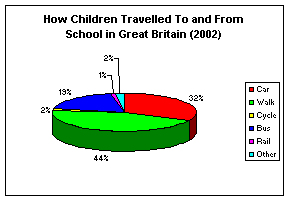
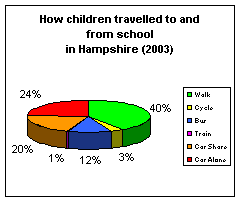
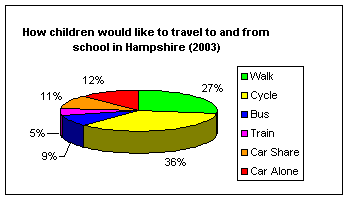
As shown below the results of the Hampshire Schools Hands-up Survey for 2003 and 2004 shows an unmet demand among Hampshire's young people for greater walking and cycling to and from school. Hampshire also has higher levels of car use than the national average which, despite the large number of rural schools in Hampshire, still provides an opportunity for decreasing car use and increasing other modes.
Safety
The 2004 report for the DfT "Smarter Choices - Changing the Way We Travel" found that "In general, higher levels of cycling seem to result in lower accident rates". The report also highlighted a study comparing cycling statistics from the UK with France, Denmark, Germany and the Netherlands where it was concluded that "cycling gets safer as it becomes more popular".
The promotion of cycling through development of a School Travel Plan can achieve higher levels of safer cycling through the introduction of good cycle training. This can increase children's confidence on the road and make them more aware of safety issues and how to overcome them. Funding from the Safer Routes to School Programme for measures such as cycle paths, footways and speed reduction measures outside schools can have an impact on both real and perceived safety on the school journey.
Health
The school journey is an opportunity for children to gain self-confidence and independence. Travelling by car can reduce opportunities for them to learn important life skills such as how to cross a road and so limit a child's ability to act independently. Walking and cycling can also help children to learn about their local environment, develop road sense, assess risk and become more self-reliant. Building exercise into the day improves fitness immediately and has benefits for longer term health. Encouraging walking and cycling to school can help reduce local pollution and congestion, improving quality of life for everybody. Better local air quality is particularly beneficial for the growing number of people who suffer from asthma.
By developing a wide-ranging travel plan schools have the opportunity to have a impact on the lives of their pupils in both the short and long-term. Children who walk and cycle to and from school may be more likely to continue this behaviour in later life, resulting in longer-term benefits in health.
Successes to date
An opportunity exists in that there are already a considerable number of schools in Hampshire who are interested in school travel planning and the County Council is proposing to build on its good work to date in this respect. As of April 2005, the County Council was engaged with 65% (393) of all schools in Hampshire which is made up of 26% (158) that now have an approved travel plan and 39% (235) that are in the process of developing a plan.
Problems - work journey
Modal Share
The car remains the dominant mode of transport for the commute to work - accounting for almost 70% of journeys. Traffic is growing at approximately 2% per year on motorways and 1% per year on local roads. The problems caused by car travel are documented in more detail elsewhere in the LTP but include congestion, poor air quality, safety, noise and other impacts on the environment.
Health and safety
Obesity, both in children and adults, is an increasing concern in the UK population due to increasingly inactive lifestyles. A growing reliance on the use of the private motorcar for all journeys, not just to work, has aided this. There are also concerns over the impact of increased car use on air and noise pollution and road traffic accidents as well as busier roads making roads more dangerous for those wanting to walk and cycle.
Economy
Car travel is often seen as the most cost effective method of transport for the commute to work. However, the cost of congestion and lost working hours to business has been estimated by the CBI to run into billions of pounds a year across the UK. Hampshire is falling steadily below the national average in terms of economic activity and transport may be one of the factors having an influence.
Opportunities - work journey
Businesses are increasingly realising that not only their business travel but also the commute to work is having an impact on congestion - particularly in localised `hot spots'. This is leading them to examine how they can work with the local authorities and neighbouring businesses to develop travel plans and more general transport policies to make a change to their own practices.
The largely urban nature of the Solent Area readily lends itself to workplace travel planning and initiatives to reduce car use, including more home working and flexible working hours, car sharing and incentives for employees to switch to public transport, walking and cycling. The high proportion of short journeys currently undertaken by car in Basingstoke also suggests that there may be an opportunity to encourage more people to walk and cycle.
The increase in use of home commuters, increased access to the Web and broadband technology is all making it easier for staff to work from home and reduce the need to commute to work. This provides both employers and employees with a `non transport' solution to transport issues.
Many companies developing travel plans are now plotting staff home post codes in order to assess how close their employees live and the potential for promoting alternatives to car use. A number of exercises already undertaken show there is significant opportunity to influence travel with staff living within 1-2 miles and up to 5 miles from their place of employment which have the potential to be converted to walking or cycling trips respectively.
Strategic movements to, from and within Hampshire places significant pressure on the local transport network particularly with respect to work journeys. Further details are outlined in the County Council's main LTP document, but as an example commuter movement between the settlements in Hart, Rushmoor and Basingstoke is relatively low, whilst the level of in and out commuting between the Southampton/Eastleigh area and the wider Solent area is high.
An analysis of the 1991 and 2001 Census results shows that there has been little change in the modes of transport used by Hampshire residents for their journeys to work - the greatest proportion of people drive. This accounted for 63.4% of all residents' journeys to work in 2001, a slight increase from 1991 and above the average for England and Wales which stands at 55.2%. Train travel has remained constant at around 3.2%, but bus travel has declined slightly from 4.1% in 1991 to 3.2% in 2001. Bicycle use has also declined from 4.5% in 1991 to 3.5% in 2001. However, the number of Hampshire residents who mainly work from home has more than doubled since 1991: 60,900 people worked mainly from home in 2001 compared with 28,200 in 1991.
Other Problems and Opportunities
The County Council undertakes an annual programme of public attitude surveys in relation to travel and transport in the form of household questionnaires. Results from recent surveys confirm the generally negative perceptions of alternatives to the car. However, encouragingly, the results show that Hampshire's public recognise the potential role for smarter travel choices (and in particular the provision of advice and support to schools and other organisations).
As mentioned, the County Council's recent public transport personalised travel planning project (InfoMotion) also demonstrated the value of the smarter travel choices in influencing perceptions. The results of the before and after survey conducted during the project showed that the number of respondents `dissatisfied' with local bus services after the project was halve that recorded prior to the project. This was despite the fact that no improvements were made to the quality of the service in between. Individuals' attitudes toward the services available had changed simply as a result of informing them of what was available and their experience of using the service (possibly for the first time).
Developing Hampshire's Smarter Travel Choices Strategy
The preparation of this provisional Strategy has taken into account a range of background information and evidence and has been compiled following consultation with a number of key stakeholders.
Following submission of its provisional Local Transport Plan (and this provisional Hampshire's Smarter Travel Choices Strategy) in July 2005 extensive consultation will take place with all key stakeholders and the public. All views will be taken into account in preparing the final version of the Smarter Travel Choices Strategy which will form part of the Final Local Transport Plan to be submitted in March 2006.
Partnership Working
In delivering its Smarter Travel Choices Strategy the County Council will make best use of its existing partnerships which have also been used to inform the preparation of this provisional document. The key partnerships of direct relevance to the Smarter Travel Choices Strategy are set out below.
Strategic Partnerships
The County Council is represented on the Hampshire Economic Partnership Transport Task Group where the implementation of the County Council's workplace travel plan strategy will be discussed. The County Council has also established a working group with the local health authority and Hampshire Constabulary in respect of school travel.
At a national and regional level the County Council is also engaged with travel planning professionals from other local authorities and meets to discuss and exchange ideas and good practice.
District Councils
The County Council has and will continue to make good use of the Local Strategic Partnerships at District Council level and participates in local panels where district and County Council Members and officers meet periodically to discuss travel and transport issues (including smarter travel choices).
A number of school travel plan adviser posts within district councils are part-funded by the County Council. There are also a number of districts councils who provide their own advice and assistance to organisations developing both school and workplace travel plans. In both instances there is extensive liaison between officers at the District and County Council level to ensure a consistent approach.
Hampshire County Council Departments, Members and Officers
Hampshire has a School Travel Officer Working Group which includes representatives from the School Travel Planning Team, Road Safety Team, Highway Safety Group, Passenger Transport Group, Children's Services Department, the Strategic Health Authority and Hampshire Constabulary. The role of this group is to guide the overall strategy for school travel planning and will play a key role in finalising this provisional strategy.
Hampshire also has a Planning Development Group which includes representatives from the School Travel Planning Team, Planning Development Control, Highways Development Control, Children's Services Department Strategic Planning officers and County Architects. This group meet regularly and has agreed an approach for working with schools required to produce travel plans by planning conditions, under the guidelines set out in Planning Policy Guidance Note 13.
Schools
Part of the process of developing a school travel plan requires the school to set up a working party. The County Council assists schools in engaging with the local community, the school pupils, school governors, parents and guardians and any other relevant parties. The team also speaks independently to teachers panels, governor forums and school councils to ensure that the material produced by the team is targeted in the right way.
Businesses
In addition to working with individual businesses in providing advice and support on travel plan preparation the County Council also acts in a role of facilitator in terms of helping to establish relationships between businesses in the same area. These can evolve into `commuter forums' which provide an opportunity for like minded businesses to meet to discuss travel issues in their area and to formulate action plans to help address these.
CHAPTER 3: OVERVIEW - HAMPSHIRE'S SMARTER TRAVEL CHOICES STRATEGY (2006-2011)
Vision, Aims, Objectives and Targets
The context for Hampshire's Smarter Travel Choices Strategy is the County Council's Local Transport Plan (2006-2011) vision which is of a transport strategy that:
"Enhances quality of life and economic prosperity by connecting people, communities, employment, goods, services and amenities."
As set out in Chapter 2 the guiding principle of the smarter travel choices concept relates to informing people of the travel options available to them in such a way that there is greater emphasis on alternatives to the private (sole occupancy) car. In this respect the overall vision for Hampshire's Smarter Travel Choices Strategy is:
"A County where a greater proportion of journeys are made in a safer, healthier, more efficient and more environmentally friendly way."
Through the delivery of an effective marketing and awareness programme and the provision of advice and support to individuals and organisations on the production of travel plans and the implementation of the measures contained therein, the three key aims of Hampshire's Smarter Travel Choices Strategy are to:
"Ensure that individuals and organisations understand the implications of the travel choices they make and feel empowered to make informed travel choices."
"Enable journeys to be made in a safer, healthier, more efficient and more environmentally friendly way through the identification and provision of, where possible, new travel and transport measures."
"Reduce the need to travel and the distance travelled, by influencing non-transport decisions that can have an impact on travel choices."
The key objectives of Hampshire's Smarter Travel Choices Strategy are to:
1. Promote practical opportunities, through the provision of advice and support, for individuals and organisations to determine changes to their own travel behaviour;
2. Improve the accessibility of key travel generators/attractors by the full range of travel options;
3. Reduce the impact of journeys to key travel generators/attractors by increasing the proportion of journeys undertaken by means other than the (single occupancy) car;
4. Improve awareness of and influence attitudes towards the full range of travel options;
5. Make a positive contribution toward the achievement of national, regional and local accessibility, safety, health, environmental and economic targets.
In pursuance of its Local Transport Plan (2006-2011) objectives the County Council has prepared a series of targets (with associated performance indicators) as required by the DfT. The full suite of targets is contained within the main Local Transport Plan and those of direct relevance to the Smarter Travel Choices Strategy are set out in the table below.
Targets for Hampshire's Smarter Travel Choices Strategy
School travel plans |
100% of students in full time education (aged 5 to 16 years) to be covered by a travel plan by 2010/11 from a 35% base. |
Workplace travel plans |
15% of people working in Hampshire to be covered by a travel plan by 2011 |
School journeys |
To reduce the proportion of school journeys made by car (alone) for students aged 5-10 years from 31% to 30% by 2010/11 with an associated increase in non-car (alone) journeys. To reduce the proportion of school journeys made by car(alone) for students aged 11-16 years from 12%to 11% by 2010/11 with an associated increase in non-car (alone) journeys |
Cycling |
To halt the decline in cycling by 2010 from a 2005/06 base. |
Passenger Transport |
44,168,000 passenger journeys per annum by the end of 2010/11, of which · Bus 26,683,000 · Rail 13,400,000 · Ferry 4,085,000 This represents an increase of 1.98% by 2011 in the total passengers carried, compared to 2003/04. |
Travel Awareness |
Target currently being developed |
Further information on how Hampshire's Smarter Travel Choices Strategy will be monitored is set out in Chapter 7.
Summary of Hampshire's Approach to Smarter Travel Choices
The overall approach is framed around the County Council's underlying philosophy for its Local Transport Plan (2006-2011). The key guiding principles for the LTP are a sequential approach of:
Reduce problems at source (eg reducing need for travel);
Manage and make best use of existing transport services and infrastructure;
Invest in provision of services and infrastructure.
The approach also gives cognisance to the County Council's approach to managing transport planning in the County by splitting Hampshire into four transport strategy areas. As such this Strategy should be read in conjunction with the strategy for each of these areas (as contained in the main Local Transport Plan document).
The key elements of the Smarter Travel Choices Strategy are:
_ Extensive origin and destination based travel planning programme;
_ Rolling programme of personalised travel planning;
_ County-wide travel awareness campaign;
_ Coordinated information and marketing strategy.
These will be supplemented by the following initiatives:
_ car clubs and car sharing schemes;
_ passenger transport enhancements;
_ measures to promote healthy modes (cycling and walking);
_ measures to reduce the need to travel (eg internet shopping, home working etc).
A summary of the County Council's overall approach to implementing this provisional Strategy is contained in the table overleaf and detailed in the following two Chapters.
Compliance with national, regional and local objectives
Hampshire's Smarter Travel Choices Strategy has been developed to be consistent with key national objectives notably the shared priorities of congestion and accessibility. It is also compatible with a number of policies contained within the Regional Transport Strategy (2004) and also the County Council's own corporate objectives. The extent to which the Strategy contributes to each of these objectives is shown in Appendix B.
SUMMARY OF APPROACH
LTP PRINCIPLES |
Workplace Travel Planning |
School Travel Planning |
Rail Station Access Strategies |
Residential Travel Planning |
Personalised Travel Planning |
Travel Awareness, Information and Marketing |
(INFLUENCE) Encourage the use of measures to reduce need for and distance travelled. |
In addition to locational/design policies measures might include: Flexible working hours, working from home, tele/video conferencing. |
Measures more limited but might include: Staggered school starting/finishing times. |
Measures might include: Promotion of local stations rather than travelling to more distant stations. |
In addition to locational/design policies measures might include promotion of internet shopping. |
Measures promoted will be relevant to needs of individual trip purpose. For example, if the trip is for work purposes encourage working from home, or if it is for shopping encourage use of home delivery. |
 REDUCE
MANAGE Making better use of the options available. |
Measures promoted will be tailored to the individual organisation. They might include: Promotion of quality and availability of alternative modes of transport where they already exist together with promotion of alternative ways of working and possibly better use of existing site (eg on-site car parking management). |
Measures promoted will be tailored to the individual school (or cluster of schools). They might include: Promotion of quality and availability of alternative modes of transport where they exist to both students and parents/ guardians, introduction of travel behaviour material into the curriculum including road safety.. |
Measures promoted will be tailored to the individual station. They include: Promotion of quality and availability of alternative modes of transport to station where they already exist and consider alternative management of station site (eg enhanced car parking management). |
Measures might include: Promotion of quality and availability of alternative modes of transport where they exist. |
Measures promoted will be tailored to the needs of the individual. They will include the promotion of existing alternative modes of transport and provision of incentives where necessary. |

INVEST Provision of alternatives where they do not already exist. |
The individual organisation would have the opportunity to use own resources or bid for County Council funds through the Business Travel Plan Partnership Fund/Access to Work Programme element of the Integrated Transport Capital Programme. Measures might include on site (eg cycle lockers, car share database) or off site facilities (eg bus services, pedestrian links). |
Schools would have the opportunity to use their own resources or bid for County Council funds through the Safer Routes to School Programme element of the Integrated Transport Capital Programme. Measures might include on site (eg cycle lockers, curriculum work) or off site facilities (eg pedestrian crossings, walking buses). |
The rail operators would have the opportunity to use their own resources or bid for County Council funds through the Accessibility element of the Integrated Transport Capital Programme. Measures might include on site (eg cycle lockers, car share database) or off site facilities (eg bus services, pedestrian links). |
Any measures identified would be developed within proposals for the relevant Area Transport Strategy and potentially funded through the Accessibility element of the Integrated Transport Capital Programme.. |
Any measures identified would be developed within proposals for the relevant Area Transport Strategy and potentially funded through the Accessibility element of the Integrated Transport Capital Programme.. |

Measures to supplement the above will also be deployed in the following areas:Car Sharing and Car Clubs Passenger Transport Healthy Modes (Cycling and Walking) Reducing the need to travel |
CHAPTER 4: KEY COMPONENTS OF HAMPSHIRES SMARTER TRAVEL CHOICES STRATEGY
The Smarter Travel Choices Strategy will be deployed in such a way that it makes best use of all the behavioural change techniques available (it will also be flexible to adapt to the introduction of new techniques as they emerge).
This Chapter details the key elements of the Smarter Travel Choices Strategy which in summary are:
· Travel Awareness Programme
· Travel and Transport Marketing and Communications Plan
· School travel planning
· Workplace travel planning
· Personalised travel planning
· Rail Station Access Strategies
· Residential Travel Planning.
These are supported by a range of supplementary programmes and initiatives which are set out in Chapter 5.
TRAVEL AWARENESS PROGRAMME
The County Council recognises that it has a key role to play in raising awareness about the impact of individual travel choices. Furthermore the County Council recognises that it has an opportunity to influence the travel choices made by individuals based on their awareness of the impacts.
In this respect the County Council's Travel Awareness Programme will be key. The detail of the programme will be confirmed in the final version of the strategy to be submitted to the DfT as part of the County Council's full LTP in March 2006. It is, however, likely to be based on the following principles:
· use of a unified brand (possibly Travelwise);
· development of a range of travel awareness messages which can be applied as necessary in different parts of the county and across a range of media;
· preparation of local travel awareness campaigns (within the County Council area transport strategies) tailored to the needs of that individual area;
· a range of activities planned to coincide with European and national travel awareness events;
· relationship building with local media in order to generate positive and proactive news items on a planned basis;
· a five year indicative action plan showing however activities will be planned over the life of the LTP and will be coordinated with other elements of the transport investment programme.
The programme will seek to influence the attitudes of individuals and organisations in Hampshire with respect to travel and transport issues as a means of encouraging them to think more about the use of alternative modes of transport.
The travel awareness programme will be a key element of the travel and transport marketing and communications plan detailed in the next section.
TRAVEL AND TRANSPORT MARKETING AND COMMUNICATIONS PLAN
The County Council recognises that providing information to individuals on the travel choices available to them must be a key element of its LTP strategy. The County Council also understands the need to promote its transport strategy (as contained in the Local Transport Plan) in such a way that Hampshire's public better understands the County Council's overall approach (and the reasons behind it) and so recognise the intended contribution of individual initiatives as they are implemented.
Furthermore the County Council recognises that this must be done in a more coordinated manner to ensure maximum impact and avoid the potential pitfalls of providing too much, too little, contradictory or inaccurate information which could lead to loss of faith from the public.
Following a review of its current approaches to marketing and communicating travel and transport, the County Council will, in the early period of its second Local Transport Plan, develop and implement a comprehensive Travel and Transport Marketing and Communications Plan. The plan is likely to include three elements as follows.
Marketing Hampshire's Local Transport Strategy - to include:
· a public `image' for the County Council's Local Transport Plan;
· a range of marketing activities intended to promote the objectives of the overall transport strategy (likely to be done on an area transport strategy basis);
· greater emphasis on the County Council's overall approach when implementing individual initiatives.
Informing individuals about the travel choices available to them - to include:
· provision of coordinated and comprehensive (ie all travel modes) information on the travel choices available;
· dissemination of information using a range of media appropriate to the target audience(s);
· greater use of real-time information (on all modes) as it becomes more readily available;
· greater use of targeted marketing and information (eg personalised travel planning, area and journey specific travel information);
· investigation of the potential role of travel planning advice centres particularly in Hampshire's main settlements;
Informing individuals about the `travel services' available from the County Council - to include:
· coordinated approach to the provision of information on the `travel services' available from the County Council;
· investigation of the potential role of travel planning advice centres particularly in Hampshire's main settlements.
The Travel and Transport Marketing and Communications Plan will cover the five year Local Transport Plan period and will be organised in such a way that it links closely with the County Council's Travel Awareness Programme as detailed in the previous section.
SCHOOL TRAVEL PLANNING
School travel planning is a means of delivering changes to ways in which school journeys are made and informing individuals about the implications of the travel choices they make. It supports the County Council vision for its Local Transport Plan (2006-2011) of a transport strategy that:
"Enhances quality of life and economic prosperity by connecting people, communities, employment, goods, services and amenities."
The County Council's Vision for School Travel, supported by school travel planning and the delivery of the County Council's policies on Home to School Transport, is:
"A County where a greater proportion of school journeys are made in a safer, healthier and more environmentally friendly way."
The Aim of the school travel planning element of this Smarter Travel Choices Strategy is, through the County Council's provision of advice and support to schools on the production of travel plans and the implementation of the measures contained therein:
"To enable school journeys to be made in a safer, healthier and more environmentally friendly way through the identification and provision, where possible, of new transport facilities. At the same time to ensure that those travelling to and from school are aware of the impacts of the travel choices they make."
The Objectives of this Smarter Travel Choices Strategy insofar as they relate to school travel are:
1. To promote practical opportunities (through learning) for young people to determine changes to their own travel habits.
2. To reduce the impact of the school journey on local congestion by increasing the proportion of journeys by walking, cycling, public transport and car sharing.
3. To contribute to the targeted 50% reduction in fatal and serious child casualties occurring on the Hampshire road network by 2010, from their average level over the years 1994-98.
4. To contribute to local and national Government health targets through improved children's health.
5. To increase awareness of the safety, health, environmental and economic implications of transport and travel.
6. To evaluate the effectiveness of school travel planning as a means of achieving these objectives.
Targets and monitoring
The overall approach to monitoring the impact of this Smarter Travel Choices Strategy is set out in Chapter 7, however this section looks at the performance indicators, targets and monitoring regime in relation to the school element.
The County Council has developed a range of performance indicators and associated targets (as contained in the main LTP document), however those which relate specifically to school travel planning are:
· Mode share for school journeys
· Proportion of students in full time education (5-16 years) covered by a school travel plan.
The targets for this Smarter Travel Choices strategy insofar as it relates to school travel are:
100% of students in full time education (aged 5 to 16 years) to be covered by a travel plan by 2008/09 from a 35% base.
To reduce the proportion of school journeys made by car (alone) for students aged 5-10 years from 31% to 30% by 2010/11 with an associated increase in non-car (alone) journeys.
To reduce the proportion of school journeys made by car (alone) for students aged 11-16 years from 12% to 11% by 2010/11 with an associated increase in non-car (alone) journeys.
It should be noted that these targets reflect the County Council's intention to exceed the national target of all schools to have a travel plan in place by 2010.
Mode share for school journeys will be monitored using the annual Hampshire Schools Hands Up Travel Survey. This survey, which has been operating since September 2003, is a voluntary survey sent to all schools in the county. It asks students how they travelled to school on the day of the survey and also how they would prefer to travel if they had the choice. The County Council is aware that the DfES is in the process of considering introducing a travel and transport question into its annual compulsory survey of schools (PLASC), however until such time as this happens the County Council will continue to use its own approach.
The proportion of students in Hampshire covered by a travel plan is monitored using information recorded by the County Council on the number of students on roll at individual schools, together with information held on those schools who have an approved travel plan in place.
Hampshire's Approach to School Travel Planning
The County Council has for a number of years been engaged in school travel planning and recently, with the assistance of bursary funding from national Government, established a School Travel Planning Team. In addition to providing advice and support to schools on the preparation of travel plans the team plays an important role in providing a link between the school and other parts of the County Council responsible for transport related activities (eg Road Safety Advice).
It should also be noted that excellent partnership working exists on school travel planning with Hampshire's District and Borough Councils where a number now have a dedicated school travel planner who work closely with those at the County Council.
The School Travel Planning Team, working with colleagues from throughout the County Council and District/Borough Councils, has and will continue to deploy its services in a number of ways as set out below.
The three key elements of the school travel planning element of this strategy are:
· Provision of advice and support to schools on travel planning:
· Implementation of engineering measures identified in travel plans through the County Council's Safer Routes to School Programme;
· Deployment of other measures identified in travel plans.
These are considered in more detail below.
School Travel Planning
Targeting schools
The County Council's approach to targeting schools has the following elements which are in priority order:
1. Targeting those schools expressing interest in resolution of travel issues;
2. Securing effective school travel plans through the planning process;
3. Providing support to those schools in deprived areas;
4. Concerted effort with regard to less enthusiastic schools.
The first element relates to generating interest among the school communities. The principles of school travel planning are signed up to through the County Council. Consequently an excellent working relationship exists between the County Council's Environment and Children's Services Departments which has ensured the existence of the school travel planning service has been well publicised. This has included attendance at working group meetings with teachers, features in newsletters to teachers and governing bodies, and presentations to conferences, etc.
In autumn 2004 a leaflet was sent to all state maintained and independent schools in Hampshire advertising the existence of the advice and support service available from the County Council in relation to school travel plans. The leaflet was intended to prompt schools to contact the School Travel Planning team. The response from this exercise was extremely encouraging and provided the County Council with a pool of schools who had expressed an interest in receiving advice and assistance in relation to travel planning. The County Council has now entered into a dialogue with these schools and many are now in the process of developing plans.
The second approach, which will continue to operate in parallel with the others, involves continuing to work through the development control process. If new schools are required or existing schools are extending then advice and support will be provided to ensure good quality travel plans are submitted as part of the planning application process. A system is currently in place where those schools identified in the County Council's Children's Services Department Capital Programme are offered assistance at the earliest opportunity.
The third approach is more selective and focuses on schools in areas considered to be deprived. Schools with more than 20% of their pupils receiving free school meals will be targeted first as this measure is used by the County Council's Healthy Schools Initiative as a means of determining schools in more deprived areas. It has been noted that out of the 69 schools who currently fall into this category, only 39 are engaged in the School Travel Planning process. The remaining 30 schools will be offered support as a priority.
The final element of targeting relates to tackling the less enthusiastic schools - this will be deployed at the point when it becomes clear that the intake of new schools to the travel planning process is slowing. A number of techniques will be deployed at this stage including a mail drop, similar to that identified above, focusing on those schools not already in the school travel planning programme. This will be followed up by electronic communications and telephone calls to elicit a higher rate of response. A list of interested schools will then be collated and an initial assessment of each school will be made using a checklist to determine the order of priority. This checklist will include whether the school is prepared to take action itself, any child casualties in the school's vicinity and the potential to encourage walking, cycling and public transport usage.
Travel Plan Assessment
The County Council operates a robust travel plan assessment system which exceeds the national standard. Individual travel plans are assessed against a set of criteria by the adviser responsible to the relevant school and, in the interests of quality control, this is verified by an independent adviser.
Schools developing a travel plan progress through a number of levels determined by the County Council's School Travel Planning Team. Levels 0-2 are the development stages of the travel plan and once a school has reached Level 3 then the travel plan has been approved and the school receives a certificate in recognition of this. The school is also put forward for the DfES Capital Grant and Hampshire County Council's Safer Routes to School funding.
Once a school has undertaken an annual review and progress has been made towards meeting one or more of their targets they attain Level 4 status and are eligible for the "School Travel Planning Award" which is a plaque awarded to the school. Schools are then entitled to use the "Excellence in School Travel Planning" accreditation mark on their headed paper. Schools must continue to monitor their travel plan on an annual basis to continue to be eligible to use this accreditation.
Support for schools and promotion of School Travel Planning
The County Council offers support to schools in a number of ways. The team provides one to one advice to teachers, governors and others involved in the school community (eg any school travel plan working group). Curriculum resources are available to schools and the County Council's advisers are available to facilitate assemblies, children's workshops, parents' evenings and governors' meetings. A comprehensive resource pack is available and the School Travel Planning and Safer Routes to School website provides information and links to relevant sites.
School travel planning in Hampshire is also promoted through the Healthy School Programme, Primary Car Trusts, Hampshire Trailblazers, The Hampshire Schools Landscape Programme, Hampshire Governors Forums, Hampshire County Children's Services newsletters and website, County Council publications and through the local media. District councils also promote the benefits to schools and local members.
Implementation of infrastructure measures identified in travel plans
Safer Routes to Schools
Schools with approved travel plans are eligible to bid for funding from the County Council's Safer Routes to School Programme (currently in excess of £1.5 million per annum).
During the process of developing a travel plan, schools receive advice from the County Council's Safer Routes to School Coordinator on practical measures that could be included in the school's action plan. Once the travel plan has been approved, eligible schools are put forward for the DfES School Travel Capital Grant. This approach ensures that those initiatives identified in travel plans are consistent with the objectives of the plan and are feasible.
The County Council deploys a robust assessment and prioritisation process to ensure that the funding programme is able to keep step with the measures being brought forward within the travel plans.
Initiatives are developed in close consultation with the school and all those involved in developing the travel plan (such as the school council), the local parish/town/district council, local and County Members and any other affected parties. The effect of the scheme is monitored in terms of the impact on modal shift and also on perceptions of safety via annual numerical and attitudinal surveys.
Implementation of other measures identified in travel plans
Passenger Transport
Local authorities are required to provide free home to school transport (HTST) to all children attending their LEA school, provided that they live:
· Over two miles from school, if under eight years old, or
· Over three miles from school, if over eight years old.
Transport for SEN children, who increasingly are now educated in mainstream schools, is provided more widely, as they are often unable to walk to school.
In urban areas, population density and school location generally mean that no free HTST is required by the legislation, as all children live within the two or three mile statutory walking distances. Also, the provision of pavements and footpaths is usually such that a safe walking route exists to the local school. However, this is not always the case in rural areas and there are a number of places in Hampshire where free HTST has to be provided as there is no safe walking route.
The LEA's policy provides assistance with transport to denominational schools, provided that they are within the following distances from home:
Primary: 6 miles (and over two/three miles)
Secondary: 10 miles (and over three miles).
The Government is promoting a Bill to enable up to 20 LEAs to devise local school travel schemes, which would replace the existing legislation on home to school transport, in their areas and for a four or five year term. Authorities would be able to devise schemes to charge pupils who currently get free transport, provided that the income from charging is used to provide more school transport, for example for those living within the walking distances. However, authorities will have to demonstrate in their application that the scheme will not lead to an increase in car traffic, as might happen where parents are required to pay for transport previously provided free of charge.
The Council has not yet decided whether to apply to operate such a scheme in Hampshire however it is intending, during the Local Transport Plan period (2006-2011), to investigate the potential for `yellow buses'.
There may well be instances where existing local bus services could be used by more fare paying children than do so at present. This would of course depend on the bus operating at the right time and having spare capacity, the fare being attractive to parents and overcoming other hurdles such as the feeling of reassurance that parents enjoy if they take children to school themselves and collect them. There is probably a greater likelihood that a modal shift could be encouraged from car to bus for secondary schoolchildren than for primary age children.
The County Council will look to promote the use of local bus services to schoolchildren by producing tailor-made information about services passing close to individual schools, perhaps showing the routes on a map with timings and fares.
Safety
A key component of the County Council's approach to school travel planning is the promotion of its Road Safety Training and Education services and a variety of programmes exists for children such as pedestrian and cycle training. Parents are also encouraged to make use of the driver training services available. Resources are also available to schools to assist in the teaching of road safety as part of the curriculum.
Healthy Modes (Walking and Cycling)
There are a number of ways in which the County Council supports schools with the encouragement of walking and cycling. In addition to the cycle and pedestrian training mentioned above, assistance in setting up walking buses and the promotion of activities such as National Bike Week and Walk to School Week is available. Schools with travel plans can also bid for funding for new footways, cycleways and other measures that will assist with the promotion of these modes.
Car use
The County Council recognises that the private car will continue to play an important part of the school journey particularly where catchment areas are large and travel patterns disperse. In this respect schools are advised on the options available to them and more specific support is available as necessary the initiatives available include:
Car sharing - this is promoted on an informal basis.
Park and walk - where parents park in a location remote from the school and walk their children the remainder of the journey.
Parking management - at locations where parking outside schools creates problems appropriate traffic management measures are promoted, in addition schools are encouraged to better manage on site parking provision.
Action Plan
A detailed five year action plan for school travel planning is currently being developed and will be contained within the final strategy submitted to the Department for Transport in March 2006.
WORKPLACE TRAVEL PLANNING
Workplace travel planning is a means of delivering changes to ways in which work journeys are made and informing individuals about the implications of the travel choices they make. It supports the County Council vision for its Local Transport Plan (2006-2011) of a transport strategy that:
"Enhances quality of life and economic prosperity by connecting people, communities, employment, goods, services and amenities."
The County Council's Vision for Workplace Travel, supported by workplace travel planning is:
"A County where a greater proportion of business related journeys (including those to and from work) are made in a safer, healthier, more efficient and more environmentally friendly way."
The Aim of the workplace travel planning element of this Smarter Travel Choices Strategy is, through the County Council's provision of advice and support to businesses on the production of travel plans and the implementation, where possible, of the measures contained therein is:
"To enable the business community (employers, staff and visitors) to travel in a safer, healthier, more efficient and more environmentally friendly way."
The Objectives of this Smarter Travel Choices Strategy insofar as they relate to workplace travel are:
1. To promote practical opportunities (through travel planning) for the business community to determine changes to their own travel habits;
2. To reduce the impact of business related travel (including journeys to and from work) by increasing the proportion of business related journeys undertaken by means other than the car;
3. To raise awareness of the safety, health, environmental and economic implications of business related transport and travel;
4. To evaluate the effectiveness of workplace travel planning as a means of achieving these objectives.
Targets and Monitoring
The overall approach to monitoring the impact of this Smarter Travel Choices Strategy is set out in Chapter 7, however this section looks at the performance indicators, targets and monitoring regime in relation to the workplace element.
The County Council has developed a range of performance indicators and associated targets (as contained in the main LTP document), however that which relates specifically to workplace travel planning is:
· Proportion of workforce employed in Hampshire covered by a travel plan.
The target for this Smarter Travel Choices strategy insofar as it relates to workplace travel planning is:
15% of people working in Hampshire to be covered by a travel plan by 2011.
This target will be monitored by maintaining up to date records of those businesses where travel plans have been secured. This will be supplemented by information on the number of employees at these locations and compared with the overall number of people employed at businesses in Hampshire.
Hampshire Approach to Influencing Workplace Travel
In broad terms there are three elements to the strategy:
· develop travel plans with existing businesses and also those associated with planning applications for new development;
· develop commuter forums where clusters of businesses can work together to identify solutions to travel and transport problems;
· implement measures identified within travel plans through the new `Access to Work Programme'.
A range of support services will continue to be developed to support this overall approach. These are considered in more detail below.
Application of travel planning
The County Council will apply travel planning in the following targeted way:
· support the development of travel plans with existing major employment sites (those employing more than 200 staff) on a proactive basis;
· support the development of travel plans with existing smaller sites as the need arises;
· support the development, monitoring and enforcement of travel plans received as part of the planning process;
· support the development of travel plans in areas of major new infrastructure investment as the need arises.
The County Council also has in place a robust system for assessing travel plans which relates to its likely impact in achieving the objectives identified therein.
Application of travel planning at existing `major' employment sites
The County Council will target and provide travel planning advice to all major employment sites (those employing over 200 staff). This will be done on an area strategy basis, prioritised against an agreed criteria. The criteria includes:
· proximity to a range of good quality transport services
· proximity to proposed infrastructure/service improvements
· proximity to cycle network
· proximity to neighbouring businesses to support critical mass for improvements to public transport and the local infrastructure
· whether the organisation is an active commuter forum member
· commitment of organisation and willingness to take part in the process
· areas with known or forecast congestions problems
· through liaison with others (eg HEP, Chambers of Commerce, SEEDA etc) to determine their particular priorities.
Application of travel planning at smaller employment sites
The County Council will respond to travel planning enquiries from either smaller sites or major sites not being targeted as and when necessary, with priority going to those scoring well against the above criteria. Any organisations not meeting the criteria, would be placed on a `waiting list' subject to resources at that time.
Travel planning as part of the planning process
The County Council will provide advice to the promoters of new sites on the requirement for, and content of, effective travel plans. The County Council will also audit any travel plans it receives as part of the planning application process. Finally, the County Council will also provide advice to District and Borough Councils on any plans submitted to them for consideration as part of the planning process.
The County Council has drafted guidance for developers intended to secure effective travel plans through the planning process and a copy is available at http://www.hants.gov.uk/environment/workplacetravel/developers.html
Travel planning at locations adjacent to major new transport infrastructure
All organisations above the 200 employee threshold, plus others as appropriate, within close proximity (this distance to be determined based on the nature of the project being implemented) of any proposed major transport project to be targeted and offered travel planning advice and support.
Travel plan assessment
The County Council operates a robust travel plan assessment system which exceeds the national standard. Individual travel plans are assessed against a set of criteria to ensuring that they meet an acceptable standard. The DfT's Travel Plan Assessment Tool is used to ensure consistency and promote an equitable approach.
As with schools, travel plans for workplaces are given a rating independent of the assessment score from the above tool. Organisations developing a travel plan progress through a number of levels determined by the County Council. Levels 0-2 are the development stages of the travel plan and once an organisation has reached Level 3 then the travel plan has been approved.
The County Council is also considering the introduction of Level 4 status. This is where an organisation can demonstrate progress toward one or more of its targets/objectives. Organisations in receipt of a level 4 rating would be awarded an accreditation mark for which they would reapply annually.
Commuter Forums
A number of successful commuter forums already exist in Hampshire. An example of a business/industrial park forum being the Whiteley Business Forum currently chaired by National Air Traffic Control Services. The County Council is however aware there is much more potential for the use of such forums and a review of their role is currently underway. The preferred approach will be contained within the final version of this strategy in March 2006.
It is likely that a three-tiered approach will be adopted. At the lower level businesses will be invited to participate in commuter forums based on the location of their business (ie business park based forum, town based forum or isolated forum), these forums would in turn report to a County-wide Commuter Forum Coordination Group which in turn would report to the Transport Group of the Hampshire Economic Partnership.
It is envisaged that strong business leadership will reduce the burden on the County Council to run all of the forums.
Access to Work Programme
A new concept (for Hampshire), this involves ring-fencing an element of the County Council's revenue and capital budgets and making it available (either in full or through matched funding) for transport projects either at or adjacent to local businesses.
This will be funded from the County Council's capital programme allocation for "Accessibility" and the revenue allocation to "Local Transport Plan Marketing Initiatives". It is proposed that, as with the County Council's Safer Routes to School Programme, this funding would only be available (or at least priority will be given) to those organisations with a travel plan meeting the County Council's standard.
The Access to Work Programme will provide an incentive to organisations to participate in the workplace travel planning programme. Without this incentive progress toward targets will be slower. It also provides added support to the justification for the development of schemes to get best value from them.
This is an extension of the County Council's Business Travel Plan Partnership Fund which has operated successfully for the past two years where organisations are encouraged to bid for matched funding for the provision of on-site facilities intended to support attainment of its travel plan objectives.
Support Services
The County Council also offers a range of value added products and services to support the development of travel plans including:
· a website (www.hants.gov.uk/environment/workplacetravel) which provides guidance, information and resources on how to develop and run a travel plan
· printed and promotional materials including posters, information leaflets and fact sheets
· displays for use at launch events or in communal spaces to advertise the travel plan
· GIS mapping to plot staff postcodes and travel modes to help identify and analysis issues of importance to contribute to the travel plan. These are also of value in providing a case to public transport operators for improved services
· a carshare database (at www.hantscarshare.com) which helps staff in finding partners to share their journeys with. This web based resource is available free of charge to the end user and businesses can buy in to it to form private user groups
· training can be provided to organisations where appropriate to raise the profile of activities required throughout the travel planning process.
On-going research is required to ensure the County Council continues to benefit from the experience of others and keeps abreast of the latest best practice guidance.
Action Plan
A detailed five year action plan for workplace travel planning is currently being developed and will be contained within the final strategy submitted to the DfT in March 2006.
PERSONALISED TRAVEL PLANNING
Following the completion of a highly successful personalised travel planning (PTP) campaign (known as InfoMotion) early in 2005 the County Council is of the view that, particularly as part of an integrated transport strategy, PTP has a key role to play in achieving the objectives of its Local Transport Plan.
The concept of personalised travel planning is an innovative approach towards changing travel behaviour through direct contact with local residents, students in schools (and colleges) and staff within local businesses. Whilst the majority of travel information currently available is presented in a broad format personalised travel planning can be tailored to an individual's requirements.
In this respect the County Council will during this Local Transport Plan period (2006-2011) develop and implement a programme of personalised travel planning projects which will be guided by the Vision of:
"A County where people understand the implications of the travel choices they make and feel empowered to make informed travel choices."
The key objectives of the County Council's programme of personalised travel planning will be to:
· raise awareness of the range of travel options available;
· improve perceptions of non car modes;
· increase the use of non car modes for appropriate journeys.
Hampshire's Approach to Personalised Travel Planning
In determining its personalised travel planning programme the County Council will ensure projects are implemented within organisations or residential areas where there is the highest probability of making a significant impact on the travel behaviour of the target audience.
The programme will be developed using the following principles:
· Targeting organisations that have an existing travel plan, thereby already demonstrating a commitment to the principles of sustainable travel and demand management measures. It will then be possible for officers to prioritise within this list of organisations.
· Reviewing the demographics of a particular residential area in relation to social deprivation and car ownership levels. This to be coupled with an assessment of people's ability to access essential goods, key services and employment areas (using Accession).
· An assessment of the existing walking, cycling, and public transport networks that such a project will look to promote to an organisation, residential area or school. Are there viable alternatives to car usage in place?
· A review of the surrounding highway network for a particular organisation, residential area or school to identify localised areas of congestion.
· Acknowledging significant areas of Local Plan development where the opportunity will arise to market public transport and the local walking and cycling networks to new residents in the area.
The approach will be reviewed in the early years of application and is likely to evolve to build on the strengths and alleviate the weaknesses identified.
RAIL STATION ACCESS STRATEGIES
In recognition of the role of rail for both strategic and local journeys in Hampshire the County Council is keen to ensure that access to the rail network is available by a range of travel options.
Many of the rail stations within Hampshire are major travel generators/attractors in their own right and as such require strategies ensuring that travel to them is possible by a range of modes.
In this respect the County Council is promoting a new concept within Hampshire called `Rail Station Access Strategies'. The principle is based on that of travel planning and involves an assessment of the travel issues/problems experienced by rail users accessing the station (through local surveys, stations audits and consultation with stakeholders). From that an action plan of measures is identified with associated objectives and targets. Regular monitoring is then undertaken to identify progress toward these objectives.
Clearly this initiative relies on good partnership working with local rail operators, and initial discussions are underway with local train operating companies to determine an agreed way forward. The County Council anticipates developing and implementing its approach to this area during the Local Transport Plan (2006-2011) period, however the principles are as follows:
· determine and apply criteria for identifying those stations at which this approach would be most beneficial;
· undertake a pilot at one or two local stations;
· review process and impact of approach;
· roll out application of process to all `short listed' stations over a programmed period.
As part of defining its approach the County Council will consult with other local authorities and the DfT with a view to determining a model which can be rolled out nationally.
RESIDENTIAL TRAVEL PLANNING
The County Council is of the view that the potential exists to deploy the principles of travel planning in residential areas although it recognises that this is more likely to be in the case of larger residential areas for which planning permission is sought.
The County Council is aware that the DfT is shortly to publish a good practice guide on residential travel planning and will consider its approach to this on receipt of that guidance.
The County Council's preferred approach will be detailed in the final version of this strategy to be submitted as part of the Full Local Transport Plan in March 2006.
CHAPTER 5: SUPPLEMENTARY INITIATIVES
A key feature of this Smarter Travel Choices Strategy is the range of supplementary initiatives, either currently in operation or under development, which support the delivery of the components set out in Chapter 4.
This Chapter discusses these supplementary initiatives in more detail which, in summary, are:
· Measures to encourage greater use of passenger transport
· Measures to encourage use of healthy modes (ie cycling and walking)
· Measures to encourage rational car use (ie car clubs and car sharing)
· Measures to reduce the need to travel (ie smarter working and shopping practices).
Hampshire's Passenger Transport Strategy
To follow.
Active Modes (Cycling and Walking)
Cycling in Hampshire
Cycling is an important element of Hampshire's transport strategy in recognition of its impact on congestion, safety, environment and the benefits which could accrue to an individual's health and overall quality of life.
The County Council's Local Transport Plan (2006-2011) includes the following target in relation to cycle use in Hampshire:
To halt the decline in cycling by 2010 from a 2005/06 base.
In order to ensure adequate and consistent progress towards meeting the above the County Council's Cycling Action Plan for delivery is targeted both county-wide and, as appropriate, focused upon the individual Transport Area strategies and districts. The individual actions are set out below.
Action 1: To focus capital programme support principally upon schemes that are likely to encourage greatest levels of utility cycling and/or which contribute to safety objectives. It is likely that the programme will prioritise expenditure in the seven Hampshire districts with the highest "existing" proportional cycling activity. Schemes will also be chosen where they have been identified as high priorities in the transport strategy and District Council area-based cycling strategies and plans. This will have reference to the outcomes of previously completed cycling infrastructure prioritisation programmes. The total level of capital expenditure on cycling will reflect the proportion of journeys made by bicycle in Hampshire - currently less than 5%.
Action 2: To ensure that infrastructure delivery and major maintenance activities throughout Hampshire take due account of the needs of cyclists, in ensuring that reasonable potential is gained from the infrastructure programme and that schemes do not unreasonably act to discourage cycling opportunities.
Action 3: To ensure resources are made available within LTP2 programmes to support reasonable maintenance and a refurbishment of existing and proposed cycle facilities that feature in local strategic cycle networks, with a priority towards facilities forming important links of or to routes gaining high priority in local cycling infrastructure plans.
Action 4: To ensure that relevant infrastructure improvements are subjected to "self audited" cycling, pedestrian and mobility impaired audits.
Action 5: Within the resource constraints in Action 1, to offer appropriate levels of support to the phased delivery of the Hampshire-wide Recreational Cycling Strategy and, in turn, locally important links of the National Cycle Network and National Byway Network, together with the County Council's Rights of Way Improvement Plan (to be submitted in 2007), where this has a direct bearing on the maintenance and development of cycle facilities.
Action 6: To ensure that encouragement for cycling is considered within a wider set of County Council and LTP2 aims: supporting the Government's promotion of "active travel", the development of integrated walking and cycling networks, the reduction of road casualties, the management of vehicle speeds, congestion and demand management, the reallocation of road space where appropriate and helping achieve social inclusion.
Action 7: To support increased cycling opportunities through the promotion of cycling as a healthy mode of travel for work, school, shopping and recreational purposes. In turn, raising awareness of existing and proposed cycling facilities, networks and opportunities through the County Council's own services and in partnership with Hampshire District Councils, the Hampshire Health sector and with the support of other local and national organisations, as opportunities arise.
Action 8: To ensure that cycling is supported and encouraged as a key `active travel' mode within the County Council's workplace, personalised and school travel planning and Access to Work and Safer Routes to School infrastructure programmes.
Action 9: To continue to deliver programmes of road safety education, training and publicity that prioritise cycle training opportunities within the primary school environment and to continue to seek appropriate training and awareness programmes for cyclists of all age groups.
Action 10: To continue the delivery of the Hampshire Speed Management Strategy through engineering, education and enforcement measures, in order to improve safety for cyclists and pedestrians, particularly in areas where they may be exposed to increased risk from high speed traffic.
Action 11: To take reasonable opportunities to promote cycling and available cycling facilities through the County Council's services, through promotional events, publicity and the County Council's internet services.
Action 12: To promote cycle interchange opportunities with modes of passenger transport (eg bus, rail, ferry).
The County Council has developed a systematic approach to monitoring cycle use in the form of an index of cycle counter sites around the county. This will be used to measure progress toward the target and will be supplemented with other information obtained using public attitudinal surveys.
Walking in Hampshire
In recognition of the contribution to be made toward the objectives of Hampshire's overall transport strategy the County Council is keen to take all opportunities to promote walking where it is a viable alternative to the private car.
In order to ensure adequate and consistent progress towards meeting the above aspiration the County Council's Walking Action Plan for delivery is targeted both county-wide and, as appropriate, focused upon the individual Transport Area strategies and districts.
Action 1: Through the `Accessibility' part of its transport capital programme to focus investment on improvements to the walking environment as identified through:
· Accessibility planning
· Urban master planning
· Community Street Audits.
Action 2: To ensure that all infrastructure delivery and major maintenance activities throughout Hampshire take due account of the needs of pedestrians, in ensuring that the maximum potential is gained from the entire infrastructure programme and that no schemes act to discourage opportunities for pedestrians.
Action 3: To ensure resources are made available within LTP2 programmes to support adequate maintenance and a comprehensive programme of refurbishment of all existing and proposed pedestrian facilities.
Action 4: To ensure that all infrastructure improvements are subjected to comprehensive "self audited" cycling, pedestrian and mobility impaired audits.
Action 5: To ensure that encouragement for walking is considered within a wider set of County Council and LTP2 aims; supporting the Government's promotion of "active travel", the development of integrated walking and cycling networks, the reduction of road casualties, the management of vehicle speeds, congestion and demand management, the reallocation of road space where appropriate and helping achieve social inclusion.
Action 6: To promote walking as a healthy mode of travel for work, school, shopping and recreational purposes. In turn, raising awareness of existing and proposed pedestrian networks and opportunities through the County Council's own services and in partnership with Hampshire District Councils, the Hampshire Health sector and with the support of other local and national organisations, as opportunities arise.
Action 7: To ensure that walking is supported and encouraged as a key `healthy travel' mode within the County Council's workplace, personalised and school travel planning and Access to Work and Safer Routes to School infrastructure programmes.
Action 8: To continue to deliver programmes of road safety education, training and publicity that include messages about walking.
Action 9: To continue to prioritise the delivery of the Hampshire Speed Management Strategy through engineering, education and enforcement measures, in order to improve safety for pedestrians, particularly in areas where they may be exposed to increased risk from high speed traffic.
Action 10: To take all available opportunities to promote walking through the County Council's services, through promotional events, publicity and the County Council's internet services.
Action 11: To promote interchange opportunities with other modes of transport.
The action plan will be implemented in partnership with a range of stakeholders as necessary.
Measures to encourage appropriate car use
The County Council recognises that the car will continue to play an important part within its overall transport strategy. The County Council will therefore promote support initiatives which provide an opportunity for the car to be used in a way that is consistent with its LTP objectives. In this respect the County Council is particularly keen to continue to develop and implement the introduction of car clubs and car sharing.
Car Clubs
Car Clubs are a relatively new phenomenon in the UK and provide people who may not have access to their own car with the opportunity to make use of a car when required. This provides individuals with the convenience of a private car, for the occasional journey, without the high fixed costs of individual car ownership.
The Car Club concept is one where individuals (who join the car club scheme) have access to a fleet of pre-bookable vehicles for long (days or weeks) or short (a few hours) periods as required. The vehicles would normally be located in areas convenient to the user and maintained by the operators of the car club.
The County Council has been monitoring the car club projects currently in operation elsewhere in the UK and notes with interest the findings of recent research which shows a reduction of at least 3,600 car kilometres per year per individual car club member. It is also notable that car clubs tend to operate most effectively in areas where the critical mass (in terms of target population) exists to support the use of such a scheme.
It is likely that for a car club to be successful in Hampshire it would be in one of the county's larger urban areas (eg Winchester or Basingstoke) or in collaboration with Portsmouth and Southampton City Councils. The County Council is also keen to investigate the potential for such schemes to be introduced as part of negotiations on larger residential developments. Finally, given the rural nature of large parts of the county, there may also be a role for similar initiatives within these areas.
The County Council will shortly commission an investigation into the potential for car clubs which will consider the above issues. Depending on the outcome of that investigation the County Council will then prepare a `deployment strategy' for car clubs and consider its role in the funding (at least in a pump priming capacity) of new initiatives.
Car Sharing
The County Council has for a number of years recognised the important role that car sharing can play in reducing the number of single occupancy car journeys. Furthermore the County Council recognises that car sharing can operate on an informal basis as well as through a more formal `matching' system.
In recognition of this the County Council established in 2003 a car share database for Hampshire. Hantscarshare.com currently has 650 individual members registered and businesses are also able to access dedicated areas of the database for their own staff (currently 16 businesses are registered).
There are four elements to the County Council's approach to car sharing:
Action 1: To take all opportunities (particularly through its travel planning activity) to promote car sharing as an alternative means of transport to the single occupancy car.
Action 2: To take all opportunities (particularly through its travel planning activity) to promote the availability of Hantscarshare.com to individuals and businesses across Hampshire.
Action 3: In partnership with other stakeholders to identify opportunities to introduce incentives to car sharing (eg provision of dedicated spaces for car sharers particularly within new developments).
Action 4: To investigate the potential for the development of local area car sharing initiatives (eg focused in Hampshire's larger settlements).
The County Council will monitor its approach to car clubs and car sharing and review as necessary.
Measures to reduce the need for travel
There are three guiding principles which underpin Hampshire's second Local Transport. As described earlier these are:
Reduce problems at source (eg reducing need for travel);
Manage and make best use of existing transport services and infrastructure;
Invest in provision of services and infrastructure.
The County Council already has well established locational policies in place which seek to minimise the need for travel and now wishes to supplement these with other initiatives which will further reduce the need for travel.
These initiatives relate to two key journey purposes - namely commuting (including business travel) and shopping. The specific initiatives with respect to these journeys are set out in more detail below.
Smarter working practices
Business related travel makes a significant contribution to traffic levels in Hampshire. As such the County Council is keen to deploy measures which can have a positive impact on reducing the amount of business mileage driven by an organisation. In addition to encouraging businesses to make use of alternatives modes of travel to the car for business travel, there are a range of `non transport' solutions now available which can reduce the need for business travel.
In addition to introducing the following as part of its own staff travel plan, the County Council will encourage local businesses in Hampshire to adopt ways of working which help reduce the need to travel. The range of options which the County Council will promote includes:
Teleworking - where an individual works from home or at a `telecentre' near to home for some or all of the time;
Flexible working hours - where an individual's start and finish times are non fixed;
Compressed working hours - where an individual is able to work longer hours over a reduced number of days (eg nine day fortnight);
Tele/audio conferencing - where individuals communicate by video/web cam or several speaking on a telephone.
While the primary means of promoting these options will be through workplace travel planning the County Council will also organise events (eg conferences), intended to raise awareness among a wider audience, in partnership with the Hampshire Economic Partnership and others.
Businesses are also able to apply for matched funding for some of these measures from the County Council's Business Travel Plan Partnership Fund. Consideration is also to be given to providing technical advice (in the form of training courses) for smaller organisations in particular that are interested in knowing more. A decision on the latter will be partly informed by the County Council's involvement in the SEEDA promoted MATISSE (Mobile and Teleworking Initiative for a Sustainable South East) project which involves a large scale trial of teleworking in Hampshire.
Smarter shopping practices
In order to reduce the need for shopping related journeys the County Council will investigate, during the early part of its Local Transport Plan (2006-2011), the options available to encourage `smarter shopping practices'.
`Smarter shopping practices' includes the following:
home/remote shopping - where individuals order and purchase items (either using the internet or over the telephone) from home and these are then delivered to their home (or other location as required);
`telecentre' shopping - where individuals use locally provided internet facilities to order and purchase items which are then delivered to their home (or other location as required);
delivery/collection points - where items (purchased either from home or at the store) are delivered by the retailer to a collection point located in the community;
home delivery - where retailers deliver goods purchased at the store to a customer's home.
The approach is likely to include the following elements:
· Raising awareness of existing options available;
· Development of support mechanisms required to deliver new options;
· Securing `smarter shopping practice' measures as part of negotiations on new retail developments.
The County Council will engage with key partners during the early part of the Local Transport Plan (2006-2011) period to develop an agreed approach which will be reported to the DfT in anticipation that it can be used as a model for national application.
CHAPTER 6: IMPLEMENTATION
The detailed action plan for Hampshire's Smarter Travel Choices Strategy is to be developed in the coming months and will form a key part of the County Council's consultation with local stakeholders on its Provisional Local Transport Plan during autumn 2005.
CHAPTER 7: MONITORING HAMPSHIRE'S SMARTER TRAVEL CHOICES STRATEGY
The County Council has in place a robust approach to monitoring its transport strategy as set out in its Local Transport Plan (2006-2011). This includes the identification of a series of indicators, targets and associated trajectories (ie annual milestones) with a robust methodology for monitoring these.
This Chapter sets out the targets and associated methodology for monitoring each of those indicators which are of direct relevance to this Smarter Travel Choices Strategy. It also sets out how this monitoring information will be reported.
Targets
The table below sets out the Local Transport Plan targets of relevance to the Smarter Travel Choices Strategy:
School travel plans |
100% of students in full time education (aged 5 to 16 years) to be covered by a travel plan by 2008/09 from a 35% base. |
Workplace travel plans |
15% of people working in Hampshire to be covered by a travel plan by 2011 |
School journeys |
To reduce the proportion of school journeys made by car (alone) for students aged 5-10 years from 31% to 30% by 2010/11 with an associated increase in non-car (alone) journeys. To reduce the proportion of school journeys made by car (alone) for students aged 11-16 years from 12% to 11% by 2010/11 with an associated increase in non-car (alone) journeys. |
Cycling |
To halt the decline in cycling by 2010 from a 2005/06 base. |
Passenger Transport |
44,168,000 passenger journeys per annum by the end of 2010/11, of which · Bus 26,683,000 · Rail 13,400,000 · Ferry 4,085,000 This represents an increase of 1.98% by 2011 in the total passengers carried, compared to 2003/04. |
Travel Awareness |
Target currently being developed |
Monitoring Methodology
Cycling
Progress toward the above cycle target will be monitored using an index of cycle counter sites throughout Hampshire. The location of the sites has been chosen to ensure they are represented and data will be collected and reported annually.
It is likely that this information will be supplemented using the results of travel awareness surveys as set out below.
Workplace Travel Planning
The target related to proportion of workforce employed in Hampshire covered by a travel plan will be monitored by maintaining up to date records of those businesses where travel plans have been secured. This will be supplemented by information on the number of employees at these locations and compared with the overall number of people employed at businesses in Hampshire.
School Travel Planning
As with the workplace travel planning target a comprehensive database system is in place to record those schools where travel plans are in place. This data includes information on the number of pupils on roll. The latter will be compared with the total number of students (5-16 years) at Hampshire schools to arrive at the proportion of all students (5-16 years) covered by a travel plan.
School Journeys
Hampshire's annual School Hands Up Survey enables the County Council to monitor the modal split for school journeys and will continue to be used until such time as advice from Central Government, particularly in terms of making use of existing DfES monitoring tools, renders this approach obsolete.
Travel Awareness
The approach to monitoring individual's awareness of and attitudes toward travel and transport is currently being reviewed, however it is likely to be based on the existing annual round of household public attitudinal surveys. The preferred approach will be included in the submission of this Strategy to the DfT in March 2006.
Reporting
The County Council will report on the results of this monitoring through the Annual Progress Report (APR) for its Local Transport Plan in July each year (which reports progress during the previous financial year).
In addition to identifying the specific initiatives (and costs thereof) implemented in the reporting year the APR will include feedback on the results of the above monitoring and hence demonstrate progress being made toward the targets.
Reporting progress in this way provides an opportunity, if necessary, for the County Council to make adjustments on the way in which it is delivering its Smarter Travel Choices strategy or to review the appropriateness of its targets.
APPENDIX A: SUMMARY OF TRANSPORT AND TRAVEL RELATED PROBLEMS AND OPPORTUNITIES IN HAMPSHIRE (LTP 2006-2011)
Problems · Growing travel demand, which is likely to be exacerbated by the level of further development proposed in the draft South East Plan. · Poor accessibility to services in some rural and urban areas. · Constraints caused by the county's geography, especially severance caused by rivers and estuaries, creating coastal peninsulas. · Increased dependence on motorised transport modes, especially the private car. · Perception gap amongst Hampshire's public regarding the quality and existence of travel choices available. · An inadequate public transport network, particularly in the south. · Historic decisions regarding the location of development and facilities necessitating more and longer trips to be made. · Difficulty in tackling relatively small residual numbers of geographically widely dispersed road casualties. · A trend of increased motor cycling casualties in recent years. · Growing levels of congestion on both the strategic and local road and rail networks. · Ongoing cost of road maintenance and pressures on local revenue budgets. · Negative environmental impacts associated with transport growth including air quality, noise and severance. · Movement of freight on the road and rail networks. · Impact of heavy goods vehicles (HGVs) and increasing traffic in rural settlements. · A generally under-performing economy in the Solent area. · Future viability of local ferry services. · Backlog in street lighting stock maintenance and replacement. |
Opportunities · The potential to reduce the need to travel through land use policies to create more sustainable communities, growth in local employment and improved quality of life. · Potential funding opportunities arising from major development proposals in the area. · The ability to build on the successes from the first Local Transport Plan. · Hampshire County Council's track record in successful delivery of transport services and schemes. · Strong partnerships as illustrated by the Solent Transport Partnership, the Safety Camera Partnership and the Blackwater Valley Network. · The County Council's excellent track record in road safety performance. · Well maintained road and highway infrastructure as a results of an effective maintenance investment record. · New technology, transport interventions and analytical tools, eg the Accession model, intelligent transport systems technologies for better road management and enforcement. · Potential funding opportunities available as a result of Hampshire's place as an international gateway and anticipated growth at its ports and airport. · High proportion of rail journeys in Hampshire are between Hampshire stations and forecast growth on the rail network in general. · The high quality of life enjoyed in Hampshire by visitors and residents. · Increasing flexible working practices and use of information and communication technology. · Strong communities in towns and villages. · Bus Quality Partnerships showing continuing passenger growth. |
APPENDIX B: COMPLIANCE WITH NATIONAL, REGIONAL AND LOCAL OBJECTIVES
The table below shows the extent to which the main elements of Hampshire's Smarter Travel Choices Strategy contributes to national and local objectives.
Level of Impact: _ = Low, _ = Moderate, _ = High
Workplace Travel Planning |
School Travel Planning |
Rail Station Access Strategies |
Residential Travel Planning |
Personalised Travel Planning |
Travel Awareness Programme | |
National Government Shared Priorities |
||||||
Tackling congestion |
_ |
_ |
_ |
_ |
_ |
_ |
Delivering accessibility |
_ |
_ |
_ |
_ |
_ |
_ |
Safer roads |
_ |
_ |
_ |
_ |
_ |
_ |
Better air quality |
_ |
_ |
_ |
_ |
_ |
_ |
Other quality of life issues |
_ |
_ |
_ |
_ |
_ |
_ |
South East Plan Objectives |
||||||
To follow |
||||||
Workplace Travel Planning |
School Travel Planning |
Rail Station Access Strategies |
Residential Travel Planning |
Personalised Travel Planning |
Travel Awareness Programme | |
Hampshire County Council Corporate Objectives |
||||||
Stewardship of the environment |
_ |
_ |
_ |
_ |
_ |
_ |
Achieving economic prosperity |
_ |
_ |
_ |
_ |
_ |
_ |
Building strong and safe communities |
_ |
_ |
_ |
_ |
_ |
_ |
Improving services |
_ |
_ |
_ |
_ |
_ |
_ |
Developing councillors and staff |
n/a |
n/a |
n/a |
n/a |
n/a |
n/a |