
Archived decisions
Hampshire County Council Cabinet Item 5 Hampshire County Council - Human Resource Planning 2005/6 (Incorporating Workforce Profiling and Equalities Monitoring) Report of the Director of Human Resources |
Contact: Pauline Lucas, 01962 813840; [email protected]
Summary
This report presents the overall Human Resource plan for 2005 / 2006 and includes elements of an extended plan through to 2008.
Included is a report on performance against last years plan and profile of the workforce including elements of the Workforce Equalities monitoring.
List of contents
Section |
Heading |
Page |
1 |
Introduction. |
2 |
2 |
How this plan has been produced. |
2 |
3 |
Hampshire in Context. |
2 |
4 |
Corporate and Community Strategy. |
5 |
5 |
7 | |
6 |
Current Workforce - a Snapshot |
8 |
7 |
The Kind of Workforce we need to have. |
9 |
8 |
Themes in Hampshire County Council. |
10 |
9 |
Summary of initiatives being led by HR. |
11 |
Appendix 1- Workforce Profiling and Equalities Reporting for 2004 - 2005 | ||
Human Resource Planning is about ensuring that Hampshire County Council has a workforce that can deliver the highest quality of services to the communities of Hampshire.
In its community leadership role and as a democratically accountable body, Hampshire County Council needs to ensure that public services are responsive, designed around local needs and promote equality. A priority for the Council is to acquire and develop a workforce that can respond to the needs of a diverse society, and meet the challenges set by national and local agenda. This requires human resource strategies and plans to address identified gaps.
2. How this plan has been produced.
In producing this report the HR Management Team has reviewed information contained in the Departmental Human Resource plans. Local and national plans, workforce and demographic information have been researched and analysed. The process involved a series of steps using the following questions:
· What will be the community demands on the Council in the future?
· How should the Council respond?
· What effect will this response have on our employees?
· What skills are needed for the future?
· What is the profile of the current workforce?
· What are the recruitment and retention issues?
· What is the gap between the current workforce and the future requirements?
· How can the Council address this?
The demographics of Hampshire and shape of the labour market, have a significant impact on the pool of potential employees and strategies the County Council needs to adopt to ensure it has the capacity and capability within its workforce to enable high quality services to be delivered.
3.1 Age Profile1
This indicates the size of the potential talent pool and also the size of the population who will be service users:
· Hampshire (excluding Portsmouth and Southampton) has a total population of 1,241,400 of which 791,000 are in the age range 16 to 64.
· The age profile of the population is similar to that of the UK as a whole.
· Overall, population growth is expected to be relatively low (4% by 2011) and the population change predictions indicate that by 2011 persons of a pensionable age as a proportion of the Working Age Population will have reached 28.4% up almost 3% in 10 years.
· While the number of children is expected to decline, a growth of 20.9% is expected in the over-85 age group in the period up to 2011.
· The extension of the retirement age linked to changes in pension provisions suggest that more people will continue working beyond the age of 65. To encourage the retention of these skills it will be important to develop strategies to ensure the retention of older workers. There may also be increased competition for employees with a younger age profile.
The graph below shows the age profile of the County Council (excluding Schools) relative to the age profile of the Hampshire population.
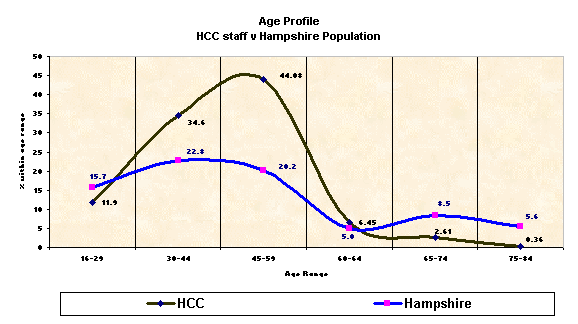
The workforce age profile shows that the County Council has more than double the percentage of people in the 45 to 59 years range than the local area but is below the average level for 16 to 29 year olds and for those aged 65 and over.
The challenge for the Council will be to attract younger people and to either recruit from the over 65's pool and/or to persuade staff approaching or achieving pensionable age to stay working rather than fully retire.
3.2 Diversity Profile2
The 2001 census shows that Hampshire has a Black and Ethnic minority population of 2.3 %.
The Council Council has a staff ethnic minority rate of 1.6% (excluding schools), of which 0.77% are in the top 5% of earners (BV11b).
This indicates some under representation within the council workforce.
3.3 Employment (Unemployment) Profile 3
In May 2005 there were 7479 unemployed people in Hampshire (excluding Portsmouth and Southampton), which equates to 1% of the available workforce, which is significantly lower than the national average of 4.8%. The level has consistently been between 0.9% to 1.0% since April 2004.
Unemployment rates vary across the County, with the lowest rate being Hart with 0.7% and the highest Havant with 1.8% - Winchester, where a large percentage of HCC staff are based, has an unemployment rate of 0.8%.
The two unitary authority areas of Portsmouth and Southampton have a higher unemployment level at 1.9% and 2.1% respectively, and this is still under half the national figure.
With an average turnover rate in 2004/05 of around17% (excluding Schools), the unemployment pool available for the Council Council to draw from is only 3 times greater than the likely number of people it needs to recruit (circa 2500 new staff).
3.4 Skills Profile4
The 2001 Census indicates that 20% of the local population between 16 and 60 have below average basic skills, and is comparable (slightly under) with the national average of 24%.
On the other hand Hampshire does have more than double the national ratio of its manufacturing workforce employed in high technology industries, especially around Rushmoor and Basingstoke.
For service workers, employed in knowledge-based services, Hampshire, at 19% is slightly higher than the national average of 17.9%.
This suggests that Hampshire's workforce, as a whole, is well skilled but that within our training and development we should consider the provision of education in the basic skills as well as technical, professional and management development
3.5 Living Conditions within Hampshire
Hampshire is the third largest county in the UK with a population of 1.24m residents and over 500,000 households. There is a mix of urban and rural areas, and although only 10% of the county is urban, 87% of the population lives in urban areas.
90% of the county is classified as rural, with significant areas that are the subject of national and international environmental designations, including the National Parks for the South Downs and New Forest.
The average house price5 is £222,695, but the range according to type is:
Detached: £337,334 |
Semi-detached: £201,217 |
Terraced: £172,195 |
Flat: £137,788 |
 Change in last year: 5.1%
Detached: £424,658 |
Semi-detached: £255,619 |
Terraced: £226,042 |
Flat: £181,664 |
and the lowest in Gosport
Detached: £271,227 |
Semi-detached: £165,041 |
Terraced: £133,391 |
Flat: £112,583 |
The high cost of housing, especially within the Winchester area, will have an effect on the catchment area for recruitment and mean that the need to use cars and public transport to get to Winchester will be a significant factor for employees and for the Council's policies on sustainability, green travel plan, flexible working, relocation and overall reward strategy.
3.6 Transport infrastructure6
The County is experiencing the effect of higher-than-average traffic growth, higher than average car ownership, increasing journey lengths and reducing usage of public transport, which will lead to even higher levels of congestion. 84% of households in Hampshire have access to one or more cars and traffic growth in recent years has been about 2% a year on motorways and 1% on local roads.
Traffic congestion problems coupled with inadequacies in the public transport system are a threat to economic competitiveness, health and quality of life.
Hampshire County Council's approaches of green travel plan, flexible working, stress management, staff wellbeing and reward are critical to workforce development and staff retention.
4. Corporate and Community Strategy
This HR plan must be seen against the background of the County Council's Corporate and Community Strategies, which it is designed to support.
4.1 Corporate Strategy - The six key aims are:
 Maximising life opportunities - creating opportunities for the whole community and reducing the impact of discrimination, through the provision of high quality accessible learning and caring services.
 Stewardship of the environment - protecting our environment by promoting the principles of environmental sustainability and ensuring that Hampshire continues to be a place where people of all backgrounds want to live, work and visit.
 Achieving economic prosperity - leading the development of strong, diverse and sustainable economy, which supports jobs, businesses and investment.
 Building strong and safe communities - working together with local people to help make people feel informed, empowered and eliminate discrimination. Working in partnership with others to make people feel safe in their own communities and to promote health and well being.
 Improving services - ensuring our services are inclusive and continuously improving to meet the changing needs of the community.
 Developing councillors and staff - ensuring that councillors and staff are equipped with the appropriate skills, knowledge and resources to respond effectively to the needs of all the people of Hampshire regardless of background.
4.2 Community Strategy7
The Community Strategy for Hampshire is a long-term view of how to ensure a better quality of life for everyone, both now and in the future. It is for everyone who lives, works or visits Hampshire and aims to reflect what the community believes are important priorities, and what collectively we can do to address these.
The key areas are:
· Strong and Safe Communities
In the future Hampshire will be a place:
- with strong and safe communities with fewer inequalities and less deprivation
- where people feel safe
- where young people play an active part in society and are valued
- where all communities are included and are actively involved in local decision - making
- and where everybody has access to quality local environments
· Health and Well being
Hampshire will be a place that supports the health and well-being of its communities by:
- providing equal access to services for everybody
- caring for our ageing population
- reducing accidents, coronary heart disease, and drug and alcohol abuse
- giving people a good start in life
- promoting healthy lifestyles and a good work/life balance
- providing opportunities for culture and leisure for everybody
· Economic Prosperity and Lifelong Learning
Hampshire will have economic prosperity and foster a culture of lifelong learning by:
- securing the long-term competitive position of the Hampshire economy
- providing sufficient employment, land and premises to meet business needs in a sustainable way
- providing adequate skills and training for recruitment and retention of staff to meet Hampshire's economic needs
- addressing the learning needs of people in Hampshire
- supporting the different needs of local employers, in different urban, suburban, rural or geographic contexts
- supporting and recognising the contribution that unpaid work and volunteers make to communities.
· Environment infrastructure and transport
Hampshire will have an environment to be proud of, and develop efficient and effective infrastructure and transport networks by:
- promoting sustainable development and encouraging people and businesses to take responsibility for recycling, minimising waste and maximising sustainable use of Hampshire's natural resources -addressing mobility and accessibility issues
- providing affordable and appropriate housing and the infrastructure needed to support population growth addressing the needs of both urban and rural communities
5. Workforce challenges
The pace of change and the expectations on Local Government continue unabated. Some of the key drivers that the County Council must prepare for and respond to are:
5.1 Gershon Report - the delivery of identifiable gains is expected to come from, for example, leading edge management practices, exploiting new technology, developing partnerships both within and outside the public sector for the purpose of achieving efficiencies.
5.2 Children's Act 2004 - requires major internal changes and also requires local authorities to forge new partnerships with relevant bodies. This means that the County Council will become increasingly dependent on the workforce of a number of partnership agencies in order to meet it obligations to children and families within Hampshire.
5.3 Comprehensive Performance Assessment - continue to be the primary mechanism by which the overall performance of the County Council is assessed. Managing people is a key driver in this assessment framework and Diversity and Gender equality is becoming a strong feature. Having achieved Excellent status in successive Comprehensive Performance Assessments (CPA), innovative, flexible and committed employees, who are responsive and able to withstand the pressures of change will help the County Council maintain this level of achievement into the future.
The corporate assessment will include consideration of whether the County Council is meeting statutory requirements on human rights, race, age, sexual orientation, gender, disability and religion.
5.4 Labour market pressures - the labour market will continue to be competitive and skills shortages will continue to present problems in specific occupational groups and in some `one-off' situations. Additionally the effects of the ageing population are now being seen within the labour market, exacerbating skills shortages and impacting on pension provision. Hampshire overall has a high level of employment and is an expensive place in which to live.
5.5 Technology change - the requirement for Local Authorities to be 100% e-enabled drives change to the way in which services are delivered to both the public and internally within the Council and changes of this nature will be more successful if supported by an adaptable workforce, willing to embrace new ways of working.
5.6 Legal issues - in employment matters there are a number of significant employment law proposals scheduled for 2005.
In October, new Transfer of Undertakings Regulations will come into force, which, amongst other changes, will introduce more comprehensive coverage for contracting out.
A new Disability Discrimination Act (2005) is also introduced which amends the 1995 Act so as to place a positive duty on public bodies to promote equality of opportunity for disabled people. The new act also removes the requirement that a mental illness should be "clinically well recognised" before it can amount to a mental impairment and a person with HIV, cancer or multiple sclerosis is deemed disabled from the point of diagnosis.
This is similar to the existing duty to promote Race Equality under the Race Relations amendment act (2000).
The government also intends to introduce a single Commission for Equality and Human Rights. The implications for the County Council are likely to be positive in that there will be a single body monitoring the range of equality legislation. It is unlikely that the commission will be in operation before 2008.
Draft regulations relating to Age Discrimination, due to be implemented in 2006, will outlaw discrimination on grounds of age and will require changes in the County Council's employment practices and service delivery.
The Information and Consultation of Employees Regulations (2004) will change the way the County Council engages with employees on Corporate and Employment issues.
6. Current Workforce - a Snapshot8
The following information offers a snapshot of the workforce within the County Council at the end of March 2005. The human resources covered include all those employed on permanent or fixed term contracts, but excludes casuals, supply, temporary agency, contract workers/ consultants and those employed directly by schools, unless otherwise stated.
We employ a total of 37,236 people (Full time Equivalent = 25,037) taking both the County Council core services and schools staff into account.
6.1 Excluding Schools based staff, the County Council employs a total of 13, 607 people (Full Time Equivalent = 10,107).
Within this number of people:
· 47.5 % of workforce works full time and 52.5 % works part time.
· Of those staff that work part time, 91.6% are women and 8.4% male and of those staff that work full time, 60.7% are women and 39.3% male.
· The average length of service with HCC is 8.2 years.
· 35.7% of the workforce has a length of service over 10 years.
· 77% of the workforce is female, 23% male.
· Women outnumber men in all the pay bandings up to Hampshire Management Grades where the situation reverses
· Women represent 37.4% of the top 5% of earners in the council (BV11a).
· 38.7% of the workforce is over the age of 50 ( 23.8 % are over the age of 55)
· 1.3% of the workforce is under the age of 20 years
· Ethnicity - 1.6% of the workforce have declared they are from a black or ethnic minority group (HCC work force excluding schools)
· Disability - 1.34% of the workforce have declared they have a disability.
· Full profile of the current HCC workforce can be found in appendices 1 & 2 of this report.
7. The Kind of Workforce we need to have
7.1 Achieving High Performance
High performing organisations recognise that success requires an integrated performance management approach. Sustained service improvement is achieved as a result of people being `well managed' and being capable, both physically and mentally, of consistent performance and action, coping with additional pressures and ongoing change whilst bringing fresh ideas and innovation to the workplace. To achieve our aims requires consistent high performance from skilled and motivated staff, working to clear goals delivering high quality services at minimum cost.
The HCC HR High Performance Model

7.2 To continue to be successful and to remain so, we therefore need a workforce capable and committed to:
· being people and community centred
· valuing people in their diversity
· working together in partnership
· continuously improving, being innovative and challenging inefficiency
· being responsive to the changing population of Hampshire
7.3 Developed as part of our current County Council Balanced Scorecard our people organisational values and behaviours are the basis of the competencies which help shape the role profiles for the organisation. They form part of the individual performance planning and management process and career development frameworks. We need to ensure therefore that:
All Staff are: Demonstrating commitment to the Council and its aims Solution orientated and results focused Taking personal responsibility and accountability Demonstrating excellence in team working and partnership |
All managers and leaders are meeting the leadership competencies by: Demonstrating an ability to create the vision and to lead organisational change to increase effectiveness, efficiency and value for money Demonstrating excellence in people management skills Facilitating a performance culture Promoting personal accountability and integrity Being able to fairly and consistently identify, assess and reward contributions towards organisational goals. Rewarding risk management and innovation |
7.4 These values and behaviours should be consistently and regularly measured through customer and staff surveys.
8. Themes in Hampshire County Council
Organisation change is the overarching theme and how employees respond to this is critical to the continued success of the County Council.
8.1 Reorganisations - the major reorganisation is within the Social Service and Education Departments, with the setting up of new Children's Services and Adult Services departments. The establishment of a corporate Contact Centre is smaller in scale but will fundamentally change the way in which HCC delivers it services and impacts on the way some jobs are designed. Other review of services are described within individual department plans.
8.2 Pay and Benefits Project - the impact of this on the longer-term performance of the County Council has been a key driver in the development of a new framework. However the immediate impact on individuals could well change the pattern of motivation and morale across the Council in the short term, if not longer. The new framework will make the Council more competitive in the marketplace, though there will be a continued need for market supplements for specific occupations.
8.3 Employee turnover - the rate continues to be higher than desirable and impacts on recruitment costs and continuity of services.
8.4 Health and Wellbeing - the Local Government Act 2000 introduced the value of wellbeing and requirement for community strategies to improve the wellbeing of the area. The Hampshire Strategic Partnership has developed its three year Community Strategy (2004 - 2007) which outlines four cross-cutting themes, one of these being `Health and Wellbeing'.
This is set against a background of the need to improve community health, an aging population many of which will have to work longer, a requirement to increase prosperity in the County, reduce traffic congestion and ultimately to provide a better quality of life for the people of Hampshire. The successful implementation of a health and well-being strategy would add significantly to the attractiveness of the County to individuals and businesses who both have agendas which include prosperity and well-being.
8.5 The pace of life is increasing which makes it increasingly difficult, from an individual perspective, to maintain wellness (e.g. 1 in 4 people will experience mental health problems in a year). There are severe pressures on time both in work and outside of work with, for example, many people having caring duties for both children and aging parents. Increased pressures are also part of modern life with more uncertainty. The percentage of people at work who have or will experience restructuring is increasing rapidly. This trend is very true within the County Council itself. If staff cannot cope with these pressures then it is certain services will be significantly impacted. Decreasing participation in physical activity (despite the efforts of Sport England) and rising levels of obesity are real threats to health, enjoyment and performance.
9. Summary of initiatives being led by HR
A number of initiatives are current underway to address the gaps identified in the workforce profile and the themes emerging from Departments. These current initiatives, combined with further planning, together with an effective HR strategy, will ensure that HCC has the right workforce both now and for the future. The HR Strategy (last reviewed in 2002) is currently being updated and due for publication in July 2005, after consultation with managers from all departments.
9.1 Employee Relations
· A project undertaking a fundamental review of sickness absence management with the aim of improving attendance at work.
· A project looking at the implications of implementing the age discrimination legislation (effective from 2006) - and to consider changes that are needed to encourage employees to continue working beyond the normal retirement age
· Development of policy and supporting processes for a career break scheme - to provide flexibility and encourage employees to return to the County Council
· Review of employment policies (e.g. probation period, relocation) - to modernise and ensure relevance to the current and future employment climate.
· Implementing the Dispute Resolution legislation - which requires new
formal processes for handling disputes in the organisation.
· Information and Consultation Regulations - reviewing the potential impact of this new legislation on the way in which the County Council engages with its workforce and Unions.
· Review of the Dignity at Work policy - to modernise and ensure relevance to current legislation and the employment climate.
9.2 Developing Leadership and Workforce Skills & Capacity
· Continuing to lead the Leadership programme.
· Development of individual performance planning linked to organisational performance management and remuneration & reward strategies.
9.3 Organisational Development
· Children's and Adults Services projects
· Development of line management programmes
· Review of manager induction programmes
· Continued development and application of the Equalities Impact Assessment process to ensure that all decisions and policies are assessed for impact on the specific groups.
· Investors in People (maintaining self assessment and accreditation)
· Investments in SAP HR & Payroll systems
9.4 Recruitment and Retention
· Development of e-recruitment system incorporating on-line job applications and talent bank
· Flexible working - to develop supporting policy and information for managers to encourage increased use of flexible working when appropriate
· Mobile working - to consider the people and managerial impacts of mobile working and develop employment policy and information for managers.
· Reviewing and streamlining employment contracts- to modernise and develop Employer Brand in the message to potential employees about the Council as a place to work.
· Graduate recruitment, "Grow your Own" and "Succession Planning" - a suite of initiatives to help address the recruitment and retention issues.
· A review of the Council's exit interview scheme - to achieve a higher participation rate and more consistent information about reasons for leaving.
9.5 Remunerations and Benefits
Reward - Design and implementation of the Pay and Benefits project.
9.6 Schools
· Remodelling of the Schools workforce to address teachers workload and recruitment / retention issues
· Restructuring of pay arrangements for teachers
· Collaboration with external company on the management of Hampshire's supply teachers database
· Roll -out of SAP HR modules across schools 