
Archived decisions
APPENDIX
New Forest Area Contents
Page |
Paragraph | |
3. Problems and Opportunities |
||
Hampshire's Area Transport Strategies |
||
New Forest Transport Strategy Area |
1-3 |
3.275-3.286 |
Public Perceptions and Attitudes in the New Forest |
3 |
3.287-3.290 |
Problems and Issues |
4 |
3.291 |
Opportunities |
||
National Park Designation and Partnership Working |
4 |
3.292-3.294 |
New Forest Tour and Car-Free Tourism |
4-5 |
3.295-3.297 |
Summary of Key Problems and Opportunities for the New Forest Transport Strategy Area |
5-7 |
|
4. Long-Term Strategy |
||
New Forest Transport Strategy Area |
8-9 |
4.120-4.123 |
Ongoing Protection of the New Forest as a Nationally Important Area for Leisure and Nature Conservation |
9 |
4.124-4.125 |
Accommodating and Managing the Impacts of Visitors to the New Forest |
9-10 |
4.126-4.129 |
Maximising Access to Services and Employment, Particularly Recognising the Rural Nature of the New Forest |
10 |
4.130-4.131 |
Addressing the Negative Impacts of Traffic in the New Forest |
10-11 |
4.132-4.139 |
Developing and Building on Existing Partnerships |
11 |
4.140 |
5. Five Year Strategy |
||
Five Year Area Transport Strategy |
||
New Forest Transport Strategy |
||
Lyndhurst |
12 |
5.294 |
Ringwood |
12 |
5.295 |
Lymington |
12 |
5.296 |
Brockenhurst |
12-13 |
5.297 |
New Milton |
13 |
5.298 |
National Park |
13 |
5.299 |
New Forest Area
Chapter 3: Problems and Opportunities
Hampshire's area transport strategies |
New Forest Transport Strategy area
3.275 The New Forest Transport Strategy area is heavily dominated by the newly designated New Forest National Park. This designation recognises its natural beauty and special qualities for nature conservation, and builds on historical protection of the area from major development.
3.276 The New Forest has its roots as an ancient royal hunting forest, dating back to 1079, and is characterised by heathland, grassland and bogs as much as by wooded areas and enclosures (or inclosures as they are termed locally).
3.277 However, the strategy area is not entirely rural. The New Forest itself covers a number of significant settlements, including Beaulieu, Brockenhurst, Lyndhurst and Ringwood, which are generally of a high environmental quality in their own right. The strategy area also covers the southern coastal towns running between Lymington and New Milton. It abuts the Southampton Waterside towns to the east and the South East Dorset conurbation, centred on Poole and Bournemouth, lies immediately to the west.
3.278 The population of the strategy area is 100,000 with 35,000 living within the National Park area. However, equally significantly, there is a population of over 500,000 living within the nearby urban centres (source: 2001 census).
3.279 Given the natural beauty of the New Forest, it is unsurprising that tourism is a very significant element of the local economy. The New Forest generates up to 20 million visits per year, including 3.5 million overnight stays. There are over 500 tourism enterprises in the New Forest district generating over £300 million per year in direct income. Currently 90% of trips to the New Forest are by car. The County Council and its partners, is trying to redress this balance through the promotion of car-free tourism under the banner The New Forest. The large number of visitors places considerable stress on the road network, particularly during the summer months. Lyndhurst particularly suffers, being the focal point for all traffic - local and visitor - accessing the south of the New Forest.
3.280 There are ancient commoners' rights, including the right to turn out livestock, with the famous New Forest ponies being the most notable example of this practise. While this practise contributes to the character of the area, these animals are vulnerable to road traffic accidents. Much of the New Forest area is covered by a blanket 40 mph speed limit to reduce the impact of traffic and to reduce human and animal accident rates.
3.281 Effective partnership working is essential to achieving progress in the New Forest. The County Council works closely with a wide range of bodies including the National Park Authority, New Forest District Council, the Countryside Agency (to be replaced by Natural England in January 2007), the Forestry Commission, the Highways Agency and tourism organisations. A number of the partners jointly employ a New Forest Transport Strategy Officer to coordinate activity and initiatives.
3.282 The County Council and its partners are looking to maintain and strengthen existing ties with organisations representing the local community's rights and traditions to protect the cultural heritage of the New Forest. This includes links with the Verderers (the ancient body protecting commoners' rights), the National Farmers' Union and the Commoners' Defence Association.
3.283 The New Forest is crossed by a number of strategic roads carrying high volumes of traffic. The A31 provides the main link to the national network for the Bournemouth/Poole conurbation and carries up to 65,200 vehicles daily. The A36 trunk road provides the main link between Southampton and Salisbury and onwards to the West Country. This is a key route for freight traffic accessing Southampton port and carries over 17,900 vehicles per day, including a high proportion (approximately 14%) of freight traffic (source: AAWT 2004 Hampshire County Council permanent counts). The A337 provides access for the Southampton Waterside towns. The high volume of fast moving traffic causes particular problems of severance between the communities and the National Park.
3.284 In carrying large volumes of traffic, these routes, and other A roads provide relief for the more rural routes, and have enabled the introduction of the 40mph blanket speed limit across much of the rest of the New Forest. However , there are existing and increasing problems of rat-running through the quiet lanes of the New Forest, including a number of short cuts used by heavy goods vehicles to avoid congestion points on the strategic network.
3.285 The New Forest is relatively well served for long distance rail travel, with a number of stops on the London-Bournemouth line. Bus service coverage is relatively sparse, reflecting the area's predominantly rural nature. There is an existing Cango demand responsive bus service in the Sway area, and the introduction of a further service is planned for the Fordingbridge area.
3.286 While visitor traffic is a significant element of road traffic, there is also a significant proportion of locally generated traffic using the network. As might be expected in a rural area adjoining two large urban conurbations, there is a net outflow in-commuting trips. Approximately 31,000 commuters out commute from the New Forest district (source: 2001 census) while only 18,000 commute inwards. A total of 46,000 live and work within the district. Diagram 3.286 shows that commuting to and from the New Forest strategy area is relatively low and reasonably balanced. This is unsurprising given the largely rural nature of the area, and the relatively small population and number of places of work. Note that the table relates to the strategy area and not to the New Forest district (which significantly also includes the Waterside area).
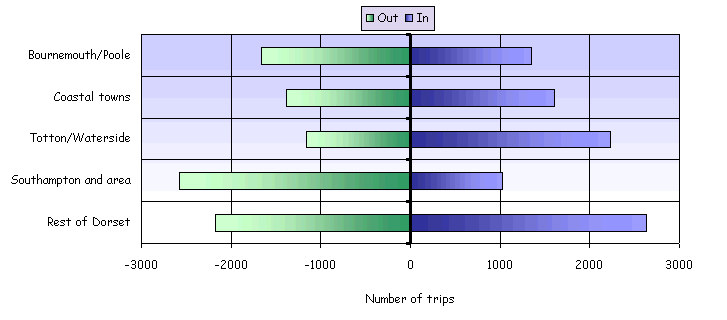 Diagram 3.286: New Forest commuting
Public perceptions and attitudes in the New Forest
3.287 The countywide travel survey, Transpol, was carried out in 2003 across the New Forest. The survey asked residents for their reasons for travelling by different modes of transport, as well as asking for attitudes towards alternative modes of transport to the car.
3.288 The main reasons given for travelling by car were journey time-savings, convenience, and lack of public transport alternatives. Bus and rail travel were chosen because they are perceived as being less stressful, conveniently located and also offer journey time-savings. Walking and cycling were chosen for their health benefits and convenience.
3.289 Asked to give their opinions on alternative modes of transport to the car, residents felt that local bus services were convenient, with good availability of seats and good ease of boarding and alighting. However residents were less happy about the frequency, price of fares and waiting facilities for buses. Rail services were seen to offer good journey times, frequency and ease of car parking, but were poorly viewed in terms of the cost of parking and fare prices. Impressions of cycling were that there is a good network of cycle lanes offering good safety to cyclists, but with concerns over cycling on normal roads and also the security of parking facilities. Walking facilities were generally considered to be quite good: clean facilities, good crossing points and good personal safety; however lighting is an issue in the New Forest, together with the quality of pavements and ease of passage.
3.290 Residents said that their top priorities for transport improvements are:
· Improvements to roads and pavements
· Measures to reduce the impact HGVs.
· Develop school and work place travel plans.
Problems and issues
3.291 Key issues for the New Forest transport strategy area are:
· Managing pressures arising from visitor traffic.
· Local congestion and air quality problems, particularly affecting Lyndhurst.
· Routing of HGVs to avoid damage to the New Forest and unacceptable impact on local communities.
· Responding to changes and new pressures arising from the National Park designation.
· Maintaining existing and building new partnerships.
· Access to services, particularly for elderly people, within the southern coastal towns
· Action to further reduce animal accidents.
· Community severance arising from traffic levels and high speeds on the A326.
· Pressure arising from major development in South East Dorset, under the South West Regional Spatial Strategy.
· Impacts of further development at Bournemouth Airport.
National Park designation and partnership working
3.292 The recent designation of the New Forest as a National Park presents new opportunities to develop and build on existing partnerships. Strong relationships already exist with various organisations representing the diverse range of interests in a protected area such as the New Forest.
3.293 The National Park Committee existed for a number of years prior to designation. As its members are now the core of the new National Park, it means continuity and an existing common understanding of problems and issues.
3.294 A number of the partners jointly fund a New Forest Strategic Transport Officer. A steering group representing all the funding bodies determines the objectives of the post, which are currently:
· Demand management.
· Strategic cycle network.
· New Forest tourism, including car-free tourism.
· Promotion of community and public transport schemes.
Partnership working and coordination is a key element of the work.
New Forest Tour and car-free tourism
3.295 The New Forest Tour, a circular tour for visitors on an open-top bus, was introduced in 2004. The bus provides the opportunity for passengers to hop-on and hop-off to suit their own needs, and includes a cycle trailer to allow cyclists to use the service. Local residents can also use the service.
3.296 The service ran as a commercial venture in the first year. The County Council is working with other partners on the route to provide discounts and tie-ins to make the service even more attractive to potential users. The County Council has signed-up to the national Tourism on Board research project, led by Lancaster University, to examine how to maximise the benefits of the service. The County Council will explore whether there is merit in further support to secure the longer-term future of the service.
3.297 The Forestry Commission is planning a full review of its visitor parking arrangements, and has invited the County Council to support this work. This will provide a major opportunity to manage the levels and locations of car based tourism in the New Forest.
Summary of key problems and opportunities for the New Forest Transport Strategy area
Problems |
Actions |
There are particular problems of traffic congestion through the centre of Lyndhurst (A35/A337 junction). |
The County Council has established the Operation of the New Forest Road Network Sub-Group to investigate all potential improvement options. The Group's initial recommendations are included in the programme (Chapter 6). |
Congestion in Lyndhurst High Street has resulted in air quality problems leading to the designation of an Air Quality Management Area. |
The County Council is working jointly with the District Council and will provide and test transport related options, as set out in Chapter 5, for inclusion in the Air Quality Management Plan. |
There is an identified need for improved public transport links and reliability, and that services are properly related to the rural nature of the area. |
· The programme (Chapter 6) includes provision for investment in public transport reliability, including QBPs, bus priority measures and improved information. · There is an existing Cango demand responsive service in the area around Sway with a further service currently being introduced in the Fordingbridge area. |
There are concerns about the future viability of the Hythe Ferry service because of increasing operating costs and the replacement cost for infrastructure (eg ferry pontoon). |
· Investment is planned for the ferry pontoon in the proposed programme (Chapter 6). There is also potential to invest in improved interchange facilities. · The County Council is working with the ferry operator to lobby against a large increase in the rating valuation, which would potentially undermine the future of the service. |
The routing of some HGVs is currently causing environmental damage and disturbance to communities, particularly on unsuitable routes. |
· The County Council is working with freight operators and with adjoining authorities, through Freight Quality Partnerships, to agree advisory routes and to introduce weight restrictions where required. · Improved signing will be introduced under the investment programme (Chapter 6) to support such measures. This will include improved signing to ports, an approach agreed with ABP (Associated British Ports). |
Safety of road users particularly those in vulnerable group eg young people, pedestrians and cyclists. The New Forest has an above average incidence of accidents involving younger people. |
The Casualty Reduction Programme -Chapter 6 - is targeted to address locations with the worst accident records. In accordance with the five-year strategy (Chapter 5), this will be supported by education and publicity to highlight particular problems for particular groups. |
There are particular problems with increasing traffic speeds and resultant personal injury accidents and animal collisions on unfenced roads. |
As above, the programme will tackle particular accident locations. This will be supplemented by new signing providing information on animal accidents. |
There are severance problems affecting Waterside residents accessing the New Forest. In particular, the A326 is a barrier to pedestrian and cycle movements, and causes significant severance. |
· Investigation is currently underway to identify safe crossing facilities, which will be delivered as part of the programme (Chapter 6). · A New Forest strategic cycle network has been agreed with partners and will guide investment in links in to the Forest. |
Major development arising from Regional Spatial Strategies, particularly in South Hampshire and South East Dorset strategic growth areas, will generate additional demand for travel within and through the New Forest. |
The County Council is working jointly with a range of authorities to ensure that the impact of new development is appropriately managed and that long distance travel to and through the Forest is minimised. Traffic management measures will be required to minimise the use of unsuitable forest roads. |
Opportunities |
Actions |
There are existing strong partnerships, particularly with the New Forest Transport Strategy Steering Group and the National Park Authority. |
· The County Council will maintain and develop existing partnerships, as described in the five year strategy (Chapter 5) to guide future transport policy. · In particular there will be a need to strengthen partnership working with the new National Park Authority as it becomes more established. |
There are a number of proposals from the recently adopted New Forest Transport Strategy (see Chapter 4). |
The strategy (see Chapters 4 and 5 for more detail), establishes a number of priorities for investment that are reflected in the programme (Chapter 6). |
Decriminalised Parking Enforcement is due to be introduced for the New Forest district in 2006. |
· The arrangements are being introduced by New Forest District Council under an agency agreement with the County Council. · Opportunities to improve demand management will be examined, albeit that such measures will need to reflect the rural nature of the area and to accommodate the needs of visitors. |
Chapter 4: Long-Term Strategy
New Forest Transport Strategy area |
4.120 The strategy for the New Forest needs to be agreed with the recently established New Forest National Parks Authority. Amendments to the long-term strategy and five year LTP strategy may be required following discussions with the National Parks Authority in order to reflect the change to National Parks status.
4.121 The shared strategy for the New Forest is set out in the document The New Forest Transport Strategy, which was adopted in November 2003. The strategy vision is:
"To maintain and improve the area's distinctive character, whilst improving opportunities for sustainable travel for everybody through appropriate transport investment and greater integration. To enhance the environment, the local economy and reduce social exclusion. This will be achieved through the integration of land use and transport policies, through an innovative approach to travel and the management of existing resources in the New Forest"
4.122 The Strategy sets out a number of aims and objectives; the following are of particular relevance to the LTP:
Aims:
· To help deliver the aims and objectives of the New Forest Committee's Strategy for the New Forest.1
· To support and maintain the vibrancy and economic vitality of local communities.
· To provide effective local transport solutions tailored to the needs of particular areas which reduce impacts on the Forest environment.
· To reduce the adverse impacts of traffic on the environment and local communities especially in the designated National Park.
· To integrate land use and transport planning.
· To increase the opportunities for sustainable travel and accessibility for all, having regard for the particular sensitivity of remote areas.
Objectives:
· To promote new and improved passenger transport, cycling and walking facilities that are accessible to all and that provide a safe, reliable, affordable and attractive alternative to the car.
· To provide imaginative local solutions that maintain the character of the New Forest and its towns and villages, contribute towards the development of a safe, attractive and cherished environment, reduce visual impact, noise and air pollution, and at the same time enhance in a sustainable way access to services, goods and markets for local people and businesses.
· To ensure that any new major development which is likely to generate significant additional traffic is located and planned to provide as far as possible alternative means of travel to the private car, preferably making use of existing services and interchanges.
· To investigate measures such as road closures and road pricing to manage the use of the New Forest's highway network and reduce the undesirable effects of traffic on wildlife, outdoor recreation, the unique New Forest environment and the understanding and enjoyment of its special qualities.
· To raise public awareness of transport issues and maintain support for the Strategy, with a view to bringing about changes in travel behaviour
· To identify a range of targets and indicators which can be monitored, in order to assess the effectiveness of the Strategy's measures.
· To improve road safety and reduce the number of injuries to both people and animals.
· To ensure adequate accessibility for people with disabilities.
· To reduce the level and impact of through traffic on the New Forest.
4.123 Drawing on these aims and objectives, and on stakeholder comments, the key long term themes for the Local Transport Plan are as follows:
Ongoing protection of the New Forest as a nationally important area for leisure and nature conservation
4.124 The approach to transport planning and traffic management must match the Forest's recent National Park designation. Visitor traffic will be managed appropriately, particularly at hotspots such as Lyndhurst, and car-free tourism will be promoted.
4.125 While it is recognised there is a need for commercial vehicle traffic to service and support the local economy, the impact of such vehicles needs to be carefully managed to minimise the impact, particularly in the quieter areas of the Forest.
Accommodating and managing the impacts of visitors to the New Forest
4.126 Car traffic accounts for over 90% of all visitor travel in the National Park. The County Council will continue to examine and implement a range of interventions to boost car-free tourism and to manage visitor traffic.
4.127 The main focus of congestion in the New Forest area centres around a traffic signal junction of very limited capacity in the centre of the village of Lyndhurst. The A337 from the north of the area intersects with the A35 from the east at a point in the centre of Lyndhurst. An Air Quality Management Area has been declared in this location (see also Chapter 5).
4.128 The strategy for Lyndhurst and the New Forest will be developed and evaluated to ensure the problems of congestion are adequately addressed within the wider policy and planning context, particularly the National Park status and the importance of the tourism industry to the local economy. A working group has been established of officers and elected members from the County Council and New Forest District Council. The group's remit is to examine the operation of the road network in the New Forest, including previous and new proposals to relieve problems of congestion.
4.129 In line with the LTP's overall theme of reduce, manage and invest, it is likely that demand management measures will need to support these approaches. Information and measures to influence travel behaviour will be particularly important. The County Council will continue to invest in alternatives to the car. Cycling is a popular activity for visitors, providing a sustainable means of accessing and getting around the New Forest.
Maximising access to services and employment, particularly recognising the rural nature of the New Forest
4.130 Given the rural nature of the New Forest, the car will continue to play an important role in personal mobility within the strategy area. There is a need to ensure adequate community and passenger transport services are available, particularly for those who do not have access to a car, or who wish to use alternatives. The long-term strategy is for improvements to bus services and infrastructure, including the appropriate use of demand responsive services, subject to funding availability.
4.131 Rail provides an important public transport alternative in the New Forest, particularly for longer distance journeys including direct services from Brockenhurst to London. The designation of the Lymington Branch line as a Heritage Line is a welcome intervention, offering greater security for the future of the service.
Addressing the negative impacts of traffic in the New Forest
4.132 Traffic levels in the New Forest area are high and increasing. Congestion, and the resultant air pollution, is a regular feature of summer life in Lyndhurst and at other hotspots.
4.133 Consultation on this provisional LTP has demonstrated considerable concern about the impact of heavy goods vehicles on local communities. Residents are concerned about the effect of goods vehicles on the safety of vulnerable road users, especially children, pedestrians, horse-riders and animals. Heavy Goods Vehicle routing strategies will be reviewed to reduce congestion and improve the overall performance of the local road network. Initial investigations will take place in the first year of the LTP to manage congestion via a demand responsive signing system. These investigations will be undertaken in liaison with the Highways Agency.
4.134 An unfortunate side effect of the open nature of the New Forest, and the existence of ancient grazing rights, is the high level of animal accidents. While extensive work has been undertaken to reduce this problem, these are still a significant issue.
4.135 Speed is widely recognised as the main contributory factor in animal accidents. When the blanket 40mph speed restriction was introduced in 1988 on the unfenced roads in the New Forest, the animal accidents rate reduced from over 200 deaths a year to around 75. However, more recently, the accidents involving stock animals have now started to increase again. In 2004 nearly 100 stock animals were killed, perhaps indicating that the initial positive reaction to the blanket speed limit had now waned and speeds were rising leading to increased animal deaths.
4.136 An animal accident reduction strategy has now been agreed with the Commoners Defence Association. It aims to reduce the current number of animal accidents relating to stock animals on the New Forest. This will hopefully be achieved through a range of different measures and approaches, such as;
· Increasing the awareness of the driver.
· Looking at high risk areas to establish need.
· Ensuring pony reflective collars are available.
· Introducing a publicity campaign in the local and national press.
· Reducing the incidents of speeding across the New Forest.
· Support the work of the road safety committee.
4.137 Hampshire County Council log the accident data onto a GIS map to provide detailed information on the location of each incident, and uses the information to support casualty reduction work and identify high risk routes.
4.138 The New Forest's location between two major conurbations generates problems of its own. The impact of planned business development at Bournemouth Airport, combined with additional passenger numbers is of concern. The potential for substantial further development under the South East and South West Regional Spatial Strategies, in both South East Dorset and Solent will be carefully assessed.
4.139 At the more local level, the A326 causes significant severance problems between the Waterside communities and the National Park.
Developing and building on existing partnerships
4.140 The importance of partnership working in the New Forest is highlighted at a number of places in this document, and is the only truly effective way of securing improvement. These relationships range across private, public, voluntary and regulatory organisations. Many, particularly the public sector organisations, are tasked with the protection of the New Forest, in line with the objectives above.
Chapter 5: Five Year Strategy
Five year area transport strategies |
New Forest Transport Strategy
Lyndhurst
5.294 The strategy for Lyndhurst focuses on reducing localised congestion, improving accessibility by non-car modes and road safety. Long periods of high volume, queuing traffic has caused an air quality problem in Lyndhurst High Street. The District Council has recently declared an AQMA. A joint working group of county council and district council representatives is currently reviewing possible options to address issues within and around the village (including traffic management measures and road building options). The key elements of the strategy are:
· Managing local congestion on the approaches to Lyndhurst village by intelligent traffic routeing (utilising VMS signs on an demand responsive basis). It is envisaged that a project between the County Council and the Highways Agency will be established to route traffic from the M27 at an earlier junction to utilise the A326 and A35 (via the new Colbury right turn junction). It is hoped this will relieve the A337 southbound and Lyndhurst High Street at the busiest times.
· Improvements to traffic control within the village with revised traffic signal operations and trials with selective vehicle detection.
· AQMA - traffic based options will be identified and modelled to reduce the air quality problems.
Ringwood
5.295 The key elements of a strategy for Ringwood are:
· Improving town centre accessibility in terms of pedestrian and cycle links by continuing and enhancing the Ringwood pedestrian and cycles project.
· Improving leisure cycle links into Dorset to create a hub of leisure cycling for the New Forest area.
Lymington
5.296 The strategy for Lymington focuses on improving local accessibility and recognises the importance of the thriving street market. The key elements are:
· Improving accessibility and safety in the High Street and considering reallocating road space in favour of pedestrians.
· Improving accessibility from the Emsworth Road car parks via New Street.. Improvements to this important route, including better pedestrian facilities will aid accessibility to the High Street.
Brockenhurst
5.297 The key elements of a strategy for Brockenhurst relate to local access and safety:
· Investigation of possible traffic management and road safety improvements or initiatives to improve traffic circulation within the village.
· Provision for utility and leisure cycling where it represents good value for money.
New Milton
5.298 The key elements of a strategy for New Milton relate to local access:
· Reviewing the town centres improvements that have taken place through the first LTP. This will identify if any further critical junctions need to be signalised or improved and consider town centre access issues.
National Park
5.299 The County and District Councils will work in partnership with the National Park Authority to develop a strategy to promote and protect the environment through transport initiatives including:
· Continued promotion of the New Forest bus tour and encouraging car-free tourism.
· Development of demand management strategies through signing and other techniques.
· Development of guidance for coach drivers in terms of suggested routeing, setting down and parking facilities.