Archived decisions
Contact: Share D'All, Chief Executive's Department,
Email: [email protected]
1. Executive Summary:
Attached is the Report of the Hampshire County Council Scrutiny Panel looking into Project Integra. The Inquiry was carried out in the style of a Westminster Select Committee and took both written and verbal evidence as well as undertaking background research.
Due to the excellent response from many of the stakeholders and their willingness to provide evidence the Panel had many issues to explore and so had to make choices as to which areas it would follow up and particularly make recommendations upon. Consequently the Panel decided to focus on broad strategic issues, within the three scoping questions it posed, rather than get involved in trying to resolve lower level, more operational issues. That said the last section does provide some advice for both Hampshire County Council and its partners about some generic issues to which it believes they should pay attention in order to make progress in the future and which, the Panel hopes, would enable them to resolve some of the more operational issues in the appropriate forums.
1.1. Recommendations
The key strategic recommendations of the Panel are that :
a) The nature of Project Integra and the Management Board is re-defined as a facilitation network between the 15 partner businesses rather than a business in itself thus allowing:
· The current structure to focus on progressing Municipal Waste with appropriately focused support, targets and expectations
· The WDAs to create a separate parallel structure but within the broader scope of Project Integra to progress work on wider integrated Waste Management issue including commercial and industrial waste - with an opportunity to WCAs willing to make firm financial commitment to be included.
b) That the Vision of Project Integra as a whole is one of `Waste Management' which is developed and owned by the Leaders and Chief Executives of the appropriate partners. From this wider vision would then flow strategies and plans for defined elements such as:
· Municipal Waste
· Commercial & Industrial Waste
c) Further recommendations are laid out in detail in the report covering:
· The role of Hampshire County Council and lessons it needs to learn
· The way in which the Executive Officer role would need to be redefined to provide support for the suggested structure & vision
· Suggested approaches to other barriers which have evidenced themselves as key to making progress as a partnership
2. Introduction:
As a consequence of the decision of its former Executive Member to threaten Hampshire County Council withdrawal from the Management Board of Project Integra unless performance standards are improved, Hampshire County Council's Policy and Resources Scrutiny and Select Committee decided to set up a `select committee style' Inquiry into the way forward with Project Integra.
The three questions the Panel scoped the Inquiry around were:
_ What should the long term vision of Project Integra be and how should partners work together to achieve it?
_ What should the Hampshire County Council role in the Project Integra Management Board be?
_ What are the barriers to moving forward and how could they be overcome?
The Panel were acutely aware that this was a sensitive topic, not least because it involved taking into account not only facts but also perceptions as both are key to providing constructive suggestions as to how partnership arrangements can work more effectively.
The Panel were very grateful for the way in which the members and partners of Project Integra engaged with the process. Without this engagement it would not have been possible to produce any useful outcomes, which the Panel were very concerned to achieve.
This report is written initially to Hampshire County Council as the instigator of the scrutiny. However it also offers constructive suggestions to the partners in Project Integra which it believes will facilitate effective future working. The report is based around the three broad elements of the scope identified above although we have separated Vision and Structure as the latter is an issue in itself that impacts on other areas:
_ Vision of Project Integra:
_ Structure of Project Integra
_ Roles within Project Integra:
_ Removing Barriers:
Additional information is available in the Appendices and is signposted throughout the report. The written evidence and themes from the oral evidence is available on the web from the link identified at the end of the report.
A description of the Panel Membership and methodology is available in Appendix 1.
3. THE VISION OF PROJECT INTEGRA :
Taking account of the evidence received the Panel wishes to make the following comments about the vision:
3.1. What is Project Integra?
Having read and listened to a variety of evidence about the nature of Project Integra the Panel felt this to be the first fundamental question about which there needs to be, and isn't currently, a common agreement.
a) Is Integra an £80m Business?
Putting aside the fact that legally the trade mark `Project Integra' is owned by ONYX and results from the contract between the Waste Disposal Authorities and ONYX, permission to use the logo has been given to the current structure to describe the workings of the partnership. It is maybe therefore not surprising that the partnership has begun to describe itself as "an £80m business" . The Panel feels that this is an inaccurate and misleading description of the partnership and potentially, is one of the current stumbling blocks to progress.
b) A more helpful Definition?
Although there is a very minimal joint budget the Panel suggests that in fact the Partnership known as Project Integra is not a business at all but rather a mechanism for facilitating joint working between many separate businesses (Waste Collection Authorities; Waste Disposal Authorities and ONYX). As such it is better described as a concept, club, network or co-operative but not a business in itself.
The Panel believes the current Management Board needs therefore to be seen as part of a wider `Project Integra' which needs to include a variety of mechanisms to facilitate the relationships between a wider variety of businesses and agendas. This may mean the Management Board needs to be titled slightly differently to describe the particular aspects of the wider business with which it is engaging. This will be expanded under the section about structure below.
Adopting this definition of Project Integra, the Panel believes, will set the scene for a clearer way of looking at both vision, roles and structure and would help clarify some of the many confused expectations and mixed perceptions that are currently hindering the effectiveness of the partnership.
3.2. The Current Vision:
The current vision of Project Integra is laid out in 1.2 of the Business Plan 2005 - 2010. It is stated as being:
"By 2020 Hampshire has a world class and sustainable material resources system that maximises efficient re-use and recycling and minimises the need for disposal"
The Panel felt there were two issues with relation to this vision statement:
a) The Breadth of Vision
The suggestion made above about the need to re-define Project Integra as a wider facilitative mechanism which brings together a variety of different businesses fits very well with the current vision which is broad and speaks of a `material resources system'.
Despite widespread agreement with the various Plans and Strategies which express the vision, several witnesses (Ref 1*) identified the need to revisit the aims and the links between the broader Material Resource Strategy (MRS); the PI Business Plan and the Joint Municipal Waste Management Strategy (JMWMS).
· The Panel believes the vision should be expanded in the context of the cost effective and integrated Management of Waste in Hampshire and not as a vision of "Project Integra" which could be limiting. Within this wider vision the current partnership within the Management Board (WCA & WDAs) would then take forward in its Business Plan and JMWMS the specific responsibility for the municipal waste aspects of the vision.
b) Clarity and Robustness:
Especially given the potential for (and indeed the apparent existence of) misunderstanding amongst so many partners, the Panel felt that the vision statement needed further clarification in terms of laying out the principles it is working to and the steps it needs to take to achieve the broader vision.
Having heard the variety of perceptions about which principles the partnership was, and should be, working to the Panel believes the Vision Statement needs to describe these more clearly. What the principles are, of course, is for Project Integra itself to clarify but from the evidence it received the Panel would suggest that as well as taking into account statutory drivers the stated underlying principles, for this wider vision, should include:
· Practical separation of waste streams utilising best practice principles for collection
· Highest achievable levels of recycling where markets are available or can be developed
· Minimisation of landfill
· Generation of energy from waste conversion: taking into account the best practical environmental option
· Reductions in the amount of waste being created
· Competitive costing against the independent sector
4. THE STRUCTURE OF PROJECT INTEGRA:
The Panel felt very strongly that the structures within Project Integra must follow the vision they are designed to achieve and should not be seen as an end in themselves. Needs and contexts are, and will be, constantly changing in a fast moving waste environment and the wider project needs to be able to change and evolve to meet the challenges.
Given the suggested wider vision for Waste Management and the definition of Project Integra as a facilitation network to deliver that vision, the Panel suggests that the structure needs to include a wider variety of different elements. Each element should be focused on specific aspects of the wider vision, providing a range of mechanisms to bring together different combinations of partners to deliver different aspects of the vision. The Panel felt the fundamental elements of such a structure should include the following to most effectively facilitate the vision:
4.1. Setting the Wider Vision:
This would inform the structure rather than being part of it but the structure for doing it is important. The Panel felt the setting of the wider `Waste Management' vision was most effectively done in a similar way to the Partnership for Urban South Hampshire (PUSH), which brought together the relevant Council Leaders and Chief Executives to define the vision. The Panel felt this approach was important for high level strategy as without real high level understanding and commitment from all necessary partners at the outset any implementation in such a complex partnership environment would be bound to struggle
4.2. Municipal Waste
Once the wider vision is set the Panel felt the Management Board should continue to exist as it is because it is the vital facilitation mechanism for WCA and WDA businesses to interact, with their private business partner, to deliver the most effective management of municipal waste. However it needs to be clear that Municipal Waste is its focus so that it can organise itself to best achieve it.
a) In this context it was felt it entirely appropriate that it should operate on a `one Authority one vote basis' whereas in a business environment that cannot be tenable where there are not equal financial obligations. It should act as the operational facilitator that links strategy on municipal waste to operations
b) Consideration should then be given to the extent to which the current sub-Management Board arrangements should continue to exist - the Panel has not given attention to this in detail.
c) It would be wise to consider the name of the PI Management Board in this context as a more appropriate title would better reflect the wider view of Project Integra. A possible title may be something like `PI Municipal Waste Management Board'.
4.3. Commercial / Industrial Waste:
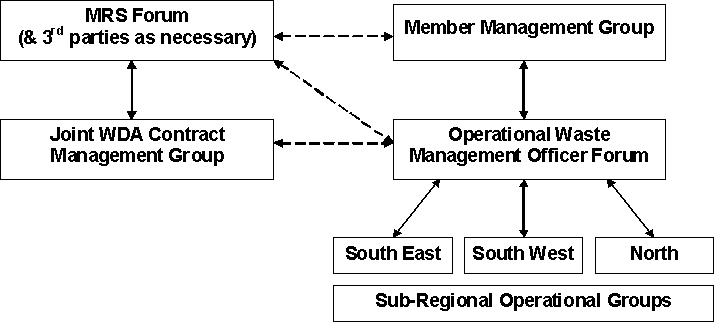
Within the wider vision and concept of Project Integra a new element of the structure should involve the Waste Disposal Authorities meeting to discuss and decide strategy and pursue targets around commercial and industrial waste. It was felt that something following the principles of the MRS Forum of the `Portsmouth Model' (outlined in their submission and attached in Appendix 3) would be a useful basis to work from to take this forward.
a) Waste Collection Authorities who wish to buy into this area (i.e. financially commit) could bid to do so separately from the Municipal Waste mechanism although joint working groups could more easily be formed within this model to streamline municipal waste collection as well (as has occurred with New Forest District Council and Test Valley).
b) The PI Municipal Waste Board would not be specifically involved as a board. However, the representative organisations that comprise the board would have direct involvement as part of a) above.
4.4. Contracts Group:
Whilst the Panel heard some strong concerns about the need for the WCAs to have a voice at the Contracts Group, they felt that the underlying issue was the need for WCAs to be assured that their recycling needs and ambitions are being included in strategic considerations. In this belief the Panel suggests that:
a) WCAs do not need to BE at the actual Contracts meetings BUT
b) Their views, particularly in relation to the specification of the infrastructure for waste disposal, would adequately be represented through the structure outlined in 4.1 and 4.2.
5. ROLES WITHIN PROJECT INTEGRA:
5.1. The Role of Hampshire County Council
a) In the newly defined Municipal Waste Management Board:
Hampshire should continue to be an equal partner in this group on the basis of a `one authority one vote basis' but with the recently agreed role of standing Vice Chairman where it is not itself in the Chair.
The Panel does have some feedback about how it can more effectively carry out that role in the next section but it is felt vital that they are there at the table as the most crucial Waste Disposal partner in relation to the Hampshire WCA partners.
b) In the wider Commercial Waste Management Group:
Hampshire should take the lead on this with their WDA partners, Portsmouth and Southampton. As previously mentioned in 4.3a the other WCAs should be able to buy into this with firm financial commitments if they are willing and able to do so.
c) In the Overall Project Integra Structure:
As the Authority with the largest capacity to provide support and expertise to the overall Waste Management project Hampshire should take a lead role in providing some of the research and specialist officer advice that different elements of the partnership network will require to enable it to move forwards. This is seen as a matter of resource reality rather than superiority and should be viewed and enacted as such.
5.2. The Executive Officer Role
Given the suggestions the Panel has made about the nature and definition of Project Integra and the role of the newly defined Municipal Waste Management Board, it is necessary then to revisit the role of the Executive Officer who supports it.
The current, and fairly newly agreed, Job Description for the Executive Officer appears to start with the assumption, which the Panel suggests is misleading, that Project Integra is an £80m business. The Panel feels that in light of its suggested change to the role and definition of the current Management Board the role of the Executive Officer should then focus on the following activities:
a) Administration:
· To provide an administrative service to the Management Board and its allied Committees and sub-committees
b) Promotion & Communication:
· To promote the overall vision of Waste Management within the Management Board and its partners
· To disseminate information to the Board
· To organise 'best practice' sharing between partners (including workshops and any other methods found to be effective)
c) Induction:
· To ensure effective induction of new Members and Officers so that they are able to participate fully and with good understanding of the Municipal Waste activities within the overall Waste Management agenda
d) Facilitation:
· Suggesting and supporting actions to ensure the smooth working of the partnership and resolve differences where they arise
· Supporting the Chairman to do the above
5.3. Managing the role:
The Panel felt that the management arrangements for the EO need to be reviewed to ensure that he is clear as to how his effectiveness is being measured and supported. Any such performance management arrangements need to enable the partnership to provide feedback and be assured that any improvements required, should they arise, would be effectively managed.
6. REMOVING BARRIERS:
6.1. Rebuilding Trust
The Panel recognised that there is a need to rebuild trust between partners following the actions of Hampshire in threatening to withdraw earlier this year. It recognises and applauds the work of the current Chairman to reconcile the situation and is pleased to hear that the new Executive Member in Hampshire has been described by both the Chairman and Executive Officer very positively and with hope for the future.
With regard to the threat to withdraw the Panel has looked into this and is very clear that whilst there were understandable reasons for the ongoing frustration that was being felt at the time, there was never any advice from officers to the previous Executive Member concerned to withdraw from the Project Integra Board.
The Panel have also had feedback from the Chairman and Executive Officer that following the meeting on the 10th October they are very clear that Hampshire is still committed to the partnership.
6.2. Feedback to Hampshire County Council:
The Panel felt that they need to give the following feedback to Hampshire County Council officers and Members involved in this area in order to try and ensure smooth and effective working in the future.
a) You need to get your message across more clearly:
It is very clear that there is an enormous amount of expertise and desire to take things forward in the area of Waste Management but equally clear that the messages are not always getting through. The Panel recognises that there are many potential barriers to understanding but believes Hampshire must hone its skills in overcoming them. Specific areas where it should focus its attention are:
· communicating the implications of the larger waste management picture
· explaining how vital it is that tonnages come through the system and WHY
· describing their views about the way ahead and WHY they hold them
· coming across with consistency
· describing the financial aspects and trends
b) You need to be more proactive in identifying issues / feeding back and resolving problems.
Many partners seemed to have no understanding of the frustrations being experienced by Hampshire and were very puzzled as to why Hampshire had taken actions like signing the Business Plan if they felt there were fundamental flaws in the approach.
The Panel are aware that the County sometimes fears being seen as `big brother' pushing its weight around and consequently holds back on occasions. Unfortunately, as has happened here, all too often the outcome is that eventually it ends up coming across in exactly the way it was trying not to by taking what appear to others to be disproportionately drastic approaches. Early, clear, assertive (not aggressive) action targeted to resolution needs to be something Hampshire becomes more known for.
c) Take a more proactive role in inputting your Waste expertise and knowledge in to the Partnership.
This is not about superiority but about resource. Several partners felt that ONYX officers were being given too powerful a role in advising the Board. If Hampshire, as the other partner providing this advice, does not take a more proactive role in doing so the current situation will continue.
d) Pay attention to what the potential high waste producers are doing (in terms of tonnage)
Focusing on percentages of overall waste collection is not necessarily the most crucial measure. Percentage against individual tonnage for each WCA would be useful to keep an eye on, particularly in relation to those areas where there is a high tonnage throughput
e) Manage the role of Hampshire Waste Services more assertively as a Customer
This is really feedback for the Contracts Group in which, it seems clear, Hampshire is often the lead player because of resources. The evidence from Bob Lisney, the other Hampshire witnesses and even HWS themselves seemed to reinforce that there are areas for improvement in the way in which the contract is managed and specifically around the need to revisit the input specification which HWS admitted had not been done since its inception.
Along with the point made in 6.2c (above) the Panel believes that the WDAs need to take a more assertive approach to the management of the contract on behalf of all the partners to ensure that it is clear (both in fact and perception) that the customer needs of the Project Integra partnership are being met by the Provider, Hampshire Waste Services.
6.3. Feedback for the whole Partnership:
a) Improving Communication
The Panel were struck by the number of areas where partners either did not understand each other's perspectives or had very different ones. Even in areas such as the targets agreed for 2010 the Panel found that there were very different perspectives as to whether these were aspirations or actual commitments, a factor which could be very significant as time goes on and needs to be revisited.
The Panel suggests that the Partners need to recognise the potential for such misunderstandings and work hard to ensure they are:
· Really listening to each other
· Clarifying things
· Trying to understand each others perspectives
· Sharing information, knowledge and good practice
· Take care over "grand" statements without authority to achieve
b) Ensuring Attendance at Sufficiently Senior Levels:
All of the witnesses the Panel interviewed, and much of the written evidence, acknowledged that part of the current problem was that many Authorities had stopped putting forward sufficiently senior officers to PI meetings. This is understandable if there were frustrations about the level at which meetings were operating BUT it is a vicious circle that can only be turned around if partners take responsibility for challenging the effectiveness of the meetings rather than voting with their feet. To take this forward each Authority needs to decide to re-commit sufficiently senior people to the Project.
c) Preparing for Decisions:
Members of the Board need to have decisions trailed sufficiently so that, especially where financial commitments are being looked for, they can gain guidance from their own Cabinets about the financial parameters they are operating to BEFORE the debate with partners.
d) Clarifying Measures:
The Panel were frustrated by the fact that every witness they asked about the financial Performance Indicators in the Business Plan was quite open about the fact that they were comparing `apples with pears' as Councils were producing the figures in different ways. The Panel suggests that it would be wise to reach agreement to the formula for reaching such figures so that they are more useful in comparison.
7. CHAIRMAN'S THANKS:
My thanks to the Members of the Panel whose attention at meetings was exceptionally high, who assiduously studied the voluminous written material, and were rigorous in their questioning of witnesses views and facts.
My thanks also to HCC Officers who assisted the Panel over this period.
Background Papers: (Section 100 D - Local Government Act 1972)
The following documents disclose facts or matters on which this report, or an important part of it, is based and has been relied upon to a material extent in the preparation of this report.
NB the list excludes
1. Published works
2. Documents which disclose exempt or confidential information as defined in the Act.
Title: |
File: |
Innovation Forum Symposium "Waste Management in Two Tier Authorities" - Workshop Report (Dec 2004) |
|
Joint Working in Waste Management Case Studies - IDeA Knowledge |
http://www.idea-knowledge.gov.uk/idk/core/page.do?pageId=678952 |
Project Integra Business Plan 2005 - 2010 |
|
External Verification of Best Value Report - Audit Commission (March 2005) |
Written Evidence & Oral Evidence Summaries are available on Hantsweb and can be accessed from the following link:
PANEL MEMBERSHIP & METHODOLOGY:
Councillors involved included:
Cllr John Bryant Cllr Keith Evans
Cllr Rod Baulk Cllr Sam James
Cllr Michael Cartwright Cllr Jo Kelly
Cllr Adrian Collett Cllr Mel Kendal (Chairman)
Cllr Brian Dash Cllr Jacqueline Porter
Cllr Dr Raymond Ellis Cllr Alan Weeks
There were two stages to the Inquiry:
· The receipt of written evidence:
o Both that received by contributors and various reports and documentation already produced for Project Integra
· Oral evidence sessions with invited witnesses
Following these the Panel considered its findings and made the recommendations attached.
Written Evidence Was Received From:
Chairman & Executive Officer of Project Integra |
Cllr R Dibbs (RBC) & Steve Read |
Chairman & Vice Chairman of Project Integra Scrutiny Committee |
Cllr A Marsh (TVBC) & Cllr S Shepherd (NFDC) |
Eastleigh Borough Council |
Chris Reed (Deputy CX) |
New Forest District Council |
John Mascall (Director of Commercial Services) |
Rushmoor Borough Council |
Peter Moyle (Leader) & David Quirk |
Test Valley Borough Council |
Alex Higgins (Interim Head of Environment & Health) |
Southampton City Council |
1.Cllr Richard Williams |
2. Lorraine Brown, Executive Director, Environment and Transport ; Gordon Adams, Head of Waste and Open Spaces ;Andrew Trayer, Waste Management and Recycling Manager | |
Basingstoke & Deane Borough Council |
Bob Brooks (For Head of Street Care) |
Gosport Borough Council |
Stevyn Ricketts (Head of Contracts & Amenities) |
Fareham Borough Council |
Jim Kettlewell (Director of Leisure & Environment) |
East Hampshire District Council |
Gill Kneller (Head of Environmental Services) |
Hart District Council |
Phil Whiting (Head of Public Spaces) |
Hampshire County Council |
Environment Dept |
Portsmouth City Council |
Julian Lomas |
Salvation Army Trading Co. |
Gareth Ward |
Individual |
Don Jerrard |
Oral Evidence was Received From:
John Mascall |
NFDC (and TV joint project) |
Gavin Graveson & John Collis |
ONYX |
Steve Read & Cllr Dibbs |
Project Integra - Executive Officer & Chairman |
Julian Lomas & Richard Johnson |
Portsmouth |
Cllr Louise Bloom (Portfolio Holder) & David Burton (Head of Direct Services - incl waste) |
Eastleigh BC |
Bob Lisney |
HCC Assistant Director of Environment |
Paul Archer, Alison Quant & Cllr Knight |
HCC Head of Waste Management; Director of Environment & Environment Portfolio Holder |
Other relevant documents referred to included :
Documents owned by Project Integra Management Board were used by permission and with thanks:
Waste Forecasts & Waste Minimisation (January 2005 Brook Lyndhurst) |
`Project Integra - Maximising Collection Efficiency' (Jacobs Babtie - May 2005) |
Project Integra Best Value Report (February 2005) |
GLOSSARY OF TERMS:
PI |
Project Integra |
WCA |
Waste Collection Authority |
WDA |
Waste Disposal Authority |
MRS |
Material Resource Strategy |
JMWMS |
Joint Municipal Waste Management Strategy |
HWS |
Hampshire Waste Services (Subsidiary of ONYX set up to work in Project Integra) |
PUSH |
Partnership for Urban South Hampshire |
MRF |
Materials Recovery Facilitiy |
`Portsmouth Model'