
Archived decisions
HFRA HR Committee Equality & Diversity Report Appendix 1
Target Audience: WT RT NU
SO/1/6/3
Page 1
(AK 9/05)
EQUALITY AND DIVERSITY STRATEGY
1 POLICY
1.1 To comply with our values, policies, procedures and current legislation and follow best available practice, HFRS will take every opportunity to positively promote equality of opportunity, promote good relations amongst all groups within our communities and eliminate unlawful discrimination.
1.2 In order to achieve this we will work towards our objectives which are:
- Ensuring that all our customers have equal access to our services.
- Ensuring that we provide fair and equal access to all employment opportunities.
1.3 Every member of the Service has responsibilities for ensuring that:
- They understand and comply with the content of the Service Orders relating to Fairness and Dignity, or Equality and Diversity.
- They understand their legal and moral responsibilities with regard to promoting equality of opportunity, promoting good relations amongst all groups within our communities and eliminating discrimination.
2 PROCEDURE
2.1 Race Equality Scheme (RES)
Our RES is a statutory requirement under The Race Relations (Amendment ) Act 2000, which places a general duty upon us to do whatever we can to:
- Eliminate unlawful discrimination
- Promote equal opportunities
- Encourage good race relations
The Act also places specific duties upon us and our RES articulates how we intend to meet these duties. Our RES is a stand alone scheme which deals with matters of Race only, and we have linked the document into our Comprehensive Equality Policy (CEP) and Corporate Equality Action Plan (CEAP) which incorporates the broader equality issues of gender, disability, age, sexual orientation and religion or belief.
SO/1/6/3
Page 2
(AK 9/05)
2.2 Comprehensive Equality Policy (CEP)
Our CEP has been developed in accordance with the Equality Standard for Local Government (ESLG), which provides a framework of best practice for equality and diversity.
The CEP contains:
- Our values and standards
- Our key aims and objectives
- The processes we have put in place to make it happen
- Our milestones for employment
- Our specific responsibilities with regard to:
* Consultation
* Publication
* Targeting and monitoring
* Access to information and services
* Training
* Equality impact assessment
* Partners and contractors
- Our policy statements on:
* Racial equality (see RES)
* Gender equality
* Disability equality
* Age equality
* Sexual orientation equality
* Religion or belief equality
* Positive Action
The CEP is translated into corporate actions within our Corporate Equality Action Plan (CEAP).
2.3 Corporate Equality Action Plan (CEAP)
Our CEAP contains our corporate actions that will enable us to achieve our key aims and objectives contained within our CEP. These actions are made up of high level outcomes that enable Function Heads to prepare their detailed Function Equality Action Plans which will enable them to contribute successfully to this plan.
3 CONDITIONS OF SERVICE
- The National Joint Council for Local Authority Fire and Rescue Services, Schemes of Conditions of Service, sixth edition (The Grey Book).
- The National Joint Council for Local Government National Agreement on Pay and Conditions of Service (The Green Book).
SO/1/6/3
Page 3
(AK 9/05)
4 APPENDICES
Appendix A - Comprehensive Equality Policy (CEP)
Appendix B - Race Equality Scheme (RES)
Appendix C - Corporate Equality Action Plan (CEAP)
Appendix D - Equality Impact Assessment Guidance Notes for Managers (Available on website at http://www.hantsfire.gov.uk/jobs/equalimp.doc)
- End -
SO/1/6/3
(AK 9/05)
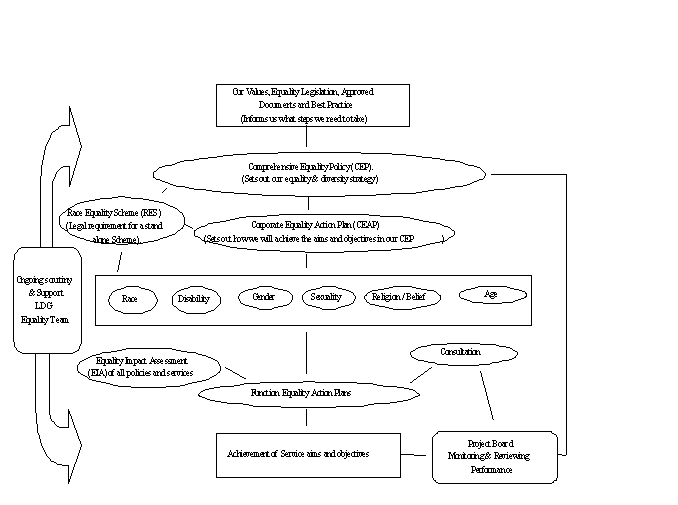
DIVERSITY AND EQUALITY STRATEGY
- End -
SO/1/6/3
Appx A
Page 1
(AK 9/05)
COMPREHENSIVE EQUALITY POLICY
1 INTRODUCTION
1.1 This policy sets out our commitment to mainstreaming equalities through a strategic and systematic approach.
1.2 Recent legislative developments covering religious belief, sexuality, the Disability Discrimination Act 1995 which removes the exemption given to Fire Services, and the requirement for us to comply with the Equality Standard for Local Government (ESLG), necessitated a review of our policies and procedures regarding equality and diversity.
1.3 In response to the review, the Chief Officer and Service Management Team re-iterate their commitment to the principles of equality, fairness, dignity and valuing diversity for everyone - our employees, service users, partners, contractors and our diverse communities in Hampshire, in one Comprehensive Equality Policy .
Our Comprehensive Equality Policy (CEP) covers the following:
- Our values and standards
- Our key aims and objectives
- Processes we have put in place to make it happen
- Our milestones for employment
- Our responsibilities in respect of:
* Consultation
* Publication
* Targeting and Monitoring
* Access to Information and Services
* Training
* Equality Impact Assessments
* Partners and Contractors
- Our policy statements on:
* Racial equality (see RES)
* Gender equality
* Disability equality
* Age equality
* Sexual orientation equality
* Religion or belief equality
* Positive Action
SO/1/6/3
Appx A
Page 2
(AK 9/05)
1.4 How is our CEP going to Work in Practice?
We already have a range of Service Orders (policies), strategies and action plans/timelines. The CEP provides a framework for all of these, including:
- Service Orders
- Function action plans
- Procedures and best practice
Our CEP will be translated into actions within our Corporate Equality Action Plan (CEAP) in Appendix C.
- End -
SO/1/6/3
Appx A
Contents
(AK 9/05)
COMPREHENSIVE EQUALITY POLICY
CONTENTS
SECTION A: VALUES, STANDARDS AND STRUCTURES
1 Values
2 Key Objectives
3 Resources, Roles and Responsibilities
4 Relationship to Race Equality Scheme
SECTION B: EMPLOYMENT
1 Context
2 Commitment
SECTION C: EQUALITY PROCESSES
1 Equality Impact Assessment
2 Consultation
3 Publication
4 Targeting and Monitoring
5 Access to Information and Services
6 Training
7 Partners and Contractors
APPENDICES
Appendix A1 - HFRS Equality and Employment Policy Statement
Appendix A2 - Definitions
Appendix A3 - Consultation
Appendix A4 - Targeting and Monitoring
Appendix A5 - Policy guidance on Racial Equality
Appendix A6 - Policy guidance on Gender Equality
Appendix A7 - Policy guidance on Disabilities Equality
Appendix A8 - Policy guidance on Sexual Orientation Equality
Appendix A9 - Policy guidance on Religion or Belief Equality
Appendix A10 - Policy guidance on Age Equality
Appendix A11 - Policy guidance on Positive Action
- End -
SO/1/6/3
Appx A
Section A
Page 1
(AK 9/05)
SECTION A: VALUES, STANDARDS AND STRUCTURES
1 VALUES
1.1 Our Mission
1.1.1 We will contribute to our mission of "making Hampshire safer" by promoting greater understanding and responsible attitudes towards fire safety and by providing a responsive, caring fire and rescue service.
In order to fulfil our mission we will embrace the following 4 values:
People - We value all our employees by practising and promoting:
- Fairness and respect
- Recognition of merit
- Honesty, integrity and mutual trust
- Co-operative and inclusive working
Improvement - We value improvement at all levels of the Service by:
- Accepting responsibility for our performance
- Being open minded
- Considering criticism thoughtfully
- Learning from our experiences
- Consulting others
Service to the Community - We value service to the community by:
- Working with all groups to reduce risk
- Treating everyone fairly and with respect
- Being answerable to those we serve
- Striving for excellence in all we do
Diversity - We value diversity in the Service and the community by:
- Treating everyone fairly and with respect
- Providing varying solutions for different needs and expectations
- Promoting equal opportunities in employment and progression within the Service
- Challenging prejudice and discrimination
SO/1/6/3
Appx A
Section A
Page 2
(AK 9/05)
1.1.2 To achieve this we rely on the contribution of all our elected members, employees, our diverse communities and other stakeholders and partners, in contributing to our policies and creating a positive climate where:
- Difference is positively valued and celebrated
- People from different backgrounds have equality of opportunity
- Positive relationships are developed between all groups
1.1.3 It is essential that all our managers actively promote our values of equality, diversity, fairness and dignity in our activities as an employer and as a service provider.
1.2 Our Commitment
1.2.1 We are committed to addressing all forms of discrimination, and have identified some priorities including race, gender, disability, sexual orientation, religious belief and age. We are also considering other issues or forms of potential disadvantage.
1.2.2 We accept our obligations under the Race Relations Act to promote good race relations and in particular our duty to have regard to the need, in all our activities to:
- Tackle racial discrimination
- Promote equality of opportunity; and
- Promote good relations between people of different racial and social groups
1.2.3 Our Race Equality Scheme and this equality and employment policy statement can be found in Appendices B and A1.
2 KEY OBJECTIVES
2.1 Our 2 key objectives are to:
- Work towards ensuring that all our customers have equal access to our services and employment opportunities.
- Provide fair and equal access to all employment opportunities, including access to career development, progression and training opportunities for employees and our diverse communities.
2.2 We accept that to achieve these objectives we must address the issues of discrimination including institutional, direct and indirect discrimination (definitions of these can be found in Appendix A2).
SO/1/6/3
Appx A
Section A
Page 3
(AK 9/05)
3 RESOURCES, ROLES AND RESPONSIBILITIES
3.1 We have created several forums to promote and support our equality and fairness strategies in employment and service delivery within a framework which accepts that equality and fairness is a mainstream function. All employees and elected members share a common responsibility for contributing to the success of our Equality Policy.
3.2 Organisational Roles and Responsibilities. Responsibility for implementing and monitoring Equality Policy and plans lies at two levels:
· Corporate level
· Function level
3.3 The Corporate Level
Elected members and the Service Management Team will provide the framework to deliver our equality policy. Their role is to:
- Determine our values and standards to be reflected in our service provision and employment.
- Set the overall targets for employment and service delivery to meet the needs of our customers and employees.
- Provide the guidance to assist functions in complying with those standards
- Monitor progress.
3.4 Elected Member Roles and Responsibilities
Elected Members have an important role to play in building an organisation that values equality, diversity and fairness and are formally involved in equality issues at 5 levels:
- Hampshire Fire and Rescue Authority
- HR Committee
- HFRS Fairness and Dignity Forum
- Equality and Diversity Project Board
- HFRS Local Diversity Group
Their responsibilities include:
- Providing leadership and support in achieving our equality objectives
- Ensure appropriate resources are available to achieve our objectives
- Oversee progress in policy development, service delivery and employment, through the committee reporting process and where appropriate discussing new equality objectives
SO/1/6/3
Appx A
Section A
Page 4
(AK 9/05)
3.5 The Service Management Team (SMT)
SMT is made up of the Principal Officers and function heads and all have a corporate responsibility for leadership, policy and target monitoring regarding equality, diversity and fairness. Function managers also have a responsibility for linking the activities of their function to the Local Diversity Group and the internal Equality and Diversity Focus Group. Members of SMT chair the Fairness and Dignity Forum on a rotating basis.
3.6 Function Level
Our middle and supervisory managers are responsible for meeting our key objectives in employment and service delivery and will be responsible for:
- Producing and reviewing function action plans to reflect our values and standards.
- Achieving the standards and targets in service provision/delivery and in employment
- Contributing to annual progress reports to SMT and the HR Committee.
3.7 Employee Involvement
As part of their contractual obligation, all employees are expected to comply with the Service policy on equality and diversity. To achieve this a structure is in place that facilitates employee involvement and participation as follows:
3.8 The Local Diversity Group (LDG)
In addition to Elected Members, SMT members and other managers, the LDG includes representative bodies and an external community representative. The LDG provides the link between corporate equality activities and function management teams by:
- Clarifying how functions can contribute towards the corporate equality objectives.
- Sharing information from internal/external consultations and monitoring.
- Providing progress reports and monitoring information to inform corporate decision making.
3.9 HFRS Fairness and Dignity Forum (F&D Forum)
The F&D Forum links the Fire Authority, SMT, LDG and the rest of the workforce in addressing equality and diversity. It meets quarterly at different workplaces to enable employees to take a participative role in the Forum which includes an update on equality and Diversity issues within HFRS and a presentation from a guest speaker.
3.10 HFRS External Consultative and Advisory Group
Our External Consultative and Advisory Group is made up from members of our diverse communities and seeks to influence the policies of HFRS by advising and commenting on the potential impact of its policies.
SO/1/6/3
Appx A
Section A
Page 5
(AK 9/05)
4 RELATIONSHIP TO OUR STATUTORY RACE EQUALITY SCHEME
4.1 The Race Relations (Amendment) Act 2000 requires all authorities to publish a Race Equality Scheme (RES) which sets out how they will meet their duties under this Act.
4.2 The Equality Standard for Local Government (ESLG) framework requires local authorities to publish and implement a Comprehensive Equality Policy that integrates with and complements the RES and we have prepared our CEP accordingly.
4.3 In line with 4.2, our Race Equality Scheme will integrate with and complement our Corporate Equality Action Plan (CEAP), covering the requirements set out in the ESLG Framework. The ESLG sets out the value and standards for guiding all our equality and diversity work, including the specific strategy outlining the key issues for each priority group.
4.4 The Function Equality Action Plans form the operational levels of our Corporate Equality Action Plan (CEAP) and these plans set out the detailed activities each function is taking to address our objectives of improving access to employment, training and services for all our priority groups.
5 TARGETING AND MONITORING
5.1 In trying to reduce disadvantage in employment, we will set targets for service providers and recruiters and monitor compliance through a formal cycle of review.
5.2 We will monitor recruitment and relevant areas of service delivery to ensure that people from all backgrounds have equal access to employment and services.
Guidance for equality monitoring of service delivery and employment are set out in Appendix A4.
6 ACCESS TO INFORMATION AND SERVICES
The success of our initiatives depends on our ability to communicate with our community about services and employment opportunities. We will ensure that:
- Our customers have equal access to information about our business, our services and employment opportunities.
- Our services meet the needs of our diverse communities.
- Our employees have the skills, information and understanding to respond to all our communities appropriately.
SO/1/6/3
Appx A
Section A
Page 6
(AK 9/05)
7 TRAINING
7.1 We recognise that appropriate training is essential to achieve our equality objectives and assist our employees to fulfil their professional and career aspirations.
7.2 Our approach to training is detailed in our Training and Development Policy and incorporates a number of principles, which include:
- Our statutory responsibilities for training under the Race Relations Amendment Act 2000
- The need to incorporate our core value of embracing equality, diversity and fairness when delivering training
- The importance of training in addressing issues of historic disadvantage in employment, including the presence of women and people from minority ethnic groups in senior management
- Setting training targets to enable employees to deal confidently and effectively with a diverse communities.
7.3 We will monitor all aspects of training provision and the employees being trained and learning outcomes.
8 PARTNERS AND CONTRACTORS
8.1 Like many other public sector service providers we are becoming increasingly involved in partnership working with local government, private sector and voluntary agencies. We also use contractors to carry out specific work for us.
8.2 We recognise our duty to promote equality of opportunity and the elimination of discrimination when working with partners and contractors. In doing so we are committed to:
- Working with and influencing our partners to make Hampshire a place where all communities are treated fairly and respectfully and where diversity is valued and celebrated.
- Ensuring that contractors comply with our Equality, Fairness and Dignity at work policy when they are undertaking work for us.
- Encouraging partner organisations and contractors to understand and oppose all forms of discrimination.
- End -
SO/1/6/3
Appx A
Section B
Page 1
(AK 9/05)
SECTION B: EMPLOYMENT
1 THE CONTEXT
We recognise the business advantage of having a workforce that reflects our community as we rely on the diverse skills and experiences our employees bring to the workforce and to our community. Our employee profile is a visible aspect of our performance in achieving this. Our ongoing monitoring of how we achieve this, and our work environment is also a requirement under legislation.
2 COMMITMENT
2.1 Commitment needs to be translated into visible actions to remove barriers, and which demonstrate progress in achieving our objectives and therefore support our equality policy.
2.2 To support this commitment we have policies covering employment practice which highlight a range of action points including:
- Monitoring our workforce, recruitment processes, grievance and disciplinary procedures, complaints and training programmes.
- Using data to identify areas and reasons for under-representation and any positive action measures to address this.
- Engaging with our under-represented groups to identify and remove any barriers to employment.
- Modifying policies, practices, equipment facilities and premises where appropriate to accommodate individual personal needs.
- Maintaining a safe working environment where people are treated with dignity and which has a zero tolerance of unacceptable behaviour.
- End -
SO/1/6/3
Appx A
Section C
Page 1
(AK 9/05)
SECTION C: EQUALITY PROCESSES
1 EQUALITY IMPACT ASSESSMENT (EIA)
1.1 EIA's are a key component of the Race Relations Amendment Act 2000 and reflect that some services are more relevant in race terms than others. Additionally the ESLG seeks to extend equalities beyond gender, disability and race to include sexuality, religion/belief and age within the assessment process.
1.2 Equality Impact Assessment (EIA) is a thorough and systematic analysis of a policy or working practice to ascertain the actual or potential for different treatment or impact on different groups. Differential impact can be:
- Positive - beneficial to one or more groups
- Negative - having a detrimental effect on a group or groups
- Neutral - different but without notable consequences
Not all different impacts are undesirable. Where a differential impact is identified, a judgement has to be made as to whether the impact would be unlawfully discriminatory or contravenes our own equality policies.
1.3 It is also important to understand how different groups view the impact of our services on them by being part of our consultation and review process. This will help eliminate unlawful discrimination and promote best practice in both employment and service delivery.
1.4 If proposals are likely to be discriminatory, or may have a detrimental impact on some racial groups, alternatives will be considered.
1.5 The outcomes of the EIA's will inform future policy development and guide the conduct of function performance against the ESLG.
1.6 We will review our policies on a systematic basis, commencing in 2005, to assess their impact to the promotion of equality for the group categories of race, gender, disability, sexuality, religion or belief and age. We will then use this data to set priorities within our planning processes and in identifying other policies to be included for EIA.
1.7 Records of decisions made in respect of significant change to policy operating procedures and the outcomes of the EIA's must be kept by a named officer for each of the functions. Our Equality and Diversity Advisor in conjunction with the LDG will be responsible for overseeing the EIA process and checking that all decisions or changes to policy and procedures have been subject to the EIA process.
SO/1/6/3
Appx A
Section C
Page 2
(AK 9/05)
2 CONSULTATION
2.1 We believe in engaging with our communities to seek to improve the service that we deliver and our practices in promoting equality in employment. Comments regarding how our services are delivered or how our employees conduct themselves are valuable as part of our monitoring process.
2.2 We are committed to:
- Listening to our communities and employees and involving them in the development of services which recognise and value their diversity
- Consulting with them over the likely impact of relevant policy proposals
- Responding to new or different needs which are identified during consultations
- Use the data gathered from the monitoring of comments to identify areas of disadvantage and improve our ability to respond to customers' needs
2.3 Principles of consultation are set out in Appendix A3.
3 PUBLICATION
3.1 To ensure transparency of our activities we will publish the results of monitoring and consultation in a way that is accessible to our communities. In doing so we will consider the appropriateness of language and media.
3.2 When publishing the results of monitoring or consultation we will include:
- Why we undertook the exercise
- How it was carried out
- What information it provided
- An assessment of the policy options involved
- Why we chose our preferred actions
- End -
SO/1/6/3
Appx A
Bibliography
Page 1
(AK 9/05)
BIBLIOGRAPHY
LEGISLATION
Best value review guidance notes
Race Relations Act 1976
Race Relations (Amendment) Act 2000
Race Relations Act (Statutory Duties) Order 2001
Sex Discrimination Act 1975
Sex Discrimination (Gender Reassignment) Regulations 1999
Sex Discrimination (Indirect Discrimination and Burden of Proof) Regulations 2001
Disability Discrimination Act 1995
Disability Rights Commission Act 1999
Equal pay Act 1970 (as amended)
Equal Pay (Amendment) Regulations 1983
Freedom of Information Act 2000
Data Protection Act 1998
Human Rights Act 1998
POLICY
Fairness, Dignity and Diversity Service Order - SO/1/6
Service Equality and Employment Statement
Service Race Equality Scheme
Management of Contractors on Service Premises - SO/3/2
Training & Development General Policy - SO/9/1
TERMS OF REFERENCE
Terms of Reference of the Local Diversity Group
Terms of Reference of the Internal Equalities Focus Group
Terms of Reference of the Fairness and Dignity Committee
Terms of Reference of the External Consultative and Advisory Group
GUIDANCE DOCUMENTS
Equality Standard for Local Government - published by Local Government employers.
- End -
SO/1/6/3
Appx A1
Page 1
(AK 9/05)
HFRS EQUALITY AND EMPLOYMENT POLICY STATEMENT
We are committed to making our services more responsive to different community and individual needs and we value the diversity of our population. We want our services, facilities and resources to be accessible to every member of our community regardless of race, gender, ethnic origin, religious belief, disability, marital status, sexuality or any other individual characteristic which may unfairly affect a person's access to employment opportunities or services.
We accept that our ability to meet these diverse needs can be significantly improved by having a workforce that is reflective of our local population and which has the skills and knowledge to achieve our service objectives. We are committed to valuing diversity in our workforce and to developing and training our employees to enable them to meet these goals in a supportive and open working environment.
- End -
SO/1/6/3
Appx A2
Page 1
(AK 9/05)
DEFINITIONS
1 INSTITUTIONAL DISCRIMINATION
"The collective failure of an organisation to provide an appropriate and professional service to people because of their colour, culture, ethnic origin, nationality, religious belief, gender, disability, sexuality, age or other status. It can be seen or detected in processes, attitudes and behaviour which amount to discrimination through unwitting prejudice, ignorance, thoughtlessness and stereotyping".
Institutional discrimination can consist not just of actions taken by a person or organisation but also of actions not taken, neglect, or services provided which do not meet the needs of individuals or communities from different backgrounds. It can be unwitting and may exist no matter how good the intentions of an individual or organisation.
2 DISCRIMINATION
Conduct, words or practices which disadvantage or advantage people because of their colour, culture, ethnic origin, nationality, religious belief, gender, disability, sexuality, age, geographical location or other status".
This includes direct and indirect forms of discrimination.
Direct discrimination occurs where a person is treated less favourably or more favourably than others would be, on grounds that are not justifiable, such as race, gender, disability or other status.
Indirect discrimination consists of treatment that appears to be fair and is applied to everybody equally, but has an unjustifiable adverse impact upon a particular group.
3 RACIST INCIDENT
"A racist incident, is any incident which is perceived to be racist by a victim or other person".
4 DISCRIMINATORY INCIDENT
"An incident of discrimination is any incident which is perceived to be discriminatory by the victim or any other person".
- End -
SO/1/6/3
Appx A3
Page 1
(AK 9/05)
PRINCIPLES OF CONSULTATION
1 PRINCIPLES OF CONSULTATION
1.1 All consultation that we undertake should follow these principles:
- It should take place with service users, including potential users
- It should take place within a structured and systematic framework
1.2 We will consult on an agreed cycle with key partner organisations in Hampshire on equality and fairness issues. In accordance with the Race Relations (Amendment) Act, we will consult on strategic race related issues to address the main minority ethnic groups in Hampshire. This will take place through a number of channels including focus groups.
1.3 All Functions are required to consult with their customers about their initiatives to maximise access to services and employment opportunities.
1.4 We have identified a number of methods to engage with our communities. Functions should consider which are most appropriate for their needs, some options include:
- Focus groups involving direct consultation with service users and potential users.
- Internal consultation with our employees.
- Consultation through seminars, conferences and public meetings.
- Citizens panels.
- Commercial- style market research.
1.5 We also have in place the following corporate vehicles which can be accessed for consulting purposes:
- HFRS External Consultative and Advisory Group
- HFRS Fairness and Dignity Committee.
- The Local Diversity Group.
- HFRS Intranet.
1.6 Complaints
All Functions and their respective units are required to comply with the corporate complaints procedure and in particular to:
- Ensure that all customers are aware of the complaints procedure.
- Ensure that all employers understand the value of customer complaints.
- Ensure that all complaints are dealt with in accordance with the laid down procedures.
- Monitor all complaints and use the data to review issues.
- End -
SO/1/6/3
Appx A4
Page 1
(AK 9/05)
TARGETING AND MONITORING
1 TARGETING AND MONITORING
1.1 Monitoring plays a key role in highlighting inequalities and addressing issues of unfairness or disadvantage in service provision and employment. Our principal strategy for addressing issues of discrimination in service delivery and employment is to set clear targets for service providers and recruiters and to monitor compliance through a formal cycle of review. The review process should also include a review of the targets as measured against the outcomes achieved.
1.2 We are committed to monitoring recruitment and relevant areas of service delivery to ensure that people from all backgrounds have equal access to jobs and services.
1.3 Equality monitoring of service delivery and employment guidelines are set out below:
- We need to know who is benefiting from our services and recruitment opportunities.
- All services should be able to show what levels of service take up and customer satisfaction they are achieving in terms of, at minimum, Race, Gender and Disability.
- Monitoring must lead to action plans based upon quantified and realistic targets.
- Targets must be based upon a detailed understanding of the composition of the client group the service is trying to serve rather than the general population.
- Targets must be achievable, quantifiable and relevant to the client group the service is trying to reach.
- Monitoring and targeting should be structured so as to allow comparison with the categories used in the 2001 census to enable us to make meaningful comparisons with the local demographic.
1.4 Our approach to equality and diversity is based on the principle of mainstreaming. In simple terms, it means that our mainstream processes must address the needs of all our diverse communities, rather than establishing special or separate arrangements for some parts of the community.
1.5 We recognise that a key factor in this mainstreaming process is to engage the Best Value Review process to challenge and end institutional discrimination. In order to bring equality and fairness activity and best value into line we will utilise the following checklist for assessing how fair our service delivery is:
- What does this service currently undertake and how is it delivered? (Service specifications).
- Who has access to this service? (Service access).
- What needs does this service meet? (meeting diverse needs).
- Who is using this service? (Service take up).
- Who has been asked about this service? (consultation and participation).
- Who works for this service? (Employment).
- How is this service planning to set, monitor and meet its equality and diversity commitments? (Performance setting, monitoring and evaluation).
SO/1/6/3
Appx A4
Page 1
(AK 9/05)
1.6 The Service was set employment targets for women and people from minority ethnic communities by the Home Office following the HMI Thematic Review in 1999. These targets have been incorporated into the National Framework Document. Targets for service delivery need to be established by the Functions and incorporated into an action plan following EIA.
- End -
SO/1/6/3
Appx A5
Page 1
(AK 9/05)
POLICY GUIDANCE ON RACIAL EQUALITY
Hampshire Fire and Rescue Service is committed to eliminating discrimination on the grounds of race and to achieving racial equality within the Service. We recognise our duties under relevant legislation and related codes of practice. We also recognise the disadvantage employees and customers from minority ethnic communities may encounter as a result of institutional discrimination within our service. We undertake to fight all forms of discrimination, whether intentional or not, to strive for racial equality in employment and service provision and to promote good relations between all our diverse communities.
We aim to achieve these objectives by:
- Taking all steps to eliminate institutional racism/discrimination in employment and service provision
- Listening to our black and minority ethnic communities and involving them in the development of services which recognise and value their diversity
- Providing services relevant to their needs and which respect their cultural and social identities
- Making every effort to ensure that our services are equally accessible and relevant to all our diverse communities
- Striving to have a representative workforce that can sensitively address the needs of all communities and providing the training our employees need to carry out their jobs effectively in a diverse environment
- Working with other partners and stakeholders to promote racial equality and eliminate racial disadvantage and racial harassment
- Striving to create a work environment which is free from racial harassment and racist behaviour
- Introducing positive action to encourage people from black and minority ethnic communities to take up employment and training opportunities
- Requiring all contractors and suppliers to provide satisfactory evidence of their commitment to racial equality
Hampshire Fire and Rescue Service's intentions on how it proposes to fulfil its race equality intentions and how it intends to meet its legal duties are set out in the Service's Race Equality Scheme which can be found in Appendix B.
- End -
SO/1/6/3
Appx A6
Page 1
(AK 9/05)
POLICY GUIDANCE ON GENDER EQUALITY
1 INTRODUCTION
Hampshire Fire and Rescue Service is committed to eliminating sex discrimination and enabling women and men to participate on an equal basis in all areas of our activities. We are also committed to the principles of individuality and diversity. In pursuing these commitments we recognise our duties under the Sex Discrimination Act 1975 (including the amendments-1986 and 2003), the Equal Pay Act 1984, Sex Discrimination (Gender Reassignment ) Regulations 1999, the Human Rights Act 1998 and associated Codes of Practice.
HFRS will ensure that in meeting its duties, women and men are protected from unlawful discrimination and harassment and are treated equally and fairly.
We aim to achieve these objectives by:
- Encouraging women and men to participate equally in the decisions which affect their employment circumstances through consultation
- Supporting employees in making personal choices about their parenting, caring and work roles
- Where operationally viable, support and enable flexible working to assist employees to achieve work - life balance
- Ensuring that female and male employees have the same development and progression opportunities
- Ensuring that development and progression opportunities for part-time employees are the same as those for full-time employees where possible under the relevant scheme of conditions of service
- Pursuing positive action strategies to encourage women into training and employment opportunities
- Ensuring that female and male employees are paid the same for doing equal work and that the same conditions of service apply
- Ensuring that employees are provided with a work environment that values them as individuals and is free from sexual harassment
- Confronting unlawful discrimination and promoting gender equality through learning and development
- Handling sensitively allegations of sexual discrimination and harassment and providing appropriate support to the alleged victim(s) in accordance with corporate procedures/standards and best practice
- Ensuring that recruitment and selection is carried out in accordance with our policies/procedures/standards and best practice
- Managing employees fairly and appropriately, ensuring there is no discrimination in terms of attitude, work allocations, promotion or other conditions of employment
- Providing appropriate development opportunities to help with the implementation of this policy to ensure that employees and elected members are aware of their individual responsibilities and the Service's commitment
- Ensuring that the services we provide are relevant to the needs of women through consultation
SO/1/6/3
Appx A6
Page 2
(AK 9/05)
- Developing partnerships with other agencies, organisations and community groups to promote gender equality and to eliminate disadvantage
- Ensuring that all consultants, contractors, suppliers and partners are made aware of this policy and our expectation that their policies will include as a minimum:
* A commitment to equality of opportunity.
* The name or position of the person responsible for the effective implementation of the policy.
2 LEGISLATION
The Sex Discrimination Act 1975 makes it unlawful to treat a person less favourably directly or indirectly due to gender or marital status. It is also unlawful to apply a requirement or condition, which discriminates against women because they are less able to comply with it than men are (or vice versa).
Under the Sex Discrimination (Gender Reassignment) Regulations 1999, it is unlawful, in certain circumstances, to treat a person less favourably than another because she or he intends to undergo, is undergoing or has undergone gender reassignment.
The Equal Pay Act 1984 requires men and women to be paid equally where they are carrying out similar jobs, including on a part time basis, doing work rated as equivalent under a job evaluation scheme or doing work of equal value.
- End -
SO/1/6/3
Appx A7
Page 1
(AK 9/05)
POLICY GUIDANCE ON EQUALITY FOR PEOPLE WITH DISABILITIES
1 INTRODUCTION
Hampshire Fire and Rescue Service is committed to eliminating discrimination against disabled people, removing the barriers which they face in accessing services and encouraging disabled peoples right to an independent life. In pursuing these objectives, we acknowledge our statutory duties under the Disability Discrimination Act 1995 (DDA), Code of Practice issued by the Disability Rights Commission, the Human Rights Act 1998 and our Code of Practice on the Employment of People with Disabilities.
We will ensure that in meeting our duties people with disabilities are free from any form of prejudice and discrimination. This will include our employees, service recipients, visitors, contractors and partners.
We aim to achieve these objectives by:
- Reviewing our policies, procedures and practices to ensure that they are fully compliant with the DDA through our corporate Equality Impact Assessment process
- Consider and take into account the specific and other identified needs in planning and delivering of services
- Improve access to services and our premises through using the experience, views, creativity and expertise of people with disabilities.
- Ensuring that equality issues in respect of disabilities are considered and prioritised in all our partnership arrangements
- Where possible, make information available through a range of media and relevant formats including Braille, British Sign Language video or audio description and symbols and offering alternatives to verbal communication so that disabled people can enjoy equal access to information and services
- Investigating allegations of discrimination and harassment in accordance with our policies and procedures and ensuring that appropriate support is made available to the alleged victim(s)
- Ensuring that recruitment and selection is carried out fairly and consistently in accordance with our procedures, associated Codes of Practice and legislation. Accordingly, reasonable adjustments will be made so that applicants with disabilities and existing employees who are or become disabled are treated fairly and with proper consideration of their circumstances and abilities
- In accordance with the spirit of reasonable adjustments, we will also positively consider making job application forms available in large print or Braille, allowing applications to be made in formats other than in writing, for example on audio tape, providing a sign language interpreter for interviews and moving the interviews to an accessible venue
- Taking all reasonable measures to help employees who are or become disabled to remain in employment with us
- Ensuring that we manage our employees fairly and appropriately and that there is no discrimination in terms of attitude, work allocations, promotion and training and development opportunities, conditions of employment or work surroundings
- Collaborating and consulting with disabled people to find appropriate solutions to disability issues to meet needs and deliver best value to our service users
SO/1/6/3
Appx A7
Page 2
(AK 9/05)
- Ensuring that all contractors, suppliers, consultants and partners are made aware of this policy and our expectation that their policies will include as a minimum:
* A commitment to equality of opportunity
* The name or position of the person responsible for the effective implementation of the policy
2 DEFINITION OF DISABILITY
The DDA 1995 states that a person has a disability "if he/she has a physical or mental impairment which has a substantial and long term adverse effect on his/her normal day to day activities".
Physical impairment includes sensory impairment but does not include:
- Addiction to or dependency on alcohol, nicotine or any other substance (other than a substance being medically prescribed or diseases resulting from addictions).
- Seasonal allergic rhinitis (eg, hayfever), except where it aggravates the effect of another condition.
- Tendency to set fires.
- Tendency to steal.
- Tendency to physical or sexual abuse of others.
- Exhibitionism.
- Voyeurism.
Disfigurements such as a tattoo (which has not been removed), non-medical body piercing, or something attached through such piercing, are to be treated as not having a substantial adverse effect on the person's ability to carry out normal day to day activities.
Mental impairment covers a wide range of impairments relating to mental functioning, including what are often referred to as learning disabilities. However, the Act states that it does not include any impairment resulting from or consisting of a mental illness, unless that illness is a clinically well - recognised illness. A clinically well - recognised illness is one that is recognised by a respected body of medical opinion.
"Substantial" means that they are not minor or trivial, they must last or be expected to last longer than twelve months and affect day to day activities.
"Normal day- to day activities" are activities that are carried out by most people on a fairly regular and frequent basis. The test for ascertaining whether or not an impairment affects normal day to day activities is whether or not it affects one of the following broad categories of capacity (this list is not exhaustive):
- Mobility
- Manual dexterity
- Physical co-ordination
- Continence
- Ability to lift, carry or otherwise move every day objects
- Speech, hearing or eyesight
- Memory or ability to concentrate, learn or understand
- Perception of the risk of physical danger
- Depression, as this affects memory or ability to concentrate, learn or understand
- Bad backs and "undiagnosed" stomach complaints
SO/1/6/3
Appx A7
Page 3
(AK 9/05)
3 LEGISLATION
The DDA 1995 prohibits discrimination on the grounds of disability and requires employers and service providers to make reasonable adjustments where working arrangements and physical features place a disabled person at a substantial disadvantage.
The DDA prevents discrimination in relation to:
- Recruitment arrangements
- Opportunities for promotion, training and other benefits
- Terms upon which employment is offered
- Dismissal
- Any other detriment
Additionally, the Disability Discrimination Bill which became law in October 2004 has extended the DDA to cover the functions of public authorities, and to impose a positive duty on public bodies to eliminate discrimination and harassment, and to promote equality of opportunity for disabled people.
This now means that the DDA makes it unlawful to treat a disabled person less favourably in the exercise of a public function and place an anticipatory duty of reasonable adjustment on public authorities.
The Bill has also introduced a positive, statutory duty on public authorities to promote equality of opportunity for disabled people and requires public authorities to have due regard to the need to:
- Eliminate unlawful discrimination against disabled people;
- Eliminate unlawful harassment of disabled people; and
- Promote equality for disabled people
The Bill also requires public bodies to produce a Disability Equality Scheme that sets out how it intends to comply with the duty to promote equality. Hampshire Fire and Rescue Service will be expected to have its Scheme in place by late 2006.
4 REASONABLE ADJUSTMENTS
Under the DDA you are only required to make changes that are `reasonable'. Guidance recommends taking a common sense approach. There are no hard and fast rules. Organisations must take into account the different needs of different people and make the adjustments appropriately in accordance with available resources. It is about what is practical in your individual situation and what resources you have.
SO/1/6/3
Appx A7
Page 4
(AK 9/05)
Examples of reasonable adjustments for employers include:
- Re-arranging furniture to provide better access
- Reallocating some duties of a job to another employee
- Allowing an employee to work more flexible hours
- Allowing an employee time off for rehabilitation or treatment
- Providing information in an accessible format such as large print, Braille or on audio tape so they can do their job
- Providing a piece of specialist equipment such as a textphone for a hearing impaired person or a screen reader for a visually impaired person (list not exhaustive)
Examples of reasonable physical adjustments for service providers include:
- Providing an induction loop for a person with a hearing impairment
- Installing a permanent ramp and a handrail at the entrance to a building where there are steps
- Lowering a reception desk so that it is more accessible for people who use wheelchairs
- Replacing a door handle with one that is easier to reach and to grip
- Ensuring that our premises are well lit and providing clearer signs
- Using colour contrast to ensure entrances and exits are easier to use
- End -
SO/1/6/3
Appx A8
Page 1
(AK 9/05)
POLICY GUIDANCE ON EQUALITY FOR GAY, LESBIAN, BISEXUAL AND TRANSGENDER PEOPLE
1 INTRODUCTION
Hampshire Fire and Rescue Service is committed to eliminating prejudice and discrimination directed at people who are gay, lesbian, bisexual or have or in the process of going through a gender reassignment programme and to the principles of individuality and diversity. In pursuing these objectives, we acknowledge our statutory duties under the Employment Equality(Sexual Orientation) Regulations 2003, the Human Rights Act 1998, Sex Discrimination Act 1975, Sex Discrimination (Gender Reassignment) Regulations 1999, Local Government Act 1988 and the guidance produced by the Local Government Association on `Supporting Inclusive Communities- Lesbians, Gay men and Local Democracy' March 2001.
We will ensure that in meeting our duties gay, lesbian, bisexual and transgender people are given equal and fair treatment and free from discrimination and harassment.
We aim to achieve these objectives by:
- Ensuring that policies, procedures and practices are not based on the assumption that everyone is or should be heterosexual
- Acknowledging same sex relationships and ensure that, wherever possible , partners have equal access to the services and benefits available to heterosexual couples
- Encouraging the participation of gay, lesbian, bisexual and transgender people in the policy planning and implementation processes
- Encouraging a culture of openness about sexual orientation and ensuring that gay , lesbian, bisexual and transgender employees have a safe, secure and supportive environment to work in
- Ensuring that service recipients are aware that they have no right to refuse service from gay, lesbian, bisexual and transgender employees
- Ensuring that recruitment and selection is carried out fairly and consistently in accordance with our procedures, standards and best practice
- Providing appropriate development opportunities to assist with the implementation of this policy and ensuring that employees and elected members are aware of their individual responsibilities and the Service's commitment
- Handling sensitively allegations of discrimination and harassment and providing appropriate support to the alleged victim(s) in accordance with our policies and procedures
- Managing our employees fairly and appropriately and ensuring that there is no discrimination in terms of attitude, work allocations, promotion, training and other conditions of employment
- Providing information and guidance to managers and employees on gender reassignment as well as on appropriate language and behaviour issues that may affect people who are gay, lesbian, bisexual or transgendered
- Ensuring that all contractors, suppliers, consultants and partners are made aware of this policy and our expectation that their policies will include as a minimum:
* a commitment to equality of opportunity
* The name or position of person responsible for the effective implementation of the policy
SO/1/6/3
Appx A8
Page 2
(AK 9/05)
2 LEGISLATION
The Employment Equality (Sexual Orientation) Regulations 2003 outlaws discrimination on grounds of sexual orientation in employment and vocational training.
- End -
SO/1/6/3
Appx A9
Page 1
(AK 9/05)
POLICY GUIDANCE ON RELIGION OR BELIEF
1 INTRODUCTION
Hampshire Fire and Rescue Service is committed to eliminating discrimination against people on account of their religion or belief. In pursuing this objective, we acknowledge our statutory obligations under the Employment Equality (Religion or Belief) Regulations 2003, the Human Rights Act 1998 and our guidelines in respect of observing religious duties outlined below.
HFRS will ensure that in meeting its duties and other arrangements that people are protected from unlawful discrimination and harassment on grounds of religion or belief.
We aim to achieve these objectives by:
- Ensuring that faith communities are involved in the planning and delivery of our services through consultation
- Considering the use of the faith media in advertising and promoting services and job opportunities.
- Ensuring that recruitment and selection is carried out in accordance with our policies, procedures, standards and best practice
- Handling sensitively allegations of religious discrimination and harassment and providing appropriate support to the alleged victim(s) in accordance with our corporate procedures, standards and best practice
- Managing employees fairly and appropriately, ensuring there is no discrimination on religious grounds in terms of attitude, work allocations, consultation and communication, development opportunities, appraisals, granting of leave and grievance and disciplinary matters
- Acknowledging and openly recognising cultural and religious festivals and holidays across the service
- Ensuring that all contractors, consultants, suppliers and partners are made aware of this policy and our expectation that their policies will include as a minimum:
* A commitment to equality of opportunity
* The name or position of the person responsible for the effective implementation of the policy.
2 GUIDELINES REGARDING THE OBSERVATION OF RELIGIOUS DUTIES
2.1 Introduction
Hampshire is a multi-cultural and multi-faith county. As a large employer we can reasonably expect to have amongst our employees, currently or in the future, members from most of the religions represented in the UK. This also includes non-believers.
When dealing with religious issues we must not assume that any one religion will be represented by a specific ethnic group. For example, there are large numbers of European Muslims as well as Asian Christians. Nor should it be assumed that all faith members would wish to be equally observant of their religious duties; all religions have their nominal followers as well as strict believers. UK law protects the rights of citizens to practice religion in the workplace and it should be noted that there is case law where religious discrimination has proved to be indirect racial discrimination also.
SO/1/6/3
Appx A9
Page 2
(AK 9/05)
2.2 Arrangements for Praying During Working Hours
Best practice would encourage a personal agreement between a manager and the employee concerned. Managers should recognise the personal commitment of individuals to observe their religious duties and be flexible as to how a suitable time and place could be found to accommodate a request, subject to operational requirements.
Employees should be able to indicate the amount of time required to fulfil their religious duties and be up front about making up any work time given to prayer. Exercising flexibility is advised here as time taken for prayers (usually about five minutes) must be balanced against employees taking cigarette breaks etc.
Facilities for prayer need to be negotiated and agreed between the respective parties. Managers are advised where possible to identify in advance a central prayer area within their respective station/area.
Religions such as Islam require followers to undertake ritual washing prior to prayer. Arrangements should be made between the individuals and their respective managers for this facility to be available where possible. If general facilities are used, co-operation and understanding from work colleagues would be assumed.
Time required away from working place for religious observances.
Some employees may request short periods away from the workplace for special prayers or observances e.g. Jumma (Friday prayer) for Muslims, days of obligation for Christians or beginning of shabhat during winter for Jews.
Such requests are likely to involve no more than an hour of working time. Employees would need to adjust their working arrangements accordingly by negotiation with their line manager.
2.3 Leave for Religious Festivals
Employees whose religious beliefs require observance of festivals which fall on normal working days should negotiate with their line managers for time off. Options available include exchange of annual leave, flexible working leave, paid or unpaid leave. Applying for religious leave should be done through normal holiday leave or leave of absence procedures.
SO/1/6/3
Appx A9
Page 3
(AK 9/05)
In considering applications for religious leave, it is important to bear in mind that:
- Leave arrangements will not always fall at the same time of the year as some festivals are set following the lunar calendar and the solar calendar.
- Not all employees of the same ethnic origin follow the same religion. Therefore, assumptions should not be made as to when members of any ethnic group may be seeking leave for religious purposes.
- For some Muslim holy days, the exact timing can only be fixed a few days before the actual event on the confirmed sightings of the moon. This may mean that different communities observe the same festival on different days depending on their source for confirmation of sighting of the moon.
- All Jewish holy days commence at sunset on the day before the festival, therefore employees may wish to get home before sunset.
2.4 Religious Dress Code
Many religions require modesty of dress and/or the covering of the head for both male and female followers. Some religions also have precise rules as to what is considered suitable styles of clothing for each sex.
Those who follow a specific dress code do so as a natural part of their daily life.
Conditions of employment which require specific forms of dress should be examined carefully to see that they do not give rise to indirect discrimination.
When employees dress, including personal appearance like wearing of beards, dreadlocks etc in accordance with their religion or culture other employees are expected to show sensitivity and understanding towards this.
2.5 Leave for Cultural Observation
Some employees may request annual leave or unpaid leave to accommodate certain cultural events such as independence or republican days of their country of origin. If these events fall on days which count as normal working days, employees should negotiate with their line managers for leave. Options available include exchange for annual leave , flexi-leave, paid or unpaid leave.
3 LEGISLATION
The Employment Equality (Religion or Belief) Regulations 2003 prohibit discrimination on grounds of religion or belief in respect of employment and vocational training.
Some situations may also be covered by the Race Relations (Amendment) Act 2000.
- End -
SO/1/6/3
Appx A10
Page 1
(AK 9/05)
POLICY GUIDANCE ON AGE DISCRIMINATION
1 INTRODUCTION
Hampshire Fire and Rescue Service is committed to eliminating age discrimination. We will create the right conditions for our employees of all ages to develop and contribute to the planning and implementation processes and also do all we can to promote greater social inclusion for people of all ages. In order to achieve our objectives we will:
- Include older and younger people in the planning and decision making processes.
- Provide services on the basis of need. Age will not be used as a criterion to restrict access to services.
- Support older and younger people's interest groups within the work place.
- Work with our partners and other stakeholders to improve our effectiveness in promoting equality and valuing diversity.
- Ensure that consultants, contractors, suppliers, partners and stakeholders are made aware of this policy and our expectation that their own policies will include as a minimum:
* A commitment to equality of opportunity.
* The name or position of the person responsible for the effective implementation of the policy.
We will continue to improve how we work towards eliminating age discrimination and carry out monitoring in respect of age the following:
- Workforce profile to identify where there are risks of discrimination and to assist in future planning.
- Service usage.
- Community consultation and engagement.
2 EMPLOYMENT
We acknowledge that older and younger people may be subject to stereotyping in regard to their capabilities and prospects and believe that stereotyping will lead to diminishing choice for individuals resulting in ineffective use of human resources in the service.
We acknowledge that age does not equate to physical or mental ability and is a poor predictor of performance and as consequence reject the use of age as a deciding factor in recruitment decision making.
HFRS will apply these principles to all employment policies and practices. This includes recruitment, selection, training, promotion, retirement, redundancies, transfers and development.
3 LEGISLATION
There is currently no specific legislation covering discrimination on the grounds of age. However we expect the Employment Equality (Age) Regulations 2006 to be in force by October 2006.
- End -
SO/1/6/3
Appx A11
Page 1
(AK 9/05)
POLICY GUIDANCE ON POSITIVE ACTION
Hampshire Fire and Rescue Service's corporate value of embracing diversity recognises the direct connection between the composition of our workforce and our ability to deliver the kind of services people want in a diverse environment. In our Comprehensive Equality Policy we have committed ourselves to recruiting and retaining a diverse workforce which generally reflects the local population.
To enable this to happen we have agreed to set the following employment targets:
- Race: 3.27% of our workforce should be from black and minority ethnic backgrounds
- Gender: 15% of our operational workforce should be represented by females
- Disability: 3% of our workforce should consist of people with disabilities
So What are the Issues/Problems?
Analysis of our recruitment information has shown that across the Service we are not moving as expected towards our employment goals set for the operational side of our business. Also the fact that we haven't recruited in the last three years has significantly contributed to the current trend. This situation is equally true for most of the fire services in the UK. However, in examining previous applications across the British Fire Service, a number of issues have been identified about how successful different racial groups, or men, or women, or people with disabilities are in getting through our operational recruitment processes. In recognition of this, the fire service recruitment processes have undergone a comprehensive national review which included the use of occupational psychologists and extensive consultation with a wide range of fire services and minority groups. The new national firefighter selection tests arising from this review are expected to be implemented by April 2006. Our recruitment monitoring systems have been adapted to take account of the new tests and will help us assess the effectiveness of eliminating any discrimination/disadvantage from our selection processes.
A key area for us to address is the issue of very low application rates from our target groups. Increasing the rates of application from our priority groups can make a significant contribution to fulfilling our aspirations to be a fair employer and service provider. This policy statement sets out the basic legal background to taking measures to increase applications and to improve training opportunities for members of under-represented groups and suggests a range of initiatives Functions might wish to take. These activities are generally known as `positive action'
This policy statement addresses the issues from the point of view of race and gender as the laws covering these two areas are the same. Issues under disability are covered by the Disability Discrimination Act 1995 and provides legal backing for a range of actions to encourage applications form disabled people and for the retention of those who become disabled in employment. Where appropriate and relevant, positive action measures as described in this policy statement will be extended to potential disabled applicants.
Our policy statement also provides advice and guidance to Functions and their units in responding to the need for reception areas and other public places to be made more welcoming to people from all cultures and levels of ability. This affects perceptions of HFRS both as an employer and service provider.
SO/1/6/3
Appx A11
Page 2
(AK 9/05)
What is Positive Action?
Positive action can be described as measures that employers may lawfully take under the Race Relations Act to meet special needs or to train or encourage people from a racial group that is under-represented in particular work.
The most important point to understand about positive action is that it is not positive discrimination. It deals with where and how jobs are advertised and also includes access to training.
We are allowed to set ourselves employment targets, because that is part of positive action. We are not allowed to set quotas, because that would be positive discrimination.
Positive Action- The Legal Basis
Positive action is covered by Section 37 of the Race Relations Act 1976 and means special encouragement to particular groups to redress under-representation within a workforce or occupational group. The kinds of encouragement which are permitted are about broadening access to jobs and training and can also include accelerated promotion schemes (Section 38).
A detailed list of suggestions for positive action is given later in this policy statement, but the kinds of actions allowed would include:
- Job advertisements designed to reach and encourage Black and Minority Ethnic people and women
- Using employment agencies, careers offices, job centres, community organisations/projects etc where black and minority ethnic people are concentrated
- Encouraging black and minority ethnic and women employees to apply for promotion or transfer opportunities
- Training schemes for school leavers and graduates designed to attract black and minority ethnic people and women
- Open days targeted at black and minority ethnic people and women to find out more about the job of a firefighter
- Pre-entry training courses for women and people from minority ethnic groups
`Positive' Discrimination?
We like to make it absolutely clear that under British and European law positive discrimination is illegal. We cannot discriminate on the grounds of race or gender, whether that discrimination is `positive'- in favour of a given group or against it. This specifically includes discrimination at the point of selection to achieve racial or gender balance. We cannot choose to recruit, for example Asian people, anymore than we can choose not to recruit them.
One immediate consequence of this distinction is that we are allowed to set ourselves employment targets, because that is part of positive action. We are not allowed to set quotas, because that would be positive discrimination.
SO/1/6/3
Appx A11
Page 3
(AK 9/05)
Genuine Occupational Qualifications (GOQ's) - Section 5 (2), Race Relations Act 1976
GOQ is the term used for appointments made under section 5 of the Race Relations Act. Broadly , it provides that, in limited circumstances, racial origin can be an acceptable qualification for a job. For example, individuals can be selected for a post on racial grounds where the job involves providing personal services promoting the welfare of people from their particular racial group, and these services can most appropriately be provided by a member of that group.
Genuine occupational qualification does not form part of positive action, and it has been mentioned only as a point of information and clarification.
Examples of Positive Action
Positive action can include a very wide range of initiatives. The main limiting factor is the imagination of the recruiters. The following list highlights the range of activities available to us:
- Recruitment information sessions at appropriate locations
- Attendance at recruitment fairs-local and national
- Support access courses run by further education establishments
- Offer work experience opportunities
- Ensure attendance at local community events
- Attendance at regional and national community events
- Targeted advertising
- Information leaflet drops targeting particular groups/areas
- Use minority ethnic media
- Arrange for scheduled community radio programmes, eg, Unity 24 Community Radio Station
- Use of role models in all literature and exhibition materials
- Review all recruitment information and methods of advertising to encourage applications from all our target groups
- Provide clear, specific information, relevant to each post
- Provide information about the Service and the facilities available to employees
- Review job requirements to ensure criteria are justifiable and free from race bias
- Provide guidelines on how to complete application forms
- Provide support for people requiring help with form completion
- Provide interview skills practice as part of access programmes
- Use of more competency based criteria to avoid disadvantage
- Translating information into other languages
- Provide effective training for all involved in the recruitment and selection process
- Produce guidelines for shortlisting and system for recording reasons for not making the shortlist
- Consider the use of external observers on selection panels
- Follow up on people who request application packs but fail to apply
- Secure member involvement and leadership from the top
- Use community stakeholders/leaders and faith groups to champion recruitment
- Offer feedback to applicants who are unsuccessful at various stages of the selection process
- Monitor progress against targets
- Set up mentoring schemes
- Target universities and higher education establishments to encourage graduate recruitment
- Arrange student placements
- Benchmark with other fire services
SO/1/6/3
Appx A11
Page 4
(AK 9/05)
Reflection of Hampshire's Diversity in Reception and Public Areas
Creating a welcoming organisational environment is vital to improving our image across our diverse communities. Feeling welcomed by our black and minority ethnic communities can only but enhance our positive action efforts in encouraging service take-up or job applications from members of these groups. We are committed to improving our image as projected by our reception areas and other publicly accessible buildings.
Our commitment will be backed up by Access Audits and Equality impact Assessments on an agreed cycle which should be identified as specific actions within Function Action Plans, our Comprehensive Equality Action Plan and our Race Equality Scheme.
Advice on access issues in terms of disabilities and race/culture is available from the our equalities team. In terms of disabilities, some obvious arrangements would include:
- Customers being able to physically access buildings- doors, ramps, counter heights etc
- Equipment installed and functioning and employees trained to assist people with sensory impairments
- Employees trained in disability awareness and having appropriate skills available, eg, signing
In race terms, a welcoming environment can be achieved by simple measures. Examples include:
- Ensuring that the Service can communicate with its customers by making available interpreter facilities (language line)
- Displaying a welcome sign in the common minority languages used in Hampshire
- Displaying information in different languages (leaflets and posters )
- Displaying positive image posters of black and other minorities and people with disabilities
- Displaying a calendar of multi-cultural festivals and events
- Acknowledging multi-cultural festivals by displaying greetings posters, eg, `Happy Eid', `Happy Diwali' etc
- Display the valuing diversity poster which has pictures of people from different backgrounds (under preparation)
- Ensuring reception staff have had race and cultural awareness training
- Ensuring reception staff know about racial harassment including complaints procedures
- End -
SO/1/6/4
Appx B
Page 1
(AK 9/05)
RACE EQUALITY SCHEME
Our Race Equality Scheme contains details on the following:
- Introduction to our scheme
- Our strategic approach to race equality
- Our key objectives
- Relevant functions and policies
- Race equality impact assessments
- Monitoring our policies for adverse impact
- Publishing results
- Training our staff
- Our employment arrangements
- Our complaints procedure
- Our action plan 2005-2008
- Relevance assessment matrix
- Relevance assessment schedule
For further details, please look at our website at www.hantsfire.gov.uk/jobs/eo/res20051.pdf
- End -
SO/1/6/4
Appx C
Page 1
(AK 9/05)
COMPREHENSIVE EQUALITY POLICY
To be issued shortly.
SO/1/6/3
Appx C
Page 1
(AK 9/05)
COMPREHENSIVE EQUALITY POLICY
All objectives are with Tasks/Outputs identified by letters, Reference Key: RR(A) A-Race Relations (Amendment) Act, SDA- Sex Discrimination Act, DDA Disability Discrimination Act, ERD-European Equality Directives, HRA- Human Rights Act, ESLG- Equality Standard for Local Government, TDAP-1&2- Towards Diversity Action Plans, PI - Performance Indicators, CEP-Comprehensive Equality Policy, RES-Race Equality Scheme, CEAP-Corporate Equality Action Plan, CFO - Chief Officer, DCO - Deputy Chief Officer, SDO Senior Divisional Officer. DO - Divisional Officer LDG - Local Diversity Group.
Leadership and organizational cultural change - to create a performance focused workforce environment which continuously seeks to improve service delivery, where managers and team leaders lead by example - embracing and acting out the values of the organization - showing respect for each other and realizing their full potential. |
ACT |
ACTION TASKS/PERFORMANCE INDICATOR |
LEAD OFFICER AND RESOURCES |
TIMELINE |
REFERENCE |
Review and update the existing Fairness & Dignity & Diversity Service Order to reflect changes in legislation and good practice guidelines and arrangements in respect of race, sexuality, gender disability, religion and age and communicate to all employees. |
A Review and implement the revised Fairness & Dignity Service Policy (SO/1/6/2) |
Equality Adviser |
Feb-2002 |
RR(A)A, ESLG, DDA, HRA ERD TDAP 2 |
SO/1/6/3
Appx A
Page 2
(AK 9/05)
ACT |
ACTION TASKS/PERFORMANCE INDICATOR |
LEAD OFFICER AND RESOURCES |
TIMELINE |
REFERENCE |
B Develop and implement Comprehensive Equality Policy |
Equality Adviser DO - HR |
February-2005 |
||
C Review all activities relevant to meeting the general duty under Section 7(I) of the RR(A)A and applying the criteria of relevance and impact on different racial and other excluded groups through the EIA process |
DCO (TFSHR) Equality Adviser LDG Function Heads |
October 2004 Ongoing |
||
D Develop and implement Corporate Equality Action Plan to move HFRS to reach, Level 1, Level 2 & Level; 3 of the ESLG |
DCO, Head of Human Resources, Equality Adviser, LGD |
Level 1 January 2005 Level 2 July 2005 Level 3 December 2006 |
||
E Program a series of seminars for senior and middle managers on the CEP, RES and CEAP, placing the embedding of equalities as integral to the Service's planning process. |
DCO(TFSHR), SDO - Training, Equality Adviser, LDG |
Place in Training cycle 2005/2007 - April 2005 On-going |
SO/1/6/3
Appx A
Page 3
(AK 9/05)
ACT |
ACTION TASKS/PERFORMANCE INDICATOR |
LEAD OFFICER AND RESOURCES |
TIMELINE |
REFERENCE |
F Marketing and Communications Department to revise communication channels for providing managers and employees with updates on achievements in equalities |
Marketing and Communications Manager |
Jan 2005, Ongoing |
||
G Senior and Middle managers to communicate the CEP to their teams H Publish guidance produced by the equalities section on minority issues and languages, faiths and beliefs, sexuality, disability and age I 1/4ly reports submitted to SMT detailing progress against equality action plans J Develop an Equality Impact Assessment training program |
DCO (Ops/CFS), Marketing and Communications Manager Marketing and Communications Manager DCO (TFSHR) DO-HR, Equality Adviser, SDO (T) |
March 2005, On-going On-going Ongoing June 2004 |
SO/1/6/3
Appx A
Page 4
(AK 9/05)
ACT |
ACTION TASKS/PERFORMANCE INDICATOR |
LEAD OFFICER AND RESOURCES |
TIMELINE |
REFERENCE | |||
K Arrange program of EIA training for senior and middle managers |
Equality Adviser, LDG, SDO (T) DCO (TFSHR), Function Heads, DO (HR), Equality Adviser BAEMM representative |
Commence in November 2004 and complete by March 2005 December 2004 |
|||||
To establish a process for cultural change - to enable embracing of and sharing of the values/mission of our organisation To create an organisation that leads by example in meeting the needs and aspirations of all our diverse communities through the provision of relevant and accessible services by: establishing a workforce that is truly representative using positive action measure to redress past and present discrimination and genuine engagement with these communities by building bridges through sharing our expertise and facilities and developing and maintaining sustainable partnerships with them. |
A Agree new core values with Fire Authority B Develop An equalities vision and mission statement C Agree to include section on core values/ vision in the development program for our managers D Mangers to include core values/vision as a regular agenda item at meetings with their teams and feedback information into the planning process |
CO LDG, DCO (TFSHR), Marketing Manager DCO(TFSHR), SDO - Training Function Heads LDG, DCO (TFSHR), Equality Adviser |
March 2005 March 2005 April 2005 April 2005 |
RR(A)A, ESLG TDAP 2, EED | |||
SO/1/6/3
Appx A
Page 5
(AK 9/05)
ACT |
ACTION TASKS/PERFORMANCE INDICATOR |
LEAD OFFICER AND RESOURCES |
TIMELINE |
REFERENCE | |||
E Raising awareness of the Fire Authority and members of the Service Management Team on the RR(A)A |
SDO - Training DO-HR Equality Adviser |
June 2002 |
|||||
F Develop Training module on RR(A) and CEP for managers and employees |
SDO - Training, DO - HR, Diversity Trainers Equality Adviser CO, DCO (TFSHR) SMT |
January 2005 |
|||||
G Ensure that our actions/proposals are available to our diverse communities, using a variety of channels, as identified in the CEP |
|||||||
To develop an equalities competency training module for mangers |
Set up a working group to consider content and external accreditation for the module |
SDO - Training, DO-HR, Equality Adviser, Training Manager, Representatives from BAEMM, FBU, GMB, RFU LD Sub Group FOA UNISON |
February 2006 |
||||
Embed equalities into performance management culture. |
A Develop a performance Management framework which equalities performance reports to SMT B Set up a working group to look at embedding equalities into Performance Management Framework |
DCO, LDG, Performance Review Team LDG DCO (TFSHR) |
September 2005 December 2005 |
ESLG, RR(A)A | |||
SO/1/6/3
Appx A
Page 6
(AK 9/05)
ACT |
ACTION TASKS/PERFORMANCE INDICATOR |
LEAD OFFICER AND RESOURCES |
TIMELINE |
REFERENCE |
To create a work environment which is free from bullying and harassment - where every employee is treated with respect and dignity. Taking a victim centred approach where the incidence of harassment or bullying is identified |
A Review the harassment and bullying procedure B Establish a team of in-house diversity trainers C Develop bullying and harassment training program D Deliver training E Review current training program and consider next round of equality training |
Head of Human Resources Equality Adviser Employee Relations Team SDO - Training Equality Adviser FBU UNISON GMB Fairness F&D Committee Equality Adviser FBU UNISON GMB Diversity Trainers Training Department DO-HR Equality Adviser Diversity Trainers |
Revised and updated February 2002 September 2002 December 2002 December 2002 Ongoing September 2004 |
RR(A)A, SDA EED, TDAP 2 |
Provide adequate resources to deliver on our equality policies and proposed actions |
Carry out a review of the dedicated resources required to deliver on our equality policies and proposed actions |
CO/DCO Marketing and Communications Manager |
December 2004 |
ESLG, RR(A)A |
SO/1/6/3
Appx A
Page 7
(AK 9/05)
ACT |
ACTION TASKS/PERFORMANCE INDICATOR |
LEAD OFFICER AND RESOURCES |
TIMELINE |
REFERENCE |
Improving Service Delivery, Community Safety and Access - To provide services that are relevant, appropriate and accessible to the needs of our diverse communities | ||||
To develop and use appropriate community consultation methods, to ascertain the needs, satisfaction levels and expectations of users and non-users from all our target groups To ensure active participation and involvement of groups acting locally, regionally or nationally and to be mindful if any actual or potential barriers to attendance, including information and services Get clear statements as to: - Whether anything about facilities or service makes it difficult or impossible to use, access. - Are there any groups who are less likely to call the fire brigade in an emergency? - Are there any barriers religious, cultural disability, age? How might these be resolved? |
A Develop corporate consultation process to ensure that target groups are fully involved. |
Director Corporate Services DCO's Function Heads |
April 2005 |
ESLG3 DDA RR(A)A TDAP 2 |
SO/1/6/3
Appx A
Page 8
(AK 9/05)
ACT |
ACTION TASKS/PERFORMANCE INDICATOR |
LEAD OFFICER AND RESOURCES |
TIMELINE |
REFERENCE | |
Carry out service delivery monitoring using the relevant category for each of our target groups |
A Develop and agree a format (flexible) for service delivery monitoring appropriate to each individual service B Implement C Review D Set up a work group and develop and agree Service Delivery monitoring for each service |
LDG DCO SD Function Heads |
February 2005 July 2005 Ongoing Ongoing |
10 ESLG2 RR(A)A TDAP 2 |
|
Make progress in respect of making our buildings accessible to all our communities |
A Conduct audit of all our premises to identify features that make it difficult or impossible for disabled people to access facilities and services. Involve target groups in the audit B Develop standards for guidelines dealing with the public in the reception areas and guidelines. Serving visitors and dealing with personals, written and telephone enquiries. |
Director Corporate Services Property Services Manager Director of Corporate Services Property Services Manager |
Complete by February 2006 July 2005 |
DDA RR(A) | |
SO/1/6/3
Appx A
Page 9
(AK 9/05)
EMPLOYMENT - TO CREATE A WORKFORCE AT ALL LEVELS THAT REFLECTS THE DIVERSE COMMUNITIES OF HAMPSHIRE |
||||
Continue to monitor according to the agreed ethnic categories (census categories) and report on the workforce based on these details. Add sexual orientation when known, but subject to consent and disability, religion and age where appropriate. |
A Monitoring system set up the following review in 2002 B Review monitoring system to ensure that we meet the RRA 1976 (Statutory Duties) · Employees in post · Applicants for employment, training and promotion · Those whop receive training · Those who benefit or suffer detriment as a result of it's performance assessment procedures (including workplace competence assessments) |
DO - HR Equality Adviser Head of HR |
June 2002 April 2005 |
RR(A) ESLG3 TDAP 2 DDA |
SO/1/6/3
Appx A
Page 10
(AK 9/05)
ACT |
ACTION TASKS/PERFORMANCE INDICATOR |
LEAD OFFICER AND RESOURCES |
TIMELINE |
REFERENCE |
· Those involved in grievance procedures · Those involved in disciplinary procedures · Those who leave HFRS's employment · Publishing this information as soon as practicable C Also monitor: · Job application rates · Sources of application · Effectiveness of positive action measures · Success rates at different stages of selection · Job acceptance rates Working for HFRS · Details of employees according to ESLG · Report the workforce targets on a departmental basis · Selection for career development schemes · Applications and success rates · Representation of applicants and recipients for all training · Formal harassment and discrimination complaints · Disciplinary proceedings and directions made |
SO/1/6/3
Appx A
Page 11
(AK 9/05)
ACT |
ACTION TASKS/PERFORMANCE INDICATOR |
LEAD OFFICER AND RESOURCES |
TIMELINE |
REFERENCE |
EMPLOYMENT - TO CREATE A WORKFORCE AT ALL LEVELS THAT REFLECTS THE DIVERSE COMMUNITIES OF HAMPSHIRE |
||||
Leaving HFRS · Dismissals, Resignations, Redundancies, Ill health, retirement, Other Deal with the issues identified from the above and feed into planning and improvement targets |
||||
SO/1/6/3
Appx A
Page 12
(AK 9/05)
ACT |
ACTION TASKS/PERFORMANCE INDICATOR |
LEAD OFFICER AND RESOURCES |
TIMELINE |
REFERENCE |
EMPLOYMENT - TO CREATE A WORKFORCE AT ALL LEVELS THAT REFLECTS THE DIVERSE COMMUNITIES OF HAMPSHIRE |
||||
To implement a robust minority ethnic attraction strategy to achieve the targets for a representative workforce by 2009 |
A. All Firefighter advertising, outreach and recruitment campaigns to be aimed at our target groups, including areas outside of Hampshire B Establish a recruitment outreach team C Consider interim measures to improve Firefighter selection process pending details of national point of entry selection tests from the ODPM |
Head of Human Resources DO HR Equality Adviser Equality Adviser DO - HR Head of Human Resources DO(HR) Head of Human Resources |
Ongoing July 2004 January 2005 February 2005 |
TDAP 2 |
SO/1/6/3
Appx A
Page 13
(AK 9/05)
ACT |
ACTION TASKS/PERFORMANCE INDICATOR |
LEAD OFFICER AND RESOURCES |
TIMELINE |
REFERENCE |
EMPLOYMENT - TO CREATE A WORKFORCE AT ALL LEVELS THAT REFLECTS THE DIVERSE COMMUNITIES OF HAMPSHIRE |
||||
D. Review measures E Set target 20% annual BME Firefighter intake F 20% target for annual women Firefighter intake G Take advantage of equality legislation. To support positive action initiatives · Sections 35 and 38 of RRA 1976, Section 47 and 48 of SDA 1975 for training purposes Sections 5(2) d and 7(2)e of the RRA and SDA Respectively - Genuine Occupational Qualification (when appropriate) |
Ongoing Ongoing Ongoing |
|||
SO/1/6/3
Appx A
Page 14
(AK 9/05)
ACT |
ACTION TASKS/PERFORMANCE INDICATOR |
LEAD OFFICER AND RESOURCES |
TIMELINE |
REFERENCE |
H Ensure that the person specifications for appropriate jobs contain: · Experience and knowledge of working with diverse community groups and the issues affecting them · Where relevant community language skills · Ensure that the physical requirements of the Firefighters job role are directly job related and that there is no unfair discrimination in test for people's ability to met those requirements and conform to national standards · Ensure that all; those involved in the recruitment, selection and training of Firefighters and main grade selection are competent on and have undergone relevant training in anti-discrimination and positive action training |
Head of Human Resources |
Ongoing |
SO/1/6/3
Appx A
Page 15
(AK 9/05)
ACT |
ACTION TASKS/PERFORMANCE INDICATOR |
LEAD OFFICER AND RESOURCES |
TIMELINE |
REFERENCE | |
EMPLOYMENT - TO CREATE A WORKFORCE AT ALL LEVELS THAT REFLECTS THE DIVERSE COMMUNITIES OF HAMPSHIRE |
|||||
Review, develop and implement retention, succession and promotion strategies that: Increases the percentage of under represented groups in management positions |
Consider the development of accelerated management promotion programmes targeted at under-represented groups including: · Mentoring, coaching and buddying schemes in place |
Head of Human Resources Head of Human Resources |
Develop by May 2008 Develop by March 2004 |
TDAP 2 | |
To have appropriate arrangements in place for employees religious/faith and cultural needs |
A Agree policy B Review current policy in light of religion or belief Regulation (2002) and issue guidelines C Make appropriate accommodation arrangements |
Head of Human Resources Head of Human Resources Equality Adviser |
February 2002 December 2003 December 2003 |
TDAP 2 | |
SO/1/6/3
Appx A
Page 16
(AK 9/05)
ACT |
ACTION TASKS/PERFORMANCE INDICATOR |
LEAD OFFICER AND RESOURCES |
TIMELINE |
REFERENCE |
Recruitment and promotion targets for non-uniformed employees Establish targets for BME and disabled employees and women at senior management levels |
A Agree % targets for all grades within Service |
Head of Human Resources |
January 2005 |
16 RR(A)A TDAP 2 DDA |
- End -
SO/1/6/3
Appx D
Page 1
(AK 9/05)
EQUALITY IMPACT ASSESSMENT - GUIDANCE NOTES
This document can be found on the HFRS Website at www.hantsfire.gov.uk/jobs/equalimp.doc
- End -