
Archived decisions
HFRA HR 29 11 2005
Re: Workforce Plan and People Strategy
Appendix 2
Draft v.6 26.9.05
HFRS -PEOPLE STRATEGY AND WORKFORCE PLAN
Executive Summary
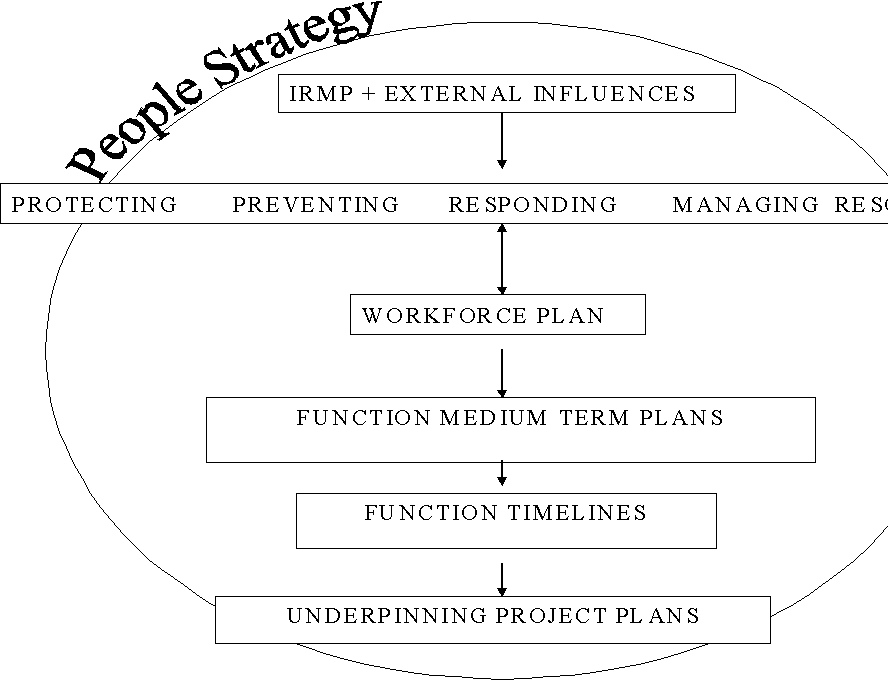
Our People Strategy provides a comprehensive framework for our employment practices and performance. Our employees are the critical element in delivering a valuable service to our community and making Hampshire safer. In planning our People Strategy we need to be sure that we have the right number of people in the right place, with the appropriate skills, level of competence and motivation to support our corporate aim and objectives, as identified in our Integrated Risk Management Plan (IRMP), now and for the future. This is informed by the key areas and issues identified in our Workforce Plan.
Our HR vision and goals are embodied in our HR medium term plan and this focuses on drivers and influences and takes account of our corporate strengths and weaknesses, and the external opportunities and threats facing us in the dynamic environment we operate in. This includes:
· Employment legislation
· National revisions to terms and conditions of employment
· Comprehensive Performance Assessment
· Government's National Framework Document
· Regional Management Boards
Our underpinning functional timelines form part of the overall performance monitoring process. Underpinning these, we have detailed project plans and local objectives.
Our People Strategy translates all the above into a People Strategy Action Plan with measurable performance indicators and targets and a mechanism to review performance against those targets at both corporate and local levels.
What we are seeking to achieve
Our People Strategy is driven by, and linked to, the Service's vision, values, aims and objectives. The medium term plans from each function reflect the corporate and functional priorities relating to people. Our performance and service delivery is primarily about people, with a considerable focus on our community, our managers and our employees. The Human Resources (HR) function therefore has a significant contribution to make to support the Service to achieve its mission, `Making Hampshire Safer' and the corporate aims of:
· 20% reduction in fire deaths by 2008
· 10% reduction in arson by 2010
· 3% reduction in building fires by 2006
· 2% transfer of resources by 2006 into Prevention activities
· HFRS in the top 20%
Background
Fire and Rescue Framework Document
The National Fire and Rescue Framework 2005/06 refers to the need for human resources strategies to fully reflect the needs set out in the IRMP. It reinforces the Government's commitment to fair treatment and equality of opportunity for all employees, with development taking account of different needs. It supports flexible working arrangements and practices, specifically identifying the valued contribution made by those on the retained duty system. Additional demands placed on Human Resources functions are reflected, together with the emphasis on regional collaboration, and the importance of the development of a skilled, professional and strategic HR function. Revisions to the Discipline procedure and the Grey Book and pensions are also referenced. There are national targets relating to the representation of women and minority ethnic groups as well as targets for sickness management and ill health retirement. There is an expectation that a Regional HR Strategy will be drawn up encompassing a Regional Equalities Strategy.
Integrated Personal Development System
The Integrated personal Development System (IPDS) is integral to our policies, practices, procedures and training. This underpins our new national firefighter selection tests; our Assessment and Development Centres; the demonstration and maintenance of competence, links to pay flexibilities, development plans and career progression.
Comprehensive Performance Assessment
The modernisation of the UK Fire and Rescue Service represents a significant change to our culture and how we manage and monitor ourselves as a public service. The Government has established robust systems to ensure consistency of monitoring standards and improving performance in the Fire and Rescue Service. The Audit Commission is responsible for Comprehensive Performance Assessments (CPA) focusing on improving service delivery.
CPA makes it clear that governance and leadership is expected from the top, at Fire Authority level. The structure of the corporate assessment focuses on what the Fire Authority is trying to achieve; how we have prepared to deliver our priorities; what has been achieved to date and what we plan to do next. The CPA exercise included scrutiny of arrangements for:
· Management and leadership
· Strategic planning and priority setting
· Operational deployment and performance improvement
Outside influences
The People Strategy takes account of the internal and external influences on HFRS which are included in a STEEPLE analysis. This includes:
· The need to be more proactive on equalities issues and in providing a safe and supportive working environment. Of immediacy are the statutory duties placed on local authorities by the Race Relations (Amendment) Act 2000; European Directives on Gender, Disability, Sexuality, Religion and Belief. The requirement to provide equality impact assessments (EIAs) whilst attaining levels 1 - 5 of the Equality Standards for Local Government.
· National strategies to reduce the cost of absence attributed to sickness.
· Draft National Workforce Development Strategy to bring about consistent implementation of the Integrated Personal Development System (IPDS)
· Revision to the National terms and conditions for employees conditioned to the Grey Book, including a new pay structure.
· Transition from local control rooms to new Regional Control Centres impacting on resilience and introducing issues of recruitment, retention, redeployment and redundancy
· The removal of national standards of fire cover, replaced with local Integrated Risk Management Plans to determine the appropriate deployment of personnel
· Becoming a precepting authority and the resulting impact on budget planning and management
· Government's expectations for greater collaboration between FRSs at a regional level and the setting up of Regional Management Boards for HR and Training as a business unit, defining targets and outcomes and cost benefits where these arise
· The introduction of national core values
What the public and our employees have said
In developing this strategy, the views expressed by the public regarding a career in HFRS in 2003 and an Employee Survey conducted in 2005, by Opinion Research Services (ORS), were taken into account.
Public Survey of careers in HFRS 2003
In 2003, the survey focused on 4,000 randomly selected households in Hampshire regarding a variety of aspects associated with the Service and how they influenced our residents. Of particular interest is the feedback about perceptions of careers in the fire service, including the recruitment of women and minority groups, as follows:
· A slight majority (52%) considered it very or fairly important for ethnic minorities to be recruited, while just below half (49%) felt it was important to recruit women.
As far as considering a career in the fire service, the responses varies widely, depending on age. The older respondents (45 years +) were very unlikely to have considered this as a career, whilst respondents in the 18 - 29 groups are relatively likely to have considered such employment. 67% of respondents said they would recommend a career in the fire service and 25% of those said they believed it was a career with high levels of job satisfaction.
Employee Survey 2005
This Survey generated a 37% response rate. This is what our employees said:
· Most regarded the service provided to the public as being very or fairly good (92%)
· The highest level of satisfaction in the job were - dealing with emergencies (69%), working as part of a team (58%), the shift system (32%) and working for the public (30%)
· Employees felt committed to serving the public, treating colleagues fairly and personal development
· Least job satisfaction came from paperwork (51%), the standard of training (29%), salary ((28%) and promotion opportunities (27%).
· Non-operational employees were particularly concerned about a lack of promotion and development opportunities
· Around 25% of all employees who responded felt they did not receive sufficient quantity or quality of training
· Most felt communications within HFRS was unsatisfactory - particularly from senior managers
· There was a desire for involvement in genuine consultation and more face-to-face meetings with senior managers. Team meetings were seen to be useful
· Line managers were viewed more favourably that the senior management
· 69% of employees felt that community safety was one of the Service's main priorities, with 60% considering this to be responding to emergencies. However, 69% identified responding to emergencies as being one of the most satisfying aspects of their job.
What to expect from our People Strategy
Having taken account of the views of our employees and representatives of our community, and given the influences described above, the following 6 key issues were identified:
1. Developing the organisation
2. Developing leadership capacity
3. Developing workforce skills and capacity
4. Recruiting and retaining employees
5. Pay and rewards
6. Developing the capacity of Human Resources
1. Developing the organisation
There is a growing focus on working in multi-agency environments, partnerships and collaborative working across the public and private sector. We will explore new ways of delivering services on a regional or national basis. This will increase the potential for new employment arrangements, practices, and working patterns. By becoming more customer-focused and building more flexibility into our workforce, we will improve the services we provide to our communities.
Specifically, these developments will require our employees to work within unfamiliar employment cultures, identify working patterns aligned to our changing community risk profile and will increase pressure to update employment contracts to meet new service demands. These pressures, coupled with existing employee dissatisfaction with the way we manage change, is likely to create further tensions and uncertainty.
We will need greater flexibility and innovation in our working practices. This includes re-modelling the workforce to give greater movement across professional and skills boundaries.
We recognise the benefits to be gained from greater employee and trade union involvement in this change at the early stages. This encourages us to review our involvement with our employees and partnership working with our trade unions.
We recognise that a healthy workforce and good attendance at work are key to maintaining optimum levels of service to our community and reducing the adverse impact on colleague workers. Ultimately good attendance contributes to a value for money service provided to our community, paid for by our community.
Morale is key to success and we recognise the need to get things right and reduce complaints both internally and from the public.
Our Core Values are based on national Core Values. These are fundamental to our Equality and Diversity strategy and how our culture evolves. This needs to be mainstreamed into how people view their personal responsibilities and conduct themselves at work.
Key objectives are:
1a Workforce planning
1b Equality and diversity
1c Core values
1d Work-Life Balance
1e Employee relations and communications
1f Attendance Management
1g Flexibility and innovative working arrangements
1h Change management
2. Developing leadership capacity
As part of our skills audit, we recognise the need for a high-level leadership programme to ensure the Service benefits from strong leadership and direction and builds corporate capacity. Responding to our corporate objectives and delivering our core services requires sound political and managerial leadership. We need to develop leadership skills and capacity across and through the organisation including engagement at Member level. This includes the development of top teams, future leaders, and attracting good leaders from outside the sector as appropriate. We will provide better induction and training for elected members, including their understanding of fire and rescue service-specific issues.
Key objectives are:
2a Strategic management development
2b Member development
2c Developing leadership
3. Developing workforce skills and capacity
The increasing demands on work time has highlighted the need for a more flexible approach to learning and development. This is to ensure the basic skills are not overlooked whilst we strive to attain new and more wide-ranging skills. The on-going implementation of IPDS will increase the skills of front-line, specialist and support staff to raise levels of training, development, performance and multi-skilling, to increase productivity, flexibility and cultural change. We recognise the benefits of making greater use of electronic systems to support this in line with Implementing Electronic Government.
We are introducing Investors in People for the benefit of all our employees. A new performance appraisal processes is to be cascaded down through the Service, commencing at the senior level. This involves input and support from elected members. It is relatively new and will take time to embed. However, it is important that managers and elected members fully understand the process and their role within it. Personal development plans and performance appraisal processes are currently being revised to take account of best practice.
Key objectives are:
3a Management development
3b People Performance management
3c Achieving and maintaining competence
3d Raising levels of development and performance
4. Recruiting and retaining employees
We want to have effective strategies in place to recruit, develop, manage and retain a diverse workforce reflecting the communities we serve. We are making steady progress in attracting interest in a career in the fire service from women and minority ethnic groups, however, this has not yet translated into an improved workforce profile in these areas.
Declining birth rates in Hampshire will be offset initially by the increase in retirement ages and changes to the criteria for compulsory ill health retirement. The evolving agenda for modernisation will cause us to focus on key skills, particularly where they do not currently exist in our organisation. Women and minority ethnic groups may be difficult to attract, particularly for non-traditional careers and there remains significant work for us to do in this area.
Changes to the profile of our communities regarding age, travel to work, second home owners or employment no longer connected to rural areas, are impacting on our ability to attract and retain key workers in some areas, and in particular, firefighters conditioned to the retained duty system.
There are limited opportunities to allow people to plan for careers across the organisation due to constraints of different terms and conditions of employment so some of our talented people choose to leave. Some posts such as in human resources, IT, performance management are proving difficult to recruit to at this time.
Key objectives are:
4a Attracting, recruiting and retaining a diverse workforce
4b Induction
4c Retention
4e Release processes
5. Pay and rewards
Changes to our working practices have identified a need to create a more flexible approach to how our posts are evaluated to ensure proper, fair and equitable remuneration to reflect this. This will be validated by a cross-service equal pay review, to take account of the varying governance and employment relationships that exist. Our local pay and reward structures need to support a high-performance, highly-skilled and flexible workforce, motivated to deliver improved services. Further, we need to verify the means to improve productivity, efficiency and value and ensure these are appropriately rewarded. We will review our policies regularly to support this.
Our employees are entitled to up to date contracts of employment to reflect developments in employment legislation as well as national changes to conditions of service. Potential changes to pension schemes are already impacting on our workforce profile and this needs to be addressed in line with national revisions.
Key objectives are:
5a Pay and reward system
5b Conditions of service
5c Pensions
6. Developing the capacity of Human Resources
The additional demands placed on the role of human resources functions as identified in the National Fire and Rescue Framework Document requires us to invest in the people management skills of all our managers. We are devolving greater managerial responsibility to line managers and we recognise the need for all line managers to be empowered and confident to apply policies and good employment practice consistently and appropriately. To assist in this process, we will develop new technology to achieve improvements in providing our managers with appropriate management information. This will assist them in planning and decision making activities at all levels.
This will enable the HR function to move from being predominantly an advisory and process function to a strategic player in transforming the Service whilst at the same time ensuring the capacity to deliver core services.
Key objectives are:
6a HR management information
6b Strengthening people management practice
6c Optimising contribution of HR
6d Developing HR professionals
The People Strategy Action Plan is based on these priorities and, in conjunction with key stakeholders, this will need to be developed into more detailed local action plans with key milestones, targets and measures of performance. Delivery of this strategy will be the responsibility of everyone and will become part of everyday management processes.
Monitoring and review
Monitoring and review of our workforce planning activities and the actions contained within the People Strategy Action plan will be carried out by a new Workforce Planning Steering Group. This will be chaired by a principal officer and will include function heads and other relevant managers. Key activities will include
· Establishment management, including future reviews of structure to meet IRMP Attendance management
· Appointments, Promotions and Transfers (ATP) Groups at Middle and Supervisory levels
· Regrading applications
· Recruitment and selection
· Assessment and Development Centres
· Changes to working patterns and duty systems etc.
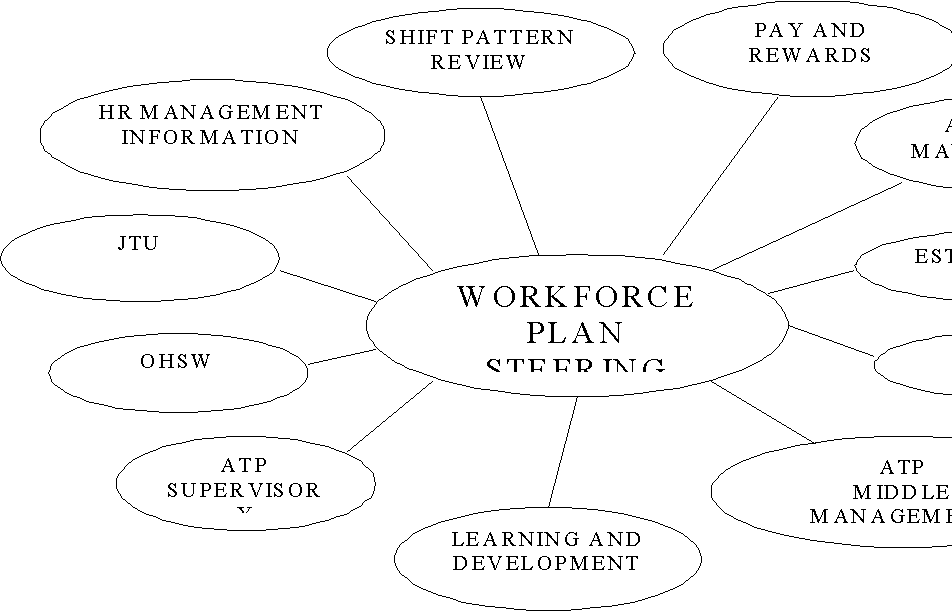
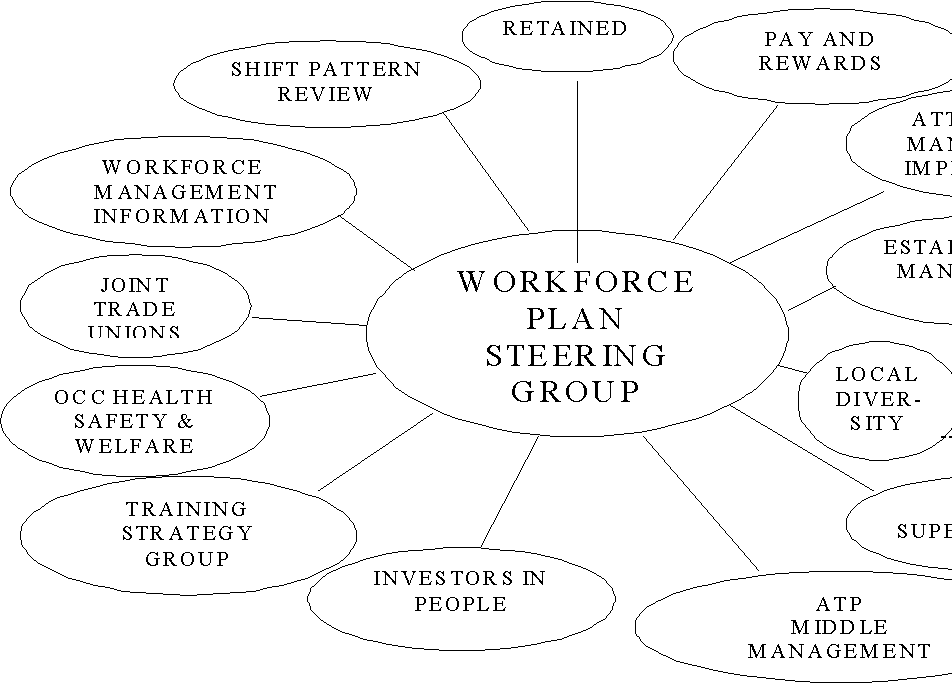
Workforce planning will require input from function heads on people management objectives, particularly where they impact across other function. The People Strategy Action plan will provide a conduit to inform local workplace plans. Issues and matters arising at a local level will inform revisions at the corporate level. Objectives will be determined with nominated managers responsible for delivering. These will be prioritised over 3 years, with measurable performance indicators and direct financial resources identified. |
Groups/Sec/WP/Word/Corporate/HFRA HFRA HR 29 11 05 People Strategy App 2