
Archived decisions
Hampshire County Council Health Overview and Scrutiny Committee Item 5 29 November 2005 Proposals to Develop or Vary NHS Services Report of the Chief Executive |
Contact: Denise Holden ex 7338
e-mail: [email protected]
1. Summary and Purpose
1.1. The purpose of this report is to alert Members to proposals from the NHS to vary or develop health services provided to people living in the area of the Committee.
1.2. Proposals that are considered to be substantial in nature will be subject to formal public consultation. The nature and scope of this consultation should be discussed with the Committee at the earliest opportunity.
1.3. The response of the Committee will take account of the Framework for Assessing Substantial Change and Variation in Health Services agreed by the Hampshire, Isle of Wight, Portsmouth and Southampton Joint Committee in March 2005. This places particular emphasis on the duties imposed on the NHS by Section 11 of the Health and Social Care Act 2001.
1.4. This Report is presented to the Committee in 2 parts:
_ Items for information: these alert the Committee to forthcoming proposals from the NHS to vary or change services. This provides the Committee with an opportunity to determine if the proposal would be considered substantial and assess the need to establish formal joint arrangements
_ Items for action: these set out the actions required by the Committee to respond to proposals from the NHS to substantially change or vary NHS services.
1.5. This report and recommendations provide members with an opportunity to influence and improve the delivery of health services in Hampshire and therefore support the delivery of Aim 5 (Improving Services) of the Corporate Strategy.
Items for Information
2. Review of Maternity Services in South West Hampshire
2.1. SUHT issued a press release on 7 November announcing that, due to pressures caused by a increased birth rate, the 4 bedded maternity unit at Romsey Hospital would be temporarily closed to allow for staff to be redeployed while a recruitment drive takes place.
2.2. Members will wish to be clear that:
_ This decision was based on recruitment and not financial pressures
_ The steps taken to recruit midwives prior to this decision being taken
_ The options considered by SUHT
_ The recruitment processes currently being pursued
_ Confirmation of the date when the unit will reopen
_ The options offered to the women who had been booked into the unit
2.3. SUHT have also indicated their intention to review maternity service provision across south west Hampshire. The background to the recent action and the next steps with regard to the review to this is attached at Appendix One
3. Mid and South West Hants Cluster: surgical services reconfiguration
3.1. SUHT is holding a briefing session on 24 November to report progress with this work. An up-date will be provided to Members on the 29 November.
4. The Future of Health Services in Fareham and Gosport
4.1. The Chairman wrote to the Secretary of State for Health on 17 October requesting that action be taken to expedite a full response from Lord Warner.
4.2. The Chairman received an undated letter from Lord Warner on the 14 November reiterating that he does not support the request for referral to the Independent Reconfiguration Panel and suggesting that the Committee contacts the SHA on the outstanding issues of concern.
4.3. All relevant correspondence has been sent to the Shadow Secretary of State for Health, at his request
5. South East Hampshire Capacity Plan
5.1. No further information has been received about the capacity plan.
5.2. The PFI contract for Queen Alexandra is not signed.
5.3. The revised capacity plan for South East Hampshire has yet to be considered by the SHA.
6. Acute Paediatric Services Review
6.1. The report of the review of these services has now been published and has been circulated to members electronically. The pattern of services across the area is assessed and recommendations for action and service reconfiguration set out. These are attached at Appendix Two.
6.2. The SHA is seeking the views of the NHS family and its partners on the review and recommendations by 31 January 2006.
7. Changes to Wessex Cardiac Services
7.1. Further to feedback from the Committee, Wessex Cardiac Services has agreed that the framework for Assessing Substantial Change is a useful tool for service planning and engaging with key stakeholders/service users.
7.2. As a result of comments to the initial proposal, changes the liaison services for children and adult had been deferred to allow for a more in-depth evaluation of the impact on patient and their families.
7.3. The reduction in beds, which was evidence based had been implemented and was being audited to ensure that there was no adverse impact on patients requiring admission. This will be available prior to the meeting.
8. Changes to Bed Modelling at Winchester and Eastleigh Health NHS Trust
8.1. Issues raised by members relating to the more intensive use of in-patient beds and recruitment will be covered in presentation on the outcome of the public consultation on Andover War Memorial Hospital.
9. Mid Hampshire PCT: Mental Health Accommodation Project
9.1. An outline of this proposal is attached at Appendix Three. There has been an extensive engagement with the individuals, their families and staff. Confirmation has been requested that other key stakeholders, including the P&PI Forums are satisfied with the section 11 involvement that has taken place.
9.2. Members need to consider if this change is substantial in nature.
10. Alliance PCTs: Contraception and Sexual Health Services
10.1. This proposal is attached at Appendix Four. Key points from the proposal include:
Clinics
To continue to provide services to all age groups, i.e. over 35s will still be provided with appropriate services.
The SW Hants PCT population will have continued access to clinics provided within the city boundary.
One session is to close at Hythe; this is a morning session, the afternoon and evening will continue to be provided in this location.
Three clinics to be nurse led but with a Doctor on call at these times, the remainder will continue to be Doctor led.
Sexual Education into Schools
To continue as before
Psychosexual Counselling
This service is to stop following recommendations from the PCT Professional Executive Committee. Those clients that have already started treatment will continue until their treatment has been completed.
10.2. GPs have been informed and alternative counselling will be made available if required, funded on an individual basis if necessary.
10.3. The P&PIF supports the proposal
10.4. Members are invited to consider whether the change is substantial.
11. Mid Hampshire PCT: Development of Adult Supportive and Palliative Care at the Countess of Brecknock Hospice, Andover War Memorial Hospital
11.1. The proposals relating to the provision of these services are attached at Appendix Five.
11.2. Members will wish to consider if the changes are substantial in nature and determine if the section 11 engagement has been satisfactory.
12. East Hampshire/Fareham and Gosport PCTs: Elderly Mental Health Services; Day Hospital Provision
12.1. Details of changes to the provision of these services are attached at Appendix Six.
12.2. A number of questions have been raised with the PCT about the lack of section 11 engagement and the speed with which the implementation was intended to take place. Specific inquires included:
· Details of the service model being developed to support people in the community
· Confirmation of the additional investment to enhance community services
· What assessment has been made of the impact of the changes on this very vulnerable patient group
· What is the impact of the changes on other service providers and do they support the proposal
· Progress with establishing the infrastructure to allow for a smooth transfer to the new arrangements
· Details of the transport arrangements for the patient group affected
· Arrangements for monitoring the impact of the proposed changes.
· These changes appear to be taking place separately from the wider review of beds for older people in the area. Both Portsmouth HOSC and ourselves have indicated our interest in the way in which this review is rolled forward, taking account of the increasing needs of an aging population. Inevitably this work will need to ensure that there is appropriate day hospital provision to support people to live independently for as long as possible. It is not clear how the changes around day hospital provision have informed this wider work.
12.3. Fareham and Gosport P&PIF have raised a number of similar concerns with the PCT.
12.4. Members will wish to determine if the changes are substantial and that section 11 engagement has been satisfactory.
13. Blackwater Valley and Hart PCT: Rainbow Assessment and Treatment Group
13.1. The Rainbow Assessment and Treatment Group provides support to preschool children with developmental delays. The proposal attached at Appendix Seven seeks to reprovide these services and streamline the assessment process.
13.2. Surrey HOSC and the relevant P&PIF have been asked to comment on the proposals. Surrey Borders PIF has also contacted the Committee requesting further information about these proposals.
13.3. Members will wish to determine if the changes are substantial and that satisfactory section 11 engagement has taken place.
14. Maternity Services in South East Hampshire
14.1. The Joint Committee met on the 7 November to hear how the option appraisal process for maternity services in south east Hampshire would be progressed. Members expressed deep concern and dissatisfaction about:
_ The fact that the recent consultation had not been underpinned by any assessment of affordability
_ That all the options for reconfiguring maternity services in the area had not been put forward as part of the original consultation, despite requests from members that these needed to be considered. These were now to be revisited with a resultant waste of time and resources
_ That the choices for women were continuing to be restricted because of the continued closure of the Grange and Blackbrook Birthing Centres.
14.2. Taking these points into account members were of the view that the current position was not in the interests of the health service in the area. Referral to the Secretary of State was considered, however there was concern that this may cause further avoidable delays.
14.3. The NHS was advised that the Committee would expected the detailed draft option appraisal to made available to them by 28 February at the latest. This would include a financial baseline for each option. The Joint Committee will reconvene on 1 March to consider this. Sir Ian Carruthers would be apprised of the concerns of the Committee and referral to the Secretary of State for Health would be kept under advisement until this time.
Items Requiring Action
15. Winchester and Eastleigh Healthcare NHS Trust/ Mid Hants PCT: Changes to Service Configuration at Andover war Memorial Hospital
15.1. The Committee will receive a presentation on the outcome of the recent consultation process and preferred option.
15.2. Members have previous expressed an interest in
_ The support for the proposal by the relevant P&PIFs, service users and carers
_ Whether the necessary infrastructure is in place to provide the level of rehabilitation support necessary in a community setting.
_ The monitoring procedures in place to ensure that the service operates as expected
_ The provision of dental, pathology and diagnostic services in support of the service model identified in the proposal
_ The type of day surgery to be undertaken
15.3. Members will wish to determine if the consultation was adequate and if the preferred option identified is in the interests of the health service in the area.
16. East Hampshire PCT: Changes to community service configuration in Emsworth and Havant
16.1. The comments from the Committee to the PCT, and the response received are attached at Appendices Eight & Nine respectively.
17. South West Alliance- Community Strategy Services for Older People
17.1. Members receive a copy of the report commissioned by the Committee.
17.2. The Chairman has written to the PCT identifying the opportunity that this work provides for a different way of working with local people. The PCT Board is meeting to review its position on the 24 November
17.3. Members will receive an up-date on the position at the meeting.
18. North Hampshire PCT: Changes to the Configuration of Services at Alton Community Hospital
18.1. North Hampshire PCT has reported that:
_ The Alton Community Hospital Stakeholders Group has met twice in the last two months. Membership of the Group includes local people, the P&PIF, Hospital Staff and Social Services. Cllr McNair Scott also attends.
_ One meeting was run as a workshop and provided the opportunity for the group to work alongside hospital and community staff to look at how services could be improved.
_ Work will now take place to identify the potential shape of services, taking into account capacity, demand and costs.
_ Communications relating to the project have improved with processes now in place for reporting progress back to the public via the media and other methods
19. Commissioning a Patient Led NHS: Department of Health
19.1. The Chief Executive wrote to the SHA on behalf of the County Council and incorporating the views of the Committee. A copy of this letter is attached at Appendix Ten
19.2. It is anticipated that the formal consultation will commence on the 1 December.
20. Hampshire Partnership NHS Trust: Improving Mental Health Services for people of Working Age
20.1. The consultation process supporting these proposals was launched on 4 November and will conclude on the 29 January 2006.
20.2. Members of the Committee have been sent copies of the consultation document directly
20.3. Hampshire Partnership have been invited to attend the next meeting of the Committee to give an up-date on the feedback from local people
20.4. Any issues that members wish to have raised with the Trust should be directed through Denise Holden by the 17 January.
Recommendations
Items for Information
21. Maternity Services in South West Hampshire
21.1. Members receive full information in support of the questions set out at paragraph 2.2 and consider the case for the urgent action taken by SUHT.
21.2. Members are advised of the next steps of the review process.
22. Mid and South West Hants Cluster: surgical services reconfiguration
22.1. The Committee is up-dated on progress with developing the surgical service reconfiguration at its next meeting.
23. Future of Health Services in Fareham and Gosport
23.1. The Committee raises its concerns about the configuration of services with the SHA.
24. South East Hampshire Capacity Plan
24.1. Members are advised of the next draft of the capacity plan
25. Acute Paediatric services/maternity service review
25.1. Members are advised of the response of the NHS and its partners to review and the way in which this will be taken forward.
26. Wessex Cardiac Services
26.1. Members are up-dated of any further changes to service delivery at the March meeting.
27. Mid Hampshire PCT: Mental Health Accommodation Project
27.1. Members note that adequate section 11 engagement has taken place and that this is not a substantial service change
28. Alliance PCTs: Contraception and Sexual Health Services
28.1. Members note that adequate section 11 engagement has taken place and that this is not a substantial service change.
28.2. The PCT provides the Committee with information on the number of requests for individuals to receive psychosexual counselling at the meeting in May.
29. Mid Hampshire PCT: Development of Adult Supportive and Palliative Care at the Countess of Brecknock Hospice, Andover
30. Members note that adequate section 11 engagement has taken place and that this is not a substantial service change
31. East Hampshire/Fareham and Gosport PCTs: Elderly mental Health Services; Day Hospital Provision
31.1. Members receive the response of the PCT to the issues raised at the next meeting.
31.2. The PCT refrains from implementing the proposals until such time as the questions raised by members and the P&PIF have been satisfactorily addressed.
32. Blackwater Valley & Hart PCT: Rainbow Assessment and Treatment Group
32.1. The PCT confirms the feedback from all stakeholders, including the P&PIFs whose population are affected in line with section 11 requirements.
32.2. This information, and the views of Surry HOSC, will inform the recommendation of the Committee about the nature of the change
33. Maternity Services in South East Hampshire
33.1. Members are advised of further action taken with regard to the review of maternity services at the meeting in March.
Items for Action
34. Winchester and Eastleigh Healthcare NHS Trust/ Mid Hants PCT: Changes to Day Surgery and Rehabilitation Services
34.1. Members review the consultation and engagement process, including input from the relevant P&PIFs, district councils and other key stakeholders
34.2. Members highlight any additional action to be taken by the PCT
34.3. Members consider
_ If the consultation process has been adequate
_ If the preferred option identified is in the interests of the community affected
35. East Hampshire PCT: changes to community service configuration in Emsworth and Havant
35.1. Members highlight any additional action to be taken by the PCT
36. South West Alliance Community Strategy
36.1. Members are apprised of the progress with engaging with the communities across the area of the Alliance at the meeting in January.
36.2. The links with this consultation, and that being conducted on the same patient group by Southampton City PCT is clearly set out by the PCT.
37. North Hampshire PCT: Changes to the Configuration of Services at Alton Community Hospital.
37.1. Members are advised of progress with developing the consultation document at the next meeting.
38. `Commissioning a Patient-led NHS'
38.1. Members are advised of the arrangements for consulting on these proposals
39. Hampshire Partnership NHS Trust: Improving Mental Health Services for people of Working Age
39.1. Members refer any comment or questions relating to the proposals to Denise Holden by 17 January
39.2. Hampshire Partnership shares the feedback from key stakeholders at the Committee meeting in January
Section 100 D - Local Government Act 1972 - background papers
The following documents disclose facts or matters on which this report, or an important part of it, is based and has been relied upon to a material extent in the preparation of this report.
NB the list excludes:
1. Published works
2. Documents that disclose exempt or confidential information as defined in the Act.
File Location
None
Hampshire County Council Appendix One
Health Overview and Scrutiny Committee
29 November 2005: Maternity Services in South West Hampshire
SOUTHAMPTON UNIVERSITY HOSPITALS NHS TRUST
Addressing the Impact of the Rising Birth-rate with temporary closure of a Birth Centre
November 2005
Introduction
This paper presents the actions already taken to address the rising birth-rate in Southampton Maternity Services and the further action needed to maintain a safe service.
(a) Background
The midwifery service operates under increasing pressure. The birth rate has risen by 12.4% since 2002, with no increase in the midwifery establishment.. The numbers of bookings for the first five months of this year (Jan-May) have risen by over 8%, and these have directly translated into an increase in births. The birth rate in August was 18% higher compared to last year and in September there was a 20% increase. The trend for births is increasing with a prediction of 12.4% (Appendix 1).
The neonatal service is over capacity, resulting in an increase in women being transferred to other units. This transfer requires a midwife to accompany the women. The fetal medicine department has developed advanced techniques, which prolong complex pregnancies, which would otherwise have been lost. These pregnancies require increased midwifery input.
With the current level of midwives, we are unable to provide one to one care in labour resulting in inadequate monitoring of the well being of the mother and her baby. Women would also be unable to have epidural pain relief and inductions of labour would be further delayed.
Antenatal care will be compromised, which would lead to the failure in identifying ` at risk' pregnancies.
Postnatal care is already compromised, which may have had a direct effect on readmissions.
I. Actions taken
The service has agreed a priority list of care. The highest priority is women in labour, but the other clinical work still needs to be carried out. Temporary staff can and are being used in caring for women in labour. The provision of postnatal care has been radically changed, which may have resulted in an increase in postnatal readmissions. An audit is underway to examine this.
All non ward-based midwifery posts have been scrutinised. Only one of these posts does not involve clinical work. This is the Risk manager.
The postnatal service has been redesigned to provide a minimum number of visits by a midwife.
II. Action Required
The underlying deficit of midwives is in the region of 10%, which equates to 17wte. The service could cope in the short term with an increase of 7wte.
The Trust has a significant financial deficit, which has required it to make 200wte posts redundant. Since there is no prospect of additional funding, temporary closure of one of the birth centre will release revenue to fund midwives. We have been working closely with the SW Hants PCTs to rationalise the birth centres, this work has fallen behind plan and urgent action is now required.
(1) Birth Centre Profiles
All of the birth centres provide facilities for birth, post natal stay and day assessment. They are the base for the organisation of work within the locality. The impact on women of temporary closure will be the loss of postnatal stay and birth facilities. The impact on staff will be the temporary redeployment to another area within the service.
(a) Hythe
Hythe birth centre is 12 miles from Princess Anne Hospital. It has 7 beds and 112 women gave birth there from Jan-October this year. The bed occupancy is 40%. There are 68 women planned to give birth there from 1st December until 31st March 2006.
(b) Romsey
Romsey birth centre is 6 miles from the Princess Anne Hospital. It has 4 beds and 82 women gave birth there from Jan-October this year. The bed occupancy is 72%. There are 31 women booked for birth between 1st December and 31st March 2006.
(2) Lymington
Lymington birth centre is 17 miles from the Princess Anne Hospital. It has 7 beds and 110 women have given birth there this year. There are 52 women booked to give birth between 1st December and 31st March 2006. The bed occupancy is 51%.
III. Summary
Maternity care is similar to emergency services in that it is extremely difficult to control the workload, which is increasing. A recurrent theme in that lack of staff leads to sub optimal care, contributing to fetal and maternal morbidity and mortality.
This is a service already under pressure and an urgent increase in midwifery staffing is needed. Since there is no additional funding available, the directorate has no other option but the temporary and urgent closure of one of the birth centres. The purpose of this paper is to enable the best decision to be made.
Supporting documentation for this paper is available on request.
IV. Karen Baker David Howe
Acting Care Group Manager Clinical Services Director
08/11 2005
Hampshire County Council Appendix Two
Health Overview and Scrutiny Committee
29 November 2005: Recommendations on the future configuration of children's services
In this section we set out our recommendations to address the constraints, risks and gaps in services that we have identified earlier in the report. We cover the points that we consider to be relatively fixed, general recommendations that apply across the whole health system, recommendations for each of the Trusts providing acute paediatric services and finally recommendations on the configuration of services across the area.
· The first fixed point is the importance of maintaining access to local child health services in Hampshire and the Isle of Wight. Access to services was emphasised by all of the parents in our stakeholder discussions and is a consistent concern by parents in other parts of the country. One of the fixed points therefore is that there should be no reduction in any points of access to paediatric services for sick children.
· The second fixed point is the stretch of water between mainland England and the Isle of Wight. It is essential that ambulatory and in-patient service continue to be available on the Island although some of the boundaries between what is undertaken there and in paediatric units on the mainland may need to change in due course.
· The third point is the essential ingredient of integrated services. Whilst there are options about how services are managed we believe that it is vitally important that there is real integration between hospital and community child health and social care services at a local level and that across Hampshire and the Isle of Wight as a whole that the concept of a managed, integrated paediatric clinical network is fully developed.
· SUHT is currently providing a secondary and tertiary level paediatric services and takes referrals from a large geographical catchment for both neonatal and paediatric care. The continued provision of neonatal and inpatient care on this site in the future is a relatively fixed point although this certainly does not mean that no changes are needed to the services that are provided.
· A major redevelopment of hospital services in planned in Portsmouth and will address many of the current difficulties of split site working. Portsmouth has a large catchment and draws from areas of significant deprivation and a significant amount of emergency activity for children. It has also been designated as a level 3 neonatal service. These important considerations suggest there will be a continued need for inpatient paediatric facilities in Portsmouth. As with Southampton, however, this does not mean that the pattern of services should continue in its current form.
1. Planning for good paediatric services. Earlier in this report we set out characteristics of a good paediatric service. Our first recommendation therefore is that each area within HIOW should review where it stands against these characteristics, identify the areas where they need to improve what they do, establish a plan about how they are going to address them and significantly, identify how these changes will be funded and over what timescale.
2. Establishing the paediatric clinical network. It will be difficult and more complicated to take forward the recommendations from this review without the establishment of a formal and strongly managed clinical network to coordinate child health services, including mental health care, across Hampshire and the Isle of Wight. Helpfully, the SHA has been successful in winning funding from the DH to take forward a paediatric clinical network. We recommend that this network, chaired by a clinician, takes responsibility for driving forward the changes set out in our report. The network board should include representation from the PCT(s) with commissioning responsibilities for paediatric services (see below) and representatives from primary and community health services. The network director should be supported by a network manager, ideally someone who also has a clinical background in children's services. The network's work programme might include:
· The development of common standards and protocols e.g. for:
Interfaces between A&E and paediatric services
Assessment
Child protection
Child health records
· The development of agreed care pathways for different conditions between primary, secondary and tertiary services
· Reviewing and prioritising investment needs in specialist services
· Coordinating and promoting research
· Developing and promoting the network identity
· Common literature for patients and parents on clinical conditions
· Identifying clinical leads for each condition to coordinate intelligence about future developments and promoting good practice
· Coordinating multidisciplinary training and development.
Arrangements will need to be made to establish close links between the network and the Children's Trusts that are either currently set up or will be formed over the next year of so in each local health system.
3. Spreading good practice. Linked to the points above we recommend that the paediatric network supports and funds short term `transfer teams' with a brief to support the transfer of good practice to all units in HIOW. There is particular (although not exclusive) merit in the following areas. We have indicated lead arrangements but a small team could be drawn from several units to provide for maximum interchange and learning:
· Ambulatory care - NHHT
· Child health records and information systems - IOW
· Children's A&E - PHT
· Integrated working between health, social care and education - IOW/W&E
· Lead professionals/key workers - W&ET
4. Improving the commissioning of children's services. In addition to strengthening links between provider services PCTs need to work together to strengthen the commissioning of acute paediatric services to ensure that services and future investment are in line with the needs of children and families and that the services provide good value for money. We strongly recommend that in the light of the recent guidance on `Commissioning a Patient led NHS' that consideration is given to bringing together the overall planning of services for acutely ill children under the responsibility of one PCT on behalf of the whole of Hampshire and the Isle of Wight. The interface between these macro commissioning arrangements and the micro commissioning that will be undertaken by practices also needs clarification.
5. Improving the quality and value for money of sub-specialist services. An early priority for commissioners is to review the configuration of sub-specialty services to develop a more coherent and sustainable pattern of care. This needs to address:
· The level of need there should be in the population within Hampshire and the Isle of Wight compared with the current estimated prevalence
· How that level of need will change over the next 10 years or so? (E.g. in relation to epidemiology and demographics)
· The critical mass of cases and staff required
· The specialist services available in neighbouring hospitals and the extent to which the network wishes to compete with these services
· The implications for the current distribution of expertise across paediatric units
· Proposals for improving the quality and value for money of paediatric sub-specialist services.
6. Sustainable funding of countywide services. A further priority for commissioners is to clarify their responsibilities for county- wide services where there is dispute about how these services should be funded. PICU, the PICU and NICU transport and retrieval services and the forensic child protection service were particular examples where there is a pressing need for clarity and a sustainable funding stream.
7. Improving service integration. The SHA and PCTs should use the opportunity presented by the transfer of PCT provider services (signalled by Commissioning a Patient Led NHS) to rethink management arrangements for community child health services (including health visiting, school nursing and specialist children's nurses) and those CAMHS that are managed by PCTs. Whilst there is a push from the centre to make community services more contestable there is also a strong case for bringing all acute and child health services together into one management unit within each health system (see below for our comments on CAMHS). We recognise that there are mixed experiences about the consequences of such a move across the country. The most significant risk is that resources for community services are sucked into acute hospital care. There are options about where the management home might be for these services but we commend the model developed by NHHT. They have been able to establish integrated acute and community services and ensure that investment in community services is maintained and enhanced. There the integration has been handled from a philosophy of care that sees overnight hospital care as the last resort for only the sickest children. Clearly whatever arrangements are put in place they will need to fit with local plans for Children's Trusts and allow for service integration between health, education and social care.
8. Improving linkages between secondary and tertiary care. Across the paediatric network in HIOW there needs to be agreement, on a specialty by specialty basis, the criteria for deciding which medical and surgical cases will be managed within the local DGH and which will be referred for more specialist treatment. This should address the problem that SUHT currently experiences in picking up the consequences of changes in clinical practice and levels of specialisation.
9. Understanding patterns of activity and financial flows: An early priority for commissioners to lead is the establishment of a consistent approach to coding of clinical activity and in particular the differences between day-cases, ambulatory cases for assessment and in-patient admissions. This is crucial both in benchmarking provider performance and in securing value for money from current activity.
10. CAMHs - whilst our remit does not explicitly include CAMHs the limited capacity in these services is having an impact on demands for acute paediatric care - the latter provide a safety net service for emergency care needs that could be more effectively treated by mental health specialists. Of particular note is the fragmentation in management responsibilities for these services. We recommend that HIOW move toward a single provider of tier 4 CAMHs to provide the best possible opportunities to make best use of current resources and to provide a sound foundation for recruitment and retention of specialist clinical skills. Again careful consideration will need to be given to the way these services interface with prevention and early intervention services.
1. Recommendations for Southampton University Hospitals Trust
There are some significant issues facing SUHT's children's services that must be resolved, the most pressing of which is the balance between its secondary and tertiary services.
· We recommend that the Trust brings together all services for children within the management remit of the Women and Children's directorate. This would provide a coherent basis for designing services around the needs of children.
· SUHT must review and improve its secondary care services for children across the whole spectrum - community and home care support, ambulatory care, A&E and inpatient services. The Trust needs to consider pathways of care, staffing and management and the way in which the hospitals facilities are used. There may be opportunities to think about tapping some of the general paediatrics expertise in other paediatric units within the network both in reviewing the approach to secondary care and in future service delivery.
· The Trust should further explore ways of reducing the length of the out of hour's period and ways in which they can move toward a more consultant provided service out of hours. The medical workforce is sizeable and there may be scope for different ways of working that both provide better continuity for patients and prove more satisfying for doctors.
· SUHT needs to formalise its working relationships and communications with other units in HIOW. Current shared care arrangements provide a sound foundation but these need to be tightened and arrangements for maintaining the skills and competencies of sub-specialists in secondary care units improved. Joint appointments as well as rotational sessions should be considered.
· As plans develop for the implementation of payment by results and as the market system and patient choice begin to be introduced in health care SUHT needs to consider its position within the health economy and the wider competitive environment. If patient experience is not improved there is a risk that the Trust could lose patients to competitors such as the Bristol or Oxford Children's Hospitals or even London providers. A thorough analysis of where its specialist children's services fit within the wider market would be worthwhile.
· The planned expansion of neonatal services is urgently needed and investment/ development work should be accelerated if possible.
2. Recommendations for Portsmouth Hospitals NHS Trust
In Portsmouth there are well-advanced plans for the consolidation of children's and other acute services onto one major site. This is an exciting development that will improve the quality and continuity of care and reduce patient transfers between sites. If possible the implementation of these plans should be accelerated. Our further recommendations need to be addressed in the shorter term:
· The Trust's approach to ambulatory care needs to be overhauled. Whilst we understand that the low level of day case activity may be a coding error it was clear from our visit that there is a good deal to be done in switching the mindset from an admissions focus to one where the emphasis is keeping children out of hospital. If this is done there may be further scope for reducing the number of in-patient beds, which seems relatively high compared with other units.
· There needs to be more investment in community nursing services. These are not only at a relatively low level but also the skills that nurses have in working independently need developing further to get the best out of this resource.
· A&E consultation rates are high compared to those in other units. We are aware that there is ongoing work to understand the pattern of demand. It is important that this work is continued any lead to action to reduce unnecessary A&E consultations.
3. Recommendation for Winchester and Eastleigh Hospitals Trust
The Trust has worked hard to develop effective working relationships with education and health services. It is services within the hospital environment that needs the greatest attention. Three things need to be addressed:
· The space and quality of the environment for children in A&E needs to be reviewed as does the interface with GP OOH services
· The Trust needs to accelerate plans for a paediatric assessment unit and learn from best practice within and outside HIOW in developing these services. Learning from the Basingstoke unit an improved ambulatory model will require both increased consultant involvement in front line services and improving the assessment skills of nurses.
· The level of community nursing services is low. Having separate teams for community nursing and palliative care may not be as cost effective or flexible as having a single team. We recommend that W&ET review these services to see how they can move to a more consistent service offering to meet children's needs through the whole week if not round the clock.
4. Recommendations for North Hampshire Hospitals Trust
Our recommendations for NHHT have some similarities to those for Winchester and Eastleigh.
· Whilst the Trust has appointed an A&E consultant with a paediatric interest in line with the approach recommended by the Royal College of Paediatrics and Child Health the amount of space and physical environment for the assessment and emergency treatment of children and young people is inadequate and needs improvement.
· The Trust has a flexible and innovative approach to deploying specialist children's nurses across the spectrum of hospital services. Although this level of efficient practice is to be commended we suggest that a higher level of paediatric nurse input into A&E is needed than is typically available.
5. Recommendations for the configuration of hospital services
The current configuration of paediatric services will not be sustainable in the longer term and plans need to be put together to address this and to make best use of available resources. We are aware that there are a number of other service reviews underway within HIOW. The SHA will need to assess the implications of our recommendations and those from other reviews on the development and configuration of paediatric services and their management arrangements.
Parents have told us that one of the things they value about the current provision of children's services is local access. They are realistic enough to expect to travel if their child has specialist needs but demanding of the availability of local services to meet the needs of the majority of children. Our recommendations aim to not only preserve but also enhance local access to paediatric care.
Points of access.
o There should be no reduction in the number of points of access to paediatric services on hospital sites. Indeed with the expansion of children's centres there is the possibility of local access to planned care and emergency assessments being enhanced.
o We also recommend that each Unit considers carefully the range of health conditions and needs that could be supported in the child's own home and the benefits that can be gained from expanding community nursing and ambulatory services. In doing so they should look at some of the best examples of practice within Hampshire and at other places.
Given the fixed points we identified earlier our main recommendation for the configuration of acute paediatric units in Hampshire and the IOW is that inpatient paediatric services in the centre and north of the county need rationalisation. There should be one in-patient unit for the whole of North and Mid Hampshire. This would mean centralising in-patient beds on either the Basingstoke or Winchester sites.
Whilst rationalisation of inpatient services will deliver some efficiency gains we do not believe that this is a workable option unless one unit has management responsibility for both services. This has to be run as a seamless service with consistent protocols and standards, flexible use of medical and nursing staff and agreements about the best use of facilities.
Although service and management configuration can be considered separately decisions about these arrangements will need to be made together.
6. Service configuration
Option 1 - Winchester and Eastleigh Trust hosts the in-patient service
· This would mean that in addition to the recommendations for W&EHT above in-patient paediatric services would be centralised on the Winchester site.
· The loss of in-patient paediatrics at NHHT would require a shift either to a midwife led unit on the Basingstoke site or an obstetric unit with paediatric cover only during the day and early evening.
· The more specialist elements of neonatal services at Basingstoke would be transferred either to Winchester or to Southampton.
Option 2: North Hampshire Hospitals Trust
· This would mean that in addition to the recommendations for NHHT outlined above inpatient services from W&ET would be centralised on the Basingstoke site.
· The loss of in-patient paediatrics at Winchester would require a shift either to a midwife led unit on that site or an obstetric unit with paediatric cover only during the day and early evening. The more specialist neonatal services in Winchester would need to be transferred either to Southampton and/or to Basingstoke.
7. Service configuration and Management arrangements
Similarly there are two options for the management of paediatric services in mid and North Hampshire. Our recommendation is that inpatient services should in the longer term be based at Winchester and that NHHT takes on the management responsibilities for these services. Whilst there are arguments that can be made for all possible configurations we believe that the following present a convincing case:
· There is spare in-patient capacity on both sites and both have been net importers of cases on some occasions when there has been a capacity shortfall at Southampton. However, Winchester is geographically closer to Southampton. This strengthens the case for the in-patient unit being located here. Were there to be no in-patient unit in Winchester patient flows would not all go to Basingstoke some would naturally flow to Southampton. This would add to the pressures that already exist on secondary paediatric services on that site.
· Accessibility to alternative paediatric units in North Hampshire is relatively good. Fridley Park Hospital in Farnborough is only 12 miles away from Basingstoke and closer still for some parts of the catchments. There is good motorway access between Basingstoke and Farnborough. The Royal Berkshire Hospital in Reading is also relatively close. We understand that Frimley Park is planning an expansion of its maternity services as it is already turning away some women who would like to have their babies there and could accommodate additional paediatric in-patient cases.
· The advantage of transferring management responsibility to NHHT is that they already have well integrated acute and community services, demonstrated significant reductions in unnecessary admissions to hospital and an approach that maximises flexible use of medical and nursing staff and are living within their budget. The Trust's paediatric team have the management experience and leadership and practical skills to oversee the necessary changes.
· There is scope for further reduction in in-patient numbers at Winchester through developing a stronger ambulatory care focus and the development of a paediatric observation and assessment unit. NHHT could help this approach to be developed quickly and consistently through application and adaptation of the approaches that have been demonstrated at Basingstoke.
In assessing the implications of these recommendations, particularly the location of in-patient services, further work will be needed to look at patient flows and the potential impact of these changes on acute units outside Hampshire, particularly Frimley Park and the Royal Berkshire and Battle Hospitals. From our initial analysis of the number of cases that would be likely to flow to these units (less than 1 child per day) the impact would appear to be manageable. For maternity care there is the opportunity to coordinate the potential changes in Basingstoke with the impact at Farnborough at an early stage.
As we noted earlier the HIOW health system is facing big risks to its acute paediatric services but not an urgent or imminent threat. This allows for a phased approach to be taken to the changes that we have suggested with time for thorough engagement and consultation with parents, children and young people and clinicians. The SHA should take a lead in overseeing the development of a detailed project plan to coordinate the implementation work and then ensuring that this plan is adhered to. The paediatric network will need to take an active role in this implementation work - given that there is so much interdependence between the paediatric units peer accountability is something that should be further developed.
In terms of the configuration elements we would suggest that the first thing to put in place would be the shared management of children's services in North and Mid Hampshire and this should be quickly followed by the development of ambulatory care, assessment and boosting of community nursing services and the development of joint protocols and care pathways. When these service elements begin to take effect and the results can be seen in lower admissions to hospital then steps can be taken to rationalise in-patient facilities.
During this period of change it is essential that there is ongoing work to engage with local parents and the wider community to ensure that their views are taken into account in service plans and keep them informed about the progress that is being made.
This interim phase should also be used to develop a detailed plan for patient and transport between the Winchester and Basingstoke sites as this could reduce some of the anxiety that parents face in travelling with their child should they need in-patient care.
Hampshire County Council Appendix Three
Health Overview and Scrutiny Committee
29 November 2005: Changes to Mental Health Accommodation
Context
People with mental health problem, like most other people, value their independence. Health and social care services need to be designed to respect the needs and the aspirations of clients, and that means that agencies need to work together to ensure that there is a comprehensive range of different types of accommodation available to meet different needs.
In Winchester there is a particular shortage of independent accommodation for people with mental health problems who need peripatetic or 24 hour support. As a result people who do not need such intensive support are living in residential homes with shared facilities and little opportunity to develop the skills for independence. This is not a reflection on the quality of care that they are receiving; staff in these services work hard to meet clients' needs, but it's the difference that any of us might experience between living in our own home with the people that we choose to live with, as opposed to living in a residential home where someone else decides with whom and how you live.
Partnership between MHPCT and HCC Adult Services
Mid Hampshire PCT and Hampshire County Council Adult Services are working together with specialist housing providers to address these gaps in provision. The PCT and Social Services have agreed to pool some of our existing resources into a single fund (Section 31) so that we can jointly agree how best it is used to meet the needs of existing and future clients who need more independent living. This is a real opportunity for the agencies to work together to make sure that scare resources are being used to best effect and to ensure that services keep up to date with client expectations.
A multi-agency project was set up about a year ago to assess the accommodation needs for people with mental health difficulties in the Winchester area. The group, which included mental health practitioners, comprised representatives from Mid Hampshire Primary Care Trust, Hampshire County Council Adult Services, Hampshire Partnership Trust, Stonham, Together and Solent Mind Advocacy Service. The work included the assessment of everyone living in residential care homes in Winchester and identified the need for fewer residential care places, but a wider range of alternative supported accommodation.
First steps
To achieve this switch we need to move resources around the system. As part of this change, it is planned by the end of this financial year to close 14 Compton Road, one of the existing residential care homes in Winchester, releasing resources for supported accommodation offering more flexible support and care. Those people living in this care home who have been assessed as having an ongoing need for residential care home accommodation will still be able to receive this, although not in the same building. Those who need more independent accommodation will move on to more appropriate placement as part of their on going care programme to increase their independence. Overall the cost of the new placements is likely to be less than the current ones. The Section 31 agreement will protect the full amount of the original revenue funding, enabling more clients to receive care packages in supported accommodation. 14 Compton Road will be sold; the PCT is working with partners to try to secure the site for further development of mental health accommodation, however there are a number of legal, financial and regulatory issues that would need to be resolved in order to achieve this, hence it is not possible at this time to make a firm commitment that this will be the outcome.
The individual residents and their relatives or carers were notified in December 2004 of the possible closure of the home; they have all had their accommodation needs assessed and advocacy support has been provided to ensure that their views are fully reflected in the care plans that have resulted from this work. Elaine Hearne is working as full time project manager finding appropriate accommodation and putting in place care plans to support each individual. Elaine has known some of these individuals for many years and she is entirely focussed on working with the clients, ensuring that the placements are developed in the best interests of the individuals and as far as possible meet their preferences as well as their needs. I have now written to each resident and their relatives advising them of the intention to close Compton Road at the latest by the end of March 2006. Staff at the unit will ensure that there is plenty of support available to the residents when they receive these letters.
Realising the benefits of the Section 31 will take some time: clearly the priority will be meeting the needs of the clients within the residential care homes covered by the project. Over time however resources will be released that can then be re-invested for successive clients, creating the financial flexibility to develop a wider range of accommodation and care support.
Hampshire County Council Appendix Four
Health Overview and Scrutiny Committee
29 November 2005: CASH Services in South West Hampshire
September 2005
Re-designing sexual health services across the South West Hampshire PCT Alliance
`Building the case for re-design'
Background - why changes?
As part of the South West Alliance commitment to service re-design, notice has been served on the service level agreement for contraception and sexual health services provided to us by Southampton City PCT. The total cost of them providing this service to the organisation is £547,994 a year. It has been calculated that by reducing management overheads and reviewing the service that is provided, the cost can be substantially reduced.
There are opportunities and risks attached to this strategy. Opportunities include:
· planning and implementing our own local contraception and sexual health services according to local needs
· improving links between primary care and PCT's for the delivery of contraception and sexual health services
· expanding the remit of the sexual health services that are delivered, e.g. improved recognition of the needs of the gay and gypsies/travelling communities
· improving monitoring and audit of the services with electronic systems to meet with clinical governance criteria and enable assessment of patient need
· developing links with stakeholders and the community to continue to improve and develop the service
Vision for redesign
It is planned that over the next 3 years the sexual health service will expand to deliver services through a variety of settings across the Alliance. Some these will be using will using skill mixes to offer services in clinics, to develop the role the of community pharmacists in line with the new contracts and to expand the sexual health in community settings by youth workers & Connexions Services.
State of sexual health
The picture of sexual health in the UK is a disheartening one. Sexual ill-health is not equally distributed among the population. There is a strong link between social deprivation, STIs, teenage conceptions & minority groups.
Teenage Pregnancy
· The UK has the highest teenage birth rate in Western Europe
· Hampshire County Council under 18 conception rate lower than national rate
· Hants has had a 15.9% reduction in conception rate from 1998 to 2004.
· Both ETVS & the New Forest have rates lower than national average however there are target wards with in these PCTS
· Target areas for the New Forest: Totton East, Fernhill, Pennington, Hythe West & Langdown, Holbury & North Blackfield, Totton Central & Milton
· Targets areas for ETVS: Eastleigh Central, Eastleigh South, Eastleigh North, urseldon & Old Netley, Netley Abbey
Sexually Transmitted Infections (STIs)
· The number of diagnosed sexually transmitted infections continues to rise in the UK
· The number of visits to GUM services has doubled in the past ten years, however capacity of service providers has not increased at the same rate.
· Cases of STIs have also increased locally. E.g. cases of gonorrhoea rose by 47% from 2002 to the second quarter 2003 in ETVS.
· 6 months after setting up GUM outreach clinics in the New Forest, the clinics had to become appointment based rather than drop-in because of demand.
HIV
· Nationally the numbers of people living with HIV continue to rise. In 2003 there was a 20% increase on the previous year
· It is estimated that about 60,000 people live with HIV in the UK.
· Hampshire has low rates of HIV infection, however numbers continue to increase.
· There has been a 32% & 9% increase in the number of infections in ETVS & NF PCTs respectively from 2003 to 2004. (SOPHID)
Local Action
Improving sexual health & reducing unintended teenage pregnancies remains a priority for public services & organisations at county & district level.
The Hampshire Teenage Pregnancy Partnership Board supports the delivery of local action plans. Both the New Forest & EVTS have a local 3 year action plan which contributes to both county & regional plans. (Actions Plans 2003-06 available on request).
The South West PCT Alliance has recently produced a draft annual sexual health action plan for 2005-06. The Strategic Health Authority with the PCTs will monitor performance & implementation of these plans.
Local sexual health projects/initiatives are being developed locally to support the sexual health agenda these include:
· Sex & Relationship Education training for local staff
· County protocols on condom distribution, EHC & pregnancy testing
· SRE Forums provide schools & local services opportunities to develop SRE in the classroom
· Chlamydia Screening for young people under 25 being rolled out across the Alliance.
· Developing educational work in supporting young people to delay sexual activity.
· Working together with organisations working groups more affected by sexual ill-health (gay men, young adults, BMEC & women).
· World AIDS Day campaigns December 2005.
Activity figures for Contraception & Sexual Health Service 2004/05
Figure 1
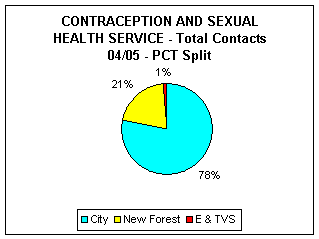
Figure 1 shows the percentage of service users seen at CASH by PCT split. CASH saw 25,138 contacts in 2004/05. 19,547 (78%) contacts were from SCPCT, 5308 (21%) & 283 (1%) from NFPCT & ETVS PCTs respectively. Just over 1/5 of contacts were from the South West PCT Alliance (22%).
Age range
5,579 patients have been seen at clinics in South West PCT Alliance in the last year. Of these 1008 were over 35 years, 756 were 25 - 35 years and the remaining 3815 were young people under 25.
Sex & Relationships Education Team
CASH offers a nurse led service to support the delivery of SRE in local schools & colleges in Southampton, New Forest & ETVS.
Figure 2
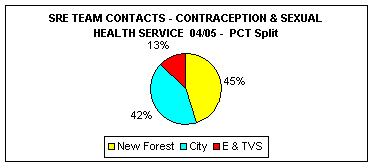
SWPCT Alliance accounts for 55% of the SRE team's activity in 2003/04. 4414 contacts were made in the New Forest in the last year. 4110 & 1263 contacts were made in Southampton & ETVS respectively.
Psychosexual Counselling
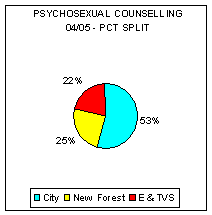
648 patients accessed the psychosexual counselling service last year. 347 (53%) were from the City, 161 (25%) from New Forest & 140 (22%) from ETVS.
Figure 3
Consultation Process May - September 2005
The consultation process is ongoing throughout the re-design, but to date consultation has been conducted with key stakeholders including:
GP consultation
· GP audit - report available
· GP stakeholder event
Key notes:
· 75% of contraception in the UK is provided through primary care
· 37 out of 38 practices in the SWPCT Alliance responded to questionnaire
· Majority of Practices offer a confidential sexual health service to young people (3 practices in ETVS did not offer services to under 16 year olds).
· 36 practices report offering at a basic contraception & sexual health service to patients (including: oral & injectable contraceptives, referral to termination of pregnancy service, chlamydia screening & smear tests)
· Identified areas of improvement to the sexual health services offered by Practices include: services for lesbian & gay community, partner notification for STIs, contraceptive implant & full STI screening)
· 20 out of 37 practices are interested in training or developing sexual health services within primary care.
Service User Consultation - full report available
Key points:
· questionnaire distributed to 10 clinics in locality
· responses from all 10 clinics
· 131 service users completed the questionnaire (113 resident in SWPCT Alliance)
· Age range 14-50 years old.
· ½ the sample under 20 years old
· Most users accessed service for contraception, condoms & pregnancy testing
· No one accessed service for issues on sexuality, mental health or infertility advice
· Feedback regarding the overall service & in particular the staff was very positive.
`The service is extremely professional & friendly, you can always ask questions and advice. Without the clinic I would never have had the courage to have a smear test which is vital.' (30)
`I'm happy that here we are not being treated as if we don't know what we are doing because of our age, when we do know. From what I've seen the staff work well. I feel comfortable that I am in a comforting surrounding.' (15)
`Walk in and walk away with problems solved' (22)
`The confidentiality factor, it makes it easier to talk about problems knowing it will be kept private' (18)
· Service users felt improvements could be made by having more clinics, varied opening times & better publicity regarding clinics locally.
· 50 (38%) of service users said they would access their GP for sexual health.
· Reasons for not wanting to access GPs included: having to wait for appointments, no out of hours service, issues of confidentiality & restricted access to female staff.
· 96 service users prefer drop-in clinics, with 35 wanting appointment based clinics.
· 35 users wanted a separate session for young people (31 of which were under 25 years old)
· 26 service users gave contact details and agreed to be involved with any subsequent consultation if appropriate.
Other comments from service users:
`Please don't close Totton!' (42)
`I really like this and it's a great help & if we didn't have this there would be a lot of underage pregnancies' (15)
`I really don't know what I would have done without my local clinic - my mind has always been put at rest, the service is always friendly & professional and I am extremely grateful that as a young woman my sexual health is at its best thanks to my clinic' (30)
`I have always received extremely friendly; professional and confidential advice & treatment and it would be a great loss to the area' (26)
Mapping target wards & location of clinics in the New Forest - see attached maps
1. The current location of clinics does correlate with targets areas for higher rates of teenage pregnancy in the New Forest (Totton, Hythe, Ringwood, New Milton & Lymington)
NF maps available on:
· Current sites for pregnancy testing in community settings
· Community pharmacists participating in EHC scheme
· Current & potential sites for condom distribution schemes.
Other consultation
· Teenage Pregnancy Local Implementation Teams discussions - minutes available
· Key stakeholders including youth service, connexions and voluntary organisations - brief report to follow.
· PPI meeting - June 05
· Steering group meetings with SCPCT - minutes/actions note available.
Standards for Sexual Health Services
The recommended standards for Sexual Health services clearly describe best practice within sexual health. Of the 10 standards, 6 explicitly link to aims of the current sexual health service re-design:
· To maintain a coordinated and integrated sexual health service across the Alliance to ensure the patient is afforded with a choice of settings that are geographically, culturally and clinically convenient.
· To minimise inequalities within sexual health and maximise health promotion opportunities, within primary care, clinical and community settings, targeted to local needs and marginalised groups. This improves access to effective interventions such as condoms and EHC.
· To promote non-discriminatory working practice through policy and staff training, User feedback is essential to this process likewise the development of community based provision can facilitate choice and enhance service access (user consultation in progress).
· To facilitate convenient and timely access to services within 2 working days to a contraception or GU service, abortion assessment within 5 working days and an abortion within a maximum of 3 weeks from initial contact. Same day/urgent access for emergency contraception, prophylactic treatment and services following sexual assault are also required. Clearly advertised, welcoming and accessible services with demonstrable confidentiality are key to these targets.
· With specific reference to preventing unintended pregnancy, to provide the full range of contraception for free
· Women who think they may be pregnant should have rapid access to free and confidential pregnancy testing at clearly advertised locations, same day results, the opportunity to consult with a health provider who can give accurate and unbiased information about pregnancy options and non-directive support to make informed choices, and prompt referral to specialist services where required.
National & Local Targets
LDP and PCT targets that could be affected include:
· A&E waiting times (percentage seen within 4hours, specifically re: EHC and sexual assault)
· Access to a GP within 48hours and a HCP within 24 hours (as a result of increased GP workload due to shift in over 25/35 year olds)
· Improving patient experience and accountability to local communities
· Reduction in teenage conception rates
· Improve access to sexual health services: 48hour target for accessing GUM
· Decrease in rates of new diagnoses of gonorrhoea.
National and Choosing Health targets that could be affected include:
· A reduction of 50% in the under 18 conception rate by 2010
· The roll out of the Chlamydia screening programme for under 25's by 2007
· 48 hour access to GUM for all by 2008
Proposed Change to Service Delivery
Options identified
1. Continue with current sites, reduce number of clinics, top age limit of 35, and provide services from within NF PCT including training to schools and vulnerable children, reduce Dr input - TUPE and recruit as appropriate. Limited psychosexual counselling - to be provided by SCPCT. (Retain access to Quays - sat AM)
2. Reduce number of clinics and provide Young people's clinics and limit service up to 25 years of age. Reduce Dr input. All ages over 25 to attend GP. Training to schools and vulnerable children to be provided by NF PCT -TUPE and recruit as appropriate. limited psychosexual counselling- to be provided by SCPCT (Retain access to Quays - sat AM)
3. Reduce SLA to reduced number of clinics as in option 1, limited psychosexual counselling- to be provided by SCPCT (Retain access to Quays - sat AM). Training to schools and vulnerable children to be provided by SCPCT
4. Reduce SLA to limited provision of young people's clinics as in option 2, limited psychosexual counselling and training into schools - to be provided by SCPCT (Retain access to Quays - sat AM)
Preferred option - number 3
Under the service level agreement that is currently held with Southampton City there are 10 clinics in total - 9 in the New Forest and 1 in Romsey. The proposal is to close one of the three clinics as Hythe (AM session only, leaving afternoon and evening) in order to maintain services to all age groups.
Sexual health education in schools and for vulnerable children will continue to be provided by Southampton City PCT. A payment of 5k per annum is also set aside to enable access of young people to Saturday morning clinic at the Quays.
This model was presented and agreed at the SW Alliance PEC where it was recommended that the psycho-sexual counselling service ceased.
NB - SCPCT have suggested that they do not wish to split the service, with over 35's going to GP practices but to maintain service as open to people of all ages.
Hampshire County Council Appendix Five
Health Overview and Scrutiny Committee
29 November 2005: Palliative Care Services at Andover War Memorial Hospital

SERVICE PROPOSAL
TO DEVELOP
AN INTERMEDIATE COMMUNITY-BASED
ADULT SUPPORTIVE AND PALLIATIVE CARE
SERVICE
BASED IN
THE COUNTESS OF BRECKNOCK HOSPICE
ANDOVER
Final Draft 17 October 2005
PROPOSAL FOR AN INTERMEDIATE COMMUNITY- BASED
ADULT SUPPORTIVE AND PALLIATIVE CARE SERVICE
COUNTESS OF BRECKNOCK HOSPICE, ANDOVER
V. INTRODUCTION
"Palliative Care is the active total care of patients and their families, usually when their disease is no longer responsive to potentially curative treatment. It provides relief from pain and other symptoms; aims to achieve the highest possible quality of life; responds to physical, psychological, social and spiritual needs; and extends as necessary to support in bereavement". The Palliative Care Handbook, 5th edition, SUHT.
Mid Hampshire Primary Care Trust is currently working in partnership with local General Practitioners and Winchester and Eastleigh Healthcare NHS Trust to develop integrated, locality-based services.
This proposal for GP-led palliative care services in Andover has been compiled taking account of the wider introduction of practice-based commissioning, the need to reduce unnecessary acute hospital admissions where better, local solutions can be offered, and consumer demand for local service delivery in a primary care setting.
This proposal promotes best clinical practice through the development of supportive and palliative care services for Mid Hampshire residents in line with national guidance, including:
· National Supportive and Palliative Care Guidance for Adults with Cancer (NICE, 2004)
· Gold Standards Framework (for co-ordinated assessment and support in primary care)
· Liverpool Care Pathway for the Dying Patient (meeting the needs of patients in all locations)
· End of Life Care initiative (DH)
The proposal underpins core values of the PCT, namely:
· Equity of access
· Partnership working
· Securing the workforce
· Achieving financial balance
1.5 The proposal sits as part of a wider Supportive and Palliative Care Strategy being developed through the Central South Coast Cancer Network and is underpinned by recent and detailed needs assessment work across Hampshire. (Tebbit, P. August 2005)
BACKGROUND AND FOUNDATION FOR DEVELOPING THE PROPOSAL
Health and social care reforms have promoted a shift towards services targeted on assessed needs and delivered in the primary care setting. Technological and other advances have broadened the pattern of service delivery, highlighting the importance of collaboration between agencies to improve the health of the local population. People are living longer, often with increasingly complex conditions. Changes in the nursing profession have lifted traditional constraints and GPs affected by increasing demands are keen to see skilled nursing services which are better co-ordinated. Gaps in community provision have led to unnecessary and often inappropriate use of acute hospital services which are now struggling to meet ever-increasing demand. Services have lacked continuity due to lack of structured out of hours support, intermittent communication across agencies and limited staffing.
To some extent, Supportive and Palliative Care services have been neglected as a "hidden" service, relying very much on the goodwill of primary care, community and hospital staff to manage individual cases as best they can. The service has relied heavily on charitable funding and support, particularly from Macmillan Cancer Relief, the Marie Curie Trust and the Countess of Brecknock Hospice Trustees. In turn this has focussed what limited services have been available on the needs of patients with cancer. End of life care for patients without cancer has been even less structured.
2.3 As part of the National Cancer Plan, funds were made available for the provision and development of specialist palliative care services, which are outside the scope of this proposal and which are commissioned for Mid Hampshire residents from specialist palliative care teams in Southampton, Salisbury and more recently in Basingstoke.
1.1 With this in mind, this proposal for a primary care-led supportive and palliative care service, working out of the Countess of Brecknock Hospice as an intermediate community team in Andover, takes account of the following principles:
· To support the development of primary care led services, with strong links to local communities
· To support those who wish to die at home, whenever practically possible
· To ensure equitable access according to identified need to palliative care services and support, whether in a hospice setting, nursing home or at the patient's home
· To provide an intermediate service between general community palliative care services provided by GPs and District Nurses, and specialist palliative care services provided by consultant-led hospital teams
· To promote a flexible multi-professional approach
· To develop a 24-hour, 7 day a week service for continuity of care and support
· To ensure services are geographically accessible and available.
· To evaluate services to ensure quality is improved and maintained.
· To promote best use of resources and ensure financial balance
· To encourage and facilitate joint working across agencies, in the interests of patients and their families.
1 NEED FOR PALLIATIVE CARE SERVICES
Mid Hampshire PCT covers a population of 170,212. National mortality data indicates an annual incidence of deaths in Mid Hampshire of 1691, 24% of which (406) are deaths from cancer. The ratio of all deaths to 100,000 population for Mid Hampshire is 993, which is close to the national average (1013). It is estimated (1) that approximately two-thirds of non-cancer deaths will have a palliative and terminal care element, the final third being sudden deaths. All cancer deaths require palliative care and terminal care services. For Mid Hampshire the estimated need for services is 1263 patients per year.
National studies have shown that 56% of people would like to stay at home and die at home. In reality only 20% of people currently are able to die at home, only 4% die in a hospice, 20% die in a care home and 56% die in hospital. Figures for Mid Hampshire indicate that 24% of our population die at home - the highest percentage across Hampshire and the Isle of Wight - , 39% in hospital,12% in nursing homes and 25% in a hospice.
The structure of our population is such that 21.8% of people are aged over 60 years. This compares with 22.6% across the Cancer Network and 20.9% nationally. It is also noteworthy that 14.5% of households are pensioners living alone and 10.4% are all pensioner households. Mid Hampshire has few resident non-white ethnic groups (0.6% mixed, 0.6% Asian, 0.2% black and 0.6% other) and 92% of the population class themselves as Christian or having no religion.
Key recommendation 15 of the NICE guidance, states that, over and above specialist palliative care services, community teams should be available to provide support to patients in their homes, community hospitals and care homes. General palliative care, including care of the dying, should be provided by all health and social care professionals in relation to the assessment, treatment and care of all those with advanced disease and should not been deemed a separate component of service. This includes the introduction of Gold Standards Framework in every practice and Liverpool Care Pathway in hospitals.
For more specialist services, commissioners are asked to "plan services flexibly around the needs of patients, recognising that this can be achieved in more than one way". No data is supplied on national estimates of, for example, beds per head of population. Tebbit (1) has estimated however that, within the Cancer Network, Mid Hampshire residents require access to 9 specialist palliative care beds (6 cancer, 3 non-cancer) and this level of provision is currently provided for in Southampton, Salisbury and Basingstoke. He goes on to estimate that Mid Hampshire requires 35 day therapy places per week. Hospital support is provided for Mid Hampshire residents via Winchester & Eastleigh Healthcare Trust, which is a designated cancer unit. The gap for Mid Hampshire is the lack of community-based provision between the very general care provided by GPs and district nurses, and the very specialist care provided at specialist inpatient centres.
This proposal sets out a model to provide an intermediate-level community palliative care service to complement and enhance local support and to ensure appropriate transfer to specialist hospital teams. Community teams require access to consultant advice and support, medical input (GP or other), Clinical nurse specialists and nursing staff, access to physiotherapy, occupational therapy, dieticians, pharmacists, social workers, chaplains, psychologists and admin support.
VI. CURRENT SERVICE
Along with access to specialist palliative care beds, advice and support, mostly from Countess Mountbatten House in Southampton, plus palliative care inpatient support from Winchester and Eastleigh Healthcare Trust, Mid Hampshire residents have access to facilities supported by the Trustees of Countess of Brecknock Hospice in Andover. In 2004/5, 68 patients were admitted to specialist palliative care beds, 67 of whom went to Southampton. Royal Hampshire County Hospital saw 327 new patients. It is estimated that Countess of Brecknock Hospice team should manage approximately 130 patients per year.
The hospice is managed by Winchester & Eastleigh Healthcare Trust, supported by funds from the Countess of Brecknock Trustees, and with strong support from local GPs to provide medical input and cover. The total budget of £464,220 is allocated and provided as follows:
Costs |
Funded establishment |
Annual Budget (£) | ||
Whole Time Equivalent (WTE) |
Total |
WEHT |
CBH Trustees | |
H Grade** |
0.13 wte |
5,202 |
5,202 |
|
G Grade |
1.00 wte |
37,088 |
26,086 |
11,002 |
F Grade |
1.00 wte |
30,846 |
13,255 |
17,591 |
E grade |
6.04 wte |
193,427 |
118,464 |
74,963 |
B grade |
0.64 wte |
12,334 |
8,675 |
3,659 |
A grade |
2.83 wte |
53,650 |
37,735 |
15,915 |
Sub-total nursing |
11.64wte |
332,547 |
209,417 |
123,130 |
Medical Cover* |
*0.95 wte |
73,512 |
73,512 |
0 |
Sub-total medical |
0.95 wte |
73,512 |
73,512 |
0.0 |
Senior 1 Physio |
0.78 wte |
26,829 |
18,870 |
7,959 |
Aromatherapist |
Contracted |
2,433 |
305 |
2,128 |
Admin |
0.53 wte |
9,641 |
1,858 |
7,783 |
Recruitment control |
-3,642 |
-3,642 |
||
Sub-total other staff |
1.31 wte |
35,261 |
17,391 |
17,870 |
Sub-Total Revenue |
13.90 wte |
441,320 |
300,320 |
141,000 |
Med & Surg equipment/ mats |
2,500 |
2,500 |
||
Drugs |
15,000 |
15,000 |
||
Dressings |
1,200 |
1,200 |
||
M&S equipment maintenance |
1,200 |
1,200 |
||
Staff uniforms |
600 |
600 |
||
Bedding and linen |
200 |
200 |
||
Stationery |
700 |
700 |
||
Staff travel & subsistence |
1,000 |
1,000 |
||
Telecoms recharge |
500 |
500 |
||
Non-staff |
22,900 |
22,900 |
||
Total |
13.90 wte |
464,220 |
323,220 |
141,000 |
· COBH Trustees have offered to fund £40k for 5 years in addition to the medical budget available
· The Trustees have also funded equipment and additional staff
THE PROPOSED ADULT COMMUNITY SUPPORTIVE AND PALLIATIVE CARE SERVICE IN ANDOVER
National guidance for the provision of supportive and palliative care services (NICE 2004) sets out extensive recommendations for the development of flexible, responsive, integrated care which is equitable, accessible and clinically appropriate.
A GP-led service, supported by community-based nurses and continued links to Winchester & Eastleigh Healthcare Trust, linked to specialist palliative care centres in Southampton, Salisbury and Basingstoke, will facilitate appropriate and planned access to comprehensive medical and nursing services according to a patient's assessed need at any one time, and as those needs change over time.
It is envisaged that the service will reduce hospital admissions as community alternatives develop and will facilitate early discharge where hospital admission is necessary. Pockets of deprivation in Andover mean proportionately fewer patients are able to die at home, or for those who do, care is not always optimal; the hospice will provide a local and more suitable alternative to an unnecessary admission to acute hospital and provide advice, support and expertise to community staff. The service will extend to patients across the whole of Mid Hampshire.
Mid Hampshire PCT and the GPs in the Andover locality have longstanding links with the Countess of Brecknock Hospice and its Trustees. Hitherto, the hospice has been managed by Winchester & Eastleigh Healthcare Trust but it is now proposed that the service be managed by a new provider on behalf of the local population, commissioned through the PCT.
The GP-led service will provide levels of care appropriate to local need, encompassing day care, home support, night sitting, respite care, pain management and symptom control, care of the dying, in-patient facilities, and ready access to specialist palliative care services as required.
Strong links to other community based resources including the Preventing Dependency Team, will ensure that the stabilisation, rehabilitative and palliative care processes occur within the home environment whenever this is feasible.
To achieve clarity of purpose, cost effectiveness and to ensure continuity of care, operational policies, clinical protocols and criteria will govern the service.
It is envisaged that the service will operate as follows:
Referrals will be made to the service based at CBH and will be reviewed by the clinical team
Referrals can be made by consultants, senior ward staff, GPs, out of hours services, district nurses, community matrons and the PDTs
Referrals will be received, logged and documented.
Once a referral is received and reviewed, a mechanism will be set in train to assess patients' suitability for admission.
At assessment, ongoing care will be discussed and agreed with the patient and their carer, including the need for respite, night sitting or out of hours support
For end of life care, the preferred place of dying will be discussed with the patient and their carer and arrangements reviewed.
Patients and their carers will be provided with a comprehensive information pack, describing the services available to them and contact numbers. The patient's GP will remain the main communication link.
Patients will be admitted to the Hospice for in-patient care according to agreed admission criteria .
Where a patient's condition requires specialist palliative care expertise, referrals can be made according to existing referral criteria, to either Southampton or Basingstoke specialist centres direct by the patient's own GP or via the palliative care service at CBH.
All clinical interventions carried out by the palliative care team will be recorded and reported back to the patients' own registered General Practitioner.
Out of hours medical cover for the hospice will be provided by West Hampshire Out of Hours Service, although the new provider may wish to investigate alternative solutions. It is hoped that with better day time management of patients and full establishment of trained nursing staff, out of hours intervention in the hospice would be minimal.
PERFORMANCE MONITORING
To ensure the service is working effectively, the following will be monitored by the PCT on behalf of local GPs:
Demand for the service in terms of number of referrals and number of admissions
Patient and carer satisfaction
Responsiveness and equity in terms of speed of response, agreed action and access by all GPs for all patient groups over the age of 16 years.
Evidence of adequate and ongoing training and professional development, plus evidence of links to consultant-led services and supervision
Reduction in hospital admissions and length of stay
Staff satisfaction,
Satisfactory links with colleagues in primary and secondary care services, social services, nursing homes and charitable organisations, in particular regular meetings with the CBH Trustees.
7 EXCLUSIONS
The service will not be available to:
· Children (defined as 16 years or under), for whom other services are available
· Patients with a diagnosed unstable acute psychiatric condition as their primary problem, for whom other services are available
· Patients with non-malignant disease, although this service may develop at a later date
8 STAFF
The Palliative Care Service will have a designated clinical director(s). Clinical leadership and operational management arrangements will be clearly identified.
8.2 All staff will transfer to the new service in accordance with statute. The new employer will recognise existing staff unions or renegotiate.
EQUIPMENT
Existing equipment will remain but will become the responsibility of the new provider to maintain or replace.
Limited equipment to support patients in their home may be needed over and above the joint equipment store currently shared between health and social services, dependent on funding; the new service would then be responsible for dispensing, installing and retrieving such equipment as necessary.
IM&T support will be required and adequate confidential storage facilities for patient notes. The new provider will need to negotiate arrangements with WEHT.
STAFF TRAINING AND DEVELOPMENT
Clinical staff working within this service will require evidence of palliative care training
Staff will participate in on-going appraisal and performance review (KSF where relevant). This process will be used to identify personal development needs. A personal development plan will then be compiled and staff will be given support to achieve learning outcomes
Team development opportunities will be required to ensure mutual understanding, communication links and shared learning with other community based health and social services workers
Successful change management will be required to generate total commitment to this approach.
11 TIMESCALE
It is envisaged that this service would be operational from April 2006. This would allow time to:
· Agree the detailed plan and service level agreement with GPs, existing nursing staff and the CBH Trustees
· Consult appropriately, through an agreed communications strategy
· Recruit staff
· Confirm service protocols and referral criteria
· Accomplish training and development
· Set up information support
· Test data collection tools
· Establish baseline data over a period of six months
· Undertake publicity
12 PUBLICITY
Existing primary and secondary care services would be informed prior to the commencement of the service. This will ensure the when direct contact and involvement is needed from Hospital services, Community Nurses or General Practitioners themselves, they are aware of the contribution that they will make to the process. Other publicity will be sought through the voluntary sector and in local media.
References
(1) A Population-Based Palliative Care Needs Assessment for the Central South Coast Cancer Network. P. Tebbit, August 2005
Hampshire County Council Appendix Six
Health Overview and Scrutiny Committee
29 November 2005: South East Hampshire Day Hospital Provision

VII.
VIII. Elderly Mental Health Services
IX.
EMH Day Hospital
Consolidation and
Modernisation

(a) Board Report
9th September 2005
a) Executive Summary
A review of the Elderly Mental Health Day Hospitals has been undertaken. A need for change was identified because of the financial position of both the service and the Trust, the quality of some of the day hospital environments and an under utilization of resources.
This review identified some significant environmental problems in two of the day hospitals as well as current over capacity of the service.
Following the review there were three options:-
1 - Do nothing
2 - Close all the day hospital services
3 - Consolidate day hospitals on to a reduced number of sites
In consultation with the service's senior clinicians, option 3 was considered the most appropriate, as it would continue the community care of patients, avoiding costly inpatient admission and aiding discharge.
The paper is looking for board approval to begin:-
1 - The consolidation of 3 days hospitals into 2 in the Portsmouth City and East Hampshire Area. The Lawns Day Hospital will close with some patients transferring to the remaining Beaton and Goddard Day Hospitals in St James' Hospital Portsmouth.
2 - The consolidation of 2 days hospitals into 1 in Fareham & Gosport area. Closure of Cedarwood Day Hospital with a small increase in the capacity at the remaining Phoenix Day Hospital in Gosport.
The above would be achieved with full consultation with users, carers, stakeholders (including statutory and voluntary), in line with Section 11 of the NHS Act.
Concurrently work will progress to provide new models of care for older people with mental health problems in the day hospitals.
The identified saving would be in the region of £202,000 per year with £81,000 saved this financial year if closed by 30th October 2005.
b) Part 1
1. Introduction
This paper is for East Hampshire and Fareham & Gosport PCT board in response to the financial challenges of the local health economy and day hospital environmental issues. It proposes that the Elderly Mental Health (EMH) day hospital service is reconfigured to meet both aims, whilst maximising value for money.
2. The Need to Change
There are a number of key factors influencing the change:-
Financial Context
The South East Cluster are projecting a £23million overspend for 2005/6, and included within that, is the EMH service, which has a forecast overspend of £525,000 as at 30 June 2005.
The cluster has been directed to breakeven, which means that to assist this EMH must breakeven too. All EMH services are being reviewed to look for savings, and one area in which we have identified potential savings is in consolidation of day hospitals.
Utilisation of Resources
At review the day hospitals were shown to be under utilised (figure 3.1), which impacts on the cost of treatment and value for money.
Day Hospital |
% Utilisation |
Beaton - SJH |
73% |
Cedarwood - St CH |
68% |
Goddard - SJH |
70% |
Lawns - Havant |
69% |
Phoenix - Gosport |
92% |
Figure 3.1 - Day Hospital Utilisation
Quality of Patient Environment
The day hospital environment is important for this patient group. It should include a layout, which can accommodate large groups, small groups and individual session rooms as well as being secure, with adequate fire exits and room for patients to wander. Due to the mobility of patients, there must be level flooring, access to disabled toilets and suitable outside access to secure garden area and transport.
Neither Cedarwood Day Hospital or The Lawns Day Hospital have adequate environments for the groups of patients served.
3. Principles for Change
Any changes must:-
1. Capitalise on staff's existing skills, experience and good practice
2. Maximise the use of resources
3. Minimise any adverse impact to patient care
4. To be used as an opportunity to modernise services
5. Take into account stakeholders views where possible
6. To ensure the provision of fit for purpose environments
7. Provide accessible services that minimise transit times
8. Ensure delivered care programmes are patient centred
4. Current Provision
Currently there are 5-day hospitals operating across the service. They provide care for patients with Functional illness (such as Severe Depression, Anxiety, Schizophrenia) and/or Organic illness (Dementia). Within this document each session is one half day (i.e 2 sessions make up one day) :-
Beaton Day - Situated in Southsea at the St James Hospital site. Beaton Day Hospital consists of one large group room, one smaller group room, one consulting room, two offices and toilets. It currently has capacity for 200 sessions per week Monday to Friday. Patient groups served are people with a functional illness . The environment is currently unlocked but is capable of being made secure if required. The quality of the environment is adequate.
Cedarwood Day - Situated in Fareham at the St Christopher's Hospital site. Cedarwood consists of 1 group room, 1 small group room, 1 consulting room, two offices and toilets (with very limited disabled facilities). It currently has available 112 sessions per week Monday to Wednesday and Friday. On Thursday additional individual sessions/counselling takes place. Patient groups served are people with a functional illness or those in the early stages of an organic illness. The day hospital is a secure standalone unit. The quality of the environment is poor with inadequate space.
Goddard Day - Situated in Southsea at the St James Hospital site. Goddard Day consists of two large group rooms, one smaller group room, one consulting room, one office and toilets. It currently has available 220 sessions per week Monday to Saturday. Patient groups served are people with severe organic illnesses. This day hospital is a secure unit with a secure garden area. The quality of the environment is good.
The Lawns - Situated in the middle of Havant at a Social Services Day Centre. The Lawns consists of one small group room, one consulting room, one office and toilets. It currently has available 138 sessions per week over 5 days Monday to Friday and concurrently the staff from The Lawns operate an additional 16 sessions at the Laurels in Petersfield Hospital on Wednesday. Patient groups served are functionally ill and early organic illness. The day hospital is unable to manage some patients due to security issues. The quality of the environment is unsuitable and cannot be expanded due to renting space from social services.
Phoenix Day - Situated in Gosport at the Gosport War Memorial site. Phoenix Day Hospital consists of one large group room, two small group rooms, two consulting rooms and toilets. It currently has available 116 sessions per week Monday to Friday. Patient groups served are both functional and organic which are provided on different days. This day hospital is a secure unit with a secure garden area. The quality of the environment is good.
Additionally there are two small, ward based day hospital services run from both Summervale House (Fareham) and Willows Ward (Petersfield). Both these day hospitals (based on residential wards) cater for a small number (1 to 6) patients and both are subject to other planned FRP, hence have been excluded from this review.
5. Current Capacity and Utilisation of Services
Figure 5.1 shows the usage of each of each of the five main day hospitals in the week of a snapshot as at 13th July to 19th July 2005 :-
Day Hospital |
Weekly Sessions | |||
Available |
Booked |
DNA |
Unused Sessions | |
Beaton |
200 |
145 |
18 |
55 |
Cedarwood |
112 |
76 |
10 |
32 |
Goddard |
220 |
155 |
14 |
65 |
Lawns |
154 |
106 |
14 |
48 |
Phoenix |
116 |
108 |
14 |
9 |
|
||||
TOTAL |
802 |
590 |
70 |
209 |
Figure 5.1 - Weekly Sessions and Unused
This snapshot indicates significant under utilisation with over 25% of sessions not booked, suggesting the potential to reduce overall service capacity whilst minimising any restriction on demand.
Figure 5.2 shows a sample of the 510 patients in receipt of EMH day services between June 2004 and May 2005 and their primary diagnosis. The table shows a relatively even split between the number of patients with the primary diagnosis of organic and functional illness. It can also be seen that the people using the service are evenly distributed between the two PCTs.
Figure 5.2 - Location and Diagnosis of patient sample
Post Code |
Dementia |
Severe Depression |
Anxiety |
Schizophrenia |
Alcohol |
Bipolar Disorder |
Other |
Total |
% Patients |
GU3 |
1 |
1 |
0% | ||||||
GU31 |
2 |
2 |
0% | ||||||
GU32 |
4 |
4 |
1% | ||||||
PO1 |
11 |
4 |
1 |
1 |
1 |
1 |
19 |
4% | |
PO2 |
9 |
16 |
2 |
1 |
1 |
1 |
1 |
31 |
6% |
PO3 |
7 |
1 |
1 |
9 |
2% | ||||
PO4 |
9 |
5 |
4 |
1 |
2 |
21 |
4% | ||
PO5 |
10 |
11 |
2 |
1 |
2 |
26 |
5% | ||
PO6 |
7 |
11 |
2 |
3 |
2 |
1 |
26 |
5% | |
PO7 |
16 |
13 |
29 |
6% | |||||
PO8 |
9 |
16 |
25 |
5% | |||||
PO9 |
23 |
16 |
39 |
8% | |||||
PO10 |
6 |
5 |
11 |
2% | |||||
PO11 |
5 |
10 |
15 |
3% | |||||
PO12 |
29 |
20 |
5 |
2 |
2 |
1 |
59 |
12% | |
PO13 |
23 |
10 |
3 |
1 |
1 |
38 |
7% | ||
PO14 |
13 |
15 |
5 |
1 |
1 |
1 |
36 |
7% | |
PO15 |
7 |
6 |
3 |
1 |
17 |
3% | |||
PO16 |
21 |
29 |
4 |
2 |
56 |
11% | |||
PO17 |
4 |
1 |
1 |
6 |
1% | ||||
SO31 |
6 |
11 |
2 |
1 |
1 |
21 |
4% | ||
SO32 |
5 |
10 |
3 |
1 |
19 |
4% | |||
Total |
220 |
210 |
31 |
16 |
8 |
11 |
7 |
510 |
100% |
% Diagnosis |
43% |
41% |
6% |
3% |
2% |
2% |
1% |
100% |
|
6. Environmental Factors
Cedarwood day hospital at St Christopher's Hospital provides a poor environment, particularly in relation to fire risk, risk of falls as a result of uneven and sloping flooring, and offers poor facilities for people with any level of disability. The day hospital is located on an otherwise unused site with no backup facilitates such as catering or security.
The Lawns day hospital environment is inappropriate because of its limited number of rooms and size of accommodation. There is limited scope for patients with dementia who wander and as a result, this group of people have to use the service located at St James Hospital.
The remaining three-day hospitals have suitable environments in which to treat people with either functional or organic illness in a safe and secure manner, with the backup services of a hospital.
7. Options For Change
There are three broad options which exist:-
1 - Do Nothing
2 - Close all day hospital services
3 - Rationalise services onto a reduced number of sites
1 - Do Nothing - This can be discounted because of the financial and also environmental issues.
2 - Close all day hospital services - The closure of all day hospitals can be discounted as day hospitals prevent admission to inpatient wards and aid early discharge. The function and option of day hospital treatment is valued by patients, carers and professionals.
3 - Rationalise services onto two sites - This is considered to be the best option as it would achieve the financial and environmental objectives and allow re-examination of the model of care to take into account new practises.
The recommendation for option 3 is as follows: -
A - Close The Lawns Day Hospital and move all patients to Goddard or Beaton Day Hospitals at St James Hospital. The 1-Day per week at the Laurels Day Hospital would remain.
B - Close Cedarwood Day Hospital and move all patients to an increased capacity Phoenix Day Hospital at Gosport War Memorial Hospital.
C - Utilise some of the released money to enhance the Community Psychiatric Nurse Teams in both East Hampshire and Fareham & Gosport to support patient who are either unable or unwilling to acceptable travel to the new day hospital sites.
The disadvantages for option 3 are:-
· A decrease in the number of places available in the Fareham and Gosport area
· Transport especially for people living in the Fareham area accessing the Gosport service and people living in Petersfield accessing the St James' service.
· There may not be places for some current patients and other patients may choose not to travel, or attend a different location.
· Some staff may be put at risk or redeployed as per Trust policy, with redundancy a possibility for a small number of staff (the expertise of this staff group will be lost).
8. Consultation
At this early stage the service has not fully consulted patients and carers on these proposals. This paper is looking for Board Approval on the direction of travel and agreement that consultation should now begin on a clear set of options.
This consultation would fulfill our obligations under Section 11 of the NHS Act and would include carers, users and statutory and voluntary organisations.
9. Financial Impact of Recommendation
The closure of The Lawns Day Hospital equate to full year savings totalling £136k, so assuming the closure takes place on 30 October 2005, would provide a savings totalling £54k in 2005/6 (based on pay and non pay).
The closure of Cedarwood Day Hospital equate to full year savings totalling £66k,
so assuming the closure also takes place on 30 October 2005, would provide savings totalling £27k in 2005/6 (based on pay and non pay).
The enhancing of community teams has been taken into account within the above financial calculations.
Part 2
1. Outline Project Plan
Establish two project teams, one for each site to:-
1 - Design detailed Project Plan
2 - Consult with Patient, Carers, Professionals and Staff (October)
3 - Review workforce implications and HR Plan (Appendix 2)
4 - Revise admission and discharge criteria
5 - Revise care pathway
6 - Review needs of those in receipt of the current service (October)
7 - Renegotiating transport contract
8 - Begin the consolidation of Day Hospitals - November 1st 2005
9 - Complete the consolidation no later than the 1st of December 2005
Part 3
X. The Role of the Elderly Mental Health Day Hospital
Day Hospitals for elderly mentally ill fulfil many functions, some specialising in particular approaches.
The following are functions that are common to most:
1 |
To provide intensive in depth clinical assessment and diagnosis for elderly patients with severe mental health problems. |
2 |
To provide treatment, advice and monitoring of progress of patients with mental illness. |
3 |
To provide support and information to the carers of elderly patients with mental illness. |
4 |
To provide respite for carers of patients whose illness results in unpredictable or challenging behaviour that cannot be managed in other environments. |
5 |
To assist with early discharge from hospital where frequent or regular attendance may enable safer and more rapid discharge form M H or DGH Wards. |
6 |
To help prevent admission of patients to acute M H or DGH beds, to enable patients to remain in the community and retain their independence. |
7 |
To coordinate and manage complex care needs by arranging liaison, CPA and at risk meetings with relevant carers and agencies when necessary. |
8 |
To enhance crisis intervention by providing care to augment CMHT/SS or primary care input. |
9 |
To prevent relapse in high risk patients. |
Referral route
Patient /carer · GP _ Social Worker

 GH Consultant/CMHT Elderly Medicine DH

 Memory Clinic Psychologist
 CPN Day Hospital Acute EMH Ward

OT SLT Consultant/Associate Spec/SPR
XI. Referral criteria
· 65 years old or over unless suffering from early onset dementia
· Requiring in depth clinical assessment or treatment and monitoring of severe mental health problems
· Patient/carer to be in agreement with attendance
· GP to be kept informed
· Referral proforma to be completed or in urgent cases telephone/fax is acceptable.
a) Day Hospital Care Pathway
Referral received:
|
Initial attendance
(within 48 hours for urgent referrals)
(within 1 month for routine referrals)
Initial assessment to include carer input and medical examination
|
Risk Assessment
|
Treatment/Care Plan starts
|
Regular attendance/monitoring/review | carers involvement
Therapies may include:
Medication Routine investigations Referral to other specialist services Reminiscence therapy Memory Group Exercise group Cooking Social activities Sensory activities |
ADL Confidence building Anxiety /Depression Management Current Affairs Group Communication skills group Relaxation therapy Bereavement counselling 1:1 Counselling CBT Psychotherapy Carers Groups |

Discharge Planning

Discharge and follow up



Psychologist
Memory Clinic Lithium Clinic
CPN OP Vol GP SS DC
DC
Discharge Criteria
· Assessment/course of treatment complete
· Patient stable or not benefiting from attendance
· Alternative appropriate care/treatment available
· Patient unwilling to attend
· Patient hospitalised
Hampshire County Council Appendix Seven
Health Overview and Scrutiny Committee
29 November 2005: Rainbow Assessment & Treatment Group
Blackwater Valley and Hart PCT
Rainbow Assessment and Treatment Group - Frimley Children's Centre
1. Introduction
Blackwater Valley and Hart have recently reviewed the service provided by the Rainbow Assessment and Treatment Group at Frimley Children's Centre. The review was undertaken in light of the ongoing development of the Health Visiting service within the PCT, changes in the provision of services by partner agencies and also in the light of the need to deliver financial balance for local health services. The proposed changes aim to streamline the assessment and treatment services for pre school children with developmental delays while maintaining the same high standards that the Rainbow group deliver.
2. Description of Current Service
Rainbow assessment and treatment groups are run by 4 childcare practitioners including 1 team leader (2.86 WTE, total salary cost circa £65K). The team have a role in supporting the multi disciplinary assessment (MDA) and care planning process in both Surrey Heath and Hampshire (Rushmoor and east of Hart) for children with special needs / learning disabilities. The support is provided by:
· Attendance at the MDA meetings
· Visits to a referred child's pre school placement to gain further information on the child's needs pre assessment and support to the child post assessment (2-3 visits are made per month)
· Provision of assessment and treatment groups, supported in the main by the speech and language therapy service
· Liaison with both Surrey and Hampshire early years services
· Supporting parents in a parents group.
3. Description of Proposal
In light of the recent development of the Health Visiting service and the current financial position of the health economy in both Hampshire and Surrey, Blackwater Valley and Hart PCT propose to re-provide the current Rainbow service in an alternative way, minimising any impact on the children and their families. In doing this, the aim is to streamline the assessment and treatment services provided by both Blackwater Valley and Hart PCT and Children's Services in Surrey and Hampshire, improving the coordination of this multi-agency work and reducing duplication (NSF for Children and Young People and Maternity Services - standard 8).
XII. Multi Disciplinary Assessment Process
· Health visitors and early years services from both counties attend the MDA meetings (Surrey Heath to start in November 2005). Information regarding both the child and the nursery setting, which is required for the MDA process, is gained from these services. The presence of the early years services enables the assessment and care planning process to be multi agency.
· With the changes in the Health Visiting service in Blackwater Valley and Hart PCT and the Surrey PCTs, it is proposed that each pre school has a named health visitor link. Care pathways are being developed between the health visiting service and early years. It is therefore proposed that the information required for the pre assessment process is considered as part of this care pathway.
· A new specialist nurse practitioner post has been developed providing services to both Surrey Heath and north east Hampshire and the post holder has responsibility for coordinating the healthcare needs of a small number of children with complex needs who receive services from a number of locations.
XIII. Groups
· Generally the targets for the groups run at Frimley Children's Centre are set by the Speech and Language Therapy service and there is direct speech and language therapy involvement with all the "mother and toddler" groups. It is proposed that this service takes responsibility for running targeted assessment and treatment groups and will then support children in these groups in their pre school setting in the most appropriate way. Increasing the assistant time by 15 hours per week, term time only, within the service, will support this proposal.
· The early years service in Surrey has approached the PCT to provide joint groups between health and early years thus enabling a multi agency approach. The early years service would then support the children in their pre school setting. The early years service has agreed to run the groups with both Hampshire and Surrey children (health could then provide support to the Hampshire children in their pre school setting if a similar agreement is not reached in Hampshire). This type of provision is running successfully in Guildford.
· The groups run by the Rainbow service at Farnborough Grange will need to be re evaluated. Staff at Farnborough Grange are skilled and competent in working with children with additional needs and support for this early years centre can be gained from appropriate health services (e.g. therapies) who will be able to visit the early years setting. In fact the Head at Farnborough Grange has agreed to running the current groups in house with on site support from therapies on a monthly basis. (This is already in place).
Group Type |
Purpose of Group |
Number of children seen in 12 months |
Current number of children in group |
Proposed alternative provision |
Mother and Toddler assessment and treatment groups (2 different groups) |
6 week assessment group followed by treatment groups (when necessary) to develop early social communication and play skills in a structured environment. Children under 3 years of age |
32 |
11 |
Speech and Language Therapy service to continue these groups with targeted population. Parents to be involved in the groups and therefore increasing the number of children in the group and also to enable the parents to learn how to support their children. |
Tues/Wed Lang groups |
Mixture of assessment and treatment to develop communication and play skills. Children aged 3-5 |
14 |
12 |
Speech and Language Therapy service working with Surrey and Hampshire early years advisory services to continue support the children requiring SLT in child's pre school. Children not on therapies' caseload to be supported by early years services. Surrey early years also asking to run groups on site at Frimley with therapy staff and their assistants so children can continue to be supported in groups. |
Mother & Toddler |
Speech and language therapy group for children under 3 years |
14 |
8 |
SLT service to continue these groups |
Thurs Group |
Groups for children with communication difficulties aged 3-5 |
8 |
0 |
No specific group but children already on SLT caseload and seen by SLT service |
Early Years (F.Grange) |
Groups for children with a variety of needs as agreed by the multi disciplinary assessment process |
12 |
Not running |
Farnborough Grange staff to support these children with advice from therapists |
Support OT group |
Occupational Therapy group |
6 |
0 |
OT service to support these children directly |
XIV. Liaison with Early Years
· The appropriate clinician e.g. speech and language therapist, occupational therapist would take direct responsibility for liasing with the early years services in Hampshire and Surrey.
XV. Parent Support Group
· The parents benefiting from the parents support group will be consulted as to what their needs are and could be signposted towards relevant parenting activities or appropriate support groups run by each county.
XVI. Population Affected
The children currently seen within Rainbow have special needs e.g. autism, communication difficulties and / or learning disabilities. Eighty six children were seen by this service between August 2004 and August 2005. Currently 31 children are provided for by Rainbow. However with an increase in Speech and Language Therapy provision, encouraging parents to take part in the groups to enable them to learn skills and strategies to support and develop their child, and also working alongside Surrey Early Years the reduction in number of children provided for is expected to be minimal.
XVII. Engagement Process Undertaken
The PCT is currently engaging with key stakeholders regarding the current and future shape of the service provided by Blackwater Valley and Hart PCT Child Health services both on site at Frimley Children's centre and the outreach support provided to pre schools. Individual or group meetings have been held to discuss the proposal.
The key stakeholders involved are:
· Parents and carers - focus group of current and previous service users held on 11th November.
· Current staff within Rainbow
· Speech and Language Therapy service
· Blackwater and Valley PCT staff side committee
· All Blackwater and Valley PCT Child Health service managers
· Head of Farnborough Grange
· Informal discussion with member of PPIF currently being followed up formally at a committee meeting on 18th November.
· Surrey Early Years service representatives
· Hampshire early years service, including Farnborough Grange, portage, educational psychologists.
· Blackwater Valley and Hart health visitors
· Surrey Heath and Woking PCT Health visitors - discussion with PCT Children's services manager
· Surrey PCT commissioners
All stakeholders have been asked to respond to the proposals by 25th November and these responses will enable us to further develop a robust proposal that is supported by the key stakeholders.
Health Overview and Scrutiny Committee
Informal contact made with Denise Holden on 20th October.
Karen Cridland
Head of Child Health
Blackwater Valley and Hart PCT
November 2005
Hampshire County Council Appendix Eight
Health Overview and Scrutiny Committee
29 November 2005: Changes to the configuration of health services in Havant & Emsworth
Thank you for attending our meeting on Tuesday and responding to the questions raised by members so clearly. As you would have gathered from the comments we found the analysis of the consultation process, and your preferred option very helpful.
The support of the GPs and the P&PIF for the proposals was particularly important, although Members were aware that some members of the public had expressed strong feelings about the removal of the inpatient beds from Emsworth Victoria Cottage Hospital, especially as assurances had been given previously about these services remaining until the Oak Park site was completed. This latter point was also highlighted to us by Havant Borough Council and remains an issue of concern to the Committee. Although we accept that circumstances have changed and the financial challenges facing the PCT are considerable, we would support the view of Havant Borough Council, and a number of local residents, that the case for Oak Park has been established. The planning for this facility now needs to be taken forward at the earliest possible opportunity. It was therefore helpful to have your confirmation that the development of the business case was progressing and that you saw the immediate changes proposed at Emsworth and Havant as a step towards achieving this goal.
With regard to the special proposal that you put forward for consultation members noted the following:
1. We were satisfied that the consultation process followed was adequate and noted that the proposals were supported by the PPIF and local GPs. There were however public concerns about the extent to which the model proposed could provide the necessary support in people's homes.
2. We welcomed the your guarantee that the maximum range of clinical services would be provided at Emsworth Victoria Cottage Hospital. This included an opportunity for additional GP services and outpatient clinics.
3. We noted, given the Health and Safety concerns that the PCT could have closed the Emsworth Victoria Cottage Hospital without consultation. It is to the credit of the PCT that this course of action was not pursued and alternative solutions were sought.
4. We would wish to have a regular up-date about the timeframes for developing the business case for Oak Park.
5. We supported your suggestion that the continuation of the steering group established to support the consultation process be continued to oversee the transition as your proposals are implemented. We would request that an elected member from Havant Borough Council be invited to sit on the Steering Group.
6. We did not disagree that the proposal was in the interests of the health services in the area, particularly given the points outlined above. Members did however express concern about the transition process and have therefore requested that additional information be provided with particular regard to:
· the links with social services
· the costs of the new model of community services
· the additional services that would be provided in peoples homes
· the monitoring arrangements to be put in place to ensure the delivery of high quality services.
We will therefore continue to scrutinise the provision of these services, in line with the request from Havant Borough Council to ensure that the health needs of local people are met.
I very much look forward to receiving your response to these comments and suggest that we arrange to met in the near future to discuss how the information requested can best be reported to the Committee.
Hampshire County Council Appendix Nine
Health Overview and Scrutiny Committee
29 November 2005: Changes to Services at Emsworth and Havant: PCT Response
The PCT recognises the feelings expressed by members of the public about the removal of inpatient beds at Emsworth Victoria Cottage Hospital in advance of proposed developments at the Oak Park Hospital.
In respect of the specific issues that you raised:
1 - The monitoring steering group to which you refer in point 5, will oversee the implementation of the proposed changes in services, including the support for people in their own homes where this is clinically appropriate. Inpatient facilities are still provided at Havant War Memorial Hospital and will complement the community services in the locality. The steering group will include representatives from Social Services.
2 - In respect of the future use of Emsworth Victoria Cottage Hospital, we will be increasing the number of outpatient clinics at Emsworth, by moving some outpatient clinics from Havant War Memorial Hospital to Emsworth Victoria Cottage Hospital. The proposal for additional GP services to be run out of Emsworth relates to an initial discussion with local GP surgeries. This did not in itself form part of the proposal on which we have just consulted.
3 - Thank you for confirming that the PCT could have closed Emsworth Victoria Cottage Hospital without consultation on the basis of our health and safety concerns.
4 - The PCT is developing the business case for a community hospital at Oak Park, and this will be brought to the PCT Board, prior to submission to the Strategic Health Authority . You will be aware that both the PCT and the SHA will need to be satisfied that the proposed development represents value for money in itself, but also that the PCT will have delivered a break even position before taking on the additional revenue consequences of such a scheme. These issues will be addressed in the business case. As requested, we will keep you updated about the process for developing a business case, including timescales.
5 - We have invited two elected members from Havant Borough Council (one from Emsworth and one from Havant) to sit on the steering group. The steering group has already met on 10th October 2005, and will continue to do so monthly. It will be chaired from now on by a member of Age Concern.
6 - You asked for further information relating to the transition process to the new model of service. As requested Social Services are represented on the steering group and the remit of which also includes future provision.
· The cost of the new service will be broadly cost-neutral although there is a contingency fund of £50k, which was highlighted in the consultation document. This will be achieved by refocusing current services.
· The new service will provide rapid assessment by senior clinicians followed up by an individual care programme delivered in the patients own home. Annex A gives an example of a `before and after' scenario. If the patient requires either an acute or community bed they will be admitted. The new model of care ensures that those patients who do not need a hospital bed have appropriate services at home.
As referred to above, the PCT has established a steering group involving representatives from the local community, Hampshire Social Services, local GPs and staff from the PCT. The remit of the group is to oversee the implementation of the agreed changes, but also the quality of the new service as perceived by users. The work of this group, will of course, be supplemented by the normal quality monitoring process which the PCT applies to all our provider services.
We would be happy to meet with you to agree how best this information should be reported to the Health Overview and Scrutiny Committee. Please let me know how you would like to progress this.
Hampshire County Council Appendix Ten
Health Overview and Scrutiny Committee
29 November 2005: HCC response to Commissioning a Patient Led NHS
`Commissioning for a Patient-Led NHS': Configuration of Health Services in Hampshire
Thank you for inviting us to comment on your proposals for reconfiguring SHA, PCT and Ambulance Service boundaries. I am responding on behalf of Hampshire County Council as these changes have major implications for us, both corporately and as a service provider.
`Commissioning a Patient Led NHS' provides a significant opportunity to review health, community and social care provision across Hampshire and the Isle of Wight. Most importantly it allows for there to be local influence on the configuration of health and social services in order to achieve the greatest improvement for the populations that we serve. We are acutely aware of the challenges you face in addressing the financial deficits that this health economy has generated. We have already indicated our wish for there to be clear and consistent strategic leadership for the NHS in Hampshire and the Isle of Wight. It is of no satisfaction to note that our concerns about `refocusing leadership' have been realised. It is essential that all learn from this experience and move forward. We believe that `Commissioning a Patient Led NHS' provides this opportunity.
Leaving aside the current local issues, we are also mindful of the significance of the national agenda around the introduction of practice based commissioning (PBC) and payment by results (PbR) as well as the forthcoming White Paper on `Healthcare outside Hospital'. These drivers, when linked with the intention to introduce plurality to community services as PCTs concentrate on commissioning care, need to be carefully worked through to deliver maximum local benefit.
The time constraints for responding to the Department of Health are exceptionally tight and it may be helpful to take this work forward in two stages:
1) Focusing on the right configuration of health service organisations in our area, we would support better organisational alignment between the NHS and Local Government to simplify and concentrate partnership working as well as minimising overheads and bureaucracy, specifically:
· Reconfiguration of PCTs: The need for PCTs to be aligned with Local Authority Children and Adult Services boundaries. We believe there are particular strengths to the notion of a single PCT aligned with us as a County Council. The current arrangements provide coterminosity with other Local Authorities in the area of the SHA and have brought advantages in terms of partnership working as well as joint arrangements for service provision and procurement. The move to the PCT clusters has not brought the benefits originally anticipated by the SHA and to perpetuate this model would be a missed opportunity. We are already progressing well with the arrangements for Local Area Agreements. A single PCT for Hampshire would add momentum to this direction of travel, providing a more consistent strategic context for health and increasing the scope for locally determined service delivery through joint working arrangements. An added benefit would be the increased commissioning leverage that this would bring, addressing a notable weakness in the current structure of the local NHS. As Foundation Hospitals become the norm in the acute sector, and contestability is introduced to community provision, this leverage will become increasingly important.
· Reconfiguration of SHAs: We do not support the proposition of coterminosity between SHAs and local government regional offices. If it is true that `form follows function' we would wish to propose a more radical approach and suggest that the future role of SHAs be carefully evaluated to ensure that they are able to actively contribute to improving performance in the NHS. It is essential that there is clarity about the rationale for remote SHAs performance managing the PCTs, which in turn would be performance managing PBC. The Healthcare Commission and Audit Commission, together with a number of other agencies, are already heavily involved in this type of monitoring of the NHS. It would make sense to align this activity with PCT boundaries, thereby keeping accountability as local as possible, rather than create ad hoc intermediate structures that are expedient rather than functional. Health Overview and Scrutiny is already bringing greater democratic involvement in the NHS and the introduction of PBC provides a significant opportunity to extend accountability for service provision to our communities. The alignment of PCTs with Local Authority boundaries, as suggested above, will support this development. The need for additional performance management through another tier therefore requires careful consideration.
If it is determined that SHAs are able to `add value' to the model we are suggesting then from a `health' perspective it is difficult to discern the rationale for linking with Thames Valley; current patient flows would suggest an alignment with Dorset and Wiltshire as being more appropriate and this would be our preferred model. Although this proposal falls outside the regional office boundaries it does more accurately reflect our community interests than artificial bureaucratic boundaries. It should also be noted that this may be the preferred configuration for police forces, in the context of the recent report by HMIC, endorsed in principle by the Home Secretary.
2) Secondly we would wish to influence and contribute to more focused work with health at a local level. The proposals to separate commissioning from service provision has significant implications for us as a County Council, particularly if the intended `plurality' of providers is to be achieved. There is scope for the County Council to look at extending and enhancing some provider functions, or establishing new working arrangements with other service providers. Bearing in mind that this is a process that, despite the initial deadlines, will take place over a period of approximately 18 months (or 30 months with regard to changes to PCT provision), this really needs to be seen at the start of an ongoing debate. We believe that early consideration should be given to the following:
· PCB and Service Provision: we need to build on the partnership working that has already been acknowledged as working well in a number of areas. Our work around the Local Area Agreements has shown how, within an overall strategic framework, local issues and priorities for action can be agreed and taken forward. As PbR is rolled out this local sensitivity will be essential if health services are to be commissioned according to need. In other instances it may be that combining some services will allow for better care provision to the communities served. Clearly this is a major issue for the NHS and Local Authorities. A useful starting point could be the development of joint values/principles that would underpin our approach to this aspect of the proposals, as well as our thinking about `Healthcare outside Hospitals'. There is scope for the County Council to take on the commissioning of some services, such as public health, using the LSPs and district councils as the focal points for shaping local action. Equally it could be that the County Council works with the NHS to combine services to reduce the duplication of functions: the provision of emergency services (i.e. Ambulance and Fire) is one example of a different way of working that could bring benefits to all, the provision of services for older people is another.
I hope you will find these comments helpful in informing your submission to the Department of Health. The views I have expressed on behalf of the County Council are strongly supported by our Cabinet and our Health Overview and Scrutiny Committee (a cross party committee). I have no doubt that the next few months will be challenging for the local NHS. I look forward to working with you to secure the maximum benefit for our population