|
|
|
|
|
|
|
|
|
|
|
|
|
|
|
|
|
|
|
|
|
|
|
|
|
1 |
|
| |
|
1.1 |
The purpose of this report is to inform members of arson reduction activities carried out by Hampshire Fire and Rescue Service. The report details the extent of arson crime in the UK and in Hampshire and indicates the progress made towards achieving the Government target of a 10% reduction in arson by 2010.
|
| |
|
1.2 |
The most effective way of tackling arson crime is through working in partnership with the police and local authorities. The presence of Fire Authority Members on local Crime and Disorder Reduction Partnerships is essential to develop stronger partnership working and demonstrate commitment from the Fire Authority to reduce arson crime and improve our communities.
|
| |
|
1.3 |
The successful reduction of arson fires has been achieved with the help of funding from the Arson Control Forum and by working in partnership with Hampshire Constabulary and all local Crime and Disorder/Community Safety Partnerships.
|
| |
|
2 |
|
| |
|
2.1 |
|
| |
|
2.2 |
That Members recognise the importance of, and continue to support, Crime and Disorder Reduction Partnerships.
|
| |
|
2.3 |
Members note that a report detailing provision of Firesetter Intervention work will be presented at a future Authority meeting.
|
| |
|
2.4 |
That HFRS maintains it's commitment to reduce arson fires through education of the public, engagement with those likely to cause arson and support to the police to prosecute those guilty of arson crime in line with our IRMP and the proposed national strategy for children and young people.
|
| |
|
3 |
|
| |
|
3.1 |
Arson is the largest single cause of fire in the UK and can lead to loss of life, serious injury and financial hardship in our communities. The cost of arson fires to society has now reached over £2.2 billion per year. In an average week in the UK, arson results in; · 3,500 deliberately started fires · 55 injuries · 2 deaths · A cost to society of at least £40 million
|
3.2 |
The communities most likely to be effected by arson crime are those in the lower socio-economic areas. Although fire deaths and major loss fires grab the media headlines, persistent minor arson can lead to business interruption, disruption of education in schools, loss of community facilities and amenities, pollution and a general reduction in the quality of life for these communities. This downturn can then act as a catalyst for other anti-social behaviour.
|
| |
|
3.3 |
The Government White Paper `Our Fire and Rescue Service' has set a target of a 10% reduction in arson by 2010. HFRS has set a similar target as one of our main aims for the service.
|
| |
|
3.4 |
The inclusion of the Fire Authority as a statutory crime and disorder partner places an onus on the Fire Service to engage in multi-agency activity to develop local initiatives in relation to the prevention, reduction and investigation of non accidental fires.
|
| |
|
4 |
|
| |
|
4.1 |
Reducing the number and severity of arson fires is essential if we are to `Make Hampshire Safer'. As highlighted above, reducing arson is a key government target and this is reflected in our Corporate Aim - "To reduce fires started deliberately by 10% by 2010." To be successful in the longer term we must engage with our communities, and in particular those who carry out arson, and work in partnership to reduce the number of arson incidents.
|
| |
|
5 |
|
| |
|
5.1 |
For reporting and statistical purposes, non accidental fires are divided into two categories; Primary Fires These are fires that involve buildings, structures and other property such as vehicles, plant and machinery. Also fires involving casualties, rescues or escapes and fires where significant Fire and Rescue service resources are deployed. Secondary Fires These involve derelict buildings / vehicles, buildings under demolition, chimney fires, outdoor fires involving grassland, gardens and fences, refuse and refuse containers.
|
| |
|
6 |
The National Picture in Detail
|
| |
|
6.1 |
The number of arson fires has been rising year on year for some time. 20% of all arson attacks are on residential properties and arson fires in property have almost doubled since 1993. Currently there are around 123,000 arson fires in property each year which lead to 60 to 70 deaths per year.
|
| |
|
6.2 |
Schools are the most arson hit buildings and account for 65% of all fires covered by insurance companies. In an average week 20 schools are damaged or destroyed. The cost of school fires in 2002 was £96million compared with £41million in 1999 and the subsequent disruption to students education and well-being can not be over estimated.
|
| |
|
6.3 |
Arson fires in road vehicles also demonstrate a general long term upward trend. In 2003 there were 70,800 nationally. The reasons vary from concealment of crime and insurance fraud to anti social behaviour and vandalism.
|
| |
|
6.4 |
Recent research conducted by the Universities of Liverpool and Huddersfield, explores in more detail the relationship between vehicle fires, abandoned vehicles and vehicle theft. The research suggests a stronger link between vehicle arson and vehicle theft than previously thought. The data analysis estimates that just over 50% of deliberate primary vehicle fires occur in vehicles that have been previously reported stolen. In terms of future policy, the link with vehicle theft clearly demonstrates the importance of close co-operation between the police and fire services.
|
| |
|
7 |
|
| |
|
7.1 |
In 2003 to 2004 69% of all fires in Hampshire were arson and this reflects the national trend. The large rural areas experience low levels of incidents, but our large urban areas, Southampton, Portsmouth and Basingstoke, have significant arson problems. There are also problems in smaller pockets of fairly dense populations such as Leigh Park, Rushmoor and Andover.
|
| |
|
| |
7.2 |
Whilst nationally the number of arson fires has continued to rise, in Hampshire we have achieved a downturn in this trend. Hampshire County Council Primary Arson Secondary Arson Primary Arson in Schools Secondary Arson in Schools Primary Vehicle Arson Secondary Vehicle Arson 2002 - 2003 775 2996 25 142 481 459 2003 - 2004 760 4169 24 216 445 389 2004 - 2005 571 2530 23 135 345 208 Southampton City Council Primary Arson Secondary Arson Primary Arson in Schools Secondary Arson in Schools Primary Vehicle Arson Secondary Vehicle Arson 2002 - 2003 279 1015 8 20 201 119 2003 - 2004 341 1623 13 36 230 118 2004 - 2005 257 1010 4 14 180 65
Portsmouth City Council |
|
|
|
|
|
|
| |
Overall we are starting to see a downward trend of arson fires although the figures for 2003/04 demonstrate the impact of a hot summer on our arson statistics.
|
|
|
|
|
|
| |
|
|
|
|
|
|
8 |
|
|
|
|
|
|
| |
|
|
|
|
|
|
|
8.1 |
Statistics indicate that every school is likely to have an arson attack during it's lifetime. Whilst the financial impact of arson in schools is significant, the enormous impact on pupils and the community is often overlooked.
|
|
|
|
|
|
|
| |
|
|
|
|
|
|
|
8.2 |
Installation of sprinkler protection into schools is the most effective method of tackling a fire in the building. Sprinklers will detect the fire in the early stages, operate to control and extinguish the fire, raise the alarm both in the premises and with the fire service. Sprinklers will reduce damage to the property from the fire to the minimum and reduce the need for extensive firefighting operations. Case studies show that a school fitted with sprinklers that suffers an arson attack will be operating the next day, with the possibility of the room affected being unavailable for a short period of time.
|
|
|
|
|
|
|
| |
|
|
|
|
|
|
|
8.3 |
Significant effort has been invested to reduce the number of arson attacks on schools in Hampshire. Working in partnership with Portsmouth City Council, Southampton City Council and Hampshire County Council, HFRS has achieved a steady reduction in the number of arson attacks on school buildings and property. Totals for Hampshire 2002 / 2003 2003 / 2004 2004 / 2005 Primary Arson in Schools 44 39 29
|
|
|
|
|
|
| |
|
|
|
|
|
|
8.4 |
By far the largest percentage of arson fires in Hampshire schools are secondary fires which involve ignition of refuse and grass. Overall we are seeing a reduction in the number of arson fires although 2003/04 reflects the hot weather and the increase in grass fires on school premises. Totals for Hampshire 2002 / 2003 2003 / 2004 2004 / 2005 Secondary Arson in Schools 205 314 180
|
|
|
|
|
|
| |
|
8.5 |
Protecting our schools from arson remains a priority due to the impact it has on our children and communities. Education of children in the dangers of arson, joint inspection programmes with schools staff, education of caretakers and improved building design all contribute to protecting our schools in the future.
|
| |
|
9 |
|
| |
|
9.1 |
An attempt to assess the costs of various fires has been made in the Home Office Research Study 229, "The Economic Costs Of Fire", published in 2001. An approximate estimate of the cost of arson to the residents of Hampshire in 2003/4, based on these average costs is shown below: Estimated Cost of Arson in Hampshire, 2003/ 4 Location Cost Dwellings £3million Other buildings (including schools) £33million Vehicles £7million Other outdoors £61million TOTAL £104million
|
| |
|
9.2 |
Putting a financial cost to arson fires is complex because the various agencies (fire service, police, ambulance, NHS, housing, council maintenance departments, insurance companies etc) will have separate costs. Ultimately most of the cost of arson is met by the taxpayer through increased council tax for public services and increased insurance premiums. This means that every citizen suffers a financial loss due to arson, even if they never experience an arson fire on their property.
|
| |
|
| |
9.3 |
There are three costs to consider when calculating the cost of arson fires: Costs in anticipation - these are predominantly protection and prevention measures undertaken to prevent or mitigate the damage caused by fire. Costs as a consequence - These are costs that are incurred as a result of fire. These costs are due to exposure of property, individuals or the environment to fire and its products, and the cost is borne by a range of victims. These include individuals, private firms and society. Costs in response - These are the costs of extinguishing and clearing up after fire. Society bears the majority of these costs. The components of these costs are presented below;
|
|
|
|
| |
Costs estimated and not estimated in the cost of fire Estimated Not Estimated Costs in Anticipation Fire protection in buildings (capital costs) Fire safety equipment Fire safety activity by the FRS Insurance administration Fire protection in consumer items Fire safety research Non-FRS fire safety education and training Fire protection in buildings (maintenance costs) Costs as a Consequence Property losses Lost output Emotional & physical suffering Healthcare costs Loss of business Environmental costs Heritage and cultural costs Costs to the community Clean-up costs Disruption to households Wider economic distortions Disruption costs to public services Loss of output due to false alarms Costs in Response FRS response costs Private fire brigades The costs of arson represents a significant proportion of the total costs of fire. Arson fires were estimated to impose a cost of £2.8bn on the economy in 2003. This is an increase of 32% since 2000, a larger increase than in the total cost of fire over this period.
|
|
|
|
| |
|
10 |
How We Are Tackling Arson in Hampshire
|
| |
|
|
|
|
|
| |
10.1 |
HFRS reorganised the structure into Group Management areas and this as completed by the end of August 2004. The designated management areas are;
|
|
|
|
| |
· Winchester Group · Fareham and Gosport Group · Test Valley and Eastleigh Group · Southampton Group · Rushmoor and Hart Group · Portsmouth Group · New Forest South Group · New Forest North Group · East Hampshire Group · Basingstoke and Deane Group |
| |
|
10.2 |
This restructure aligned our Groups with Police Basic Command Units (BCUs) and now means that command boundaries are broadly shared. This co-terminosity has enabled a direct interface with the appropriate Crime and Disorder Reduction Partnerships (CDRP)and has enabled the attack on arson to become much more focused and driven by local issues.
|
| |
|
10.3 |
The recent review of Hampshire Constabulary will bring about a change in the overall structure to a reduced number of Operational Command Units. This has been discussed with the police and will have minimal impact on the existing work as the existing BCU areas will still have a senior police officer in charge and responsible for delivery in the area.
|
| |
|
| |
10.4 |
|
| |
|
|
| |
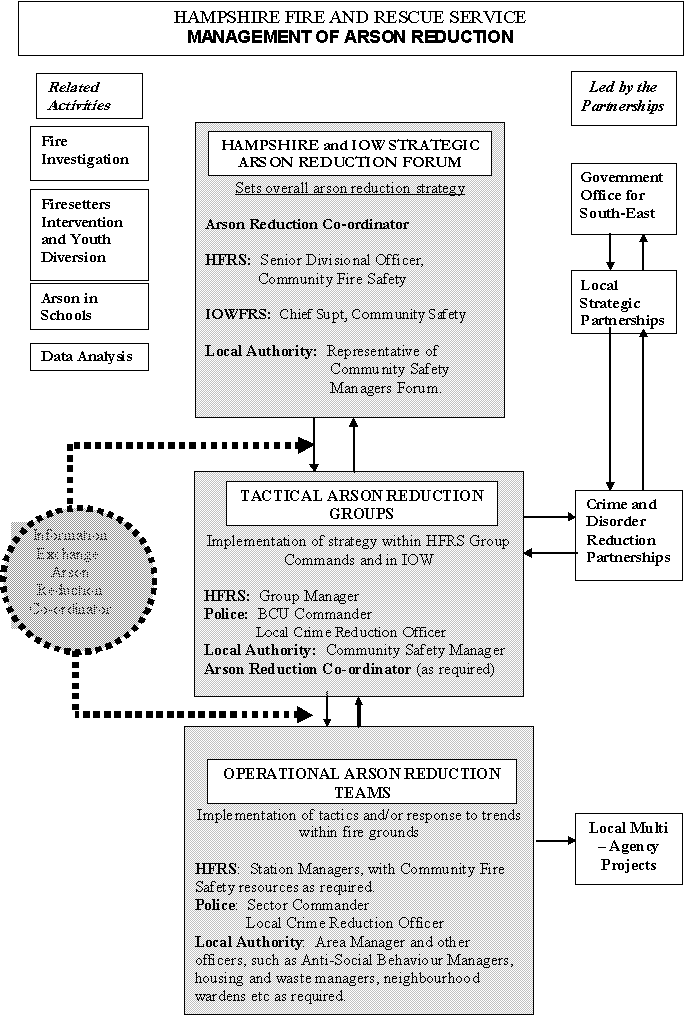
To fully exploit the advantages of the Hampshire Constabulary and HFRS management boundaries aligning we have formed the Hampshire and Isle of Wight Arson Reduction Strategy Forum. The role of this group is to implement the 14 recommendations contained within the thematic review, "Arresting Arson".
|
|
| |
|
|
10.5 |
The aim of the group is to maintain a structured approach to arson reduction, in conjunction with local Crime and Disorder Reduction Partnerships (CDRP), at three levels: · Strategic · Tactical · Operational The Hampshire and Isle of White Strategic Arson Reduction Forum offers leadership, policies, strategies and protocols for partnership working to reduce arson within the county. The structure of the HIOW Strategic Arson Reduction Forum is shown at Appendix A
|
|
| |
|
|
| |
The Hampshire Fire and Rescue Service is taking the lead role within the integrated partnership working groups to reduce arson crime across the county. At each level these groups have the active participation of the Fire Service, Police and Community Safety Officers and they interface directly with local Crime and Disorder Reduction Partnerships.
|
|
| |
|
10.6 |
|
| |
|
| |
The HFRS Risk Intelligence Team is currently developing improved systems of data collection and analysis, which when complete will greatly improve multi agency information sharing. The Team conduct project work to identify arson hot spot areas and this is shared with our partners to develop the appropriate response. The Risk Intelligence Team are actively supporting development of the Crime and Disorder Data Information Exchange (CADDIE) system. This is a tri-agency product that will allow analysis of several agencies data at a time. This will enable Group Managers to access up to date information for their areas develop events or initiatives within their group or the CDRP.
|
| |
|
| |
10.7 |
|
| |
|
|
| |
A successful partnership initiative that has reduced vehicle arson is Project Car Clear. This began in March 2002 and the aim was to reduce vehicle fires in the western wards of Southampton. Project Car Clear used Redbridge Hill fire station as a reporting centre for unwanted vehicles, which might otherwise be abandoned, vandalised and then burnt out. The process involves HFRS personnel faxing the details of vehicles to the City Council which then arranged for the prompt removal of the vehicle, without charge. Vehicle arson fell by 24 % in the first 10 months of the project. Following on from this success and in response to a renewed increase in vehicle arson activity in Southampton the project was extended through a partnership initiative between HFRS, Southampton City Council and Trents Garages at St Mary's fire station on 9th December 2003. Southampton Primary vehicle fires Secondary vehicle fires 01/04/01 - 01/04/02 229 181 01/04/02 - 01/04/03 206 123 01/04/03 - 01/04/04 235 119 01/04/04 - 01/04/05 184 66 Car Clear and other similar abandoned vehicle removal partnerships are also currently operating in;
· Basingstoke and Dean · East Hampshire · Portsmouth City · Rushmoor and Hart |
|
| |
|
|
10.8 |
|
|
| |
|
| |
Arson prevention messages are integrated into each of the three Key Stage inputs our Schools Education Team deliver. Key Stage 1 - Introduces very young children to the dangers of matches and lighters during a Fire Awareness Workshop. Key Stage 2 - Fire setting behaviour is addressed during a session on hazards in the home using aerosol canisters, candles etc. Key Stage 3 - This is the first time the word Arson is introduced. Interactive group work is based around the Consequences video, using drama, discussion, actual reports and local intelligence. In February 2005 the HFRS Fire Challenge Crew, in partnership with the Stopwatch Theatre Company, staged 10 performances of the educational play `Arson About' at 10 secondary schools across Hampshire. Each school, located in an identified arson hot spot, hosted a production of the play to educate its pupils on the dangers and consequences of arson. 2000 pupils experienced the play and took part in a specially created interactive workshop which explored the issues raised by the performance.
|
| |
|
10.9 |
Firesetters Intervention Scheme
|
| |
|
| |
|
HFRS continue to support a Firesetters Intervention Team. The aim of the team is to prevent firesetting behaviour in children, young people and on occasions adults. Referrals to the programme are received from a variety of sources including the Courts, Youth Offending Teams, Police, Social Services, schools and parents. Currently the team consists of 32 volunteers, who are all undertaking at least one case; some members have had up to 5 cases running simultaneously and hence HFRS have to be limited when advertising the scheme to avoid being overwhelmed by the workload. Since it began the Firesetters programme has dealt with over 1000 cases. Between April 2003 and April 2004 in excess of 167 new cases were been opened by HFRS. The appointment of a full time Fire Setter Intervention Co-ordinator now enables us to engage with the more difficult cases and increase our capacity to provide this service. The work of the team is an essential element in our efforts to reduce arson. A review of the team is currently underway and proposals for the future structure, operation and remuneration for the team will be presented to the Authority.
|
|
| |
|
10.10 |
|
| |
|
| |
In February 2005 Hampshire Fire and Rescue Service, with sponsors New Forest Community Partnership and Connexions South Central, ran two highly successful Local Intervention Fire Education (LIFE) courses. The courses were attended by 24 New Forest teenagers aged from 13-19 and were aimed at reducing anti-social behaviour, particularly fire setting. A detailed evaluation report has now been completed. This evaluation will form the basis of a business case being prepared for HFRS Senior Management team to gain approval for resources to develop LIFE from a pilot initiative to a fully supported service activity HFRS from April 2006.
|
| |
|
10.11 |
|
| |
|
| |
The Prince's Trust Team Programme is a unique 12-week personal development course, designed to help teams of 16-25 year olds from a range of diverse backgrounds, employed and unemployed, to work in the community and to give them the incentive to continue to make a contribution of lasting impact, both on themselves and their communities. Based on a "City and Guilds Profile of Achievement" qualification, the Programme also allows for Key Skills to be gained in a variety of areas. Since May 2002, when Hampshire Fire & Rescue became the Delivery Partner for Southampton Franchise, we have run 13 teams. To date HFRS have had over 100 young people complete the programme. Currently based in Wheatsheaf House, Southampton and at Base 2000 in Popley, Basingstoke. The aim of the Programme is to work towards meeting some of the aims and objectives set by Hampshire Fire and Rescue in the IRMP. At present we are recruiting from Southampton, Basingstoke and the New Forest which are known arson hot spot areas. We have implemented a Fire Awareness Day, which covers various aspects of fire safety including: Prevention, causes, Hoax calls, consequences etc.
|
| |
|
10.12 |
|
| |
|
| |
The Redbridge Community Motorcycle Youth Project is a partnership scheme set up with Hampshire Fire and Rescue Service, Southampton City Council Youth Service, Hampshire Constabulary and Southampton Youth Offending Team. It has been funded from Re-generation Groups and Southampton West Neighbourhood Partnership. Students for the eight week course are referred on to the course by Southampton City Council Youth Service and will come from the Millbrook, Lordshill and Shirley areas. Opportunities are taken to educate young people in riding consequences, nuisance and associated arson. These messages relate to firefighters' experiences of dealing with these incidents. This helps alleviate localised problems benefiting the local communities.
|
| |
|
10.13 |
|
| |
|
| |
Hampshire Fire and Rescue Service's Community Fire Safety Department has recognised the need for effective partnership working with frontline community workers to enable it, as an organisation, to target hard to reach or potentially excluded social groups. One group of community workers key to this philosophy are the Neighbourhood Wardens and Accredited Community Safety Officers. In order to facilitate partnership working, training and office accommodation on HFRS fire stations has been provided for Hampshire County Council's Accredited Community Safety Officers and Portsmouth City Council's Community Wardens. Environmental Audits are being carried out in areas where there is an identified arson `hot spot' . The process involves officers from HFRS, Hampshire Constabulary and the local warden scheme physically walking around the area to identify potential arson targets and arrange for the removal of likely fuel sources.
|
| |
|
10.14 |
|
| |
|
| |
We continue to deliver `best practice' advice to businesses and commercial premises on the most effective ways to protect them from arson attack. This advice is delivered through targeted leaflet and poster campaigns, HFRS marketing and communications department and in person by members of our Community and Technical Fire Safety functions. Our Fire Safety Inspecting Officers continue to promote the installation of sprinklers in non-domestic properties to reduce the impacts of fire in the building.
|
| |
|
|
|
|
10.15 |
|
|
|
| |
|
|
|
| |
Close liaison, co-operation and mutual assistance between the police and fire service is required to achieve a successful investigation into a suspected non-accidental fire, including the prosecution of any suspected offenders. An extensive amount of work is being carried out in the area of fire and arson investigation both within Hampshire and by the Regional Management Board Fire Investigation Working Group of which HFRS are a member. HFRS Fire Investigation Team are currently working closely with Hampshire Constabulary on the following project areas ; · Development of a joint agency fire and arson investigation protocol which will ensure that collaborative working arrangements are as effective as possible between HFRS, Hampshire Constabulary Scenes of Crime Department and Forensic Science Service. · Joint agency fire and arson investigation training events. Twenty Hampshire Constabulary Crime Scene Investigators (CSI's) joined Fire Investigators from HFRS and West Sussex at Eastleigh Headquarters where they received input on vehicle and building fire investigations, fire behaviour, fires involving accelerants and a demonstration from a fire investigation Dog Team. · HFRS Fire Investigation Team has regular input to the CID Detective course at police HQ Netley · HFRS is currently developing working protocols with Hampshire Constabulary Field Intelligence Units, Volume Crime and Major Crime Units and provides central support and co-ordination between all Group Managers and the police throughout arson investigations across the county. · Development and delivery of a joint multi-agency training package for fire fighters, police officers and community wardens, which aims to improve arson crime scene evidence preservation is almost complete.
|
|
|
| |
|
|
|
11 |
|
| |
|
| |
HFRS has recently concluded successful negotiation with the ODPM to include a target for the reduction of deliberate in the LPSA 2 agreement for Hampshire County Council and Portsmouth City Council. We have agreed `stretch targets' over and above our anticipated drive down the number of deliberate fires. If we successfully achieve the `stretch targets' agreed then we will receive Reward Grant as part of the LPSA 2 agreement. Achieving the targets will require significant commitment from our personnel and resources. Fire Authority Members can support this work through their engagement with the local Crime and Disorder Partnerships/Community Safety Partnerships in the county. Southampton City Council are within a different band of LPSA to HCC and PCC. HFRS will be seeking a similar target for reduction of deliberate fires with Southampton City Council if they engage in LPSA 2 in 2006.
|
| |
|
12 |
|
| |
|
12.1 |
Failure to address arson crime will represent a significant risk for HFRS and the Authority in the following ways; · Potential failure to achieve our corporate aims. · An increase in the financial burden that high levels of deliberate fire setting brings · Potential failure of statutory duty under the Crime and Disorder Act · Inability to achieve the government target of a 10% reduction in deliberate fires by 2010. This could lead to government intervention, adverse impact on our reputation and negative effect on CPA scoring.
|
| |
|
13 |
|
| |
|
13.1 |
|
| |
|
| |
The systems through which partnership agencies share information and data are still some way from being ideal and work must continue to improve these. This will place future demands on our ICT structure and resources that may require future investment.
|
| |
|
13.2 |
|
| |
|
| |
The impact of arson in the county, and in individual communities, is enormous and makes the investment in arson reduction activities worthwhile. However, committing the resources to reduce arson across the county has an impact on our financial and human resources as well as our capacity to deliver on other safety initiatives. As arson reduction strategies and initiatives are developed we will seek funding from outside sources and look to reallocate budgets to meet the demands. To continue our current success in reducing the number of arson fires may require future growth of the budget to remain effective in other areas of community fire safety.
|
| |
|
14 |
|
| |
|
14.1 |
Equality Impact Assessment will strengthen our arson reduction strategy by ensuring that our policies, protocols and actions comply with current legislation and improve equality and diversity in the workplace and in our delivery of services to the public.
|
| |
|
14.2 |
The individual policies and initiatives will undergo an Equality Impact Assessment in line with the agreed service policy. New initiatives will undergo Equality Impact Assessment as they are developed.
|
| |
|
14.3 |
The proposals within this report are considered compatible with the provisions of the European Convention on Human Rights, the Human Rights Act 1998, and the Race Relations (Amendment) Act 2000.
|
| |
|
15 |
|
| |
|
| |
|
| |
|
16 |
|
| |
|
16.1 |
Arson is the largest single cause of fire in the UK and can lead to loss of life, serious injury and financial hardship in our communities. The cost of arson fires in Hampshire is estimated to be over £100 million per year.
|
| |
|
16.2 |
HFRS is committed to reduce the number of arson fires in the county by working with those that cause the fires to change their behaviour. We will work with other agencies and develop local initiatives to tackle the menace of arson.
|
| |
|
16.3 |
The most effective way of tackling arson crime is through working in partnership with the police and local authorities. The presence of Fire Authority Members on local Crime and Disorder Reduction Partnerships is essential to develop stronger partnership working and demonstrate commitment from the Fire Authority to reduce arson crime and improve our communities.
|
| |
|
17.3 |
Closer partnership working and mutual understanding of other agencies needs along with adequate financial, physical and human resource support is an absolute requirement in the development of long term, effective and viable solutions to the arson problem.
|
| |
|
|
|
| |
|
The following documents disclose the facts or matters on which this report, or an important part of it, is based and has been relied upon to a material extent in the preparation of the report: "None" Note: The list excludes: (1) published works; and (2) documents that disclose exempt or confidential information defined in the Act.
|
|
Secretarial/WP/Corporate/HFRA/ HFRA 7 12 05 Arson Reduction AH/MR/26/11/2005

 APPENDIX A