
Archived decisions
Hampshire County Council
Cabinet Item 9
19 December 2005
Contact Centre
Report by the Director of Property, Business and Regulatory Services and Chairman of the Contact Centre Board |
Contact: Andrew Smith Ext: 7826 email: [email protected]
1. Summary
1.1 With over 2 million telephone calls to the County Council each year, the organisation, management and handling of call volumes is crucial to our communication strategies, public image and our e-government and efficiency programmes. This report recommends the development of a Contact Centre to both improve call handling and create a more efficient means by which these processes are managed.
1.2 The Contact Centre (focussed on public access to information and services by telephone and e-mail) will:
· Deliver tangible and measurable improvements to customer service - ease of access, joined-up approach, consistency, responsiveness and speed.
· Establish a more corporate and customer focused approach to doing business with the public - particularly a `one and done' approach.
· Simplify customer access - shielding the customer from the complexities of our internal and partnership structures enabling the Council to become more user centric.
· Create an opportunity to establish the Contact Centre as a key enabler of business change and modernisation (including establishing it as a key building block of the Children's Services programme).
· Provide capacity to deliver other public sector services, and the means of delivering services and transactions with the public at the lowest possible cost.
1.3 If we do not progress a corporate Contact Centre, there will be continued pressure at departmental level to modernise and improve. Replacing departmental developments (and systems) will only perpetuate silo working, dilute the corporate and customer service benefits, duplicate development costs, and increase operating costs (without the economies of scale and management practices that a corporate approach offers) with little capacity to enable partnership working.
2. Rationale for the Contact Centre
2.1 The overall business case for moving forward with the Contact Centre
programme is based on:
· Improved customer access and customer experience: The Contact Centre achieves this by extending opening hours, simplifying customer access to services, designing the customer interface around user needs, joined-up working across departments and with other agencies, consistent experience across access channels (phone, web, face-face), being more responsive, one contact gets things done, fixing things faster, more efficient, more accountable.
· Performance management and continuous improvement: The Contact Centre will extend the Council's existing performance management arrangements to include the measurement and improvement of customer contact (e.g. call abandonment rates, time to answer, % of calls resolved at first point of contact, end-to-end service resolution times).
· Improved means of public engagement: MORI surveys have consistently indicated that Hampshire County Council is seen by the public as somewhat distant and remote. The Contact Centre will provide a more effective means of engaging with the public, given the preference that people have to access public services by telephone and increasingly e-mail.
· Building the Hampshire brand: Through appropriate branding and promotion, the Contact Centre will help to re-enforce the County Council's public service and community leadership role in the eyes of the public. This means doing it well with a distinct Hampshire approach.
· The modernisation agenda and ODPM expectations: ODPM are expecting local authorities to have implemented contact centres by December 2005. Priority Service Transformation Outcome targets, set by ODPM relating to customer contact and customer relationship management are central to local authority obligations under the e-government agenda.
· CPA - increased service user/citizen focus: Increasing emphasis will be placed in future CPA assessments on the extent to which we are addressing service user needs and creating a citizen focussed approach to doing business. e-Government Priority Service Transformation Outcome Targets are a Key Line of Enquiry in CPA2005. The Contact Centre places the County Council in a strong position.
· Efficiencies and the Gershon agenda: The programme will deliver £1m/annum of cashable efficiency savings once the Contact Centre has been implemented. Centralising telephone-based contact management (if combined with the rationalisation of function-based area office face to face reception points) also has the potential to make it easier to implement accommodation strategies aimed at reducing costs.
· Shared services agenda: The Contact Centre will deliver the strategic management capacity to undertake District, County and Regional front-office functions. Without this capacity, the Council will struggle to engage in shared services relating to the broader citizen focus agenda. Specific examples include the recent regionalisation of trading standards contact management (Consumer Direct), the Home Office/ODPM Single Non-Emergency Number, and the opportunity to provide an out of hours contact management function on behalf of the Districts.
· Supports partnership working and Local Area Agreements: A corporate and more customer-focussed approach to contact management will facilitate partnership working and potentially contribute to LAA initiatives, whereby users and the public can access services without detailed knowledge of the organisation and how it is structured
· Releases capacity in professional service teams to help cope with rising demand: OT Direct in Adult Services demonstrated the benefits of a County-wide contact centre approach to handling customer contacts, releasing professional occupational therapists from more routine duties, and reducing waiting lists for equipment by one third.
· Lower cost option relative to further segmented departmental development: Further fragmented development across departments as existing arrangements reach capacity or obsolescence, will result in duplication of development costs, higher operating costs, and different technology platforms and standards across the Council.
3. Concept of Operation
3.1 The aim will be to develop a professional customer service centre operation with well trained staff delivering quality services to Hampshire's residents.
3.2 The Contact Centre will handle telephone calls (about 2 million calls per annum), e-mail, and possibly at a later stage white-mail (letters).
3.3 The Contact Centre will have extended hours of operation, 8am to 8pm weekdays, some weekend opening, and 24/7 access for emergencies.
3.4 The Contact Centre will form part of a three-pronged approach to handling customer contact: contact centre; face to face access through Information Centres and other outlets; and self-service over the web. All channels will be underpinned by a common customer relationship management (CRM) system which will capture customer contact history across all channels.
3.5 The Contact Centre will provide information and handle service requests. A high percentage of calls (target 80%) will be resolved at first point of contact (i.e. within the Contact Centre, without having to be transferred to the back office).
4. Avoiding the Pitfalls
4.1 The common perception of many contact centres/call centres is that they offer poor service - lack of human operator, navigating complex menus, long wait times, customers passed from pillar to post. This is often because they have been poorly designed, or because they are poorly managed, or because efforts to cut costs have been at the expense of good customer service.
· The Contact Centre will have a directly employed staff interface.
· Call answering standards will be set, the Contact Centre will be appropriately resourced, and call management technologies will be used to ensure that performance standards are met.
· Staff groups will be designed around user needs. Some staff will focus on specific areas (e.g. Children's Services), others will be able to multi-skill across a number of relatively straightforward service areas (e.g. libraries, blue badge). Some of the more complex areas may have supporting specialists working within the Contact Centre in a second tier.
· The Contact Centre is being designed and sized to allow agents to handle a reasonable number of calls in a day, with appropriate breaks and emphasis on training and professional development.
· It will be an operation which focuses on excellent customer service.
4.2 The risk in the project is probably less financial and more to do with the damage we could inflict on ourselves if poorly implemented.
5. Current Status
5.1 The current status is as follows:
· Governance: The Programme Board for the Project Definition phase will roll forward as the Executive Board responsible for delivering the programme.
· Financials: The financial business case has been validated by doing a top down sense check of the original evidence-based assessment, based on implementation experiences at other local authority contact centres offering similar services.
· Implementation: The implementation approach, roles and responsibilities (programme team and Contact Centre operations), release plan, and location/premises brief have been defined. Business requirements for technology (CRM/telephony) and the technology acquisition strategy are currently being worked up.
6. Management Arrangements
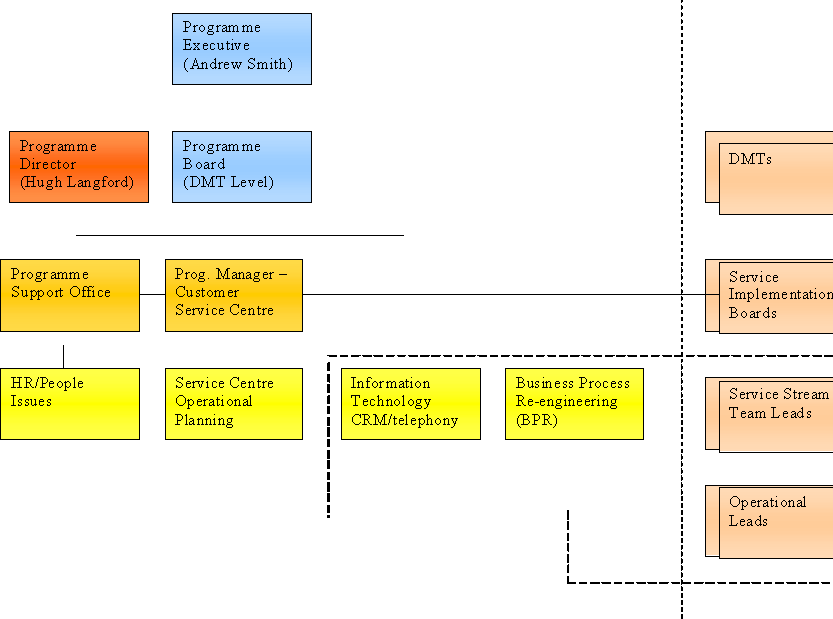
6.1 The management arrangements have been defined (see Appendix A), with particular emphasis on the mechanism to ensure appropriate engagement across the business (corporate leadership, business ownership). Funding has been allowed to back-fill staff within departments to help ensure that appropriate resourcing (the right people and the right level of input) can be secured during the delivery of the programme.
7. Finances
7.1 The headlines of the financial business case are:
· Capital investment required: £4.84m
· Re-organisation cost allowance: £750,000
· Investment spread over 4 FY's: 05/06 to 08/09
· Annual operating cost (post roll-out): £2.97m
· 5 year NPV / 10 year NPV - £2.79m / +£1.04m
· Internal rate of return: 7.87%
· Gershon efficiency contribution (cashable) £1.03m/annum
7.2 The annual operating cost of £2.97m compares to a current estimated cost of call handling of about £4m to yield the £1.03m efficiency saving.
7.3 The initial capital cost could be met from an `invest to save reserve' for the Contact Centre, funded from additional capital receipts. It is suggested that the receipts should match the expenditure in the particular year it is incurred for 2005/06 to 2008/09 or, if necessary, by planned slippage in locally reserved capital projects.
8. Department Financial Impacts
8.1 It is proposed that Departments will pay the total operating costs of the Contact Centre (costs to be apportioned according to utilisation across service areas - this can be accurately measured in a contact centre environment). Further work is required to determine the exact mechanism, and to address the transitional arrangements to a fully operational contact centre.
9. Deliverability
9.1 Key points to note on deliverability are:
· Leadership from the top: Cabinet and CMT must have 100% commitment to the success of the programme.
· Corporate leadership and business ownership: This is an IT-enabled business change programme and as such must be business led. The governance and management arrangements are designed to ensure that this will be the case. Delivery teams within departments will work closely with the Corporate delivery team. Cabinet may wish to consider a member representative to work with the Executive Board. Given the emphasis on efficiency this would seem appropriate.
· Strong programme management: The proposed programme management will have the experience and expertise to successfully deliver this complex business change programme.
· Mix of internal staff and external contact centre specialists: The delivery team will be multi-disciplinary, resourced from across the organisation, and will include some external staff with specialist contact centre skills.
· Delivery methodology: PRINCE2 will be used as the framework for managing and controlling the programme.
· Challenge existing working practices and the nature of the demand: The programme will fundamentally challenge how and why we do things during service adaptation - the focus will be on service re-engineering rather than replication.
10. Recommendations
That
1. Cabinet approve the proposals for the implementation of a corporate
Contact Centre
2. An invest to save reserve be created from additional capital receipts
and planned slippage from the locally financed capital programme,
subject to the final budget decisions
3. Departmental budgets be adjusted to ensure that the relevant costs
and efficiency savings are achieved.
Section 100 D - Local Government Act 1972 - background papers
The following documents disclose facts or matters on which this report, or an important part of it, is based and has been relied upon to a material extent in the preparation of this report.
NB the list excludes:
1 Published works
2 Documents which disclose exempt or confidential information as defined in the Act
........................
........................
CAB1205A



Customer Service Manager
(TBD)



Release Manager
Incl. Facilities/
Accommodation


Service Adaptation
